Questions

4 Marks Questions

Take a timed test

7 questions · self-marked practice — reveal the answer and mark yourself.

Question 14 Marks
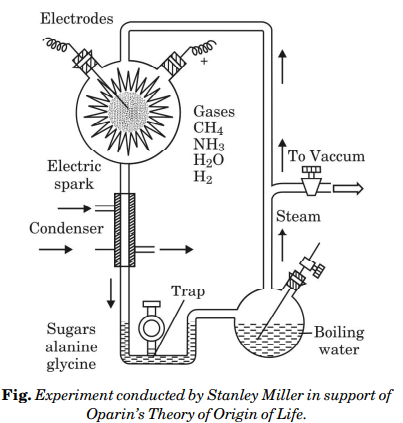
State the hypothesis proposed by Oparin and Haldane. Describe how S.L. Miller experiemen-tally supported it.###Describe the experiment of S.L. Miller. Comment upon his contribution in origin of life on earth, on the basis of experiments and observations.
Answer
Oparin and Haldane suggested that the life originated from non-living organic molecules like proteins and RNA. Stanley L. Miller and Harold C. Urey conducted an experiment to explain the origin of life on earth. They concluded that the early earth's atmosphere was capable of producing amino acids from inorganic materials.
The two biologists used water, methane, ammonia, and hydrogen as they believed it's presence in the early earth's atmosphere. The chemicals were sealed inside sterile glass tubes and flasks connected together in a loop and circulated inside the apparatus.
One flask is half-filled with water and the other flask contains a pair of electrodes. The water vapour was heated and the vapour discharged was added to the chemical mixture. The released gases circulated around the apparatus imitating the earth's atmosphere. The water in the flask represents the water on the earth's surface and the water vapour is just like the water evaporating from lakes, and seas. The electrodes were used to spark the fire to imitate lightning and storm through water vapour.
The vapours were cooled and the water compressed.
This condensed water trickles back in the first water flask in a countinous cycle. After a week Miller and Urey examined the cooled water and observed that 10-15% of the carbon was in the form of organic compounds. 2% of carbon had formed 13 amino acids.
View full question & answer
Question 24 Marks
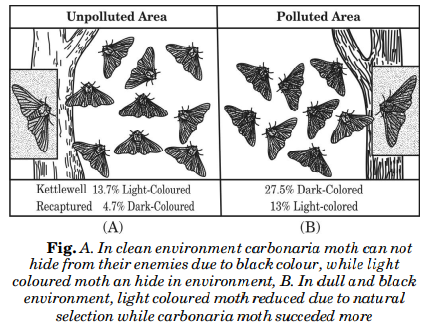
(a) Describe the observations made on collection of white winged moths and dark winged moths in England between the years 1850 and 1920. What did these observations lead to?
(b) How is the use of herbicides, pesticides and antibiotics by humans for various, comparable with the observations made on moths in the above question? What is this type of phenomenon called?
Answer
(a) Before industrialisation tree bark were covered with light coloured lichens, this background white-winged moth survived but dark coloured moth was picked out by predators, post industrialization tree trunks converted dark due to industrial smoke and soot, under this situation the white-winged moth did not survive due to predators, while the dark-winged/melanised moth survived, this showed that organism that is better adapted to survive are selected by Nature/Natural selection.
Image
(b) Excessive use of these chemicals has resulted in the selection of resistant varieties, in a much lesser time.
This type of phenomenon is called anthropogenic action.
View full question & answer
Question 34 Marks
Write about chemical evolution in brief.
View full question & answer
Question 44 Marks
What are fossils? How many types of fossils are there? How will you determine the age of fossils?
Answer
Fossils are dead remains of animals and plants from remote past.
Type of fossils :
(i) Type 1. Petrified Folssils : The fossils form when minerals replace all or the parts of the organisms. Water is full of dissolved minerals. it seeps through the layer of sediments to reach the dead organism. When water evaporates only the hardened, materials are left behind.
(ii) Type 2. Molds and Casts : A mold forms when hard parts of an organism are buried in the sediment such as sand, slit or clay. The hard part completely dissolves overtime, leaving behind a hollow area of organism shape.
(iii) Type 3. Carbon Films : All living things contain an element carbon. When an organism dies and is buried in sediment, the materials that make the organism break down and eventually only the carbon remains. The thin layer of carbon left behind can show an organism's delicate parts like leaves or plant e.g. fern fossil 300 million years old.
(iv) Type 4. Trace Fossils : These fossils show the activities of the organism. An animal makes a foot print when it steps in sand. Overtime the foot print is burried in layers of sediment. Then the sediment becomes solid rock.
(v) Type 5. Preserved Remains : Some organisms are preserved in or close to their original states. These fossils are called preserved remains e.g., an organism such as an insect is trapped in a tree's sticky resin and dies.
(vi) Type 6. Compression : This type of fossil is common in the sedimentary deposits of rocks. It is a sort of impression where most of the organic remains of the plant remain in the fossil state. The plant or plant part gets buried and the sediments go on accumulating over the plant.
(vii) Type 7. Impression : These fossils are just impression of plants or plant parts on sediments. These fossils are useful in studying the external features of various plant parts and venation pattern of leaves.
(viii) Type 8. Pseudofossils : Sometimes watery solutions of various minerals speed through the sediments and it takes the shape of some plant part or animal. Their study shows that they are neither plants nor animals.
Two methods of determining the age of fossils are :
(a) Relative method : By estimating the age of the layer of earth's crust where the fossil is found. Fossils near the surface are recent and those in the deeper layers are more ancient.
(b) Radio-carbon dating method : By detecting the ratios of different isotopes of carbon in the fossils.
View full question & answer
Question 54 Marks
Explain evolution with the help of its embryological evidences.###Explain evidence from embryology in evolution.
Answer
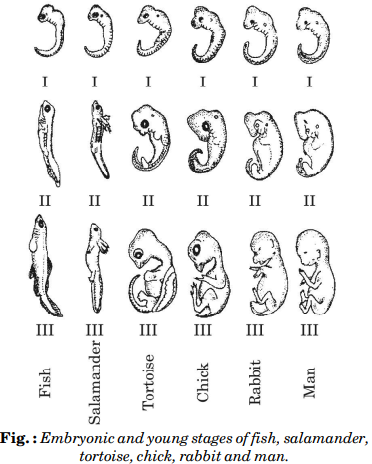
Evidences from Embryology : With the exception of a few, every multicellular animal originates from a zygote. The development from zygote to adult shows many similarities in various organisms. The development is termed as ontogeny.
Recapitulation Theory/Biogenetic Law : Haeckel, a German biologist, gave a theory "Ontogeny repeats Phylogeny". An individual organism during its development (ontogeny) tries to repeat the history of its race by different stages (phylogeny).The vertebrate development confirms the above statement. For example, the embryos of all vertebrates pass through a gilled stage. In fishes, the gills are present in the adult condition. In amphibians, gills are present in some forms of frog and in tadpole. While in reptiles, birds and mammals these gills are never functional but nevertheless they are always present in the embryo.
Image
Haeckel, believed that all those stages, which have occurred during the course of evolution of a particular animal, also pass through its development.
There are objections to this theory, but it throws enough light to show the inter -relationship of animals. Besides, the following facts also confirm the evolution :
(i) All the metazoa develop from the zygote which is single celled and is comparable to protozoa. From this we infer that all the metazoans have evolved from protozoans.
(ii) Early stages of embryonic development e.g., morula, blastula, gastrula are basically similar in all the metozoa which also confirms the monophyletic origin of the metozoa.
(iii) Gastrula is a diploblastic stage through which all the metazoa pass during embryonic development, and also some animals like Porifers and Cnidarians have retained their diploblastic nature.
(iv) All the vertebrates have gills in their embryonic stages while animals like fish and amphibians larvae possess gills. Embryos of reptiles, birds and mammals do not retain gills in the adult but during embryonic development pass through the gilled stage.
These examples prove that vertebrates have evolved from common fish-like ancestors.

View full question & answer
Question 64 Marks
Describe the Darwin's theory of natural selection.
Answer
The theory of natural selection stated that carrying capacity of natural resources is limited and in order to survive, the organism struggle for their existence.
(i) In order to cope up, the organism undergoes variations and are able to adapt, so they are naturally selected for survival.
(ii) The theory highlights "Struggle for existence" and "Survival of fittest".
Features of Natural Selection
(1) Struggle for existence :
(i) Organism struggle for its existence because natural resources (food, water and shelter) are limited but the population multiplies rapidly.
(ii) In order to survive, the organism competes for their needs.
(iii) To fulfil their need they modify their organs or traits and adapt according to the environment.
(iv) Organism which are able to adapt classified as superiors.
(v) Superiors exist while the inferiors gets diminished as they are unable to adapt.
(2) Survival for fittest :
(i) Variations are sudden gradual change which helps the organism to adapt.
(ii) The organism which undergoes variation and are fittest to survive and so they are selected naturall.
(iii) The organism after survival transfers the variation from one generation to the other.
(iv) The inheritance of variation eventually leads to speciation.
View full question & answer
Question 74 Marks
Describe the Lamarkism in relation to organic evolution.
Answer
Lamarck was one of the most brilliant stars on the horizon of the history of evolution.
He was the first naturalist to put forward a general theory of evolution in his famous book Philosophic Zooligique published in 1809. His evolutionary theory may be summarised in the form of following laws :
(1) The internal forces of life tend to increase the size of an organism.
(2) The necessity in animals produces new structures.
(3) The effect of use and disuse of organs.
(4) Inheritance of acquired characters.
(1) The internal forces of life tend to increase the size of an organism : Lamarck believed that there is some kind of internal force which is constantly working in living beings. It tries to make the animal bigger in size.
(2) The necessity in animals produces new structures : According to this law, each organ and structure is the product of some continuous necessity in the animals to develop it. He believed that it was not due to the direct influence of the environment but acted through the nervous system, the process being very slow. The plants, he said, were directly influenced by their environmental conditions.
(3) Effect of use and disuse of organs : Lamarck thought that the continuous use of a particular organ or structure tends to increase its size and its development. On the other hand, disuse results in disappearance of that structure, the process being slow and gradual. He supported this by a number of well-known examples. The long neck giraffe was the result of continuous stretching to obtain food from the trees (long neck was acquired due to excessive use) The wings of certain birds Ratitae were not used for long, as there were no formidable enemies and food was available in abundance. So they did not fly, consequently lost the power of flight. Their wings became rudimentary (flightless condition acquired due to the disuse of wings.)
(4) Inheritance of acquired characters : Lamarck in 1815 stated that all the characters, which are acquired in one's own lifetime are inherited by its offsprings.
View full question & answer