Question 14 Marks
Read the following and answer any four questions from (i) to (v) given below:
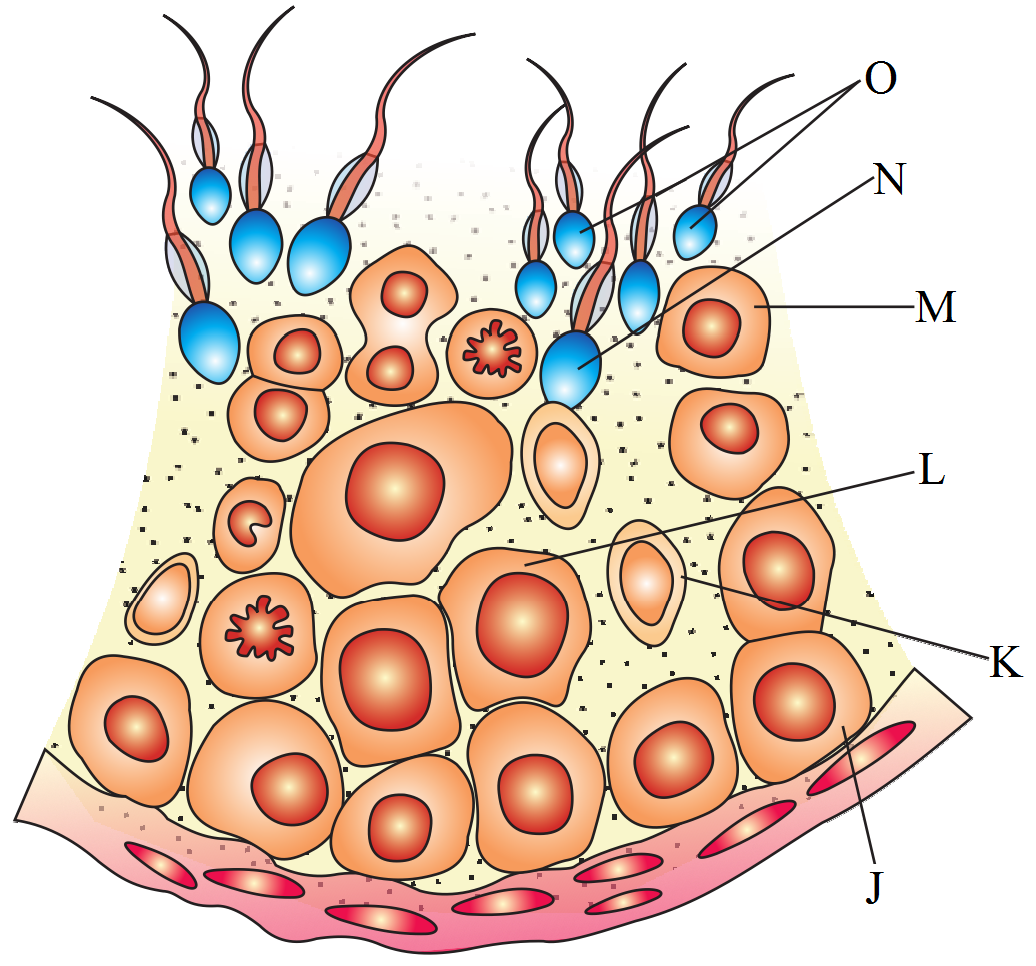
In testis, the immature male germ cells produce sperms by spermatogenesis that begins at puberty. It occurs in the seminiferous tubules of the testes. Seminiferous tubules are lined by germinal epithelium. Study the schematic representation of spermatogenesis and answer the following questions.
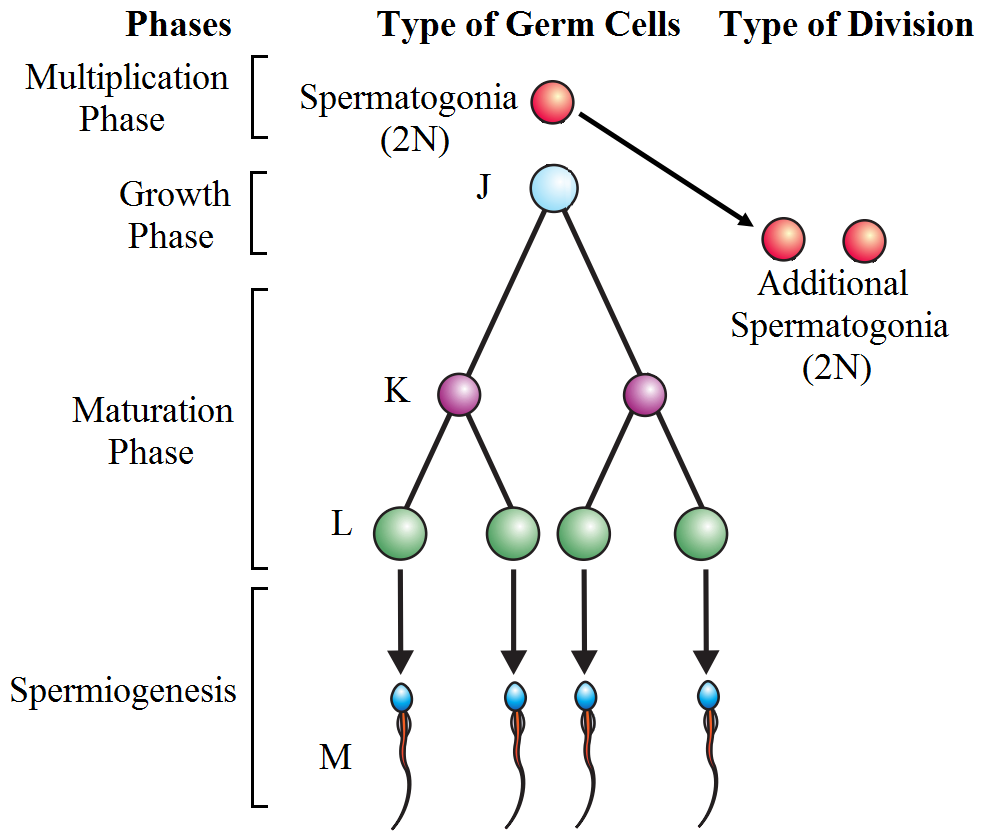
In testis, the immature male germ cells produce sperms by spermatogenesis that begins at puberty. It occurs in the seminiferous tubules of the testes. Seminiferous tubules are lined by germinal epithelium. Study the schematic representation of spermatogenesis and answer the following questions.
- Which cell division occurs during multiplication phase?
- Mitosis.
- Meiosis I.
- Meiosis II.
- Both (b) and (c).
- How many chromosomes are present in secondary spermatocyte and spermatid, respectively?
- 46, 23
- 46, 46
- 23, 23
- 23, XY
- Transformation of L into M is known as:
- Spermiation.
- Spermateliosis.
- Spermatogenesis.
- None of these.
- Select the correct option.
- Type A spermatogonia grows to larger primary spermatocyte.
- One spermatogonium forms two spermatids.
- Spenniation is the release of sperms from seminiferous tubules.
- Primary spermatocyte undergoes mitosis to form secondary spermatocytes.
- Which hormone acts on spermatogonia to stimulate sperm production?
- LH.
- GnRH.
- ABP.
- FSH.
Answer
View full question & answer→- (a) Mitosis.
Explanation:
Inmultiptication phase, the undifferentiated primordial germ cells divide several times by mitosis to produce large number of spermatogonia.
- (c) 23, 23
- (b) Spermateliosis.
Explanation:
Transformation of spermatids (L) into spermatozoa (M) is known as spermiogenesis or spermateliosis.
- (c) Spenniation is the release of sperms from seminiferous tubules.
- (d) FSH.
Explanation:
FSH acts on spermatogonia to stimulate sperm production.