Questions

3 Marks Question

Take a timed test

8 questions · self-marked practice — reveal the answer and mark yourself.

Question 13 Marks
Prabha has seen huge garbage dumps outside your school which are not being regularly disposed of by MCD. Prabha discusses the problems with school mates and decide to organize rally to spread awareness among local people about public hygiene.
→ Prepare two slogans for rally
→ Name any two infectious diseases which may spread due to such unhygienic conditions at public place
Answer
1)(i) Brush your teeth every day, To keep the doctor away.
(ii) Take care of your body, it's the only place you have to live.
2) Diseases like typhoid and amoebiasis.
Values
→ Responsibility
→ Sensitivity towards public. Hygiene
→ Problem solving
View full question & answer
Question 23 Marks
i. Why is the collection of white-winged moths and dark-winged moths made in England between 1850-1920 considered a good example of natural selection?
ii. Evolution is based on chance events in nature and chance mutations in organisms. Justify the statement.
Answer
i. During the pre-industrialisation all the white-winged moths survived due to white coloured lichens on trees, but during post- industrialisation, white-winged moths were unable to survive as predators could spot the moth against contrasting background, and the dark-winged moths survived, this showed that in a mixed population of white and dark-winged moths those who can adapt better will survive.
ii. The excess use of herbicides and pesticides has resulted in the selection of resistant varieties that developed due to the chance or random mutation.
View full question & answer
Question 33 Marks
Define and design a test cross.
Answer
Test cross: A cross in which an individual with an unknown dominant phenotype is crossed with a recessive individual for that trait. So it is helpful in knowing the genotype (whether it is homozygous or heterozygous for the dominant trait) of an unknown individual.
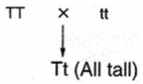
Condition I: If the unknown is homozygous tall (TT) then crossing with dwarf recessive (tt) gives all tall offsprings (Tt).
Image
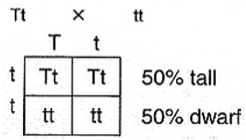
Condition II: If the unknown is heterozygous tall (Tt), then crossing with dwarf results in 50% tall (Tt) and 50% dwarf (tt) progeny.
Image
View full question & answer
Question 43 Marks
What does the term genetic diversity refer to? What is the significance of large genetic diversity in a population?
Answer
The term genetic diversity refers to the diversity of genes within a species.
It is important for the following reasons:
(i) Greater the genetic diversity among organisms of a species, the more chances it has in surviving environmental perturbations.
(ii) Species with higher genetic variations tend to be more resistant to diseases. They also show greater adaptibility to changing environmental conditions. On the other hand, genetically uniform populations are highly prone to diseases and harsh environment.
View full question & answer
Question 53 Marks
A species-area curve is drawn by plotting the number of species against the area. How is it that when a very large area is considered the slope is steeper than that for smaller areas?
Answer
When we consider a large area to assess the species-area curve, we need to understand the advantages offered by the large areas. A larger area means more resources and a higher number of plants. This will provide more food to sustain more individuals. Thus, species richness increases with an increase in the explored area. This explains the occurrence of the steeper slope when we draw the species-area curve for a large area.
View full question & answer
Question 63 Marks
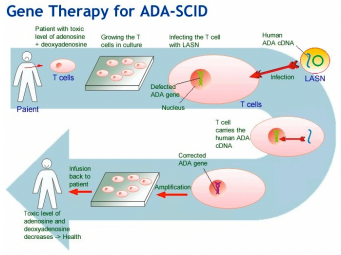
This image highlights the process of Gene Therapy of ADA-SCID.
Image
i. Mention the cause of ADA deficiency in humans.
ii. How has genetic engineering helped patients suffering from it?
Answer
i. Deletion of the gene for ADA in an individual leads to ADA deficiency disorder Adenosine Deaminase (ADA) enzyme is crucial for immune system to function.
ii. Gene therapy is helpful in the treatment of ADA deficiency.
The treatment involves the following steps:
a. Lymphocytes from the blood of patient are grown on a culture outside the body.
b. A functional ADA, cDNA (using a retroviral vector) is then introduced into these lymphocytes.
c. Such genetically engineered lymphocytes are returned to the blood of patient.
d. Periodic infusion of such genetically engineered lymphocytes is required by the patient.
View full question & answer
Question 73 Marks
Define the following terms and give one example for each:
a. Commensalism
b. Parasitism
c. Camouflage
d. Mutualism
e. Interspecific competition
Answer
a. Commensalism: In ecology, commensalisms is a class of relationship between two organisms where one organism benefits but the other is unaffected.
b. Parasitism: It is a relationship between two organisms where the larger animal is at harm and the smaller animal is benefited.
c. Camouflage: Camouflage is a method of crypsis avoidance of observation - that allows an otherwise visible organism or object to remain indiscernible from the surrounding environment through deception. The best example of camouflage is shown by the garden lizard which changes its colour as per its surroundings.
d. Mutualism: It is relationship between two organisms where both organisms are benefited. For example, some birds pick worms and insects from big animals skin to get food. This helps the bigger animal to get rid of insects and worms.
e. Interspecific competition: Interspecific competion, in ecology, is a form of competition in which individuals of different species compete for the same resource in an ecosystem (e.g. food or living space).
View full question & answer
Question 83 Marks
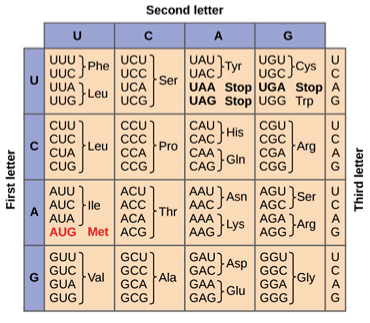
Observe the diagram of Genetic code and answer the following questions:
Image
i. How many codons codes for amino acids and how many do not?
ii. Explain the following giving one example of each.
a. Unambiguous and specific codon
b. Degeneration codon
c. Universal codon
d. Initiator codon
Answer
i. Out of 64 codons 61 code for amino acids and rest 3 codons do not code for any amino acids. These function as stop codons.
ii. a. Unambiguous and specific codon These code for only one amino acid, thus, making the genetic code unambiguous and specific e.g. UUU.
b. Some amino acids are coded by more than one codon, so the code is degenerate, e.g. serine is coded by 6 codons.
c. The codon is nearly universal. Some exceptions to the rule are mitochondrial codon and in some protozoans, e.g. UUU.
d. Initiator codon AUG has a dual function. It codes for methionine and also acts as an initiator.
View full question & answer