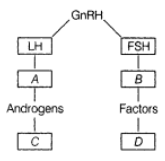
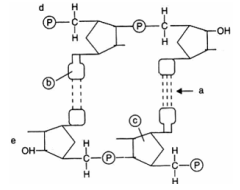
Question types

MODEL PAPER 2 question types

38 questions across 6 question groups — pick any mix to generate a BIOLOGY paper with step-by-step answer keys.

38
Questions
6
Question groups
5
Question types
Sample Questions

MODEL PAPER 2 questions

One sample from each question group in this chapter. Select any group above to see the full set with answer keys.

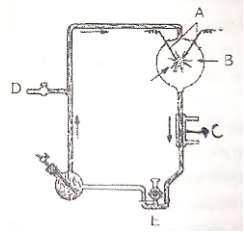
The diagram represents miller's experiment. Choose the correct combination of labelling.
Image
  • A
    A-electrodes, B-NH3 + H2O, C-hot water, D-tap, E-U trap
  • B
    A-electrodes, B-NH4+ H2 + CO2 +CH3, C- hot water, D-vacuum, E-U trap
  • C
    A-electrodes, B-NH3 + H2 + H2O +CH2, C- cold water, D-vacuum, E-U trap
  • D
    A-electrodes, B-NH3 + H2 + H2O +CH4, C- steam, D-vacuum, E-U trap

View full solution
The amount of usable energy which is available for doing work, when the temperature and pressure are uniform throughout the system, is called:
  • A
    Free energy
  • B
    Spontaneous energy
  • C
    Activation energy
  • D
    Enthalphy
View full solution
DNA fragments move at different distances in Gel Electrophoresis because:
  • A
    The voltage is too high.
  • B
    Molecular weights of the fragments are different.
  • C
    DNA has a positive charge.
  • D
    DNA gets denatured.
View full solution
Study the pedigree chart given below:
Image
What does it show?
  • A
    The pedigree chart is wrong as this is not possible
  • B
    Inheritance of a recessive sex-linked disease like haemophilia
  • C
    Inheritance of a condition like phenylketonuria as an autosomal recessive trait
  • D
    Inheritance of a sex-linked inborn error of metabolism like phenylketonuria
View full solution
a. Draw an L.S. of pistil showing pollen tube entering into the embryo sac. Label the following:
i. Nucellus
ii. Antipodals
iii. Synergids
iv. Micropyle
b. Write the functions of the following:
i. Synergids
ii. Micropyle
View full solution
Name the group of bacteria involved in setting milk into curd. Explain the process they carry in doing so. Write another beneficial role of such bacteria.
View full solution
Q 113 Marks Question3 Marks
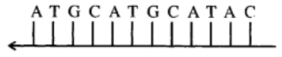
i. Construct a complete transcription unit with promotor and terminator on the basis of the hypothetical template strand given below.
Image
ii. Write the RNA strand transcribed from the above transcription unit along with its polarity.
View full solution
Q 133 Marks Question3 Marks
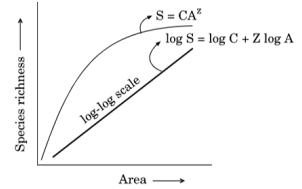
Study the graphical representation of Species richness - Area relationship given below and answer the questions that follow:
Image
a. What do S, C, Z and A represent in the given graph?
b. What will be the range value of Z line if we analyse the species-area relationship among very large areas like entire continent?
View full solution
Q 143 Marks Question3 Marks
A patient complains of suffering from constipation, stomach ache, stool with blood clots and excess mucous.
The physician diagnosed it as amoebiasis, after stool test.
a. Write the scientific name of the microbe identified in the stool sample.
b. How do you think, the patient must have contracted it?
c. Write your suggestions to the patient to avoid infection in future.
View full solution
Q 153 Marks Question3 Marks
Classify the following as examples of homology and analogy:
(i)Mouth parts of cockroach and butterfly
(ii)Hearts of rabbits and human beings
(iii)Eyes of octopus and mammals
(iv)Sweet potato and potato
(v)Stings of honey bee and scorpion
(vi)Tendrils of Lathyrus and tendrils of Gloriosa
View full solution
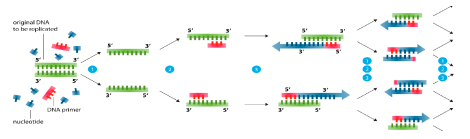
Polymerase chain reaction (PCR) is a laboratory technique used to amplify DNA sequences. The method involves using short DNA sequences called primers to select the portion of the genome to be amplified. The temperature of the sample is repeatedly raised and lowered to help a DNA replication enzyme copy the target DNA sequence. The technique can produce a billion copies of the target sequence in just a few hours.
Image
i. List the three steps involved in Polymerase Chain Reaction (PCR).
ii. Name the source organism of Taq polymerase.
iii. Explain the specific role of this enzyme in PCR.
View full solution
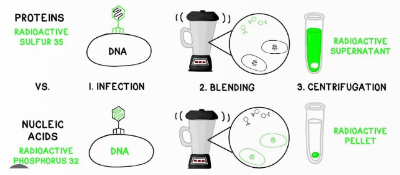
In 1952, Alfred Hershey and Martha Chase took an effort to find the genetic material in organisms. Their experiments led to an unequivocal proof to DNA as genetic material.
Image

Answer the following questions based on Hershey and Chases's experiments:
i. Name the kind of virus they worked with and why?
ii. Why did they use two types of culture media to grow viruses in? Explain.
iii. What was the need for using a blender and later a centrifuge during their experiments? OR
iv. State the conclusion drawn by them after the experiments.
View full solution
a. Draw a diagram of a fully developed embryo sac of an angiosperm. Label its chalazal end and any other five parts within the embryo sac.
b. Why does the development of an endosperm precede that of the embryo in angiosperm?
c. Number of chromosomes in an onion plant cell is 16. Name the cells of the embryo sac having 16 and 24 chromosomes formed after fertilisation.
View full solution
a. Explain the process of syngamy and triple fusion in angiosperms.
b. Trace the development of the product of syngamy upto its mature stage in a dicot plant.
c. Draw and label three important parts of a mature dicot embryo.
View full solution
Assertion (A): Azolla is used as a biofertiliser in rice fields.
Reason (R): Azolla shows the presence of N2 - fixing bacteria in its leaf cavities.
  • A
    Both A and R are true and R is the correct explanation of A
  • B
    Both A and R are true but R is not the correct explanation of A.
  • C
    A is true but R is false.
  • D
    A is false but R is true.
View full solution
Assertion (A): Determining the sex of an unborn child followed by MTP is an illegal practice.
Reason (R):
Amniocentesis is a practice to test the presence of genetic disorders also.
  • A
    Both (A) and (R) are true and (R) is the correct explanation of (A).
  • B
    Both (A) and (R) are true, but (R) is not the correct explanation of (A).
  • C
    (A) is true, but (R) is false.
  • D
    (A) is false, but (R) is true.
View full solution
Assertion (A): No energy that is trapped in an organism remains in it forever.
Reason (R): The energy trapped by a producer/consumer is either passed to a consumer/secondary consumer or the organism dies.
  • A
    Both A and R are true and R is the correct explanation of A.
  • B
    Both A and R are true but R is not the correct explanation of A.
  • C
    A is true but R is false.
  • D
    A is false but R is true.
View full solution
Assertion: The earliest organisms that appeared on the earth were non-green and presumably anaerobes.
Reason: The first autotrophic organisms were the chemoautotrophs that never released oxygen.
  • A
    If both Assertion & Reason are true but the reason is not the correct explanation of the assertion
  • B
    If both Assertion & Reason are true and the reason is the correct explanation of the assertion
  • C
    If Assertion is true statement but Reason is false,
  • D
    If both Assertion and Reason are false statements,
View full solution
Read the following text carefully and answer the questions that follow:
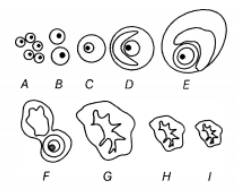
The following is the illustration of the sequence of ovarian events (A-I) in a humans female.
Image
i. Identify the figure that illustrates ovulation and mention the stage of oogenesis it represents. (1)
ii. Name the ovarian hormone and the pituitary hormone that have caused the above mentioned event. (1)
iii. Explain the changes that occur in the uterus simultaneously in anticipation. (2)
OR
Write the differences between C and H. (2)
View full solution
Read the following text carefully and answer the questions that follow:
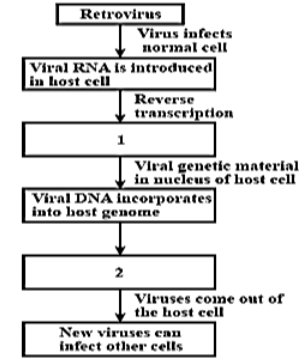
The diagram shows the replication of the retrovirus in the host.
Image

i. Fill in the missing data in boxes labelled 1 & 2. (1)
ii. Why is it named as retrovirus? (1)
iii. While the virus is being replicated and released, does the infected cell survive and why the virus infected cells prevent spreading of virus to healthy cells? (2)
OR
What is the effect of HIV infection on immune system? (2)
View full solution

Generate a MODEL PAPER 2 paper free

Pick question groups from the list above, set marks and difficulty, and export a branded PDF with step-by-step answer keys. First 3 chapters free — no signup.

Download App