Question 14 Marks
Read the following text carefully and answer the questions that follow:
The following is the illustration of the sequence of ovarian events (A-I) in a humans female.
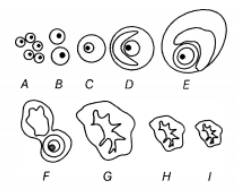
i. Identify the figure that illustrates ovulation and mention the stage of oogenesis it represents. (1)
ii. Name the ovarian hormone and the pituitary hormone that have caused the above mentioned event. (1)
iii. Explain the changes that occur in the uterus simultaneously in anticipation. (2)
OR
Write the differences between C and H. (2)
The following is the illustration of the sequence of ovarian events (A-I) in a humans female.
i. Identify the figure that illustrates ovulation and mention the stage of oogenesis it represents. (1)
ii. Name the ovarian hormone and the pituitary hormone that have caused the above mentioned event. (1)
iii. Explain the changes that occur in the uterus simultaneously in anticipation. (2)
OR
Write the differences between C and H. (2)
Answer
View full question & answer→i. Figure F illustrates ovulation. It represents the ovulatory stage of oogenesis.
ii. Ovarian and pituitary hormones involved in causing ovulation are
Ovarian hormone Estrogen.
Pituitary hormone LH and FSH.
iii. In anticipation of receiving the fertilised egg, the endometrium of the uterus gets thickened and also the blood supply to the endometrium increases.
OR
The figure C stage represents the secondary follicle and the H stage represents the degenerating corpus luteum.
ii. Ovarian and pituitary hormones involved in causing ovulation are
Ovarian hormone Estrogen.
Pituitary hormone LH and FSH.
iii. In anticipation of receiving the fertilised egg, the endometrium of the uterus gets thickened and also the blood supply to the endometrium increases.
OR
The figure C stage represents the secondary follicle and the H stage represents the degenerating corpus luteum.
| Secondary follicle | Corpus luteum |
| It is surrounded by layers of granulosa cells and theca layer. | Layers of granulosa cells and theca cells are absent. |
| It contains an oocyte in the developing stage. | It does not contain oocyte as it is formed after the release of secondary oocyte. |