Questions

3 Marks Question

Take a timed test

8 questions · self-marked practice — reveal the answer and mark yourself.

Question 13 Marks
Study the table showing the population interaction between species Z and Y respectively. Assign the appropriate +/– signs for A,B,D,E and respective interactions for C and F.
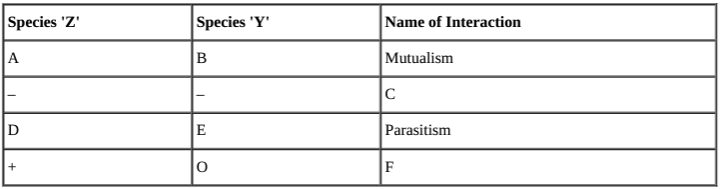
Image
Answer
A = +
B = +
C = Competition
D = +
E = -
F Commensalism
View full question & answer
Question 23 Marks
i. Explain the concept of endemism.
ii. Name four regions in and around our country that are considered hot-spots.
Answer
i. Endemism: These are the species which are confined to a particular geographical region and they are not found anywhere else. Such species are called endemic species.
ii. Four regions in and around our country that are considered hot-spots are
a. Western Ghats
b. Himalaya
c. Indo-Burma
d. Sri Lank
View full question & answer
Question 33 Marks
A child is born with ADA-deficiency.
a. Suggest and explain a procedure for possible life-long (permanent) cure.
b. Name any other possible treatment for this disease.
Answer
a. Gene therapy can be used for the treatment of the child with ADA deficiency. In this method, the lymphocytes from the blood of the patient are grown in a culture outside the body. A functional ADA CDNA is introduced into these lymphocytes using a retroviral vector. These lymphocytes are then returned to the patient. If the gene isolated from marrow cells producing ADA is introduced into cells at early embryonic stage, then it can be a permanent cure.
b. Other possible methods for curing ADA deficiency disease Bone marrow transplantation and enzyme replacement therapy (giving the functional enzyme to the patient by injection).
View full question & answer
Question 43 Marks
Who put forward the theory of natural selection? Explain the concept of differential reproduction as a major component of the theory of natural selection.
Answer
Charles Darwin formulated the theory of natural selection.
Differential reproduction means that some members of a population have traits that enable them to grow up and reproduce at a higher rate and leave more surviving offspring in the next generation than others. If it continues for many generations genes of the individuals, which produce more offspring will become more predominant in the gene pool of population.
View full question & answer
Question 53 Marks
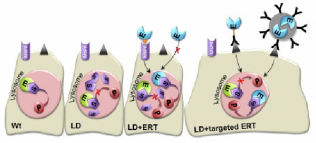
The image below eleborates enzyme-replacement therapy.
Image
i. Explain enzyme-replacement therapy to treat adenosine deaminase deficiency.
ii. Mention two disadvantages of this procedure.
Answer
In enzyme replacement therapy, the patient is given functional ADA (Adenosine Desaminase) by injection.
Hereditary disease can be corrected by gene therapy. It is a collection of methods that allows correction or replacement of defective genes. The first gene therapy was given in 1990 to a 4 years old girl with Adenosine Deaminase (ADA) deficiency. It is caused due to the deletion of gene for adenosine deaminase.
Disadvantage
i. The patient does not completely recover from the disease.
ii. It needs periodic injections of the enzyme to the patients.
View full question & answer
Question 63 Marks
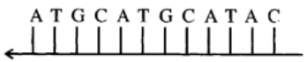
i. Construct a complete transcription unit with promotor and terminator on the basis of the hypothetical template strand given below.
Image
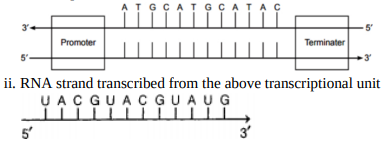
ii. Write the RNA strand transcribed from the above transcription unit along with its polarity.
Answer
I. Transcription unit
Image
View full question & answer
Question 73 Marks
Mention the advantages of selecting pea plant for experiment by Mendel.
Answer
Pea is a annual plant which gives result within a year. Large number of seeds are produced by pea plant in one generation. Pea plant has short life cycle. A large number of true breeding varieties with observable alternative forms for a trait were available.
View full question & answer
Question 83 Marks
How arein-situ and ex-situ approaches of biodiversity conservations different from each other?
Answer
In situ conservation - conservation and protection of whole ecosystem and its biodiversity at all levels in their natural habitat.
Whereas Ex situ conservation involves taking out the threatened animals and plants from their natural habitat and placed in special settings where they can be protected and given special care.
View full question & answer