Questions

1 Marks Question

Take a timed test

222 questions · self-marked practice — reveal the answer and mark yourself.

Question 11 Mark
If the sequence of the coding strand in a transcription unit is written as follows:
5'-ATGCATGCATGCATGCATGCATGCATGC-3'
Write down the sequence of mRNA.
Answer
mRNA: 5'-A U G CAU G CAU G C AU G CA UGCAUGCAUGC-3'.
View full question & answer
Question 21 Mark
Briefly describe the following:
Bioinformatics.
Answer
Bioinformatics: It is the application of computer science and information technology which deals with handling, storing of huge information of genomics, processing information, analyzing data and creating new knowledge.
View full question & answer
Question 31 Mark
Explain (in one or two lines) the function of the following:
tRNA.
Answer
tRNA: tRNA or transfer RNA is a small RNA that reads the genetic code present on mRNA. It carries specific amino acid to mRNA on ribosome during translation of proteins.
View full question & answer
Question 41 Mark
If the sequence of one strand of DNA is written as follows:
5'-ATGCATGCATGCATGCATGCATGCATGC-3'
Write down the sequence of complementary strand in 5' → 3' direction.
Answer
The DNA strands are complementary to each other with respect to base sequence. Hence, if the sequence of one strand of DNA is 5'-ATGCATGCATGCATGCATGCATGCATGC-3’ Then, the sequence of complementary strand in 5' to 3' direction will be 3'-TACGTACGTACGTACGTACGTACGTACG-5’ Therefore, the sequence of nucleotides on DNA polypeptide in 5' to 3' direction is 5'-GCATGCATGCATGCATGCATGCATGCAT-3’.
View full question & answer
Question 51 Mark
Briefly describe the following:
Polymorphism.
Answer
Polymorphism: The variation in DNA arising through mutation at non-coding sequences is known as Polymorphism. Such variations are unique to specific sites of DNA and can occur due to deletion, insertion or substitution of bases. It can be observed by making fragments of DNA sample and separating them through electrophoresis. The polymorphism in a DNA sequence is the basis of genetic mapping of the human genome as well as DNA fingerprinting.
View full question & answer
Question 61 Mark
Briefly describe the following:
Translation.
Answer
Translation: It refers to the process of polymerisation of amino acids to form a polypeptide. The order and sequence of amino acids are defined by the sequence of bases in the mRNA. It occurs in cytoplasm in both prokaryotes and eukaryotes.
View full question & answer
Question 71 Mark
Briefly describe the following:
Transcription.
Answer
Transcription: The process of copying genetic information from one strand of the DNA into RNA is known as transcription. RNA is assembled simply based on complementarity of the DNA strand, only uracil is substituted in place of thymine. Only a small segment of DNA that codes for a polypeptide is copied.
View full question & answer
Question 81 Mark
Explain (in one or two lines) the function of the following:
Exons.
Answer
Exons: Exons are the coding sequences of DNA that are transcribed and translated.
View full question & answer
Question 91 Mark
Explain (in one or two lines) the function of the following:
Promoter.
Answer
Promoter: It is a region of DNA that helps in initiating the process of transcription. It serves as the binding site for RNA polymerase.
View full question & answer
Question 111 Mark
Which one out of Rho factor and sigma factor act as initiation factor during transcription in a prokaryote?
Answer
Sigma factor.
View full question & answer
Question 121 Mark
What function does B-galactosidase carry out?
Answer
B-galactosidase catalyses the hydrolysis of lactose into glucose and galactose.
View full question & answer
Question 181 Mark
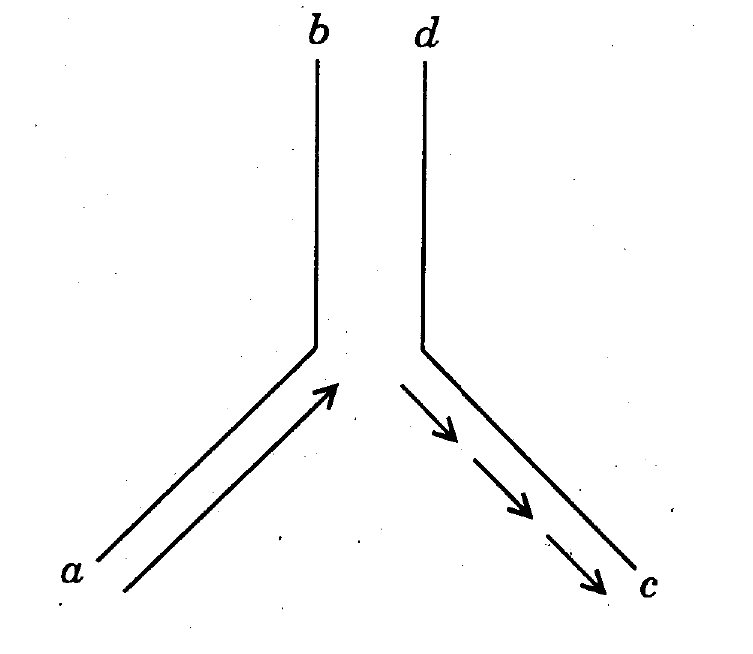
Mention the polarity of the DNA strands a-b and c-d shown in the replicating fork given below.

Answer
  1. a - b = 3 - 5
  2. c - d = 5 - 3
View full question & answer
Question 191 Mark
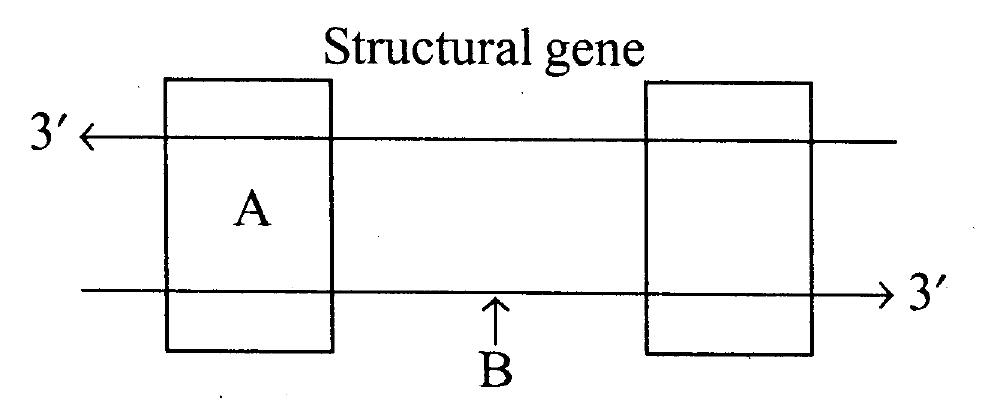
Name the parts ‘A’ and ‘B’ of the transcription unit given below.

Answer
  1. Promoter.
  2. Coding strand.
View full question & answer
Question 201 Mark
  1. What percent of human genome codes for proteins?
  2. What percent of discovered gene's functions are unknown?
Answer
  1. Less than 2 percent.
  2. About 50 percent.
View full question & answer
Question 211 Mark
When and at what end does the ‘tailing’ of hnRNA take place?
Answer
During conversion of hnRNA into functional mRNA, at 3’ end.
View full question & answer
Question 221 Mark
 Name the chromosome that has
  1. The maximum/most number of genes.
  2. The least number of genes.
Answer
  1. Chromosome I has maximum number of genes (2968).
  2. Y-chromosome has least number of genes (231).
View full question & answer
Question 231 Mark

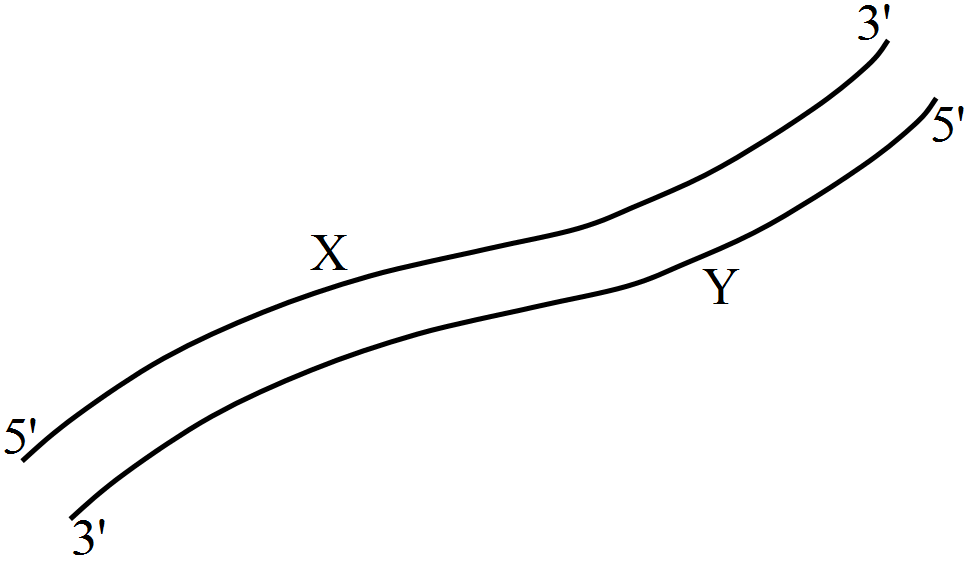
A structural gene has two DNA strsnds X snd y shown above. Identify the template strand.

Answer
Strand Y.
View full question & answer
Question 261 Mark
Who experimentally proved that DNA replication is semiconservative?
Answer
Mathew Meselson and Franklin Stahl.
View full question & answer
Question 291 Mark
A low level of expression of lac operon occurs at all the time. Can you explain the logic behind this phenomenon?
Answer
In the complete absence of expression of lac operon, permease will not be synthesised which is essential for transport of lactose from the medium into the cells. And if lactose cannot be transported into the cell, then it cannot act as an inducer. Hence, cannot relieve the lac operon from its repressed state.
View full question & answer
Question 301 Mark
Mention the role of DNA polymerase other than polymerising deoxyribonucleotides during DNA synthesis?
Answer
Proof reading or replacing the wrong bases added during replication of DNA is done by DNA polymerase.
View full question & answer
Question 311 Mark
What do you mean by nonsense codon?
Answer
The codon which do not code for any amino acid and leads to termination of translation process is called nonsense codon.
View full question & answer
Question 321 Mark
If one nucleotide (encircled) gets missed in the given series then how many amino acid will be changed?
AUG (U)AU CAA AAG UAG
Answer
In the given series the concerning amino acids are:
$\frac{\text{AUG}}{\text{Met}}\frac{\text{UAU}}{\text{Tyr}}\frac{\text{CAA}}{\text{GIn}}\frac{\text{AAG}}{\text{Lys}}\frac{\text{UAG}}{\text{Non-sense codon}}$
After deleting (U), the new series with their amino acids will be
$\frac{\text{AUG}}{\text{Met}}\frac{\text{AUC}}{\text{Ile}}\frac{\text{AAA}}{\text{Lys}}\frac{\text{AGU}}{\text{Ser}}\frac{\text{AG}}{\text{X}}\ \ (\text{Incomplete codon})$
So three amino acids will be changed:
Isoleucine in place of tyrosine.
Lysine in place of Glutamine.
Serine in place of Lysine.
View full question & answer
Question 331 Mark
Why is lactose considered an inducer in lac operon?
Answer
Lactose binds to repressor and prevents it from binding with the operator, as a result RNA polymerase binds to promoter–operator region to transcribe the structural genes.
View full question & answer
Question 341 Mark
The accessibility of promoter region of prokaryotic DNA is often regulated by the interaction of a protein with a certain sequence of DNA. What name is given to such a DNA sequence?
Answer
Operator.
View full question & answer
Question 351 Mark
Sometimes cattle or even human beings give birth to their young ones that have extremely different sets of organs like limbs/position of eye(s), etc. Why?
Answer
This is due to a disturbance in coordinated regulation of expression of sets of genes associated with organ development or due to mutations.
View full question & answer
Question 371 Mark
What is the function of aminoacyl tRNA synthetase?
Answer
It catalyses the attachment of amino acid to tRNA.
View full question & answer
Question 381 Mark
How is repetitive/satellite DNA separated from bulk genomic DNA for various genetic experiments?
Answer
Density gradient centrifugation.
View full question & answer
Question 401 Mark
How many bases will be there in three codons? How many amino acids will this number of bases code for?
Answer
There will be nine bases in three codons. These bases will code for three amino acids.
View full question & answer
Question 411 Mark
Why is it not possible for an alien DNA to become part of chromosome anywhere along its length and replicate normally?
Answer
An alien DNA cannot become a part of chromosome any where along its length and replicate normally, due to the absence of origin of replication where the replication process is initiated.
View full question & answer
Question 421 Mark
Explain (in one or two lines) the function of the following:
Exons.
Answer
Exons: Exons are the coding sequences of DNA that are transcribed and translated.
View full question & answer
Question 441 Mark
RNA polymerase II in eukaryotes catalyses the transcription of _________.
Answer
RNA polymerase II in eukaryotes catalyses the transcription of hnRNA.
View full question & answer
Question 451 Mark
Define translation.
Answer
Translation is the process of polymerisation of amino acids to form a polypeptide in a sequence as dictated by the mRNA.
View full question & answer
Question 461 Mark
Put phrases 1-6 in the correct order to describe gene expression:
  1. mRNA is produced in the nucleus.
  2. Ribosomes move along mRNA.
  3. DNA has a code.
  4. Polypeptide results.
  5. tRNA brings amino acids to ribosomes.
  6. mRNA moves to ribosomes.
Answer
The correct order is:
  1. DNA has a code.
  1. mRNA is produced in the nucleus.
  1. mRNA moves to ribosomes.
  1. Ribosomes move along mRNA.
  1. tRNA brings amino acids to ribosomes.
  1. Polypeptide results.
View full question & answer
Question 471 Mark
Why is RNA more reactive in comparison to DNA?
Answer
The OH-bond in the ribose of RNA makes the molecule more reactive, compared with DNA, RNA is not stable under alkaline conditions.
View full question & answer
Question 481 Mark
Give the initiation codon for protein synthesis. Name the amino acid it codes for.
Answer
AUG; it codes for amino acid, methionine.
View full question & answer
Question 491 Mark
What is the function of ligase?
Answer
The small DNA fragments called okazaki fragments, synthesised on the lagging strand, are joined together by the enzyme DNA ligase.
View full question & answer
Question 501 Mark
In a double stranded DNA, which strand is transcribed and why?
Answer
The strand having the polarity 3′ → 5′ is transcribed because RNA polymerase polymerises nucleotides only in 5′ → 3′ direction.
View full question & answer
Question 521 Mark
During splicing in eukaryotes, the are joined to from the _________ RNA.
Answer
During splicing in eukaryotes, the are joined to from the exons RNA.
View full question & answer
Question 531 Mark
Due to an error during transcription, ATG of DNA formed UAG in mRNA.
What would happen to the polypeptide chain during translation due to this changed mRNA?
Answer
Polypeptide chain synthesis will stop as UAG is stop codon.
View full question & answer
Question 541 Mark
Name the negatively charged and positively charged components of a nucleosome.
Answer
Negatively charged component- DNA.
Positively charged component- histones.
View full question & answer
Question 571 Mark
Mention the two additional processings which hnRNA needs to undergo after splicing so as to become functional.
Answer
Capping and tailing.
View full question & answer
Question 581 Mark
Sometimes cattle or even human beings give birth to their young ones that are having extremely different sets of organs like limbs/ position of eye(s) etc. Comment.
Answer
There is a disturbance in co-ordinated regulation of expression of sets of genes associated with organ development.
View full question & answer
Question 591 Mark
Mark the odd one in the following group.
Har Gobind Khorana, Marshal Nirenberg, Severo Ochoa, Alec Jeffreys.
Answer
Alec Jeffreys.
View full question & answer
Question 601 Mark
How many base pairs are present in one full turn of DNA helix?
Answer
There are ten base pairs in each turn.
View full question & answer
Question 611 Mark
Who proposed the nucleosome mode!? State the function of rRNA.
Answer
Roger Kornberg proposed nucleosome model rRNA plays structural and catalytic role during translation.
View full question & answer
Question 621 Mark
How is the length of DNA usually calculated?
Answer
The length of DNA is calculated by multiplying the total number of base pairs with the distance between two consecutive base pairs, which is 0.34nm or 0.34 × 10m.
View full question & answer
Question 631 Mark
Lac operon shows the control of gene expression at the _________ level, in E.coli.
Answer
Lac operon shows the control of gene expression at the transcription level, in E.coli.
View full question & answer
Question 651 Mark
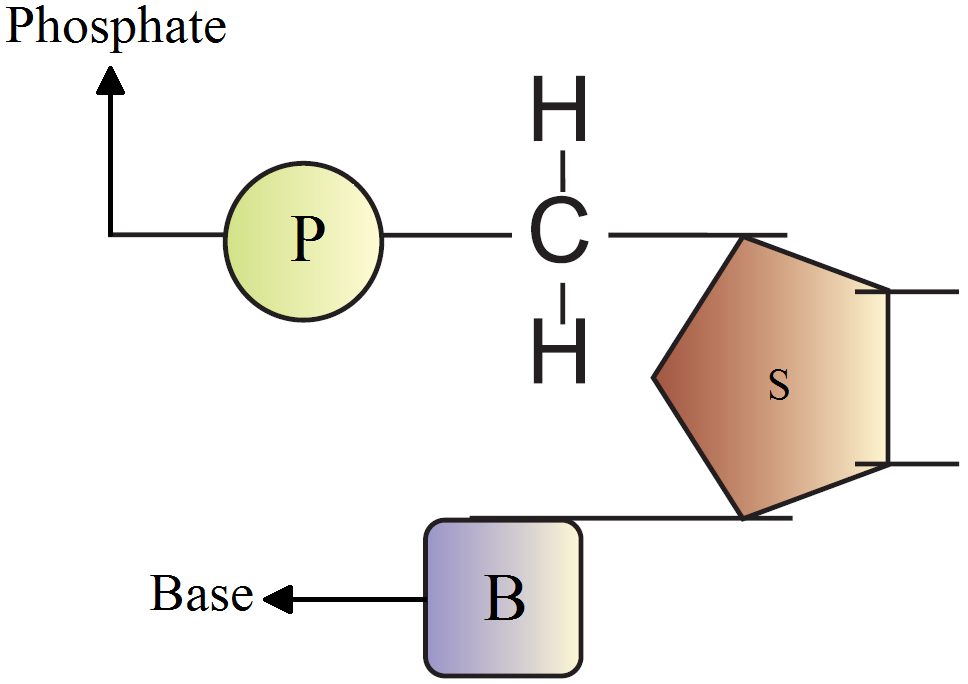
Name the specific components and the linkage between them that form deoxyadenosirie.
Answer
Adenine (N-glycosidic linkage) + Deoxyribose → Deoxyadenosine.
View full question & answer
Question 661 Mark
The last chromosome to be completely sequenced in the Human Genome Project (HGP) is _________.
Answer
The last chromosome to be completely sequenced in the Human Genome Project (HGP) is Chromosome 1.
View full question & answer
Question 671 Mark
What is genetic code?
Answer
It is the sequence of base triplet in a DNA molecule which determines the sequence of amino acids in a polypeptide.
View full question & answer
Question 691 Mark
A change in a sequence of DNA occurs so that the mRNA codon reads AUC rather than AUU. Both of these code for the amino acid iso leucine. Argue that this is not a mutation.
Answer
If one defines a mutation as a change in genetic material resulting in a different phenotypic expression, then this is not a mutation.
View full question & answer
Question 701 Mark
Name the process in which the unwanted mRNA regions are removed and the wanted regions are joined.
Answer
Splicing.
View full question & answer
Question 721 Mark
Name the two types of nucleic acids in living systems.
Answer
Deoxyribonucleic acid and ribonucleic acid.
View full question & answer
Question 731 Mark
Name the specific components and the linkages between them that form deoxyguanosine.
Answer
The nitrogenous base guanine is linked to deoxyribose sugar by N-glycosidic linkage.
View full question & answer
Question 751 Mark
What conclusion was drawn from the blender experiment performed by Hershey and Chase?
Answer
The conclusion drawn was that the genetic material that is passed from virus to bacteria mentioned in transforming principle, was DNA not proteins.
View full question & answer
Question 771 Mark
________ factor functions as the initiation factor in the transcription of prokaryotes.
Answer
Sigma (0) factor functions as the initiation factor in the transcription of prokaryotes.
View full question & answer
Question 781 Mark
What is the function of histones in DNA packaging?
Answer
Histone acts like a spool around which DNA is wrapped.
View full question & answer
Question 801 Mark
If the base adenine constitutes 30 percent of an isolated DNA fragment, then what is the expected percentage of the base cytosine in it?
Answer
20 percent.
View full question & answer
Question 811 Mark
In an experiment, DNA is treated with a compound which tends to place itself amongst the stacks of nitrogenous base pairs. As a result of which the distance between two consecutive base increases, from 0.34nm to 0.44nm. Calculate the length of DNA double helix (which has 2 × 10⁹ bp) in the presence of saturating amount of this compound.
Answer
2 × 109 × 0.44nm.
View full question & answer
Question 821 Mark
What is a nucleoid?
Answer
Nucleoid is the region in prokaryotic cells where DNA is organised as large loops held by some positively charged proteins.
View full question & answer
Question 831 Mark
Why are proteins either positively or negatively charged?
Answer
If the proteins are rich in basic amino acids, they are positively charged, and if the proteins are rich in acidic amino acids, they are negatively charged.
View full question & answer
Question 841 Mark
How many hydrogen bonds are present between the A-T and G-C pairs, respectively?
Answer
A - T - Two, G - C - Three.
View full question & answer
Question 851 Mark
Why does hnRNA undergo splicing? Where does splicing occur in the cell?
Answer
hnRNA undergoes splicing to remove introns and join exons. Splicing occurs in the nucleus of the cell.
View full question & answer
Question 861 Mark
Mention the two additional processing which hnRNA needs to undergo after splicing so as to become functional.
Answer
Capping and tailing.
View full question & answer
Question 871 Mark
Mention the role of the codons AUG and UGA during protein synthesis.
Answer
AUG- codes for methionine/initiation codon,
UGA- termination codon/stop codon.
View full question & answer
Question 881 Mark
What do you understand by transformation?
Answer
It is a biological phenomenon by which the DNA from one type of cell, when introduced into another type, is able to bestow some of the properties of the former to the latter.
View full question & answer
Question 921 Mark
How does HIV differ from a bacteriophage?
Answer
HIV has RNA as its genome and shows reverse transcription, while bacteriophage has double-stranded DNA as its genome and no reverse transcription.
View full question & answer
Question 931 Mark
Why hnRNA is required to undergo splicing?
Answer
Since hnRNA is non-functional, it has to be made functional/removal of introns and joining of exons.
View full question & answer
Question 951 Mark
Cattle or even human beings, sometimes give birth to their youngones having extremely different sets of organs like limbs/ position of eye(s), etc. Comment with respect of genetics involved in it.
Answer
Sometimes cattle or even human beings give birin to their youngones that are having different sets of organs like limbs/ position of eye, etc. It happens due to the disturbance in coordinated regulation of expression in sets of genes, which are associated with organ development .
View full question & answer
Question 961 Mark
Which one out of an intron and an exon is the reminiscent of antiquity?
Answer
Intron is considered to be the reminiscent of antiquity.
View full question & answer
Question 971 Mark
Write the concept of central dogma.
Answer
The concept of central dogma proposed the unidirectional flow of information from DNA to RNA and then to protein:
$\text{DNA}\xrightarrow{\text{transcription}}\text{mRNA}\xrightarrow{\text{translation}}\text{protien}$
View full question & answer
Question 981 Mark
What is hnRNA?
Answer
The precursor RNA transcribed by RNA polymerase that contains both exons and introns.
View full question & answer
Question 991 Mark
What do you understand by the semiconservative replication of DNA?
Answer
In semiconservative DNA replication, each replicated DNA molecule consists of an old and a new strand i.e., one parental strand and one newly formed daughter strand.
View full question & answer
Question 1001 Mark
Mention the position of the ribonucleotide, where the OH group is present.
Answer
The OH-group is present at the 2-position.
View full question & answer
Question 1011 Mark
Why should the DNA be cut into smaller fragments for sequencing?
Answer
DNA is a giant molecule and there are technical limitations in sequencing very long segments of DNA; hence DNA has to be cut into smaller fragments.
View full question & answer
Question 1021 Mark
Define an anticodon.
Answer
The triplet base present on the tRNA which is complementary to codon on mRNA is called anticodon.
View full question & answer
Question 1031 Mark
Define transformation.
Answer
Transformation is a phenomenon by which the DNA isolated from one type of cell, when introduced into another type, is able to bestow some of the properties of the former to the latter.
View full question & answer
Question 1041 Mark
When and at what end does the tailing' of hnRNA takes place?
Answer
After splicing, tailing occurs at the 3' end of hnRNA.
View full question & answer
Question 1061 Mark
Name the enzyme that transcribes hnRNA in eukaryotes.
Answer
The RNA polymerase-II transcribes the precursor of mRNA, the heterogeneous nuclear RNA (hnRNA).
View full question & answer
Question 1071 Mark
________ step in transcription is catalysed by the enzyme DNA-dependent RNA polymerase.
Answer
Elongation step in transcription is catalysed by the enzyme DNA-dependent RNA polymerase.
View full question & answer
Question 1081 Mark
If the base adenine constitutes 31 percent of an isolated DNA fragment, then what is the expected percentage of the base cytosine in it?
Answer
According to Chargaff's rule.
A + G = C + T = 50%
$\therefore$ if A = 31% then T = 31%
C + T = 50%
$\therefore$ C = 50% - 31%
= 19%
View full question & answer
Question 1091 Mark
How is a polypeptide chain synthesis terminated during protein synthesis?
Answer
Synthesis of polypeptide chain terminates when a nonsense codon of mRNA reaches the A-site. There are three nonesense codon UAA, UAG and UGA, which are not recognised by any of the tRNAs. Therefore no more amino-acyl tRNA reaches the A site. The P site t-RNA is hydrolysed and the completed polypeptide is released in the presence of GTP dependent release factor.
View full question & answer
Question 1101 Mark
The presence of _________ group in every ribonucleotide makes RNA labile and reactive.
Answer
The presence of 2'-OH group in every ribonucleotide makes RNA labile and reactive.
View full question & answer
Question 1111 Mark
Who was the first to identify DNA and what was the name given to it by him?
Answer
DNA was first isolated by Friedrich Meischer in 1869 who named it as nuclein.
View full question & answer
Question 1121 Mark
Why is hRNA required to undergo splicing?
Answer
Since it contains both the coding sequences (exons) and non-coding sequences (introns), hnRNA has to undergo splicing for the removal of introns.
View full question & answer
Question 1131 Mark
Given below is a statement state whether it as true or false. If false give reason.
Sequencing of whole genome with both the coding and non-coding regions is EST.
Answer
False. ESTs are short sequence of cDNA. They are used to identify all the genes that are expressed as RNA. The statement given here represents sequence annotation.
View full question & answer
Question 1141 Mark
The enzyme DNA polymerase catalyses the polymerisation of nucleotides in the _________ direction, for the lagging strand.
Answer
The enzyme DNA polymerase catalyses the polymerisation of nucleotides in the 5' → 3' direction, for the lagging strand.
View full question & answer
Question 1151 Mark
Which is the site of control of gene expression in prokaryotes?
Answer
Control of the rate of transcriptional initiation.
View full question & answer
Question 1171 Mark
Name the enzyme that joins the short pieces in the lagging strand during synthesis of DNA?
Answer
DNA ligase joins Okazaki fragments in lagging strands.
View full question & answer
Question 1181 Mark
While an mRNA strand is being translated in the ribosome subunit, the triplets in sequence were UAC and UAG. One of them codes for tyrosine. What is the significance of the other? Pick out the codon and specify.
Answer
UAG acts as terminator codon thus leads to the termination of polypeptide chain. It does not specify any amino acid.
View full question & answer
Question 1201 Mark
Name two basic amino acids that provide positive charge to histone proteins.
Answer
Lysine and Arginine.
View full question & answer
Question 1211 Mark
Mention one difference to distinguish an exon from an intron.
Answer
Exon: coded/expressed sequence of nucleotides in mRNA.
Intron: Intervening sequence of nucleotides not appearing in processed mRNA.
View full question & answer
Question 1221 Mark
What is the base pairing pattern of DNA?
Answer
Guanine pair with cytosine and adenine pair with thymine.
View full question & answer
Question 1231 Mark
Name the enzyme and state its property that is responsible for and discontinuous replication of the two strands of a DNA molecule.
Answer
DNA polymerase is the enzyme. The property that is responsible for continuous and discontinuous replication of two strands of DNA molecule is that the enzyme catalyses the polymerization of nucleotides in the 5’ to 3’ direction. 
View full question & answer
Question 1251 Mark
 In F. Griffith's experiment, how did the non-virulent strain of Streptococcus pneumonia become virulent?
Answer
 By transformation.
View full question & answer
Question 1271 Mark
Why does the distance between the two polynucleotide strands of DNA remain almost constant?
Answer
In a DNA molecule, a large sized purine (A, G) always comes opposite and pairs with pyrimidines (T, C). This generates a uniform distance between the two strands of a DNA helix.
View full question & answer
Question 1281 Mark
Name the enzyme and state its property that is responsible for Continuous and discontinuous replication of the two strands of a DNA molecule.
Answer
DNA-dependent DNA polymerase. This enzyme can polymerise deoxynucleotides in 5' → 3' direction only. Due to this, replication of DNA is continuous in one strand 3' → 5' while discontinuous in another 5' → 3'.
View full question & answer
Question 1291 Mark
Where does transcription and translation occur in bacteria and eukaryotes, respectively?
Answer
In bacteria, both transcription and translation processes occur in the cytoplasm as there is no nucleus.
In eukaryotes, transcription occurs in nucleus, while translation occurs in the cytoplasm.
View full question & answer
Question 1301 Mark
Why is the strand of DNA with 3' → 5 polarity transcribed and not the other strand of 5' → 3' polarity?
Answer
RNA polymerase can polymerise the RNA strand only in 5' → 3' direction.
View full question & answer
Question 1311 Mark
Which one out of Rho factor and sigma factor, acts as initiation factor during transcription in prokaryote?
Answer
Sigma factor.
View full question & answer
Question 1331 Mark
State anyone reason to explain why RNA viruses mutate and evolve faster than other viruses?
Answer
- RNA is unstable as 2-OH group of the RNA-nucleotide is reactive.
- RNA is also a catalyst, hence RNA viruses mutate faster.
View full question & answer
Question 1341 Mark
In a nucleus, the number of RNA nucleoside triphosphates is 10 times more than the number of DNA nucleoside triphosphates, still only DNA nucleotides are added during the DNA replication, and not the RNA nucleotides. Why?
Answer
DNA polymerase is highly specific to recognise only deoxyribonucleoside triphosphates. Therefore it cannot hold RNA nucleotides.
View full question & answer
Question 1351 Mark
Mention the contribution of genetic maps in human genome project.
Answer
Sequencing of genes, DNA finger printing, tracing human history, chromosomal location for disease associated sequences.
View full question & answer
Question 1361 Mark
Name the negatively charged and positively charged components of a nucleosome.

OR

Name the positively charged protein around which the negatively charged DNA wrapped.

Answer
A histone octamer is the positively charged component and the DNA helix is the negatively charged component of nucleosome.
View full question & answer
Question 1381 Mark
Write the dual purpose served by Deoxyribonucleoside triphosphates in polymerisation.
Answer
Deoxyribonucleoside triphosphates serve dual purposes. They serves as substrates i.e. nucleotides during replication and also provide energy for polymerisation reaction by cleavage of high energy terminal phosphates bond.
View full question & answer
Question 1391 Mark
If the sequence of the nitrogen bases in the coding strand of DNA is 5'- ATGAATT'-3', the sequence of bases in the RNA transcribed by it will be_________.
Answer
If the sequence of the nitrogen bases in the coding strand of DNA is 5'- ATGAATT'-3', the sequence of bases in the RNA transcribed by it will be 3' AUGAAUU 5'.
View full question & answer
Question 1401 Mark
Write the role of histone protein in packaging of DNA in eukaryotes.
Answer
Histones carry positve charge, and so negatively charged DNA is wrapped around it.
View full question & answer
Question 1411 Mark
Why is RNA more reactive in comparison to DNA?

OR

Why do RNA viruses undergo mutation and evolution faster than most of the DNA viruses?

Answer
The 2' OH-group in the nucleotides of RNA is a reactive group, that makes RNA labile and easily degradable.
View full question & answer
Question 1421 Mark
What is replication fork?
Answer
During DNA replication the two strands separate out to form a Y-shaped structure on either side of origin which is called replication fork.
View full question & answer
Question 1431 Mark
Who developed the principle/ method of automated DNA sequences?

OR

Name the scientist who developed the method to determine the sequence of amino acids in proteins.

Answer
Frederick Sanger.
View full question & answer
Question 1441 Mark
Name the enzyme that joins the small fragments of DNA of a lagging strand during DNA replication.
Answer
DNA-ligase.
View full question & answer
Question 1471 Mark
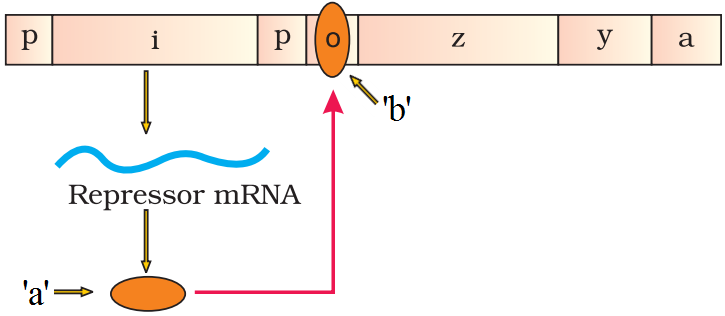
Given below is a schematic representation of a lac operon in the absence of an inducer. Identify 'a'and 'b' in it.

Answer
'a'-Repressor.
'b'-Operator.
View full question & answer
Question 1481 Mark
Why were protein discarded from being the genetic material?
Answer
Proteins are not able to replicate itself.
View full question & answer
Question 1491 Mark
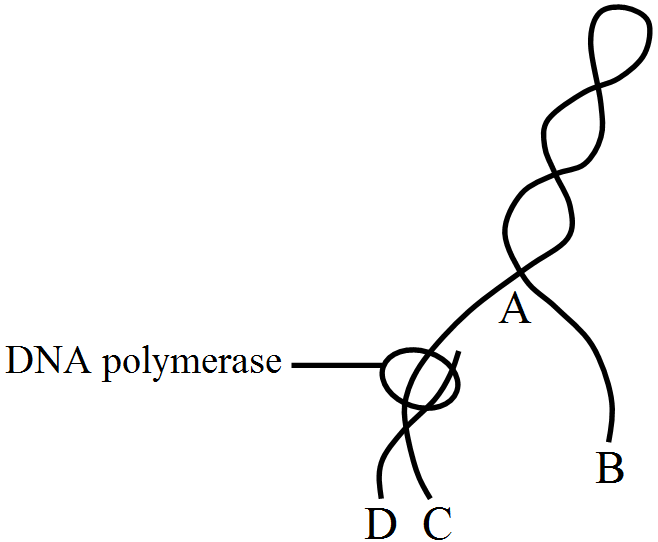
A replicating fork along with the direction (shown by arrow) of migration of DNA polymerase on the leading strand is shown in the given figure. What is the directions of the ends A, B, C and D are respectively?

Answer
A - 3'
B - 5'
C - 3'
D - 5'
View full question & answer
Question 1501 Mark
How many base pairs are present in one turn of DNA helix and what is the distance between consequent base pairs in a helix?
Answer
There are 10 base pairs in one turn and distance between consecutive bases is 0.34nm.
View full question & answer
Question 1511 Mark
Define a codon.
Answer
The triplet bases on mRNA that codes for a particular amino acid is called codon.
View full question & answer
Question 1521 Mark
What type of transcription is found in retrovirus? Name the enzyme.
Answer
In retrovirus the genetic information flows from RNA to DNA and is called reverse transcription while the enzyme involved is called reverse transcriptase.
View full question & answer
Question 1531 Mark
Write the conclusion Griffith arrived at the end of his experiment with Streptococcus pneumoniae.
Answer
Griffith concluded that the R-strain bacteria had somehow been transformed by heat-killed S-strain bacteria. This must be due to transfer of genetic material.
View full question & answer
Question 1541 Mark
 A DNA molecule in which both strands have radioactive thymidine is allowed to duplicate in an environment containing non-radioactive thymidine. What will be the correct number of DNA molecule that contain some radioactive thymidine after 3 duplications?
Answer
Two DNA molecules.
View full question & answer
Question 1551 Mark
Write the two specific codons that a translational unit of mRNA is flanked by, one on its either sides.
Answer
The start/ initiation codon (AUG) at the 5' end and the stop condon (UAA/ UAG/ UGA) at the 3' end.
View full question & answer
Question 1561 Mark
Name the largest of the known human gene and the number of bases it contains.
Answer
Dystrophin, it contains 2.4 million bases.
View full question & answer
Question 1581 Mark
Why is the enzyme DNA-polymerase called DNAdependent DNA-polymerase
Answer
Because it polymerises the nucleotides in a DNA template dependent manner.
View full question & answer
Question 1591 Mark
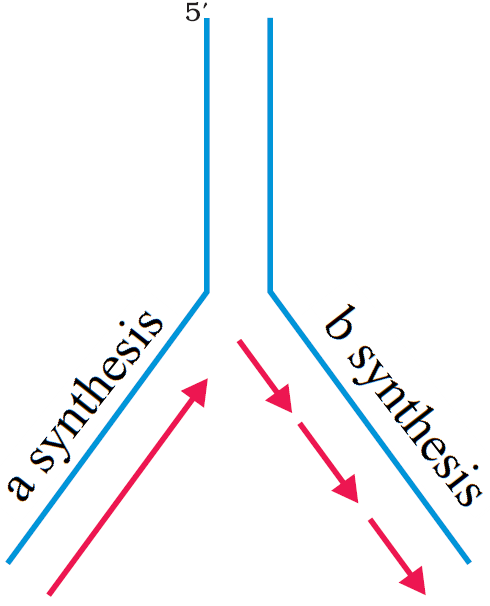
Name the types of synthesis a' and 'b' occurring in the replication fork of DNA as shown below:

Answer
'a'-Continuous synthesis.
'b'-Discontinuous synthesis.
View full question & answer
Question 1601 Mark
Name the enzyme involved in the continuous replication of DNA strand. Mention the polarity of the template strand.
Answer
(DNA dependent) DNA polymerase 3’ –> 5’.
View full question & answer
Question 1611 Mark
What is origin of replication or ori?
Answer
It is the specific point in DNA from where replication begins.
View full question & answer
Question 1631 Mark
Who discovered the nucleic acid DNA? What was it called then?
Answer
Frederich Meischer discovered DNA.
It was called nuclein.
View full question & answer
Question 1641 Mark
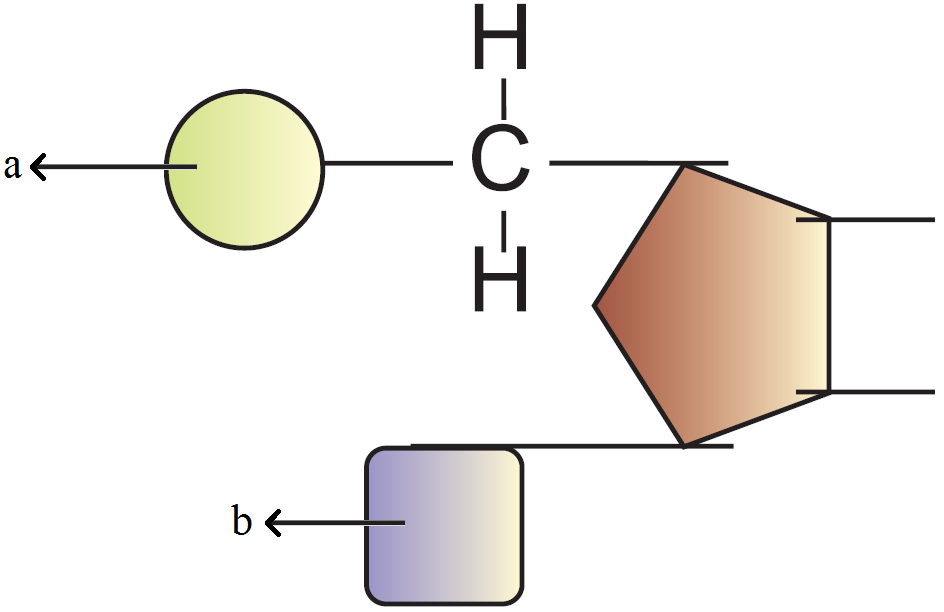
Name the components 'a' and 'b' in the nucleotide with a purine, given below:

Answer
a-Phosphate group.
b-Nitrogenous base.
View full question & answer
Question 1651 Mark
Name any three viruses which have RNA as the genetic material.
Answer
Following viruses have RNA as genetic material:
  • Ebola virus.
  • Tobacco Mosaic Virus.
  • SARS.
View full question & answer
Question 1661 Mark
The two strands of DNA have antiparallel polarity. What does it mean?
Answer
It means that one of the strands of DNA has 5' → 3' polarity and the other strand has 3' → 5' polarity.
View full question & answer
Question 1671 Mark
What are variable number tandem repeats (VNTRs)?
Answer
The short nucleotide repeat sequences in the DNA which vary in number from person to person and are inheritable are called variable number tandem reports.
View full question & answer
Question 1691 Mark
What will happen if DNA replication is not followed by cell division in a eukaryotic cell?
Answer
It will lead to polyploidy, a condition where the cell comes to possess more than two sets of chromosomes.
View full question & answer
Question 1721 Mark
Name the two basic amino acids that provide positive charges to histone proteins.
Answer
Lysine and arginine.
View full question & answer
Question 1741 Mark
The process of translation of mRNA begins, when the mRNA encounters the large subunit of ribosome.
Answer
False.
View full question & answer
Question 1781 Mark
In which direction is the new strand of DNA synthesised during DNA replication:
Answer
New strand of DNA is synthesised in 5' 3' direction.
View full question & answer
Question 1791 Mark
What do you call the kind of mutation in which a single base is added to a base strand?
Answer
Point mutation.
View full question & answer
Question 1801 Mark
Define transcription.
Answer
Transcription is the process of copying the genetic information from one of the strands of DNA into RNA.
View full question & answer
Question 1811 Mark
What is the distance between two base pairs in DNA?
Answer
The average distance between two adjacent base Å pairs is 3.4 (.34 nm).
View full question & answer
Question 1831 Mark
How is the length of DNA usually defined?
Answer
Length of DNA is defined as the:
  1. Number of nucleotides in single-stranded DNA.
  2. Number of pairs of nucleotides (base pairs) in double-stranded DNA.
View full question & answer
Question 1851 Mark
How do the tRNA molecules appear in
(i) two-dimensional, and (ii) three-dimensional views?
Answer
(i) Clover-leaf like.
(ii) Inverted L-shaped.
View full question & answer
Question 1871 Mark
Name the base triplets which code for amino acid as well as start signal for translation.
Answer
AUG and GUG.
View full question & answer
Question 1881 Mark
At which ends do 'capping' and 'tailing' of hnRNA occur, respectively?
Answer
Capping at the 5' end and tailing at the 3' end.
View full question & answer
Question 1891 Mark
Name the free-living, non-pathogenic nematode, whose genome has been sequenced.
Answer
Caenorhabditis elegans.
View full question & answer
Question 1931 Mark
Write the scientific name of the plant on which Taylor et al performed their experiments.
Answer
Vicia faba.
View full question & answer
Question 1951 Mark
Meselson and Stahl experimentally proved the ________ replication of DNA.
Answer
Meselson and Stahl experimentally proved the Semiconservative replication of DNA.
View full question & answer
Question 1971 Mark
Give an example of a human disorder that is caused due to a single gene mutation.
Answer
Sickle cell anaemia/Thalassemia/Phenyl ketonuria.
View full question & answer
Question 2011 Mark
When does DNA replication takes place in cell cycle of eukaryotes?
Answer
DNA replication takes place during s-phase of the cell cycle.
View full question & answer
Question 2021 Mark
Write the number of genes found on chromosome 1 and Y-chromosome, respectively of humans.
Answer
  1. 2968
  2. 231
View full question & answer
Question 2031 Mark
Name the specific components and the linkage between them that form deoxyadenosine.
Answer
  • Nitrogenous base (Adenine) and pentose sugar
  • N-glycosidic linkage
View full question & answer
Question 2041 Mark
How do the tRNA molecules appear in.
  1. Two-dimensional.
  2. Three-dimensional views?
Answer
  1. As a clover-leaf.
  2. As an inverted L.
View full question & answer
Question 2061 Mark
Mention the direction in which:
  1. The leading strand is synthesised.
  2. Discontinuous synthesis of DNA occurs.
Answer
  1. 5' → 3'.
  2. 5' → 3'.
View full question & answer
Question 2071 Mark
Write the conclusion Griffith arrived at, at the end of his experiments with Streptococcus pneumoniae.
Answer
  1. Griffith concluded that the R strain/ non-virulent bacteria had been transformed into virulent form by the heat-killed S strain bacteria.
  2. It must be due to transfer of a transforming principle, i.e., genetic material from the heat-killed S strain bacteria.
View full question & answer
Question 2081 Mark
Mention the number:
  1. Bases in the DNA of phage, ϕ 174.
  2. Base pairs in the DNA of phages lambda (λ).
Answer
  1. 5386 nucleotides.
  2. 48502 base pairs.
View full question & answer
Question 2091 Mark
Khorana and his colleagues synthesized an RNA molecule with repeating sequence of AG nitrogenous bases (AG AG AG AG AG AG). It produced a tetrapeptide with alternating sequence of valine and tyrosine. It proves that codon for valine and tyrosine are?
Answer
 Codon for valine - AGA

Codon for tyrosine - GAG

View full question & answer
Question 2111 Mark
Mention two functions of the codon AUG.
Answer
  1.  It codes for methionine amino acid
  2. It acts as initiator codon for protein synthesis
View full question & answer
Question 2121 Mark
What formed the basis for assigning the genetic and physical maps on the human genome?
Answer
  1. Information on polymorphism of restriction endonuclease recognition sites.
  2. Some repetitive DNA sequences, called microsatellites.
View full question & answer
Question 2141 Mark
In which position is the phosphate group linked to a nucleoside? Name the linkage too.
Answer
  1. A phosphate group is linked to the 5-OH of a nucleoside.
  2. Phosphoester linkage.
View full question & answer
Question 2151 Mark
A region of a coding DNA strand has the following nucleotide sequence: –A T G C–
What shall be the nucleotide sequence in:
  1. sister DNA segment it replicates, and
  2. M-RNA polynucleotide it transcribes?
Answer
  1. -TACG-
  2. -AUGC-
View full question & answer
Question 2161 Mark
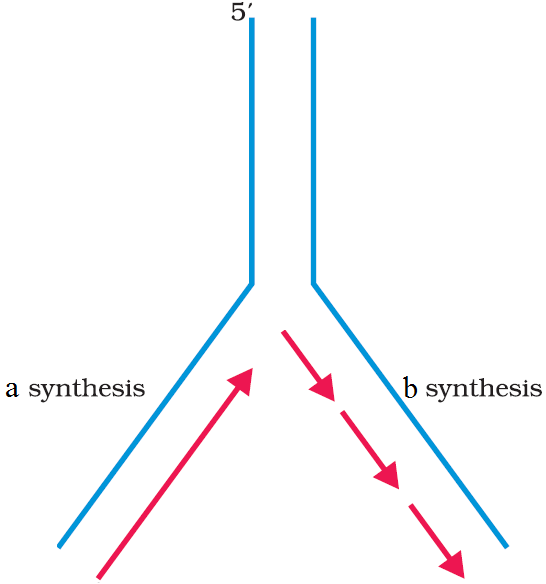
Name the types of synthesis 'a' and 'b' occurring in the replicating fork of DNA as shown below:
Answer

'a' - synthesis of leading/continuous strand.

'b' - synthesis of lagging/discontinuous strand.

View full question & answer
Question 2171 Mark
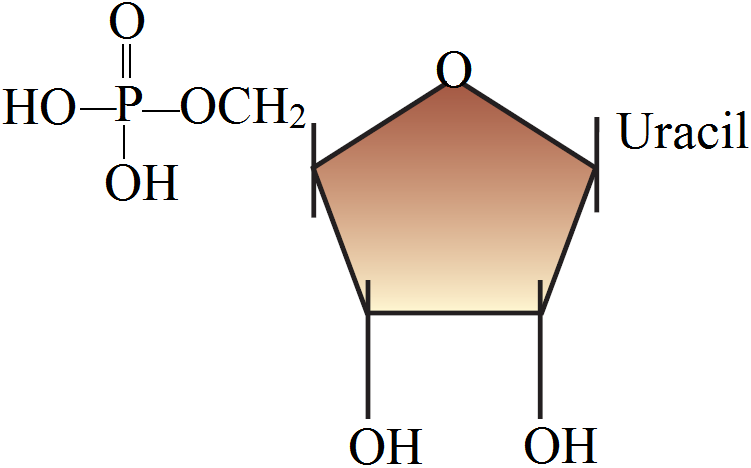
Mention the carbon positions to which the nitrogenous base and the phosphate molecule are respectively linked in the nucleotide given below:

Answer
  1. Nitrogenous base at the first carbon.
  2. Phosphate at the fifth carbon.
View full question & answer
Question 2181 Mark
Why is it that transcription and translation can be coupled in prokaryotic cells but not in eukaryotic cells?
Answer
  1. In prokaryotes, the mRNA does not require any processing to become active.
  2. Transcription and translation occur in the same compartment-cytosol, as there is no well-defined nucleus.
  3. So coupling of transcription and translation is possible.
  4. The mRNA has to be processed before becoming active (splicing is necessary).
  5. Since nucleus and cytoplasm are well separated, in eukaryotes the RNA has to be transported to the cytoplasm for translation.
  6. So coupling of transcription and translation is not possible.
View full question & answer
Question 2201 Mark
State the properties of DNA replication model.
Answer
DNA replication is:
  1. Semi-conservative.
  2. Semi-discontinuous.
  3. Unidirectional.
View full question & answer
Question 2211 Mark
Name the enzyme and the direction in which it catalyses the polymerisation of ribonucleotides.
Answer
  1. DNA-dependent, RNA-polymerase.
  2. 5' → 3' direction.
View full question & answer
Question 2221 Mark
Mention any two ways in which single nucleotide polymorphism (SNPs) identified in human genome, can bring out revolutionary changes in biological and medical sciences?
Answer
  1. By finding chromosomal locations for disease associated sequences.
  2. By tracing human history.
View full question & answer