Questions

1.5 Marks Questions

Take a timed test

18 questions · self-marked practice — reveal the answer and mark yourself.

Question 12 Marks
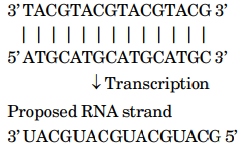
Given below is one of the strands of a DNA segment
3' TACGTACGTAACGTACG 5'
(a) Write its complementary strand.
(b) Write a possible RNA strand that can be transcribed from the above DNA molecule formed.
Answer
(a) 5' ATGCATGCATGCATGC 3'
(b)Image
View full question & answer
Question 22 Marks
What are the goals of Human Genome Project?
Answer
(i) To map all human genes precisely to their respective positions on chromosomes and to itentify their DNA sequence.
(ii) To store this information in databases and develop tools for data analysis.
(iii) to solve the Ethical, Legal and Social Issues (ELSI) that may arise from the project.
View full question & answer
Question 32 Marks
Give name and functional different type of RNAs.###Name the different types of RNAs.
Answer
The three RNAs involved in protein synthesis are summarized here :
(i) mRNA (messenger RNA) : Produced during transcription. Carries the genetic instructions of a gene from the nucleus to the ribosome in the cytoplasm.
(ii) rRNA (ribosomal RNA) : Together with proteins, composes the ribosome, the organelles that are the site of protein synthesis.
(iii) tRNA (transfer RNA) : Bring the correct amino acid to the ribosome during translation.
View full question & answer
Question 42 Marks
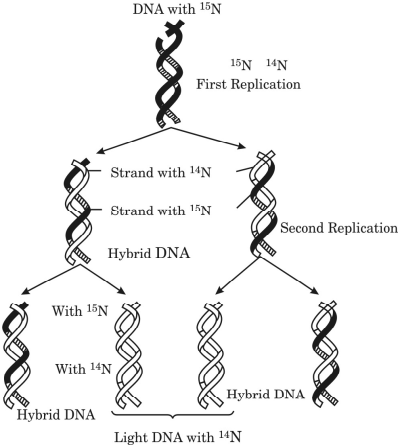
Explain the meselson stahle experiment.
Answer

Image
Messelson and Stahl (1958) grew the bacterium Escherichia coli in a medium containing nitrogen salts with stable isotope ${ }^{15} N$. ${ }^{15} N$ got incorporated into both strands of DNA and this DNA was heavier as compared to the DNA obtained from E. coli grown in ${ }^{14} N$ medium. The heavier DNA could be separated by centrifugation. Messelson and Stahl obtained E. coli cells grown in ${ }^{15} N$ and transferred them to a medium containing ${ }^{14} N$. After one generation, when bacterial cell had multiplied into two, they isolated the DNA and evaluated its density which was found to be intermediate between that of the heavier ${ }^{15} N$ DNA and lighter ${ }^{14} N$ DNA. Clearly, this was because during one generation, new DNA molecules with ${ }^{15} N$ old strand and a complementary ${ }^{14} N$ new strand were formed (having intermediate density). It proved that DNA replication is semiconservative.
View full question & answer
Question 52 Marks
Describe transcription is short.
Answer
Transcription is the process by which the information in a strand of DNA is copied into a new molecule of messenger RNA (mRNA). DNA safely and stably stores genetic material in the nuclei of cells as a reference, or template. Mean while, mRNA is comparable to a copy from a reference book because it carries the same information as DNA but is not used for long - term storage and can freely exit the nucleus. Although the mRNA contains the same information, it is not an identical copy of the DNA segment, because its sequence is complementary to the DNA template.
Transcription is carried out by an enzyme called RNA polymerase and a number of accessory proteins called transcription factors. Transcription factors can bind to specific DNA sequences called enhancer and promoter sequences in order to recruit RNA polymerase to an appropriate transcription site. Together, the transcription factors and RNA polymerase form a complex called the transcription initiation complex. This complex initiates transcription, and the RNA polymerase begins mRNA synthesis by matching complementary bases to the original DNA strand. The mRNA molecule is elongated and, once the strand is completely synthesized, transcription is terminated. The newly formed mRNA copies of the gene then serve as blueprints for protein synthesis during the process of translation.
View full question & answer
Question 62 Marks
Describe initiation and termination codons.
Answer
Out of 64 codons, one initiation codon is AUG and three ending codons are UAA, UAG and UGA. These codons corresponds to the start and end of the polypeptide chain, respectively.
View full question & answer
Question 72 Marks
Differentiate between Heterochromatin and Euchromatin.
Answer
Important difference between Heterochromatin and Euchromatin
 HeterochromatinEuchromatin
1.It is a form of DNA in the chromosome that has the characterization of tight packingIt is a form of DNA in the chromosome that has the characterization of loose packing
2.Dark stainLight stain
3.High density of DNALow density of DNA
4.Little or no transcriptional activity here.There is the active participation of the transcriptional process here
5.They exist at the periphery of the nucleus. Furthermore, they exist only in eukaryotic cells.They exist in the nucleus's inner body. Furthermore, they exist in eukaryotic as well as prokaryotic cells.
6.Coiling is compact, regions are sticky, there is no change in the phenotype of an organism, gene expression regulation is possible, and maintenance of the cell's structural integrity.Coiling is loose, regions are non -sticky, variation may occur due to the effect in DNA at the time of the genetic process, genetic variations are possible and genetic transcription takes place.
View full question & answer
Question 82 Marks
Give names of two enzymes of DNA replication and write one specific function of each of them.
Answer
(i) Polymerase - I : It is the enzyme that carries in the daughter nucleotides and DNA helicase is the one that unwinds the double helix to the replication.
(ii) Polymerase - II : It is specialized repair enzyme. Like Pol I, a large number of Pol II, molecules reside in the cell (about 100). The enzyme is more processive than Pol I.
View full question & answer
Question 92 Marks
Describe two main characteristics of DNA double stranded structure.
Answer
(1) The DNA model has double helical polynucleotide chains or strands which are spirally coiled clock-wise around a common central axis. The thickness of the right handed double helix is about 2 nm (20 Å).
(2) The DNA molecule assumes the shape of a spiral staircase because the nitrogenous bases of successive nucleotide monomers of opposite strands face each other and are joined by hydrogen bonds. The alternating sugar and phosphate molecules of the two strands remain towards the outsides like the long side bars or railings of a staircase. On the other hand, H-bonded bases of opposite strands form the horizontal steps (cross bars) at right angles to central axis. In this way, the two strands cannot be separated easily without completely unwinding them. This type of co coiling is called plectonic.
View full question & answer
Question 102 Marks
Give difference between Nucleotide and Nucleoside.
Answer
Difference between Nucleotide and Nucleoside :
NucleotidesNucleosides
1. The chemical composition of nucleotide consists of a phosphate group, a sugar and a nitrogenous base.A nucleoside has a chemical composition that consists of a sugar and a base without the phosphate group.
2. They are one of the major causes of cancer causing agents to this very day.They are used as agents in medicine that are primarily used against viruses and cancer causing agents.
3. Some of the major examples of nucleotides are adenosine, guanosine etc.Some of the key examples of nucleosides are the same as nucleotides only with the addition of phosphate groups.
View full question & answer
Question 112 Marks
What do you understand by southern blotting technique?
Answer
Southern blotting is a laboratory technique used to detect a specific DNA sequence in a blood or tissue sample. A restriction enzyme is used to cut a sample of DNA into fragments that are separated using gel electrophoresis. The DNA fragments are transferred out of the gel to the surface of a membrane.
View full question & answer
Question 122 Marks
Differentiate between DNA and RNA.
Answer
Differences between DNA and RNA :
DNARNA
1. It usually occurs inside nucleus and some cell organelles.Very little RNA occur inside nucleus. Most of it is found in the cytoplasm.
2. It is a genetic material.It is not the genetic material except in certain viruses. e.g., Rheovirus.
3. It has deoxyribose sugar.It has ribose sugar.
4. It is usually double stranded except in certain viruses e.g., $\phi \times 174$.It is single stranded except in certain viruses e.g. Rheovirus.
5. It has thymine as one of the nitrogenous bases.Thymine is replaced by uracil in RNA.
6. DNA contains over a million nucleotides.Depending upon the type, RNA contains 7012000 nucleotides.
7. It replicates to form new DNA molecule.It normally cannot replicate itself.
8. DNA transcribe genetic information to RNA.It translates the transcribed message for formating polypeptide.
9. Renaturation after melting is slow.Renaturation after. melting is quite fast.
10. Its quantity is fixed for cell.The quantity of RNA of a cell is variable.
11. Purine and pyrimidine bases are in equal number.Purine and pyrimidine number are not in equal proportion.
12. DNA is fuelgen positive.RNA is fuelgen negative.
 
View full question & answer
Question 132 Marks
Answer
(a) (Codon) X, is AUG.
Codon Y may be UAA, UAG or UGA.
(b) The code AUG is the initiation input. It codes for the amino acid methiomine. UAA, UAG, UGA are closing signal. They do not code any amino acid.
(c) The other codons of $m$-RNA are UAC, CGU, UUU and AGA. They codes amino acids tryosin, arginine, phenyl aniline and arginine respectively.
(d) The bonds between first amino acid and t-RNA breaks down during the peptide formation. The carboxyl group of this acid forms a peptide bond between the $- NH _2$ of the other amino acid. Hence, the secondary t-RNA carries dipeptide.
View full question & answer
Question 142 Marks
What is the category virus that carries the enzyme reverse transcriptase? What is the purpose of this enzyme?
Answer
Virus carrying reverse transcriptase enzyme is retrovirus. That enzyme catalyzes the formation of DNA from RNA. This process is called reverse transcriptase. The DNA formed in this way takes over the DNA of the host cell.
View full question & answer
Question 152 Marks
Mention four salient features of genetic code.
Answer
The salient feature of genetic code are as follows :
(i) The codon is a triplet. 61 codons code for 20 amino acids and 3 codons do not code for any amino acids, hence they function as stop codons.
(ii) One codon codes for only one amino acid, hence, it is unambiguous and specific.
(iii) The code is degenerate because some amino acids are coded by more than one codon.
(iv) The codon is read in mRNA in a contiguous fashion. There are no punctuations.
View full question & answer
Question 162 Marks
Write the transcribed RNAs from DNA strand with base sequences :
(a) TAG TAC АСТ,
(b) GAT CAT АСТ,
(c) TAC AGT ATT
What is the name and specific function of the last codon in $m$-RNA?
Answer
(a) DNA : TAG TAC ACT (Transcribed), $m$-RNA AUG AUG UGA
(b) DNA : Base sequence GAT CAT ATC (Transcribed) $m$-RNA CUA GUA UAG
(c) DNA : Base sequence TAC AGT ATT Transcribed $m$-RNA AUG UCA UAA
UGA, UAG and UAA are termination code, they stop the chain of $m$-RNA formation meaning stops protein synthesis. UGA is called opal, UAG is called Amber and UAA is known as Ochre.
View full question & answer
Question 172 Marks
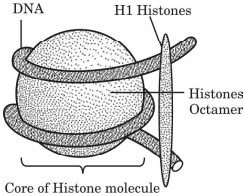
(a) Draw the well labelled diagram of nucleosome.
(b) Mention what enables histones to acquire a positive charge?
Answer
(a) Structure of nucleosome
Image
(b) Histone is like a spool which needs to wind the DNA around. DNA is negatively charged and so, histone has to be positively charged for good interaction between DNA and histone. They have a highly positive charged N - terminus with many lysine and arginine residues (which are positively charged amino acids).
View full question & answer
Question 182 Marks
What are Role of the three parts of the transcription unit?
Answer
The process of transcription completed in following steps :
(i) The enzyme RNA polymerase binds itself to a site on DNA molecule. This is called promoter site.
(ii) As RNA polymerase moves over the DNA molecule, DNA gets uncoiled and its one strand gerves as template for the synthesis of m - RNA.
(iii) At point called termination point RNA polymerase seperates from DNA and the synthesis of m - RNA steps.
View full question & answer