Questions

1.5 Marks Questions

Take a timed test

104 questions · self-marked practice — reveal the answer and mark yourself.

Question 12 Marks
Distinguish between the following:
Hibernation and Aestivation
Answer
  Hibernatioa Aeslivation
1. It is a sleep like state in which some animals pass the winter months as a way of surviving food scarcity and cold weather. It is a state of inactivity occurring in some animals, such as lungfish, during prolonged periods of drought or heat.
2. Animals that hibernate include bats, hedgehogs, many fishes and amphibians and reptiles. Various bodily activities, such as feeding, respiration, movement, are slowed down considerably.
View full question & answer
Question 22 Marks
Distinguish between the following:
Ectotherms and Endotherms
Answer
  Ectotherms Endotherms
1. Ectotherm are those animals that does not have the ability to produce sufficient internal metabolic heat to maintain a constant body temperature. Endotherms are animals which can generate and maintain heat within its body independently of the environmental temperature.
2. All animals except mammals and birds are ectotherms, and are often described as being cold-blooded animals. Mammals and birds are endotherms and are often described as homoiotherms or  warm-blooded animals.
View full question & answer
Question 32 Marks
What is the ecological principle behind the biological control method of managing with pest insects?
Answer
The basis of various biological control methods is on the concept of predation. Predation is a biological interaction between the predator and the prey, whereby the predator feeds on the prey. Hence, the predators regulate the population of preys in a habitat, thereby helping in the management of pest insects.
View full question & answer
Question 42 Marks
Name important defence mechanisms in plants against herbivory.
Answer
There are various defence measures for animals against predators. But plants, as they cannot move away, have certain defence mechanisms against herbivory. Their main defences are chemical toxins, such as strychnine, a poison produced by tropical vine, morphine by opium poppy, nicotine produced by tobacco plant. Apart from these chemicals, the common defence measure is presence of spines (modified leaves) on the leaves, stems of the plant, modifications of leaves into thorns, development of sharp silicated edges in leaves which prevent them against damage caused by herbivores.
View full question & answer
Question 52 Marks
Define population and community.
Answer
Population:
A population can be defined as a group of individuals of the same species residing in a particular geographical area at a particular time and functioning as a unit. For example, all human beings living at a particular place at a particular time constitute the population of humans.
Community:
A community is defined as a group of individuals of different species, living within a certain geographical area. Such individuals can be similar or dissimilar, but cannot reproduce with the members of other species.
View full question & answer
Question 62 Marks
Define phenotypic adaptation. Give one example.
Answer
Phenotypic adaptation involves changes in the body of an organism in response to genetic mutation or certain environmental changes. These responsive adjustments occur in an organism in order to cope with environmental conditions present in their natural habitats. For example, desert plants have thick cuticles and sunken stomata on the surface of their leaves to prevent transpiration. Similarly, elephants have long ears that act as thermoregulators.
View full question & answer
Question 72 Marks
An orchid plant is growing on the branch of mango tree. How do you describe this interaction between the orchid and the mango tree?
Answer
An orchid growing on the branch of a mango tree is an epiphyte. Epiphytes are plants growing on other plants which however, do not derive nutrition from them. Therefore, the relationship between a mango tree and an orchid is an example of commensalisms, where one species gets benefited while the other remains unaffected.Here, the orchid is benefited as it gets support while the mango tree remains unaffected.
View full question & answer
Question 82 Marks
Most living organisms cannot survive at temperature above 45ºC. How are some microbes able to live in habitats with temperatures exceeding 100ºC?
Answer
Micro-organisms of hot. Springs and vents (mouth of sea bed volcanoes) are able to survive at the high temperature due to
  1. Occurrence of branched chain lipids in their cell membrane that reduce fluidity of cell membranes.
  2. Having minimum amount of free water in their bodies. Removal of water provides resistance to high temperature.
View full question & answer
Question 92 Marks
If a marine fish is placed in a fresh water aquarium, will the fish be able to survive? Why or why not?
Answer
If a marine fish is placed in a fresh water aquarium, then its chances of survival will be reduced. This is because their bodies are habituated to high salt concentrations of the marine environment. In fresh water conditions, they are unable to regulate the water entering their body (through osmosis). Water enters their body due to the hypotonic environment outside. This results in the swelling up of the body, leading to the death of the marine fish.
View full question & answer
Question 112 Marks
What is mutualism? Mention any two examples where the organisms involved are commercially exploited in agriculture.
Answer
Interaction between two species in which both are benefitted.
  1. Rhizobium in the roots (nodules) of legumes.
  2. Mycorrhiza/Glomus with the roots of higher plants.
View full question & answer
Question 122 Marks
Describe the mutual relationship between fig. tree and wasp and comment on the phenomenon that operates in their relationship.
Answer
Wasp - Helps in pollination/pollinator (specific). Oviposition/seeds and ovules used for nourishing larva.
Co-evolution exists between their close specific tight relationship.
View full question & answer
Question 132 Marks
Name the interaction in each of the following:
  1. Cuscuta growing on a shoe flower plant.
  2. Mycorrhizae living on the roots of higher plants.
  3. Clownfish living among the tentacles of sea anemone.
  4. Koel laying her eggs in crow’s nest.
Answer
  1. Parasitism.
  2. Mutualism.
  3. Commensalism.
  4. Brood parasitism.
View full question & answer
Question 142 Marks
What is quarantine? Why is quarantine essential before introducing a plant species from another country?
Answer
Quarantine: Careful examination of all introduction of plants for the presence of weeds insects and disease causing organisms Reduces risk of entry of plant pathogens/insects/weeds in the country.
View full question & answer
Question 152 Marks
Plants that inhabit a rain-forest are not found in a wetland. Explain
Answer
Plants that inhabit a rain forest are not adapted to survive in aquatic conditions/wetlands.
Plants are conformers/stenothermal/cannot maintain constant internal environment/temperature/osmotic concentration of the body fluids affects kinetics of enzymes through basal metabolism/activity and other physiological functions of the organisms.
View full question & answer
Question 162 Marks
Many freshwater animals can not survive in marine environment. Explain.
Answer
High salt concentration outside/hypertonic surroundings.
Loss of water from body/exosmosis from animal body/animal suffers osmotic problems.
View full question & answer
Question 172 Marks
Apart from being part of the food chain, predators play other important roles. Mention any two such roles supported by examples.
Answer
  • Keeps prey population under control.
  • Biological control methods.
  • Maintains species diversity.
  • Reduces intensity of competition among prey species.
View full question & answer
Question 192 Marks
Some organisms suspend their metabolic activities to survive in unfavourable conditions. Explain with the help of any four examples.
Answer
Any four examples with their relevant conditions under which they suspend their metabolic activities such as polar bear-hibernation/during winter.
Snails/fishes-aestivation/during summer, some species of zooplankton-diapause, Seeds of higher plants/spores of bacteria/fungi-dormancy/Cyst formation as in case of amoeba.
View full question & answer
Question 202 Marks
Why do clownfish and sea anemone pair up? What is this relationship called?
Answer
Clown fish gets protection from its predators by moving around the stinging tentacles of the sea anemone. The sea anemone is neither helped or harmed by the interaction with the fish Commensalism.
View full question & answer
Question 212 Marks
How does the floral pattern of Mediterranean orchid Ophrys guarantee cross pollination?
Answer
One petal of Ophrys resembles the female of a bee, male bees are attracted to it/perceives it as female, pseudocopulates, same male bee pseudocopulates with another flower of Ophrys and pollination is completed.
View full question & answer
Question 222 Marks
Name the interaction in each of the following:-
  1. Cuckoo lays her eggs in the crow’s nest.
  2. Orchid grows on a mango tree.
  3. Ticks live on the skin of dogs.
  4. Sea anemone is often found on the shell of hermit crab.
Answer
  1. Brood parasitism.
  2. Commensalism.
  3. Parasitism.
  4. Mutualism.
View full question & answer
Question 232 Marks
What does S-shaped pattern of population growth represent? How is J-shaped pattern different from it and why?
Answer
S-shaped growth curve: There is initial gradual increase in population size followed by an exponential increase and then a gradual decline to a near-constant level.

J-shaped growth curve: The population grows exponentially, and after attaining the peak value the population abruptly crash, Due to environmental resistance/environment is ever changing/food and space are limited/end of season.

View full question & answer
Question 242 Marks
What is meant by total fertility rate? How does it differ from replacement level?
Answer
TFR (Total Fertility Rate): Average number of children that would be born to a woman during her lifetime.

Whereas replacement level (RL) is the number of children a couple must produce to replace themselves in a population.

View full question & answer
Question 252 Marks
Substantiate with the help of one example that in an ecosystem mutualists:
  1. Tend to co-evolve.
  2. Are also one of the major causes of biodiversity loss.
Answer
Mutualists are pairs of organism that benefit from the interactions between them.
  1. Mutualism between a flower and its pollinator follows co-evolution as the interaction should be safe from "cheating". A Fig species is pollinated by a particular species of wasp. While the wasp uses the fruit for oviposition and source of nourishment for its larvae, the fig is pollinated by the wasp.
  2. Since both the participants in the mutualism are linked, a change, anthropogenic or otherwise, affecting one species will consequently also reduce the population of the other species. Plant-Pollinator interaction is an example of the same. Extinction of the pollinator will reduce the diversity of plant species which is dependent on it. Reduction in bees population is posing a threat to the diversity of crops.
View full question & answer
Question 262 Marks
Write any three characteristics of a population
Answer
The three major characteristics (attributes) of a population are:
Birth Rate (Natality): It refers to the average number of new individuals added to the population through reproduction per unit of time.
Death Rate (Mortality): It refers to the average number of individuals dying in a population during a given period.
Sex Ratio: Instead of being an individual characteristic (male or female), a population has a sex ratio. It is the ratio of the number of males to females in a population (e.g., 55% females and 45% males).
Age Distribution: A population at any given time is composed of individuals of different ages. If the age distribution is plotted for the population, the resulting structure is called an Age Pyramid.
View full question & answer
Question 272 Marks
Explain the defence mechanisms evolved in preys to avoid overpopulation of their predators.
Answer
  1. Certain insect species and frogs have camouflage (cryptic colouration) to avoid detection by their predators
  2. Some animals are highly distasteful to their predators, e.g. monarch butterfly accumulates a chemical by feeding on a poisonous weed during its caterpillar stage.
  3. Some prey are poisonous and hence are avoided by predators.
  4. Plants have developed thorns and spines as defence mechanism against browsing animals.
  5. Some plants produce certain chemicals which affect the metabolism of the herbivores.
View full question & answer
Question 282 Marks
The density of a population in a habitat per unit area is measured in different units. Write the unit of measurement against the following:
  1. Bacteria.
  2. Grass.
  3. Banyan.
  4. Deer.
  5. Fish.
Answer
  1. Numbers/ volume.
  2. Coverage/ area.
  3. Biomass/ area.
  4. Numbers/ area.
  5. Weight/ area.
View full question & answer
Question 292 Marks
Name the four levels of organisation that ecology is basically concerned with.
Answer
  1. Organisms.
  2. Populations.
  3. Communities.
  4. Biomes.
View full question & answer
Question 302 Marks
How are stenohaline animals different from euryhaline animals?
Answer
Stenohaline animals
Euryhaline animals
These are the animals, which show tolerance only to a narrow range wider range of salinities.
These are the animals, which can tolerate a wider range of salinities.
Their distributional range is limited.
Their distribution shows a wide range.
View full question & answer
Question 312 Marks
List any four characters that are employed in human population census.
Answer
  1. Birthrates.
  2. Death rates.
  3. Sex ratio.
  4. Age distribution.
View full question & answer
Question 322 Marks
Differentiate between immigration and emigration.
Answer
 
Immigration
 
Emigration
1
Immigration refers to the number of individuals aiming into a population from elsewhere during a given period of time.
1
Emigration refers to the number of individuals going out of a population to elsewhere during a given period of time.
2
It leads to an increase in population density.
2
It leads to a decrease in population density.
View full question & answer
Question 332 Marks
List any four parasitic adaptations in a parasite.

OR

List any four features evolved in animals to adapt to their parasitic mode of life.

Answer
  1. Loss of unnecessary sense organs.
  2. Presence of hooks/ adhesive organs and suckers.
  3. Loss of digestive system.
  4. High reproductive capacity
View full question & answer
Question 342 Marks
Differentiate between predators and parasites.
Answer
  Predators   Parasites
1 They are the larger animals which kill and consume the smaller animal (prey). 1 These are the smaller organisms (than the host) and do not kill or consume the host.
2 They are highly mobile. 2 They are less mobile or non-mobile.
3 Their reproductive capacity is low. 3 Their reproductive capacity is high.
4 They do not live on/ inside the body of the Prey. 4 They live on/inside the body of the host.
View full question & answer
Question 352 Marks
In a sea shore, the benthic animals live in sandy, muddy and rocky substrata and accordingly developed the following adaptations. Find the suitable substratum against each adaptation.
  1. Burrowing ______________________.
  2. Building cubes ________________________.
  3. Holdfasts/ peduncle _________________________.
Answer
  1. Burrowing Sandy.
  2. Building cubes Muddy.
  3. Holdfasts/ peduncle Rocky.
View full question & answer
Question 362 Marks
Differentiate between population size and population density.
Answer
Population size
Population density
Population size refers to the number of individuals of a species in a given area at a given time.
Population density Refers to the number of individuals of a species per unit area at a given time.
View full question & answer
Question 372 Marks
How is predation different from competition?
Answer
Predetion
Competition
It is an interspecific interaction where one animal. called predator, kills and consumes the other animal. called prey.
It is the type of interaction € ither among the individuals of the same species or of different sPecies, which compete for food or shelter.
One is benefitted and the other is harmed.
Both the partners are affectrd.
View full question & answer
Question 382 Marks
How do plants tide over stressful environmental conditions?
Answer
  1. Plants have seeds and other vegetative propagules that remain dormant and tide over the unfavourable conditions.
  2. Plants shed all their leaves during severe winter.
View full question & answer
Question 392 Marks
Shark is eurythermal, while polar bear is stenothermal. What is the advantage the former has and what is the constraint the latter has?
Answer
  • Shark is eurythermal because it can tolerate and thrive in a wide range of temperatures.
  • Polar bear is stenothermal as it can tolerate and thrive only in a narrow range of temperatures.
  • The thermal tolerance determines the geographical distribution of organisms; hence shark can live in a wide variety of places but the polar bear is restricted only to a narrow range (polar regions or ice-capped mountains), beyond which it cannot survive.
View full question & answer
Question 402 Marks
How do desert lizards cope with temperature variations in their environment? Explain.
Answer
  • Desert lizards cope with the temperature variations in their habitat by behavioural means.
  • They bask in the sun and absorb heat when their body temperature drops below the comfort zone.
  • They move into the shade when the temperature starts increasing.
View full question & answer
Question 412 Marks
Name the four levels of group organization of living things in order of increasing size.
Answer
  1. Population.
  2. Community.
  3. Ecosystem.
  4. Biosphere.
View full question & answer
Question 422 Marks
Mention the adaptations the kangaroo rat in North American deserts has, to survive in the absence of an external source of water.
Answer
  1. It is capable of meeting all its water requirements through its internal oxidation of fat in which water is a by product.
  2. It can concentrate its urine, so that only minimal volume of water is removed during excretion of wastes.
View full question & answer
Question 432 Marks
Give the scientific names of any two microorganisms inhabiting the human intestine.
Answer
  1. Escherichia coli.
  2. Enterococcus faecalis.
View full question & answer
Question 442 Marks
Koel is clever enough to lay eggs in Crow's nest. Write the reason for this peculiar behaviour. Name the type of interaction.
Answer
  1. The eggs of koel have evolved to resemble the eggs of host bird in colour and size, to reduce chances of the host bird detecting the foreign egg and throwing them out.
  2. This type of interaction is called brood parasitism.
View full question & answer
Question 452 Marks
Mention the characteristics found in endoparasites.
Answer
Characteristics of endoparasites:
  1. Loss of unnecessary sense organs.
  2. Presence of adhesive organs like hooks and suckers.
  3. Loss of digestive system.
  4. Mechanism to counteract and neutralise the digestive juices.
View full question & answer
Question 462 Marks
Niche is a part of habitat'. Explain with the help of an example.
Answer
  1. Niche of an organism represents the defined range of conditions that it can tolerate, the diversity in the resources it utilises and the distinct functional role it plays in the ecological system.
  2. The green plants/ algae are not found in very deep waters, as they need light for photosynthesis, they are the producers of the ecosystem.
View full question & answer
Question 472 Marks
How is commensalism different from predation, though one of the partners is benefitted in each of them?
Answer
 
Commensalism
 
Predation
1
It is an interspecific interaction in which one of the species is benefitted and the other is neither benefitted and harmed.
1
It is an interspecific interaction in which the large animal, called predator, kills and consumes the smaller animal, called prey.
2
No species is harmed.
2
One species is harmed.
3
It is not a conduit for energy transfer
3
It is a conduit for energy transfer.
View full question & answer
Question 482 Marks
Define heliophytes and sciophytes. Name a plant from your locality that is either heliophyte or sciophyte.
Answer
  • Heliophytes also called sun-loving plants, are those that require for their optimum growth full exposure to the sun. E.g., Mango.
  • Sciophytes also called shade-loving plants, are those plants that require reduced light intensity. E.g., Lycopodium.
View full question & answer
Question 492 Marks
Lianas are vascular plants rooted in the ground and maintain erectness of their stem by making use of other trees for support. They do not maintain direct relation with those trees. Discuss the type of association the lianas have with the trees.
Answer
Lianas are in competition with other trees. While taking support from other trees, lianas usually strangulate the other tree. They also compete for sunlight and water and in the process, harm the host tree.
View full question & answer
Question 502 Marks
What is brood parasitism? Explain with the help of an example.
Answer
In this type of parasitism, a bird lays its eggs in the nest of another bird. The eggs resemble those of the host bird. The host bird incubates the eggs; unaware of its actual identity. This is seen in koyal (cuckoo) which lays its eggs in a crow’s nest.
View full question & answer
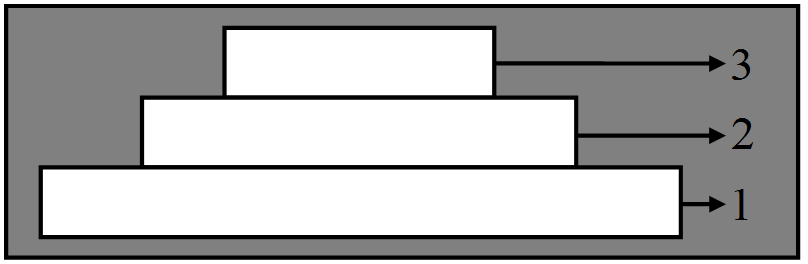
Question 512 Marks

  1. Label the three tiers 1, 2, 3 given in the above age pyramid.
  2. What type of population growth is represented by the above age pyramid?
Answer
  1.  
  1. Represents Pre-reproductive age group.
  2. Represents Reproductive age group.
  3. Represents Post-reproductive age group.
  1. Expanding population.
View full question & answer
Question 522 Marks
What is a tree line?
Answer
When we go up the altitude, beyond a particular height no trees are found and the vegetation comprises only of shrubs and herbs. The altitude beyond which no tree is seen is known as tree line.
View full question & answer
Question 532 Marks
  1. What is 'r' in the population equation given below:

$\frac{\text{dN}}{\text{dt}}=\text{rN}$

  1. How does the increase and the decrease in the value of 'r' affect the population size?
Answer
  1. 'r' is intrinsic rate of natural increase.
  2. With increase in 'r' the population size increases while a decrease in 'r' decreases the ponulation size.
View full question & answer
Question 542 Marks
In an association of two animal species, one is a termite which feeds on wood and the other is a protozoan Trichonympha present in the gut of the termite. What type of association they establish?
Answer
Termite and Trichonympha show mutualism; a relationship in which both the organisms are benefited from each other. Trichonympha breaks down cellulose in the wood and thus help the termite in digestion of wood. Trichonympha also feeds on fragments of wood.
View full question & answer
Question 552 Marks
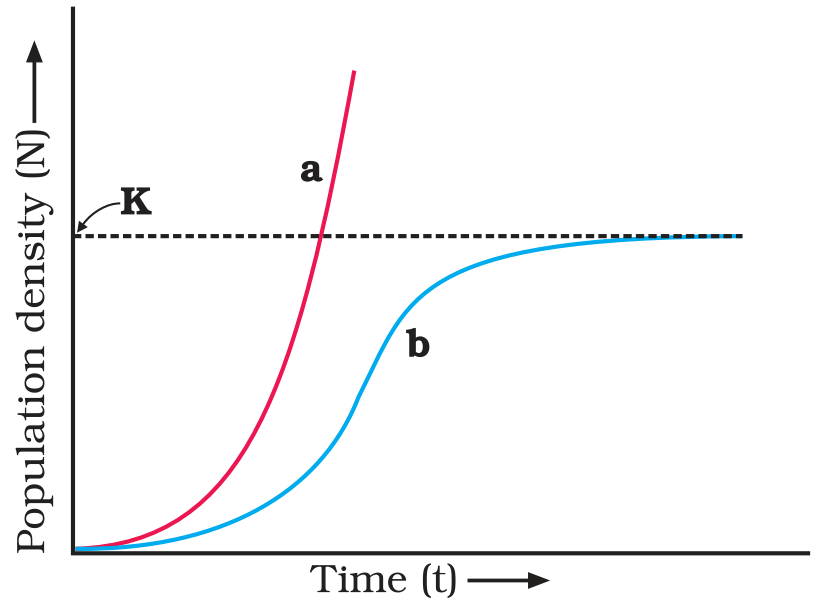
A population of 100 spotted deer was living without any carnivores in an enclosure of a few hectares of rich tropical forest land. Deer census was taken after a few years. Now study the graph given below and answer the questions that follow:

  1. Identify the curve that represents the deer population.
  2. Is it a realistic one? Justify.
Answer
  1. Curve 'a'
  2. It is not realistic as resources become limiting sooner or later.
View full question & answer
Question 562 Marks
Why are coral reefs not found from West Bengal to Andhra Pradesh but found in Tamil Nadu on the east coast of India?
Answer
High salinity, optimal temperature and less siltation are essential to colonise corals. If siltation and fresh water inflow are very high, the corals don’t colonise. In contrast when the siltation and fresh water in flow by the rivers are very less, the corals do colonise.
View full question & answer
Question 572 Marks
Write the normal body temperature of humans. How is it maintained during summers?
Answer
It is 37°C or 98.4°F.
  • During summer, when the outside temperature is higher than our body temperature, we sweat profusely.
  • The evaporation of sweat causes a cooling to maintain the body temperature.
View full question & answer
Question 582 Marks
Why do submerged plants receive weaker illumination than exposed floating plants in a lake?
Answer
Most of the colours from the visible spectrum fail to reach deep into a water body. This happens because of refraction of light through different layers of water. Due to this, floating plants get plenty of sunlight but submerged plants get weaker illumination.
View full question & answer
Question 592 Marks
What is meant by sex ratio? Is it a characteristic of an individual or a population?
Answer
Sex ratio An individual is either a male or a female but a population has sex ratio. It is the number of females and males per 1000 individuals of a population in a given time.
View full question & answer
Question 602 Marks
What would be the growth rate pattern, when the resources are unlimited?
Answer
When resources are unlimited, growth rate of population is exponential. This gives a J-shaped curve on graph.
View full question & answer
Question 612 Marks
When is an organism called a 'conformer"? Explain with the help of an example.
Answer
When an organism cannot maintain a constant internal environment, but changes the temperature, osmotic concentration of body fluids, etc. with those of the ambient environment, it is called a conformer, e.g. freshwater fishes cannot live in sea water and vice-versa due to the osmotic problems they face.
View full question & answer
Question 622 Marks
Why are coral reefs not found in the regions from west Bengal to Andhra Pradesh but are found in Tamil Nadu and on the east coast of India?
Answer
In West Bengal and Andhra Pradesh, freshwater is released from the Ganges and some other rivers. Due to this, coral reefs are not found in regions from West Bengal to Andhra Pradesh. From Tamil Nadu to the southern tip of the east coast, coral reefs are present because of no interference from freshwater.
View full question & answer
Question 632 Marks
Plants that inhabit a rainforest are not found in a wetland. Explain.
Answer
The rainforest plants have a thin, smooth bark because they do not need thick bark to prevent moisture. The smoothness of the bark makes it difficult for other plants to grow on their surface. While in wetland, plants have roots in the soil under the water but they grow above the water for respiration (pneumatophores). They have adapted to growing in very wet soil. So, rainforest plants are not found in wetland.
View full question & answer
Question 642 Marks
Why do high altitude areas have brighter sunlight and lower temperatures as compared to the plains?
Answer
High altitude areas have brighter sunlight because at high altitude there is a very low concentration of dust particles and atmospheric gases which absorbs the sunlight. There is a low atmospheric pressure at high altitudes. Lower atmospheric pressure results in lower temperatures at high altitudes.
View full question & answer
Question 652 Marks
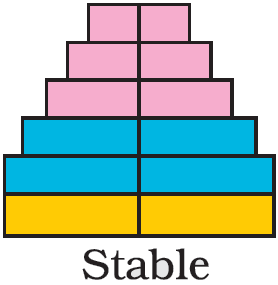
Define ‘zero population growth rate’. Draw a age pyramid for the same.
Answer
When the population of a location neither grows, nor declines, this shows zero population growth rate. The following pyramid shows a population with zero growth rate.

View full question & answer
Question 662 Marks
Construct an age pyramid which reflects a stable growth status of human population.
Answer
'The age pyramid that reflects a stable growth status of human population can be represented as follows:

View full question & answer
Question 672 Marks
Why the plants that inhabit a desert are not found in a mangrove? Give reasons.
Answer
Answer: In xerophytic (desert) condition, plant roots grow deeply to explore any possibility of underground water, leaves are highly reduced (spine) to minimise transpiration. Leaves may have sunken stomata, stem has thick cuticle and are fleshy to preserve moisture. While mangrove has salty condition so that specialised root grows negatively geotropic and called pneumatophores, leaves are thin, small and green. Stems are usually cuticularised. That is why desert inhabit plants are not found in a mangrove.
View full question & answer
Question 682 Marks
What is resource partitioning? Give an example.
Answer
It is a mechanism evolved by competing species for coexistence and avoid competition by changing their forage pattern and other behaviours.
Example: five different species of warblers coexisted in a tree by changing their forage patterns.
View full question & answer
Question 692 Marks
What advantage does the sea anemone get in the sea anemone-hermit crab interaction as facultative mutualism? Give an alternative term for this kind of mutualism.
Answer
The sea anemone is transported on the back of hermit crab for reaching new food sources. Alternative term for this type of mutualism is protocooperation.
View full question & answer
Question 702 Marks
The red spotted newt Notophthalmus viridescens secretes toxins from its skin that make predators avoid it. The red salamander Pseudotriton ruber has no such secretions but resembles the red spotted newt and gains protection from this resemblance. What is this an example of? Who is the model, the mimic, and the dupe?
Answer
This is an example of Batesian mimicry.
The red spotted newt is the model.
The red salamander is the mimic.
Dupe is any predator species that would avoid the red salamander, believing it to be a red newt.
View full question & answer
Question 712 Marks
Name the type of curve that characterises most population growing in favourable environment. Also define carrying capacity.
Answer
When the environment is favourable, the growth curve is J-shaped.
In nature, a given habitat has resources to support only a certain number of individuals of a population beyond which no further growth is possible. This limit is called carrying capacity (K).
View full question & answer
Question 722 Marks
Explain relationship between biotic potential and environmental resistance.
Answer
Biotic potential is defined as the maximum inherent capacity of an organism to reproduce or increase the number of individuals. Whereas the environmental resistance is the biotic and abiotic factors of the environment, that do not allow the population of organisms to grow unlimited and keep the population size in control.
View full question & answer
Question 732 Marks
“Snow leopards are not found in Kerala forests and tuna fish are rarely found beyond tropical latitude in the ocean”. Study the above two cases and state the possible reasons for the same.
Answer
Change in temperature from their established habitats affects the kinetics of the enzymes and through it the basal metabolism, activity and other physiological functions of the organism.
View full question & answer
Question 742 Marks
Define aestivation.
Answer
Aestivation is a state of dormancy characterized by inactivity and a lowered metabolic rate in response to high temperatures and arid conditions.
View full question & answer
Question 752 Marks
Why do people suffer from altitude sickness after reaching the high altitude regions? How does their body acclimatised after a couple of days?
Answer
People visiting high altitude regions experience altitude sickness. This is because the body does not get enough oxygen. The person shows symptoms of nausea, fatigue and heart palpitations. After couple of days, the body responds gradually by physiological adaptation. The body compensates low 0, availability by
  1. Increasing RBCs production.
  2. Decreasing binding capacity of haemoglobin.
  3. Increased breathing rate.
View full question & answer
Question 762 Marks
What is diapause and its significance?
Answer
The period of suspended development in order to tide over the unfavourable conditions is called diapause.
View full question & answer
Question 772 Marks
Heat loss or heat gain depends upon the surface area of the organism's body. Explain with the help of a suitable example.

OR

Explain, why are small animals rarely found in the polar regions?

Answer
Small animals like humming bird or shrew, have a large surface area relative to their volume. So, they tend to lose body heat very fast during cold conditions. They need to spend more energy to generate body heat through metabolism. Due to this, smaller animals are rarely found in polar regions.
View full question & answer
Question 782 Marks
Is it possible to achieve ‘zero population growth rate’? If yes, what kind of age pyramid is obtained?
Answer
Yes. An inverted bell shaped age pyramid is obtained. The young or pre-reproductive age group individuals are less in number and both post-reproductive and reproductive stage are in the same level.
View full question & answer
Question 792 Marks
Write the exponential equation for J-shaped growth form.
Answer
Exponential equation for J-shaped growth form is:
$\frac{\text{dN}}{\text{dt}} = \text{rN}$
where, $\frac{\text{dN}}{\text{dt}} $ is the rate of change in population size, Pis intrinsic rate of natural increase and 'N' is the population size.
View full question & answer
Question 802 Marks
Besides acting as ‘conduits’ for energy transfer across trophic levels, predators play other important roles. Justify.
Answer
Besides acting as ‘conduits’ of energy transfer across trophic levels, predators play other important roles like:
  1. They keep prey population under control.
  2. Predators also help in maintaining species diversity in a community by reducing the intensity of competition among competing prey species.
View full question & answer
Question 812 Marks
Describe the mutual relationship between the fig tree and wasp and comment on the phenomenon that operates in their relationship.
Answer
The relationship between fig tree and wasp shows mutualism. The wasp while searching for sites to lay its eggs, pollinates the fig's inflorescence. On the other hand, the fig not only provides shelter (fruit) for oviposition but also allows wasp's larva to feed on its seeds.
View full question & answer
Question 822 Marks
The ‘clown’ fish lives among the tentacles of sea anemone. What is this interaction between them called and why?
Answer
The interaction between clown fish and sea anemone is called commensalism. The clown fish gets protection from predators which stay away from the stinging tentacles of sea anemone. The sea anemone does not appear to derive any benefit by hosting the clown fish.
View full question & answer
Question 832 Marks
Name the interaction in the following:
Mycorrhizae living on the roots of higher plants.
Answer
Mutualism.
View full question & answer
Question 842 Marks
Why are predators considered prudent in nature?
Answer
Predators are called prudent because they eat the prey population in a manner that the prey population continues to survive and is not overexploited. It is necessary for the survival of predator population because in absence of preys they will also get extinct sooner or later.
View full question & answer
Question 852 Marks
Shark is eurythermal while polar bear is stenothermal. What is the advantage the former has and what is the constraint the later has?
Answer
A few organisms can tolerate and thrive in wide range of temperature (they are called eurythermal), but a vast majority of them are restricted to narrow range of temperatures (such organisms are called stenothermal). The levels of thermal tolerance of different species determine to a large extent their geographical distribution.
View full question & answer
Question 862 Marks
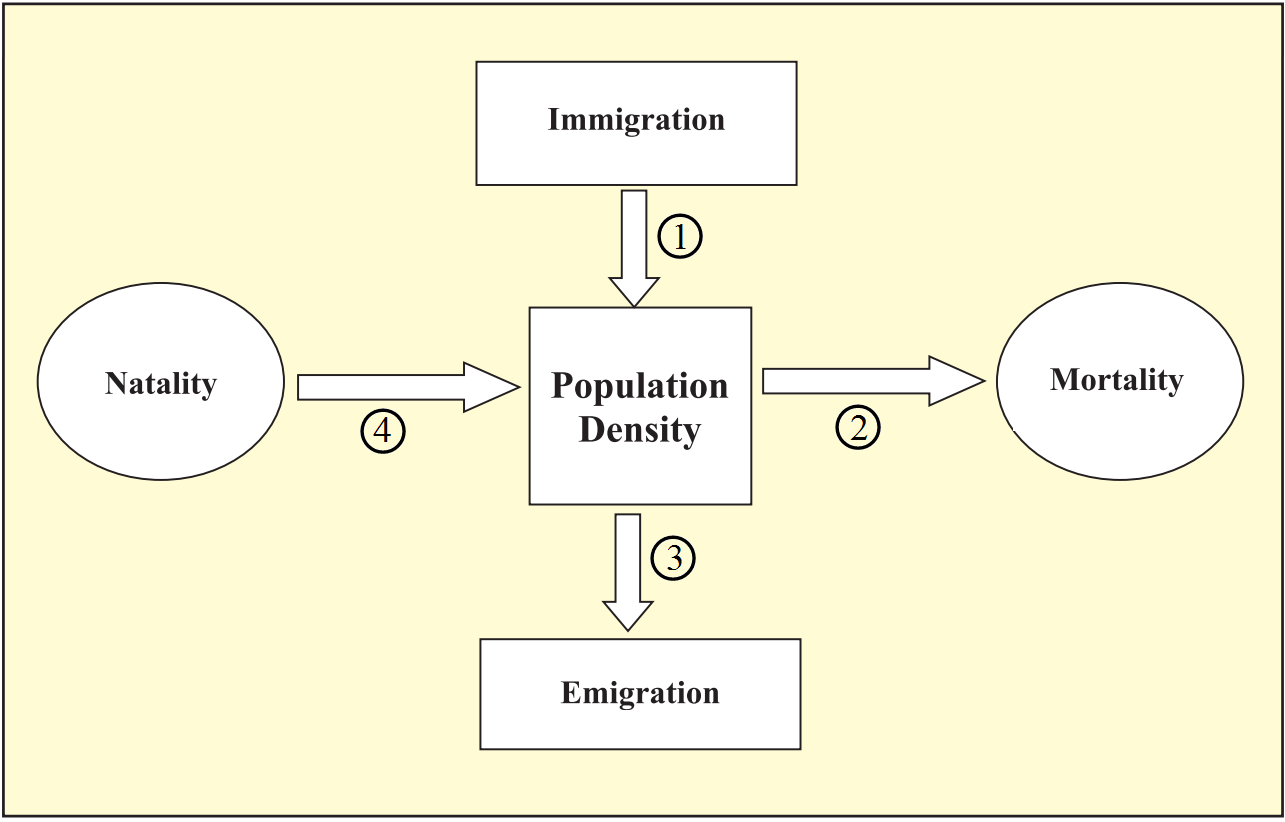
Which of the following represent increase or decrease in population?

Answer
1 and 4- Increase.
2 and 3- Decrease.
View full question & answer
Question 872 Marks
What is Gause’s competitive exclusion principle? Explain with an example.
Answer
Gause’s competitive exclusion principle states that two closely related species competing for the same resource cannot coexist indefinitely and the competitively inferior one will be eliminated eventually by the superior one. For example, after the introduction of goats in Galapagos Islands, the Abingdon tortoise became extinct within a decade due to greater browsing efficiency of the goats.
View full question & answer
Question 882 Marks
How do mammals living in colder regions and seals living in polar regions able to reduce the loss of their body heat?
Answer
Mammals from colder climates generally have shorter ears and limbs to minimize heat loss. This is called Allen's rule. In polar seas, aquatic mammals like seals have a thick layer of fat (blubber) below their skin that acts as an insulator and reduces loss of body heat.
View full question & answer
Question 892 Marks
How does temperature affect the organisms?
Answer
Physiological functions as well as geographical distribution of plans and animals are governed by the temperature conditions and their thermal tolerance. Organisms which can tolerate and thrive in a wide range of temperatures are called eurythermal, e.g. most mammals and birds while organisms which can tolerate a narrow range of temperatures are called stenothermal, e.g. polar bear, amphibians.
View full question & answer
Question 902 Marks
If a fresh water fish is placed in an aquarium containing sea water, will the fish be able to survive? Explain giving reasons.
Answer
If a fresh water fish is placed in an aquarium containing sea water, it will not be able to survive because of the osmotic problems, they would face. Sea water is hypertonic as compared to fish, so it lost water through exosmosis and die due to dehydration.
View full question & answer
Question 912 Marks
Why do we experience shivering during winters when the temperature is very low?
Answer
Shivering is a form of exercise which produces heat and raises the body temperature; so we shiver during winters at low temperature.
View full question & answer
Question 922 Marks
What is homeostasis?
Answer
The process by which an organism maintains constancy in its internal environment is called homeostasis. Osmoregulation and thermoregulation are parts of homeostasis.
View full question & answer
Question 932 Marks
How do mammals living in colder regions and seals living in polar regions able to reduce the loss of their body heat?
Answer
  1. They have short ears and short limbs (Allen's rule).
  2. Seals have a thick layer of fat, called blubber under their skin, which acts as an insulator and reduces loss of body heat.
View full question & answer
Question 942 Marks
Name two basic types of competition found amongst organisms. Which one of them is more intense and why?
Answer
The two basic types of competitions are:

  1. Interspecific competition.
  2. Intraspecific competition.

The intraspecific competition is more intense because the requirement of the individual of the species are similar.

View full question & answer
Question 952 Marks
What are the different ways in which parasite can alter the population of hosts?
Answer
Following are the ways in which parasite can alter the population of host:
  1. They can shorten the life cycle of the host and can weaken it.
  2. They can drastically reduce the reproduction to the extent of causing sterility.
  3. They reduce its population density.
View full question & answer
Question 962 Marks
In a pond, we see plants which are free-floating, rooted-submerged, rooted emergent, rooted with floating leaves. Write the type of plants against each of them.
  1. Hydrilla.
  2. Typha.
  3. Nymphaea.
  4. Lemna.
  5. Vallisnaria.
Answer
  1. Submerged.
  2. Rooted emergent.
  3. Rooted with floating leave.
  4. free-floating.
  5. Rooted Submerged.
View full question & answer
Question 972 Marks
Why do people suffer from altitude sickness after reaching the high altitude regions? How does their body get acclimatized after a couple of days?
Answer
  1. At high altitude places, one may experience altitude sickness, as the atmospheric pressure is low and the body does not get enough oxygen.
  2. But gradually the body gets acclimatised by increasing the red blood cell production, increasing the breathing rate and deffeasing the binding affinity of haemoglobin.
View full question & answer
Question 982 Marks
Categorise the following plants into hydrophytes, xerophytes, halophytes and mesophytes. Write the type of plant against the following examples.
  1. Salvinia.
  2. Opuntia.
  3. Rhizophora.
  4. Mangifera.
Answer
  1. Hydrophyte.
  2. Xerophyte.
  3. Halophyte.
  4. Mesophyte.
View full question & answer
Question 1002 Marks
How does a Monarch butterfly defend itself from predation? Explain.
Answer
  1. The Monarch butterfly is highly distasteful to its predators because of a special chemical present in its body.
  2. The butterfly acquires this chemical by feeding ona poisonous weed during its caterpillar stage.
View full question & answer
Question 1012 Marks
Why are a fig tree and its partner wasp considered a good example of mutualism?
Answer
  1. It is a case of mutualism because both the fig tree and the Wasp are benefitted by this interaction.
  2. The female wasp uses the ovary of the flower as a site for oviposition and the developing seeds within the fruit for nourishing the larvae.
  3. The fig inflorescence is pollinated when the wasp is searching for a suitable place for egg-laying.
View full question & answer
Question 1022 Marks
Give a suitable example for commensalism.
Answer
Egrets ride on the back of cattle. When cattle forage for grass, insects fly away abruptly. This gives the egrets a chance to feed on those insects. In this relationship, cattle get no benefit from egrets.
View full question & answer
Question 1032 Marks
Name two dominant plant species of mangroves.
Answer
Rhizophora and Aegiceras are two dominant plant species of mangroves.
View full question & answer