Questions · Page 1 of 3

1 Marks Question

🎯

Test yourself on this topic

50 questions · timed · auto-graded

Question 11 Mark
Answer the following questions:
Why are ethers insoluble in water?
Answer
Ethers are insoluble in water because due to the bigger size of the alkyl groups, the oxygen atom in ethers fails to form intermolecular H-bonds with water.
View full question & answer
Question 21 Mark
What is the structure and IUPAC name of glycerol?
Answer
$\text{CH}_2\text{OH} \\ \ | \\ \text{CHOH} \\ \ | \\ \text{CH}_2\text{OH}$
IUPAC name of glycerol is Propane-1,2,3-triol.
View full question & answer
Question 31 Mark
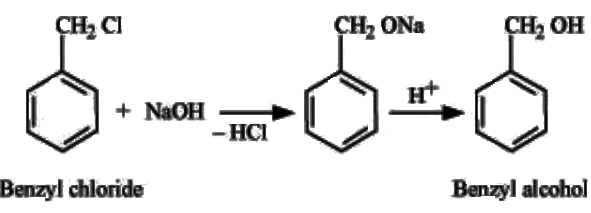
How are the following conversions carried out?Benzyl chloride → Benzyl alcohol.
Answer

If benzyl chloride is treated with NaOH (followed by acidification) then benzyl alcohol is produced.
View full question & answer
Question 41 Mark
Write IUPAC names of the following compound:$\text{C}_6\text{H}_5-\text{O}-\text{C}_7\text{H}_{15}(\text{n}-)$
Answer
1-Phenoxy heptane.
View full question & answer
Question 51 Mark
Write structure of the compound whose IUPAC names are as follow:1 – Ethoxypropane.
Answer
$\text{C}_2\text{H}_5\text{O}-\text{CH}_2-\text{CH}_2-\text{CH}_3$
View full question & answer
Question 61 Mark
o-Nitrophenol has lower boiling point than p-nitrophenol. Explain.
Answer
Due to intramolecular H-bonding o-nitrophenol exists as a discrete molecule whereas due to intermolecular H-bonding p-nitrophenol exists as associated molecules. As a result of this p-nitrophenol has higher boiling point than o-nitrophenol.
View full question & answer
Question 71 Mark
Suggest a reagent for conversion of ethanol to ethanal.
Answer
$CrO_3$, pyridine and $\text{HCl} ($Pyridinium chlorochromate, $\text{PCC})$ in $\ce{CH_2C_{12}}.$
View full question & answer
Question 81 Mark
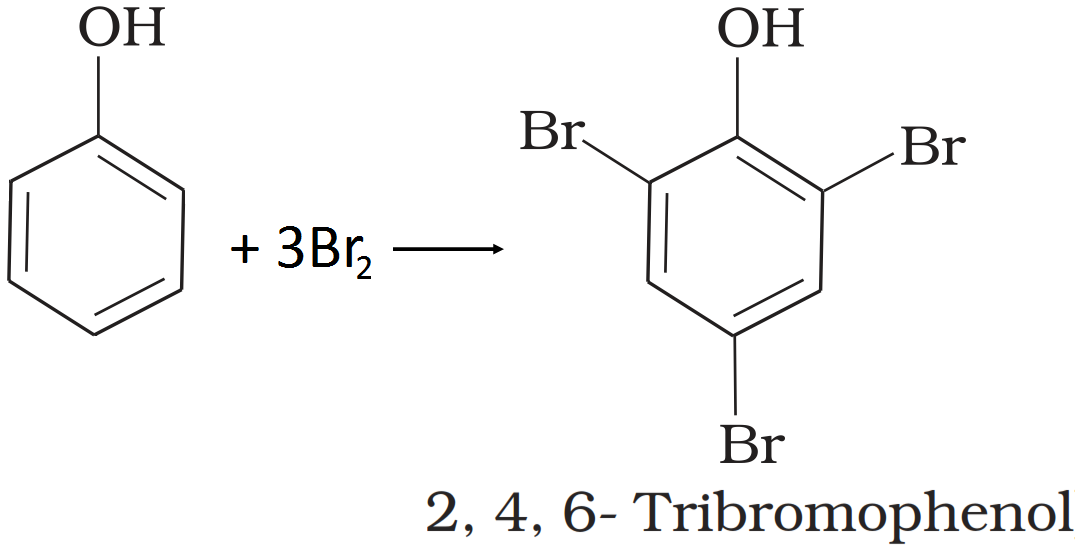
When phenol is treated with bromine water, white precipitate is obtained. Give the structure and the name of the compound formed.
Answer

When phenol is treated with bromine water, 2,4,6-tribromophenol is formed as white precipitate.
View full question & answer
Question 91 Mark
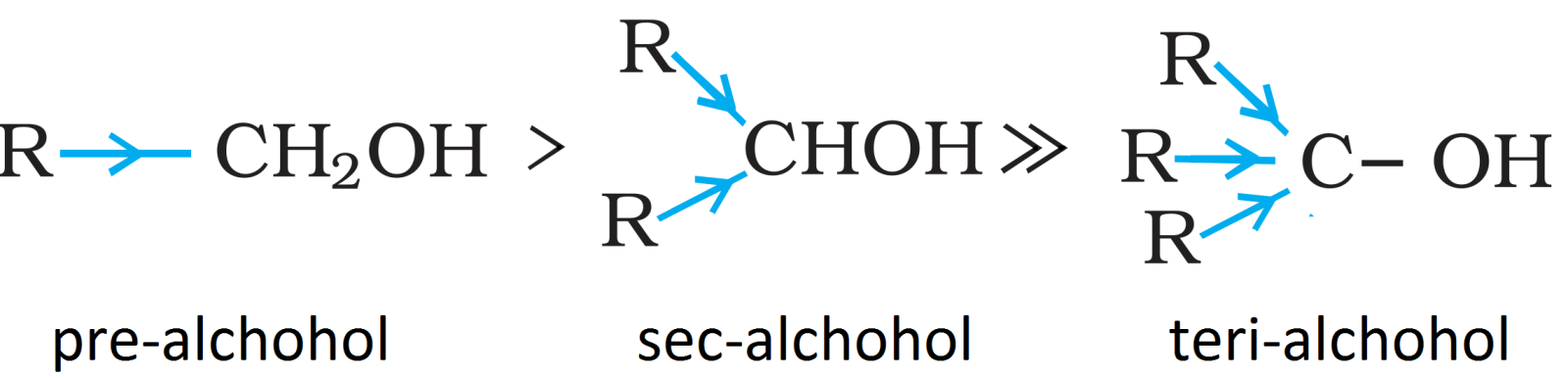
Alcohols react with active metals e.g. Na, K etc. to give corresponding alkoxides. Write down the decreasing order of reactivity of sodium metal towards primary, secondary and tertiary alcohols.
Answer

Decreasing order of reactivity of sodium metal is: 1° > 2° > 3°
Alcohols react with sodium metal to form alkoxides and hydrogen is liberated:
$\text{R}-\text{O}-\text{H}+\text{Na}\rightarrow\text{RO}-\text{Na}^{+}+\frac{1}{2}\text{H}_2$
The order of reactivity of alcohols is primary > secondary > tertiary. This can be explained on the basis of cleavage of O – H bond. The alkyl groups are electron releasing groups (+1 effect) and they increase the electron density around the oxygen. As a result, the electrons of O – H bond cannot be withdrawn strongly towards oxygen and O – H remains strong. Therefore, greater is the number, of alkyl groups present, smaller will be reactivity of alcohol.
View full question & answer
Question 101 Mark
Which of the following is most soluble in water?
  1. n- butyl alcohol
  2. Iso-butyl alcohol
  3. Tertiary butyl alcohol
  4. None of the above
Answer
  1. Tertiary butyl alcohol
Explanation:
Amongst isomeric alcohols, the solubility increases with branching. This is due to the reason that as the branching increases, the surface area of the non-polar hydrocarbon and the solubility increases.
So, the sequence of solubility of alcohols are
Tertiary alcohol > secondary alcohol > primary alcohol
View full question & answer
MCQ 111 Mark
Alcohol can be dehydrated by:
  • A
    $\ce{(CH_3​CO)_{2​}O}$
  • B
    $\ce{(CH_3​)_2​SO_{4​}}$
  • C
    $HI/P$
  • D
    $Anhy\ \ce{ZnCl_{2​/}} \Delta$
Answer
$\text{R}-\text{CH}_2-\text{OH}\xrightarrow{\text{Anhy Zncl}_2{\Delta}}\text{R}=\text{CH}_2$
 
View full question & answer
Question 131 Mark
Explain why nucleophilic substitution reactions are not very common in phenols.
Answer

The -OH group attached to the benzene ring activates it towards electrophilic substitution reaction. Also, it directs the incoming group to ortho and para positions in the ring as these positions become electron rich due to the resonance effect caused by -OH group. That is why nucleophilic substitution reaction is not common in phenol.
View full question & answer
MCQ 141 Mark
Methyl alcohol is industrially prepared by the action of?
  • A
    $\ce{CH_3​COCH_3​}$
  • B
    $\ce{CO + H_2​}$
  • C
    $\ce{CH_3​COOH}$
  • D
    $\ce{C_2​H_{5​}OH}$
Answer
The industrial method of preparation of methanol or methyl alcohol is by the action of $CO+H_2​$ as:$\ce{CO + H_2 ​\rightarrow CH_3​OH (230−400^\circ C)}$
Carbon monoxide reacts with hydrogen to produce methanol/methyl alcohol.
This reaction takes place at a temperature of $230−400^\circ C$ and at $50-100$ atm. In this reaction, the catalyst is can be copper oxide on oxide chromium$(III).$
View full question & answer
Question 151 Mark
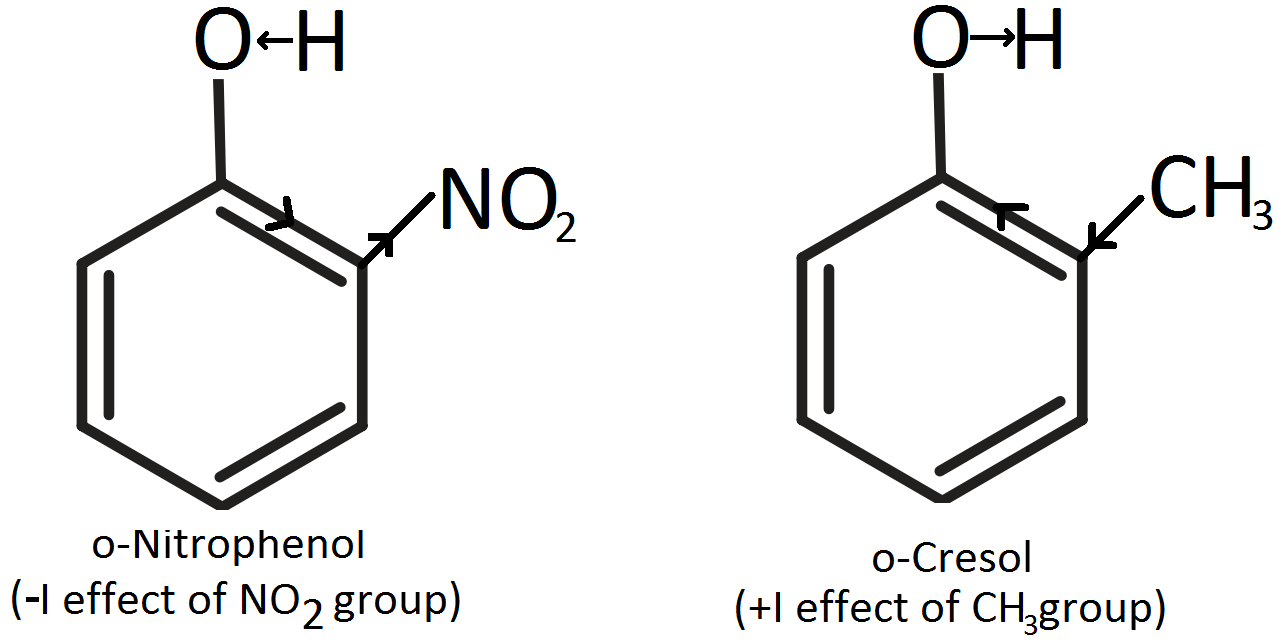
Out of $o-$nitrophenol and $o-$cresol which is more acidic?
Answer
Nitro group is electron is electron withdrawing while $-CH_3$ group is electron releasing.

As a result, $O – H$ bond in $o-$nitrophenol is much weaker than the $O – H$ bond in $o-$cresol and hence $o-$nitrophenol is much more acidic than $o-$cresol.
View full question & answer
Question 161 Mark
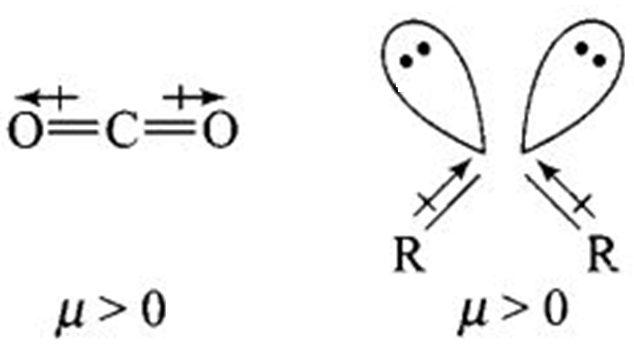
Explain why is O=C=O nonpolar while R-O-R is polar.
Answer

O=C=O molecule is linear so that the polarities of two C – O bonds get cancelled and the molecule is linear.
Ethers have structures similar to water and have angular or bent structure. Therefore, the polarity of two R – O groups does not get cancelled and these have net dipole moment. Thus, R – O – R is polar.
View full question & answer
Question 181 Mark
Give IUPAC name of the following ether:$\text{C}_2\text{H}_5\text{OCH}_2-\text{CH}-\text{CH}_3\\\ \ \ \ \ \ \ \ \ \ \ \ \ \ \ \ \ \ \ \ \ \ \ \ \ \ |\\\ \ \ \ \ \ \ \ \ \ \ \ \ \ \ \ \ \ \ \ \ \ \ \ \ \text{CH}_3$
Answer
1-Ethoxy-2-methylpropane.
View full question & answer
Question 191 Mark
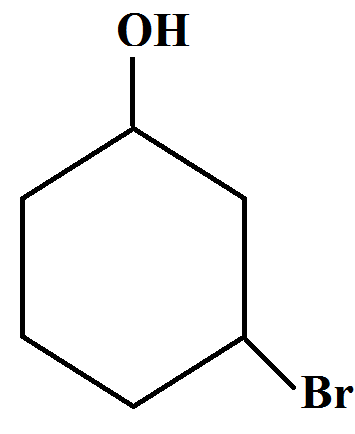
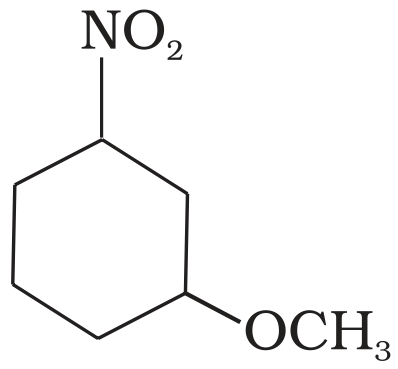
Write the IUPAC name of the following compounds.
  1. $\text{CH}_3-\text{CH}-\text{CH}-\text{CH}-\text{CH}-\text{CH}_3 \\ \ \ \ \ \ \ \ \ \ \ \ \ \ \ {|} \ \ \ \ \ \ \ \ \ \ {|} \ \ \ \ \ \ \ \ \ \ {|} \ \ \ \ \ \ \ \ \ \ {|} \\ \ \ \ \ \ \ \ \ \ \ \ \ \ \text{CH}_3 \ \ \ \ \text{OH} \ \ \ \ \ \text{C}_2\text{H}_5 \ \ \text{OH}$
  2.  
Answer
  1. 3-Ethyl-5-methylhexan-2,4-diol.
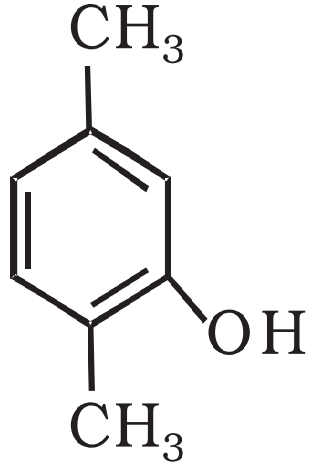
  2. 1-Methoxy-3-3nitrocyclohexan.
View full question & answer
Question 201 Mark
Name the reagent used in the following reaction: Butan$-2-$one to butan$-2-$ol.
Answer
$\ce{Ni/H_2}$ or $\ce{NaBH_4}$ or $\ce{LiAIH_4}.$
View full question & answer
Question 211 Mark
Write structure of the compound whose IUPAC names are as follow:2-Ethoxy-3-methylpentane.
Answer
$\text{CH}_3-\text{CH}-\text{CH}-\text{CH}_2-\text{CH}_3\\\ \ \ \ \ \ \ \ \ \ \ \ \ \ \ \ |\ \ \ \ \ \ \ \ \ \ |\\\ \ \ \ \ \ \ \ \ \ \text{OC}_2\text{H}_5\ \ \ \text{CH}_3$
View full question & answer
Question 221 Mark
Phenol is an acid but does not react with sodium bicarbonate solution. Why?
Answer
Phenol is a weaker acid than carbonic acid $\ce{(H_2CO_3)}$ and hence does not liberate $CO_2$ from sodium bicarbonate.
View full question & answer
Question 231 Mark
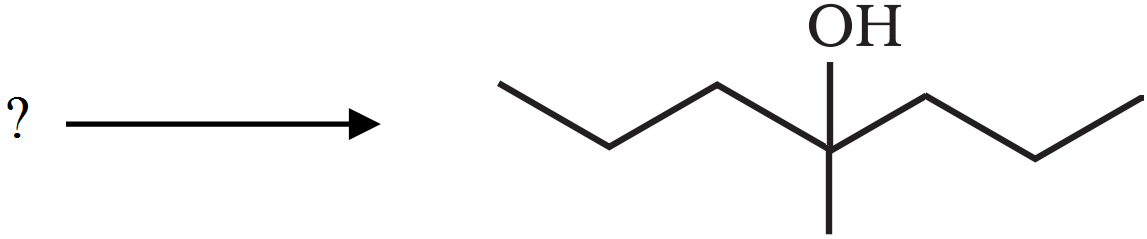
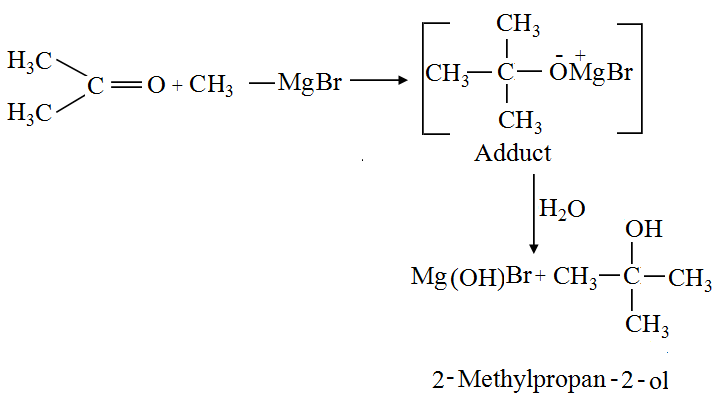
How are the following conversions carried out?Methyl magnesium bromide → 2-Methylpropan-2-ol.
Answer

When methyl magnesium bromide is treated with propane, an adduct is the product which gives 2-methylpropane-2-ol on hydrolysis.
View full question & answer
Question 241 Mark
Write IUPAC names of the following compound:$\ \ \ \ \ \ \ \ \ \ \ \ \ \ \ \ \ \ \ \ \ \ \ \ \ \ \ \ \ \ \ \ \ \ \text{CH}_3\\\ \ \ \ \ \ \ \ \ \ \ \ \ \ \ \ \ \ \ \ \ \ \ \ \ \ \ \ \ \ \ \ \ \ \ |\\\text{CH}_3-\text{CH}-\text{CH}-\text{C}-\text{CH}_3\\\ \ \ \ \ \ \ \ \ \ \ \ \ \ |\ \ \ \ \ \ \ \ \ \ |\ \ \ \ \ \ \ \ \ |\\\ \ \ \ \ \ \ \ \ \ \ \ \ \text{CH}_3\ \ \ \ \text{OH}\ \ \ \ \text{CH}_3$
Answer
2, 2, 4-Trimethyl pentan-3-ol.
View full question & answer
Question 251 Mark
Write IUPAC names of the following compound:$\text{H}_3\text{C}-\text{CH}-\text{CH}_2-\text{CH}-\text{CH}-\text{CH}_2-\text{CH}_3\\\ \ \ \ \ \ \ \ \ \ \ \ \ \ |\ \ \ \ \ \ \ \ \ \ \ \ \ \ \ \ \ \ \ \ \ \ |\ \ \ \ \ \ \ \ \ \ |\\\ \ \ \ \ \ \ \ \ \ \ \ \ \text{OH}\ \ \ \ \ \ \ \ \ \ \ \ \ \ \ \ \ \text{OH}\ \ \ \ \ \text{C}_2\text{H}_5$
Answer
5-Ethyl heptanes-2, 4-diol.
View full question & answer
Question 261 Mark
Give reason for the higher boiling point of ethanol in comparison to methoxymethane.
Answer
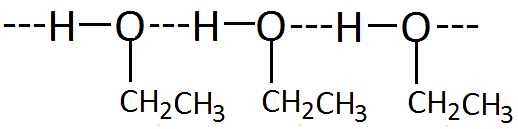
Ethanol undergoes intermolecular H-bonding due to the presence of a hydrogen atom attached to the electronegative oxygen atom. As a result, ethanol exists as associated molecules.
Consequently, a large amount of energy is required to break these hydrogen bonds. Therefore, the boiling point of ethanol is higher than that of methoxymethane which does not form H-bonds.
View full question & answer
Question 271 Mark
Write structures of the products of the following reactions:$\text{CH}_3-\text{CH}=\text{CH}_2\ \xrightarrow{\text{H}_2 \text{O}/\text{H}^+}$
Answer
$\text{CH}_3-\text{CH}-\text{CH}_3\\ \ \ \ \ \ \ \ \ \ \ \ \ \ \ |\\ \ \ \ \ \ \ \ \ \ \ \ \ \ \text{OH}$Propane-2-ol
View full question & answer
Question 281 Mark
Name the reagent used in the following reaction:Oxidation of a primary alcohol to aldehyde.
Answer
Pyridinium chlorochromate (PCC), $(\text{C}_5\text{H}_5\text{NH})+\text{ClCrO}_3\ ^-$ in $\text{CH}_2\text{Cl}_2$or Pyridinium dichromate (PDC), $[(\text{C}_5\text{H}_5\text{NH})_2]^{2+}\text{Cr}_2\text{O}_{7^{2-}} $ in $\text{CH}_2\text{Cl}_2$
View full question & answer
Question 291 Mark
Name the following compounds according to IUPAC system.$\ \ \ \ \ \ \ \ \ \ \ \ \ \ \ \ \ \ \ \ \ \ \ \ \ \ \ \ \ \ \ \ \ \ \ \ \text{CH}_2\text{OH}\\\ \ \ \ \ \ \ \ \ \ \ \ \ \ \ \ \ \ \ \ \ \ \ \ \ \ \ \ \ \ \ \ \ \ \ \ \ |\\\text{CH}_3-\text{CH}_2-\text{CH}-\text{CH}-\text{CH}-\text{CH}_3\\\ \ \ \ \ \ \ \ \ \ \ \ \ \ \ \ \ \ \ \ \ \ \ \ \ \ |\ \ \ \ \ \ \ \ \ \ \ \ \ \ \ \ \ \ \ \ \ |\\ \ \ \ \ \ \ \ \ \ \ \ \ \ \ \ \ \ \ \ \ \ \ \ \ \ \text{CH}_2\text{Cl}\ \ \ \ \ \ \ \ \ \ \text{CH}_3$
Answer
3-Chloromethyl-2-isopropylpentan-1-ol.
View full question & answer
Question 301 Mark
Predict the products of the following reactions:$(\text{CH}_3)_3\text{C}-\text{OC}_2\text{H}_5\xrightarrow{\ \ \ \ \text{HI}\ \ \ \ } $
Answer
$(\text{CH}_3)_3\text{C}-\text{OC}_2\text{H}_5\xrightarrow{\ \ \ \ \text{HI}\ \ \ \ }(\text{CH}_3)_3\text{C}-\text{I}\ \ \ \ +\ \ \ \ \ \text{C}_2\text{H}_5\text{OH}\\\text{tert-Butyl ethyl ether}\ \ \ \ \ \ \ \ \text{tert-Butyliodide}\ \ \ \ \ \ \ \ \ \ \ \ \ \ \text{Ethanol}$
View full question & answer
Question 311 Mark
Explain the following with an example.Kolbe’s reaction.
Answer
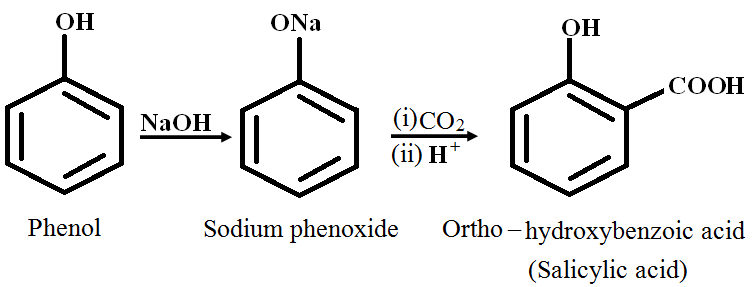
Kolbe's reaction:When phenol is treated with sodium hydroxide, sodium phenoxide is produced. This sodium phenoxide when treated with carbon dioxide, followed by acidification, undergoes electrophilic substitution to give ortho-hydroxybenzoic acid as the main product. This reaction is known as Kolbe's reaction.
View full question & answer
Question 321 Mark
Predict the major product of acid catalysed dehydration ofbutan-1-ol
Answer
$\text{CH}_3\text{CH}_2\text{CH}_2\text{CH}_2\text{OH}\xrightarrow[]{\ \ \ \ \ \ \ \ \ \ \ \ }\text{CH}_3\text{CH}=\text{CH}-\text{CH}_3\ +\ \text{CH}_3\text{CH}_2\text{CH}=\text{CH}_2\\ \ \ \ \ \ \ \ \ \ \ \ \ \ \ \ \ \ \ \ \ \ \ \ \ \ \ \ \ \ \ \ \ \ \ \ \ \ \ \ \ \ \ \ \ \ \ \ \ \ \ \ \ \ \ \ \ \ \ \ \ \text{But-2-ene}\ \ \ \ \ \ \ \ \ \ \ \ \ \ \ \ \ \ \ \ \ \ \ \ \text{But-1-ene}\\\ \ \ \ \ \ \ \ \ \ \ \ \ \ \ \ \ \ \ \ \ \ \ \ \ \ \ \ \ \ \ \ \ \ \ \ \ \ \ \ \ \ \ \ \ \ \ \ \ \ \ \ \ \ \ \ \ \ \ \ \ \ \ (\text{major)} \ \ \ \ \ \ \ \ \ \ \ \ \ \ \ \ \ \ \ \ \ \ \ \ \ \ \ (\text{minor})$
View full question & answer
Question 331 Mark
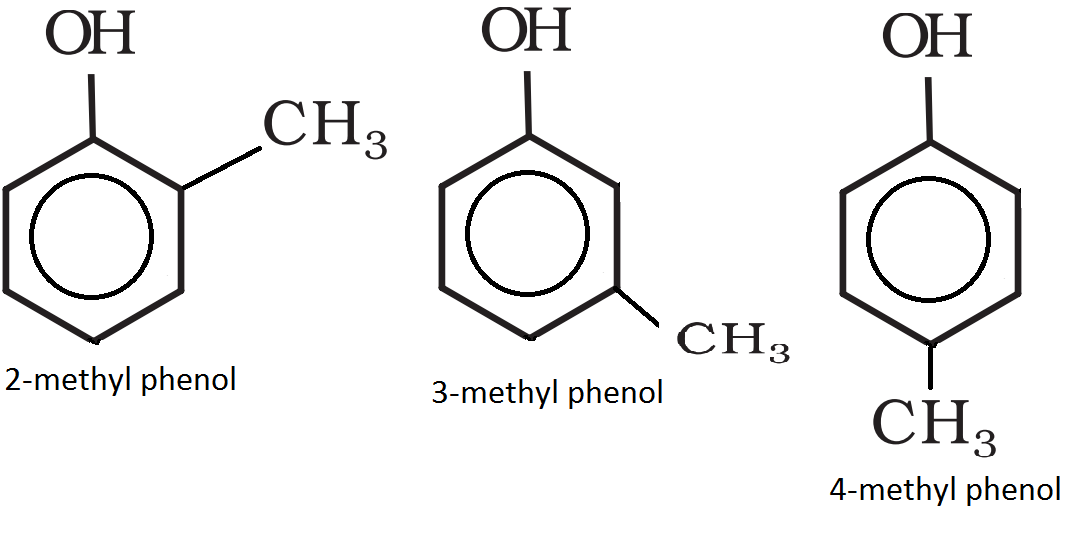
Give the structures and $\ce{IUPAC}$ names of monohydric phenols of molecular formula, $\ce{C_7H_8O}.$
Answer
Three monohydric phenols are possible which have molecular formula $\ce{C_7H_8O}.$ These are:
View full question & answer
Question 341 Mark
Name the reagent used in the following reaction:Benzyl alcohol to benzoic acid.
Answer
Acidifled or alkaline potassium permanganate.
View full question & answer
Question 351 Mark
Write structure of the compound whose IUPAC names are as follow:3,5-Dimethylhexane –1, 3, 5-triol.
Answer
$\ \ \ \ \ \ \ \ \ \ \ \ \ \ \ \ \ \ \ \ \ \ \ \ \ \ \ \ \ \ \ \text{OH}\ \ \ \ \ \ \ \ \ \ \ \ \ \ \ \text{OH}\\\ \ \ \ \ \ \ \ \ \ \ \ \ \ \ \ \ \ \ \ \ \ \ \ \ \ \ \ \ \ \ \ |\ \ \ \ \ \ \ \ \ \ \ \ \ \ \ \ \ \ \ \ |\\\text{HOCH}_2-\text{CH}_2-\text{C}-\text{CH}_2-\text{C}-\text{CH}_3\\\ \ \ \ \ \ \ \ \ \ \ \ \ \ \ \ \ \ \ \ \ \ \ \ \ \ \ \ \ \ \ \ |\ \ \ \ \ \ \ \ \ \ \ \ \ \ \ \ \ \ \ \ |\\\ \ \ \ \ \ \ \ \ \ \ \ \ \ \ \ \ \ \ \ \ \ \ \ \ \ \ \ \ \ \ \text{CH}_3\ \ \ \ \ \ \ \ \ \ \ \ \ \text{CH}_3$
View full question & answer
Question 361 Mark
What is meant by hydroboration$-$oxidation reaction? Illustrate it with an example.
Answer
The addition of borane followed by oxidation is known as the hydroboration$-$oxidation reaction.
In the first step, alkene reacts with diborane $\ce{(B_2H_6)}$ as boron hydride $\ce{(BH_3)}$ to form an alkyl borane.
In the next step, the alkyl borane is oxidised by alkaline $\ce{H_2O_2}$ to form an alcohol.
The indirect hydration proceeds according to Anti Markovnikoff’s rule.
For example,
$\text{3CH}_3\text{CH}=\text{CH}_2+\text{BH}_3\ \ \xrightarrow{\ \ \ \ }\ \ (\text{CH}_3\text{CH}_2\text{CH}_2)_3\text{B}\\ \ \ \ \ \ \ \ \ \ \ \ \ \ \ \ \ \ \ \ \ \ \ \ \ \ \ \ \ \ \ \ \ \ \ \ \ \ \ \ \ \ \ \ \ \ \ \ \text{Tri-n-Propyl borate}\\ \ \ \ \ \ \ \ \ \ \ \ \\ \ \\ \ \ \ \ \ \ \ \ \ \ \ \ \ \ \ \ \ \ \ \ \ \ \ \ \ \ \ \ \ \ \ \ \xrightarrow[\text{H}_2\text{O}]{\text{H}_2\text{O}_2/\text{OH}^-}\text{3CH}_3\text{CH}_2\text{CH}_2\text{OH}+\text{H}_3\text{BO}_3\\ \ \ \ \ \ \ \ \ \ \ \ \ \ \ \ \ \ \ \ \ \ \ \ \ \ \ \ \ \ \ \ \ \ \ \ \ \ \ \ \ \ \ \ \ \ \ \ \ \ \ \ \ \ \ \ \text{Propan-1-ol}\ \ \ \ \ \ \ \ \ \ \ \text{Boric acid}$
View full question & answer
Question 371 Mark
Explain the following with an example.Unsymmetrical ether.
Answer
Unsymmetrical ether:An unsymmetrical ether is an ether where two groups on the two sides of an oxygen atom differ $($i.e., have an unequal number of carbon atoms$).$ For example: ethyl methyl ether $\ce{(CH_3- O-CH_2CH_3)}.$
View full question & answer
Question 381 Mark
Write IUPAC names of the following compound:$\text{CH}_3-\text{CH}_2-\text{O}-\text{CH}-\text{CH}_2-\text{CH}_3\\\ \ \ \ \ \ \ \ \ \ \ \ \ \ \ \ \ \ \ \ \ \ \ \ \ \ \ \ \ \ \ \ \ \ \ |\\\ \ \ \ \ \ \ \ \ \ \ \ \ \ \ \ \ \ \ \ \ \ \ \ \ \ \ \ \ \ \ \ \ \ \text{CH}_3$
Answer
2-Ethoxy butane.
View full question & answer
Question 401 Mark
Write IUPAC names of the following compound:$\text{CH}_3-\text{O}-\text{CH}_2-\text{CH}-\text{CH}_3\\\ \ \ \ \ \ \ \ \ \ \ \ \ \ \ \ \ \ \ \ \ \ \ \ \ \ \ \ \ \ \ \ \ \ |\\\ \ \ \ \ \ \ \ \ \ \ \ \ \ \ \ \ \ \ \ \ \ \ \ \ \ \ \ \ \ \ \ \ \text{CH}_3$
Answer
 1-Methoxy-2-methylpropane.
View full question & answer
Question 411 Mark
Write the names of reagents and equations for the preparation of the following ethers by Williamson’s synthesis:1-Methoxyethane.
Answer
$\text{CH}_3\text{CH}_2\text{O}^-\text{Na}^++\text{CH}_3-\text{Br}\xrightarrow{\ \Delta\ }\text{CH}_3\text{CH}_2\text{OCH}_3+\text{NaBr}\\\ \ \ \ \ \ \ \ \text{Sodium}\ \ \ \ \ \ \ \ \ \ \ \text{Bromoethane}\ \ \ \ \text{1-Methoxyethane}\\\ \ \ \ \ \ \ \text{ethoxide}$
View full question & answer
Question 421 Mark
Write structures of the products of the following reactions:$\text{CH}_3-\text{CH}_2-\text{CH}-\text{CHO}\xrightarrow{\text{NaBH}_4}\\ \ \ \ \ \ \ \ \ \ \ \ \ \ \ \ \ \ \ \ \ \ \ \ \ \ \ |\\ \ \ \ \ \ \ \ \ \ \ \ \ \ \ \ \ \ \ \ \ \ \ \ \ \ \text{CH}_3$
Answer
$\text{CH}_3-\text{CH}_2-\text{CH}-\text{CH}_2\text{OH}\\ \ \ \ \ \ \ \ \ \ \ \ \ \ \ \ \ \ \ \ \ \ \ \ \ \ \ |\\ \ \ \ \ \ \ \ \ \ \ \ \ \ \ \ \ \ \ \ \ \ \ \ \ \ \text{CH}_3$
View full question & answer
Question 431 Mark
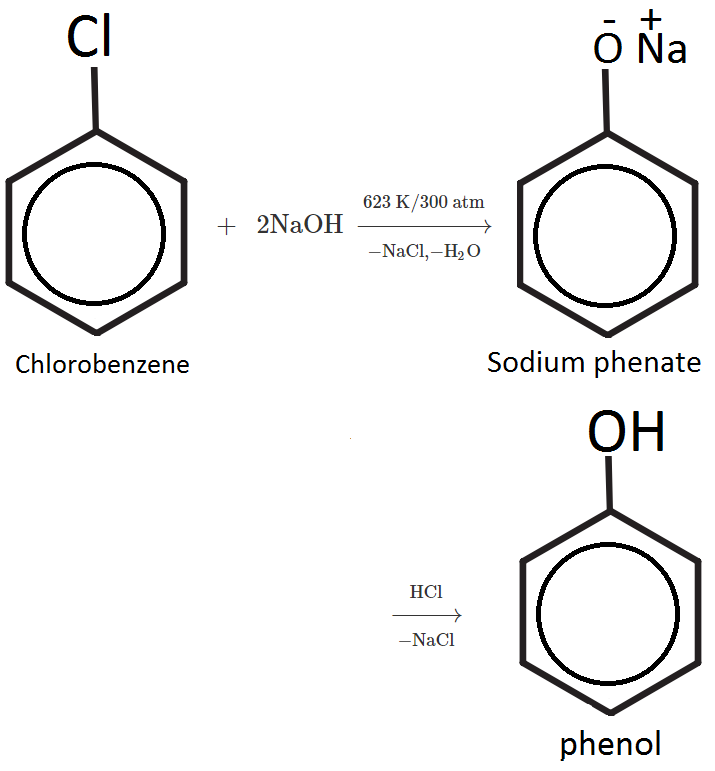
Write chemical reaction for the preparation of phenol from chlorobenzene.
Answer
Chlorobenzene is heated with 6 to 8% solution of NaOH to about 623 K under a pressure of 300 atmospheres to form sodium phenate which upon acidification with dilute HCl gives phenol as follows:
View full question & answer
Question 441 Mark
Write the names of reagents and equations for the preparation of the following ethers by Williamson’s synthesis:1-Propoxypropane.
Answer
$\text{CH}_3\text{CH}_2\text{CH}_2\text{O}^-\text{Na}^++\text{CH}_3\text{CH}_2\text{CH}_2\text{Br}\xrightarrow{\ \ \Delta\ \ }\text{CH}_3\text{CH}_2\text{CH}_2-\text{O}-\text{CH}_2\text{CH}_2\text{CH}_3+\text{NaBr}\\ \ \ \ \text{Sodium propoxide}\ \ \ \ \ \ \text{1-Bromopropane}\ \ \ \ \ \ \ \ \ \ \ \ \ \ \ \ \ \ \ \ \ \ \ \ \ \ \ \ \ \ \ \text{1-Propexypropane}$
View full question & answer
Question 451 Mark
Give equation of the following reaction:Oxidation of propan$-1-$ol with alkaline $\ce{KMnO_4}$ solution.
Answer
$\text{CH}_3\text{CH}_2\text{CH}_2\text{OH}\xrightarrow{\text{alk KmnO}_4}\text{CH}_3\text{CH}_2\text{COOH}\\ \text{Propan-1-ol}\ \ \ \ \ \ \ \ \ \ \ \ \ \ \ \ \ \ \ \ \ \ \ \ \ \ \ \ \text{Propanoic acid}$
View full question & answer
Question 461 Mark
Name the reagent used in the following reaction:Brominationofphenolto2,4,6-tribromophenol.
Answer
Aqueous bromine, i.e., $\text{Br}_2/\text{H}_2\text{O}.$
View full question & answer
Question 471 Mark
Give IUPAC name of the following ether:$\text{CH}_3\text{CH}_2\text{CH}_2\text{OCH}_3$
Answer
1-Methoxypropane.
View full question & answer
Question 481 Mark
Write structure of the compound whose IUPAC names are as follow:2-Methylbutan-2-ol.
Answer
$\ \ \ \ \ \ \ \ \ \ \ \ \text{CH}_3\\\ \ \ \ \ \ \ \ \ \ \ \ \ |\\\text{CH}_3-\text{C}-\text{CH}_2-\text{CH}_3\\\ \ \ \ \ \ \ \ \ \ \ \ \ |\\\ \ \ \ \ \ \ \ \ \ \ \ \text{OH}$
View full question & answer
Question 491 Mark
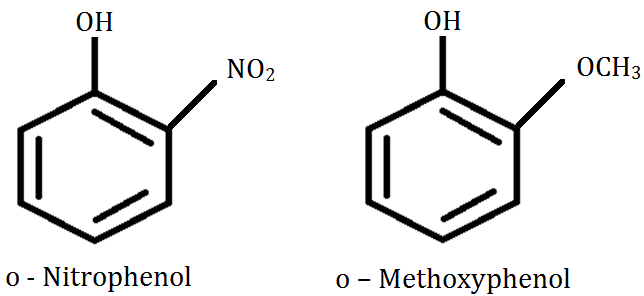
Explain why is ortho nitrophenol more acidic than ortho methoxyphenol?
Answer


The nitro-group is an electron-withdrawing group. The presence of this group in the ortho position decreases the electron density in the O-H bond. As a result, it is easier to lose a proton. Also, the o-nitrophenoxide ion formed after the loss of protons is stabilized by resonance. Hence, ortho nitrophenol is a stronger acid. On the other hand, methoxy group is an electron-releasing group. Thus, it increases the electron density in the O-H bond and hence, the proton cannot be given out easily. For this reason, ortho-nitrophenol is more acidic than ortho-methoxyphenol.
View full question & answer
Question 501 Mark
Show how will you synthesise:pentan-1-ol using a suitable alkyl halide?
Answer
When 1-chloropentane is treated with NaOH, pentan-1-ol is produced.$\text{CH}_3\text{CH}_2\text{CH}_2\text{CH}_2\text{CH}_2\text{Cl}+\text{NaOH}\xrightarrow{\ \ \ \ \ \ \ \ \ }\text{CH}_3\text{CH}_2\text{CH}_2\text{CH}_2\text{CH}_2\text{OH}+\text{NaCl}\\ \text{1-Chloropentane} \ \ \ \ \ \ \ \ \ \ \ \ \ \ \ \ \ \ \ \ \ \ \ \ \ \ \ \ \ \ \ \ \ \ \ \ \ \ \ \ \ \ \ \ \ \text{Pantan-1-ol}$
View full question & answer
1 Marks Question - Chemistry STD 12 Science Questions - Vidyadip