Question 12 Marks
Although phenoxide ion has more number of resonating structures than carboxylate ion, carboxylic acid is a stronger acid than phenol. Why?
Answer
Consider the resonating structures of carboxylate ion and phenoxide ion.
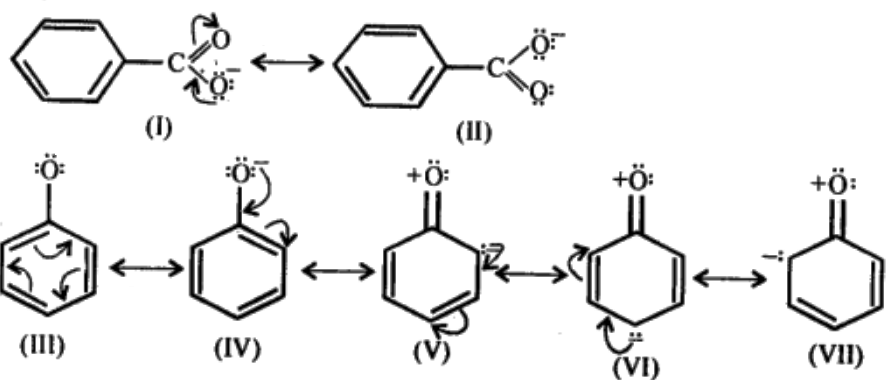
In case of phenoxide ion. structures (V - VII) carry a negative charge on the less electronegative carbon atom. Therefore, their contribution towards the resonance stabilization of phenoxide ion is very small. In structures I and II, (carboxylate ion), the negative charge is delocalized over two oxygen atoms while in structures III and IV, the negative charge on the oxygen atom remains localized only the electrons of the benzene ring are delocalized. Since delocalization of benzene electrons contributes little towards the stability of phenoxide ion therefore, carboxylate ion is much more resonance stabilized than phenoxide ion. Thus, the release of a proton from carboxylic acids is much easier than from phenols. In other words, carboxylic acids are stronger acids than phenols.
Consider the resonating structures of carboxylate ion and phenoxide ion.
In case of phenoxide ion. structures (V - VII) carry a negative charge on the less electronegative carbon atom. Therefore, their contribution towards the resonance stabilization of phenoxide ion is very small. In structures I and II, (carboxylate ion), the negative charge is delocalized over two oxygen atoms while in structures III and IV, the negative charge on the oxygen atom remains localized only the electrons of the benzene ring are delocalized. Since delocalization of benzene electrons contributes little towards the stability of phenoxide ion therefore, carboxylate ion is much more resonance stabilized than phenoxide ion. Thus, the release of a proton from carboxylic acids is much easier than from phenols. In other words, carboxylic acids are stronger acids than phenols.
View full question & answer→Question 22 Marks
An organic compound $(A) \ ($molecular formula $\ce{C_8H_{16}O_2)}$ was hydrolysed with dilute sulphuric acid to give a carboxylic acid $(B)$ and an alcohol $(C)$. Oxidation of $(C)$ with chromic acid produced $(B). (C)$ on dehydration gives but $-1-$ ene. Write equations for the reactions involved.
AnswerSince an ester $A$ with molecular formula $\ce{C_8H_{16}0_2}$ upon hydrolysis gives carboxylic acid $B$ and the alcohol $C$ and oxidation of $C$ with chromic acid produces the acid $B,$
therefore, both the carboxylic acid $B$ and alcohol $C$ must contain the same number of carbon atoms.
Further,since ester $A$ contains eight carbon atoms, therefore, both the carboxylic acid $B$ and the alcohol $C$ must contain four carbon atoms each.
Since the alcohol $C$ on dehydration gives but $-1-$ ene, therefore, $C$ must be a straight chain alcohol, i.e., butan$-l-$ ol .
If $C$ is butan $-l-$ ol, then the acid $B$ must be butanoic acid and the ester $A$ must be butyl butanoate.
The chemical equations are as follows:
$\ \ \ \ \ \ \ \ \ \ \ \ \ \ \ \ \ \ \ \ \ \ \ \ \ \ \ \text{O}\\\ \ \ \ \ \ \ \ \ \ \ \ \ \ \ \ \ \ \ \ \ \ \ \ \ \ \ \ ||\\\text{CH}_3\text{CH}_2\text{CH}_2-\text{C}-\text{O}-\text{CH}_2\text{CH}_2\text{CH}_2\text{CH}_3\xrightarrow[\text{Hydrolysis}]{\ \ \text{Dil} \text{ H}_2\text{SO}_4\ \ }\\ \ \ \ \ \ \ \ \ \ \ \text{Butylbutanoate}(\text{A})\\ \ \ \ \ \ \ \ \ \text{Molecular formula}=\text{C}_8\text{H}_{10}\text{O}_2$
$\ \ \ \ \ \ \ \ \ \ \ \ \ \ \ \ \ \ \ \ \ \ \ \ \ \ \ \text{O}\\\ \ \ \ \ \ \ \ \ \ \ \ \ \ \ \ \ \ \ \ \ \ \ \ \ \ \ \ ||\\ \text{CH}_3\text{CH}_2\text{CH}_2-\text{C}-\text{OH}+\text{CH}_3\text{CH}_2\text{CH}_2\text{CH}_2\text{OH}\\ \ \ \ \ \ \ \ \text{Butanoic acid}\ \ \ \ \ \ \ \ \ \ \ \ \ \ \ \ \ \ \ \ \ \ \ \text{Butan-1-ol}\\ \ \ \ \ \ \ \ \ \ \ \ \ (\text{B})\ \ \ \ \ \ \ \ \ \ \ \ \ \ \ \ \ \ \ \ \ \ \ \ \ \ \ \ \ \ \ \ \ \ \ \ \ \ \ \ \ \ \ (\text{C})$
$\ \ \ \ \ \ \ \ \ \ \ \ \ \ \ \ \ \ \ \ \ \ \ \ \ \ \ \ \ \ \ \ \ \ \ \ \ \ \ \ \ \ \ \ \ \ \ \ \ \ \ \ \ \ \ \ \ \ \ \ \ \ \ \ \ \ \ \ \ \ \ \ \ \ \ \ \ \ \ \ \ \ \ \ \ \ \ \ \ \ \text{O}\\\ \ \ \ \ \ \ \ \ \ \ \ \ \ \ \ \ \ \ \ \ \ \ \ \ \ \ \ \ \ \ \ \ \ \ \ \ \ \ \ \ \ \ \ \ \ \ \ \ \ \ \ \ \ \ \ \ \ \ \ \ \ \ \ \ \ \ \ \ \ \ \ \ \ \ \ \ \ \ \ \ \ \ \ \ \ \ \ \ \ \ ||\\\text{CH}_3\text{CH}_2\text{CH}_2\text{CH}_2\text{OH}\xrightarrow[\text{Oxidation}]{\text{CrO}_3/\text{CH}_3\text{COOH}}\text{CH}_3\text{CH}_2\text{CH}_2-\text{C}-\text{OH}\\ \ \ \ \ \ \ \ \ \ \text{Butan-1-ol}\ \ \ \ \ \ \ \ \ \ \ \ \ \ \ \ \ \ \ \ \ \ \ \ \ \ \ \ \ \ \ \ \ \ \ \ \ \ \ \ \ \ \ \text{Butanoic acid}\\\ \ \ \ \ \ \ \ \ \ \ \ (\text{C})\ \ \ \ \ \ \ \ \ \ \ \ \ \ \ \ \ \ \ \ \ \ \ \ \ \ \ \ \ \ \ \ \ \ \ \ \ \ \ \ \ \ \ \ \ \ \ \ \ \ \ \ \ \ \ \ \ \ \ \ \ \ (\text{B})$
$\text{CH}_3\text{CH}_2\text{CH}_2\text{CH}_2\text{OH}\xrightarrow[\text{-H}_2\text{O}]{\text{Dehydration}}\text{CH}_3\text{CH}_2\text{CH}=\text{CH}_2\\ \ \ \ \ \ \ \ \ \ \ \ \ \ \ \ \ \ \ \ \ \ \ \ \ \ \ \ \ \ \ \ \ \ \ \ \ \ \ \ \ \ \ \ \ \ \ \ \ \ \ \ \ \ \ \ \ \ \ \ \ \ \ \text{But-1-ene}$
View full question & answer→Question 32 Marks
An organic compound contains $69.77\%$ carbon $, 11.63\%$ hydrogen and rest oxygen. The molecular mass of the compound is $86.$ It does not reduce Tollen's reagent but forms an addition compound with sodium hydrogensulphite and give positive iodoform test. On vigorous oxidation it gives ethanoic and propanoic acid. Write the possible structure of the compound.
Answer$\text{C}=69.77\%,\text{ H}=11.67\%$
$\therefore\ \text{O}=100-(69.77+11.63)\%=18.6\%$
$\therefore\ \text{C}:\text{H}:\text{O}=\frac{69.77}{12}:\frac{11.63}{1}:\frac{18.6}{16}$
$=5.88:11.63:1.16::5:10:1$
The empirical formula of the given compound $= \ce{C_5H_{10}O}$
Empirical fonnula mass $= 5 x 12 + 10 x 1 + 1 x 16= 86$
Molar mass $= 86 ($given$)$
$\therefore$ Molecular formula $= \ce{C_5H_{10}O}$
Since the compound form sodium hydrogen sulphite addition product, therefore, it must be either an $-$ aldehyde or rnethyl cyclic ketone.
Since the compound does not reduce Tollen's reagent therefore, it cannot be an aldehyde.
Since the compound gives positive iodoform test, therefore, the given compound is a methyl ketone.
Since the given compound on vigorous oxidation gives a mixture ofethanoic acid and propanoic acid, therefore, the methyl ketone is pentan $-2-$ one, i.e.,
$\ \ \ \ \ \ \ \ \ \ \ \ \text{O}\\\ \ \ \ \ \ \ \ \ \ \ \ \ ||\\ \text{CH}_3-\text{C}-\text{CH}_2\text{CH}_2\text{CH}_3, \text{ The reactions involved are:}$

$\ \ \ \ \ \ \ \ \ \ \ \ \text{O}\\ \ \ \ \ \ \ \ \ \ \ \ \ \ || \\ \text{CH}_3-\text{C}-\text{CH}_2\text{CH}_2\text{CH}_3+3\text{NaOI}\xrightarrow{\ \ \ \ \ }\text{CHI}_3+\text{CH}_3\text{CH}_2\text{CH}_2\text{COONa}+2\text{NaOH}\\ \ \ \ \ \ \ \ \ \ \ \ \ \ \ \ \ \ \ \ \ \ \ \ \ \ \ \ \ \ \ \ \ \ \ \ \ \ \ \ \ \ \ \ \ \ \ \ \ \ \ \ \ \ \ \ \ \ \ \ \ \ \ \ (\text{Yellow ppt.})$
$\ \ \ \ \ \ \ \ \ \ \ \ \ \text{O}\\ \ \ \ \ \ \ \ \ \ \ \ \ \ || \\ \text{CH}_3-\text{CCH}_2\text{CH}_2\text{CH}_3\xrightarrow[\text{H}_2\text{SO}_4]{\text{K}_2\text{Cr}_2\text{O}_7}\text{CH}_3\text{COOH}+\text{CH}_3\text{CH}_2\text{COOH}$ View full question & answer→Question 42 Marks
Give plausible explanation for each of the following:Cyclohexanone forms cyanohydrin in good yield but $2, 2, 6 -$ trimethylcyclohexanone does not.
Answer
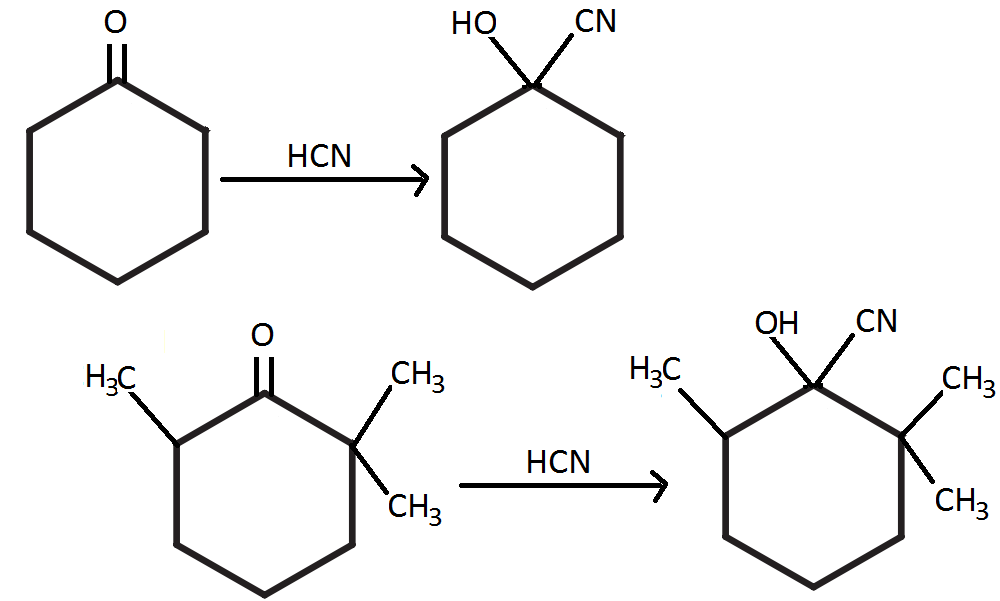
The yield of second reaction is very low because of the presence of three methyl groups at ex $-$ positions with respect to the $C = 0$, the nucleophilic attack by the $CN^- $ ion does not occur due to steric hinderance.
Since there is no such steric hindrance in cyclohexanone,
therefore, nucleophilic attack by the $CN^-$ ion occurs readily and hence cyclohexanone cyanohydrin is obtained in good yield. View full question & answer→Question 52 Marks
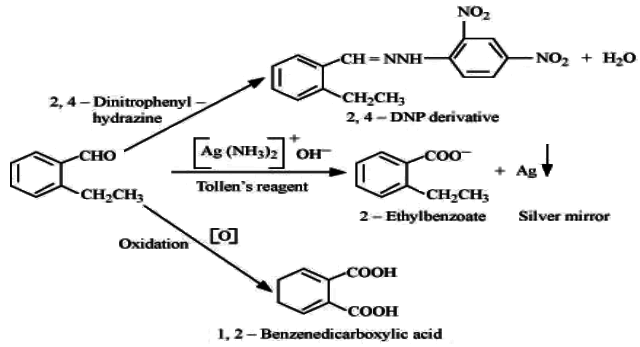
An organic compound with the molecular formula $\ce{C_9H_{10}O}$ forms $2,4-\ce{DNP}$ derivative, reduces Tollens’ reagent and undergoes Cannizzaro reaction. On vigorous oxidation, it gives $1, 2-$ benzenedicarboxylic acid. Identify the compound.
AnswerIt is given that the compound $($with molecular formula $\ce{C_9H_{10}O)}$ forms $2, 4-\ce{DNP}$ derivative and reduces Tollen's reagent.
Therefore, the given compound must be an aldehyde.
Again, the compound undergoes cannizzaro reaction and on oxidation gives $1, 2- $ benzenedicarboxylic acid.
Therefore, the $-\ce{CHO}$ group is directly attached to a benzene ring and this benzaldehyde is or tho $-$ substituted.
Hence, the compound is $2-$ ethylbenzaldehyde.
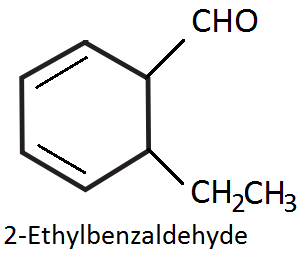
The given reactions can be explained by the following equations.
View full question & answer→Question 62 Marks
How will you convert ethanal into the following compound?But-2-enoic acid.
AnswerWhen treated with Tollen's reagent, But-2-enal produced in the above reaction produces but-2-enoicacid.$\text{CH}_3-\text{CH}=\text{CH}-\text{CHO}\xrightarrow[\text{Tollen's}\text{ reagent}]{\big[\text{Ag}(\text{NH}_3)_2\big]^+\text{OH}^-}\text{CH}_3\text{CH}=\text{CHCOOH}\\\text{But - 2 - enal}\ \ \ \ \ \ \ \ \ \ \ \ \ \ \ \ \ \ \ \ \ \ \ \ \ \ \ \ \ \ \ \ \ \ \ \ \ \ \ \ \ \ \ \ \ \ \ \ \ \ \ \ \text{But - 2 - enoic acid}$
View full question & answer→Question 72 Marks
Predict the product formed when cyclohexanecarbaldehyde reacts with following reagent.Excess ethanol and acid.
Question 82 Marks
Write structural formulas and names of four possible aldol condensation products from propanal and butanal. In each case, indicate which aldehyde acts as nucleophile and which as electrophile.
Answer
- Taking two molecules of propanal, one which acts as a nucleophile and the other as an electrophile.
$\ \ \ \ \ \ \ \ \ \ \ \ \ \ \ \ \ \ \ \ \ \ \ \ \ \ \ \ \ \ \ \ \ \ \ \ \ \ \ \ \ \ \ \ \ \ \ \ \ \ \ \ \ \ \ \ \ \ \ \ \ \ \ \ \ \text{OH}\ \ \ \ \ \text{CH}_3\\\ \ \ \ \ \ \ \ \ \ \ \ \ \ \ \ \ \ \ \ \ \ \ \ \ \ \ \ \ \ \ \ \ \ \ \ \ \ \ \ \ \ \ \ \ \ \ \ \ \ \ \ \ \ \ \ \ \ \ \ \ \ \ \ \ \ |\ \ \ \ \ \ \ \ \ \ |\\\text{2 CH}_3\text{CH}_2\text{CHO}\xrightarrow{\ \text{dil}\text{ NaOH}\ }\text{CH}_3\text{CH}_2-\text{CH}-\text{CH}-\text{CHO}\\\ \ \ \ \ \ \ \text{Propanal}\ \ \ \ \ \ \ \ \ \ \ \ \ \ \ \ \ \ \ \ \ \ \ \ \ \ \ \text{3-hydroxy-2-methylpentanal}$
- Taking two molecules of butanal, one which acts as a nucleophile and the other as an electrophile.
$\ \ \ \ \ \ \ \ \ \ \ \ \ \ \ \ \ \ \ \ \ \ \ \ \ \ \ \ \ \ \ \ \ \ \ \ \ \ \ \ \ \ \ \ \ \ \ \ \ \ \ \ \ \ \ \ \ \ \ \ \ \ \ \ \ \ \ \ \ \ \ \ \ \ \ \ \ \ \ \ \text{OH}\ \ \ \ \text{CH}_2 \text{CH}_3\\\ \ \ \ \ \ \ \ \ \ \ \ \ \ \ \ \ \ \ \ \ \ \ \ \ \ \ \ \ \ \ \ \ \ \ \ \ \ \ \ \ \ \ \ \ \ \ \ \ \ \ \ \ \ \ \ \ \ \ \ \ \ \ \ \ \ \ \ \ \ \ \ \ \ \ \ \ \ \ \ \ |\ \ \ \ \ \ \ \ \ \ |\\\text{2 CH}_3\text{CH}_2\text{CH}_2\text{CHO}\xrightarrow{\ \text{dil}\text{ NaOH}\ }\text{CH}_3\text{CH}_2\text{CH}_2-\text{CH}-\text{CH}-\text{CHO}\\\ \ \ \ \ \ \ \ \ \ \text{Butanal}\ \ \ \ \ \ \ \ \ \ \ \ \ \ \ \ \ \ \ \ \ \ \ \ \ \ \ \ \ \ \ \ \ \ \ \ \ \text{2-Ethyl-3-hydroxyhexanal}$
- Taking one molecule each of propanal and butanal in which propanal acts as a nucleophile and butanal acts as an electrophile.$\ \ \ \ \ \ \ \ \ \ \ \ \ \ \ \ \ \ \ \ \ \ \ \ \ \ \ \ \ \ \ \ \ \ \ \ \ \ \ \ \ \ \ \ \ \ \ \ \ \ \ \ \ \ \ \ \ \ \ \ \ \ \ \ \ \ \ \ \ \ \ \ \ \ \ \ \ \ \ \ \ \ \ \ \ \ \ \ \ \ \ \ \ \ \ \ \ \ \text{OH}\ \ \ \ \ \text{CH}_3\\ \ \ \ \ \ \ \ \ \ \ \ \ \ \ \ \ \ \ \ \ \ \ \ \ \ \ \ \ \ \ \ \ \ \ \ \ \ \ \ \ \ \ \ \ \ \ \ \ \ \ \ \ \ \ \ \ \ \ \ \ \ \ \ \ \ \ \ \ \ \ \ \ \ \ \ \ \ \ \ \ \ \ \ \ \ \ \ \ \ \ \ \ \ \ \ \ \ \ \ |\ \ \ \ \ \ \ \ \ \ |\\\text{CH}_3\text{CH}_2\text{CH}_2\text{CHO}+\text{CH}_3\text{CH}_2\text{CHO}\xrightarrow{\ \ \ \ \ \ \ \ }\text{CH}_3\text{CH}_2\text{CH}_2-\text{CH}-\text{CH}-\text{CHO}\\\ \ \ \ \ \ \ \text{Butanal}\ \ \ \ \ \ \ \ \ \ \ \ \ \ \ \ \ \ \ \text{Propanal}\ \ \ \ \ \ \ \ \ \ \ \ \ \ \ \ \ \ \text{3-Hydroxy-2-methylpentanal}\\ \ \ \ (\text{Electrophile})\ \ \ \ \ \ \ \ \ \ (\text{Nucleophile})$
- Taking one molecule each of propanal and butanal in which propanal acts as an electrophile and butanal acts as a nucleophile.
$\ \ \ \ \ \ \ \ \ \ \ \ \ \ \ \ \ \ \ \ \ \ \ \ \ \ \ \ \ \ \ \ \ \ \ \ \ \ \ \ \ \ \ \ \ \ \ \ \ \ \ \ \ \ \ \ \ \ \ \ \ \ \ \ \ \ \ \ \ \ \ \ \ \ \ \ \ \ \ \ \ \ \ \ \ \ \ \ \ \ \ \text{OH}\ \ \ \ \ \text{CH}_2\text{CH}_3\\ \ \ \ \ \ \ \ \ \ \ \ \ \ \ \ \ \ \ \ \ \ \ \ \ \ \ \ \ \ \ \ \ \ \ \ \ \ \ \ \ \ \ \ \ \ \ \ \ \ \ \ \ \ \ \ \ \ \ \ \ \ \ \ \ \ \ \ \ \ \ \ \ \ \ \ \ \ \ \ \ \ \ \ \ \ \ \ \ \ \ \ \ |\ \ \ \ \ \ \ \ \ \ |\\\text{CH}_3\text{CH}_2\text{CHO}+\text{CH}_3\text{CH}_2\text{CH}_2\text{CHO}\xrightarrow{\ \ \ \ \ \ \ \ }\text{CH}_3\text{CH}_2-\text{CH}-\text{CHCHO}\\\ \ \ \ \ \ \ \text{Propanal}\ \ \ \ \ \ \ \ \ \ \ \ \ \ \ \ \text{Butanal}\ \ \ \ \ \ \ \ \ \ \ \ \ \ \ \ \ \ \text{2-Ethyl-3-hydroxyhexanal}\\\ \ (\text{Electrophile})\ \ \ \ \ \ (\text{Nucleophile})$ View full question & answer→Question 92 Marks
Write the reagents used in the following reactions:
- $\text{C}_{6}\text{H}_{5}-\text{CO}-\text{CH}_{3}\xrightarrow{\text{ }\ \ \ \ \ \ {?}\ \\ \ \ \ \ \ }\text{C}_{6}\text{H}_{5}-\text{CH}_{2}-\text{CH}_{3}$
- $\text{CH}_{3}-\text{COOH}\xrightarrow{\text{ }\ \ \ \ \ \ {?}\ \\ \ \ \ \ \ }\text{CH}_{3}-\text{COCl}$
Answer
- $\ce{Zn-Hg,HCl} $ or $ \ce{H_2N–NH_2 KOH } /Glycol, \triangle $
- $\ce{PCl_5/PCl_3/SOCl_2}$
View full question & answer→Question 102 Marks
- Arrange the following compounds in increasing order of their property as indicated:
$\ce{CH_3CHO, C_6H_5CHO, HCHO}$
(reactivity towards nucleophilic addition reaction)
- $2,4-$dinitrobenzoic acid, $4-$methoxybenzoic acid, $4-$nitrobenzoic acid
$($acidic character$)$Answer
- $\ce{C_6H_5CHO3CHO}$
- $4–$Methoxybenzoic acid $ < 4–$ Nitrobenzoic acid $ < 2,4–$ Dinitrobenzoic acid.
View full question & answer→Question 112 Marks
State chemical tests to distinguish between the following pairs of compounds:
- Propanal and Propanone.
- Phenol and Benzoic acid.
Answer
- Propanal and propanone: Propanone gives yellow ppt of Iodoform $\ce{(CHI_3)}$ on addition of $\ce{NaOH/I_2}$ whereas propanal does not give this test. Or/Propanal gives Tollen’s test/or Fehling’s test whereas Propanone does not give any of this test.
- Phenol and Benzoic acid: Add neutral $\ce{FeCl_3}$ to both of them. Phenol gives violet colour.
View full question & answer→Question 122 Marks
Do the following conversions in not more than two steps:
- Propene to Acetone.
- Propanoic acid to 2-hydroxypropanoic acid.
Answer
- $\text{CH}_3\text{CH}=\text{CH}_2\xrightarrow[\text{H}^+]{\text{ }\text{ }\text{H}_2\text{O}}\text{CH}_3\text{CH(OH)CH}_3\xrightarrow[\text{CrO}_3]{\text{ }\text{ }\text{[O]}\text{ }}\text{CH}_3\text{COCH}_3$
- $\text{CH}_3\text{CH}_2\text{COOH}\xrightarrow{\text{ }\text{ }\text{Br}_2/\text{Red P}}\text{CH}_3\text{CH(Br)COOH}\xrightarrow[\text{ii)}\text{ }\text{H}^+]{\text{ }\text{i)}\text{ }\text{aq KOH or NaOH}\text{ }}\text{CH}_3\text{CH}\text{(OH)}\text{COOH}$
View full question & answer→Question 132 Marks
Write the reaction involved in the following:
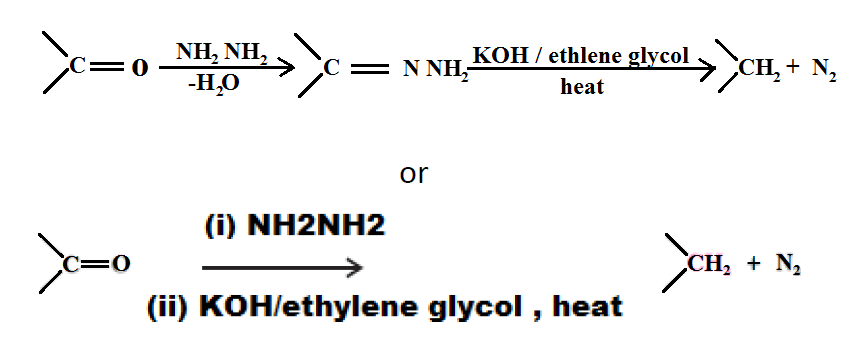
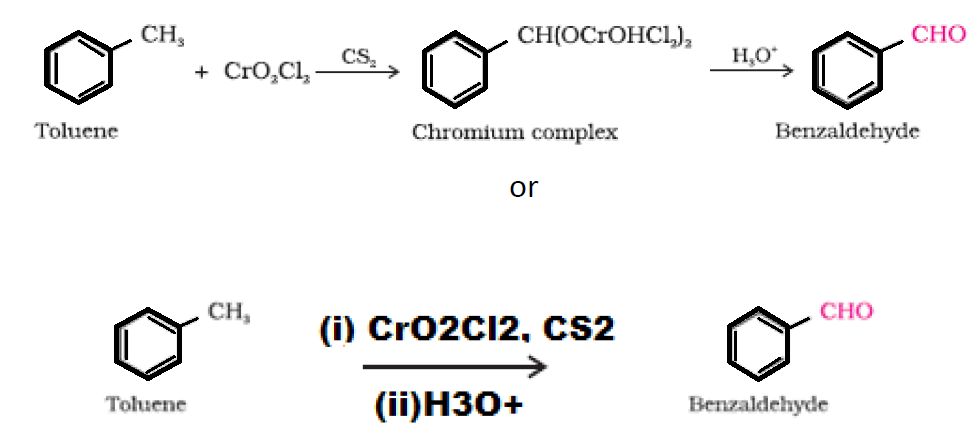
- Etard reaction.
- Wolff-Kishner reduction.
Answer
-
 Alternate Answer
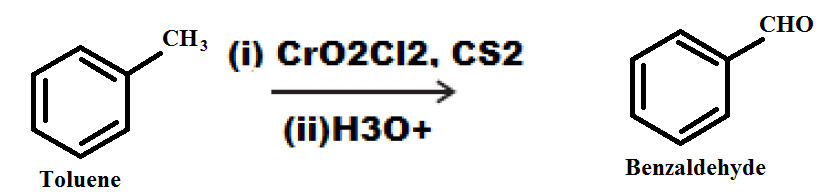
-
 Alternate Answer
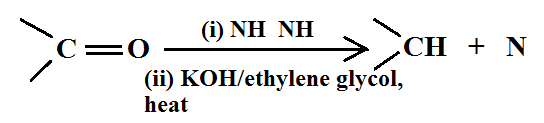
View full question & answer→Question 142 Marks
An organic compound ‘$X$’ having molecular formula $\ce{C_4H_8O}$ gives orange $-$ red ppt. with $2, 4-\ce{DNP}$ reagent. It does not reduce Tollens’ reagent but gives yellow ppt. of iodoform on heating with $\ce{NaOI}$. Compound $X$ on reduction with $\ce{LiAlH_4}$ gives compound ‘$Y$’ which undergoes dehydration reaction on heating with conc. $\ce{H_2SO_4}$ to form But $-2$-ene. Identify the compounds $X$ and $Y$.
Answer$X = \ce{CH_{3 }— CO — CH_{2 }— CH_3} /$ Butan $-2-$ one
$Y= \ce{CH_{3 }— CH(OH) — CH_{2 }— CH_3} / $Butan $-2-$ ol
View full question & answer→Question 152 Marks
Write the reactions involved in the following reactions :
- Clemmensen reduction
- Cannizzaro reaction
Question 162 Marks
Write the reactions involved in the following :
- Hell $-$ Volhard Zelinsky reaction
- Decarboxylation reaction
Answer
- Hell $-$ Volhard Zelinsky reaction: Carboxylic acid having $\alpha -$ hydrogen are halogenated at $\alpha -$ position on treatment with chlorine or bromine in the presence of red phosphorous to give $\alpha -$ halogenated carboxylic acid.
$\text{HVZ reaction}\text{ }\text{ }\text{ }\text{ }\text{ }\text{ }\text{ }\text{ }\text{ }\text{ }\text{ }\text{ }\text{ }\text{ }\text{ }\text{ }\text{ }\text{ }\text{ }\text{ }\text{ }\text{ }\text{ }\text{ }\text{ }\text{ }\text{ }\text{ }\text{ }\text{ }\text{ }\text{ }\text{ }\text{ }\text{ }\text{ }\text{ }\text{ }\text{ }\text{ }\\\text{RCH}_2\text{COOH}\xrightarrow[\text{(ii) H}_2\text{O}]{\text{(i) X}_2/\text{Red P}}\text{RCHCOOH}\\\text{ }\text{ }\text{ }\text{ }\text{ }\text{ }\text{ }\text{ }\text{ }\text{ }\text{ }\text{ }\text{ }\text{ }\text{ }\text{ }\text{ }\text{ }\text{ }\text{ }\text{ }\text{ }\text{ }\text{ }\text{ }\text{ }\text{ }\text{ }\text{ }\text{ }\text{ }\text{ }\text{ }\text{ }\text{ }\text{ }\text{ }\text{ }\text{ }\text{ }\text{ }\text{ }\text{ }\text{ }\text{ }\text{ }\text{ }\text{ }\text{ }\text{ }\text{ }\text{ }|\\\text{ }\text{ }\text{ }\text{ }\text{ }\text{ }\text{ }\text{ }\text{ }\text{ }\text{ }\text{ }\text{ }\text{ }\text{ }\text{ }\text{ }\text{ }\text{ }\text{ }\text{ }\text{ }\text{ }\text{ }\text{ }\text{ }\text{ }\text{ }\text{ }\text{ }\text{ }\text{ }\text{ }\text{ }\text{ }\text{ }\text{ }\text{ }\text{ }\text{ }\text{ }\text{ }\text{ }\text{ }\text{ }\text{ }\text{ }\text{ }\text{ }\text{ }\text{ }\text{X}$
- Decarboxylation reaction: Carboxylic acid lose $\ce{CO_2}$ to form hydrocarbons when their sodium salts are heated with sodalime $\ce{(NaOH}$ and $\ce{CaO}$ in the ratio $3:1)$. The reaction is known as decarboxylation reaction.
$\text{RCOONa}\xrightarrow[\triangle]{\text{NaOH and CaO}}\text{RH}+\text{Na}_2\text{CO}_3$ View full question & answer→Question 172 Marks
Write the equations involved in the following reactions:
- Wolff-Kishner reduction.
- Etard reaction.
Question 182 Marks
Account for the following:
- Aromatic carboxylic acids do not undergo Friedel $-$ Crafts reaction.
- $\ce{pK_a}$ value of $4-$ nitrobenzoic acid is lower than that of benzoic acid.
Answer
- Aromatic carboxylic acids undergo electrophilic substitution reactions in which the carboxyl group acts as a deactivating and meta $-$ directing group.
- They however do not undergo Friedel $–$ Crafts reaction because the carboxyl group is deactivating and the catalyst aluminium chloride $($Lewis acid$)$ gets bonded to the carboxyl group.
- Para $-$ nitro benzoic acid is more acidic than benzoic acid because of the electron-withdrawing nitro group at the para position to the acid group. The nitro group $\ce{(-NO_2)}$ withdraws the electrons from the carboxylic acid group due to which the electron density on the hydrogen atom of the carboxylic acid becomes low, and it can be easily removed. Hence, it is more acidic than benzoic acid.
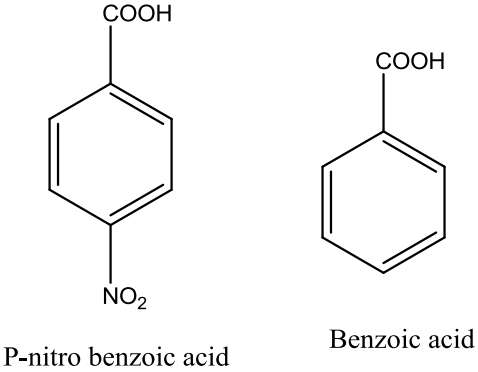
View full question & answer→Question 192 Marks
When $\ce{MnO_2}$ is fused with $\ce{KOH}$ in the presence of $\ce{KNO}_3$ as an oxidizing agent, it gives a dark green compound $(A)$. Compound $(A)$ disproportionates in acidic solution to give purple compound $(B)$. An alkaline solution of compound $(B)$ oxidises $KI$ to compound $(C)$ whereas an acidified solution of compound $(B)$ oxidises $KI$ to $(D)$. Identify $(A), (B), (C),$ and $(D).$
AnswerPotassium permanganate is prepared by fusion of $\ce{MnO}_2$ with an alkali metal hydroxide and an oxidising agent like $\ce{KNO}_{3 }$.
This produces the dark green $\ce{K_2MnO_{4 }}$ which disproportionates in a neutral or acidic solution to give permanganate.
$2\text{MnO}_2+4\text{KOH}+\text{O}_2\xrightarrow{\ \ \ \ \ \ \ \ \ \ }2\text{K}_2\text{MnO}_4+2\text{H}_2\text{O}\\\ \ \ \ \ \ \ \ \ \ \ \ \ \ \ \ \ \ \ \ \ \ \ \ \ \ \ \ \ \ \ \ \ \ \ \ \ \ \ \ \ \ \ \ \ \ \ \ \ ^{(\text{A})\text{Dark Green}}$
$3\text{MnO}^{2-}_4+4\text{H}^+\xrightarrow{\ \ \ \ \ \ \ \ \ \ }2\text{MnO}^-_4+\text{MnO}_2+2\text{H}_2\text{O}\\\ \ \ \ \ \ \ \ \ \ \ \ \ \ \ \ \ \ \ \ \ \ \ \ \ \ \ \ \ \ \ \ \ \ \ \ \ \ ^{(\text{B})\text{purple}}$
In acid solutions : Iodine is liberated from potassium iodide,
$10\text{I}^-+2\text{MnO}^-_4+16\text{H}^+\xrightarrow{\ \ \ \ \ \ \ \ \ \ }2\text{Mn}^{2+}+8\text{H}_2\text{O}+5\text{I}_2\\\ \ \ \ \ \ \ \ \ \ \ \ \ \ \ (\text{B})\ \ \ \ \ \ \ \ \ \ \ \ \ \ \ \ \ \ \ \ \ \ \ \ \ \ \ \ \ \ \ \ \ \ \ \ \ \ \ \ \ \ \ \ \ \ \ \ \ \ \ \ \ \ \ \ \ \ \ \ \ \ (\text{D})$
In neutral or faintly alkaline solution : A notable reaction is the oxidation of iodide to iodate,
$2\text{MnO}^{-}_4+\text{H}_2\text{O}+\text{I}^{-}\xrightarrow{\ \ \ \ \ \ \ \ \ \ }2\text{MnO}_2+2\text{OH}^-+\text{IO}^-_3\\\ \ \ (\text{B})\ \ \ \ \ \ \ \ \ \ \ \ \ \ \ \ \ \ \ \ \ \ \ \ \ \ \ \ \ \ \ \ \ \ \ \ \ \ \ \ \ \ \ \ \ \ \ \ \ \ \ \ \ \ \ \ \ \ \ \ \ \ \ \ \ \ \ \ \ \ (\text{C})$
View full question & answer→Question 202 Marks
Identify the compounds A, B and C in the following reaction.
$\text{CH}_3-\text{Br}\xrightarrow{\text{Mg}/\text{ether}}\text{(A)}\xrightarrow[(\text{ii})\text{Water}]{(\text{i})\text{CO}_2}\text{(B)}\xrightarrow[\triangle]{\text{CH}_3\text{OH/}\text{H}^+}\text{(C)}$
View full question & answer→Question 212 Marks
Benzaldehyde can be obtained from benzal chloride. Write reactions for obtaining benzalchloride and then benzaldehyde from it.
Question 222 Marks
Match the common names given in Column I with the IUPAC names given in Column II.
|
|
Column I
(Common names)
|
|
Column II
(IUPAC names)
|
|
(i)
|
Cinnamaldehyde
|
(a)
|
Pentanal
|
|
(ii)
|
Acetophenone
|
(b)
|
Prop-2-enal
|
|
(iii)
|
Valeraldehyde
|
(c)
|
4-Methylpent-3-en-2-one
|
|
(iv)
|
Acrolein
|
(d)
|
3-Phenylprop-2-enal
|
|
(v)
|
Mesityl oxide
|
(e)
|
1-Phenylethanone
|
Answer
|
|
Column I
(Common names)
|
|
Column II
(IUPAC names)
|
|
(i)
|
Cinnamaldehyde
|
(d)
|
3-Phenylprop-2-enal
|
|
(ii)
|
Acetophenone
|
(e)
|
1-Phenylethanone
|
|
(iii)
|
Valeraldehyde
|
(a)
|
Pentanal
|
|
(iv)
|
Acrolein
|
(b)
|
Prop-2-enal
|
|
(v)
|
Mesityl oxide
|
(c)
|
4-Methylpent-3-en-2-one
|
View full question & answer→Question 232 Marks
Match the reactions given in Column $I$ with the suitable reagents given in Column $II.$
|
|
Column $I ($Reactions$)$
|
|
Column $II ($Reagents$)$
|
| $(i)$ |
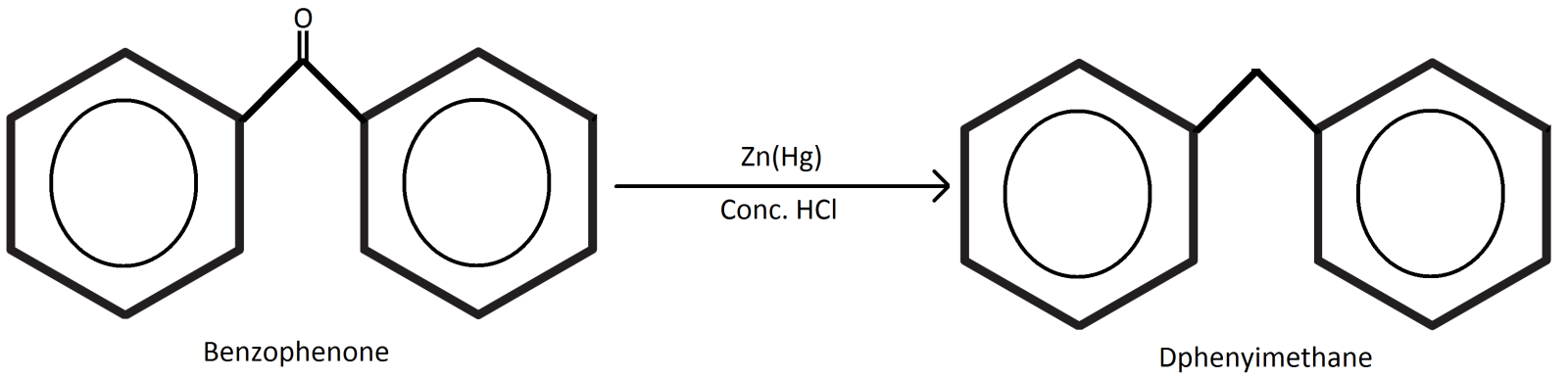
Benzophenone $\rightarrow$ Diphenylmethane
|
$(a)$ |
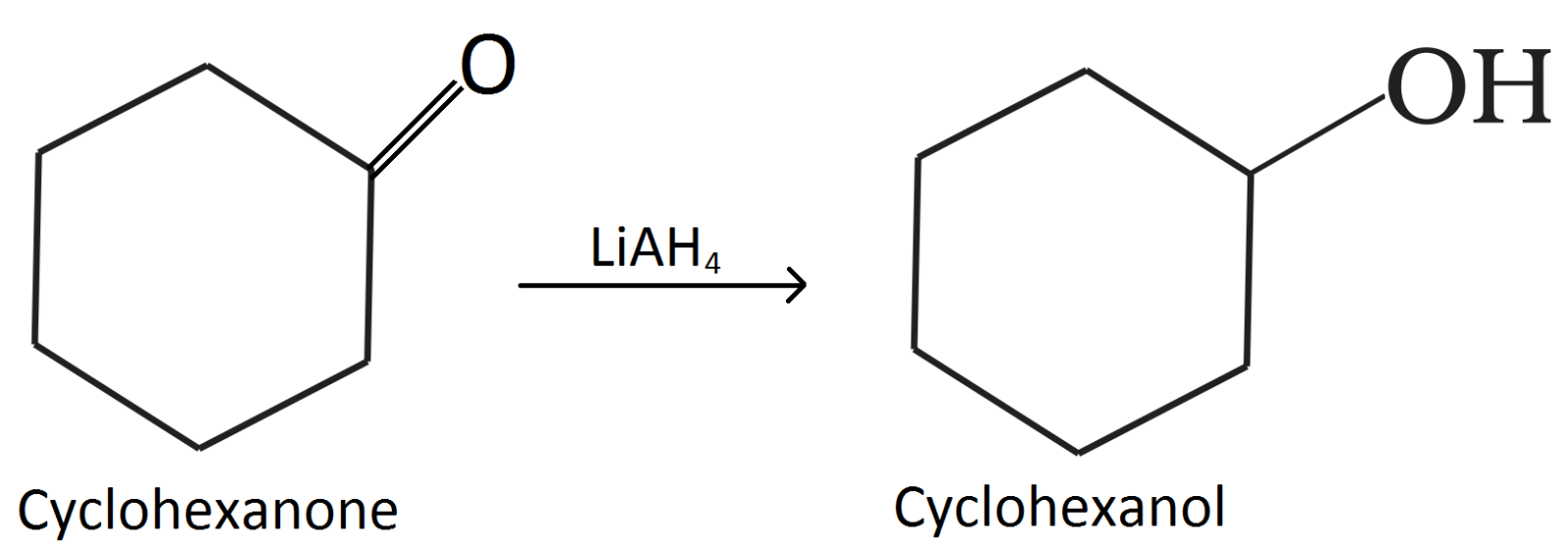
$\ce{LiAlH_4}$
|
| $(ii)$ |
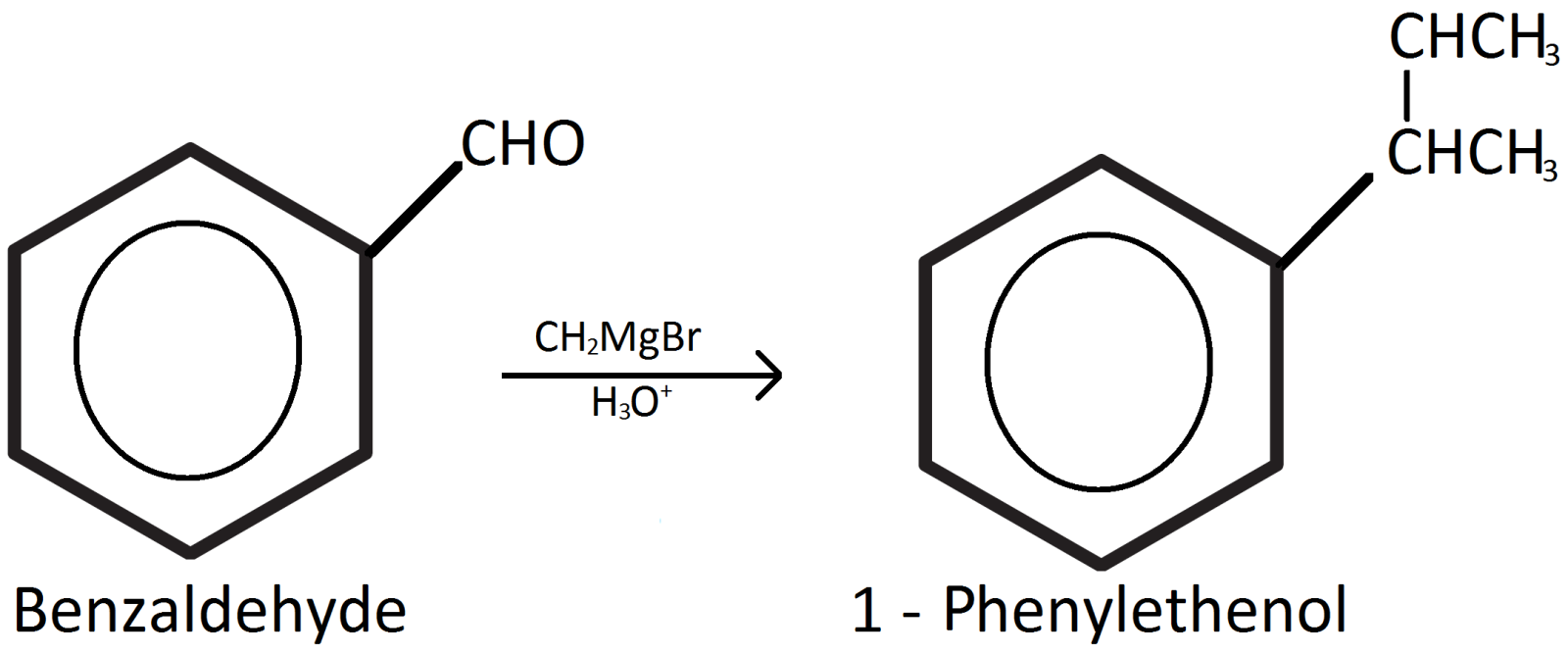
enzaldehyde $\rightarrow 1-$Phenylethanol
|
$(b)$ |
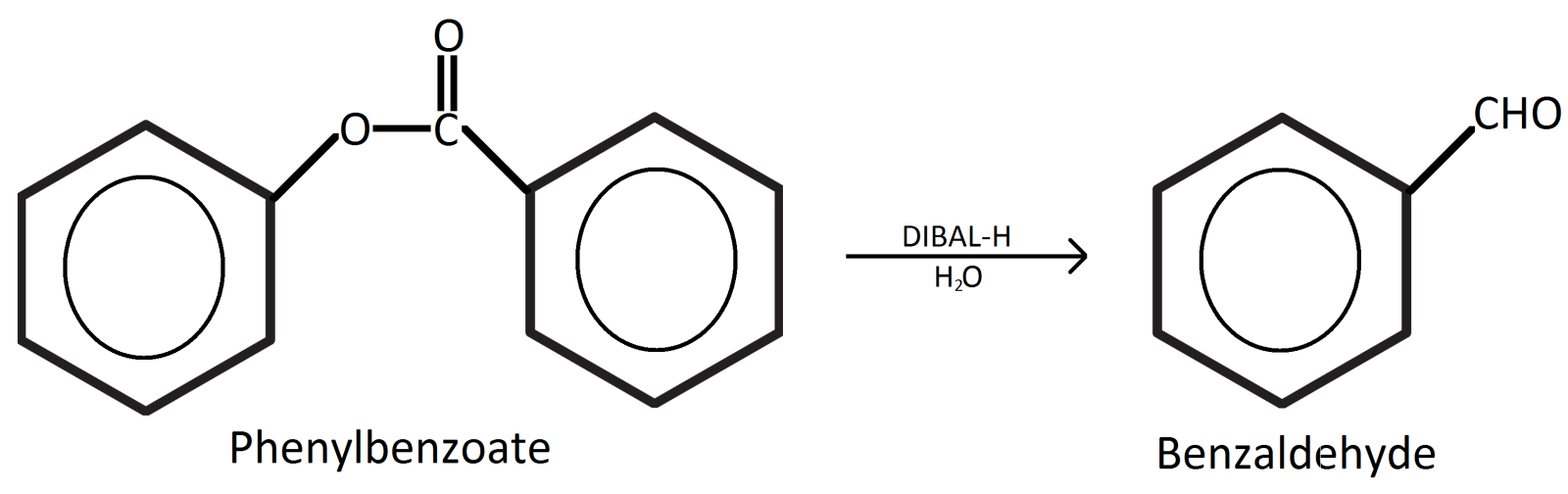
$\ce{DIBAL-H}$
|
| $(iii)$ |
Cyclohexanone $\rightarrow$ Cyclohexanol
|
$(c)$ |
$\ce{Zn(Hg)/Conc. HCl}$
|
| $(iv)$ |
Phenyl benzoate $\rightarrow$ Benzaldehyde
|
$(d)$ |
$\ce{CH_3MgBr}$
|
View full question & answer→Question 242 Marks
Arrange the following in the decreasing order of their acidic character.
- $\ce{C_6H_5COOH, FCH_2COOH, NO_2CH_2COOH}$
- $\ce{CH_3CH_2OH, CH_3COOH, ClCH_2COOH, FCH_2COOH, C_6H_5CH_2COOH}$
Answer
- $\ce{NO_2CH_2COOH > FCH_2COOH > C_6H_5COOH}$
- $\ce{FCH_2COOH > ClCH_2COOH > C_6H_5CH_2COOH > CH_3COOH > CH_3CH_2OH}$
View full question & answer→Question 252 Marks
Compound $'A\ ’$ was prepared by oxidation of compound $'B\ ’$ with alkaline $\ce{KMnO_4}.$ Compound $'A\ ’$ on reduction with lithium aluminium hydride gets converted back to compound $'B\ ’.$ When compound $'A\ ’$ is heated with compound $B$ in the presence of $\ce{H_2SO_4}$ it produces fruity smell of compound $C$ to which family the compounds $'A\ ’, 'B\ ’$ and $'C\ ’$ belong to?
Answer$'A\ '$ is carboxylic acid $\ce{(R-COOH)}, 'B\ '$ is an alcohol $\ce{(R-CH_2OH)}$ and $'C\ '$ is an ester $\ce{(RCH_2-COOR)}$
$\text{R}-\text{CH}_2\text{OH}\xrightarrow{\text{Oxidation (KMn O}_4)}\text{R}-\text{COOH}\\\ \ \ \ \ \ \ \ \ ^\text{(B)}\ \ \ \ \ \ \ \ \ \ \ \ \ \ \ \ \ \ \ \ \ \ \ \ \ \ \ \ \ \ \ \ \ \ \ \ \ \ \ \ \ \ \ \ \ \ \ \ ^\text{(A)}$
$\text{Alcohol (B)}\xleftarrow{\text{LiAlH}_4,\text{reduction}}\text{Carboxylic acid (A)}$

View full question & answer→Question 262 Marks
Complete the following reaction sequence.
$\ \ \ \ \ \ \ \ \ \ \ \ \text{O}\\\ \ \ \ \ \ \ \ \ \ \ \ \ ||\\\text{CH}_3-\text{C}-\text{CH}_3\xrightarrow[(\text{ii})\text{H}_2\text{O}]{(\text{i})\text{CH}_3\text{MgBr}}\text{(A)}\xrightarrow[\text{Ether}]{\text{Na}\ \text{Metal}}\text{(B)}\xrightarrow{\text{CH}_3-\text{Br}}\text{(C)}$
View full question & answer→Question 272 Marks
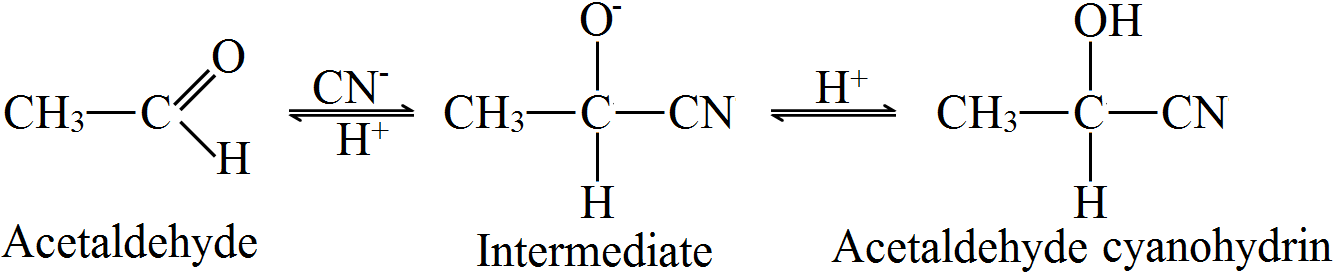
Propose the mechanism for the following reaction:
$\text{CH}_3\text{CHO}\ \ +\ \ \text{HCN}\xrightarrow{\ \ \text{a}+ }\ \ \text{CH}_3-\text{CH}-\text{CN}\\ \ \ \ \ \ \ \ \ \ \ \ \ \ \ \ \ \ \ \ \ \ \ \ \ \ \ \ \ \ \ \ \ \ \ \ \ \ \ \ \ \ \ \ \ \ \ \ \ \ \ \ \ \ \ \ \ \ \ | \\ \ \ \ \ \ \ \ \ \ \ \ \ \ \ \ \ \ \ \ \ \ \ \ \ \ \ \ \ \ \ \ \ \ \ \ \ \ \ \ \ \ \ \ \ \ \ \ \ \ \ \ \ \ \ \ \ \ \ \text{OH}$
Answer
The reaction proceeds through the nucleophilic attack of CN-ion as follows:
View full question & answer→Question 282 Marks
Answer the following question:Although phenoxide ion has more number of resonating structures than carboxylate ion, carboxylic acid is a stronger acid than phenol. Give two reasons.
AnswerResonating structures of carboxylate ion are more stable than phenoxide ion.
Negative charge is dispersing on two electronegative oxygens in carboxylate ion whereas it is on one oxygen atom in phenoxide ion.
View full question & answer→Question 292 Marks
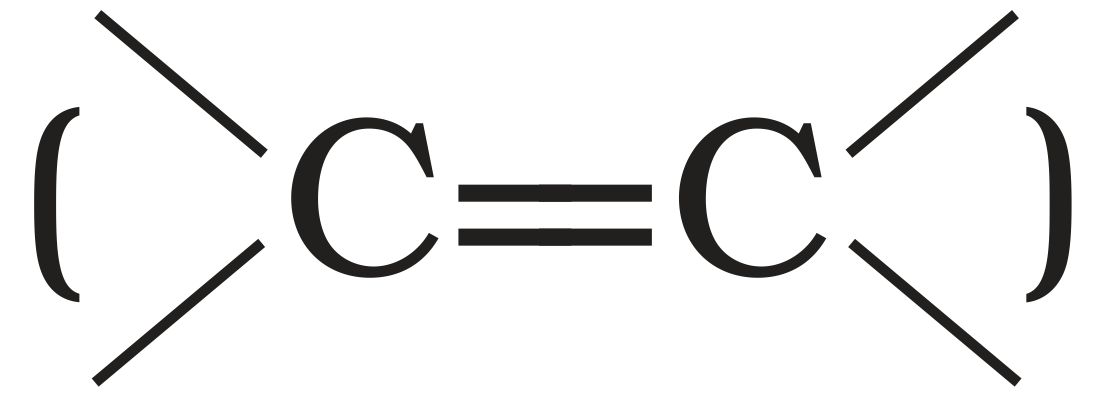
Alkenes
and carbonyl compounds
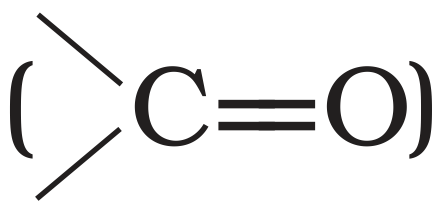
, both contain a π bond but alkenes show electrophilic addition reactions whereas carbonyl compounds show nucleophilic addition reactions. Explain.
Answer
Carbonyl group is polar in nature. Due to larger electronegativity of oxygen as compared to carbon, carbon acquires partial positive charge while O acquires partial negative charge.
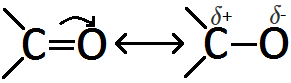
Because of slight positive charge on C atom, it is attacked by nucleophiles and, therefore, undergoes nucleophilic addition reaction.
Ethylenic double bond is a non-polar bond and is a source of electrons. Therefore, it is attacked by electrophiles and undergoes electrophilic addition reactions.
View full question & answer→Question 302 Marks
Complete the following reaction by identifying A, B and C.
$\text{A}+\text{H}_2\text{(g)}\xrightarrow{ \ \ \text{Pd/BaSO}_4\ \ }\text{(CH}_3)_2\text{CH}-\text{CHO}$
Answer$\text{A}=\text{(CH}_3)_2\text{CH}-\text{C}-\text{Cl}\\ \ \ \ \ \ \ \ \ \ \ \ \ \ \ \ \ \ \ \ \ \ \ \ \ \ \ \ \ \ \ \ \ ||\\ \ \ \ \ \ \ \ \ \ \ \ \ \ \ \ \ \ \ \ \ \ \ \ \ \ \ \ \ \ \ \ \ \text{O}$
View full question & answer→Question 312 Marks
Write the chemical equation for the following conversion (not more than 2 steps):
Acetone to propene.
Answer$\text{CH}_3-\text{C}-\text{CH}_3\xrightarrow{\text{NaBH}_4}\text{CH}_3\text{CH}-\text{CH}_3\xrightarrow[\triangle]{\text{conc. H}_2\text{SO}_4}\text{CH}_3-\text{CH}==\text{CH}_2\\ \ \ \ \ \ \ \ \ \ \ \ \ || \ \ \ \ \ \ \ \ \ \ \ \ \ \ \ \ \ \ \ \ \ \ \ \ \ \ \ \ \ \ \ \ \ \ \ | \ \ \ \ \ \ \ \ \ \ \ \ \ \ \ \ \ \ \ \ \ \ \ \ \ \ \ \ \ \ \ \ \ \ \ \ \ \ \ \ \ \ \ \ \ \ \ ^\text{Propene}\\ \ \ \ \ \ \ \ \ \ \ \ \ \text{O} \ \ \ \ \ \ \ \ \ \ \ \ \ \ \ \ \ \ \ \ \ \ \ \ \ \ \ \ \ \ \ \ \ \ \text{OH} \\ \ \ \ \ \ \ \ \ \ ^\text{Acetone}$
View full question & answer→Question 322 Marks
Arrange the following compound in increasing order of their reactivity in nucleophilic addition reaction.
Benzaldehyde, p-Tolualdehyde, p-Nitrobenzaldehyde, Acetophenone.
AnswerAcetophenone is a ketone. All the other three compounds are aldehydes. Hence, acetophenone is least reactive.
p-Tolualdehyde has an electron-donating methyl group at the para position of the benzene ring whereas p-nitrobenzaldehyde has an electron-withdrawing nitro group at the para position. Thus, p-tolualdehyde is less reactive and p nitrobenzaldehyde is more reactive than benzaldehyde.
Therefore, the required order is as follows:
Acetophenone < p-Tolualdehyde < Benzaldehyde < p-Nitrobenzaldehyde
View full question & answer→Question 332 Marks
Arrange the following in decreasing order of their acidic strength and give reason for your answer.
$\ce{CH_3CH_2OH, CH_3COOH, ClCH_2COOH, FCH_2COOH, C_6H_5CH_2COOH}$
Answer$\ce{FCH_2COOH > CICH_2COOH > C_6H_5CH_2COOH > CH_3COOH > CH_3CH_2OH}$
Effect of substituents on the acidity of carboxylic acids: Substituents may affect the stability of the conjugate base and thus, also affect the acidity of the carboxylic acids. Electron withdrawing groups increase the acidity of carboxylic acids by stabilising the conjugate base through delocalisation of the negative charge by inductive and resonance effects. Conversely, electron donating groups decrease the acidity by destabilising the conjugate base.
View full question & answer→Question 342 Marks
Complete the following reactions by identifying A, B and C.
$\ \ \ \ \ \ \ \ \ \ \ \ \ \text{CH}_3\\ \ \ \ \ \ \ \ \ \ \ \ \ \ |\\\text{CH}_3-\text{C}-\text{C}-\text{CH}_3\ +\ \text{NaOI}\ \rightarrow\ \text{B}\ +\ \text{C}\\ \ \ \ \ \ \ \ \ \ \ \ \ \ | \ \ \ \ \ \ || \ \\ \ \ \ \ \ \ \ \ \ \ \ \ \text{CH}_3\text{O}$
Answer$\ \ \ \ \ \ \ \ \ \text{CH}_3\\ \ \ \ \ \ \ \ \ \ |\\\text{B}=\text{CH}_3-\text{C}-\text{C OONa};\ \ \ \ \ \text{C}=\text{CHI}_3\\ \ \ \ \ \ \ \ \ \ |\\ \ \ \ \ \ \ \ \ \ \text{CH}_3$
View full question & answer→Question 352 Marks
Give reason for the following: Benzaldehyde reduces Tollens’ reagent but not the Fehling’s or Benedict’s solution.
AnswerDue to $+R$ effect of benzene ring, the electron density in the carbonyl group of benzaldehyde increases.
This in turn, increases the electron density in the $\ce{C—H}$ bond of aldehyde group.
As a result, the $C—H$ bond becomes stronger and hence only oxidising agent like Tollens’ agent; $\ce{Ag(NH_3)_2^+ (E^o_{Ag^+/Ag} = 0.8 V)}$ can oxidise $\ce{C—H to C—OH}$ to form carboxylic acids but weaker oxidising agents like Fehling’s solution or Benedict’s solution $\Big(\frac{\text{E}^\circ_{\text{Cu}^{2+}}}{\text{Cu}^+}=0.18\text{v}\Big)$ fail to oxidise benzaldehyde to benzoic acid.
View full question & answer→Question 362 Marks
Arrange the following compound in increasing order of their reactivity in nucleophilic addition reaction.
Ethanal, Propanal, Propanone, Butanone.
AnswerThe reactivity in nucleophilic addition reactions increases in the order:
Butanone < Propanone < Propanal < Ethanal.
View full question & answer→Question 372 Marks
Arrange the following in order of property indicated for set.
$\ce{(CH_3)_2CHCOOH, CH_3CH_2CH(Br)COOH, CH_3CH(Br)CH_2COOH } \ ($increasing order of their acid strengths$).$
Answer$\text{(CH}_3)_2\text{CHCOOH}<\text{CH}_3-\text{CH}-\text{CH}_2-\text{COOH}<\text{CH}_3-\text{CH}_2-\text{CH}-\text{COOH}\\ \ \ \ \ \ \ \ \ \ \ \ \ \ \ \ \ \ \ \ \ \ \ \ \ \ \ \ \ \ \ \ \ \ \ \ \ \ \ \ \ \ \ \ \ \ \ \ \ \ | \ \ \ \ \ \ \ \ \ \ \ \ \ \ \ \ \ \ \ \ \ \ \ \ \ \ \ \ \ \ \ \ \ \ \ \ \ \ \ \ \ \ \ \ \ \ \ \ \ \ \ \ \ \ \ \ \ \ \ \ \ \ \ \ \ |\\ \ \ \ \ \ \ \ \ \ \ \ \ \ \ \ \ \ \ \ \ \ \ \ \ \ \ \ \ \ \ \ \ \ \ \ \ \ \ \ \ \ \ \ \ \ \ \ \ \ \text{Br} \ \ \ \ \ \ \ \ \ \ \ \ \ \ \ \ \ \ \ \ \ \ \ \ \ \ \ \ \ \ \ \ \ \ \ \ \ \ \ \ \ \ \ \ \ \ \ \ \ \ \ \ \ \ \ \ \ \ \ \ \ \ \text{Br}$
View full question & answer→Question 382 Marks
Arrange the following in order of property indicated for set. $\ce{CH_3CHO, CH_3CH_2OH, CH_3OCH_3, CH_3CH_2CH_3 } \ ($increasing order of boiling points$).$
Answer$\ce{CH_3CH_2CH_3 < CH_3OCH_3 < CH_3CHO< CH_3CH_2OH}$
View full question & answer→Question 392 Marks
Arrange the following in decreasing order of their acidic strength. Give explanation for the arrangement. $\ce{C_6H_5COOH, FCH_2COOH, NO_2CH_2COOH}$
AnswerElectron withdrawing groups increase the acidity of carboxylic acids by stabilising the conjugate base through delocalisation of the negative charge by inductive and resonance effects.
View full question & answer→Question 402 Marks
Give reason for the following: $\ce{CH_3CHO}$ is more reactive than $\ce{CH_3COCH_3}$ towards reaction with $\ce{HCN}$.
AnswerThe methyl group due to its $+I$ effect reduce the magnitude of positive charge on carbonyl carbon atom.
Moreover, it also hinders the approach of nucleophile $\ce{CN^-}$.
Since in acetaldehyde there is one methyl group while in acetone there are two methyl groups attached to carbonyl group therefore acetaldehyde is more reactive than acetone towards nucleophilic addition with $\ce{HCN}$.
View full question & answer→Question 412 Marks
(a) Carboxylic acid is more acidie than phenol why?
(b) Write the IUPAC name of malonic acid.
Answer(a) Carboxylic acids are stronger acids than phenols because the carboxylate ion (conjugate base) is more stable than the phenoxide ion. In the carboxylate ion, the negative charge is delocalized over two electronegative oxygen atoms through equivalent resonance structures. In phenol, the charge is delocalized over less electronegative carbon atoms in the benzene ring, making it less stable.
(b) IUPAC name of Malonic Acid
The IUPAC name of Malonic acid is Propanedioic acid. Its formula is $HOOC - CH _2- C O O H$.
View full question & answer→