Questions

Assertion (A) & Reason (B) MCQ

Take a timed test

15 questions · 14 auto-graded MCQ + 1 self-marked written.

MCQ 11 Mark
In these questions, a statement of assertion followed by a statement of reason is given. Choose the correct answer out of the following choices.
 Assertion: Benzaldehyde undergoes aldol condensation
Reason: Aldehydes having $\alpha-$hydrogen atom undergo aldol condensation.
  • A
    Assertion and reason both are correct statements and reason is correct explanation for assertion.
  • B
    Assertion and reason both are correct statements but reason is not correct explanation for assertion.
  • C
    Assertion is correct statement but reason is wrong statement.
  • Assertion is wrong statement but reason is correct statement.

Answer
Correct option: D.
Assertion is wrong statement but reason is correct statement.
View full question & answer
MCQ 21 Mark
In these questions, a statement of assertion followed by a statement of reason is given. Choose the correct answer out of the following choices.
Assertion: Hydrogen bonding in carboxylic acids is stronger than alcohols.
Reason: Highly branched carboxylic acids are more acidic than unbranched acids.
  • A
    Assertion and reason both are correct statements and reason is correct explanation for assertion.
  • B
    Assertion and reason both are correct statements but reason is not correct explanation for assertion.
  • Assertion is correct statement but reason is wrong statement.
  • D
    Assertion is wrong statement but reason is correct statement.
Answer
Correct option: C.
Assertion is correct statement but reason is wrong statement.
Highly branched carboxylic acids are less acidic than unbranched acids. The $+I$ effect of alkyl groups in branched acid increases the magnitude of negative charge. Thus$, -\text{COOH}$ group is shielded from solvent molecules and cannot be stabilized by solvation as effectively as in unbranched carboxylic acids.
View full question & answer
MCQ 31 Mark
Note: In the following questions a statement of assertion followed by a statement of reason is given. Choose the correct answer out of the following choices.
Assertion: Aromatic aldehydes and formaldehyde undergo Cannizaro reaction.
Reason: Aromatic aldehydes are almost as reactive as formaldehyde.
  • A
    Assertion and reason both are correct and reason is correct explanation of assertion.
  • B
    Assertion and reason both are wrong statements.
  • Assertion is correct statement but reason is wrong statement.
  • D
    Assertion is wrong statement but reason is correct statement.
Answer
Correct option: C.
Assertion is correct statement but reason is wrong statement.
Aromatic aldehydes and formaldehyde do not contain a-hydrogen and thus undergo Cannizzaro’s reaction. Formaldehyde is more reactive than aromatic aldehydes.
View full question & answer
MCQ 41 Mark
Note: In the following questions a statement of assertion followed by a statement of reason is given. Choose the correct answer out of the following choices.
Assertion: Formaldehyde is a planar molecule.
Reason: It contains $sp^2$ hybridised carbon atom.
  • Assertion and reason both are correct and reason is correct explanation of assertion.
  • B
    Assertion and reason both are wrong statements.
  • C
    Assertion is correct statement but reason is wrong statement.
  • D
    Assertion is wrong statement but reason is correct statement.
Answer
Correct option: A.
Assertion and reason both are correct and reason is correct explanation of assertion.
Formaldehyde is a planar molecule because it contains $sp^2$ hybridised carbon atom.
View full question & answer
MCQ 51 Mark
Note: In the following questions a statement of assertion followed by a statement of reason is given. Choose the correct answer out of the following choices.
Assertion: Aldehydes and ketones, both react with Tollen’s reagent to form silver mirror.
Reason: Both, aldehydes and ketones contain a carbonyl group.
  • A
    Assertion and reason both are correct and reason is correct explanation of assertion.
  • B
    Assertion and reason both are wrong statements.
  • C
    Assertion is correct statement but reason is wrong statement.
  • Assertion is wrong statement but reason is correct statement.
Answer
Correct option: D.
Assertion is wrong statement but reason is correct statement.
Ketones are generally oxidised under vigorous conditions, i.e., strong oxidising agents and at elevated temperatures. Their oxidation involves carbon$-$carbon bond cleavage. The mild oxidising agents given below are used to distinguish aldehydes from ketones:
Tollen’ test: On warming an aldehyde with freshly prepared ammoniacal silver nitrate solution $($Tollen’s reagent$),$ a bright silver mirror is produced due to the formation of silver metal. The aldehydes are oxidised to corresponding carboxylate anion. The reaction occurs in alkaline medium.
$\text{RCHO}+2[\text{Ag}(\text{NH}_3)_2]^++3\stackrel{{-}}{\hbox{O}}\text{H}\rightarrow\text{RCO}\ \text{O}+2\text{Ag}+2\text{H}_2\stackrel{{-}}{\hbox{O}}+4\text{NH}_3$
View full question & answer
MCQ 61 Mark
In these questions, a statement of assertion followed by a statement of reason is given. Choose the correct answer out of the following choices.
Assertion: Fluoroacetic acid is stronger than chloroacetic acid.
Reason: Carboxylic acids are weak acids and turn blue litmus red.
  • A
    Assertion and reason both are correct statements and reason is correct explanation for assertion.
  • Assertion and reason both are correct statements but reason is not correct explanation for assertion.
  • C
    Assertion is correct statement but reason is wrong statement.
  • D
    Assertion is wrong statement but reason is correct statement.
Answer
Correct option: B.
Assertion and reason both are correct statements but reason is not correct explanation for assertion.
The $-I$ effect of $F$ is greater than inductive effect of $Cl$ and thus fluoroacetate ion is more stabilized to show more tendency to lose proton by its acid.
View full question & answer
MCQ 71 Mark
In these questions, a statement of assertion followed by a statement of reason is given. Choose the correct answer out of the following choices.
 Assertion: $m-$Chlorobenzoic acid is a stronger acid than $p-$chlorobenzoic acid.
Reason: In $m-$chlorobenzoic acid both $-I$ effect and $+R$ effect of $Cl$ operate but in $p-$chlorobenzoic acid only $+R-$effect of $Cl$ operates.
  • A
    Assertion and reason both are correct statements and reason is correct explanation for assertion.
  • B
    Assertion and reason both are correct statements but reason is not correct explanation for assertion.
  • Assertion is correct statement but reason is wrong statement.
  • D
    Assertion is wrong statement but reason is correct statement.
Answer
Correct option: C.
Assertion is correct statement but reason is wrong statement.
In $p-$chlorobenzoic acid, both $+R$ and $-I$ effect operate together but in $m-$chlorobenzoic acid only $-I$ effect operates. Therefore$, m-$chlorobenzoic acid is a stronger acid than $p-$chlorobenzoic acid.
View full question & answer
MCQ 81 Mark
In these questions, a statement of assertion followed by a statement of reason is given. Choose the correct answer out of the following choices.
Assertion: Formic acid is a stronger acid than benzoic acid.
Reason: $pK_a$ of formic acid is lower than that ofbenzoic acid.
  • A
    Assertion and reason both are correct statements and reason is correct explanation for assertion.
  • Assertion and reason both are correct statements but reason is not correct explanation for assertion.
  • C
    Assertion is correct statement but reason is wrong statement.
  • D
    Assertion is wrong statement but reason is correct statement.
Answer
Correct option: B.
Assertion and reason both are correct statements but reason is not correct explanation for assertion.
Due to overall electron-donating effect of the phenyl group, benzoate ion is less stable than formate ion.
View full question & answer
MCQ 91 Mark
In these questions, a statement of assertion followed by a statement of reason is given. Choose the correct answer out of the following choices.
 Assertion: $\alpha-$Hydrogen atoms in aldehydes and ketones are acidic.
Reason: The anion left after the removal of $\alpha-$hydrogen is stabilised by inductive effect.
  • A
    Assertion and reason both are correct statements and reason is correct explanation for assertion.
  • B
    Assertion and reason both are correct statements but reason is not correct explanation for assertion.
  • Assertion is correct statement but reason is wrong statement.
  • D
    Assertion is wrong statement but reason is correct statement.
Answer
Correct option: C.
Assertion is correct statement but reason is wrong statement.
The anion left after the removal of $\alpha-$hydrogen is stabilized by resonance effect.
View full question & answer
MCQ 101 Mark
In these questions, a statement of assertion followed by a statement of reason is given. Choose the correct answer out of the following choices.
Assertion: Presence of acids and bases activates carbonyl compounds for reaction.
Reason: Carbonyl compounds possess positive and negative centres and provide a seat for electrophilic and nucleophilic attack.
  • A
    Assertion and reason both are correct statements and reason is correct explanation for assertion.
  • Assertion and reason both are correct statements but reason is not correct explanation for assertion.
  • C
    Assertion is correct statement but reason is wrong statement.
  • D
    Assertion is wrong statement but reason is correct statement.
Answer
Correct option: B.
Assertion and reason both are correct statements but reason is not correct explanation for assertion.
Presenceofacid intensifies the partial positive charge on carbonyl carbon and hence, activates the group.
Presence of base activates et-methylene component of the carbonyl compounds by converting them in carbanions.
$\text{RCH}_2\text{CHO}+\text{:B}^-\rightarrow\text{RCH}\bar{\text{C}}\text{HO}+\text{BH}$
View full question & answer
MCQ 111 Mark
In these questions, a statement of assertion followed by a statement of reason is given. Choose the correct answer out of the following choices.
Assertion: $\ce{NaHSO_3}$ is used for the purification of carbonyl compounds.
Reason: They are used in the blending of perfumes and flavouring agents.
  • A
    Assertion and reason both are correct statements and reason is correct explanation for assertion.
  • Assertion and reason both are correct statements but reason is not correct explanation for assertion.
  • C
    Assertion is correct statement but reason is wrong statement.
  • D
    Assertion is wrong statement but reason is correct statement.
Answer
Correct option: B.
Assertion and reason both are correct statements but reason is not correct explanation for assertion.
Carbonyl compounds fonn solid additive products with $\ce{NaHSO_3}$ which are separated out. The solid bisulphites of carbonyl compounds on hydrolysis with dilute acid regenerate original carbonyl compounds and thus, this property is used for the purification of carbonyl compounds as well as for their separation.
View full question & answer
MCQ 121 Mark
In these questions, a statement of assertion followed by a statement of reason is given. Choose the correct answer out of the following choices.
Assertion: Aromatic aldehydes and formaldehyde undergo Cannizzaro reaction.
Reason: Aromatic aldehydes are almost as reactive as formaldehyde.
  • A
    Assertion and reason both are correct statements and reason is correct explanation for assertion.
  • B
    Assertion and reason both are correct statements but reason is not correct explanation for assertion.
  • Assertion is correct statement but reason is wrong statement.
  • D
    Assertion is wrong statement but reason is correct statement.
Answer
Correct option: C.
Assertion is correct statement but reason is wrong statement.
Aromatic aldehydes and formaldehyde do not contain $\alpha-$hydrogen and thus undergo Cannizzaro reaction. Formaldehyde is more reactive than aromatic aldehydes.
View full question & answer
MCQ 131 Mark
In these questions, a statement of assertion followed by a statement of reason is given. Choose the correct answer out of the following choices.
Assertion: Carboxylic acids are stabilised by resonance.
Reason: Chloroacetic acid is weaker than acetic acid.
  • A
    Assertion and reason both are correct statements and reason is correct explanation for assertion.
  • B
    Assertion and reason both are correct statements but reason is not correct explanation for assertion.
  • Assertion is correct statement but reason is wrong statement.
  • D
    Assertion is wrong statement but reason is correct statement.
Answer
Correct option: C.
Assertion is correct statement but reason is wrong statement.
Chlorine atom has $-I$ effect which increases the ionisation of chloroacetic acid and stabilizes the chloroacetate ion by dispersal of negative charge. In acetic acid, methyl group due to $+I$ effect destabilizes the acetate ion by intensification of negative charge. Hence, chloroacetic acid dissociates to a greater extent than acetic acid.
View full question & answer
MCQ 141 Mark
In these questions, a statement of assertion followed by a statement of reason is given. Choose the correct answer out of the following choices.
Assertion: Acetic acid in vapour state shows a molecular mass of $120.$
Reason: It undergoes intennolecular hydrogen bonding.
  • Assertion and reason both are correct statements and reason is correct explanation for assertion.
  • B
    Assertion and reason both are correct statements but reason is not correct explanation for assertion.
  • C
    Assertion is correct statement but reason is wrong statement.
  • D
    Assertion is wrong statement but reason is correct statement.
Answer
Correct option: A.
Assertion and reason both are correct statements and reason is correct explanation for assertion.
View full question & answer
Question 151 Mark

Read the passage given below and answer the following questions:
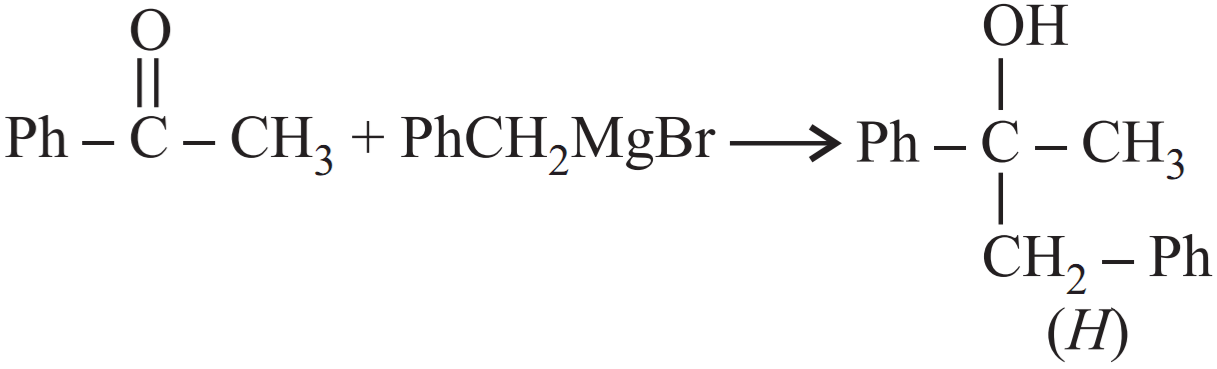
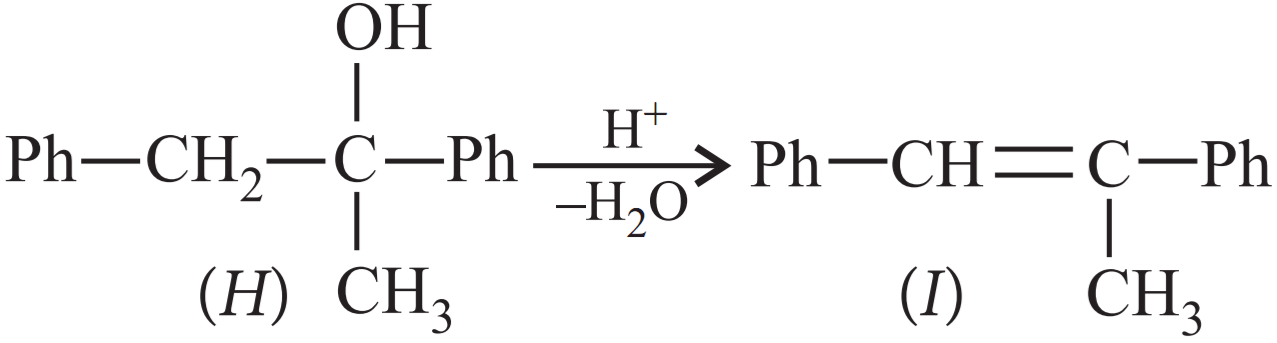
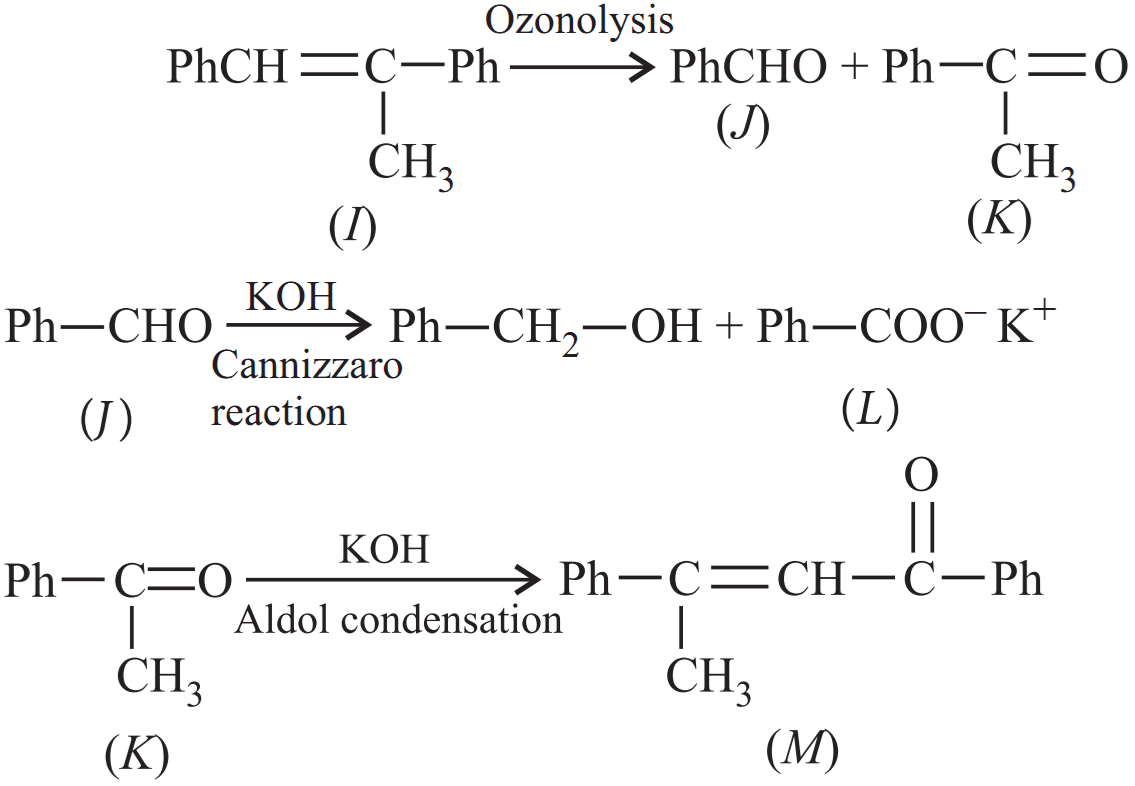
A tertiary alcohol H upon acid catalysed dehydration gives a product I. Ozonolysis of I leads to compounds J and K. Compound J upon reaction with KOH gives benzyl alcohol and a compound I, whereas K on reaction with KOH gives only M.

The following questions are multiple choice questions. Choose the most appropriate answer:
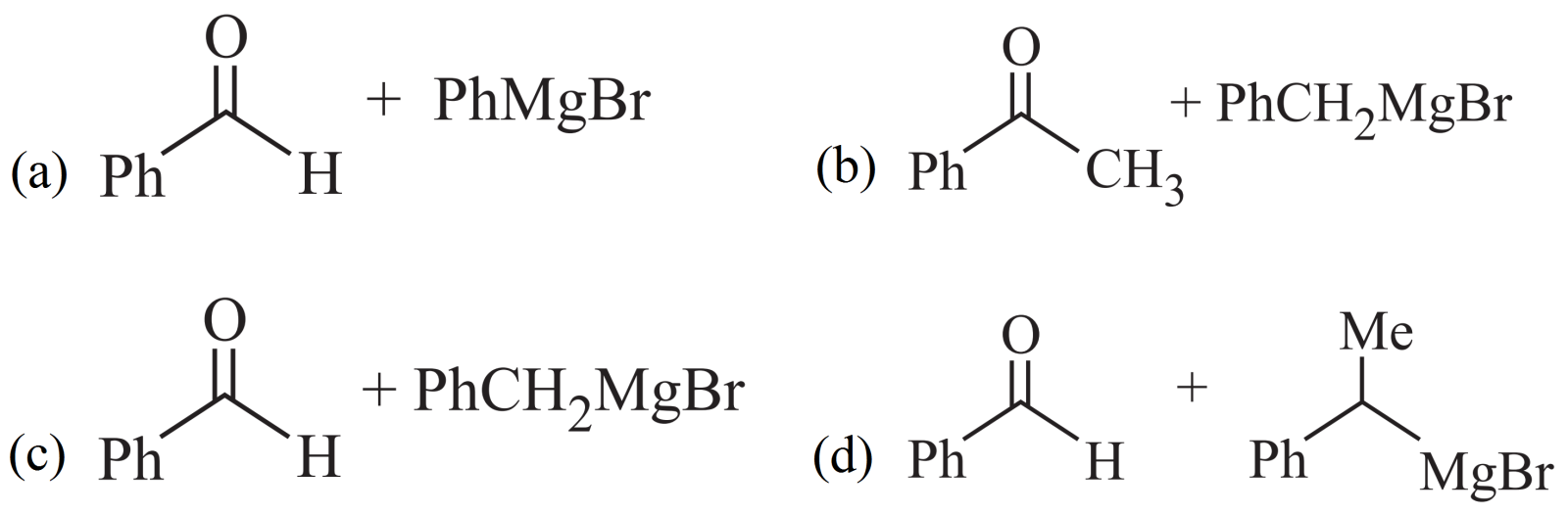
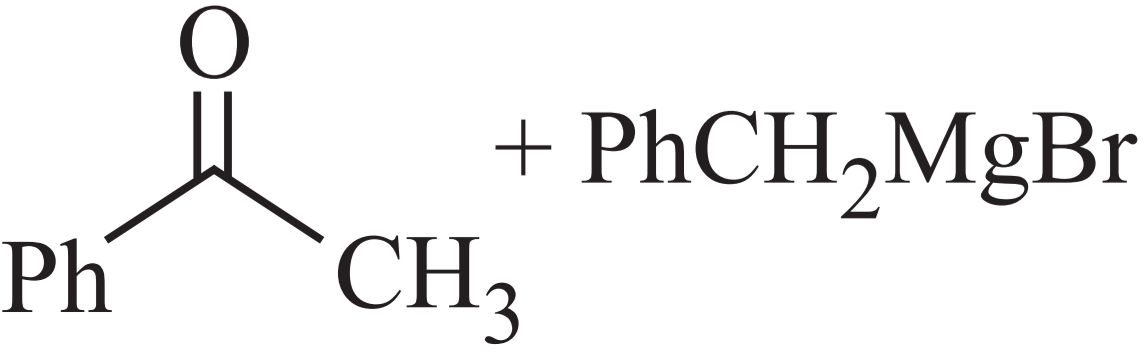
  1. Compound H is formed by the reaction of:
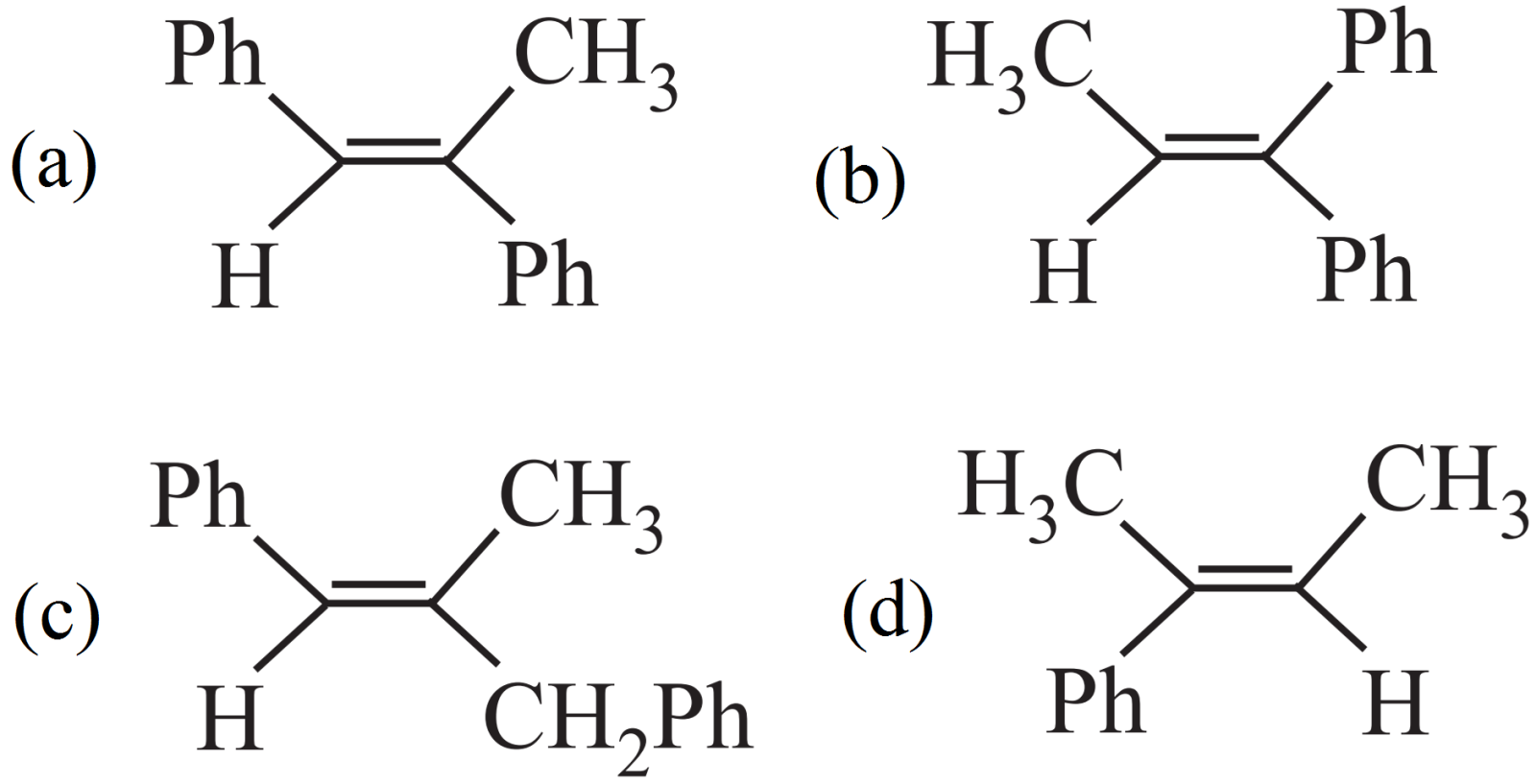
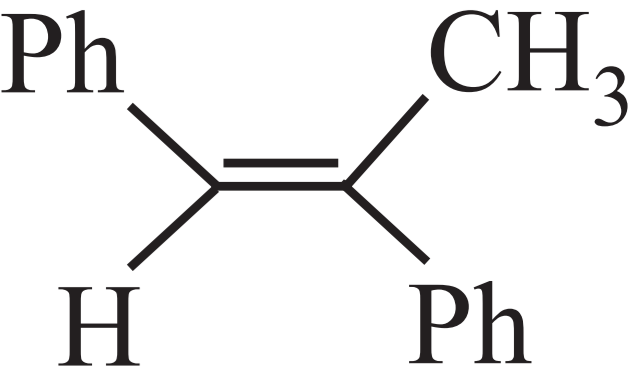
  1. The structure of compound I is:
  1. The structures of compound J, K and I, respectively, are:
  1. $\mathrm{PhCOCH}_3, \mathrm{PhCH}_2 \mathrm{COCH}_3$ and $\mathrm{PhCH}_2 \mathrm{COO}^{-} \mathrm{K}^{+}$
  2. $\mathrm{PhCHO}, \mathrm{PhCH}_2 \mathrm{CHO}$ and $\mathrm{PhCOO}^{-} \mathrm{K}^{+}$
  3. $\mathrm{PhCOCH}_3, \mathrm{PhCH}_2 \mathrm{CHO}$ and $\mathrm{CH}_3 \mathrm{COO}^{-} \mathrm{K}^{+}$
  4. $\mathrm{PhCHO}, \mathrm{PhCOCH}_3$ and $\mathrm{PhCOO}^{-} \mathrm{K}^{+}$
  1. When (J) is treated with acetic anhydride, in the presence of corresponding salt of an acid, the product obtained is:
  1. Cinnamic acid.
  2. Crotonic acid.
  3. Maleic acid.
  4. Benzylic acid.
  1. Which of the following statements is correct for compound (K)?
  1. It reacts with alkaline KMn04 followed by acidic hydrolysis and forms benzoic acid.
  2. It reacts with iodine and NaOH to form triiodomethane.
  3. It is prepared by the reaction of benzene with benzoyl chloride in presence of anhydrous aluminium chloride.
  4. It reacts with freshly prepared ammoniacal silver nitrate solution.
Answer
  1. (b)

Explanation:
  1. (a)

Explanation:
  1. (d) $\mathrm{PhCHO}, \mathrm{PhCOCH}_3$ and $\mathrm{PhCOO}^{-} \mathrm{K}^{+}$
Explanation:
  1. (a) Cinnamic acid.
Explanation:
$\text{C}_6\text{H}_5\text{CHO}+\text{(CH}_2\text{CO)}_2\text{O}\xrightarrow[\text{-CH}_3\text{COOH}]{\text{CH}_3\text{COONa}} \ \ \ \ \ \ \ \ \\\text{Benzaldehyde Acetic anhydride}$
$\text{C}_6\text{H}_5-\text{CH}=\text{CH}-\text{COOH} \ \ \ \ \ \ \ \ \ \ \ \ \ \ \ \ \ \ \ \ \\ \ \ \ \ \ \ \ \ \ \ \ \ \text{Cinnarnlc add }$
  1. (b) It reacts with iodine and NaOH to form triiodomethane.
View full question & answer