Questions

Case study (4 Marks)

Take a timed test

8 questions · self-marked practice — reveal the answer and mark yourself.

Question 14 Marks
Read the passage given below and answer the following questions:
Amines are basic in nature. The basic strength of amines can be expressed by their dissociation constant, $K_b$ or $pK_b$.
$\text{RNH}_2+\text{H}_2\text{O}\rightleftharpoons\text{RNH}^+_3+\text{OH}^-$
$\text{k}_\text{b}=\frac{[\text{RNH}^+_3][\text{OH}^-]}{[\text{RNH}_2]}\text{and}\text{ pk}_\text{b}=-\log\text{k}_\text{b}$
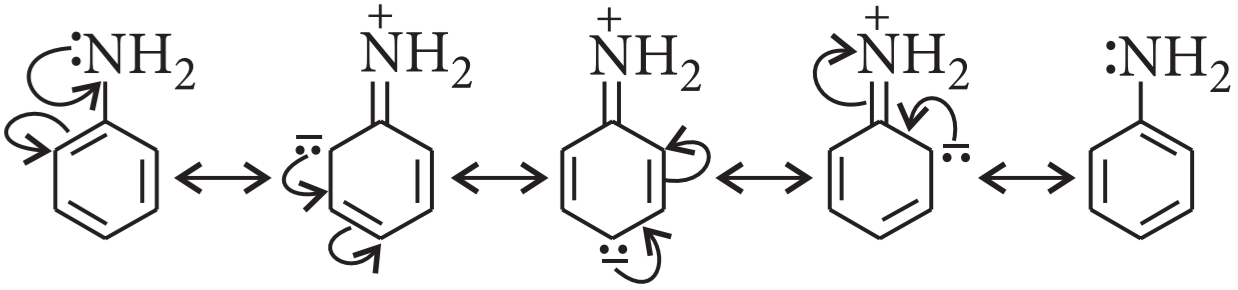
Greater the $K_b$ value or smaller the $pK_b$​​​​​​​ value, more is the basic strength of a mine. Aryl amines such as aniline are less basic than aliphatic amines due to the involvement of lone pair of electrons on N-atom with the resonance in benzene. In derivatives of aniline, the electron releasing groups increase the basic strength while electron withdrawing groups decrease the basic strength. The base weakening effect of electron withdrawing group and base strengthening effect of electron releasing group is more marked at p-position than at m-position. a-Substituted aniline is less basic than aniline due to ortho effect and is probable due to combination of electronic and steric effect.
The following questions are multiple choice questions. Choose the most appropriate answer:
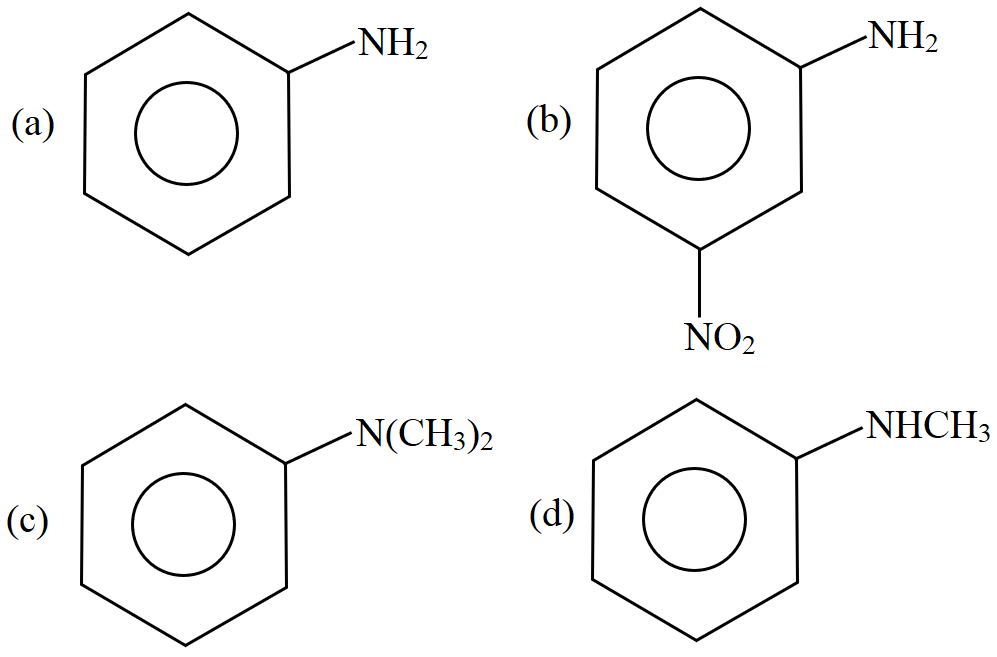

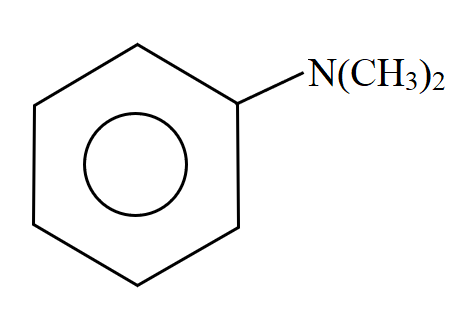
  1. Which of the following has lowest $pK_b$ value?
  1. The strongest base among the following is:
  1. $C_6H_5NH_2$
  2. $p-NO_2 - C_6H_4NH_2$
  3. $m-NO_2 - C_6H_4NH_2$
  4. $C_6H_5CH_2NH_2$
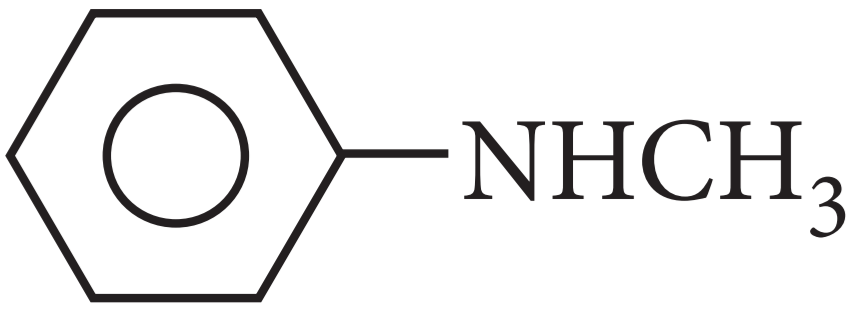
  1. Maximum $pK_b​​​​​​​$​​​​​​​ value of:
  1.  
  1.  
  1. $(CH_3CH_2)_2NH$
  2. $(CH_3)_2NH$
  1. The order of basic strength among the following amines in benzene solution is:
  1. Methylamine is more basic than $NH_3$.
  2. Amines form hydrogen bonds.
  3. Ethylamine has higher boiling point than propane.
  4. Dimethylamine is less basic than methylamine.
  1. $CH_3CH_2NH_2$ contains a basic $-NH_2$ group, but $CH_3CONH_2$​​​​​​​ does not because:
  1. Acetamide is amphoteric in character.
  2. In ethylamine the electron pair on N-atom is delocalised by resonance.
  3. In ethylamine there is no resonance while in acetamide the lone pair of electrons on N-atom is delocalised and is less available for protonation.
  4. None of these.
Answer
  1. (c)
  1. (d) $C_6H_5CH_2NH_2$
  1. (a)
  1. (d) Dimethylamine is less basic than methylamine.
Explanation:
Dimethylarnine is more basic than methyl amine.
  1. (c) In ethylamine there is no resonance while in acetamide the lone pair of electrons on N-atom is delocalised and is less available for protonation.
View full question & answer
Question 24 Marks
Read the passage given below and answer the following questions:
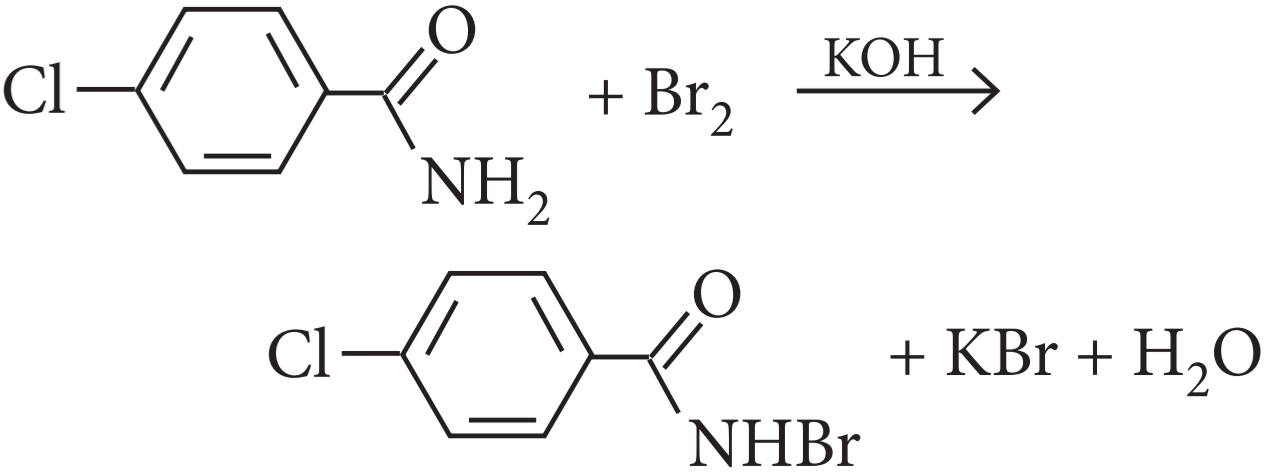
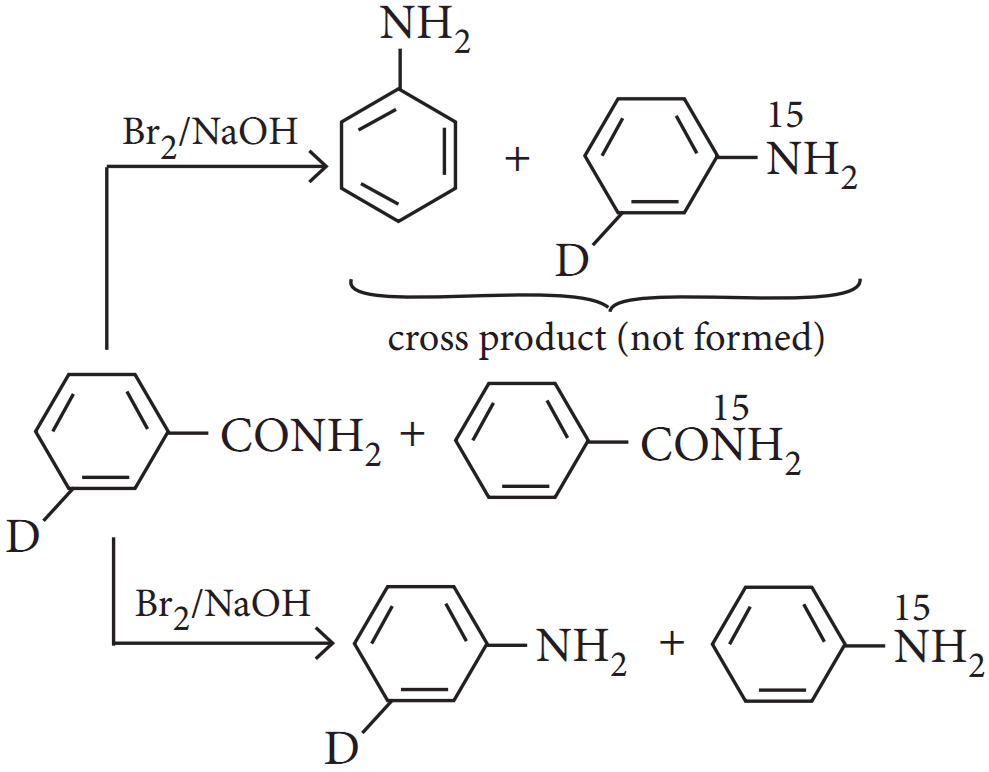
$RCONH_2$ is converted into $RNH_2$ by means of Hoffmann bromamide degradation. During the reaction amide is treated with $Br_2$ and alkali to get amine. This reaction is used to descend the series in which carbon atom is removed as carbonate ion $(\text{CO}^{2-}_3)$ Hoffmann bromide degradation reaction can be written as:

The following questions are multiple choice questions. Choose the most appropriate answer:
  1. Hoffmann bromamide degradation is used for the preparation of
  1. Primary amines.
  2. Secondary amines.
  3. Tertiary amines.
  4. Secondary aromatic amines.
  1. Which is the rate determining step in Hoffmann bromamide degradation?
  1. Formation of (i)
  2. Formation of (ii)
  3. Formation of (iii)
  4. Formation of (iv).
  1. Which of the following are used for the conversion of (i) to (ii)?
  1. $KBr$
  2. $KBr + CH_3ONa$
  3. $KBr + KOH$
  4. $Br_2 + KOH$
  1. Identify Bin the following reaction.
$\text{R}-\text{C}\equiv\text{N}\xrightarrow[\text{(Partially hydrolysis) }]{\text{Cone. HCI}}\text{A}\xrightarrow{\frac{\text{Br}_2}{\text{KOH}}}\text{B}$
  1. $RCONH_2$
  2. $RNH_2$
  3. $RNHBr$
  4. $R = N = C = O$
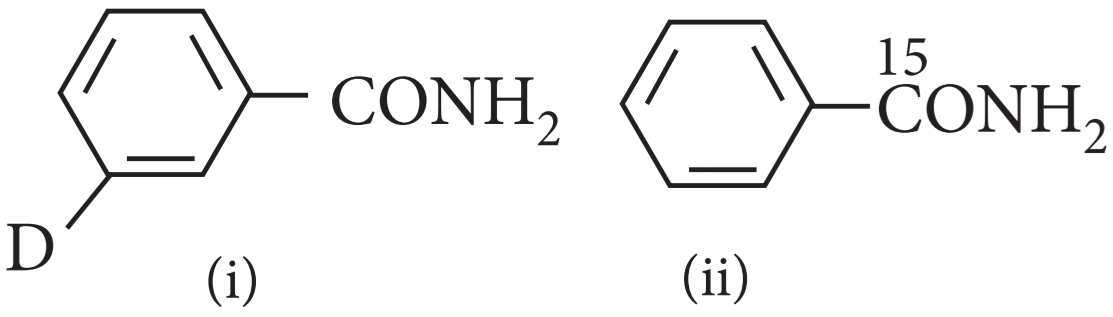
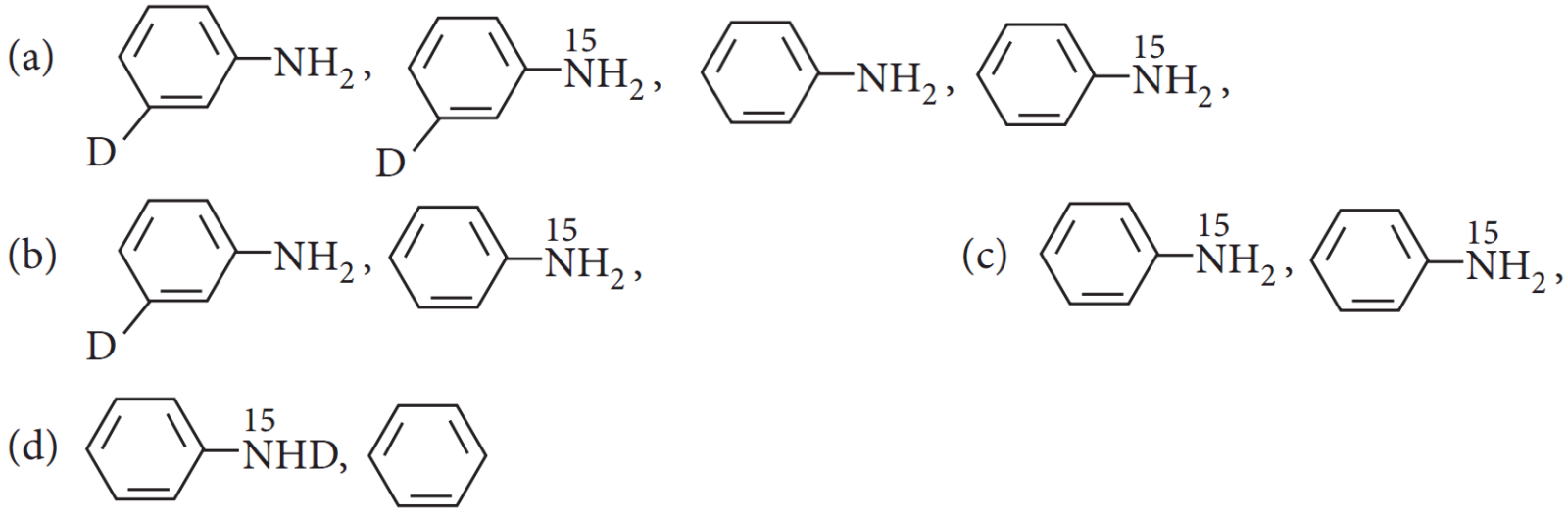
  1. What are the constituent amines formed when the mixture of (i) and (ii) undergoes Hoffmann bromamide degradation?

Answer
  1. (a) Primary amines.
  1. (d) Formation of (iv).
Explanation:
The rate determining step is probably loss of $Br^-$ to form is ocyanate as this is the slowest step.
  1. (d) $Br_2 + KOH$
Explanation:
  1. (b) $RNH_2$
Explanation:
$\ \ \ \ \ \ \ \ \ \ \ \ \ \ \ \ \ \ \ \ \ \ \ \ \ \ \ \ \ \ \ \ \ \ \ \ \ \ \ \ \ \ \ \ \ \ \ \ \ \ \ \ \ \ \ \ \ \text{O}\\\ \ \ \ \ \ \ \ \ \ \ \ \ \ \ \ \ \ \ \ \ \ \ \ \ \ \ \ \ \ \ \ \ \ \ \ \ \ \ \ \ \ \ \ \ \ \ \ \ \ \ \ \ \ \ \ \ ||\\\text{R}-\text{C}\equiv\text{N}\xrightarrow[\text{(partially hydrolysis)}]{\text{Cone. HCI}}\text{R}-\text{C}-\text{NH}_2\\\ \ \ \ \ \ \ \ \ \ \ \ \ \ \ \ \ \ \ \ \ \ \ \ \ \ \ \ \ \ \ \ \ \ \ \ \ \ \ \ \ \ \ \ \ \ \ \xrightarrow{\frac{\text{br}_2}{\text{KHO}}}\text{R}-\text{NH}_2$
  1. (b) In ethylamine there is no resonance while in acetamide the lone pair of electrons on N-atom is delocalised and is less available for protonation.
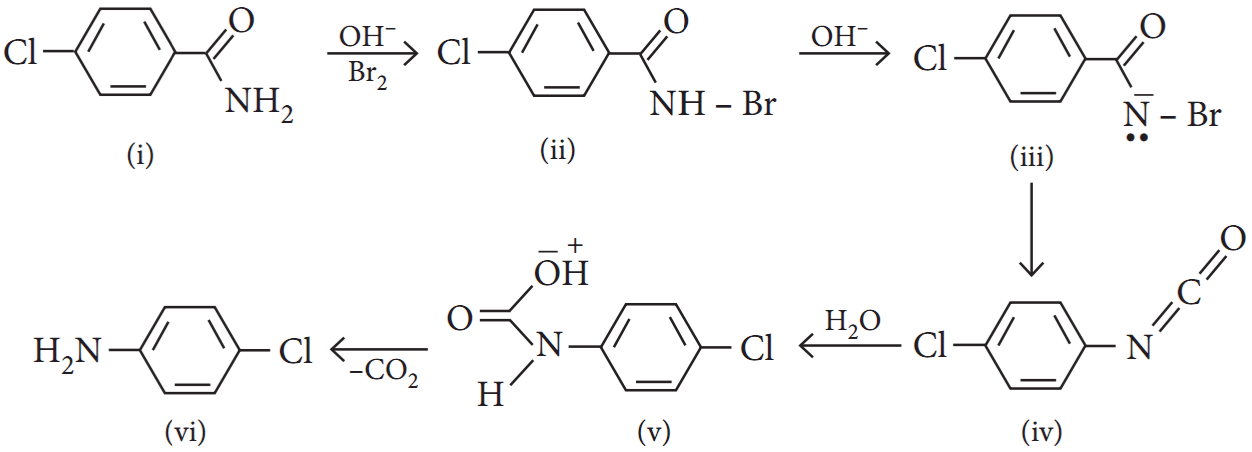
Explanation:
Since, the overall reaction is intermolecular, hence there will be no effect on product fonnation.
View full question & answer
Question 34 Marks
Read the passage given below and answer the following questions: Aniline activates the benzene ring by increasing electron density at ortho- and para-positions. Hence, it is o-, p-directing. -NH2 group strongly activates the ring therefore it is difficult to stop the reaction at monosubstitution stage. Among electrophilic substitution reaction, direct nitration of aniline is not done to get o- and p-nitroaniline because lone pair of electrons present at nitrogen atom will accept proton from nitrating mixture to give anilinium ion which is meta-directing. Aniline with $NaNO_2$ and HCI forms benzene diazonium chloride at very low temperature. Aromatic amines react with nitrous acid to form a yellow oily liquid known as N-nitrosoamines. A statement of assertion followed by a statement of reason is given. Choose the correct answer out of the following choices.
  1. Assertion and reason both are correct statements and reason is correct explanation for assertion.
  2. Assertion and reason both are correct statements but reason is not correct explanation for assertion.
  3. Assertion is correct statement but reason is wrong statement.
  4. Assertion is wrong statement but reason is correct statement.
  1. Assertion: Nitrating mixture used for carrying out nitration of benzene consists of cone. $HNO_3$ + cone. $H_2SO_4$.
Reason: In presence of $H_2SO_4, HNO_3$ acts as a base and produces $\text{NO}^+_2$ ions.
  1. Assertion: Anilinium chloride is more acidic than ammonium chloride.
Reason: Anilinium ion is not resonance-stabilised.
  1. Assertion: Nitrobenzene can be prepared from benzene by using mixture of cone. $HNO_3$ and cone. $H_2SO_4$.
Reason: In the mixture, $H_2SO_4$ act as a acid.
  1. Assertion: In strongly acidic solution, aniline becomes less reactive towards electrophilic reagents.
Reason: The amino group being completely protonated in strongly acidic solution, the lone pair of electrons on the nitrogen is no longer available for resonance.
  1. Assertion: Nitration of aniline can be done conveniently by protecting $-NH_2$ group through acetylation.
Reason: Acetylation of aniline results in the increase of electron density in the benzene ring.
Answer
  1. (a) Assertion and reason both are correct statements and reason is correct explanation for assertion.
Explanation:
$\text{HNO}_3+2\text{H}_2\text{SO}_4\rightleftharpoons2\text{HSO}^-_4+\text{NO}^+_4+\text{H}_3\text{O}^+$
  1. (c) Assertion is correct statement but reason is wrong statement.
Explanation:
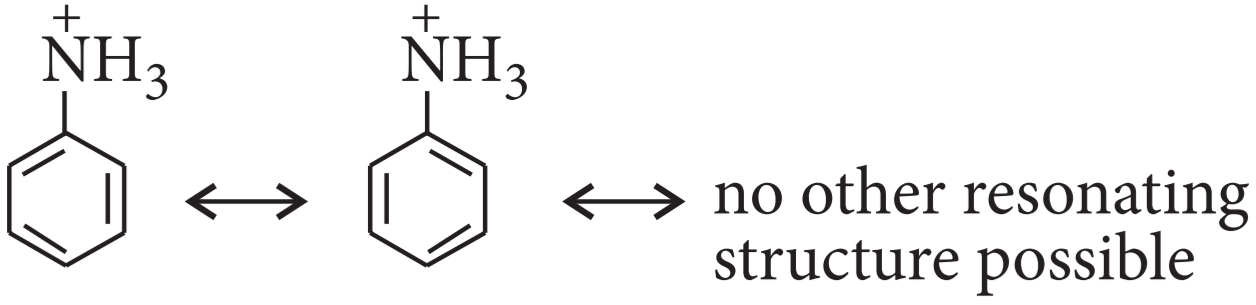
$\\\ \ \text{C}_6\text{H}_5\stackrel{{+}}{\hbox{N}}\text{H}_3\xrightarrow{\ \ \ \ \ \ \ \ \ \ \ \ }\text{C}_6\text{H}_5\text{NH}_2+\text{H}^+\\\text{anilinium ion}\ \ \ \ \ \ \ \ \ \ \ \ \ \ \text{aniline}\\\text{stronger acid}\ \ \ \ \text{weaker conjugated base}$
Aniline is weaker base than ammonium chloride. In $NH_4CI$ or aliphatic amines, the non-bonding electron pair of N is localized and is fully avail able for coordination with a proton. On the other hand, in aniline or other aromatic amines, the non-bonding electron pair is delocalised into benzene ring by resonance.

But anilinium ion is less resonance stabilised than aniline.
  1. (b) Assertion and reason both are correct statements but reason is not correct explanation for assertion.
  1. (a) Assertion and reason both are correct statements and reason is correct explanation for assertion.
  1. (c) Assertion is correct statement but reason is wrong statement.
View full question & answer
Question 44 Marks
Read the passage given below and answer the following questions:
A mixture of two aromatic compounds $(A)$ and $(B)$ was separated by dissolving in chloroform followed by extraction with aqueous $KOH$ solution. The organic layer containing compound $(A)$, when heated with alcoholic solution of KOH produce $C_7H_5N (C)$ associated with unpleasant odour.
The following questions are multiple choice questions. Choose the most appropriate answer:
  1. What is A?
  1. $C_6H_5NH_2$
  2. $C_6H_5CH_3$
  3. $C_6H_5CH_3$
  4. None of these.
  1. The reaction of $(A)$ with alcoholic solution of $KOH$ to produce $(C)$ of unpleasant odour is called:
  1. Sandmeyer reaction.
  2. Carbylamine reaction.
  3. Ullmann reaction.
  4. Reimer-Tiemann reaction..
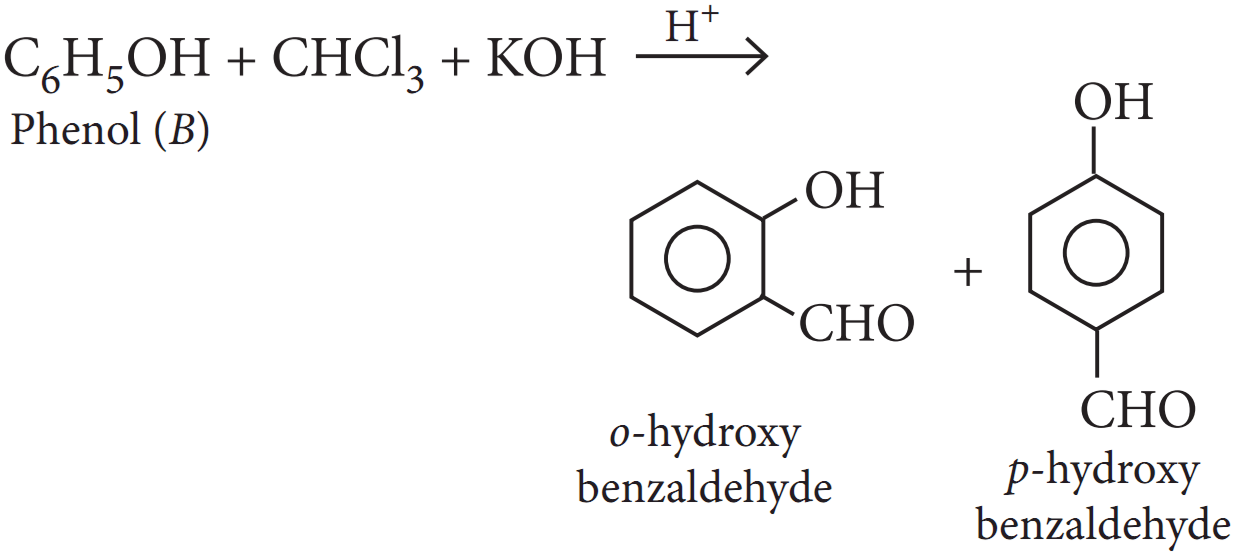
  1. The alkaline aqueous layer $(B)$ when heated with chloroform and then acidified give a mixture of isomeric compounds of molecular formula $C_7H_6O_2. (B)$ is:
  1. $C_6H_5CHO$
  2. $C_6H_5COOH$
  3. $C_6H_5CH_3$
  4. $C_6H_5OH$
  1. In the chemical reaction, $CH_3CH_2NH_2 + CHCl_3 + 3KOH \rightarrow (A)+ (B) + 3H_2O,$
  1. $C_2H_5NC$ and $KCl$
  2. $C_2H_5CN$ and $KCl$
  3. $CH_3CH_2CONH_2$ and $KCl$
  4. $C_2H_5NC$ and $K_2CO_3$
  1. Direct nitration of an aromatic compound (A) is not feasible because:
  1. The reaction cannot be stopped at the mononitration stage.
  2. A mixture of o, m and p-nitroaniline is always obtained.
  3. Nitric acid oxidises most of the aromatic compound to give oxidation products along with only a small amount of nitrated products.
  4. All of the above.
Answer
  1. (a) $C_6H_5NH_2$
Explanation:

Given, mixture of $(A)$ and $(B)$ $\xrightarrow[+\text{KOH(aq)}]{\text{CHCl}_3}$ organic layer $(A)+$ alkaline aqueous layer $(B)$ Organic layer on treating with $KOH$ (ale.) produces $(C_7H_5N) (C)$ of unpleasant odour and thus $(C)$ is $C_6H_5NC.$ Therefore, (A) is $C_6H_5NH_2.$​​​​​​​
  1. (b) Carbylamine reaction.
Explanation:

Carbylamine reaction,

$\text{C}_6\text{H}_5\text{NH}_2+\text{CHCl}_3+3\text{KOH(alc.)}\rightarrow\text{C}_6\text{H}_5\text{NC}+3\text{KCl}+3\text{H}_2\text{O}\\\ \ \ \ \text{Aniline}\ \ \ \ \ \ \ \ \ \ \ \ \ \ \ \ \ \ \ \ \ \ \ \ \ \ \ \ \ \ \ \ \ \ \ \ \ \ \ \ \ \ \ \ \text{phenyl isocyanide}$
  1. (d) $C_6H_5OH$
Explanation:

Alkaline layer on treating with $CHCl_3$ followed by acidification gives two isomers having formula $(C_7H_6O_2)$. This is Reimer-Tiemann reaction and thus $(B)$ is $C_6H_5OH.​​​​​​​$

  1. (a) $C_2H_5NC$ and $KCl$
Explanation:

$\text{CH}_3\text{CH}_2\text{NH}_2+\text{CHCl}_3+3\text{KOH}\rightarrow\text{C}_2\text{H}_5+3\text{KCl}+3\text{H}_2\text{O}$

This is called carbylamine reaction.
  1. (c) Nitric acid oxidises most of the aromatic compound to give oxidation products along with only a small amount of nitrated products.
Explanation:

Direct nitration of aniline is not a feasible process because nitric acid oxidises most of aniline to give oxidation products along with only a small amount of nitrated products.
View full question & answer
Question 54 Marks

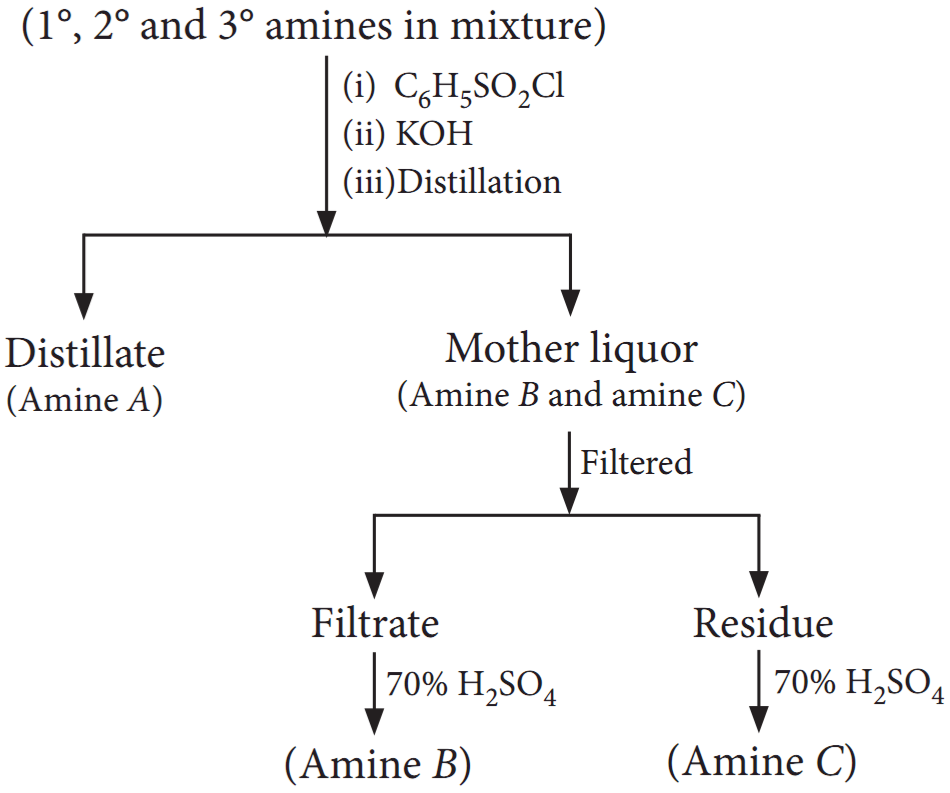
When the mixture contains the three amine salts (1º, 2º and 3º) along with quaternary salt, it is distilled with KOH solution. The three amines distill, leaving the quaternary salt unchanged in the solution. Then the mixture of amines is separated by fractional distillation, Hinsberg's method and Hoffmann's method.

The following questions are multiple choice questions. Choose the most appropriate answer:
  1. Hinsberg reagent is:
  1. Aliphatic sulphonyl chloride.
  2. Phthalamide.
  3. Aromatic sulphonyl chloride.
  4. Anhydrous ZnCl2 + cone. HCI.
  1. Primary amine with Hinsberg's reagent forms:
  1. N-alkyl benzene sulphonamide soluble in KOH solution.
  2. N-alkyl benzene sulphonamide insoluble in KOH solution.
  3. N, N-alkyl benzene sulphonamide soluble in KOH solution.
  4. N, N-alkyl benzene sulphonamide insoluble in KOH solution.
  1. Secondary amine with Hinsberg's reagent forms:
  1. N-alkyl benzene sulphonamide soluble in KOH solution.
  2. N-alkyl benzene sulphonamide insoluble in KOH solution.
  3. N,N-dialkyl benzene sulphonamide soluble in KOH solution.
  4. N,N-dialkyl benzene sulphonamide insoluble in KOH solution.
  1. To separate amines in a mixture Hoffmann's method is used. The Hoffman n's reagent is:
  1. Benzenesulphonyl chloride.
  2. Diethyl oxalate.
  3. Benzeneisocyanide.
  4. P-toulenesulphonic acid.
  1. 3º amines with Hinsberg's reagent give:
  1. No reaction.
  2. Product which is same as that of 1° amine.
  3. Product which is same as that of 2° amine.
  4. Products which is a quaternary salt.
Answer
  1. (c) Aromatic sulphonyl chloride.
  1. (a) N-alkyl benzene sulphonamide soluble in KOH solution.
Explanation:
A primary amine forms N-alkylbenzene sulphonamide which because of the presence of anacidic hydrogen on the N-atom dissolves in aqueous KOH.
  1. (d) N,N-dialkyl benzene sulphonamide insoluble in KOH solution.
Explanation:
A secondary amine forms N, N-dialkylbenzene sulphonamide which due to absence of acidic hydrogen on N-atoms does not dissolve in aqueous KOH.
  1. (b) Diethyl oxalate.
  1. (a) No reaction.
Explanation:
Tertiary amine does not contain a replaceable hydrogen on the nitrogen atom. So, 3º amine does not react with Hinsberg's reagent.
View full question & answer
Question 64 Marks
Read the passage given below and answer the following questions:
Amines are produced when an alcoholic solution of ammonia and an alkyl or a benzyl halide is heated in a sealed tube at 373K. This reaction is called ammonolysis and usually gives a mixture of primary, secondary and tertiary amines along with some quarternary ammonium salts. This reaction is an example of nucleophilic substitution reaction in which ammonia acts as a nucleophile due to the presence of a lone pair of electrons on the nitrogen atom. However this method cannot be used for the preparation of aryl amines. One of the most convenient methods for the preparation of aryl amines is reduction of nitro compounds. Aryl amines can also be prepared by reduction of nitrites or Gabriel phthalimide synthesis.
A statement of assertion followed by a statement of reason is given. Choose the correct answer out of the following choices.
  1. Assertion and reason both are correct statements and reason is correct explanation for assertion.
  2. Assertion and reason both are correct statements but reason is not correct explanation for assertion.
  3. Assertion is correct statement but reason is wrong statement.
  4. Assertion is wrong statement but reason is correct statement.
  1. Assertion: Ammonolysis of alkyl halides only produces 2° amines.
Reason: Ammonolysis of alkyl halides involves the reaction between alkyl halides and alcoholic ammonia.
  1. Assertion: Gabriel-phthalimide reaction can be used to prepare both aryl and alkyl primary amines.
Reason: Aryl halides are more reactive alkyl halides towards nucleophilic substitution reactions.
  1. Assertion: Anunonolysis method cannot be used for the preparation of aryl amines.
Reason: Aryl halides are much less reactive than alkyl halides towards nucleophilic substitution reaction.
  1. Assertion: Ammonolysis can be used to prepare pure primary amines.
Reason: Ammonolysis of haloalkanes lead to multiple ammonium salts.
  1. Assertion: Aromatic 1º amines can not be prepared by Gabriel phthalimide synthesis.
Reason: Aryl halides do not undergo nucleophilic substitution with anion formed by phthalimide.
Answer
  1. (d) Assertion is wrong statement but reason is correct statement.
Explanation:

Reaction can be used to prepare 1º, 2º, 3º amines and finally quaternary ammonium salts.
  1. (c) Assertion is correct statement but reason is wrong statement.
Explanation:

Aryl halides are less reactive than aralkyl halides towards nucleophilic substitution reactions.
  1. (a) Assertion and reason both are correct statements and reason is correct explanation for assertion.
  1. (d) Assertion is wrong statement but reason is correct statement.
Explanation:

Ammonolysis cannot be used to prepare pure primary amines. This method usually gives a mixture of primary, secondary and tertiary amines along with some quaternary ammonium salts.
  1. (a) Assertion and reason both are correct statements and reason is correct explanation for assertion.
View full question & answer
Question 74 Marks
Read the passage given below and answer the following questions: Amines are alkyl or aryl derivatives of ammonia formed by replacement of one or more hydrogen atoms. Alkyl derivatives are called aliphatic amines and aryl derivatives are known as aromatic amines. The presence of aromatic amines can be identified by performing dye test. Aniline is the simplest example of aromatic amine. It undergoeselectrophilic substitution reactions in which $-NH_2$ group strongly activates the aromatic ring through delocalisation of lone pair of electrons of N-atom. Aniline undergoes electrophilic substitution reactions. Ortho and para positions to the $-NH_2$ group become centres of high electrons density. Thus, $-NH_2$ group is ortho and para-directing and powerful activating group. The following questions are multiple choice questions. Choose the most appropriate answer:
  1. Cyclohexylamine and aniline can be distinguished by:
  1. Hinsberg test.
  2. carbylamine test.
  3. Lassaigne test.
  4. azo dye test.
  1. Which of the following compounds gives dye test?
  1. Aniline.
  2. Methyl amine.
  3. Diphenyl amine.
  4. Ethyl amine.
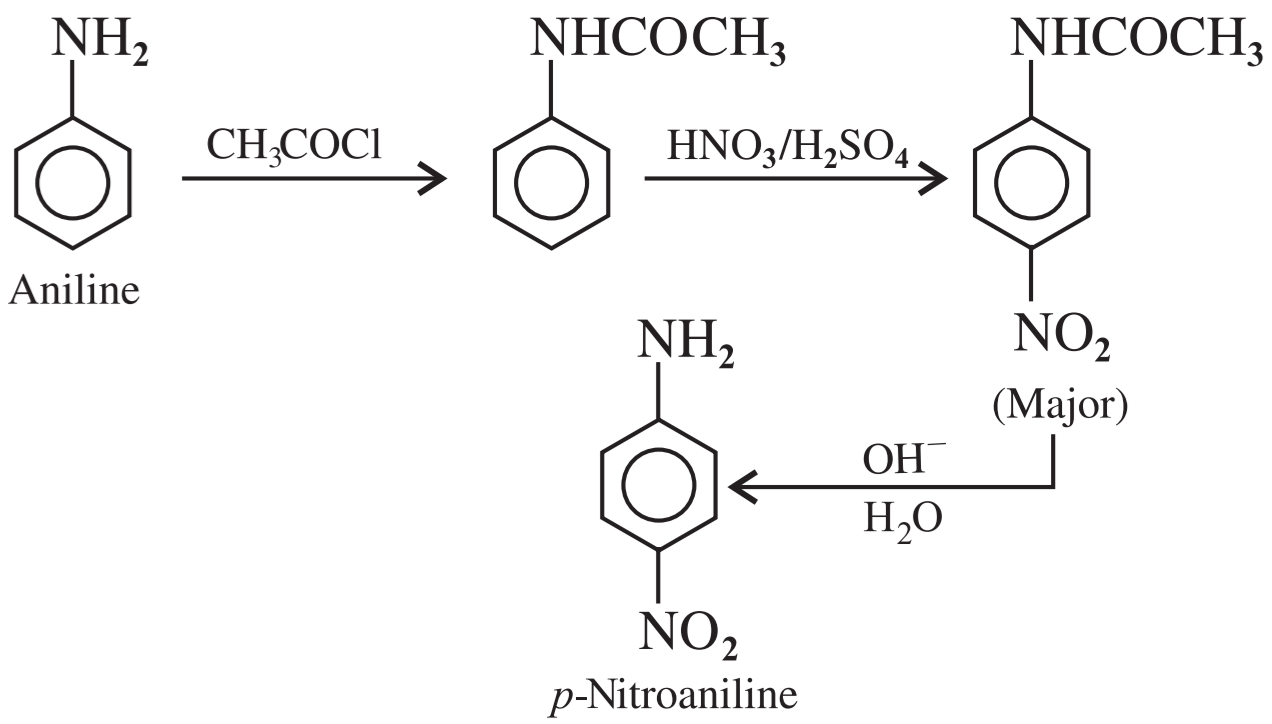
  1. Aniline when acetylated, the major product on nitration followed by alkaline hydrolysis gives:
  1. Acetanilide.
  2. o-nitroacetanitide.
  3. p-nitroaniline.
  4. m-nitroanitine.
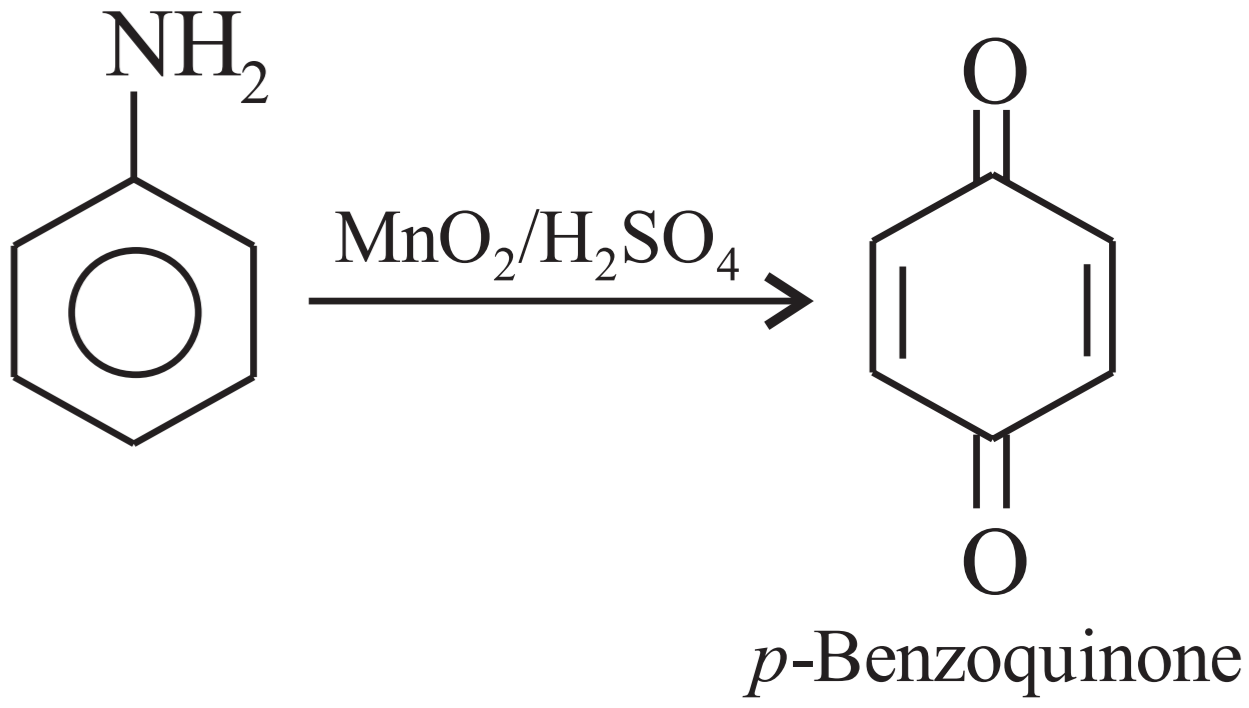
  1. Oxidation of aniline with manganese dioxide and sulphuric acid produces:
  1. Phenylhydroxylamine.
  2. Nitrobenzene.
  3. p-benzoquinone.
  4. Phenol.
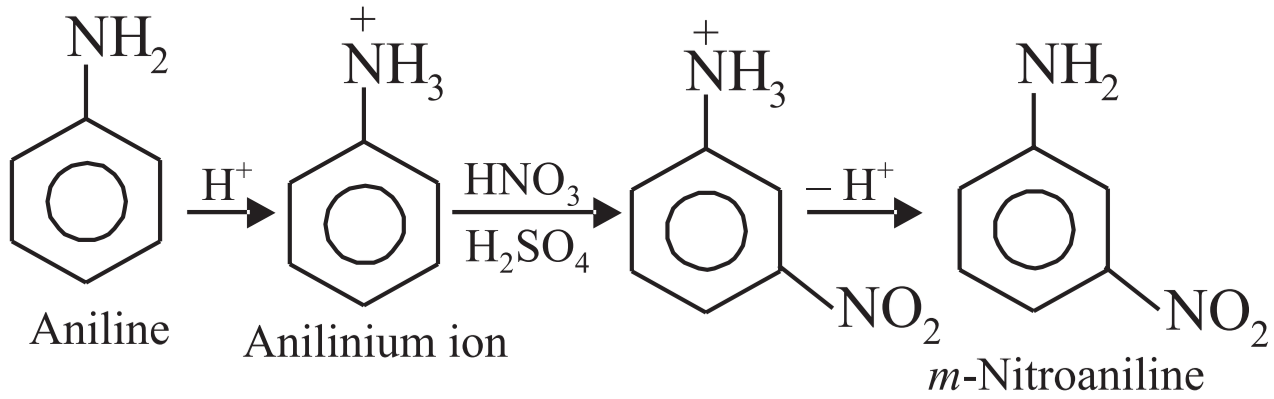
  1. Aniline when treated with cone. $HNO_3$ and $H_2S0_4$ gives:
  1. p-phenylenediamine.
  2. m-nitroaniline.
  3. p-benzoquinone.
  4. Nitrobenzene.
Answer
  1. (d) Azo dye test.
  1. (a) Aniline.
Explanation:
Aromatic primary amines give dye test.
  1. (c) p-nitroaniline.
Explanation:
  1. (c) p-benzoquinone.
Explanation:
  1. (b) m-nitroaniline.
Explanation:
In acidic medium aniline gets protonated to anilinium ion which is meta-directing.
View full question & answer
Question 84 Marks
Read the passage given below and answer the following questions: The amines are basic in nature due to the presence of a lone pair of electron on $N-$atom of the $-NH_2$ group, which it can donate to electron deficient compounds. Aliphatic amines are stronger bases than $NH_3$ because of the $+I$ effect of the alkyl groups. Greater the number of alkyl groups attached to $N-$atom, higher is the electron density on it and more will be the basicity. Thus, the order of basic nature of amines is expected to be $3^\circ > 2^\circ > 1^\circ$ , however the observed order is $2^\circ > 1^\circ > 3^\circ $. This is explained on the basis of crowding on N-atom of the amine by alkyl groups which hinders the approach and bonding by a proton, consequently, the electron pair which is present on N is unavailable for donation and hence $3^\circ$ amines are the weakest bases. Aromatic amines are weaker bases than ammonia and aliphatic amines. Electron-donating groups such as $-CH_3, -OCH_3,$ etc. increase the basicity while electron-withdrawing substitutes such as $-NO_2, -CN,$ halogens, etc. decrease the basicity of amines. The effect of these substituents is more at p than at m-positions. The following questions are multiple choice questions. Choose the most appropriate answer:
  1. Which one of the following is the strongest base in aqueous solution?
  1. Methyl amine.
  2. Tri methyl amine.
  3. Aniline.
  4. Dimethyl amine.
  1. Which order ofbasicity is correct?
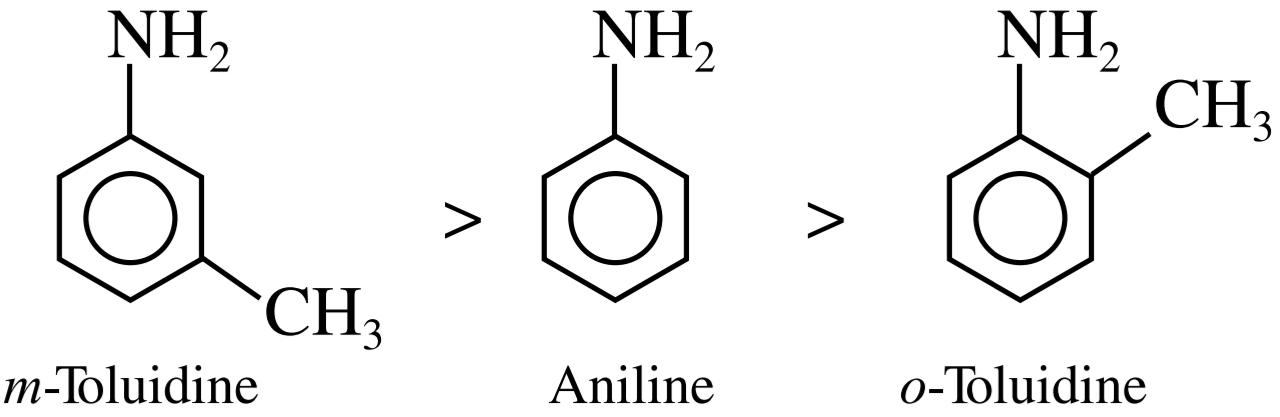
  1. Aniline > m-toluidine > o-toluidine
  2. Aniline> o-toluidine > m-toluidine
  3. o-toluidine > aniline> m-toluidine
  4. o-toluidine < aniline < m-toluidine
  1. What is the decreasing order of basicity of primary, secondary and tertiary ethylamines and $NH_3?$
  1. $NH_3 > C_2H_5NH_2 > (C_2H_5)_2NH > (C_2H_5)_3N$
  2. $(C_2H_5)_3N > (C_2H_5)_2NH_> C_2H_5NH_2 > NH_3$
  3. $(C_2H_5)_2NH > C_2H_5NH_2> (C_2H_5)_3N > NH_3$
  4. $(C_2H_5)_2NH > (C_2H_5)_3N > C_2H_5NH_2 > NH_3$
  1. The order of basic strength among the following amines in benzene solution is:
  1. $CH_3NH_2 > (CH_3)_3N > (CH_3)_2NH$
  2. $(CH_3)_3N > (CH_3)_2NH > CH_3NH_2$
  3. $CH_3NH_2 > (CH_3)_2NH > (CH_3)_3N$
  4. $(CH_3)_3N > CH_3NH_2 > (CH_3)_2NH$
  1. Choose the correct statement.
  1. Methylamine is slightly acidic.
  2. Methylamine is less basic than ammonia.
  3. Methylamine is a stronger base than ammonia.
  4. Methylamine forms salts with alkalies.
Answer
  1. (d) Dimethyl amine.
Explanation:
The increasing order of basicity of the given compounds is $(CH_3)_2NH > CH_3NH_2 > (CH_3)_3N > C_6H_5NH_2.$ Due to the +I effect of alkyl groups, the electron density on nitrogen increases and thus, the availability of the lone pair of electrons to proton increases and hence, the basicity of amines also increases. So, aliphatic amines are more basic than aniline. ln case of tertiary amine $(CH_3)_3N,$ the covering of alkyl groups over nitrogen atom from all sides makes the approach and bonding by a proton relatively difficult, hence the basicity decreases. Electron withdrawing groups decrease electron density on nitrogen atom and thereby decreasing basicity.
  1. (d) o-toluidine < aniline < m-toluidine
Explanation:
In general, electron donating $( +R)$ group which when present on benzene ring $(-NH_2, -OR, -R, etc.)$ at the para position increases the basicity of aniline.
Ortho substituted anilines are weaker bases than aniline due to ortho effect.
  1. (d) $(C_2H_5)_2NH > (C_2H_5)_3N > C_2H_5NH_2 > NH_3$
Explanation:
In case of ethylamines, the combined effect of (c) inductive effect, steric effect and salvation effect gives the order of basic strength as
$(\text{C}_2\text{H}_5)_2\text{NH}>(\text{C}_2\text{H}_5)_3\text{N}>\text{C}_2\text{H}_5\text{NH}_2>\text{NH}_3\\\ \ \ \ \ \ \ \ (2^\circ)\ \ \ \ \ \ \ \ \ \ \ \ \ \ \ \ \ \ (3^\circ)\ \ \ \ \ \ \ \ \ \ \ \ \ (1^\circ)$
  1. (b) $(CH_3)_3N > (CH_3)_2NH > CH_3NH_2$
Explanation:
In non-aqueous solvents the basic strength of alkyl amines follows the order:
tertiary amines> secondary amines> primary amines.
  1. (c) Methylamine is a stronger base than ammonia.
Explanation:
Methyl amine is stronger base than ammonia due to electron releasing inductive effect of methyl group.
View full question & answer