Question
Read the passage given below and answer the following questions: The amines are basic in nature due to the presence of a lone pair of electron on $N-$atom of the $-NH_2$ group, which it can donate to electron deficient compounds. Aliphatic amines are stronger bases than $NH_3$ because of the $+I$ effect of the alkyl groups. Greater the number of alkyl groups attached to $N-$atom, higher is the electron density on it and more will be the basicity. Thus, the order of basic nature of amines is expected to be $3^\circ > 2^\circ > 1^\circ$ , however the observed order is $2^\circ > 1^\circ > 3^\circ $. This is explained on the basis of crowding on N-atom of the amine by alkyl groups which hinders the approach and bonding by a proton, consequently, the electron pair which is present on N is unavailable for donation and hence $3^\circ$ amines are the weakest bases. Aromatic amines are weaker bases than ammonia and aliphatic amines. Electron-donating groups such as $-CH_3, -OCH_3,$ etc. increase the basicity while electron-withdrawing substitutes such as $-NO_2, -CN,$ halogens, etc. decrease the basicity of amines. The effect of these substituents is more at p than at m-positions. The following questions are multiple choice questions. Choose the most appropriate answer:
  1. Which one of the following is the strongest base in aqueous solution?
  1. Methyl amine.
  2. Tri methyl amine.
  3. Aniline.
  4. Dimethyl amine.
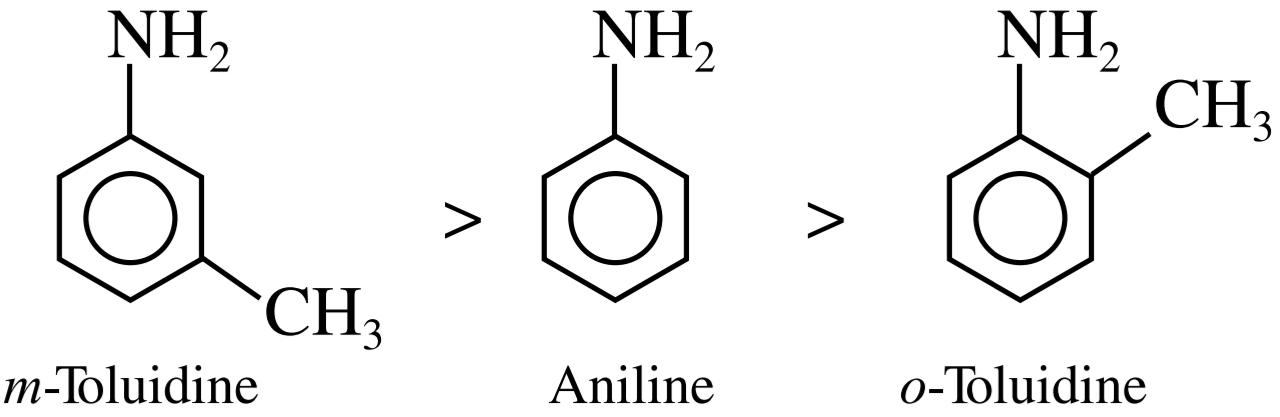
  1. Which order ofbasicity is correct?
  1. Aniline > m-toluidine > o-toluidine
  2. Aniline> o-toluidine > m-toluidine
  3. o-toluidine > aniline> m-toluidine
  4. o-toluidine < aniline < m-toluidine
  1. What is the decreasing order of basicity of primary, secondary and tertiary ethylamines and $NH_3?$
  1. $NH_3 > C_2H_5NH_2 > (C_2H_5)_2NH > (C_2H_5)_3N$
  2. $(C_2H_5)_3N > (C_2H_5)_2NH_> C_2H_5NH_2 > NH_3$
  3. $(C_2H_5)_2NH > C_2H_5NH_2> (C_2H_5)_3N > NH_3$
  4. $(C_2H_5)_2NH > (C_2H_5)_3N > C_2H_5NH_2 > NH_3$
  1. The order of basic strength among the following amines in benzene solution is:
  1. $CH_3NH_2 > (CH_3)_3N > (CH_3)_2NH$
  2. $(CH_3)_3N > (CH_3)_2NH > CH_3NH_2$
  3. $CH_3NH_2 > (CH_3)_2NH > (CH_3)_3N$
  4. $(CH_3)_3N > CH_3NH_2 > (CH_3)_2NH$
  1. Choose the correct statement.
  1. Methylamine is slightly acidic.
  2. Methylamine is less basic than ammonia.
  3. Methylamine is a stronger base than ammonia.
  4. Methylamine forms salts with alkalies.
Answer

  1. (d) Dimethyl amine.
Explanation:
The increasing order of basicity of the given compounds is $(CH_3)_2NH > CH_3NH_2 > (CH_3)_3N > C_6H_5NH_2.$ Due to the +I effect of alkyl groups, the electron density on nitrogen increases and thus, the availability of the lone pair of electrons to proton increases and hence, the basicity of amines also increases. So, aliphatic amines are more basic than aniline. ln case of tertiary amine $(CH_3)_3N,$ the covering of alkyl groups over nitrogen atom from all sides makes the approach and bonding by a proton relatively difficult, hence the basicity decreases. Electron withdrawing groups decrease electron density on nitrogen atom and thereby decreasing basicity.
  1. (d) o-toluidine < aniline < m-toluidine
Explanation:
In general, electron donating $( +R)$ group which when present on benzene ring $(-NH_2, -OR, -R, etc.)$ at the para position increases the basicity of aniline.
Ortho substituted anilines are weaker bases than aniline due to ortho effect.
  1. (d) $(C_2H_5)_2NH > (C_2H_5)_3N > C_2H_5NH_2 > NH_3$
Explanation:
In case of ethylamines, the combined effect of (c) inductive effect, steric effect and salvation effect gives the order of basic strength as
$(\text{C}_2\text{H}_5)_2\text{NH}>(\text{C}_2\text{H}_5)_3\text{N}>\text{C}_2\text{H}_5\text{NH}_2>\text{NH}_3\\\ \ \ \ \ \ \ \ (2^\circ)\ \ \ \ \ \ \ \ \ \ \ \ \ \ \ \ \ \ (3^\circ)\ \ \ \ \ \ \ \ \ \ \ \ \ (1^\circ)$
  1. (b) $(CH_3)_3N > (CH_3)_2NH > CH_3NH_2$
Explanation:
In non-aqueous solvents the basic strength of alkyl amines follows the order:
tertiary amines> secondary amines> primary amines.
  1. (c) Methylamine is a stronger base than ammonia.
Explanation:
Methyl amine is stronger base than ammonia due to electron releasing inductive effect of methyl group.

Need a full question paper?

Generate a complete, print-ready paper with questions like this in minutes — across 16+ boards, with answer keys.

Start Generating Free

Similar questions

Read the passage given below and answer the following questions:
Ozone is an unstable, dark blue diamagnetic gas. It absorbs the UV radiation strongly, thus protecting the people on earth from the harmful UV-radiation from the sun. The use of chlorofluorocarbon (CFC) in aerosol and refrigerators and their subsequent escape into the atmosphere, is blamed for making holes in the ozone layer over the Antarctica. Ozone acts as a strong oxidising agent in acidic and alkaline medium. for this property, ozone is used as a germicide and disinfectant for sterilizing water. It is also used in laboratory for the ozonolysis of organic compounds and in industry for the manufacture of potassium permanganate, artificial silk, etc.
The following questions are multiple choice questions. Choose the most appropriate answer:
  1. Which of the following statements is not correct for ozone?
  1. lt oxidises lead sulphide.
  2. It oxidises potassium iodide.
  3. It oxidises mercury.
  4. It cannot act as bleaching agent in dry state.
  1. Ozone gives carbonyl compounds with.
  1. Alkyl chloride
  2. Alkanes
  3. Alkenes followed by decomposition with $\frac{\text{Zn}}{\text{H}_2\text{O}}.$
  4. Alcohols followed by decomposition with $\frac{\text{Zn}}{\text{H}_2\text{O}}.$
  1. Ozone reacts with moist iodine gives.
  1. $HI$
  2. $HIO_3$
  3. $I_2O_5$
  4. $I_2O_4$
  1. Ozone acts as an oxidising agent due to.
  1. Iiberation of nascent oxygen.
  2. Iiberation of nascent oxygen.
  3. Both $(a)$ and $(b).$
  4. Both $(a)$ and $(b).$
  1. The colour of ozone molecule is:
  1. White.
  2. Blue.
  3. Pale green.
  4. Pale yellow.
Read the passage given below and answer the following questions:
When a protein in its native form, is subjected to physical changes like change in temperature or chemical changes like change in pH, the hydrogen bonds are disturbed. Due to this, globules unfold and helix get uncoiled and protein loses its biological activity. This is called denaturation of protein.
The denaturation causes change in secondary and tertiary structures but primary structures remains intact. Examples of denaturation of protein are coagulation of egg white on boiling, curdling of milk, formation of cheese when an acid is added to milk.
The following questions are multiple choice questions. Choose the most appropriate answer:
  1. Mark the wrong statement about denaturation of proteins.
  1. The primary structure of the protein does not change.
  2. Globular proteins are converted into fibrous proteins.
  3. Fibrous proteins are converted into globular proteins.
  4. The biological activity of the protein is destroyed.
  1. Which structure(s) of proteins remains(s) intact during denaturation process?
  1. Both secondary and tertiary structures.
  2. Primary structure only.
  3. Secondary structure only.
  4. Tertiary structure only.
  1. $\alpha$-helix and $\beta$-pleated structures of proteins are classified as:
  1. Primary structure.
  2. Secondary structure.
  3. Tertiary structure.
  4. Quaternary structure.
  1. Cheese is a:
  1. Globular protein.
  2. Conjugated protein.
  3. Denatured protein.
  4. Derived protein.
  1. Secondary structure of protein refers to:
  1. Mainly denatured proteins and structure of prosthetic groups.
  2. Three-dimensional structure, especially the bond between amino acid residues that are distant from each other in the polypeptide chain.
  3. Linear sequence of amino acid residues in the polypeptide chain.
  4. Regular folding patterns of continuous portions of the polypeptide chain.
In these questions, a statement of assertion followed by a statement of reason is given. Choose the correct answer out of the following choices.
Assertion: Gases are easily adsorbed on the surface of metals especially transition metals.
Reason: Transition metals have free valencies.
Read the passage given below and answer the following questions:
In ideally ionic structures, the coordination numbers of the ions are determined by electrostatic considerations. Cations surround themselves with as many anions as possible, and vice versa. This maximizes the attractions between neighbouring ions of opposite charge and hence maximizes the lattice energy of the crystal. This requirement led to the formulation of the radius ratio rule for ionic structures, in which the ions and the structure adopted for a particular compound depend on the relative sizes of the ions. Thus, for the stable ionic crystalline structures, there is definite radius ratio limit for a cation to fit perfectly in the lattice of anions, called radius ratio rule. This depends upon the ratio of radii of two types of ions $\frac{\text{r}_+}{r}$This ratio for coordination numbers $3, 4, 6$ and $8$ are respectively $0.155 - 0.225, 0.225 - 0.414, 0.414 - 0.732$ and $0.732 - 1.000$. The coordination number of ionic solids also depends upon temperature and pressure. On applying high pressure, coordination number increases. On the other hand, on applying high temperature, it decreases.
The following questions are multiple choice questions. Choose the most appropriate answer:
  1. The ionic radii of $K^+,Rb^+$ and $Br-$ are $137, 148$ and $195$pm. The coordination number of cation in RbBr and KBr structures are respectively.
  1. $8, 6$
  2. $6, 4$
  3. $6, 8$
  4. $4, 6$
  1. For a coordination number $4,$ the maximum limiting radius ratio is.
  1. $0.414$
  2. $0.732$
  3. $0.225$
  4. $0.155$
  1. If the radius of $Na^+$ ion is 95 pm and that of $Cl^-$ ion is $181$  pm, the coordination number of $Na^+$ ion is.
  1. $6$
  2. $4$
  3. $8$
  4. $12$
  1. Which is not the correct statement for ionic solids, in which positive and negative ions are held by strong electrostatic attractive forces?
  1. The radius ratio $\frac{\text{r}_+}{r}$ increases as coordination number increases.
  2. As the difference in size of ions increases, coordination number increases.
  3. When coordination number is eight, $\frac{\text{r}_+}{r}$ ratio lies between $0.225$ to $0.414.$
  4. In ionic solid of the type AX (ZnS, wurtzite), the coordination number of $Zn^2$ and $S^2$- respectively are $4 $and $4.$
  1. If the pressure of CsCl is increased, then its coordination number will.
  1. Increase
  2. Remain the same
  3. Decrease
  4. None of these.
Read the passage given below and answer the following questions:
Nitric acid reacts with most of the metals (except noble metals like gold and platinum) and non-metals. Towards its reaction with metals. $HNO_3$ acts as an acid as well as an oxidising agent. Like other acids, $HNO_3$ liberate nascent hydrogen from metals which further reduces the nitric acid into number of products like $NO, NO_2, N_{2O}$ or $NH_3.$ The different stages of reduction of nitric acid are:
$\ \ _{+5}\ \ \ \ \ \ \ \ \ \ \ \ \ \ \ \ \ \ _{+4}\ \ \ \ \ \ \ \ \ \ \ \ \ \ \ \ \ \ _{+2}\ \ \ \ \ \ \ \ \ \ \ \ \ \ \ _{+1}\ \ \ \ \ \ \ \ \ \ \ \ \ \ \ \ \ _{-3}\\\text{HNO}_3\xrightarrow{\ \ \ \ +\text{e}\ \ \ \ }\text{NO}_2\xrightarrow{\ \ \ \ +2\text{e}^-}\text{NO}\xrightarrow[\text{NaOH}]{\ \ \ \ +\text{e}^-}\text{N}_2\text{O}\xrightarrow{\ \ \ \ +4\text{e}^-}\text{NH}_3$
The product of the reduction of $HNO_3$ depends upon the nature of the metal, concentration of nitric acid and temperature.
The following questions are multiple choice questions. Choose the most appropriate answer:
  1. Which of the following reactions is used to prepare laughing gas?
  1. $Pb +$ dil. $HNO_3 \rightarrow$
  2. $Hg +$ dil. $HNO_3 \rightarrow$
  3. $Zn +$ dil. $HNO_3 \rightarrow$
  4. $Cu +$ dil. $HNO_3 \rightarrow$
  1. Gold and platinum does not dissolve in $HNO_3$ but soluble in $1 : 3$ mixture of $HNO_3$ and $HCl$ due to the formation of respectively.
  1. $Au(NO_3)_2, [Pt(NO_3)_2]$
  2. $H[AuCl_4J, H_2[PtCl_6]$
  3. $[AuCl_6]^{2-}, [PtCl_2)^{2-}$
  4. $[Au(NO_3)_4], [Pt(NO_3)_6]^{2-}$
  1. Identify B in the following reaction.
$\text{Cu}+\text{HNO}_{3{\text{(conc.)}}}\xrightarrow{\ \ \ \ }\ \ \ \ \ \ (\text{A})\ \ \ \ \ \ \ +\ \ \ \ \ \ \ (\text{B})+\text{H}_2\text{O}\\\ \ \ \ \ \ \ \ \ \ \ \ \ \ \ \ \ \ \ \ \ \ \ \ \ \ \ \ \ \ \ \ {\text{Deep blue colour}}\ \ \ \ \ \ \ \text{Gas}$
  1. $NO_2$
  2. $N_2$
  3. $NO$
  4. $N_2O$
  1. In which of the following reactions $HNO_3$ will not act as an oxidising agent?
  1. $HNO_3 + H_2SO_4 \rightarrow$
  2. $HNO_3 + FeS0_4 + H_2S0_4 \rightarrow$
  3. $KI + HNO_3 \rightarrow$
  4. $Au + HNO_3\rightarrow$
  1. When dil. $HNO_3$ reacts with Hg, which gas will liberate?
  1. $N_2$
  2. $O_2$
  3. $NO$
  4. $NO_2$
Read the passage given below and answer the following questions:
If some solute is added to a solvent, the boiling point of solution increases. This is known as elevation in baiting point.
$\Delta\text{T}_\text{b}=\text{K}_\text{b}\text{m}$ where, $K_b =$ Molal elevation constant,
$\Delta\text{T}_\text{b}\propto\text{m}$
Hence, it is a colligative property,
Also, $\text{K}_\text{b}=\frac{\text{MRT}^2_\text{b}}{\Delta\text{Vap}\text{H}\times1000}$
where, $M =$ Molar mass of solvent,
$\Delta\text{vap}$ $H = $Enthalpy of vaporisation,
Molar mass can also be calculated using elevation in boiling point.
$\text{M}_\text{B}=\frac{\text{K}_\text{B}\times\text{W}_\text{B}\times1000}{\Delta\text{T}_\text{b}\times\text{W}_\text{A}}$
A statement of assertion followed by a statement of reason is given. Choose the correct answer out of the following choices.
  1. Assertion and reason both are correct statements and reason is correct explanation for assertion.
  2. Assertion and reason both are correct statements but reason is not correct explanation for assertion.
  3. Assertion is correct statement but reason is wrong statement.
  4. Assertion is wrong statement but reason is correct statement.
  1. Assertion: In a pressure cooker, the water is brought to boil. The cooker is then removed from the stove. Now on removing the lid of pressure cooker, the water starts boiling again.
Reason: The impurities in water bring down its boiling point.
  1. Assertion: On dissolving $3.24g$ of sulphur in $40g$ of benzene, boiling point of solution get higher than that of benzene by $0.081K$, then the formula of sulphur is $S_8. (K_b$ for benzene $= 2.53K\ kg\ mol^{-1})$
Reason: Molecular mass of sulphur comes out to be $253.$
  1. Assertion: When sugar is added to water, boiling point of water increases.
Reason: When a non-volatile solute is added to a solvent, elevation in boiling point is observed.
  1. Assertion: Cooking time in pressure cookers is reduced.
Reason: Boiling point inside the pressure cooker in raised.
  1. Assertion: Elevation in boiling point of two isotonic solutions is same.
Reason: Boiling point depends upon the concentration of the solute.
Read the passage given below and answer the following questions:
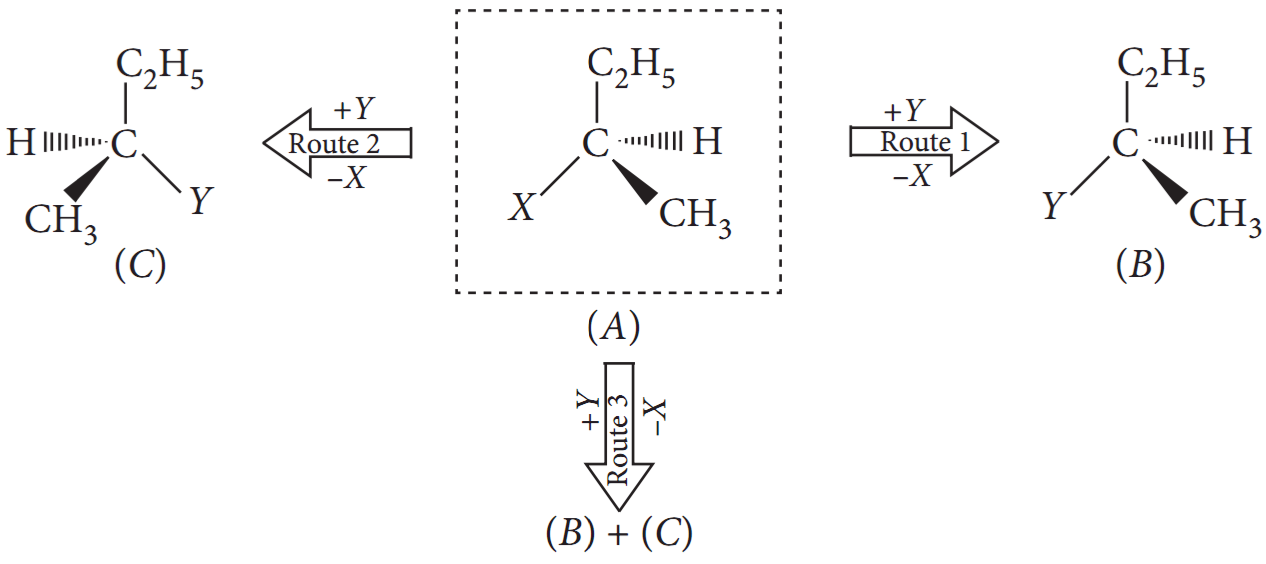
When a chemical reaction involves bond cleavage or bond formation at an asymmetric carbon atom, three different products may be formed. For example, during the substitution of a group $X$ by $Y$ in the following reaction, the three possible products may be shown below:
  1. If Bis the only product, the process is called retention of configuration because $B$ has the same configuration as the starting reactant $(A).$
  2. If C is the only product, the process is called inversion of configuration because $C$ has the configuration opposite to the starting reactant $(A).$
  3. If an equimolar mixture of Band $C (r.e., a 50 : 50$ mixture$)$ is fanned, then the process is called racemisation and the product is optically inactive because one isomer will rotate the light in the direction opposite to another.
In these questions (Q. No. i-iv), a statement of assertion followed by a statement of reason is given. Choose the correct answer out of the following choices.
  1. Assertion and reason both are correct statements and reason is correct explanation for assertion.
  2. Assertion and reason both are correct statements but reason is not correct explanation for assertion.
  3. Assertion is correct statement but reason is wrong statement.
  4. Assertion is wrong statement but reason is correct statement.
  1. Assertion: A reaction is said to be stereospecific if a particular stereoisomer of the reactant produces a specific stereoisomer of the product.
Reason: Bromination of cis$-2-$butene gives meso$-2, 3-$dibromobutane which is stereospecific.
  1. Assertion: Addition of $Br_2$ to cis-but-2-ene is stereoselective.
Reason: $S_N2$ reactions are stereospecific as well as stereoselective.
  1. Assertion: Optically active $2-$iodobutane on treatment with Nal in acetone undergoes recemization.
Reason: Repeated Walden inversions on the reactant and its product eventually gives a racemic mixture.
  1. Assertion: $S_N2$ reaction of an optically active alkyl halide with an aqueous solution of $KOH$ always gives an alcohol with opposite sign of rotation.
Reason: $S_N2$ reactions always proceed with inversion of configuration.
  1. Assertion: Nudeophilic substitution reaction of an optically active alkyl halide gives a mixture of en an ti om ers.
Reason: The reaction occurs by $S_N2$ mechanism.
Describe detailed information on classification of carbohydrates.

Read the passage given below and answer the following questions:
Carbohydrates can exist in either of two conformations, as determined by the orientation of the hydroxyl group about the asymmetric carbon farthest from the carbonyl.

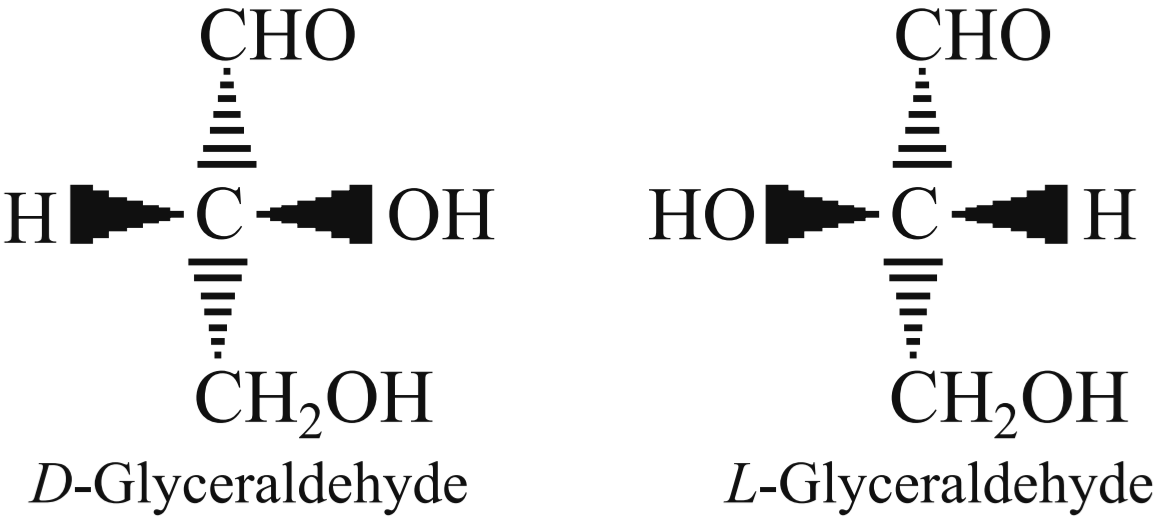
By convention, a monosaccharide is said to have D-configuration if the hydroxyl group attached to the asymmetric carbon atom adjacent to the $-CH_2OH$ group is on the right hand side irrespective of the positions of the other hydroxyl groups. On the other hand, the molecule is assigned L-configuration if the -OH group attached to the carbon adjacent to the $- CH_2OH$ group is on the left hand side.
The following questions are multiple choice questions. Choose the most appropriate answer:
  1. D-Glyceraldehyde and L-Glyceraldehyde are:
  1. Epimers.
  2. Enantiomers.
  3. Anomers.
  4. Conformational diasteriomers.
  1. Which of the following monosaccharides, is the majority found in the human body?
  1. D-type.
  2. L-type.
  3. Both of these.
  4. None of these.
  1. The two functional groups present in a typical carbohydrate are:
  1. -OH and -COOH
  2. -CHO and -COOH
  3. >C= O and -OH
  4. -OH and -CHO
  1. Monosaccharides contain:
  1. Always six carbon atoms.
  2. Always five carbon atoms.
  3. Always four carbon atoms.
  4. May contain 3 to 7 carbon atoms.
  1. The correct corresponding order of names of four aldoses with configuration given below respectively, is:
  1. L-erythrose, L-threose, L-erythrose, D-threose.
  2. D-threose, D-erythrose, L-threose, L-erythrose.
  3. L-erythrose, L-threose, D-erythrose, D-threose.
  4. D-erythrose, D-threose, L-erythrose, L-threose.
The potential of each electrode is known as electrode potential. Standard electrode potential is the potential when concentration of each species taking part in electrode reaction is unity and the reaction is taking place at 298K. By convention, the standard electrode potential of hydrogen (SHE) is $0.0V.$ The electrode potential value for each electrode process is a measure of relative tendency of the active species in the process to remain in the oxidised/ reduced form. The negative electrode potential means that the redox couple is stronger reducing agent than $\frac{\text{H}^+}{\text{H}_2}$ couple. A positive electrode potential means that the redox couple is a weaker reducing agent than the $\frac{\text{H}^+}{\text{H}_2}$ couple. Metals which have higher positive value of standard reduction potential form the oxides of greater thermal stability.
In these questions (Q. No. i-iv), a statement of assertion followed by a statement ofreason is given. Choose the correct answer out of the following choices.
  1. Assertion and reason both are correct statements and reason is correct explanation for assertion.
  2. Assertion and reason both are correct statements but reason is not correct explanation for assertion.
  3. Assertion is correct statement but reason is wrong statement.
  4. Assertion is wrong statement but reason is correct statement.
  1. Assertion: An electrochemical cell can be set-up only if the redox reaction is spontaneous.
Reason: A reaction is spontaneous if the free energy change is negative.
  1. Assertion: The standard electrode potential of hydrogen is $0.0V.$
Reason: It is by convention.
  1. Assertion: The more negative is the standard reduction potential, greater is its ability to displace $H_2$ from acid.
Reason: Strength of reducing agent increases with the increase in negative value of the standard reduction potential.
  1. Assertion: The negative value of standard reduction potential means that reduction takes place on this electrode with reference to hydrogen electrode.
Reason: The standard electrode potential of a half cell has a fixed value.
  1. Assertion: The absolute value of electrode potential cannot be determined experimentally.
Reason: The electrode potential values are generally determined with respect to SHE.