Questions

Assertion (A) & Reason (B) MCQ

Take a timed test

31 questions · 7 auto-graded MCQ + 24 self-marked written.

Question 11 Mark
Two statements are given- one labelled Assertion (A) and the other labelled Reason (R). Select the correct answer to these questions from the codes (a), (b), (c) and (d) as given below:
  1. Both Assertion (A) and Reason (R) are correct statements, and Reason (R) is the correct explanation of the Assertion (A).
  2. Both Assertion (A) and Reason (R) are correct statements, but Reason (R) is not the correct explanation of the Assertion (A).
  3. Assertion (A) is correct, but Reason (R) is incorrect statement.
  4. Assertion (A) is incorrect, but Reason (R) is correct statement.
Assertion (A): Sucrose is a non-reducing sugar.
Reason (R): Reducing groups of glucose and fructose are involved in glycosidic bond formation.
Answer
  1. Both Assertion (A) and Reason (R) are correct statements, and Reason (R) is the correct explanation of the Assertion (A).
View full question & answer
Question 21 Mark
Two statements are given- one labelled Assertion (A) and the other labelled Reason (R). Select the correct answer to these questions from the codes (a), (b), (c) and (d) as given below:
  1. Both Assertion (A) and Reason (R) are correct statements, and Reason (R) is the correct explanation of the Assertion (A).
  2. Both Assertion (A) and Reason (R) are correct statements, but Reason (R) is not the correct explanation of the Assertion (A).
  3. Assertion (A) is correct, but Reason (R) is incorrect statement.
  4. Assertion (A) is incorrect, but Reason (R) is correct statement.
Assertion (A): Sucrose is a non-reducing sugar.
Reason (R): Sucrose has glycosidic linkage.
Answer
  1. Both Assertion (A) and Reason (R) are correct statements, but Reason (R) is not the correct explanation of the Assertion (A).
View full question & answer
Question 31 Mark
Note: In the following questions a statement of assertion followed by a statement of reason is given. Choose the correct answer out of the following choices.
  1. Assertion and reason both are correct statements and reason explains the assertion.
  2. Both assertion and reason are wrong statements.
  3. Assertion is correct statement and reason is wrong statement.
  4. Assertion is wrong statement and reason is correct statement.
  5. Assertion and reason both are correct statements but reason does not explain assertion.
Assertion: Vitamin D can be stored in our body.
Reason: Vitamin D is fat soluble vitamin.
Answer
  1. Assertion and reason both are correct statements and reason explains the assertion.
Explanation:
Vitamin D can be stored in our body because it is a fat soluble vitamin.
View full question & answer
Question 41 Mark
Note: In the following questions a statement of assertion followed by a statement of reason is given. Choose the correct answer out of the following choices.
  1. Assertion and reason both are correct statements and reason explains the assertion.
  2. Both assertion and reason are wrong statements.
  3. Assertion is correct statement and reason is wrong statement.
  4. Assertion is wrong statement and reason is correct statement.
  5. Assertion and reason both are correct statements but reason does not explain assertion.
Assertion: All naturally occurring α-aminoacids except glycine are optically active.
Reason: Most naturally occurring amino acids have L-configuration.
Answer
  1. Assertion and reason both are correct statements but reason does not explain assertion
Explanation:
All amino acids except glycine contain at least one chiral carbon.
View full question & answer
Question 51 Mark
In these questions, a statement of assertion followed by a statement of reason is given. Choose the correct answer out of the following choices.
  1. Assertion and reason both are correct statements and reason is correct explanation for assertion.
  2. Assertion and reason both are correct statements but reason is not correct explanation for assertion.
  3. Assertion is correct statement but reason is wrong statement.
  4. Assertion is wrong statement but reason is correct statement.
Assertion: Insulin is water soluble.
Reason: Insulin is a globular protein.
Answer
  1. Assertion and reason both are correct statements but reason is not correct explanation for assertion.
Explanation:
Insulin is a globular protein This protein has three-dimensional folded structure. These are stabilised by internal hydrogen bonding, hence, they are water soluble.
View full question & answer
Question 61 Mark
In these questions, a statement of assertion followed by a statement of reason is given. Choose the correct answer out of the following choices.
  1. Assertion and reason both are correct statements and reason is correct explanation for assertion.
  2. Assertion and reason both are correct statements but reason is not correct explanation for assertion.
  3. Assertion is correct statement but reason is wrong statement.
  4. Assertion is wrong statement but reason is correct statement.
Assertion: $\alpha$-Amino acids exist as dipolar ions or zwitter ions.
Reason: $\alpha$-Amino acids are the building blocks of proteins.
Answer
  1. Assertion and reason both are correct statements but reason is not correct explanation for assertion.
View full question & answer
Question 71 Mark
In these questions, a statement of assertion followed by a statement of reason is given. Choose the correct answer out of the following choices.
  1. Assertion and reason both are correct statements and reason is correct explanation for assertion.
  2. Assertion and reason both are correct statements but reason is not correct explanation for assertion.
  3. Assertion is correct statement but reason is wrong statement.
  4. Assertion is wrong statement but reason is correct statement.
Assertion: DNA has a double helix structure.
Reason: The two strands in a DNA molecule are exactly similar.
Answer
  1. Assertion is correct statement but reason is wrong statement.
Explanation:
The two strands in a DNA molecule are not exactly similar but are complimentary.
View full question & answer
MCQ 81 Mark
In these questions, a statement of assertion followed by a statement of reason is given. Choose the correct answer out of the following choices.
Assertion: Glycine exists as zwitter ion but $o-$ and $p-$aminobenzoic acids do not.
Reason: Due to the presence of $-\ce{NH_2}$ and $-\ce{COOH}$ group within the same molecule, they neutralise each other and hence, $n-$amino acids exist as dipolar ions or zwitter ions.
  • A
    Assertion and reason both are correct statements and reason is correct explanation for assertion.
  • B
    Assertion and reason both are correct statements but reason is not correct explanation for assertion.
  • C
    Assertion is correct statement but reason is wrong statement.
  • Assertion is wrong statement but reason is correct statement.
Answer
Correct option: D.
Assertion is wrong statement but reason is correct statement.
In $o-$ or $p-$aminobenzoic acids, the lone pair of electrons on the $-\ce{NH_2}$ group is donated towards the benzene ring.
As a result, the basic character of $-\ce{NH_2}$ group and acidic character of $-\ce{COOH}$ group decreases.
Therefore, the weakly acidic $-\ce{COOH}$ group cannot transfer $H^+$ ion to the weakly basic $-\ce{NH_2}$ group.
therefore, $o$ and $p-$aminobenzoic acids do not exist as zwitter ion.
View full question & answer
Question 91 Mark
In these questions, a statement of assertion followed by a statement of reason is given. Choose the correct answer out of the following choices.
  1. Assertion and reason both are correct statements and reason is correct explanation for assertion.
  2. Assertion and reason both are correct statements but reason is not correct explanation for assertion.
  3. Assertion is correct statement but reason is wrong statement.
  4. Assertion is wrong statement but reason is correct statement.
Assertion: The specific rotation of a freshly prepared solution of $\alpha$-glucose decreases from + 112º to 52.7º while that of $\beta$-glucose increases from + 19º to 52.7º.
Reason: The change in specific rotation of an optically active compound with time to an equilibrium value is called mutarotation.
Answer
  1. Assertion and reason both are correct statements but reason is not correct explanation for assertion.
Explanation:
Glucose exists in two forms, i.e. ti-D: glucose with a specific rotation of +112º and $\alpha$-Dglucose with a specific rotation of + 19º. However, when either of these two fonns is dissolved in water and allowed to stand, it gets converted into the same equilibrium mixture of both the $\alpha$- and $\beta$-forms with a small amount of open chain form. As a result of this equilibrium, the specific rotation of a freshly prepared solution of $\alpha$-glucose decreases from + 112º to 52.7º while th at of $\beta$-glucose increases from + 19º to 52. 7º.
View full question & answer
MCQ 101 Mark
In these questions, a statement of assertion followed by a statement of reason is given. Choose the correct answer out of the following choices.
Assertion: Amino acids are insoluble in benzene and ether.
Reason: Amino acids exist as zwitter ions.
  • A
    Assertion and reason both are correct statements and reason is correct explanation for assertion.
  • Assertion and reason both are correct statements but reason is not correct explanation for assertion.
  • C
    Assertion is correct statement but reason is wrong statement.
  • D
    Assertion is wrong statement but reason is correct statement.
Answer
Correct option: B.
Assertion and reason both are correct statements but reason is not correct explanation for assertion.
View full question & answer
MCQ 111 Mark
In these questions, a statement of assertion followed by a statement of reason is given. Choose the correct answer out of the following choices.
Assertion: Glucose and fructose give the same osazone.
Reason: During osazone formation stereochemistry at $C_1$ and $C_2$ is destroyed.
  • Assertion and reason both are correct statements and reason is correct explanation for assertion.
  • B
    Assertion and reason both are correct statements but reason is not correct explanation for assertion.
  • C
    Assertion is correct statement but reason is wrong statement.
  • D
    Assertion is wrong statement but reason is correct statement.
Answer
Correct option: A.
Assertion and reason both are correct statements and reason is correct explanation for assertion.
View full question & answer
Question 121 Mark
In these questions, a statement of assertion followed by a statement of reason is given. Choose the correct answer out of the following choices.
  1. Assertion and reason both are correct statements and reason is correct explanation for assertion.
  2. Assertion and reason both are correct statements but reason is not correct explanation for assertion.
  3. Assertion is correct statement but reason is wrong statement.
  4. Assertion is wrong statement but reason is correct statement.
Assertion: Glucose and fructose are reducing sugars.
Reason: Glucose and fructose contain a free aldehydic and ketonic group adjacent to a > CHOH group respectively.
Answer
  1. Assertion and reason both are correct statements and reason is correct explanation for assertion.
Explanation:
Reducing sugars contain a free aldehydic or ketonic group adjacent to a > CH OH group and reduce Tollen's reagent, Schiff's reagent or Benedict's solution.
View full question & answer
Question 131 Mark
In these questions, a statement of assertion followed by a statement of reason is given. Choose the correct answer out of the following choices.
  1. Assertion and reason both are correct statements and reason is correct explanation for assertion.
  2. Assertion and reason both are correct statements but reason is not correct explanation for assertion.
  3. Assertion is correct statement but reason is wrong statement.
  4. Assertion is wrong statement but reason is correct statement.
Assertion: Fructose reduces Fehling's solution and Tollens' reagent.
Reason: Fructose does not contain any aldehyde group.
Answer
  1. Assertion and reason both are correct statements but reason is not correct explanation for assertion.
Explanation:
Fructose on warming with dilute alkali, gives rise to an equilibrium mixture of glucose, fructose and mannose. The ability of fructose to reduce Fehling solution and Tollens' reagent is probably due to the isomerisation of fructose to glucose and man nose (this is called Lobry de Bruyn and Elkenstein rearrangement).
View full question & answer
Question 141 Mark
In these questions, a statement of assertion followed by a statement of reason is given. Choose the correct answer out of the following choices.
  1. Assertion and reason both are correct statements and reason is correct explanation for assertion.
  2. Assertion and reason both are correct statements but reason is not correct explanation for assertion.
  3. Assertion is correct statement but reason is wrong statement.
  4. Assertion is wrong statement but reason is correct statement.
Assertion: DNA undergoes replication.
Reason: DNA contains cytosine and thymine as pyrimidine bases.
Answer
  1. Assertion and reason both are correct statements but reason is not correct explanation for assertion.
Explanation:
The genetic information of the cell is contained in the sequence of base A, T, G and C in DNA molecule when a cell divides, DNA molecules replicate and make exact copies of themselves so that each daughter cell will have DNA identical to that of the parent cell.
View full question & answer
Question 151 Mark
In these questions, a statement of assertion followed by a statement of reason is given. Choose the correct answer out of the following choices.
  1. Assertion and reason both are correct statements and reason is correct explanation for assertion.
  2. Assertion and reason both are correct statements but reason is not correct explanation for assertion.
  3. Assertion is correct statement but reason is wrong statement.
  4. Assertion is wrong statement but reason is correct statement.
Assertion: Uracil occurs in DNA.
Reason: DNA undergoes replication.
Answer
  1. Assertion is wrong statement but reason is correct statement.
Explanation:
Uracil occurs in RNA
View full question & answer
Question 161 Mark
Note: In the following questions a statement of assertion followed by a statement of reason is given. Choose the correct answer out of the following choices.
  1. Assertion and reason both are correct statements and reason explains the assertion.
  2. Both assertion and reason are wrong statements.
  3. Assertion is correct statement and reason is wrong statement.
  4. Assertion is wrong statement and reason is correct statement.
  5. Assertion and reason both are correct statements but reason does not explain assertion.
Assertion: Glycine must be taken through diet.
Reason: It is an essential amino acid.
Answer
  1. Both assertion and reason is wrong statements. 
Explanation:
Glycine can be synthesized by the body and is a non-essential amino acid.
View full question & answer
MCQ 171 Mark
In these questions, a statement of assertion followed by a statement of reason is given. Choose the correct answer out of the following choices.
Assertion: Alpha $(\alpha)-$amino acids exist as internal salt in solution as they have amino and carboxylic acid groups in near vicinity.
Reason: $H^+$ ion given by carboxylic group $\ce{(-COOH)}$ is captured by amino group $\ce{(-NH_2)}$ having lone pair of electrons.
  • Assertion and reason both are correct statements and reason is correct explanation for assertion.
  • B
    Assertion and reason both are correct statements but reason is not correct explanation for assertion.
  • C
    Assertion is correct statement but reason is wrong statement.
  • D
    Assertion is wrong statement but reason is correct statement.
Answer
Correct option: A.
Assertion and reason both are correct statements and reason is correct explanation for assertion.
$\ce{NH_2 - CH_2 - COOH}$ is a typical $a-$amino acid.
In solution it exists as, internal salt or zwitter ion,
$\ce{(\stackrel{{+}}{\hbox{NH}}_3)-\text{CH}_2-\text{COO}^-)}$
because the proton $\ce{(H^+)}$ of $\ce{-COOH}$ group is captured by $\ce{-NH_2}$ group as $\ce{NH_2}$ has a lone pair of electrons on $N$ atom.
View full question & answer
Question 181 Mark
In these questions, a statement of assertion followed by a statement of reason is given. Choose the correct answer out of the following choices.
  1. Assertion and reason both are correct statements and reason is correct explanation for assertion.
  2. Assertion and reason both are correct statements but reason is not correct explanation for assertion.
  3. Assertion is correct statement but reason is wrong statement.
  4. Assertion is wrong statement but reason is correct statement.
Assertion: Haemoglobin is a globular protein.
Reason: Globular proteins are insoluble in water.
Answer
  1. Assertion is correct statement but reason is wrong statement.
Explanation:
Globular proteins have weak intermolecular forces of attraction and hence they are soluble in water.
View full question & answer
Question 191 Mark
In these questions, a statement of assertion followed by a statement of reason is given. Choose the correct answer out of the following choices.
  1. Assertion and reason both are correct statements and reason is correct explanation for assertion.
  2. Assertion and reason both are correct statements but reason is not correct explanation for assertion.
  3. Assertion is correct statement but reason is wrong statement.
  4. Assertion is wrong statement but reason is correct statement.
Assertion: Glucose gives a reddish-brown precipitate with Fehling's solution.
Reason: Reaction of glucose with Fehhng's solution gives CuO and gluconic acid.
Answer
  1. Assertion is correct statement but reason is wrong statement.
Explanation:
$\ \text{CHO}\ \ \ \ \ \ \ \ \ \ \ \ \ \ \ \ \ \ \ \ \ \ \ \ \ \ \ \ \ \ \ \ \ \ \ \ \ \ \ \ \ \ \ \text{COOH}\\\ \ |\ \ \ \ \ \ \ \ \ \ \ \ \ \ \ \ \ \ \ \ \ \ \ \ \ \ \ \ \ \ \ \ \ \ \ \ \ \ \ \ \ \ \ \ \ \ \ \ \ \ \ |\$\text{CHOH}_4)\xrightarrow[\text{Fehling Benedict solution}]{\text{Cu}^{2+}}(\text{CHOH})_4+\text{Cu}_2\text{F}\downarrow\\\ \ |\ \ \ \ \ \ \ \ \ \ \ \ \ \ \ \ \ \ \ \ \ \ \ \ \ \ \ \ \ \ \ \ \ \ \ \ \ \ \ \ \ \ \ \ \ \ \ \ \ \ \ \ |\ \ \ \ \ \ \ \ \ \ \ \ \text{Red brown}\\\ \text{CH}_2\text{OH}\ \ \ \ \ \ \ \ \ \ \ \ \ \ \ \ \ \ \ \ \ \ \ \ \ \ \ \ \ \ \ \ \ \ \ \ \ \ \ \ \text{CH}_2\text{OH}\\\ \ \ \ \ \ \ \ \ \ \ \ \ \ \ \ \ \ \ \ \ \ \ \ \ \ \ \ \ \ \ \ \ \ \ \ \ \ \ \ \ \ \ \ \ \ \ \ \ \ \text{Gluconic Acid}$
View full question & answer
Question 201 Mark
Note: In the following questions a statement of assertion followed by a statement of reason is given. Choose the correct answer out of the following choices.
  1. Assertion and reason both are correct statements and reason explains the assertion.
  2. Both assertion and reason are wrong statements.
  3. Assertion is correct statement and reason is wrong statement.
  4. Assertion is wrong statement and reason is correct statement.
  5. Assertion and reason both are correct statements but reason does not explain assertion.
Assertion: In presence of enzyme, substrate molecule can be attacked by the reagent effectively.
Reason: Active sites of enzymes hold the substrate molecule in a suitable position.
Answer
  1. Assertion and reason both are correct statements and reason explains the assertion.
Explanation:
In presence of enzyme, substrate molecule can be attacked by the reagent effectively because active sites of enzymes hold the substrate molecule in a suitable position.
View full question & answer
MCQ 211 Mark
Note: In the following questions a statement of assertion followed by a statement of reason is given. Choose the correct answer out of the following choices. Assertion: Deoxyribose,$ \ce{C_5H_{10}O_4}$ is not a carbohydrate.
Reason: Carbohydrates are hydrates of carbon so compounds which follow $\ce{C_x(H_2O)y}$ formula are carbohydrates.
  • A
    Assertion and reason both are correct statements and reason explains the assertion.
  • B
    Both assertion and reason are wrong statements.
  • C
    Assertion is correct statement and reason is wrong statement.
  • Assertion is wrong statement and reason is correct statement.
Answer
Correct option: D.
Assertion is wrong statement and reason is correct statement.
Complete hydrolysis of $\text{DNA} ($or $\text{RNA})$ yields a pentose sugar, phosphoric acid and nitrogen containing hetero-cyclic compounds $($called bases$)$. In $\text{DNA}$ molecules, the sugar moiety is $D-2- $Deoxyribose.
View full question & answer
Question 221 Mark
In these questions, a statement of assertion followed by a statement of reason is given. Choose the correct answer out of the following choices.
  1. Assertion and reason both are correct statements and reason is correct explanation for assertion.
  2. Assertion and reason both are correct statements but reason is not correct explanation for assertion.
  3. Assertion is correct statement but reason is wrong statement.
  4. Assertion is wrong statement but reason is correct statement.
Assertion: $\beta$-pleated sheet structure of protein shows maximum extension.
Reason: Intermolecular hydrogen bonding is present in them.
Answer
  1. Assertion and reason both are correct statements but reason is not correct explanation for assertion.
Explanation:
In $\beta$-pleated sheet structure, the polypeptide chains are held together by intermolecular H-bonds. Extension and contraction of $\beta$-pleated sheet structure of protein depends on the size of R.
View full question & answer
Question 231 Mark
Note: In the following questions a statement of assertion followed by a statement of reason is given. Choose the correct answer out of the following choices.
  1. Assertion and reason both are correct statements and reason explains the assertion.
  2. Both assertion and reason are wrong statements.
  3. Assertion is correct statement and reason is wrong statement.
  4. Assertion is wrong statement and reason is correct statement.
  5. Assertion and reason both are correct statements but reason does not explain assertion.
Assertion: D(+)-Glucose is dextrorotatory in nature.
Reason: ‘D’ represents its dextrorotatory nature.
Answer
  1. Assertion is correct statement and reason is wrong statement.
Explanation:
Glucose is correctly named as D(+)-glucose. ‘D’ before the name of glucose represents the configuration whereas ‘(+)’ represents dextrorotatory nature of the molecule. The letters ‘D’ or ‘L’ before the name of any compound indicate the relative configuration of a particular stereoisomer.
View full question & answer
Question 241 Mark
In these questions, a statement of assertion followed by a statement of reason is given. Choose the correct answer out of the following choices.
  1. Assertion and reason both are correct statements and reason is correct explanation for assertion.
  2. Assertion and reason both are correct statements but reason is not correct explanation for assertion.
  3. Assertion is correct statement but reason is wrong statement.
  4. Assertion is wrong statement but reason is correct statement.
Assertion: Nucleotides are phosphate esters of nucleosides.
Reason: The various nucleotides in nucleic acids are linked either through purine or pyrimidine bases.
Answer
  1. Assertion is correct statement but reason is wrong statement.
Explanation:
The various nucleotides in nucleic acids are linked through phosphate ester groups.
View full question & answer
Question 251 Mark
In these questions, a statement of assertion followed by a statement of reason is given. Choose the correct answer out of the following choices.
  1. Assertion and reason both are correct statements and reason is correct explanation for assertion.
  2. Assertion and reason both are correct statements but reason is not correct explanation for assertion.
  3. Assertion is correct statement but reason is wrong statement.
  4. Assertion is wrong statement but reason is correct statement.
Assertion: Valine is an essential amino acid.
Reason: The lack of essential amino acids in the diet causes Kwashiorkor.
Answer
  1.  Assertion and reason both are correct statements but reason is not correct explanation for assertion.
Explanation:
Valine is an essential amino acid. The amino acids which the body cannot synthesize are called essential amino acid. 
View full question & answer
Question 261 Mark
In these questions, a statement of assertion followed by a statement of reason is given. Choose the correct answer out of the following choices.
  1. Assertion and reason both are correct statements and reason is correct explanation for assertion.
  2. Assertion and reason both are correct statements but reason is not correct explanation for assertion.
  3. Assertion is correct statement but reason is wrong statement.
  4. Assertion is wrong statement but reason is correct statement.
Assertion: Solubility of proteins is minimum at the isoelectric point.
Reason: At isoelectric point, protein molecule behaves as a zwitter ion.
Answer
  1. Assertion and reason both are correct statements and reason is correct explanation for assertion.
Explanation:
At isoelectric point, protein molecules behave as zwitter ions and hence, do not move toward any electrode or act as neutral molecules. This reduces their solubility to minimum and thus, helps in their separation and purification
View full question & answer
Question 271 Mark
In these questions, a statement of assertion followed by a statement of reason is given. Choose the correct answer out of the following choices.
  1. Assertion and reason both are correct statements and reason is correct explanation for assertion.
  2. Assertion and reason both are correct statements but reason is not correct explanation for assertion.
  3. Assertion is correct statement but reason is wrong statement.
  4. Assertion is wrong statement but reason is correct statement.
Assertion: Tollens' reagent, Benedict's solution and Fehling's solution are reducing agents.
Reason: Mild oxidising agents like chlorine or bromine water convert glucose into gluconic acid.
Answer
  1. Assertion is wrong statement but reason is correct statement.
Explanation:
Benedict's solution, Tollens' reagent, Fehllng's solution etc. are mild oxidising agents. They oxidise the aldoses and ketoses to the corresponding acids and get themselves reduced.
View full question & answer
MCQ 281 Mark
In these questions, a statement of assertion followed by a statement of reason is given. Choose the correct answer out of the following choices.
Assertion: Glucose when treated with $\ce{CH_3OH}$ in presence of dry $\ce{HCI}$ gas gives $ct-$and $-$methyl glucosides.
Reason: Glucose reacts with phenyl hydrazine to form crystalline osazone.
  • A
    Assertion and reason both are correct statements and reason is correct explanation for assertion.
  • Assertion and reason both are correct statements but reason is not correct explanation for assertion.
  • C
    Assertion is correct statement but reason is wrong statement.
  • D
    Assertion is wrong statement but reason is correct statement.
Answer
Correct option: B.
Assertion and reason both are correct statements but reason is not correct explanation for assertion.
Because of the ring structure $C_1$ in glucose becomes chiral and hence glucose exists in two stereoisomeric forms, i.e., $\alpha-$ and $\beta-,$ corresponding to each stereoisomeric fonn glucose forms two methyl glucosides, i.e., $\alpha- $and $\beta-$methyl glucosides.
View full question & answer
Question 291 Mark
In these questions, a statement of assertion followed by a statement of reason is given. Choose the correct answer out of the following choices.
  1. Assertion and reason both are correct statements and reason is correct explanation for assertion.
  2. Assertion and reason both are correct statements but reason is not correct explanation for assertion.
  3. Assertion is correct statement but reason is wrong statement.
  4. Assertion is wrong statement but reason is correct statement.
Assertion: Cysteine can cross link peptide chains.
Reason: Amino acids are classified as essential and non-essential amino acids.
Answer
  1. Assertion and reason both are correct statements but reason is not correct explanation for assertion.
Explanation:
Cysteine can cross link peptide chains through disulphide bridge. Cross linking by disulphide bridge can occur either between the distant, properly oriented parts of the same polypeptide chain (as in oxytocin or vasopressin) or between different polypeptide chains.
View full question & answer
Question 301 Mark
In these questions, a statement of assertion followed by a statement of reason is given. Choose the correct answer out of the following choices.
  1. Assertion and reason both are correct statements and reason is correct explanation for assertion.
  2. Assertion and reason both are correct statements but reason is not correct explanation for assertion.
  3. Assertion is correct statement but reason is wrong statement.
  4. Assertion is wrong statement but reason is correct statement.
Assertion: Disruption of the native structure of a protein is called denaturation.
Reason: The change in colour and appearance of egg during cooking is due to denaturation.
Answer
  1. Assertion and reason both are correct statements but reason is not correct explanation for assertion.
Explanation:
Due to denaturation, a protein loses its biological activity. During denaturation the protein molecule uncoils from a more random conformation and precipitates from the solution.
View full question & answer
MCQ 311 Mark
Note: In the following questions a statement of assertion followed by a statement of reason is given. Choose the correct answer out of the following choices.
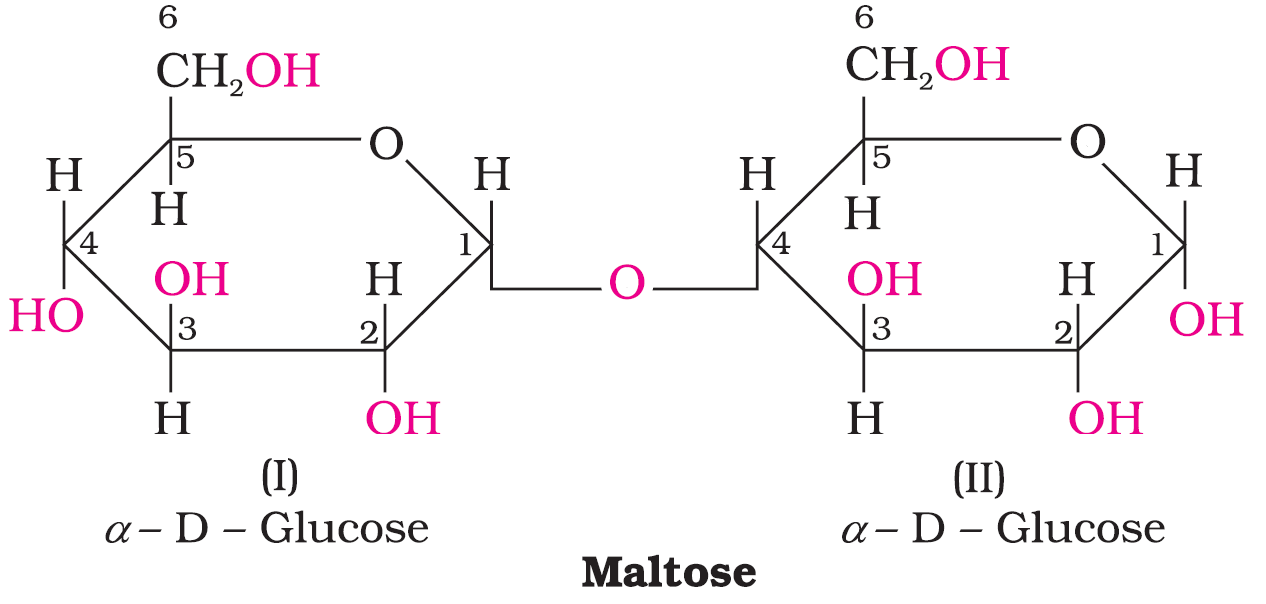
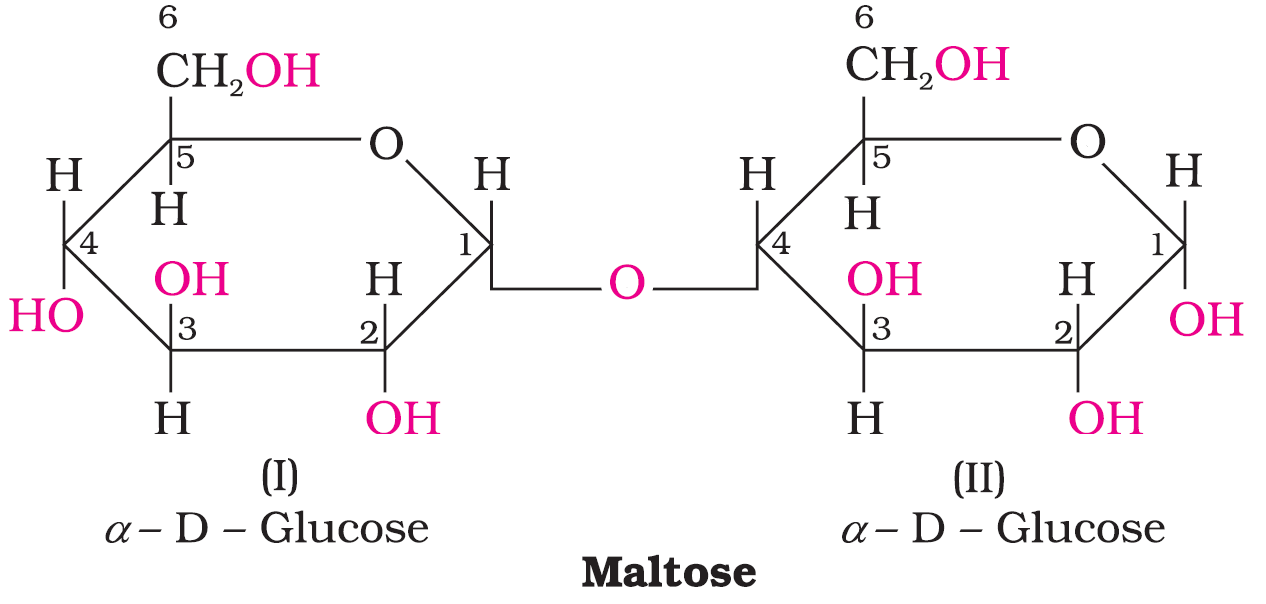
Assertion: $\beta-$glycosidic linkage is present in maltose,

Reason: Maltose is composed of two glucose units in which $C_1$ of one glucose unit is linked to $C_4$ of another glucose unit.
  • A
    Assertion and reason both are correct statements and reason explains the assertion.
  • B
    Both assertion and reason are wrong statements.
  • C
    Assertion is correct statement and reason is wrong statement.
  • Assertion is wrong statement and reason is correct statement.
Answer
Correct option: D.
Assertion is wrong statement and reason is correct statement.
 
Maltose is composed of two $D-$glucose units in which $C_1$ of one glucose $(I)$ is linked to $C_4$ of another glucose unit.
View full question & answer