Questions

3 Marks Question

Take a timed test

10 questions · self-marked practice — reveal the answer and mark yourself.

Question 13 Marks
Define isomerism and tell its types.
Answer
Isomerism : Two or more such compounds which have the same chemical formula (molecules) but have different arrangement of atoms are called isomers of each other and this property is called isomerism. Due to different arrangements of atoms, there is variation in one or more of their physical or chemical properties. There are two main types of isomerism in coordination compounds, which can again be classified into several parts :
(a) Stereoisomerism :
(1) Geometric isomerism
(2) Polarization isomerism
(b) Structural isomerism :
(i) Bond isomerism
(ii) Subcovalent isomerization or coordination isomerism
(iii) Ionization isomerism
(iv) Solvation isomerism or hydrate isomerism
(v) Ligand isomerism
(vi) Polymerization isomerism
(vii) Coordination position isomerism.
View full question & answer
Question 23 Marks
$Pt ( IV ), NH _3, Cl ^{-}$and $Na ^{+}$combine with each other to form seven types of complex compounds.
The following is :
$
\left[Pt\left(NH_3\right)_6\right] Cl_4
$
(i) Write the formulas of other six complex compounds.
(ii) Write the IUPAC names of these complex compounds.
(iii) Which of these complex aqueous solutions will have the highest conductivity?
(iv) Which of these complexes is non-ionic?
(v) Oxidation number of Pt in these complexes and also tell the coordination number.
Answer
(i) (a) $\left[ Pt \left( NH _3\right)_5 Cl ^2\right] Cl _3$
(b) $\left[ Pt \left( NH _3\right)_4 Cl _2\right] Cl _2$
(c) $\left[ Pt \left( NH _3\right)_3 Cl _3\right] Cl$
(d) $\left[ Pt \left( NH _3\right)_2 Cl _4\right]$
(e) $Na \left[ Pt \left( NH _3\right) Cl _5\right]$
(f) $Na _2\left[ PtCl _6\right]$
(ii) (a) Pentaammine platinum (IV) chloride
(b) Tetraammine dichlorido platinum (IV) chloride
(c) Triammine trichlorido platinum (IV) chloride
(d) Diammine tetrachlorido platinum (IV)
(e) Sodium ammine pentachlorido platinate (IV)
(f) Sodium hexachlorido platinate (IV)
(iii) The conductivity of complex $\left[ Pt \left( NH _3\right)_6\right] Cl _4$ will be highest because it gives maximum (five ion) in solution.
(iv) $\left[ Pt \left( NH _3\right)_6\right] Cl _4$ is non-polar.
(v) In all these complexes the oxidation number of Pt is 4 and coordination number is 6 .
View full question & answer
Question 33 Marks
How many geometrical isomers are possible in the following coordination entities?
(i) $\left[ Cr \left( C _2 O _4\right)_3\right]^{3-}$
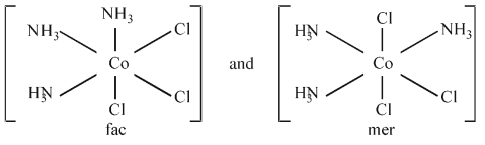
(ii) $\left[ Co \left( NH _3\right)_3 Cl _3\right]$
View full question & answer
Question 43 Marks
What is meant by unidentate, didentate and ambidentate ligands? Give two examples for each.
View full question & answer
Question 53 Marks
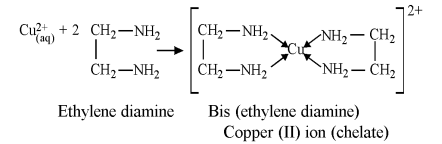
What is meant by the chelate effect? Give an example.
View full question & answer
Question 63 Marks
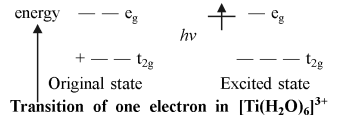
Explain the violet colour of the complex $\left[ Ti \left( H _2 O \right)_6\right]^{3+}$ on the basis of crystal field theory.
View full question & answer
Question 73 Marks
Give the oxidation state, d-orbital occupation and coordination number of the central metal ion in the following complexes : 
(i) $K _3\left[ Co \left( C _2 O _4\right)_3\right]$
(ii) cis - $\left[ Cr ( en )_2 Cl _2\right] Cl$
(iii) $\left( NH _4\right)_2\left[ CoF _4\right]$
(iv) $\left[ Mn \left( H _2 O \right)_6\right] SO _4$
Answer
(i) In K3[Co(C2O4)], the oxidation state of metal is +3 and coordination number is 6 because $C _2 O _4^{2-}$ (oxalate) is didentate stronge ligand and hence the electronic configuration of $Co ^{3+}$ is $t _{2 g}^6 e _{ g }^0\left[ Co ^{+3}=3 d^6\right]$.
(ii) In cis- $\left[ Cr ( en )_2 Cl _2\right] Cl$, the oxidation state of the metal is +3 and coordination number is 6. The electronic configuration of metal ion $t_{2 g}^3 \cdot\left[ Cr ^{3+}=3 d^3\right]$
(iii) In $\left( NH _4\right)_2\left[ CoF _4\right]$, the oxidation state of the metal is +2 and the coordination number is 4. The electronic configuration of the metal ion is $t_{2 g}^5 e_g^2 \cdot\left[ Co ^{+2}=3 d^7\right]$
(iv) In $\left[ Mn \left( H _2 O \right)_6\right] SO _4$, the oxidation state of metal is +2 and the coordination number is 6. The electronic configuration of mental ion is $t_{2 g}^3 e_g^2 \cdot\left[Mn^{3+}=3 d^5\right]$
View full question & answer
Question 83 Marks
[Fe(CN)6]4- and [Fe(H2O)6]2+ are of different colours in dilute solutions. Why?
Answer
In [Fe(CN)6]4-, CN- is a strong ligand and all the electrons in it are paired (d²sp³ hybridization), hence there is no d-d transition and the complex is colourless.
Whereas in [Fe(H2O)6]2+, H2O is a weak ligand and hence it has four unpaired electrons even after d2sphybridization, due to which d-d transition occurs easily. For this reason, the complex is colourful. 
Due to different ligands, the crystal field splitting energy also varies due to which there is a difference in colours despite being the same metal ion.
View full question & answer
Question 93 Marks
What is spectrochemical series? Explain the difference between a weak field ligand and a strong field ligand.
Answer
According to the crystal field theory, the crystal field splitting, $\Delta_0$ , in octahedral complexes depends on the field generated by the charge located on the ligand and the metal ion. Some ligands produce strong field and in this case, the splitting is more, these are called strong field ligands. Other ligands produce weak fields due to which the splitting of d-orbitals is less, these are called weak field ligands.
Ligands are arranged in a series in order of their increasing field strength as follows:
$\begin{array}{l}\quad I ^{-}< Br ^{-}< SCN ^{-}< Cl ^{-}< S ^{2-}< F ^{-}< OH ^{-}< C2O_4^{2-} \\ < H _2 O < NCS ^{-}<\text {edta }^{4-}< NH _3<\text { en }< CN -< CO \end{array}$
This series is known as spectrochemical series and it is based on complexes formed with different ligands. On the basis of facts obtained from experimental measurements of absorption of light by complexes formed with different ligands.
View full question & answer
Question 103 Marks
Aqueous copper sulphate solution (blue in colour) gives :
(i) a green precipitate with aqueous potassium fluoride and
(ii) a bright green solution with aqueous potassium chloride. Explain these experimental results.
Answer
In aqueous solution CuSO4, is found in form of [Cu(H2O)4]SO4 whose blue colour is due to [Cu(H2O)4]2+ ions.
(i) On adding aqueous KF to it, the weak ligand H2O is replaced by F- and [CuF4]2- ion is formed which is green precipitate.
$\left[Cu\left(H_2 O\right)_4\right]^{2+}+4 F^{-} \rightarrow\left[CuF_4\right]^{2-}+4 H_2 O$
$\qquad\qquad\qquad\qquad\qquad$Tetrafluorocuprate (II) ion
$\qquad\qquad\qquad\qquad\qquad\quad$(green precipitate)
(ii) When aqueous KCl is added to [Cu(H2O4)]2+, the Cl- replaces the weak ligand (H2O) to form (CuCl4)2+ which is bright green in colour.
$
\left[Cu\left(H_2 O\right)_4\right]^{2+}+4 Cl^{-} \rightarrow\left[CuCl_4\right]^{2-}+4 H_2 O
$
$\qquad\qquad\qquad\qquad\qquad$Tetrachloro cuprate (II) ion
$\qquad\qquad\qquad\qquad\qquad\qquad$(bright green)
View full question & answer