Question 13 Marks
The molar conductivity of $0.025 mol L^{–1}$ methanoic acid is $46.1 S \ cm^2 mol^{–1}.$ Calculate its degree of dissociation and dissociation constant. Given $\lambda ^0 (H^+) = 349.6 S \ cm^2 mol^{–1}$ and $\lambda ^0 (HCOO^–) = 54.6 S \ cm^2 mol^{-1}.$
AnswerGiven that
$\lambda ^0(H^+) = 349.6 S \ cm^2\ mol^{–1}$
$\lambda ^0(HCOO^–) = 54.6 S \ cm^2\ mol^{–1}$
Concentration, $C = 0.025\ mol\ L^{−1}$
$\lambda (HCOOH) = 46.1\ S \ cm^2\ mol^{−1}$
Use formula
$\lambda ^o(HCOOH) = \lambda ^0(H^+) + \lambda ^0(HCOO^–)$
Plug the values we get
$\lambda ^o(HCOOH) = 0.349.6 + 54.6$
$= 404.2 S \ cm^2 mol^{−1}$
Formula of degree of dissociation
$ά = \lambda ^{o }(HCOOH)/ \lambda ^{o }(HCOOH)$
$ά = 46.1/404.2$
$ά = 0.114 $
Formula of dissociation constant:
$K = (c ά^2)/ (1 – ά)$
Plug the values we get
$=\alpha=\frac{\wedge_\text{m}}{\wedge^\circ_\text{m}}=\frac{{46.1}\text{s cm}^2\ \text{mol}^{-1}}{{404.2}\text{s cm}^2\ \text{mol}_1}$
$\text{K}=\frac{\text{C}\alpha^2}{1-\alpha}=\frac{0.025\times(0.114)^2}{1-0.114}$
$=\frac{0.025\times0.013}{0.806}=\frac{0.000325}{0.806}$
$= 3.67 \times 10^4 mol^{-1}.$
View full question & answer→Question 23 Marks
In the button cells widely used in watches and other devices the following reaction takes place:
$Zn(s) + Ag_2O(s) + H_2O(l) \rightarrow Zn^{2+}(aq) + 2Ag(s) + 2OH^– (aq)$
Determine $\triangle_\text{r}\text{G}^\ominus$ and $\text{E}^\ominus$ for the reaction.
AnswerThe formula of standard cell potential is
$E^0_{cell} = E^0_{right} - E^0_{left}$
$E^0_{cell} = 0.344 - (- 0.76)$
$E^0_{cell} = 0.344 + 0.076 V$
$E^0_{cell} = + 1.104 V$
In balanced reaction there are $2$ electron are transferring so that $n = 2$
Faraday constant, $F = 96500\ C\ mol^{-1}$
$E^0_{cell} = + 1.104\ V$
Use formula
$\triangle_\text{r}\text{G}^\ominus = - nFE^0_{cell}$
Plug the value we get
Then, $= -2 \times 96500\ C\ mol^{-1}\times 1.104 V$
$= -212304\ CV\ mol^{-1}$
$= -212304\ J\ mol^{-1}$
$= -212.304\ kJ\ mol^{-1}$
$= -213.04\ kJ$
View full question & answer→Question 33 Marks
Conductivity of $0.00241 M$ acetic acid is $7.896 \times 10^{–5} S \ cm^{–1}$. Calculate its molar conductivity and if $\wedge^\circ_\text{m}$ for acetic acid is $390.5 S \ cm^2\ mol^{–1},$ what is its dissociation constant?
AnswerGiven$, K = 7.896 \times 10^{-5} S m$
$c = 0.00241\ mol\ L^{-1}$
Then, molar conductivity, $\text{A}_\text{m}=\frac{\text{K}}{\text{c}}$
$=\frac{7.896\times10^{-5}\ \text{S cm}^{-1}}{0.00241\ \text{mol L}^{-1}}\times\frac{1000\ \text{cm}^3}{\text{L}}$
$= 32.76\ S \ cm^2\ mol^{-1}$
Again, $\text{A}^\circ_\text{m} = 390.5\ S \ cm^2\ mol^{-1}$
Now$,\ \alpha=\frac{\text{A}_\text{m}}{\text{A}^\circ_\text{m}}=\frac{32.76\ \text{S cm}^2\ \text{mol}^{-1}}{390.5\ \text{S cm}^2\ \text{mol}^-1}$
$= 0.084$
Therefore, Dissociation constant, $\text{K}_\text{a}=\frac{\text{c}\alpha^2}{(1-\alpha)}$
$=\frac{(0.00241 \text{mol L}^{-1})(0.084)^2}{(1-0.084)}$
$= 1.86 \times 10^{-5}\ mol\ L^{-1}$
View full question & answer→Question 43 Marks
Write the Nernst equation and emf of the following cells at $298\ K:$
$Sn(s) | Sn^{2+}(0.050\ M) || H^+ (0.020\ M) | H_2(g) (1\ bar) | Pt(s)$
AnswerFor the given cell Anode reaction:
$Sn(s) \rightarrow Sn^{2+} (aq) + 2e^-$
Cathode reaction:
$2H^+(aq) + 2e^- \rightarrow H_2(g)$
Overall cell reaction:
$Sn(s) + 2H^+ (aq) \rightarrow Sn^{2+}(aq) + H_2(g)$
Here, $n = 2, E^0_{cell} = E^0_{cathode} - E^0_{anode} = 0 - (- 0.14 V) = +0.14 V.$
The Nernst equation for $E_{cell}$ and $298 k$ can be written as:
$\text{E}_\text{cell}=\text{E}^\circ_\text{cell}-\frac{0.059}{\text{n}}\ \text{log}\ \frac{\Big[\text{Sn}^\text{2+}\Big]}{\Big[\text{H}^+\Big]^2}$
$=0.14-\frac{0.059}{\text{n}}\ \text{log}\ \frac{\Big[\text{0.05}\Big]}{\Big[\text{0.02}\Big]^2}$
$= 0.14 V - 0.0295 (\log 1.25 \times 10^2)$
$= 0.14 V - 0.0295 \times 2.0969$
$= 0.14 - 0.0619$
$= 0.0781 V$
View full question & answer→Question 53 Marks
The conductivity of sodium chloride at $298 K$ has been determined at different concentrations and the results are given below:
| Concentration$/M$ |
$0.001$ |
$0.010$ |
$0.020$ |
$0.050$ |
$0.100$ |
| $10^2\times k/S m^{-1}$ |
$1.237$ |
$11.85$ |
$23.15$ |
$55.53$ |
$106.74$ |
Calculate $\wedge_\text{m}$ for all concentrations and draw a plot between $\wedge_\text{m}$ and $\text{C}^\frac{1}{2}.$ Find the value of $\wedge^\circ_\text{m}.$ Answer$\frac{1\text{S cm}^{-1}}{100\text{Sm}^{-1}}=1\ ($unit conversion factor$)$
| $\text{Concentration (M)}$ |
$\text{K (S}\ \text{m}^{-1})$ |
$\text{k (S}\ \text{cm}^{-1})$ |
$\wedge_\text{m}=\frac{1000\times\text{k}}{\text{Molarity}}(\text{S cm}^2\ \text{mol}^{-1})$ |
$\text{C}^\frac{1}{2}(\text{M}^\frac{1}{2})$ |
| $10^{-3}$ |
$1.237\times10^{-2}$ |
$1.237\times10^{-4}$ |
$\frac{1000\times1.237\times10^{-4}}{10^{-3}}=123.7$ |
$0.0316$ |
| $10^{-2}$ |
$11.85\times10^{-2}$ |
$11.85\times10^{-4}$ |
$\frac{1000\times11.85\times10^{-4}}{10^{-2}}=118.5$ |
$0.100$ |
| $2\times10^{-2}$ |
$23.15\times10^{-2}$ |
$23.15\times10^{-4}$ |
$\frac{1000\times23.15\times10^{-4}}{5\times10^{-2}}=115.8$ |
$0.141$ |
| $5\times10^{-2}$ |
$55.53\times10^{-2}$ |
$55.53\times10^{-4}$ |
$\frac{1000\times55.53\times10^{-4}}{5\times10^{-2}}=111.1$ |
$0.224$ |
| $10^{-1}$ |
$106.74\times10^{-2}$ |
$106.74\times10^{-4}$ |
$\frac{1000\times106.74\times10^{-4}}{10^{-1}}=0.316$ |
$0.316$ |
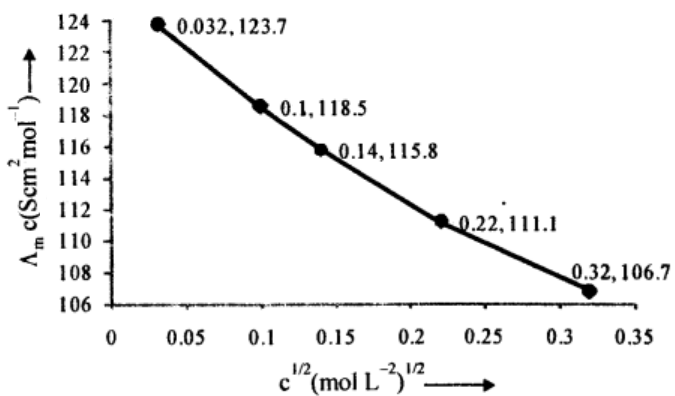
$\wedge^\circ$ = Intercept on $\wedge_\text{m}$ axis $= 124.0 S \ cm^2\ mol^{-1},$ which is obtained by extrapolation to zero concentration. View full question & answer→Question 63 Marks
Three electrolytic cells $A, B, C$ containing solutions of $ZnSO_4, AgNO_3$ and $CuSO_4,$ respectively are connected in series. A steady current of $1.5$ amperes was passed through them until $1.45\ g$ of silver deposited at the cathode of cell $B.$ How long did the current flow $?$ What mass of copper and zinc were deposited $?$
AnswerAccording to the reaction:
$\text{Ag}^{+}_\text{(aq)}+\text{e}^-\rightarrow\text{Ag}_\text{(s)}\\ \ \ \ \ \ \ \ \ \ \ \ \ \ \ \ \ \ \ \ \ \ \ \ \ \ \ \ 108\text{g}$
i.e., $108 g$ of $Ag$ is deposited by $96487\ C$
Therefore, $1.45\ g$ of $Ag$ is deposited by $=\frac{96487\times1045}{108}\text{C}$
$= 1295.43\ C$
Given,
Current $= 1.5\ A$
Therefore, Time $=\frac{1295.43}{105}\text{s}$
$= 863.6 s$
$= 864 s$
$= 14.40 \min$
Again,
$\text{Cu}^{2+}_\text{(aq)}+2\text{e}^-\rightarrow\text{Cu}_\text{(s)}\\ \ \ \ \ \ \ \ \ \ \ \ \ \ \ \ \ \ \ \ \ \ \ \ \ \ \ \ 63.5\text{g}$
i.e., $2 \times 96487\ C$ of charge deposit $= 63.5g$ of $Cu$
Therefore, 1295.43 C of charge will deposit $=\frac{63.5\times1295.43}{2\times96487}\text{g}$
$= 0.426\ g$ of $Cu$
Therefore, $1295.43\ C$ of charge will deposit $=\frac{65.4\times1295.43}{2\times96487}\text{g}$
$= 0.439\ g$ of $Zn$
View full question & answer→Question 73 Marks
Write the Nernst equation and emf of the following cells at $298\ K:$
$Pt(s) | Br_2(l) | Br^– (0.010 M) || H^+ (0.030 M) | H_2(g) (1\ bar)|Pt(s).$
AnswerFor given cell Anode reaction:
$2Br^-(aq) \rightarrow Br_2(l) + 2e^-$
Cathode reaction:
$2H^+(aq) + 2e^- \rightarrow H_2(g)$
Overall cell reaction:
$2Br^-(aq) + 2H^+(aq) \rightarrow Br_2(l) + H_2(g)$
Here, $n = 2,$
$E^o_{cell} = E^o_{cathode} - E^o_{anode} = 0 - 1.08 V = - 1.08 V.$
The Nernst equation for $E_{cell}$ and $298\ k$ can be written as:
$\text{E}_\text{cell}=\text{E}^\circ_\text{cell}-\frac{0.059}{\text{n}}\ \text{log}\ \frac{[\text{Br}^{2+}]\ [\text{H}_2]}{[\text{Br}^-]\ [\text{H}^+]^\text{2}}$
$=1.08-\frac{0.059}{2}\ \text{log}\ \frac{1}{\Big[10^{-2}\Big]^2[{3\times10^{-2}]^2}}$
$=-1.08-{0.059}\ \Bigg[\text{log}\ \frac{1}{10^{-4}\times9\times10^{-4}}\Bigg]$
$= - 1.08 - 0.0295(\log 10^8 - \log 9)$
$= -1.08 - 0.0295 (7.0458)$
$= -1.08 - 0.2078 = -1.2878 V.$
The negative value of Ecell indicates the cell has been arranged in a reverse way, i.e., hydrogen electrode will act as anode and bromine electrode act as cathode. The cell should be represented as $Pt\ I\ H_2\ (1$ bar$),$
$H^+(0.03 M) II Br (0.01 M) I Br_2(1), Pt.$
View full question & answer→Question 83 Marks
The cell in which the following reaction occurs:
$2\text{Fe}^{3+}(\text{aq})+2\text{I}^-(\text{aq})\rightarrow2\text{Fe}^{2+}(\text{aq})+\text{I}_2(\text{s})\ \text{has}\ \text{E}^\circ_{\text{cell}}= 0.236\ V$ at $298\ K.$ Calculate the standard Gibbs energy and the equilibrium constant of the cell reaction.
AnswerThe cell is
$2\text{Fe}^{3+}(\text{aq})+2\text{I}^-(\text{aq})\rightarrow2\text{Fe}^{2+}(\text{aq})+\text{I}_2(\text{s})2\text{Fe}_2+(\text{aq})+\text{I}_2(\text{s})$
$E^0\ cell = 0.236 V^0_a$
$\triangle r G^0 = −nFE^0\ cell$
$= − 2 \times 0.236 \times 96487\ C\ mol^{−1 }$
$= −45541 J $
$\text{Log Kc}=\frac{\text{nFE}^\circ\text{cell}}{2.303\times{\text{RT}}}$
$=\frac{2\times96487\times0.236}{2.303\times8.31\times298}$
$=\frac{45541.864}{5703.1031}$
$= 7.9854$
Or $Kc =$ Antilog $7.9854$
Or $Kc = 9.62 \times 10^7$
View full question & answer→Question 93 Marks
Define conductivity and molar conductivity for the solution of an electrolyte.
Discuss their variation with concentration.
AnswerConductivity: The reciprocal of resistance of an electrolyte in aqueous solution is known as its conductivity. It is equal to $\frac{1}{\text{R}}$
Molar Conductivity: Molar conductivity of a solution is defined as the conductance of all ions present in one mole of electrolyte in the solution. If $M$ is the molar concentration in mol $L^{–1},$ then.
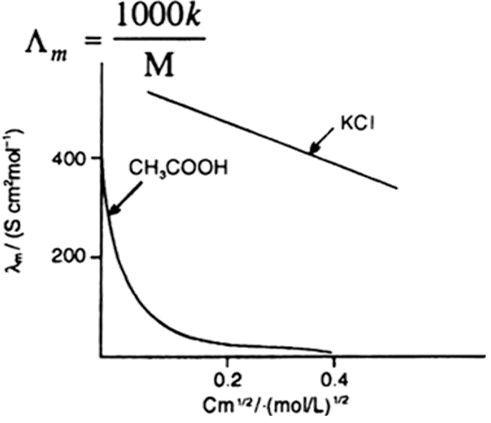
Fig: Molar conductivity versus $C^{1/2}$ for acetic acid $($week electrolyte$)$ and potassium chloride $($strong electrolyte in aqueous solutions$)$
The curve shown below gives the change in conductance against square root of concentrations. We observe that for strong electrolytes like $KCl,$ the conductance does not change much with decrease in $\sqrt C;$ whereas in the case of weak electrolyte like acetic acid $(CH_3COOH)$ it increases much with decrease in $\sqrt C.$ View full question & answer→Question 103 Marks
Calculate the standard cell potentials of galvanic cell in which the following reactions take place:
$2Cr(s) + 3Cd^{2+}(aq) \rightarrow 2Cr^{3+}(aq) + 3Cd$
Calculate the $\triangle_\text{r}\text{G}^\ominus$ and equilibrium constant of the reactions.
Answer$E^\circ _{Cd^{2+}/Cd} = -040 V, E^\circ _{Cr^{3+}/Cr} = -0.74 V$
$E^\circ _{Fe^{3+}/Fe} = 0.77 V, E^\circ _{Ag^+/Ag} = +0.80 V$
$\text{Cr(s) |}\ \text{Cr}^{3+}\text{(aq)}\ ||\ \text{Cd}^{2+}\ |\ \text{Cd(s)}$
$($anode is on left and cathode on right$)$
$E^\circ _{cell} = E^\circ _{right} - E^\circ _{left}$
$= -0.40 - (0.74) = +0.34 V$
$\triangle\text{G}^\circ_\text{r}\ \text{or}\ \triangle\ \text{G}^\circ_\text{cell}=-\text{nFE}^\circ_\text{cell}$
Here $n = 6$ as $6e$ are involved in overall cell reaction i.e.,
$2\text{Cr}+3\text{Cd}^{2+}\rightarrow 3\text{Cr}^{3+}+3\text{Cd}$
$= -6 \times 96500 C \times 0.34$
$= -196860 J\ mol^{-1}$
$= -196.86 kJ\ mol^{-1}$
$\text{E}^\circ_\text{cell}=\frac{0.0591}{\text{n}}=\text{log}\ \text{K}_\text{c}$
$\text{log k}_\text{c}=\frac{0.34\times6}{0.0591}=34.5177$
or $k_c =$ antilog $34.5177 = 3.294 \times 10^{34}$
View full question & answer→Question 113 Marks
Calculate the standard cell potentials of galvanic cell in which the following reactions take place:
$Fe^{2+}(aq) + Ag^+ (aq) \rightarrow Fe^{3+}(aq) + Ag(s)$
Calculate the $\triangle_\text{r}\text{G}^\ominus$ and equilibrium constant of the reactions.
AnswerThe galvanic cell of the given reaction is represented as
$Fe^{2+}(aq) | Fe^{3+}(aq) \| Ag^+ | Ag(s)$
The formula of standard cell potential is
$E^\circ _{cell} = E^\circ _{right} - E^\circ _{left}$
$E^\circ _{cell} = 0.80 - 0.77$
$E^\circ _{cell} = +0.03 V$
In balanced reaction there are $1$ electron are transferriin so that $n = 1$
Faraday constant, $F = 96500 C \ mol^{-1}$
$E^\circ _{cell} = +0.03 V$
Use formula
$\triangle_\text{r}\text{G}^\theta=-\text{nFE}^\circ_\text{cell}$
Plug the value we get
Then,$ = -1 \times 96500 C \ mol^{-1} \times 0.03 V$
$= -2895 CV \ mol^{-1}$
$= -2895 J \ mol^{-1}$
$= -2.895 kJ \ mol^{-1}$
Again,
Use second formula of $\triangle_\text{r}\text{G}^\theta $
$ \triangle_\text{r}\text{G}^\theta = -2.303RT \log k_c$
$log K_c = (\triangle_\text{r}\text{G}^\theta) / (-2.303RT)$
Plug the values we get
$\text{\log k}_\text{c}=\frac{\text{nE}^\circ_\text{cell}}{0.0591}=\frac{1\times0.03}{0.0591}=0.5076 $
$k_c =$ antilog $0.5076 = 3.218.$
View full question & answer→Question 123 Marks
Depict the galvanic cell in which the reaction $Zn(s) + 2Ag^+(aq) \rightarrow Zn^{2+}(aq) + 2Ag(s)$ takes place. Further show:
- Which of the electrode is negatively charged?
- The carriers of the current in the cell.
- Individual reaction at each electrode.
AnswerThe electrochemical cell can be depicted as $\text{Zn(s)}|\text{Zn}^{2+}\text{(aq)}||\text{Ag}^+\text{(aq)}|\text{Ag(s)}\\\text{Anode}\ \ \ \ \ \ \ \ \ \ \ \ \ \ \ \ \ \ \ \ \ \ \text{Cathode}\ \ \ \\ \text{(-ve)}\ \ \ \ \ \ \ \ \ \ \ \ \ \ \ \ \ \ \ \ \ \ \ \ \ \text{(+ve)}\ \ \ $
- Cathode reaction:
$2\text{Ag}^+\text{(aq)}+2\text{e}^-\rightarrow2\text{A}\text{(s)}\\ \ \ \ \ \ \ \ \ \ \ \ \ \ \ \text{(positive electrode oxidation)}$
Anode reaction:
$\text{Zn}\text{(s)}\rightarrow\text{Zn}^{2+}\text{(aq)}+2\text{e}^-\\ \ \ \ \ \ \ \ \ \ \ \text{(negative electrode oxidation)}$
- Electrons move from anode $($zinc electrode$)$ to cathode $($silver electrode$)$ in the external circuit. Zinc ions go into solution at anode and $Ag^{+ }$ ions get deposited at cathode. Thus electrons in the external and metal ions in the internal circuit act as carrier of current in.
- Overall reaction is obtained by anode and cathode reactions.
$Zn(s) + 2Ag^+(aq) \rightarrow Zn^{2+}(aq) + 2Ag(s)$ View full question & answer→Question 133 Marks
Write the Nernst equation and emf of the following cells at $298\ K:$
$Mg(s) | Mg^{2+}(0.001M) || Cu^{2+}(0.0001 M) | Cu(s)$
AnswerFor an electrochemical cell reaction
$aA + bB - cC + dD$
The Nernst's equation for cell reaction is
$\text{E}_\text{cell}=\text{E}^\circ_\text{cell}-\frac{0.059}{\text{n}}\ \text{log}\ \frac{[\text{C}]^\text{c}\ [\text{D}]^\text{d}}{[\text{A}]^\text{a}\ [\text{B}]^\text{b}}$
The values of $a, b, c, d$ and $n$ can be obtained from the balanced cell reaction. $(i)$ Anode reaction:
$Mg(s) \rightarrow Mg^{2+}(aq) + 2e^-$
Cathode reaction:
$Cu^{2+}(aq) + 2e^- \rightarrow Cu(s)$
Overall cell reaction:
$Mg(s) + Cu^{2+}(aq) \rightarrow Mg^{2+}(aq) + Cu(s)$
Here, $n = 2, E^0_{cell} = E^0_{cathode} - E^0_{anode} = 0. 34 V - (-2. 37) V = 2.71 V$
The Nernst equation for $E_{cell}$ at $298$ can be written as
$E_{cell} = E^0_{cell}$
$=\ -\frac{0.059}{\text{n}}\text{log}\frac{10^{-3}}{10^{-4}}$
$= 2.71 - 0.0295 = 2.68 V$
View full question & answer→Question 143 Marks
Write the Nernst equation and emf of the following cells at $298\ K:$
$Fe(s) | Fe^{2+}(0.001M) || H^+ (1M) | H_2(g)(1\ bar) | Pt(s)$
AnswerAnode reaction:
$Fe(s) \rightarrow Fe^{2+}[aq] + 2e^-$
Cathode reaction:
$2H^+ + 2e^- \rightarrow H2(g)$
Overall cell reaction:
$Fe(s) + 2H^+(aq) \rightarrow Fe^{2+}(aq) + H_2(g)$
Here, $n = 2, E^0_{cell} = E^0_{cathode} - E^0_{anode} = 0 - (-0. 44 V) = +0.44 V.$
The Nernst equation for $E_{cell}$ at $298\ k$ can be written as:
$\text{E}_\text{cell}=\text{E}^\circ_\text{cell}-\frac{0.059}{\text{n}}\ \text{log}\ \frac{\Big[\text{Fe}^\text{2+}\Big]}{\Big[\text{H}^+\Big]}$
$=0.44-\frac{0.059}{\text{n}}\text{log}\frac{10^{-3}}{1}$
$=0.44-\frac{0.059}{\text{n}}\ (-3)$
$= 0.44 - 0.0295 (-3) = 0.44 - 0.0885 = 0.5285 V$
View full question & answer→Question 153 Marks
- The cell in which the following reaction occurs$:$
- $\ce{2 Fe^{3+} (aq) + 2 I^- (aq) \longrightarrow 2 Fe^{2+}(aq) + I_2(s)}$
has $\text{E}^0_{\text{cell}} = 0·236 V$ at $298 K.$ Calculate the standard Gibbs energy of the cell reaction. $($Given $: 1 F = 96,500 \ce{C mol^{-1})}$
- How many electrons flow through a metallic wire if a current of $0.5 A$ is passed for $2$ hours? $($Given $: 1 F = 96,500 \ce{C mol^{-1})}$
Answer
- $\triangle\text{G}^0=-\text{nFE}^0_{\text{cell}}$
$\text{n}=2$
$\triangle\text{G}^0=-2\times96500\text{ }\text{C/mol}\times0.236\text{V}$
$=-45548\text{ }\text{J/mol}$
$=-45.548\text{ }\text{kJ/mol}$
- $\text{Q}=\text{I t}=0.5\times2\times60\times60$
$=3600\text{ }\text{C}$
$96500\text{ }\text{C}=6.023\times10^{23}\text{electrons}$
$3600\text{ }\text{C}=2.25\times10^{22}\text{ }\text{electrons}$ View full question & answer→Question 163 Marks
- The cell in which the following reaction occurs:
$2 Fe^{3+} (aq) + 2 I^- (aq) \longrightarrow 2 Fe^{2+}(aq) + I_2 (s)$
has $\text{E}^0_{\text{cell}} = 0·236 V$ at $298 K.$ Calculate the standard Gibbs energy of the cell reaction. $($Given : $1 F = 96,500\ C\ mol^{-1})$
- How many electrons flow through a metallic wire if a current of $0·5\ A$ is passed for $2$ hours? $($Given : $1 F = 96,500\ C\ mol^{-1})$
Answer
- $\triangle\text{G}^0=-\text{nFE}^0_{\text{cell}}$
$\text{n}=2$
$\triangle\text{G}^0=-2\times96500\text{ }\text{C/mol}\times0.236\text{V}$
$=-45548\text{ }\text{J/mol}$
$=-45.548\text{ }\text{kJ/mol}$
- $\text{Q}=\text{I t}=0.5\times2\times60\times60$
$=3600\text{ }\text{C}$
$96500\text{ }\text{C}=6.023\times10^{23}\text{electrons}$
$3600\text{ }\text{C}=2.25\times10^{22}\text{ }\text{electrons}$ View full question & answer→Question 173 Marks
- Calculate $\Delta$rG^{o }for the reaction:
- $\ce{Mg (s)+Cu^{2+} (aq) \rightarrow Mg^{2+} (aq) + Cu (s)}$
Given: $\ce{E^o_{cell} = + 2.71 V, 1 F = 96500 C mol^{–1}}$
- Name the type of cell which was used in Apollo space programme for providing electrical power.
Answer
- Given $\ce{E^oCell = +2.71V F = 96500C mol^{-1} n = 2 }($from the given reaction$).$
- $\ce{\triangle rG^o = -n \times F \times E^oCell}.$
$\ce{\triangle rG^o = –2 \times 96500 C mol^{-1} \times 2.71V}.$
$\ce{= -523030 J/mol or -523.030 kJ/mol}.$
- Hydrogen $–$ Oxygen fuel Cell$/$Fuel cell.
View full question & answer→Question 183 Marks
Calculate $E^o_{cell }$ and $\Delta_{ r }G^{o}$ for the following reaction at $25^oC:$
$\text{A}^{2+}+\text{B}^{+}\xrightarrow{\text{ }\ \ \ \ \ \ \ \ \ \ \ \ }\text{A}^{3+}+\text{B}$
Given: $K_c =10^{10},1F =96500C mol^{-1}$
Answer$\text{A}^{2+}+\text{B}^{+}\xrightarrow{\text{ }\ \ \ \ \ \ \ \ \ \ \ \ }\text{A}^{3+}+\text{B }\text{ (n=1)}$
$K_{c }= 10^{10 }F = 96500C/mol T = 25^0C = 298K$
$\Delta\text{G}^{o}=\ ?$ $\text{E}^{o}= \ ?$ $R = 8.314J/K/mol$
$\Delta\text{G}^{o}=-2.303\text{ RT log Kc}$
$\Delta\text{G}^{o}\text{= -2.303}\times\text{8.314J/K/mol}\times\text{298K}\times\log{10}^{10}$
$\therefore\Delta\text{G}^{o}=\text{-57058.4J/mol or -57.0584 kJ/mol}$
$\Delta\text{G}^{o}=\text{-57058.4J/mol = -nFE}^{o}=\text{-1}\times\text{96500}\times\text{E}^{o}$
$\therefore\text{E}^{o}=\frac{\text{-57084.4}}{\text{-96500}}=\text{0.591V}$
View full question & answer→Question 193 Marks
- The cell in which the following reaction occurs:
- $2 Fe^{3+} (aq) + 2 I^- (aq) \longrightarrow 2 Fe^{2+}(aq) + I2 (s)$
has $\text{E}^0_{\text{cell}} = 0·236 V$ at $298 K$. Calculate the standard Gibbs energy of the cell reaction. $($Given :$ 1 F = 96,500 C mol^{-1})$
- How many electrons flow through a metallic wire if a current of $0·5 A$ is passed for $2$ hours? $($Given : $1 F = 96,500 C mol^{-1})$
Answer
- $\triangle\text{G}^0=-\text{nFE}^0_{\text{cell}}$
$\text{n}=2$
$\triangle\text{G}^0=-2\times96500\text{ }\text{C/mol}\times0.236\text{V}$
$=-45548\text{ }\text{J/mol}$
$=-45.548\text{ }\text{kJ/mol}$
- $\text{Q}=\text{I t}=0.5\times2\times60\times60$
$=3600\text{ }\text{C}$
$96500\text{ }\text{C}=6.023\times10^{23}\text{electrons}$
$3600\text{ }\text{C}=2.25\times10^{22}\text{ }\text{electrons}$ View full question & answer→Question 203 Marks
- Calculate $\Delta rG^{o }$ for the reaction:
$Mg (s) + Cu^{2+} (aq) \rightarrow Mg^{2+} (aq) + Cu (s)$
Given: $E^o_{cell} = + 2.71 V, 1 F = 96500 C mol^{–1}$
- Name the type of cell which was used in Apollo space programme for providing electrical power.
Answer
- Given $E^oCell = +2.71V F = 96500C \ mol^{-1} n = 2 ($from the given reaction$).$
$\triangle rG^O = -n x F x E^o\ Cell.$
$\triangle rG^O = –2 x 96500 C \ mol^{-1} x 2.71V.$
$= -523030 J/mol or -523.030 kJ/mol.$
- Hydrogen $–$ Oxygen fuel Cell/Fuel cell.
View full question & answer→Question 213 Marks
Calculate the emf of the following cell at $25^oC:$
$Ag(s)|Ag^+(10^{-3}M)||Cu^{2+}(10^{-1}M)|Cu(S).$
Given $E^o_{cell}=+0.46 V and \log 10^n=n.$
AnswerGiven cell notation is incorrect Correct cell formula is $Cu^{2+} (10^{-1}M) │Cu(s)││Ag^+ (10^{-3}M)│Ag(s)$
Given $E^o_{cell} = 0∙46V \text{E}_{cell}=\text{E}^{o}_{cell}-\frac{\text{0.0591}}{\text{n}}\log\frac{\text{[Cu}^{2+}]}{\text{[Ag}^{+}]^{2}} $
$ \text{E}_{cell}=\text{0.46}-\frac{\text{0.0591}}{\text{2}}\log\frac{\text{[0.1}]}{\text{[10}^{-3}]^{2}} E_{cell} = \text{0.46-0.02955}\log\frac{\text{[0.1]}}{\text{[10}^{-6}]} E_{cell} = 0∙46 - 0∙02955 \log 10^5$
$E_{cell}= 0∙46 - 0∙02955 x 5 E_{cell}= 0∙46 - 0∙146$
$E_{cell}= 0∙314VA$ lternate Answer
$\text{E}_{cell}=\text{E}^{o}_{cell}\frac{\text{0.059}}{\text{2}}\log\frac{\text{[Ag}^{+}]^{2}}{\text{[cu}^{2+}]} $
$ =\text{.46 V}-\frac{\text{0.059}}{\text{2}}\log\frac{\text{[10}^{-3}]^{2}}{\text{[0.1}]} = 0.46V + 0.0295 x 5$
$=0.6075V.$
View full question & answer→Question 223 Marks
The reaction, $\ce{N_2 (g) + O_2 (g) \rightleftharpoons 2NO(g)}$ contributes to air pollution whenever a fuel is burnt in air at a high temperature. At $1500K, $equilibrium constantKfor it is $1.0 \times 10^{–5}.$ Suppose in a case $\ce{[N_2] = 0.80 mol L^{–1}}$ and $\ce{[O_2] = 0.20 mol L^{–1}}$ before any reaction occurs. Calculate the equilibrium concentrations of the reactants and the product after the mixture has been heated to $1500 K.$
Answer
| |
$\text{N}_{2(g)}$ |
$+ O_{2(g)}$ |
$\rightarrow 2NO_{(g)}$ |
| Initial Conc. |
$0.80M$ |
$0.20M$ |
$0$ |
| Final Conc. |
$(0.80 – x) $ |
$(0.20 – x)$ |
$2x$ |
$\text{K}_{c}=\frac{[NO]^{2}}{[N_{2}]\times[{O}_{2}]}$
$1\times10^{-5}\frac{[2x]^{2}}{[0.80-x]\times[0.20-x]}$
Thus $x = 0.66 \times 10^{-3 }($approx$)$
At equilibrium $[NO] = 2x = 1.32 \times 10^{–3}.$ View full question & answer→Question 233 Marks
The electrical resistance of a column of $\ce{0.05M NaOH}$ solution of diameter $1 \ cm$ and length $50 \ cm$ is $\ce{5.55 \times 10^3 ohm}.$ Calculate its resistivity, conductivity and molar conductivity.
Answer$\text{A}=\pi\text{r}^{2}=3.14\times0.52\ \text{cm}^{2}{=0.785}\times{10}^{-4}\text{m}^{2}$
$l = 50 \ cm = 0.5 m $
$\text{R}=\frac{\rho\text{l}}{A}$ OR $ \rho=\frac{R\text{A}}{l}$
View full question & answer→Question 243 Marks
A copper-silver cell is set up. The copper ion concentration in it is $0.10 M$. The concentration of silver ion is not known. The cell potential measured $0.422 V$. Determine the concentration of silver ion in the cell.
$\text{Given: E}^{o}_{\text{Ag}^{+}/\text{Ag}}=+0.80\text{V},\text{E}^{o}_{\text{Cu}^{2+}/\text{Cu}}=+0.34\text{V}.$
AnswerThe cell reaction: $Cu(s) + 2 Ag^+(aq) \rightarrow Cu^{2+}(aq) + 2 Ag(s)$
$\text{E}^{\circ}_{\text{cell}}=0.46\text{ V}$
Nernst equation
$\text{E}_{\text{cell}}=\text{E}^{\circ}_{\text{cell}}-\frac{0.059}{2}\log\frac{[\text{Cu}^{2+}]}{[\text{Ag}^{+}]^{2}}$
$\text{E}_{\text{cell}}=(0.80-0.34)-\frac{0.059}{2}\log\frac{[\text{Cu}^{2+}]}{[\text{Ag}^{+}]^{2}}$
$0.422\text{V}=0.46\text{V}-\frac{0.059}{2}\log\frac{0.10}{[\text{Ag}^{+}]^{2}}$
$\log\frac{0.10}{[\text{Ag}^{+}]^{2}}=1.2881$
$[Ag^+]^2 = 0.0051$
$[Ag^+] = 7.1 x 10^{–2} M.$
View full question & answer→Question 253 Marks
Calculate the standard cell potential of the galvanic cell in which the following reaction takes place:$\text{2 Cr(s)}+3\text{ Cd}^{2+}\text{(aq.)}\rightarrow2\text{Cr}^{3+}\text{(aq.)}+3\text{ Cd(s)}$ Also calculate the $\Delta_{\text{r}}\text{G}^{\ominus}$ value of the reaction. $(\text{Given: }\text{E}^{\ominus}_{\text{ }\text{ }\text{ }\text{ Cr}^{3+/}/\text{Cr}}=+0.74\text{V};\text{E}^{\ominus}_{\text{ }\text{ }\text{ }\text{ }\text{Cd}^{2+}\text{/Cd}}=-0.40\text{V and F = 96500 C mol}^{-1})$.
Answer$\text{E}^{\ominus}=-0.40\text{V}-(-0.74)\text{V}=0.34\text{V}$
Number of electrons involved $\ce{= 6 mol}$
$\ce{\Delta_{\text{r}}\text{G}^{\ominus}=-\text{n}\text{FE}^{\ominus}= -6 \times (96500 C mol^{-1}) \times 0.34V}$
$\ce{= -196.86 KJ mol^{-1}}.$
View full question & answer→Question 263 Marks
The electrical resistance of a column of $0.05 M KOH$ solution of diameter $1 \ cm$ and length $45·5 \ cm$ is $4.55 \times 10^3 ohm.$ Calculate its molar conductivity.
Answer$\text{A}=\pi\text{r}^2$
$=3.14\times0.5\times0.5\text{ }\text{cm}^2$
$=0.785\text{ }\text{cm}^2$
$l=45.5\text{ }\text{cm}$
$\rho=\text{R}\times\text{A}/l$
$\rho=4.55\times10^3\Omega\times0.785\text{ }\text{cn}^2/45.5\text{ }\text{cm}$
$\rho=78.5\Omega\text{ }\text{cm}$
$\text{conductivity, K}=1/\rho$
$=1/78.5 \text{ }\text{S \ cm}^{-1}=0.0127\text{ }\text{S \ cm}^{-1}$
$\text{molar conductivity}\text{ }{\wedge\text{m}}=\text{K}\times1000/\text{C}$
$=0.0127\text{ }\text{S \ cm}^{-1}\times1000/0.05\text{ }\text{mol/cm}^3$
$=254.77\text{ }\text{S \ cm}^2\text{mol}^{-1}$
Alternate Answer
$\text{A}=\pi\text{r}^2$
$=3.14\times0.5\times0.5\text{ }\text{cm}^2$
$=0.785\text{ }\text{cm}^2$
$l=45.5\text{ }\text{cm}$
$\text{G}^*=l/\text{A}=45.5\text{ }\text{cm}/0.785\text{ }\text{cm}^2$
$=57.96\text{ }\text{cm}^{-1}$
$\text{K}=\text{G}^*/\text{R}$
$=57.96\text{ }\text{cm}^{-1}/4.55\times10^3\Omega=1.27\times10^{-2}\text{ }\text{S \ cm}^{-1}$
${\wedge\text{m}}=\text{K}\times1000/\text{C}$
$=[1.27\times10^{-2}\text{ }\text{S \ cm}^{-1}]\times1000/0.05\text{ }\text{mol/cm}^3$
$=254.77\text{ }\text{S \ cm}^2\text{mol}^{-1}$
View full question & answer→Question 273 Marks
The electrical resistance of a column of $0.05 M KOH$ solution of diameter $1 \ cm$ and length $45_·5 \ cm$ is $4.55 \times 10^3 ohm$. Calculate its molar conductivity.
Answer$\text{A}=\pi\text{r}^2$
$=3.14\times0.5\times0.5\text{ }\text{cm}^2$
$=0.785\text{ }\text{cm}^2$
$l=45.5\text{ }\text{cm}$
$\rho=\text{R}\times\text{A}/l$
$\rho=4.55\times10^3\Omega\times0.785\text{ }\text{cm}^2/45.5\text{ }\text{cm}$
$\rho=78.5\Omega\text{ }\text{cm}$
$\text{conductivity, K}=1/\rho$
$=1/78.5 \text{ }\text{S \ cm}^{-1}=0.0127\text{ }\text{S \ cm}^{-1}$
$\text{molar conductivity}\text{ }{\wedge\text{m}}=\text{K}\times1000/\text{C}$
$=0.0127\text{ }\text{S \ cm}^{-1}\times1000/0.05\text{ }\text{mol/cm}^3$
$=254.77\text{ }\text{S \ cm}^2\text{mol}^{-1}$
Alternate Answer
$\text{A}=\pi\text{r}^2$
$=3.14\times0.5\times0.5\text{ }\text{cm}^2$
$=0.785\text{ }\text{cm}^2$
$l=45.5\text{ }\text{cm}$
$\text{G}^*=l/\text{A}=45.5\text{ }\text{cm}/0.785\text{ }\text{cm}^2$
$=57.96\text{ }\text{cm}^{-1}$
$\text{K}=\text{G}^*/\text{R}$
$=57.96\text{ }\text{cm}^{-1}/4.55\times10^3\Omega=1.27\times10^{-2}\text{ }\text{S \ cm}^{-1}$
${\wedge\text{m}}=\text{K}\times1000/\text{C}$
$=[1.27\times10^{-2}\text{ }\text{S \ cm}^{-1}]\times1000/0.05\text{ }\text{mol/cm}^3$
$=254.77\text{ }\text{S \ cm}^2\text{mol}^{-1}$
View full question & answer→Question 283 Marks
The electrical resistance of a column of 0.05 M KOH solution of diameter 1 cm and length 45·5 cm is 4.55 $\times$ 103 ohm. Calculate its molar conductivity.
Answer$\text{A}=\pi\text{r}^2$ $=3.14\times0.5\times0.5\text{ }\text{cm}^2$ $=0.785\text{ }\text{cm}^2$ $l=45.5\text{ }\text{cm}$ $\rho=\text{R}\times\text{A}/l$ $\rho=4.55\times10^3\Omega\times0.785\text{ }\text{cn}^2/45.5\text{ }\text{cm}$ $\rho=78.5\Omega\text{ }\text{cm}$ $\text{conductivity, K}=1/\rho$ $=1/78.5 \text{ }\text{S cm}^{-1}=0.0127\text{ }\text{S cm}^{-1}$ $\text{molar conductivity}\text{ }{\wedge\text{m}}=\text{K}\times1000/\text{C}$ $=0.0127\text{ }\text{S cm}^{-1}\times1000/0.05\text{ }\text{mol/cm}^3$ $=254.77\text{ }\text{S cm}^2\text{mol}^{-1}$Alternate Answer
$\text{A}=\pi\text{r}^2$ $=3.14\times0.5\times0.5\text{ }\text{cm}^2$ $=0.785\text{ }\text{cm}^2$ $l=45.5\text{ }\text{cm}$ $\text{G}^*=l/\text{A}=45.5\text{ }\text{cm}/0.785\text{ }\text{cm}^2$ $=57.96\text{ }\text{cm}^{-1}$ $\text{K}=\text{G}^*/\text{R}$ $=57.96\text{ }\text{cm}^{-1}/4.55\times10^3\Omega=1.27\times10^{-2}\text{ }\text{S cm}^{-1}$ ${\wedge\text{m}}=\text{K}\times1000/\text{C}$ $=[1.27\times10^{-2}\text{ }\text{S cm}^{-1}]\times1000/0.05\text{ }\text{mol/cm}^3$ $=254.77\text{ }\text{S cm}^2\text{mol}^{-1}$
View full question & answer→Question 293 Marks
Calculate e.m.f of the following cell at $298 K:$
$2Cr(s)+3Fe^{2+}(0.1M) \rightarrow 2Cr^{3+}(0.01M)+3Fe(s)$
Given:$ E^\circ (Cr^{3+}|Cr)= –0.74 V E^\circ (Fe^{2+}|Fe) = –0.44 V$
Answer$\text{E}^{o}_{cell}=\text{E}^{o}_{c}-\text{E}^{o}_{a}$
$=(-0.44)-(-0.74) V$
$=0.30 V$
$\text{E}_{cell}=\text{E}^{o}_{cell}\frac{\text{-0.059}}{\text{n}}\log\frac{\text{[Cr}^{3+}]^{2}}{\text{[Fe}^{2+}]^{3}}$
$\text{E}_{cell}=\text{E}^{o}_{cell}\frac{\text{-0.059}}{\text{6}}\log\frac{\text{[0.01]}^{2}}{\text{[0.1]}^{3}}$
$=0.30-(-0.059/6)$
$=0.3098 V$
View full question & answer→Question 303 Marks
Calculate emf of the following cell at $25 ^\circ C:$
$Fe|Fe^{2+}(0.001 M)||H^+(0.01 M)|H_2(g) (1bar)|Pt(s)$
$E^o(Fe^{2+}| Fe) = –0.44 V E^o(H^+|H_2) = 0.00 V$
Answer$\text{The cell reaction: Fe(s)+2H}^{+}\text{(aq)}\rightarrow\text{Fe}^{2+}\text{aq}+\text{H}_{2}\text{(g)}$
$\text{E}^{o}_{\text{cell}}=\text{E}^{o}_{\text{c}}-\text{E}^{o}_{\text{a}}$
$=\text{[0-(-0.44)]V=0.44V}$
$\text{E}_{\text{cell}}=\text{E}^{o}_{\text{cell}}-\frac{\text{0.059}}{\text{2}}\log\frac{\text{[Fe}^{2+]}}{\text{[H}^{+}]^{2}}$
$\text{E}_{\text{cell}}=\text{0.44V}-\frac{\text{0.059}}{\text{2}}\log\frac{\text{(0.001)}}{\text{(0.01)}^{2}}$
$=\text{0.44V}-\frac{\text{0.059}}{\text{2}}\log\text{(10)}$
$=\text{0.44V}-\text{0.0295 V}$
$=\ \approx\text{0.410V}$
View full question & answer→Question 313 Marks
- Calculate the mass of Ag deposited at cathode when a current of $2$ amperes was passed through a solution of $AgNO_3$ for $15$ minutes.
$($Given: Molar mass of $Ag = 108 \ g \ mol^{–1} 1F = 96500 \ C \ mol^{–1})$
- Define fuel cell.
Answer
- $m = ZIt$
$=\frac{108\times2\times15\times60}{1\times96500}$
$= 2.01 g$
- Cells that converts the energy of combustion of fuels directly into electrical energy.
View full question & answer→Question 323 Marks
Calculate e.m.f of the following cell at $298 K:$
$2Cr(s)+3Fe^{2+}(0.1M) \rightarrow 2Cr^{3+}(0.01M)+3Fe(s)$
Given: $E^\circ (Cr^{3+}|Cr)= –0.74 V E^\circ (Fe^{2+}|Fe) = –0.44 V$
Answer$\text{E}^{o}_{cell}=\text{E}^{o}_{c}-\text{E}^{o}_{a}$
$=(-0.44)-(-0.74) V$
$=0.30 V$
$\text{E}_{cell}=\text{E}^{o}_{cell}\frac{\text{-0.059}}{\text{n}}\log\frac{\text{[Cr}^{3+}]^{2}}{\text{[Fe}^{2+}]^{3}}$
$\text{E}_{cell}=\text{E}^{o}_{cell}\frac{\text{-0.059}}{\text{6}}\log\frac{\text{[0.01]}^{2}}{\text{[0.1]}^{3}}$
$=0.30-(-0.059/6)$
$=0.3098 V$
View full question & answer→Question 333 Marks
Calculate emf of the following cell at $25^\circ C:$
$Fe|Fe^{2+}(0.001M)||H^+(0.01M)|H_2(g) (1bar)|Pt(s)$
$E^o(Fe^{2+}| Fe) = –0.44 V E^o(H^+|H_2) = 0.00V$
Answer$\text{The cell reaction: Fe(s)+2H}^{+}\text{(aq)}\rightarrow\text{Fe}^{2+}\text{aq}+\text{H}_{2}\text{(g)}$
$\text{E}^{\circ}_{\text{cell}}=\text{E}^{\circ}_{\text{c}}-\text{E}^{\circ}_{\text{a}}$
$=\text{[0 - (-0.44)]V = 0.44V}$
$\text{E}_{\text{cell}}=\text{E}^{\circ}_{\text{cell}}-\frac{\text{0.059}}{\text{2}}\log\frac{\text{[Fe}^{2+]}}{\text{[H}^{+}]^{2}}$
$\text{E}_{\text{cell}}=\text{0.44V}-\frac{\text{0.059}}{\text{2}}\log\frac{\text{(0.001)}}{\text{(0.01)}^{2}}$
$=\text{0.44V}-\frac{\text{0.059}}{\text{2}}\log\text{(10)}$
$=\text{0.44V}-\text{0.0295 V}$
$=\text{0.410V}$
View full question & answer→Question 343 Marks
Calculate the emf of the following cell at $298 K:$
$\ce{Fe(s)|Fe^{2+}(0.001M)| |H^+(1M)|H_2(g)(1bar),Pt (s) (Given E^o_{cell}=+0.44 V)}$
AnswerThe cell reaction: $Fe(s) + 2H^+ (aq) \rightarrow Fe^{2+} (aq) + H_2(g)$
$E^o_{cell} = 0.44 V$
Nernst equation
$\text{E}^{o}_{cell}=\text{E}^{0}_{cell}-\frac{\text{0.059}}{\text{2}}\log\frac{\text{[Fe}^{2+}]}{\text{[H}^{+}]^{2}}$
$\text{E}^{o}_{cell}=0.44 V-\frac{\text{0.059}}{\text{2}}\log\frac{\text{0.001 M}}{\text{(1 M)}^{2}}$
$=0.44 V-\frac{\text{0.059}}{\text{2}}\log{(10}^{-3})$
$= 0.44 V + 0.0885 V$
$=0.5285V$
View full question & answer→Question 353 Marks
A current of 5 ampere is flowing though a wire for 193 seconds. Calculate the number of electrons flowing through the cross section of wire for 193 seconds.
AnswerQ = l × t = 5A × 193s = 965C
96500C is equivalent to flow of 6.022 × 10²³ electrons.
$\therefore$ 965C will be equivalent to flow of electrons
$=\frac{6.022\times10^{23}}{96500}\times965=6.022\times1021$
View full question & answer→Question 363 Marks
Write electrode reactions taking place in:
- Ni–Cd cell.
- Lead Acid Accumulator.
Answer
- $\text{Cd(s)}+2\text{OH}^-(\text{aq})\xrightarrow{ \ \ \ \ \ }\text{Cd(OH)}_2(\text{s}) + 2\text{e}^-$
$\text{NiO}_2(\text{s) + 2H}_2\text{O}+2\text{e}^-\xrightarrow{ \ \ \ \ \ \ \ }\text{Ni(OH)}_2(\text{s})+2\text{OH}^-(\text{aq})$
- $\text{Pb}\xrightarrow{ \ \ \ \ \ \ \ }\text{Pb}^{2+}+2\text{e}^-\text{(at anode)}\text{PbO}_2^+$
$\text{SO}_4^{2-}+4\text{H}^++2\text{e}^-\xrightarrow{\ \ \ \ \ \ \ \ \ }\text{PbSO}_4+2\text{H}_2\text{O}$ (at cathode) View full question & answer→Question 373 Marks
Chromium metal can be plated out from an acidic solution containing $CrO_3$ according to the following equation:
$\text{CrO}_3(\text{aq})+6\text{H}^+(\text{aq})+6\text{e}^-\xrightarrow{ \ \ \ \ \ \ \ \ \ \ \ }\text{Cr(s)}+3\text{H}_2\text{O}$
Calculate:
- How many grams of chromium will be plated out by $24,000$ coulombs.
- How long will it take to plate out $1.5g$ of chromium by using $12.5A$ current?
$($At. mass of $Cr = 52).$ Answer
- $6 \times 96500$ coulomb deposit $Cr = 1 \ mole = 52g$
$\therefore 24000$ coulomb deposit $Cr =\frac{52\times24000}{6\times96500}\text{g}=2.1554\text{g}$
- $52g$ of $Cr$ is deposited by electricity $= 6 \times 96500C$
$\therefore 1.5g$ require electricity $= 1.5C = 16071.9C$
$\therefore$ Time for which the current is required to be passed $=\frac{16071.9\text{C}}{12.5\text{A}}=1336\text{s}$ View full question & answer→Question 383 Marks
For a weak electrolyte, molar conductance in dilute solution increases sharply as its concentration in solution is decreased. Give reason.
AnswerBecause with dilution, there is increase in degree of dissociation and consequently the number of ions in total volume of solution increases and hence molar conductivity increases sharply.
View full question & answer→Question 393 Marks
Given that $\Lambda^{0}_{\text{m}}(\text{HCl})=426\text{ S cm}^2\text{mol}^{-1},\Lambda^{0}_{\text{m}}(\text{NaCl})\\=126\text{ S cm}^2\text{mol}^{-1}$
$\Lambda^{0}_{\text{m}}(\text{CH}_3\text{COONa})=91\text{ S cm}^2\text{mol}^{-1}$
Answer$\Lambda^{0}_{\text{m}}(\text{CH}_3\text{COOH})=\Lambda^{0}_{\text{CH}_3\text{COO}^-}+\Lambda^{0}_{\text{H}^+}$
$=\Lambda^{0}_{\text{CH}_3\text{COO}^-}=\Lambda^{0}_{\text{Na}^{+}}+\Lambda^{0}_{\text{H}^{+}}+\Lambda^{0}_{\text{Cl}^{-}}-\Big(\Lambda^{0}_{\text{Na}^{+}}+\Lambda^{0}_{\text{Cl}^{-}}\Big)$
$=\Lambda^{0}_{\text{m(CH}_3\text{COONa})}+\Lambda^{0}_{\text{m(HCl})}-\Lambda^{0}_{\text{m(NaCl})}$
$=(91+426+126)\text{S cm}^2\text{mol}^{-1}$
$=391\text{ S cm}^2\text{mol}^{-1}$
View full question & answer→Question 403 Marks
Calculate the standard free energy change for the following reaction at $25^\circ C.$
$\text{Au(s) + Ca}^{2+}(1\text{M})\xrightarrow{ \ \ \ \ \ \ \ }\text{Au}^{3+}(1\text{m) + Ca(s)}$
$\text{E}^{\circ}_{\text{Au}^{3+}/\text{Au}}=+1.50\text{V},=\text{E}^{\circ}_{\text{Ca}^{2+}/\text{Ca}}-2.87\text{V}$
Predict whether the reaction will be spontaneous or not at $25^\circ C$. Which of the above two half cells will act as an oxidising agent and which one will be a reducing agent?
Answer$\text{E}^{\circ}_{\text{cell}}=\text{E}^{\circ}_{\text{Ca}^{2+}/\text{Ca}}-\text{E}^{\circ}_{\text{Au}^{3+}/\text{Au}}$
$=(-2.87\text{V})-(1.50\text{V})=-4.37\text{V}$
$\Delta_{\text{r}}\text{G}^{\circ}_{\text{cell}}=-6\times96500\times(-4.37\text{V})$
$=+2530.230\text{kJ/ mol}$
Since $\Delta_{\text{r}}\text{G}^{\circ}$ is positive, therefore, reaction is non$-$spontaneous.
$Au^{3+}/Au$ half cell will be an oxidising agent while $Ca^{2+}/Ca$ half cell will be a reducing agent.
View full question & answer→Question 413 Marks
Account for the following:
- Alkaline medium inhibits the rusting of iron.
- Iron does not rust even if the zinc coating is broken in a galvanized iron pipe.
Answer
- The alkalinity of the solution prevents the availability of H+ ions.
- Zinc has lower reduction potential than iron. Therefore, zinc coating acts as anode and the exposed iron portions act as cathode. If zinc coating is broken, zinc still undergoes oxidation, protecting iron from rusting. No attack occurs on iron till all the zinc is corroded.
View full question & answer→Question 423 Marks
Estimate the minimum potential difference needed to reduce $Al_2O_3 at 500^\circ C$. The free energy change for the decomposition reaction,
$\frac{2}{3}\text{Al}_2\text{O}_3\frac{4}{3}\text{Al + O}_2\text{ is }960\text{kJ (F = 96500C mol}-1)$
Answer$\text{Al}_2\text{O}_3(2\text{Al}^{3+}+3\text{O}^{2-})\xrightarrow{ \ \ \ \ \ }2\text{Al}+\frac{3}{2}\text{O}_2,\text{n}=6\text{e}^-$
$\therefore\frac{2}{3}\text{Al}_2\text{O}_3\xrightarrow{ \ \ \ \ \ \ \ }\frac{4}{3}\text{Al + O}_2,\text{n}=\frac{2}{3}\times6\text{e}^-=4\text{e}^-$
$\Delta_{\text{r}}\text{G}=960\times1000=960000\text{J}$
Now, $\Delta_{\text{r}}\text{G}=-\text{nFE}_{\text{cell}}$
$\Rightarrow\text{E}_{\text{cell}}=-\frac{\Delta_{\text{r}}\text{G}}{\text{nF}}=\frac{-960000}{4\times96500}$
$\Rightarrow\text{E}_{\text{cell}}=-2.487\text{V}$
$\therefore$ Minimum potential difference needed to reduce $Al_2O_3 $ is $-2.487V.$
View full question & answer→Question 433 Marks
A zinc rod is dipped in $0.1M$ solution of $ZnSO_4$. The salt is $95\%$ dissociated at this dilution at $298K$. Calculate the electrode potential $\Big(\text{E}^{\circ}_{\text{Zn}^{2+/\text{Zn}}}=-0.76\text{V}\Big).$
AnswerThe electrode reactionwritten as reduction reaction is
$\text{Zn}^{2+}+2\text{e}^-\xrightarrow{ \ \ \ \ \ \ }\text{Zn(n = 2})$
Applying Nernst equation, we get
$\text{E}_{\text{Zn}^{2+}/\text{Zn}}=\text{E}^{\circ}_{\text{Zn}^{2+}/\text{Zn}}-\frac{0.0591}{2}\log\frac{1}{[\text{Zn}^{2+}]}$
As $0.1M ZnSO_4 $ solution is $95\%$ dissociated, this means that in the solution,
$[\text{Zn}^{2+}]=\frac{95}{100}\times0.1\text{M}=0.095\text{M}$
$\text{E}_{\text{Zn}^{2+}/\text{Zn}}=-076-\frac{0.0591}{2}\log\frac{1}{0.095}$
$=-0.76-0.02955(\log1000-\log95)$
$=-0.76-0.02955(3-1.9777)$
$=-0.76-0.03021=-0.79021\text{V}$
View full question & answer→Question 443 Marks
When a current of $0.75A$ is passed through a $\ce{CuSO_4}$ solution for $25$ min, $0.369g$ of copper is deposited at the cathode. Calculate the atomic mass of copper.
Answer$\text{W = Z}\times\text{I}\times\text{t}$
$0.369=\frac{\text{M}}{2\times96500}\times0.75\times25\times60 (M =$ molar mass of copper$)$
$\text{M}=63.3\ \text{g}/\text{mol}$
View full question & answer→Question 453 Marks
At what $pH$ of $HCl$ solution will hydrogen gas electrode show electrode potential of $-0.118V? H_2$ gas is passed at $298K$ and $1 \ atm$ pressure.
Answer$\text{H}^++\text{e}^-\xrightarrow{ \ \ \ \ \ \ \ \ }\frac{1}{2}\text{H}_2$
Applying Nernst equation,
$\text{E}_{\text{H}^+/\frac{1}{2}\text{H}_2}=\text{E}^{\circ}_{\text{H}^+/\frac{1}{2}\text{H}_2}-\frac{0.059}{\text{n}}\log\frac{1}{[\text{H}^+]}$
$-0.118=0-\frac{0.059}{1}\log\frac{1}{[\text{H}^+]}$
$-0.118=0.059\log[\text{H}^+]$
$-0.118=-0.059\text{pH}$
$\text{pH}=2$
View full question & answer→Question 463 Marks
The electrochemical cell given alongside converts the chemical energy released during the redox reaction
$\text{Zn(s) + Cu}^{2+}\text{(aq)}\xrightarrow{ \ \ \ \ \ \ \ }\text{Zn}^{2+}(\text{aq) + Cu(s)}$
to electrical energy. It gives an electrical potential of $1.1V$ when concentration $Zn^{2+}$ and $Cu^{2+}$ ions is unity. State the direction of flow of current and also specify whether zinc and copper are deposited or dissolved at their respective electrodes when:
- An external opposite potential of less than $1.1V$ is applied.
- An external potential of $1.1V$ is applied.
- An external potential of greater than $1.1V$ is applied.
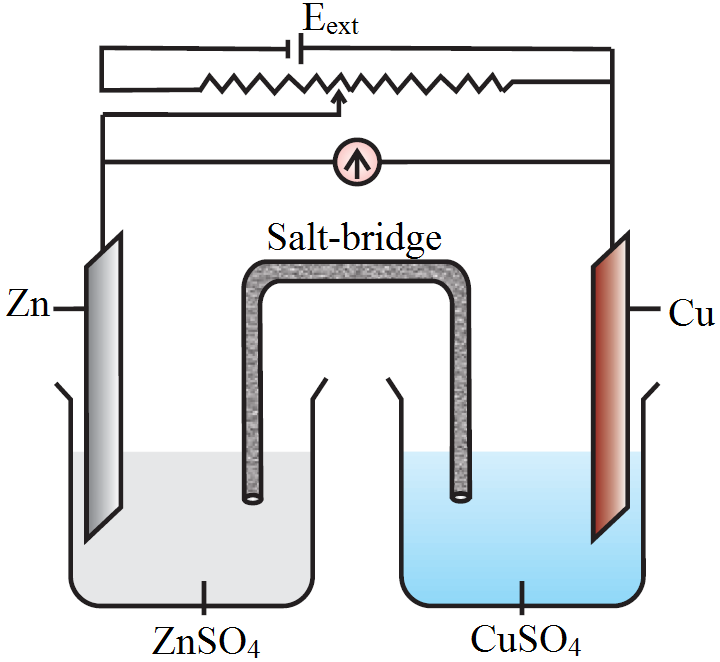
Answer
- Reaction continues to take place. Electrons flow from $Zn$ electrode to copper electrode, hence current flows from $Cu$ to $Zn$. Zn dissolves and copper deposits at their respective electrodes.
- The reaction stops and no current flows. A state of equilibrium is achieved and no change is observed at zinc and copper electrodes.
- Reaction takes place in opposite directions. Electrons flow from copper electrode to zinc electrode and hence current flows from $Zn$ to Cu. Zinc deposits and copper dissolves at their respective electrodes. The cell functions as an electrolytic cell.
View full question & answer→Question 473 Marks
Calculate the potential for half-cell containing
$0.10M K_2Cr_2O_7 (aq), 0.20M Cr^{3+}(aq) and 1.0 \times 10^{-4}M H^+(aq).$ The half cell reaction is
$\text{Cr}_2\text{O}_7^{2-}(\text{aq})14\text{H}^+(\text{aq})+6\text{e}^-\xrightarrow{ \ \ \ \ \ \ \ \ \ \ }2\text{Cr}^{3+}(\text{aq})+7\text{H}_2\text{O}(\text{l})$
and the standard electrode potential is given as $E^\circ = 1.33V.$
AnswerFor half cell reaction
$\text{Cr}_{2}\text{O}^2_7(\text{aq})+14\text{H}^+(\text{aq})+6\text{e}^-\xrightarrow{ \ \ \ \ \ \ \ \ }2\text{Cr}^{3+}(\text{aq})+7\text{H}_2\text{O}(\text{l})$
$\text{E}_{\text{cell}}=\text{E}^{\circ}_{\text{cell}}-\frac{0.0591}{\text{n}}\log\frac{[\text{Cr}^{3+}]^2}{[\text{Cr}_2\text{O}^{2-}_7][\text{H}^+]^{14}}$
Here, $\text{E}^{\circ}=1.33\text{V, n}=6,[\text{Cr}^{3+}]=0.2\text{M}$
$\Big[\text{Cr}_2\text{O}^2_7\Big]=0.1\text{M},[\text{H}^+]=1\times10^{-4}\text{M}$
Substituting these values in the given expression, we get
$\text{E}_{\text{cell}}=1.33\text{V}-\frac{0.0591}{6}\log\frac{(0.20)^2}{(0.1)(10^{-4})^{14}}$
$=1.33\text{V}\frac{0.0591}{6}-\log(4\times10^{55})$
$=1.33\text{V}-\frac{0.0591}{6}[\log4+\log10^{55}]$
$=1.33\text{V}-\frac{0.0591}{6}[2\log2+55\log10]$
$=1.33\text{V}-\frac{0.0591}{6}[2\times0.3010+55]$
$=1.33\text{V}-0.548\text{V}=0.782\text{V}$
View full question & answer→Question 483 Marks
Calculate the equilibrium constant for the reaction,$\text{Cd}^{2+}(\text{aq})+\text{Zn(s)}\xrightarrow{ \ \ \ \ \ \ \ }\text{Zn}^{2+}(\text{aq) + Cd(s)}$
If $\text{E}^{\circ}_{\text{Cd}^{2+}/\text{Cd}}=-0.403\text{V;}\text{ E}^{\circ}_{\text{Zn}^{2+}/\text{Zn}}=-0.763\text{V}$
Answer$\text{E}^{\circ}_{\text{cell}}=\text{E}^{\circ}_{\text{Cd}^{2+}/\text{Cd}}-\text{E}^{\circ}_{\text{Zn}^{2+}/\text{Zn}}$
$=-0.403\text{V}-(-0.763\text{V})=0.360\text{V, n}=2$
$\log\text{K}_{\text{c}}=\Big(\frac{\text{nE}^{\circ}_{\text{cell}}}{0.059}\Big)=\Big(\frac{2\times0.360}{0.059}\Big)=\Big(\frac{0.720}{0.059}\Big)=2=12.20$
$\text{K}_{\text{c}}=\text{antilog}(12.20)=1.585\times10^{12}$
View full question & answer→Question 493 Marks
Resistance of a conductivity cell filled with $0.1 \ mol L^{-1} KCl$ solution is $100\Omega.$ If the resistance of the same cell when filled with $0.02 \ mol L^{-1} KCl$ solution is $520\Omega,$ calculate the conductivity and molar conductivity of $0.02 \ mol L^{-1} KCl$ solution. The conductivity of $0.1 \ mol L^{-1} KCl$ solution is $1.29\times10^{-2}\Omega^{-1}\text{cm}^{-1}.$
AnswerFor $0.1 mol L^{-1} KCl$ solution,
Conductivity, $\text{k}=1.29\times10^{-2}\Omega^{-1}\text{cm}^{-1}$
Resistance, $\text{R}=100\text{W}$
Cell constant $=$ Conductivity $\times $ resistance
$=1.29\times10^{2-}\Omega-1\text{cm}^{-1}\times100\Omega=1.29\text{cm}^{-1}$
For $0.02 mol L^{-1} $ solution
Resistance $=520\Omega,$ Cell constant $=1.29\text{cm}^{-1}$
Conductivity, $k =\frac{\text{Cellconstant}}{\text{Resistance}}$
$=\frac{129\text{cm}^{-1}}{520\Omega}=0.0248\Omega^{-1}\text{cm}^{-1}$
Molar conductivity, $\Lambda_{\text{m}}=\frac{\text{Conductivity (k)}\times1000\text{cm}^3\text{L}^{-1}}{\text{Molarity}}$
$=\frac{0.00248\Omega^{-1}\text{cm}^{-1}\times1000\text{cm}^3\text{L}^{-1}}{0.02\text{ mol L}^{-1}}$
$=124\Omega^{-1}\text{cm}^2\text{mol}^{-1}$
View full question & answer→Question 503 Marks
How many molecules of chlorine should be deposited from molten sodium chloride in one minute by a current of 300 milliampere?
Answer$\text{Q}=\text{I}\times\text{t}$
Here, $\text{I}=\frac{300}{1000}=0.3\text{A};\text{t}=60\text{s; Q}=0.3\text{A}\times60\text{s = 18C}$
$2\times96500\text{C deposit Cl}_2=1\text{mol}$
$2\text{Cl}^-\xrightarrow{ \ \ \ \ \ \ }\text{Cl}_2+2\text{e}^-$
$\therefore$ 18 C will deposit $\text{Cl}_2=\frac{1\text{mol}\times18\text{C}\times6.022\times10^{23}}{2\times96500\text{C}}\text{molecules mol}^{-1}$
$=5.616\times10^{19}\text{ molecules}$
View full question & answer→Question 513 Marks
State the relationship amongst cell constant of a cell, resistance of the solution in the cell and conductivity of the solution. How is molar conductivity of a solute related to conductivity of its solution?
Answer$\text{k}=\frac{1}{\text{R}}\times\Big(\frac{\text{l}}{\text{A}}\Big)=$ where, k = Conductivity, $\frac{\text{l}}{\text{A}}=$ Cell constant, R = Resistance
$\Lambda_{\text{m}}=\frac{\text{k}\times1000}{\text{M}}$ where, $\Lambda^{\text{m}}=$ Molar conductivity, k = Conductivity, M = Molarity of solution
View full question & answer→Question 523 Marks
Give reactions taking place at the two electrodes if these are made up of Ag.
AnswerAg electrodes:
Anode: $\text{Ag(s)}\xrightarrow{ \ \ \ \ \ }\text{Ag}^+(\text{aq})+\text{e}^-$
Cathode: $\text{Ag}^+(\text{aq})+\text{e}^-\xrightarrow{ \ \ \ \ \ \ \ }\text{Ag(s)}$
View full question & answer→Question 533 Marks
Calculate the electrode potential of copper electrode dipped in $0.1\ce{M CuSO_4}$ solution at $298K.$ Given that $\text{E}^{\circ}_{\text{cu}^{2}+/\text{cu}}=0.34\text{V}.$
Answer$\text{Cu}^{2+}+2\text{e}^-\xrightarrow{ \ \ \ \ \ \ }\text{Cu};\text{n}=2$
$\text{E}_{\text{Cu}^{2+}/\text{Cu}}=\text{E}^{\circ}_{\text{Cu}^{2+}/\text{Cu}}-\frac{0.059}{\text{n}}\log\frac{1}{[\text{Cu}^{2+}]}$
$\text{E}_{\text{Cu}^{2+}/\text{Cu}}=0.34-\frac{0.059}{2}\log\frac{1}{0.1}$
$\text{E}_{\text{Cu}^{2+}/\text{Cu}}=0.34-0.0295=0.3105\text{V}$
View full question & answer→Question 543 Marks
From the following molar conductivities at infinite dilution, calculate $\Lambda^0_{\text{m}}$ for $\ce{NH_4OH}.$
$\Lambda^0_{\text{m}}\text{ for }\text{Ba(OH)}_2=457.6\Omega^{-1}\text{cm}^2\text{mol}^{-1}$
$\Lambda^0_{\text{m}}\text{ for }\text{BaCl}_2=240.\Omega^{-1}\text{cm}^2\text{mol}^{-1}$
$\Lambda^{0}_{\text{m}}\text{ for }\text{NH}_4\text{Cl}=129.8\Omega^{-1}\text{cm}^2\text{mol}^{-1}$
Answer$\Lambda^0_{\text{m}(\text{NH}_4\text{OH})}=\lambda^0_{\text{NH}^+_4}+\lambda^{0}_{\text{OH}^-}$
$=\Big(\lambda^0_{\text{NH}^+_4}+\lambda^0_{\text{Cl}^{-}}\Big)+\frac{1}{2}\Big(\lambda^0_{\text{Ba}^{2+}}+2\lambda^0_{\text{OH}^-}\Big)\\-\frac{1}{2}\Big(\lambda^0_{\text{Ba}^{2+}}+2\lambda^0_{\text{Cl}^-}\Big)$
$\Lambda^0_{\text{m}(\text{NH}_4\text{Cl})}+\frac{1}{2}\Big[\Lambda^0_{\text{m}(\text{BaOH})_2}\Big]-\frac{1}{2}\Big[\Lambda^0_{\text{m(BaCl}_2)}\Big]$
$129.8+\frac{1}{2}\times457.6-\frac{1}2{}\times240.6$
$=238.3\text{ ohm}^{-1}\text{cm}^2\text{mol}^{-1}$
View full question & answer→Question 553 Marks
A current of $1.50A $ was passed through an electrolytic cell containing $AgNO_3$ solution with inert electrodes. The weight of Ag deposited was $1.50g$. How long did the current flow?
Answer$\text{Ag}^++\text{e}^-\xrightarrow{ \ \ \ \ \ \ }\text{Ag}$
Quantity of charge required to deposit $108g$ of silver $= 96500C$
$\therefore$ Quantity of charge required to deposit $1.50g$ of silver $=\frac{96500}{108}\times1.50=1340.28\text{C}$
$\text{t}=\frac{\text{Q}}{\text{I}}$
$\therefore$ Time taken $=\frac{1340.28}{1.50}=893.52\text{s}$
View full question & answer→Question 563 Marks
Write the reactions taking place at the anode and cathode in the above cell.
AnswerInert electrodes:
Anode: $2\text{H}_2\text{O}(\text{l})\xrightarrow{ \ \ \ \ \ \ \ }\text{O}_2(\text{g})+4\text{H}^{+}(\text{aq})+4\text{e}^-$
Cathode: $\text{Ag}^{+}(\text{aq})+\text{e}^-\xrightarrow{\ \ \ \ \ \ \ }\text{Ag(s)}$
View full question & answer→Question 573 Marks
The conductivity of $0.001028 \ mol \ L^{-1}$ acetic acid is $4.95 \times 10^{-5} S \ cm^{-1}$. Calculate its dissociation constant $\Lambda^{\circ}_{\text{m}}$ if for acetic acid is $390.5 S \ cm^2 \ mol^{-1}.$
Answer$\Lambda_{\text{m}}=\frac{\text{k}\times1000}{\text{c}}=\frac{4.95\times10^{-5}\text{ S cm}^{-1}}{0.001028\text{ mol L}^{-1}}\times\frac{1000\text{cm}^3}{\text{L}}$
$=48.15\text{ S cm}^2\text{mol}^{-1}$
$\alpha=\frac{\Lambda_{\text{m}}}{\Lambda^{0}_{\text{m}}}=\frac{48.15\text{ S cm}^2\text{mol}^{-1}}{390.5\text{ S cm}^2\text{mol}^{-1}}=0.1233$
$\text{K}=\frac{\text{c}\alpha^2}{(1-\alpha)}=\frac{0.001028\text{ mol L}^{-1}\times(0.1233)^2}{1-0.1233}$
$=1.78\times10^{-5}\text{mol}\text{ L}^{-1}$
View full question & answer→Question 583 Marks
The emf of a cell corresponding to the reaction.
$\text{Zn(s)}+2\text{H}^+(\text{aq})\xrightarrow{ \ \ \ \ \ }\text{Zn}^{2+}(0.1\text{M})+\text{H}_2(\text{g 1 atm} )$ is 0.28 volt at 25°C.
Write the half-cell reactions and calculate the pH of the solution at the hydrogen electrode.
$\text{E}^{\circ}_{\text{Zn}^{2+}/\text{Zn}}=-0.76\text{V},\text{E}^{\circ}_{\text{H}^+/\text{H}_2}=0\text{V}$
AnswerHalf-cell reactions:
$\begin{matrix}\text{At anode: } \ \ \ \ \text{Zn}\xrightarrow{ \ \ \ \ \ }\text{Zn}^{2+}+2\text{e}^-\\\text{At cathode:} \ \ \ 2\text{H}^++2\text{e}^-\xrightarrow{ \ \ \ \ }\text{H}_2\\ \ \ \ \ \ \ \ \ \ \ \ \ \ \ \ \ \ \ \ \ \ \ \ \ \ \ \ \ \ \ \ \ \ \overline{ \ \ \ \ \ \ \ \ \ \ \ \ \ \ \ \ \ \ \ \ \ \ \ \ \ \ \ \ \ \ \ \ \ \ \ \ \ \ \ \ \ \ \ \ \ \ }\\ \ \ \ \ \ \ \ \ \ \ \ \ \text{Cell reaction:}\text{ Zn + 2H}^+\xrightarrow{ \ \ \ \ \ }\text{Zn}^{2+}+\text{H}_2\end{matrix}$
$\text{E}_{\text{cell}}=\text{E}^{\circ}_{\text{cell}}-\frac{0.0591}{\text{n}}\log\frac{[\text{Zn}^{2+}]}{[\text{H}^+]^2}$
$=\Big(\text{E}^{\circ}_{\text{H}^+/\text{H}_2}-\text{E}^{\circ}_{\text{Zn}^{2+}/\text{Zn}}\Big)-\frac{0.0591}{2}\log\frac{0.1}{[\text{H}^+]^2}$
$=[0-(-0.76)]-0.02955[\log10^{-1}-2\log(\text{H}^+)]$
$0.28=0.76-0.02955(-1+2)\text{pH}$ $[\because\text{pH}=-\log(\text{H}^+)]$
$2\text{pH}-1=16.244$
$\text{pH}=8.62$
View full question & answer→Question 593 Marks
Aqueous copper sulphate solution and aqueous silver nitrate solution are electrolysed by $1$ ampere current for $10$ minutes in separate electrolytic cells. Will the mass of copper and silver deposited on the cathode be same or different? Explain your answer.
AnswerIt will be different. According to Faraday’s second law, the amounts of different substances liberated by the same quantity of electricity passing through the electrolytic solution are proportional to their chemical equivalent weights, $\frac{\text{Atomic mass of metal}}{\text{No. of electrons}}$ electrons required to reduce the cation. Here, for the electrode reactions:
$\text{Cu}^{2+}+2\text{e}^{-}\xrightarrow{\ \ \ \ \ \ \ \ \ \ \ \ }\text{Cu(s)}$
$\text{Ag}^{+}+\text{e}^{-}\xrightarrow{\ \ \ \ \ \ \ \ \ \ \ \ }\text{Ag(s)}$
Hence, one mole of $Cu^{2+} $ and $Ag^{3+}$ require $2 \ mol$ of electron $(2F)$ and $1 \ mol$ of electrons $(F1)$ respectively.
View full question & answer→Question 603 Marks
Write overall cell reaction for lead storage battery when the battery is being charged.
Answer$2\text{PbSO}_4(\text{s})+2\text{H}_2\text{O}(\text{l})\xrightarrow{ \ \ \ \ \ \ \ }\text{Pb(s)}+\text{PbO}_2\text{(s)}+4\text{H}^+(\text{aq})+2\text{SO}^{2-}_4(\text{aq})$
View full question & answer→