Questions

3 Marks Question

🎯

Test yourself on this topic

8 questions · timed · auto-graded

Question 13 Marks
The equilibrium constant of cell reaction :
$Sn^{4+}(.aq) + Al(s) Al^{3+ }\rightarrow + Sn^{2+} (aq)$  is  $4.617 \times 10^{184}, at 25 ^\circ C$
a. Calculate the standard emf of the cell. $($Given: $\log 4.617 \times 10^{184} = 184.6644)$
b. What will be the $E^\circ$ of the half cell $Al^{3+}/Al, if E^\circ$ of half cell $Sn^{4+}/Sn^{2+}$ is $4+ 0.15 V.$
Answer
$\mathrm{E}_{\text {Cell }}=\mathrm{E}_{\text {Cell }}^o-\frac{2.303 \mathrm{RT}}{\mathrm{nF}} \cdot \log \mathrm{Kc}$
At $298 K$
|$\mathrm{E}_{\text {Cell }}=\mathrm{E}^{\mathrm{o}}{ }_{\text {Cell }}-\frac{0.0591}{\mathrm{n}} \log \mathrm{Kc}$
At equilibrium Ecell $=0, n=6$
$E_{\text {Cell }}^o =\frac{0.0591}{n} \operatorname{\log~Kc}$
$ =0.059 / 6 \log 4.617 \times 10^{184}$
$ =0.00983 \times 184.6644$
$ =1.8152$
$(ii) \mathrm{E}_{\text {cell }}^0=\mathrm{E}_{\mathrm{Sn}_{n 4+/ S n 2+}}-\mathrm{E}^0{ }_{\mathrm{Al} 3+/ \mathrm{Al}}$
$1.81=-0.15-\mathrm{E}^0{ }^{\mathrm{Al} 3}+\mathrm{Al}$
$ \mathrm{E}_{\mathrm{AA}^0+/ \mathrm{Al}}=-1.66 \mathrm{~V}$
View full question & answer
Question 23 Marks
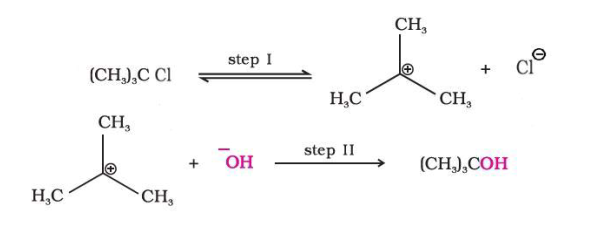
Various isomeric haloalkanes with the general formula $\ce{{C_4H_9CI}}$ undergo hydrolysis reaction. Among them, compound $"A "$ is the most reactive through $\ce{S_N^1}$ mechanism. Identify $"A "$ citing the reason for your choice. Write the mechanism for the reaction.
Answer
$"A "$ is $\ce{(CH_3)_3CCI},$ the carbocation intermediate obtained in tertiary alkyl halide is most stable, making $A$ most reactive of all possible isomers.
Image
View full question & answer
Question 33 Marks
Neeta was experimenting in the lab to study the chemical reactivity of alcohols. She carried out a dehydration reaction of propanol at $140^\circ C$ to $180^\circ C$. Different products were obtained at these two temperatures.
a. Identify the major product formed at $140^\circ C$ and the substitution mechanism followed in this case.
b. Identify the major product formed at $180^\circ C$ and the substitution mechanism followed in this case.
Answer
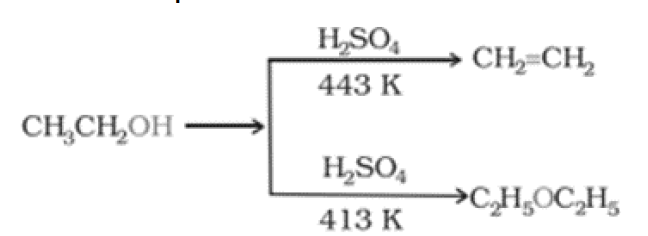
$(a)$ Ethanol undergoes a dehydration reaction. At $140^\circ C,$ diethyl ether is formed. The formation of ether is a nucleophilic $\ce{S_N2}$ substitution bimolecular reaction
$(b)$ When the temperature exceeds $170^\circ C,$ ethene is the major product. Nucleophilic substitution $\ce{S_N1}$ unimolecular reaction
Image
View full question & answer
Question 43 Marks
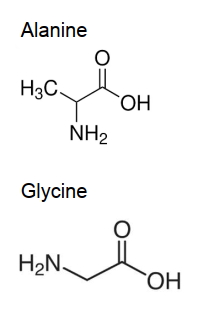
a. Give the structure of all the possible dipeptides formed when the following two amino acids form a peptide bond.
Image
b. Keratin, insulin, and myosin are a few examples of proteins present in the human body. Identify which type of protein is keratin and insulin and differentiate between them based on their physical properties.
Answer
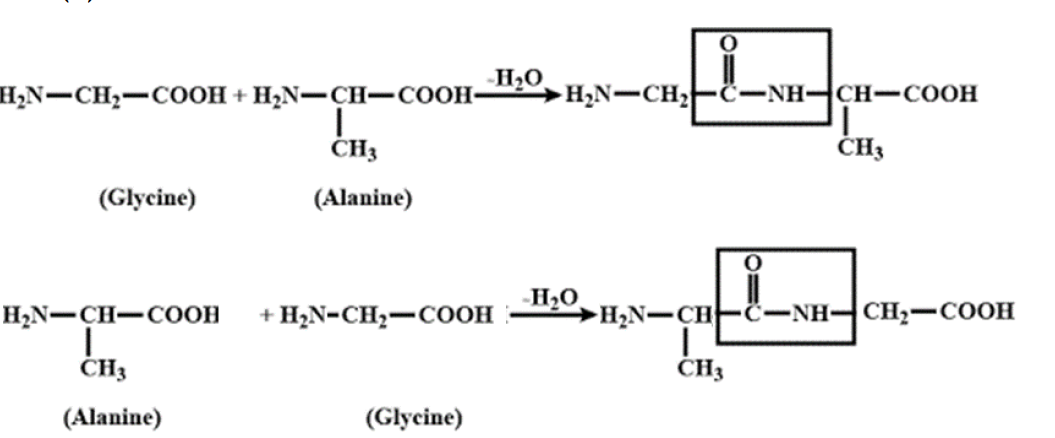
(a)
Image
(b) (i) Keratin is a fibrous protein. fibre- like structure is formed. Such proteins are generally insoluble in water.
(ii)Insulin is a globular protein. This structure results when the chains of polypeptides coil around to give a spherical shape. These are usually soluble in water.
View full question & answer
Question 53 Marks
An organic compound 'X', does not undergo aldol condensation. However 'X' with compound 'Y' in the presence of a strong base react to give the compound 1,3-diphenylprop-2-en-1-one.
a. Identify 'X' and 'Y'
b. Write the chemical reaction involved.
c. Give one chemical test to distinguish between X and Y.
Answer
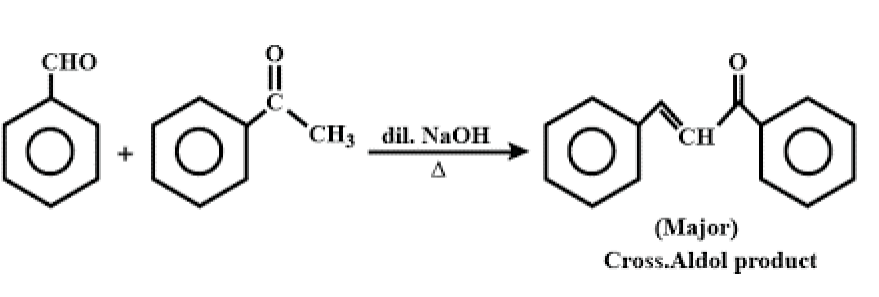
(a) Compound 'X' = Benzaldehyde, Compound Y = Acetophenone
(b)
Image
Chemical test to distinguish between X and Y is the Tollen Test.
(c) Benzaldehyde undergoes Silver mirror test with Tollen reagent and forms silver mirror. However Acetophenone does not react with Tollen Reagent.

View full question & answer
Question 63 Marks
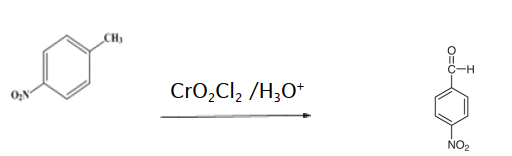
a. Give the chemical reaction involved when $p-$ nitrotoluene undergoes Etard reaction.
b. Why does Benzoic acid exist as a dimer in an aprotic solvent?
c. Benzene on reaction with methylchloride in the presence of anhydrous $\ce{AlCl3}$ forms toluene. What is the expected outcome if benzene is replaced by benzoic acid? Give a reason for your answer.
Answer
$(a)$
Image
$(b)$ Benzoic acid undergoes extensive intermolecular hydrogen bonding, leading to the formation of dimer.
$(c)$ Benzoic acid does not undergo reaction with $\ce{CH_3Cl}$
i.e Friedel Craft reaction because the carboxyl group is deactivating and the catalyst aluminium chloride $($Lewis acid$)$ gets bonded to the carboxyl group
View full question & answer
Question 73 Marks
Account for the following:
a. The lowest oxide of transition metal is basic, and the highest is acidic.
b. Chromium is a hard metal while mercury is a liquid metal
c. The ionisation energy of elements of the 3d series does not vary much with increasing atomic number.
Answer
(a) In the case of a lower oxide of a transition metal, the metal atom has some electrons present in the valence shell of the metal atom that are not involved in bonding. As a result, it can donate electrons and behave as a base whereas in higher oxide of a transition metal, the metal atom does not have an electron in the valence shell for donation. As a result, it can accept electrons and behave as an acid.
(b) Chromium has unpaired electrons which result in strong metallic bonding which results in it being a hard solid and the absence of unpaired electrons in Hg results in it being a liquid.
(c) The increase in effective nuclear charge responsible for steady increase in ionisation energy is counterbalanced by shielding effect of (n-1)d electrons
View full question & answer
Question 83 Marks
a. Write down the reaction occurring on two inert electrodes when electrolysis of copper chloride is done. What will happen if a concentrated solution of copper sulphate is replaced with copper chloride?
b. Write an expression for the molar conductivity of aluminium sulphate at infinite dilution according to Kohlrausch law.
Answer
$a)$ Product of electrolysis of Copper Chloride
Cathode$(-)$
$Cu^{2+} + 2e \leftarrow Cu(s)$
anode$(+)$
$2CI \rightarrow Cl_2+ 2e$
Product of electrolysis of concentrated Copper Sulphate
Anode$(+) SO_4^2S_2O_8 + 2e$
Cathode $(-) Cu^{2+} + 2e \leftarrow Cu(s)$
$(B) \Lambda^0{ }_{\mathrm{m}}\left[\mathrm{Al}_2\left(\mathrm{SO}_4\right)_3\right]=2 \lambda^0{ }_{\mathrm{m}}\left(\mathrm{Al}^{3+}\right)+3 \lambda^0{ }_{\mathrm{m}}\left(\mathrm{SO}_4{ }^{2-}\right)$
View full question & answer
3 Marks Question - Chemistry STD 12 Science Questions - Vidyadip