Question
a. Write down the reaction occurring on two inert electrodes when electrolysis of copper chloride is done. What will happen if a concentrated solution of copper sulphate is replaced with copper chloride?
b. Write an expression for the molar conductivity of aluminium sulphate at infinite dilution according to Kohlrausch law.
Answer

$a)$ Product of electrolysis of Copper Chloride
Cathode$(-)$
$Cu^{2+} + 2e \leftarrow Cu(s)$
anode$(+)$
$2CI \rightarrow Cl_2+ 2e$
Product of electrolysis of concentrated Copper Sulphate
Anode$(+) SO_4^2S_2O_8 + 2e$
Cathode $(-) Cu^{2+} + 2e \leftarrow Cu(s)$
$(B) \Lambda^0{ }_{\mathrm{m}}\left[\mathrm{Al}_2\left(\mathrm{SO}_4\right)_3\right]=2 \lambda^0{ }_{\mathrm{m}}\left(\mathrm{Al}^{3+}\right)+3 \lambda^0{ }_{\mathrm{m}}\left(\mathrm{SO}_4{ }^{2-}\right)$

Need a full question paper?

Generate a complete, print-ready paper with questions like this in minutes — across 16+ boards, with answer keys.

Start Generating Free

Similar questions

Explain how does the - OH group attached to a carbon of benzene ring activate it towards electrophilic substitution?
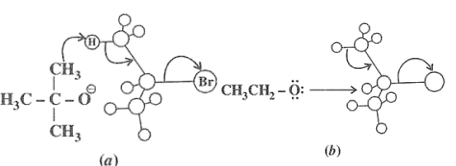
One of the two figures given below represents substitution and the other represents elimination. Indicate which is substitution and which is elimination.
Image
Explain ẞ Elimination reaction with example. ### Explain Dihydrohalogenation reaction of Haloalkane ### Explain zaitsev or Saytzeff rule with example.
At what $pH$ of $HCl$ solution will hydrogen gas electrode show electrode potential of $-0.118V? H_2$ gas is passed at $298K$ and $1 \ atm$ pressure.
(a) Write the chemical reaction involved in Etard reaction.
(b) Arrange the following in the increasing order of their reactivity towards nucleophilic addition reaction :
$CH _3- CHO, C _6 H _5 COCH _3, HCHO$
(c) Why $pK _a$ of $Cl - CH _2- COOH$ is lower than the $pK _a$ of $CH _3 COOH$ ?
An organic compound $A,$ which has a characteristic odour, on treatment with con. $NaOH$ forms two compounds $B$ and $C.$ Compound $B$ has molecular formula $C_7H_8O$ which on oxidation gives back $A.$ Compound $C$ is the sodium salt of an acid. $C,$ when heated with soda lime yields an aromatic hydrocarbon $D.$ Deduce the structures of $A, B, C$ and $D.$
What is meant by hydroboration-oxidati on reaction? Illustrate it with an example.
What happens when D-glucose is treated with the following reagents?
(i) HI, (ii) Bromine water.
For the first order thermal decomposition reaction, the following data were obtained: $\text{C}_{2}\text{H}_{5}\text{Cl}\text{(g)}\rightarrow \text{C}_{2}\text{H}_{4}\text{(g)} + \text{HCl}\text{(g)} $
Time/$\sec$ Total pressure$/\ce{atm}$
$0$ $0.30$
$300$ $0.50$
Calculate the rate constant $($Given: $\ce{\log 2 = 0.301, \log 3=0.4771, \log 4 =0.6021)}$