DNA fingerprinting means the
Question types
MODEL PAPER 2 question types
39 questions across 6 question groups — pick any mix to generate a Chemistry paper with step-by-step answer keys.
39
Questions
6
Question groups
5
Question types
01
M.C.Q (1 Marks)
12 Q→02Assertion (A) & Reason (B) MCQ
4 Q→032 Marks Questions
6 Q→043 Marks Question
8 Q→055 Marks Questions
5 Q→064 Marks Questions
4 Q→Sample Questions
MODEL PAPER 2 questions
One sample from each question group in this chapter. Select any group above to see the full set with answer keys.
View full solution →
Match the items of column I with appropriate entries of column $II.$
View full solution →| Column $I$ | Column $II$ |
| $(a) \frac{\Delta P }{ P ^{\circ}{ }_A}$ | $(i) \frac{\Delta T _{ b }}{ m }$ |
| $(b)\ K_b$ | $(ii)$ mol fraction of solute |
| $(c)\ i$ | $(iii) \frac{\Delta T _{ f }}{ m }$ |
| $(d)\ K_f$ | $(iv)$ Ratio of observed molar mass to actual molar mass |
How to do the following conversion:
$RCOOCI + ? \rightarrow RCHO$
View full solution →$RCOOCI + ? \rightarrow RCHO$
One mole of an organic compound $'A\ '$ with the formula $C_3H_8O$ reacts completely with two moles of $HI$ to form $X$ and $Y.$ When $'Y\ '$ is boiled with aqueous alkali forms $Z.\ Z$ answers the iodoform test. The compound $'A\ '$ is ________
View full solution →The correct increasing order of basic strength for the following compounds is __________ .

Assertion $(A):$ The oxygen of $OH$ group in alcohols is attached to $sp^3$ hybridised carbon.
Reason $(R):$ The bond angle in alcohols $C-O-H$ is $109^\circ 28'.$
View full solution →Reason $(R):$ The bond angle in alcohols $C-O-H$ is $109^\circ 28'.$
Assertion $(A):$ Hydrolysis of $(-)-2-$bromooctane proceeds with inversion of configuration.
Reason $(R):$ This reaction proceeds through the formation of a carbocation to give $(+)-$octan$-2-$ol as a product. In $S_N2$ reaction of optically active halides are accompanied by inversion of configuration.
View full solution →Reason $(R):$ This reaction proceeds through the formation of a carbocation to give $(+)-$octan$-2-$ol as a product. In $S_N2$ reaction of optically active halides are accompanied by inversion of configuration.
Assertion (A): Benzaldehyde is less reactive than ethanal towards nucleophilic addition reactions.
Reason (R): Ethanal is more sterically hindered
Reason (R): Ethanal is more sterically hindered
Assertion (A): Cellulose is not digested by human beings.
Reason (R): Cellulose is a polymer of β-D-glucose.
Reason (R): Cellulose is a polymer of β-D-glucose.
Calculate the freezing point of a solution containing $0.520\ g$ glucose $(C_6H_{12}O_6)$ dissolved in $80.20\ g$ of water.
$($For water $Kf = 1.86 K \ kg\ mol^{-1})$
View full solution →$($For water $Kf = 1.86 K \ kg\ mol^{-1})$
Why do gases always tend to be less soluble in liquids as the temperature is raised?
Draw the structures of the following compounds.
i. 4-Chloropentan-2-one
ii. 3-Bromo-4-phenylpentanoic acid
i. 4-Chloropentan-2-one
ii. 3-Bromo-4-phenylpentanoic acid
Answer the following:
(a) For a chemical reaction, what is the effect of catalyst on the rate of the reaction.
(b) Why is the probability of reaction with molecularity higher than three very rare?
(a) For a chemical reaction, what is the effect of catalyst on the rate of the reaction.
(b) Why is the probability of reaction with molecularity higher than three very rare?
Why is $Cr^{2+}$ reducing and $Mn^{3+}$ oxidising when both have $d^4$ configuration$?$
View full solution →In each of the following pairs of compounds, identify the compound which will undergo $S_N1$ reaction faster.
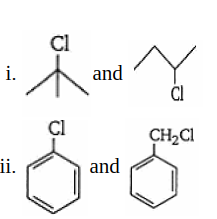
View full solution →Calculate the potential of hydrogen electrode in contact with a solution whose PH is 10.
Determine the value of equilibrium constant $(Kc)$ and $\Delta G^\theta$ for the following reaction. $N i(s)+2 A g^{+}(a q) \rightarrow N i^{2+}(a q)+2 A g(s)$
$E^\theta=1.05 V\left(1 F=96500 C mol^{-1}\right)$
View full solution →$E^\theta=1.05 V\left(1 F=96500 C mol^{-1}\right)$
An aromatic compound $A ($Molecular formula $C_8H_8O)$ gives positive $2, 4-DNP$ test. It gives a yellow precipitate of compound $B$ on treatment with iodine and sodium hydroxide solution. Compound $A$ does not give Tollen's or Fehling's test. On drastic oxidation with potassium permanganate it forms a carboxylic acid $C ($Molecular formula $C_7H_6O_2),$ which is also formed along with the yellow compound in the above reaction. Identify $A, B$ and $C$ and write all the reactions involved.
View full solution →Write the structures of the major products expected from the following reactions:
$a.$ Mononitration of $3-$methylphenol
$b.$ Dinitration of $3-$methylphenol
$c.$ Mononitration of phenyl methanoate
View full solution →$a.$ Mononitration of $3-$methylphenol
$b.$ Dinitration of $3-$methylphenol
$c.$ Mononitration of phenyl methanoate
Attempt any five of the following:
$(a)$ What are Purines and Pyrimidines? Name the purines and Pyrimidines present in $\text{DNA}$ and $\text{RNA}$ nucleic Acids.
$(b)$ Write the full forms of $\text{DNA}$ and $\text{RNA}$.
$(c)$ Name the vitamin whose deficiency causes convulsions.
$(d)$ Which vitamin B group can be stored in our body?
$(e) (i)$. What is the difference between a nucleoside and nucleotide?
$(ii).$ Write one difference between a-helix and $ẞ-$pleated sheet structures of protein.
$(f)$ What are nucleic acids? Why two strands in $\text{DNA}$ are not identical but are complementary?
$(g)$ Some enzymes are named after the reaction, where they are used. What name is given to the class of enzymes which catalyse the oxidation of one substrate with simultaneous reduction of another substrate?
View full solution →$(a)$ What are Purines and Pyrimidines? Name the purines and Pyrimidines present in $\text{DNA}$ and $\text{RNA}$ nucleic Acids.
$(b)$ Write the full forms of $\text{DNA}$ and $\text{RNA}$.
$(c)$ Name the vitamin whose deficiency causes convulsions.
$(d)$ Which vitamin B group can be stored in our body?
$(e) (i)$. What is the difference between a nucleoside and nucleotide?
$(ii).$ Write one difference between a-helix and $ẞ-$pleated sheet structures of protein.
$(f)$ What are nucleic acids? Why two strands in $\text{DNA}$ are not identical but are complementary?
$(g)$ Some enzymes are named after the reaction, where they are used. What name is given to the class of enzymes which catalyse the oxidation of one substrate with simultaneous reduction of another substrate?
Using IUPAC norms write the formulas for the following:
a. Tetrahydroxozincate(II)
b. Potassium tetrachloridopalladate(II)
c. Diamminedichloridoplatinum(II)
d. Potassium tetracyanonickelate(II)
e. Pentaamminenitrito-O-cobalt(III)
f. Hexaamminecobalt (III) sulphate
g. Potassium tri(oxalato) chromate(III)
h. Hexaammineplatinum(IV)
i. Tetrabromidocuprate(II)
j. Pentaamminenitrito-N-cobalt(III)
a. Tetrahydroxozincate(II)
b. Potassium tetrachloridopalladate(II)
c. Diamminedichloridoplatinum(II)
d. Potassium tetracyanonickelate(II)
e. Pentaamminenitrito-O-cobalt(III)
f. Hexaamminecobalt (III) sulphate
g. Potassium tri(oxalato) chromate(III)
h. Hexaammineplatinum(IV)
i. Tetrabromidocuprate(II)
j. Pentaamminenitrito-N-cobalt(III)
Write major product(s) in the following reaction .
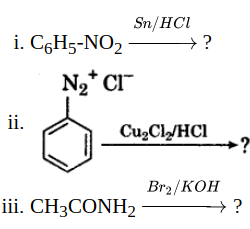
i. Write the structures of main products when benzene diazonium chloride reacts with the following reagents:
a. $H_3PO_2 + Hp$
b. $CuCN/KCN$
c. $H_2O$
ii. Arrange the following in the increasing order of their basic character in an aqueous solution: $\ce{C_2H_5NH_2, (C_2H5)_2NH, (C_2H_5)_3N.}$ Give justification.
View full solution →a. $H_3PO_2 + Hp$
b. $CuCN/KCN$
c. $H_2O$
ii. Arrange the following in the increasing order of their basic character in an aqueous solution: $\ce{C_2H_5NH_2, (C_2H5)_2NH, (C_2H_5)_3N.}$ Give justification.
Write the IUPAC names of the following coordination compounds:
i. $\left[ Co \left( NH _3\right) 6\right] Cl _3$
ii. $\left[ Co \left( NH _3\right)_5 Cl \right] Cl _2$
iii. $K_3\left[ Fe ( CN )_6\right]$
iv. $K_3\left[ Fe \left( C _2 O _4\right)_3\right]$
v. $K_2\left[P_{d C l}^4\right]$
vi. $\left[ Pt \left( NH _3\right)_2 Cl \left( NH _2 CH _3\right)\right] Cl$
View full solution →i. $\left[ Co \left( NH _3\right) 6\right] Cl _3$
ii. $\left[ Co \left( NH _3\right)_5 Cl \right] Cl _2$
iii. $K_3\left[ Fe ( CN )_6\right]$
iv. $K_3\left[ Fe \left( C _2 O _4\right)_3\right]$
v. $K_2\left[P_{d C l}^4\right]$
vi. $\left[ Pt \left( NH _3\right)_2 Cl \left( NH _2 CH _3\right)\right] Cl$
Read the following text carefully and answer the questions that follow:
Transition metal oxides are generally formed by the reaction of metals with oxygen at high temperatures. The highest oxidation number in the oxides coincides with the group number. In vanadium, there is a gradual change from the basic $V_2O_3$ to less basic $V_2O_4$ and to amphoteric $V_2O_5. V_2O_4$ dissolves in acids to give $VO^{2+}$ salts. Potassium dichromate is a very important chemical used in the leather industry and as an oxidant for the preparation of many azo compounds. Dichromates are generally prepared from chromate. Sodium dichromate is more soluble than potassium dichromate. The latter is, therefore, prepared by treating the solution of sodium dichromate with potassium chloride. Sodium and potassium dichromates are strong oxidising agents; sodium salt has a greater solubility in water and is extensively used as an oxidising agent in organic chemistry. Potassium dichromate is used as a primary standard in volumetric analysis.
i. Which of the 3d series of the transition metals exhibits the largest number of oxidation and why?
ii. A transition metal exhibits highest oxidation state ih oxides and fluorides. Give reason.
iii. How would you account for the increasing oxidising power in the series:
$\ce{VO _2^{+}< Cr _2 O _7^{2-}< MnO _4^{-}}$?
View full solution →Transition metal oxides are generally formed by the reaction of metals with oxygen at high temperatures. The highest oxidation number in the oxides coincides with the group number. In vanadium, there is a gradual change from the basic $V_2O_3$ to less basic $V_2O_4$ and to amphoteric $V_2O_5. V_2O_4$ dissolves in acids to give $VO^{2+}$ salts. Potassium dichromate is a very important chemical used in the leather industry and as an oxidant for the preparation of many azo compounds. Dichromates are generally prepared from chromate. Sodium dichromate is more soluble than potassium dichromate. The latter is, therefore, prepared by treating the solution of sodium dichromate with potassium chloride. Sodium and potassium dichromates are strong oxidising agents; sodium salt has a greater solubility in water and is extensively used as an oxidising agent in organic chemistry. Potassium dichromate is used as a primary standard in volumetric analysis.
i. Which of the 3d series of the transition metals exhibits the largest number of oxidation and why?
ii. A transition metal exhibits highest oxidation state ih oxides and fluorides. Give reason.
iii. How would you account for the increasing oxidising power in the series:
$\ce{VO _2^{+}< Cr _2 O _7^{2-}< MnO _4^{-}}$?
Which mechanisms helps in the transportation of water in a plant?
Read the following text carefully and answer the questions that follow:
Many chemical and biological processes depend on osmosis, the selective passage of solvent molecules through the porous membrane from a dilute solution to a more concentrated one. The osmotic pressure $\pi$ depends on molar concentration of the solution ($\pi$ = CRT). If two solutions are of equal solute concentration and, hence, have the same osmotic pressure, they are said to be isotonic. If two solutions are of unequal osmotic pressures, the more concentrated solution is said to be hypertonic and the more diluted solution is described as hypotonic. Osmosis is the major mechanism, for transporting water upward in the plants. Transpiration is the leaves supports the transport mechanism of water. The osmotic pressure of seawater is about 30 atm; this is the pressure that must be applied to the seawater (separated from pure water using a semi-permeable membrane) to get drinking water.
i. What will happen if a plant cell kept in a hypertonic solution?
ii. Blood cells are isotonic with 0.9% sodium chloride solution. What happens if we place blood cells in a solution containing in 1.2% sodium chloride solution?
iii. What happens when the external pressure applied becomes more than the osmotic pressure of solution?
View full solution →Many chemical and biological processes depend on osmosis, the selective passage of solvent molecules through the porous membrane from a dilute solution to a more concentrated one. The osmotic pressure $\pi$ depends on molar concentration of the solution ($\pi$ = CRT). If two solutions are of equal solute concentration and, hence, have the same osmotic pressure, they are said to be isotonic. If two solutions are of unequal osmotic pressures, the more concentrated solution is said to be hypertonic and the more diluted solution is described as hypotonic. Osmosis is the major mechanism, for transporting water upward in the plants. Transpiration is the leaves supports the transport mechanism of water. The osmotic pressure of seawater is about 30 atm; this is the pressure that must be applied to the seawater (separated from pure water using a semi-permeable membrane) to get drinking water.
i. What will happen if a plant cell kept in a hypertonic solution?
ii. Blood cells are isotonic with 0.9% sodium chloride solution. What happens if we place blood cells in a solution containing in 1.2% sodium chloride solution?
iii. What happens when the external pressure applied becomes more than the osmotic pressure of solution?
$MnO$ is basic whereas $Mn_2O_7$ is acidic in nature. Give reason.
View full solution →Generate a MODEL PAPER 2 paper free
Pick question groups from the list above, set marks and difficulty, and export a branded PDF with step-by-step answer keys. First 3 chapters free — no signup.