Questions

2 Marks Questions

Take a timed test

6 questions · self-marked practice — reveal the answer and mark yourself.

Question 12 Marks
Calculate the freezing point of a solution containing $0.520\ g$ glucose $(C_6H_{12}O_6)$ dissolved in $80.20\ g$ of water.
$($For water $Kf = 1.86 K \ kg\ mol^{-1})$
Answer
$ M _{ B }=\text { Molecular mass of glucose, } C _6 H _{12} O _6$
$=(6 \times 12)+(12 \times 1)+6 \times 16)=180\ g\ mol ^{-1}$
$w _{ B }=\text { mas of glucose }=0.520 g$
$W _{ A }=\text { mass of water }=80.20 g$
$K _{ f }=1.86 K\ kg / mol$
$\Delta T_f=\frac{K_f \times w_B \times 1000}{M_B \times w_A}=\frac{1.86 \times 0.520 \times 1000}{180 \times 80.20}$
$=0.0669$
View full question & answer
Question 22 Marks
Why do gases always tend to be less soluble in liquids as the temperature is raised?
Answer
Mostly dissolution of gases in liquid is an exothermic process. It is because the fact that this process involves decrease of entropy. Thus, increase of temperature tends to push the equilibrium in backward direction as a result solubility of the gas decreases. (Gas + Solvent$\rightleftharpoons$ Solution + Heat)
View full question & answer
Question 32 Marks
Draw the structures of the following compounds.
i. 4-Chloropentan-2-one
ii. 3-Bromo-4-phenylpentanoic acid
View full question & answer
Question 42 Marks
Answer the following:
(a) For a chemical reaction, what is the effect of catalyst on the rate of the reaction.
(b) Why is the probability of reaction with molecularity higher than three very rare?
Answer
Answer the following:
(i) Catalyst increases the rate of reaction by providing alternative path with lower energy of activation.
(ii) As the number increases the chance of simultaneous collision decrease that means the probability of more than three molecules colliding simultaneously is very small. Therefore, the possibility of molecularity being three is very low.
View full question & answer
Question 52 Marks
Why is $Cr^{2+}$ reducing and $Mn^{3+}$ oxidising when both have $d^4$ configuration$?$
Answer
Chromium $Cr^{2+}$ is reducing as its configuration changes from $d^4$ to $d^3,$ the latter having a half-filled $t_{2g}$ level. On the other hand, the change from $($Manganese$) Mn^{3+}$ to $Mn^{2+}$ results in the half-filled $(d^5)$ configuration which has extra stability.
View full question & answer
Question 62 Marks
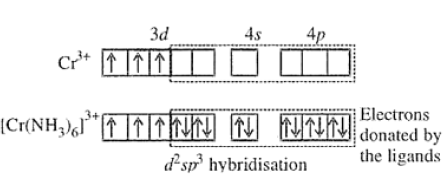
Using the valence bond approach, deduce the shape and magnetic behaviour of $[Cr(NH_3)_6]^{3+}$ ion. $[$Atomic number of $Cr = 24]$
Answer
$Cr$ has electronic configuration $[Ar]4s^13d^5$
$Cr^{3+}$ has electronic configuration $[Ar]4s^03d^5$
Image
$d^5\ sp^3,$ hybridisation gives octahedral shape. The complex is paramagnetic due to the presence of unpaired electrons.
View full question & answer