Questions

5 Marks Questions

Take a timed test

5 questions · self-marked practice — reveal the answer and mark yourself.

Question 15 Marks
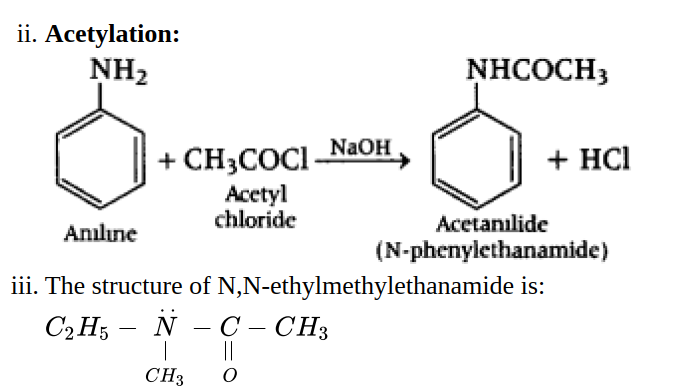
i. Write one chemical reaction for each
a. Carbylamine reaction
b. Acetylation reaction
ii. Write structure of N,N-ethylmethylethanamide
View full question & answer
Question 25 Marks
An organic compound $A$ with molecular formula $C_7H_7NO$ reacts with $Br_2/aq.\ KOH$ to give compound $B,$ which upon reaction with $NaNO_2$ and $HCl$ at $0^\circ\ C$ gives $C.$ Compound $C$ on heating with $CH_3CH_2OH$ gives a hydrocarbon $D.$ Compound $B$ on further reaction with $Br_2$ water gives white precipitate of compound $E.$ Identify the compound $A, B, C, D$ and $E;$ also justify your answer by giving relevant chemical equations.
View full question & answer
Question 35 Marks
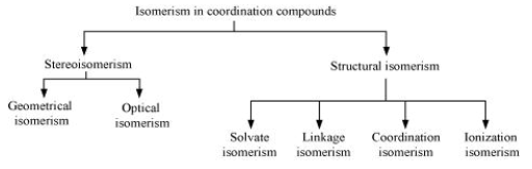
List various types of isomerism possible for coordination compounds, giving an example of each.
Answer
Image
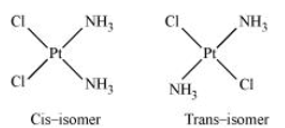
$i.$ Geometric isomerism: This type of isomerism is common in heteroleptic complexes. It arises due to the different possible geometric arrangements of the ligands. For example:
Image
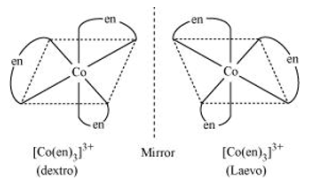
$ii.$ Optical isomerism: This type of isomerism arises in chiral molecules. Isomers are mirror images of each other and are non- superimposable.
Image
$iii.$ Linkage isomerism: This type of isomerism is found in complexes that contain ambidentate ligands. For example: $\ce{[Co(NH_3)_5 (NO_2)] Cl_2}$ and $\ce{[Co(NH_3)_5 (ONO)Cl_2}$
Yellow form Red form
$iv.$ Coordination isomerism:
This type of isomerism arises when the ligands are interchanged between cationic and anionic entities of different metal ions present in the complex.
$[\ce{Co(NH_3)_5ONO]^{2+}}$ and $[\ce{Co(NH_3)_5NO_2]^{2+}}$
$v.$ Ionization isomerism:
This type of isomerism arises when a counter ion replaces a ligand within the coordination sphere. Thus, complexes that have the same composition, but furnish different ions when dissolved in water are called ionization isomers. For e.g., $\ce{Co(NH_3)_5SO_4Br,}$ and $\ce{Co(NH_3)_5BrSO_4}$
$vi.$ Solvate isomerism:
Solvate isomers differ by whether or not the solvent molecule is directly bonded to the metal ion or merely present as a free solvent molecule in the crystal lattice.
$\ce{[Cr(H_2O)_6] Cl_3 [Cr(H_2O)_5Cl]Cl_2.H_2O[Cr(H_2O)_5Cl_2 Cl._2H_2O}$
Violet Blue-green Dark green
View full question & answer
Question 45 Marks
Attempt any five of the following:
(a) Aldopentoses named ribose and 2-deoxyribose are found in nucleic acids. What is their relative configuration?
(b) What are the three components of nucleic acids?
(c) Name the sugar present in milk. How many monosaccharide units are present in it? What are such oligosaccharides called?
(d) Is nucleotide and nucleoside the same? What are their roles?
(e) Why cannot vitamin C be stored in our body?
(f) During curdling of milk, what happens to sugar present in it?
(g) Account for the following:
a. There are 5-OH groups in glucose.
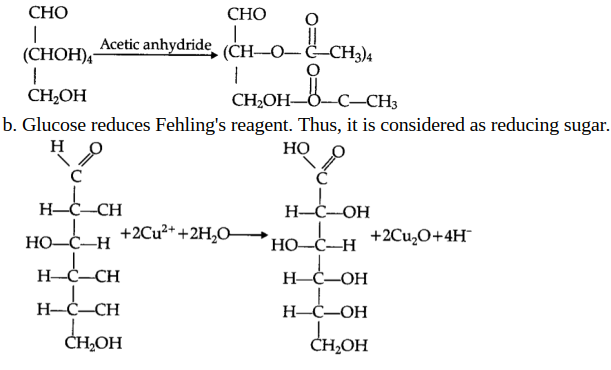
b. Glucose is a reducing sugar
Answer
Attempt any five of the following:
(i) Both the aldopentoses(ribose and 2-deoxyribose) have D-configuration.
(ii) The three components of nucleic acid are base, sugar and phosphate group..
(iii) Lactose is present in milk as sugar. Two monosaccharide units (i.e., glucose and galactose) are present in it. Such oligosaccharides are called disaccharides.
(iv) The main difference between nucleotide and nucleoside lies in their chemical composition. Nucleotide consists of phosphate group, a sugar and a nitrogenous base. Nucleoside consists of sugar and a base without the phosphate group.
Nucleotides are the major causes of cancer and nucleosides are same as nucleotides only with the addition of phosphate groups.
(v) Vitamin C cannot be stored in our body because it is water soluble. As a result, it is readily excreted in the urine.
(vi) The milk sugar lactose is converted into lactic acid by the bacteria during curdling of milk.
(vii) a. Acetylation of glucose with acetic anhydride gives glucose pentaacetate which confirms the presence of five -OH
groups. Since, it exists as a stable compound, five -OH groups should be attached to different carbon atoms.
Image
View full question & answer
Question 55 Marks
Explain with two examples each of the following: Coordination entity, ligand coordination number, coordination polyhedron, homoleptic and heteroleptic.
Answer
Coordination entity: This entity usually constitutes a central metal atom or ion, to which are attached a fixed number of other atoms or ions or groups by coordinate bonds. Examples are $\ce{[Ni(CO)_4], [COC]_3(NH_3)_3],}$ etc.
Ligands: It is an ion having at least one lone pair of electrons and capable of forming a coordinate bond with central atom/ion in the coordination entity.
Examples are: $\ce{Cl^-, (OH)^-, (CN)^-}$ etc.
Coordinate number: The total number of coordinate bonds with which central atom/ion is linked to ligands in the coordination entity is called coordination number of central atom / ion.
Coordination polyhedron: The spatial arrangement of the ligands which are directly attached to the central atom / ion defines a coordination polyhedron about the central atom.
Examples are: $\ce{[Co(NHM_3)_6]^{3+}}$ is octahedral,
$\ce{[Ni(CO)_4]}$ is tetrahedral.
Homoleptic and hedroleptic: Complexes in which a metal is bound to only one kind of donor groups are known as homoleptic.
Example $\ce{[CO(NH_3)_6]^{3+}}$
Complex in which a metal is bound to more than one kind of donor groups are called hetroleptic. Example: $\ce{[Co(NH_3)_4Cl_2]^+}$
View full question & answer