For the reaction $A + 3B \rightarrow 2C + 2D,$ the concentration of $A$ changes from $0.150 M$ to $0.0135 M$ in $1$ min. The rate of formation of $C$ in $mol/L/s$ is:
View full solution →Question types
MODEL PAPER 3 question types
39 questions across 6 question groups — pick any mix to generate a Chemistry paper with step-by-step answer keys.
39
Questions
6
Question groups
5
Question types
01
M.C.Q (1 Marks)
12 Q→02Assertion (A) & Reason (B) MCQ
4 Q→032 Marks Questions
6 Q→043 Marks Question
8 Q→055 Marks Questions
5 Q→064 Marks Questions
4 Q→Sample Questions
MODEL PAPER 3 questions
One sample from each question group in this chapter. Select any group above to see the full set with answer keys.
The IUPAC name of the compound shown below is:
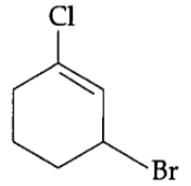
Amide which gives propanamine by Hoffmann bromamide is:
For the reaction 3A → 2B, rate of reaction $-\frac{ d [ A ]}{ dt }$ is equal to
View full solution →Haemoglobin and chlorophyll contain:
Assertion $(A): (CH_3)_3C-O-CH_3$ gives $(CH_3)_3C-I$ and $CH_3OH$ on treatment with $HI.$
Reason $(R):$ The reaction occurs by $S_N1$ mechanism.
View full solution →Reason $(R):$ The reaction occurs by $S_N1$ mechanism.
Assertion (A): Vitamin C cannot be stored in our body.
Reason (R): Vitamin C is fat soluble and is excreted from the body in urine.
Reason (R): Vitamin C is fat soluble and is excreted from the body in urine.
Assertion $(A):$ Oximes are less acidic than hydroxyl amine.
Reason $(R):$ Oximes of aldehydes and ketones show geometrical isomerism.
View full solution →Reason $(R):$ Oximes of aldehydes and ketones show geometrical isomerism.
Assertion (A): Alkylbenzene is not prepared by Friedel-Crafts alkylation of benzene.
Reason (R): Alkyl halides are less reactive than acyl halides.
Reason (R): Alkyl halides are less reactive than acyl halides.
a. Differentiate between Ideal solution and Non-ideal solution.
b. 30 g of urea is dissolved in 846 g of water. Calculate the vapour pressure of water for this solution if vapour pressure of pure water at 298 K is 23.8 mm Hg.
b. 30 g of urea is dissolved in 846 g of water. Calculate the vapour pressure of water for this solution if vapour pressure of pure water at 298 K is 23.8 mm Hg.
Write the formula of the following complexes:
$i.$ Hexaammine platinum $(IV)$ chloride.
$ii.$ Dichloro tetrammine cobalt $(III)$ ion.
View full solution →$i.$ Hexaammine platinum $(IV)$ chloride.
$ii.$ Dichloro tetrammine cobalt $(III)$ ion.
Convert Toluene to m-Nitrobenzoic acid.
If the density of some lake water is $1.25\ g\ mL^{-1}$ and contains $92\ g$ of $Na^+$ ions per kg of water, calculate the molarity of $Na^+$ ions in the lake.
View full solution →Answer the following:
$(a)$ The rate of a reaction is given by rate $= k [N_2O_5].$ In this equation what does $k$ stand for?
$(b)$ Is it possible to determine or predict the rate law theoretically by merely looking at the equation?
View full solution →$(a)$ The rate of a reaction is given by rate $= k [N_2O_5].$ In this equation what does $k$ stand for?
$(b)$ Is it possible to determine or predict the rate law theoretically by merely looking at the equation?
How the following conversions can be carried out?
i. 2-Bromopropane to 1-bromopropane
ii. Chloroethane to butane
iii. Benzene to diphenyl
i. 2-Bromopropane to 1-bromopropane
ii. Chloroethane to butane
iii. Benzene to diphenyl
The first order rate constant for the decomposition of ethyl iodide by the reaction
$C_2H_5I(g) \rightarrow C_2H_4(g) + HI(g)$
at $600\ K$ is $1.60 \times 10^{-2} s^{-1}$. Its energy of activation is $209\ kJ/mol.$ Calculate the rate constant of the reaction at $700 Κ.$
View full solution →$C_2H_5I(g) \rightarrow C_2H_4(g) + HI(g)$
at $600\ K$ is $1.60 \times 10^{-2} s^{-1}$. Its energy of activation is $209\ kJ/mol.$ Calculate the rate constant of the reaction at $700 Κ.$
Write the chemistry of recharging the lead storage battery, highlighting all the materials that are involved during recharging.
Silver is deposited on a metallic vessel by passing a current of 0.2 amps. for 3 hrs. Calculate the weight of silver deposited. (At mass of silver = 108 amu, 1 F = 96500 C)?
How much copper is deposited on the cathode of an electrolytic cell if a current of $5$ ampere is passed through a solution of copper sulphate for $45$ minutes?
View full solution →i. Write one chemical reaction for each
a. Carbylamine reaction
b. Acetylation reaction
ii. Write structure of N,N-ethylmethylethanamide
a. Carbylamine reaction
b. Acetylation reaction
ii. Write structure of N,N-ethylmethylethanamide
An organic compound $A$ with molecular formula $C_7H_7NO$ reacts with $Br_2/aq.\ KOH$ to give compound $B,$ which upon reaction with $NaNO_2$ and $HCl$ at $0^\circ\ C$ gives $C.$ Compound $C$ on heating with $CH_3CH_2OH$ gives a hydrocarbon $D.$ Compound $B$ on further reaction with $Br_2$ water gives white precipitate of compound $E.$ Identify the compound $A, B, C, D$ and $E;$ also justify your answer by giving relevant chemical equations.
View full solution →List various types of isomerism possible for coordination compounds, giving an example of each.
Attempt any five of the following:
(a) Aldopentoses named ribose and 2-deoxyribose are found in nucleic acids. What is their relative configuration?
(b) What are the three components of nucleic acids?
(c) Name the sugar present in milk. How many monosaccharide units are present in it? What are such oligosaccharides called?
(d) Is nucleotide and nucleoside the same? What are their roles?
(e) Why cannot vitamin C be stored in our body?
(f) During curdling of milk, what happens to sugar present in it?
(g) Account for the following:
a. There are 5-OH groups in glucose.
b. Glucose is a reducing sugar
(a) Aldopentoses named ribose and 2-deoxyribose are found in nucleic acids. What is their relative configuration?
(b) What are the three components of nucleic acids?
(c) Name the sugar present in milk. How many monosaccharide units are present in it? What are such oligosaccharides called?
(d) Is nucleotide and nucleoside the same? What are their roles?
(e) Why cannot vitamin C be stored in our body?
(f) During curdling of milk, what happens to sugar present in it?
(g) Account for the following:
a. There are 5-OH groups in glucose.
b. Glucose is a reducing sugar
Explain with two examples each of the following: Coordination entity, ligand coordination number, coordination polyhedron, homoleptic and heteroleptic.
Read the following text carefully and answer the questions that follow:
The f-block consists of elements in which 4f and 5f orbitals are progressively filled. They are placed in a separate panel at the bottom of the periodic table. The names transition metals and inner transition metals are often used to refer to the elements of $d-$and $f-$blocks respectively. The d-block occupies the large middle section of the periodic table flanked between $s$ and $p$ blocks in the periodic table. In general, the electronic configuration of the outer orbitals of these elements is $(n-1)d^{1-10}ns^{1-2}$. The electronic configurations of outer orbitals of $Zn, Cd, Hg$ and $Cn$ are represented by the general formula $(n - 1)d^{10}ns^2$. The transition metals and their compounds also exhibit catalytic property and paramagnetic behaviour. Transition metal also forms an alloy. An alloy is a blend of metals prepared by mixing the components. Alloys may be homogeneous solid solutions in which the atoms of one metal are distributed randomly among the atoms of the other.
i. Transition metals form alloys. Justify?
ii. Why do transition elements exhibit higher enthalpies of atomization?
iii. Transition metals and many of their compounds show paramagnetic behaviour. Give reason.
View full solution →The f-block consists of elements in which 4f and 5f orbitals are progressively filled. They are placed in a separate panel at the bottom of the periodic table. The names transition metals and inner transition metals are often used to refer to the elements of $d-$and $f-$blocks respectively. The d-block occupies the large middle section of the periodic table flanked between $s$ and $p$ blocks in the periodic table. In general, the electronic configuration of the outer orbitals of these elements is $(n-1)d^{1-10}ns^{1-2}$. The electronic configurations of outer orbitals of $Zn, Cd, Hg$ and $Cn$ are represented by the general formula $(n - 1)d^{10}ns^2$. The transition metals and their compounds also exhibit catalytic property and paramagnetic behaviour. Transition metal also forms an alloy. An alloy is a blend of metals prepared by mixing the components. Alloys may be homogeneous solid solutions in which the atoms of one metal are distributed randomly among the atoms of the other.
i. Transition metals form alloys. Justify?
ii. Why do transition elements exhibit higher enthalpies of atomization?
iii. Transition metals and many of their compounds show paramagnetic behaviour. Give reason.
Out of pure liquid and azeotrope showing positive deviation, Which one has a higher boiling point?
Read the following text carefully and answer the questions that follow:
The solutions which boil at a constant temperature like a pure liquid and possess the same composition in liquid, as well as vapour state are called azeotropes. The components of azeotropes cannot be separated by fractional distillation. Only non-ideal solutions form azeotropes. Solutions with negative deviation form maximum boiling azeotrope and the solutions with positive deviation form minimum boiling azeotrope. The boiling point of azeotrope is never equal to the boiling points of any of the components of the azeotrope.
i. The azeotropic solutions of two miscible liquids show what type of deviation from Raoult's law?
ii. The azeotropic mixture of water & HCI boils at 108.5°C. What type of deviation is shown by the solution?
Does this solution behave as ideal or non-ideal?
iii. Do ideal solutions form azeotropes?
The solutions which boil at a constant temperature like a pure liquid and possess the same composition in liquid, as well as vapour state are called azeotropes. The components of azeotropes cannot be separated by fractional distillation. Only non-ideal solutions form azeotropes. Solutions with negative deviation form maximum boiling azeotrope and the solutions with positive deviation form minimum boiling azeotrope. The boiling point of azeotrope is never equal to the boiling points of any of the components of the azeotrope.
i. The azeotropic solutions of two miscible liquids show what type of deviation from Raoult's law?
ii. The azeotropic mixture of water & HCI boils at 108.5°C. What type of deviation is shown by the solution?
Does this solution behave as ideal or non-ideal?
iii. Do ideal solutions form azeotropes?
Transition metals and their many compounds act as good catalyst. Give reason.
Generate a MODEL PAPER 3 paper free
Pick question groups from the list above, set marks and difficulty, and export a branded PDF with step-by-step answer keys. First 3 chapters free — no signup.