Questions

M.C.Q (1 Marks)

Take a timed test

12 questions · self-marked practice — reveal the answer and mark yourself.

Question 11 Mark
For the reaction $A + 3B \rightarrow 2C + 2D,$ the concentration of $A$ changes from $0.150 M$ to $0.0135 M$ in $1$ min. The rate of formation of $C$ in $mol/L/s$ is:
Answer
$(c)\ 5 \times 10^{-5}$
Explanation: rate $=-\frac{d[A]}{d t}=-\frac{1}{3} \frac{d[B]}{d t}=+\frac{1}{2} \frac{d[C]}{d t}=+\frac{1}{2} \frac{d[D]}{d t}$
$\Rightarrow \frac{d[A]}{d t}=-\frac{1}{2} \frac{d[C]}{d t}$
$\Rightarrow \frac{d[C]}{d t}=2 \frac{d[A]}{d t}$
$=-\frac{2 \times(0.0135-0.0150)}{1 \times 60}$
$=5 \times 10^{-5} mol\ L^{-1}\ s^{-1}$
rate $=5 \times 10^{-5} mol\ L^{-1}\ s^{-1}$
View full question & answer
Question 21 Mark
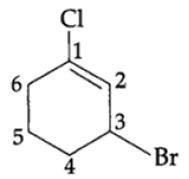
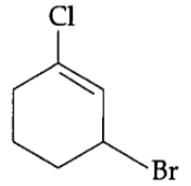
The IUPAC name of the compound shown below is:
Image
Answer
(b) 3-bromo-1-chlorocyclohexene
Explanation:Image
IUPAC name: 3-bromo 1-chlorocyclohexene
View full question & answer
Question 31 Mark
Amide which gives propanamine by Hoffmann bromamide is:
Answer
In the Hoffmann bromamide reaction, the amine formed has one carbon less than that present in the amide.
$RCONH_2 + Br_2 + _4NaOH\rightarrow RNH_2 + Na_2CO_3 +_2NaBr + 2H_2O$
View full question & answer
Question 41 Mark
For the reaction 3A → 2B, rate of reaction $-\frac{ d [ A ]}{ dt }$ is equal to
Answer
(d) $\frac{+3}{2} \frac{d[ B ]}{ dt }$
Explanation: $\frac{+3}{2} \frac{d[ B ]}{ dt }$
View full question & answer
Question 51 Mark
Haemoglobin and chlorophyll contain:
Answer
(a) Fe and Mg
Explanation: Haemoglobin contains Fe and Chlorophyll contains Mg.
View full question & answer
Question 61 Mark
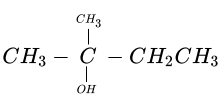
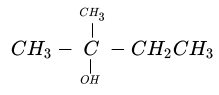
The correct IUPAC name ofImage is
Answer
(a) 2-Methylbutan-2-ol
Explanation: The correct IUPAC name of Imageis 2-Methylbutan-2-ol
View full question & answer
Question 71 Mark
Cheilosis is caused by deficiency of
Answer
Deficiency of Vitamin $B_2\ ($Riboflavin$)$ results in Cheilosis $($fissuring at corners of mouth and lips$).$
View full question & answer
Question 81 Mark
Ethylidene chloride is a/an $.......$
Answer
Gem-dihalides are dihaloalkanes that have two halogen atoms of the same type attached to the same carbon a in a molecule. The common naming system of gem-dihalides $($geminal halide$)$ is alkylidene dihalides. Ethylidene dichloride thus is a gem-dihalide. The chemical formula of ethylidene dichloride is $C_3H_6Cl_2.$
View full question & answer
Question 91 Mark
Lucas reagent is?
Answer
anhydrous $ZnCl_2$ and conc. $HCl.$
"Lucas' reagent" is a solution of anhydrous zinc chloride in concentrated hydrochloric acid.
View full question & answer
Question 101 Mark
Match the items of column $I$ with appropriate entries of column $II.$
Column $I$ Column $II$
$(а)\ K_b$ $(i)$ Elevation in boiling point
$(b)\ K_f$ $(ii)$ Van't Hoff factor
$(c)\ i$ $(iii)$ Cryoscopic constant
$(d)\ \Delta T _{ b }$ $(iv)$ Ebullioscopic constant
Answer
$(a) - (iv), (b) - (iii), (c) - (ii), (d) - (i)$
View full question & answer
Question 111 Mark
Which of the following reagents would one choose to transform $CH_3COCI$ into acetone?
Answer
$(CH_3)_2Cd$
View full question & answer
Question 121 Mark
Image
The structure of A and type of isomerism in the above reaction are respectively.
Answer
(a) (c) Prop-1-en-2-ol, tautomerism
Explanation:  ImageProp-1-en-2-ol (A) acetone are tautomers.
View full question & answer