Question 14 Marks
Read the following text carefully and answer the questions that follow:
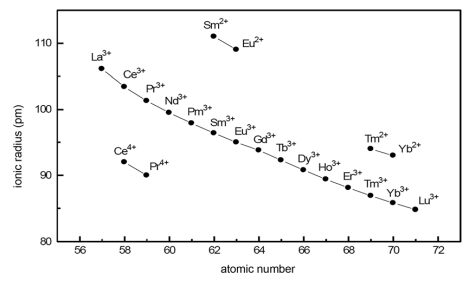
The $f-$ block consists of the two series, lanthanoids $($the fourteen elements following lanthanum$)$ and actinoids $($the fourteen elements following actinium$)$. Because lanthanum closely resembles the lanthanoids. The chemistry of the actinoids is much more complicated. The complication arises partly owing to the occurrence of a wide range of oxidation states in these elements and partly because their radioactivity creates special problems in their study. The overall decrease in atomic and ionic radii from lanthanum to lutetium $($the lanthanoid contraction$)$ is a unique feature in the chemistry of the lanthanoids. In the lanthanoids $,La (II)$ and $Ln (III)$ compounds are predominant species.
i. Which metal in the first transition series $(3d$ series$)$ exhibits $+1$ oxidation state most frequently and why?
ii. The transition metals $($with the exception of $\ce{Zn, Cd}$ and $\ce{Hg})$ are hard and have high melting and boiling points. Give reason.
iii. Both $O_2$ and $F_2$ stabilize high oxidation states of transition metals but the ability of oxygen to do so exceeds that of fluorine. Give reason.
$OR$
iii. The atomic radii of the metals of the third $(5d)$ series of transition elements are virtually the same as those of the corresponding members of the second $(4d)$ series. Give reason.
The $f-$ block consists of the two series, lanthanoids $($the fourteen elements following lanthanum$)$ and actinoids $($the fourteen elements following actinium$)$. Because lanthanum closely resembles the lanthanoids. The chemistry of the actinoids is much more complicated. The complication arises partly owing to the occurrence of a wide range of oxidation states in these elements and partly because their radioactivity creates special problems in their study. The overall decrease in atomic and ionic radii from lanthanum to lutetium $($the lanthanoid contraction$)$ is a unique feature in the chemistry of the lanthanoids. In the lanthanoids $,La (II)$ and $Ln (III)$ compounds are predominant species.
i. Which metal in the first transition series $(3d$ series$)$ exhibits $+1$ oxidation state most frequently and why?
ii. The transition metals $($with the exception of $\ce{Zn, Cd}$ and $\ce{Hg})$ are hard and have high melting and boiling points. Give reason.
iii. Both $O_2$ and $F_2$ stabilize high oxidation states of transition metals but the ability of oxygen to do so exceeds that of fluorine. Give reason.
$OR$
iii. The atomic radii of the metals of the third $(5d)$ series of transition elements are virtually the same as those of the corresponding members of the second $(4d)$ series. Give reason.
Answer
View full question & answer→i. Copper exhibits $+1$ oxidation state more frequently i.e. $, Cu^{1+}$ because of its electronic configuration $3d^{10}4s^1$.
It can easily lose $4s^1$ electron to give stable $3d^{10}$ configuration.
ii. Because of stronger metallic bonding and high enthalpies of atomization.
iii. The ability of $O_2$ to stabilize higher oxidation states exceeds that of fluorine because oxygen can form multiple bonds with metals.
It can easily lose $4s^1$ electron to give stable $3d^{10}$ configuration.
ii. Because of stronger metallic bonding and high enthalpies of atomization.
iii. The ability of $O_2$ to stabilize higher oxidation states exceeds that of fluorine because oxygen can form multiple bonds with metals.