Questions

3 Marks Question

Take a timed test

8 questions · self-marked practice — reveal the answer and mark yourself.

Question 13 Marks
What are haloarenes? How are they classified? Give one method for each of the preparation of nuclear and side chain substituted halorenes.
Answer
Haloarenes: The replacement of hydrogen atoms in a aromatic hydrocarbon by halogen atoms results in the formation of aryl halide (haloarene). Haloarenes contain halogen atoms attached to sp2 hybridized carbon atoms of an aryl group. They are classified as:
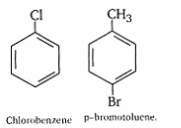
i. Nuclear halogen derivatives: Halogen derivatives of aromatic hydrocarbons in which the halogen atom (F, Cl, Br, or I) is directly attached to an aromatic ring are called nuclear halogen derivatives. Some examples are:
Image
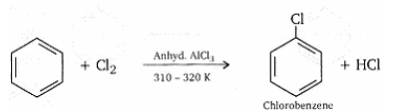
It is prepared by the direct chlorination of aromatic hydrocarbon.
Image
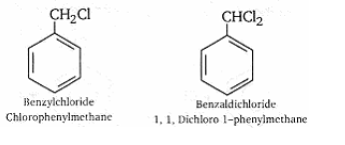
ii. Side chain halogen derivatives: Halogen derivatives of aromatic hydrocarbons in which the halogen atom is linked to one of the carbon atoms of the side chain carrying the aryl group are called aryl halides. For example,
Image
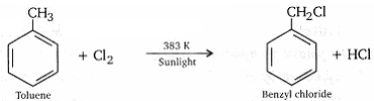
Preparation: By the direct halogenation of a suitable arenas.
Image
View full question & answer
Question 23 Marks
Depict the galvanic cell in which the reaction:
$ Z n(s)+2 A g^{+}(a q) \rightarrow Z n^{2+}(a q)+2 A g(s) $
takes place. Further show:
i. Which of the electrodes is negatively charged?
ii. The carries of current in the cell.
iii. Individual reaction at each electrode.
Answer
We have,
$
Z n(s)+2 Ag^{+}(a q) \rightarrow Z n^{2+}(a q)+2 Ag(s)
$
At Cathode (Reduction):
$
2 Ag^{+}(a q)+2 e^{-} \rightarrow 2 Ag(s)
$
At Anode (Oxidation):
$
Z n(s) \rightarrow Z n^{2+}(a q)+2 e^{-}
$
The cell will be represented as:
$
Z n(s)\left|Z n^{2+}(a q)\right|\left|A g^{+}(a q)\right| A g(s)
$
i. From half cell reaction, Zinc acts as Anode, i.e. zinc electrode will be negatively charged.
ii. The current will flow from silver to zinc in the external circuit and inside the solution, ions are responsible as shown in the half cell reaction. $Zn ^{2+}$ is formed in the anode container and goes to the solution and in the cathode container, $Ag ^{+}$goes from solution to the silver metal(cathode) and gets deposited. To maintain the concentration of ions in both the containers, salt bridge is used which contain an electrolyte i.e. KCl .
iii. At anode : $Z n(s) \rightarrow Z n^{2+}(a q)+2 e^{-}$
At cathode: $A g^{+}(a q)+e \rightarrow A g(s)$
View full question & answer
Question 33 Marks
Conductivity of saturated solution of $BaSO _4$ at 315 K is $3.648 \times 10^{-6} ohm ^{-1} cm^{-1}$ and that of water is $1.25 \times$ $10^{-6} ohm ^{-1} cm^{-1}$. Ionic conductance of $Ba ^{2+}$ and $SO _4^{2-}$ are 110 and $136.6 ohm ^{-1} cm^2 mol^{-1}$ respectively. Calculate the solubility of $BaSO _4$ in $g / L$.
Answer
$\Lambda_m^{\circ}\left( BaSO _4\right)=\Lambda_m^{\circ} Ba ^{2+}+\Lambda_m^{\circ} SO _4^{2-}=110+136.6=246.6 ohm ^{-1} \ cm^{-1}$
$K_{ B , S 04}= K _{ B , s 04}(\text { solution })- K _{\text {watar }}=3.648 \times 10^{-6}-1.25 \times 10^{-6}$
$=2.398 \times 10^{-6} s \ cm ^{-1}$
$\Lambda_m^c=\frac{ K \times 1000}{\text { Solubility }}=\frac{2.398 \times 10^{-6} \times 1000}{246.6}=9.72 \times 10^{-6} mol / L$
$\text { Solubility }=9.72 \times 10^{-6} \times 233=2.26 \times 10^{-3} g / L $
View full question & answer
Question 43 Marks
Write the products formed when $(CH_3)_3 C-CHO$ reacts with the following reagents:
$i. \ CH_3COCH_3$ in the presence of dilute $NaOH$
$ii.\ HCN$
$iii.\ Conc.\ NaOH$
View full question & answer
Question 53 Marks
How would you account for the following:
i. Phenols are much more acidic than alcohols.
ii. The boiling point of ethers are much lower than those of the alcohols of comparable molar masses.
Answer
i. Since the phenoxide ion left after the removal of a proton is stabilized by resonance whereas alkoxide ion left after the removal of a proton from alcohol is not.
ii. The large difference in boiling points of alcohols and ethers is due to the presence of hydrogen bonding in alcohols.
View full question & answer
Question 63 Marks
Write the equation of the reaction of hydrogen iodide with:
i. 1-propoxypropane
ii. Methoxybenzene
iii. Benzyl ethyl ether
View full question & answer
Question 73 Marks
For the reaction $R\rightarrow P$, the concentration of a reactant changes from $0.03 M$ to $0.02 M$ in $25$ minutes. Calculate the average rate of reaction using units of time both in minutes and seconds.
Answer
Average rate of reaction $-\frac{\Delta[R]}{\Delta t}$
$ =-\frac{[R]_2-[R]_1}{t_2-t_1}=-\frac{0.02-0.03}{25} M \min ^{-1}$
$=-\frac{-0.01}{25} M min^{-1}=4 \times 10^{-4} M \min ^{-1}$
$=\frac{4 \times 10^{-4}}{60} M s^{-1}=6.67 \times 10^{-6} M s^{-1} $
View full question & answer
Question 83 Marks
What do you understand by the term 'conductance'? What are its units?
Answer
The reciprocal of electrical resistance is called conductance. It is usually represented by 'G'.
Thus $G=\frac{1}{R}$
Units: The units of conductance are reciprocal ohms written as
ohm ${ }^{-1}$ or mho
or siemens (S)
$
1 S=1 \Omega^{-1}
$
View full question & answer