In order to prepare a $1^\circ$ amine from an alkyl halide with simultaneous addition of one $CH_2$ group in the carbon chain, the reagent used as source of nitrogen is$...........$ .
View full solution →Question types
MODEL PAPER 7 question types
37 questions across 6 question groups — pick any mix to generate a Chemistry paper with step-by-step answer keys.
37
Questions
6
Question groups
5
Question types
01
M.C.Q (1 Marks)
12 Q→02Assertion (A) & Reason (B) MCQ
4 Q→032 Marks Questions
6 Q→043 Marks Question
8 Q→055 Marks Questions
5 Q→064 Marks Questions
2 Q→Sample Questions
MODEL PAPER 7 questions
One sample from each question group in this chapter. Select any group above to see the full set with answer keys.
Monochlorination of toluene in sunlight followed by hydrolysis by aq. NaOH yields
Consider the reaction
$
N_2(g)+3 H_2(g) \rightarrow 2 NH_3(g)
$
The equality relation between $\frac{d\left[ NH _3\right]}{d t}$ and $\frac{-d\left[ H _2\right]}{d t}$ is:
View full solution →$
N_2(g)+3 H_2(g) \rightarrow 2 NH_3(g)
$
The equality relation between $\frac{d\left[ NH _3\right]}{d t}$ and $\frac{-d\left[ H _2\right]}{d t}$ is:
Which of the following has most acidic hydrogen?
In a chemical reaction X → Y, it is found that the rate of reaction doubles when the concentration of X is increased four times. The order of the reaction with respect to X is
Assertion (A): The nucleophilic substitution of vinyl chloride is difficult than ethyl chloride.
Reason (R): Vinyl group is an electron-donating group.
Reason (R): Vinyl group is an electron-donating group.
Assertion $(A):$ Isobutanal does not give the iodoform test.
Reason $(R):$ It does not have alpha-hydrogen.
View full solution →Reason $(R):$ It does not have alpha-hydrogen.
Assertion (A): Fructose can reduce Tollen's reagent.
Reason (R): Fructose is a ketone.
Reason (R): Fructose is a ketone.
Assertion $(A): 4-$nitrophenol is more acidic than $2, 4, 6-$trinitrophenol.
Reason $(R):$ Phenol is a weaker acid than carbonic acid.
View full solution →Reason $(R):$ Phenol is a weaker acid than carbonic acid.
Answer the following:
$(a)$ What is the order of photochemical reaction?
$(b)$ For the homogeneous decomposition of $N _2 O _5$ into $NO _2$ and $O _2 ; 2 N_2 O _5(g) \rightarrow 4 N O_2(g)+O_2(g)$
Rate $= k \left[ N _2 O _5\right]$
Find out the order of reaction with respect to $N _2 O _5$.
View full solution →$(a)$ What is the order of photochemical reaction?
$(b)$ For the homogeneous decomposition of $N _2 O _5$ into $NO _2$ and $O _2 ; 2 N_2 O _5(g) \rightarrow 4 N O_2(g)+O_2(g)$
Rate $= k \left[ N _2 O _5\right]$
Find out the order of reaction with respect to $N _2 O _5$.
How are the following conversions carried out?
i. Ethanol to 1, 2-Ethanediol
ii. Phenol to Acetophenone
i. Ethanol to 1, 2-Ethanediol
ii. Phenol to Acetophenone
What factors are responsible for deviations for Raoult's law?
Calculate the volume of water which could be added to $20\ m$l of $0.65 \ m \ \text{HCl}$ to dilute the solution to $0.2\ m$?
View full solution →What is lanthanoid contraction? What are the consequences of lanthanoid contraction?
What are haloarenes? How are they classified? Give one method for each of the preparation of nuclear and side chain substituted halorenes.
Depict the galvanic cell in which the reaction:
$ Z n(s)+2 A g^{+}(a q) \rightarrow Z n^{2+}(a q)+2 A g(s) $
takes place. Further show:
i. Which of the electrodes is negatively charged?
ii. The carries of current in the cell.
iii. Individual reaction at each electrode.
View full solution →$ Z n(s)+2 A g^{+}(a q) \rightarrow Z n^{2+}(a q)+2 A g(s) $
takes place. Further show:
i. Which of the electrodes is negatively charged?
ii. The carries of current in the cell.
iii. Individual reaction at each electrode.
Conductivity of saturated solution of $BaSO _4$ at 315 K is $3.648 \times 10^{-6} ohm ^{-1} cm^{-1}$ and that of water is $1.25 \times$ $10^{-6} ohm ^{-1} cm^{-1}$. Ionic conductance of $Ba ^{2+}$ and $SO _4^{2-}$ are 110 and $136.6 ohm ^{-1} cm^2 mol^{-1}$ respectively. Calculate the solubility of $BaSO _4$ in $g / L$.
View full solution →Write the products formed when $(CH_3)_3 C-CHO$ reacts with the following reagents:
$i. \ CH_3COCH_3$ in the presence of dilute $NaOH$
$ii.\ HCN$
$iii.\ Conc.\ NaOH$
View full solution →$i. \ CH_3COCH_3$ in the presence of dilute $NaOH$
$ii.\ HCN$
$iii.\ Conc.\ NaOH$
How would you account for the following:
i. Phenols are much more acidic than alcohols.
ii. The boiling point of ethers are much lower than those of the alcohols of comparable molar masses.
i. Phenols are much more acidic than alcohols.
ii. The boiling point of ethers are much lower than those of the alcohols of comparable molar masses.
$\ce{COSO_4Cl._5NH_3}$ exists in two isomeric forms $'A\ '$ and $'B\ '.$ Isomer $'A\ '$ reacts with $AgNO_3$ to give white precipitate but does not react with $BaCl_2.$ Isomer $'B\ '$ gives a white precipitate with $BaCl_2$ but does not react with $AgNO_3.$ Answer the following questions.
i. Identify $'A\ '$ and $'B\ '$ and write their structural formulas.
ii. Name the type of isomerism involved.
iii. Give the $\text{IUPAC}$ name of $'A\ '$ and $'B\ '.$
View full solution →i. Identify $'A\ '$ and $'B\ '$ and write their structural formulas.
ii. Name the type of isomerism involved.
iii. Give the $\text{IUPAC}$ name of $'A\ '$ and $'B\ '.$
Attempt any five of the following:
$(a)$ Deficiency of which vitamin causes night-blindness.
$(b)$ Give two examples of reducing sugars.
$(c)$ Define the following terms:
$i.$ Glycosidic linkage
$ii.$ Native protein
$(d)$ Write function of carbohydrates in plants.
$(e)$ Differentiate between:
$i.$ Peptide linkage and Glycosidic linkage
$ii.$ Nucleoside and Nucleotide
$(f)$ What type of linkage holds together the monomers of $\text{DNA}$?
$(g)$ Write the product obtained when $D-$glucose reacts with $H_2N-OH.$
View full solution →$(a)$ Deficiency of which vitamin causes night-blindness.
$(b)$ Give two examples of reducing sugars.
$(c)$ Define the following terms:
$i.$ Glycosidic linkage
$ii.$ Native protein
$(d)$ Write function of carbohydrates in plants.
$(e)$ Differentiate between:
$i.$ Peptide linkage and Glycosidic linkage
$ii.$ Nucleoside and Nucleotide
$(f)$ What type of linkage holds together the monomers of $\text{DNA}$?
$(g)$ Write the product obtained when $D-$glucose reacts with $H_2N-OH.$
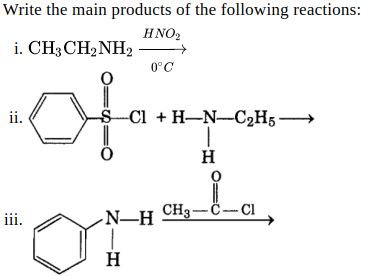
Giving an example for each describe the following reactions:
i. Hofmann bromamide reaction.
ii. Gattermann reaction.
iii. Coupling reaction.
i. Hofmann bromamide reaction.
ii. Gattermann reaction.
iii. Coupling reaction.
$\ce{[NIC14]^{2-}}$ is paramagnetic while $\ce{[Ni(CO)_4]}$ is diamagnetic though both are tetrahedral. Why?
View full solution →Read the following text carefully and answer the questions that follow:
The actinoids include the fourteen elements from $Th$ to $Lr.$ The actinoids are radioactive elements and the earlier members have relatively long half$-$lives, the latter ones have half$-$life values ranging from a day to $3$ minutes for lawrencium. The latter members could be prepared only in nanogram quantities. Actinoids show a greater range of oxidation states. The elements, in the first half of the series frequently exhibit higher oxidation states. The actinoids resemble the lanthanoids in having more compounds in $+3$ state than in the $+4$ state. All the actinoids are believed to have the electronic configuration of $7s^2$ and variable occupancy of the $5f$ and $6d$ subshells. The magnetic properties of the actinoids are more complex than those of the lanthanoids. The variation in the magnetic susceptibility of the actinoids with the number of unpaired $5f$ electrons is roughly parallel to the corresponding results for the lanthanoid.
i. Actinoid contraction is greater from element to element than lanthanoid contraction. Why?
ii. Actinoids show irregularities in their electronic configuration. Justify?
iii. The actinoid metals are all silvery in appearance but display a variety of structures than lanthanoid give reason.
OR
iii. The magnetic properties of the actinoids are more complex than those of the lanthanoids. Why?
View full solution →The actinoids include the fourteen elements from $Th$ to $Lr.$ The actinoids are radioactive elements and the earlier members have relatively long half$-$lives, the latter ones have half$-$life values ranging from a day to $3$ minutes for lawrencium. The latter members could be prepared only in nanogram quantities. Actinoids show a greater range of oxidation states. The elements, in the first half of the series frequently exhibit higher oxidation states. The actinoids resemble the lanthanoids in having more compounds in $+3$ state than in the $+4$ state. All the actinoids are believed to have the electronic configuration of $7s^2$ and variable occupancy of the $5f$ and $6d$ subshells. The magnetic properties of the actinoids are more complex than those of the lanthanoids. The variation in the magnetic susceptibility of the actinoids with the number of unpaired $5f$ electrons is roughly parallel to the corresponding results for the lanthanoid.
i. Actinoid contraction is greater from element to element than lanthanoid contraction. Why?
ii. Actinoids show irregularities in their electronic configuration. Justify?
iii. The actinoid metals are all silvery in appearance but display a variety of structures than lanthanoid give reason.
OR
iii. The magnetic properties of the actinoids are more complex than those of the lanthanoids. Why?
Read the following text carefully and answer the questions that follow:
The boiling point elevation and the freezing point depression of solutions have a number of practical applications. Ethylene glycol $\ce{(CH_2OH-CH_2OH)}$ is used in automobile radiators as an antifreeze because it lowers the freezing point of the coolant. The same substance also helps to prevent the radiator coolant from boiling away by elevating the boiling point. Ethylene glycol has a low vapour pressure. We can also use glycerol as an antifreeze. In order for boiling point elevation to occur, the solute must be non$-$volatile, but no such restriction applies to freezing point depression. For example, methanol $\text{(CH_3OH)},$ a fairly volatile liquid that boils only at $65^\circ C$ is sometimes used as antifreeze in automobile radiators.
$i.$ Out of the $CH_3OH$ and $C_6H_{12}O_6,$ which is a better reagent for depression in freezing point but not for elevation in boiling point?
$ii.$ Will the depression in freezing point be same or different, if $0.1$ moles of sugar or $0.1$ moles of glucose is dissolved in $1\ L$ of water?
$iii.\ 124 g$ each of the two reagents glycerol and glycol are added in $5 \ kg$ water of the radiators in the two cars. Which one is better for a car? Justify your answer.
$OR$
$iii.$ If the cost of glycerol, glycol and methanol are the same, then what would be the sequence of the economy to use these compounds as antifreeze?
View full solution →The boiling point elevation and the freezing point depression of solutions have a number of practical applications. Ethylene glycol $\ce{(CH_2OH-CH_2OH)}$ is used in automobile radiators as an antifreeze because it lowers the freezing point of the coolant. The same substance also helps to prevent the radiator coolant from boiling away by elevating the boiling point. Ethylene glycol has a low vapour pressure. We can also use glycerol as an antifreeze. In order for boiling point elevation to occur, the solute must be non$-$volatile, but no such restriction applies to freezing point depression. For example, methanol $\text{(CH_3OH)},$ a fairly volatile liquid that boils only at $65^\circ C$ is sometimes used as antifreeze in automobile radiators.
$i.$ Out of the $CH_3OH$ and $C_6H_{12}O_6,$ which is a better reagent for depression in freezing point but not for elevation in boiling point?
$ii.$ Will the depression in freezing point be same or different, if $0.1$ moles of sugar or $0.1$ moles of glucose is dissolved in $1\ L$ of water?
$iii.\ 124 g$ each of the two reagents glycerol and glycol are added in $5 \ kg$ water of the radiators in the two cars. Which one is better for a car? Justify your answer.
$OR$
$iii.$ If the cost of glycerol, glycol and methanol are the same, then what would be the sequence of the economy to use these compounds as antifreeze?
Generate a MODEL PAPER 7 paper free
Pick question groups from the list above, set marks and difficulty, and export a branded PDF with step-by-step answer keys. First 3 chapters free — no signup.