Questions

M.C.Q (1 Marks)

Take a timed test

12 questions · self-marked practice — reveal the answer and mark yourself.

Question 11 Mark
In order to prepare a $1^\circ$ amine from an alkyl halide with simultaneous addition of one $CH_2$ group in the carbon chain, the reagent used as source of nitrogen is$...........$ .
Answer
$RX+NaCN \rightarrow RCN+KX$
$R-CN+4 H \xrightarrow{H_2 / \text { Raney } N i} RCH_2 N H_2$
View full question & answer
Question 21 Mark
Monochlorination of toluene in sunlight followed by hydrolysis by aq. NaOH yields
Answer
(a) benzyl alcohol
Explanation: Monochlorination of toluene gives benzylchloride.
$
C_6 H_5 CH_3+Cl_2+hv \rightarrow C_6 H_5 CH_2 Cl
$
benzyl chloride on reaction with aq. NaOH will give benzyl alcohol by substitution reaction.
$
C_6 H_5 CH_2 Cl+NaOH(aq) \rightarrow C_6 H_5 CH_2 OH
$
View full question & answer
Question 31 Mark
Consider the reaction
$
N_2(g)+3 H_2(g) \rightarrow 2 NH_3(g)
$
The equality relation between $\frac{d\left[ NH _3\right]}{d t}$ and $\frac{-d\left[ H _2\right]}{d t}$ is:
Answer
(b) $\frac{d\left[ NH _3\right]}{d t}=-\frac{2}{3} \frac{d\left[ H _2\right]}{d t}$
Explanation: For the given reaction,
$
\text { rate }=-\frac{1}{2} \frac{d\left[N_2\right]}{d t}=-\frac{1}{3} \frac{d\left[H_2\right]}{d t}=\frac{1}{2} \frac{d\left[N H_3\right]}{d t}
$
View full question & answer
Question 41 Mark
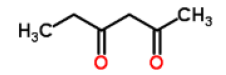
Which of the following has most acidic hydrogen?
Answer
The structure of $2,4-$hexanedione is

Image
$-CH_2$ group present between the two carbonyl group is active methylene group, these hydrogens are highly acidic as their conjugate base is highly stable.
View full question & answer
Question 51 Mark
In a chemical reaction X → Y, it is found that the rate of reaction doubles when the concentration of X is increased four times. The order of the reaction with respect to X is
Answer
(a) $\frac{1}{2}$
Explanation: $X \rightarrow Y$
Rate $( r ) \propto[ X ]^{ n }$ [Where $n =$ order of reaction $]$
If the concentration X is increased by 4 times
$
X^{\prime}=4 X
$
Then, Rate $\left(r^{\prime}\right) \propto\left[X^{\prime}\right]^{ n }$
$
\frac{r^{\prime}}{r}=\frac{[4 X]^n}{[X]^n}=2
$
$r^{\prime}$ is new rate, $X^{\prime}$ is a new concentration
$
\begin{aligned}
{[4]^{n} } & =2 \\
n & =\frac{1}{2}
\end{aligned}
$
Order of reaction $=\frac{1}{2}$
View full question & answer
Question 61 Mark
Which of the following characteristics of transition metals is associated with their catalytic activity?
Answer
(c) Variable oxidation states
Explanation: Variable oxidation states is associated with their catalyst activity.
View full question & answer
Question 71 Mark
Methyl ketones are usually characterized by:
Answer
(b) Iodoform test
Explanation: $CH _3 COR + I _2+ NaOH \rightarrow CHI _3+ RCOO ^{-} Na ^{+}$
Iodoform test is a characteristic test given by methyl ketones. CHI formed is yellow precipitate.
View full question & answer
Question 81 Mark
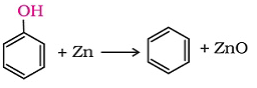
Phenol on distillation with zinc dust gives
Answer
(c) benzene
Explanation: Phenol is reduced to benzene when it is distilled with zinc dust or its vapour is passed over granules of zinc at 400°C.
Image
View full question & answer
Question 91 Mark
Decomposition of benzene diozonium chloride by using $Cu_2Cl_2/HCl$ to form chlorobenzene is:
Answer
Mixing the solution of the freshly prepared diazonium salt with cuprous chloride or cuprous bromide results in the replacement of the diazonium group by $- Cl$ or $- Br .$ This is called Sandmeyer's reaction.
View full question & answer
Question 101 Mark
A halogen used in potential blood substitutes in surgery is:
Answer
(a) Fluorine
Explanation: Certain fully fluorinated compounds are being considered as potential blood substitutes in surgery. So fluorine is the element used in these blood substitutes.
View full question & answer
Question 111 Mark
Match the items of column $I$ with appropriate entries of column $II.$
Column I Column II
$(a)$ For electrolyte $CaSO_4$ $(i) i = 5$
$(b)$ For ideal Solution $(ii) i = 2$
$(c)$ For electrolyte $Al_2(SO_4)_3$ $(iii) i = 4$
$(d)$ For electrolyte $Na_3PO_4$ $(iv) i = 1$
Answer
$(a)- (ii), (b) - (iv), (c) - (i), (d) - (iii).$
View full question & answer
Question 121 Mark
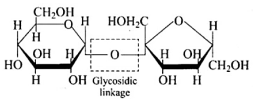
In disaccharides, if the reducing groups of monosaccharides i.e. aldehydic or ketonic groups are bonded, these are non-reducing sugars. Which of the following disaccharide is a non-reducing sugar?
Answer
This structure represents sucrose$($diasaccharides$)$ in which $\alpha-D$ glucose and $\beta-D-$fructose is attached to each other by $C_1-C_2$ glycosidic linkage. Since reducing groups of glucose and fructose are involved in glycosidic bond formation, this is considered as a non-reducing sugar.
Image
View full question & answer