Question 13 Marks
Describe the following:
i. Acetylation
ii. Cannizzaro reaction
iii. Cross aldol condensation
iv. Decarboxylation
i. Acetylation
ii. Cannizzaro reaction
iii. Cross aldol condensation
iv. Decarboxylation
Answer
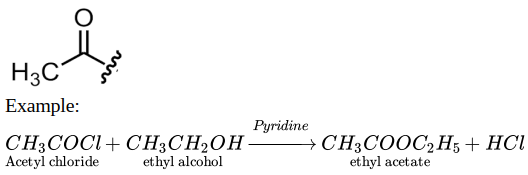
View full question & answer→$i.$ Acetylation: Acetylation simply involves the addition of an acetyl group to a compound. An acetyl group is made up of a carbonyl group, or carbon double bonded to oxygen, with a methyl group $(-CH_3)$ on the end. The part of the acetyl group that's attached to the compound is often represented with $'R\ '.$
$ii.$ Cannizzaro reaction: Aldehydes which do not have an alpha$-$hydrogen atom, undergo self oxidation and reduction $($disproportionation$)$ reaction on treatment with concentrated alkali. In this reaction, one molecule of the aldehyde is reduced to alcohol while another is oxidized to carboxylic acid salt.

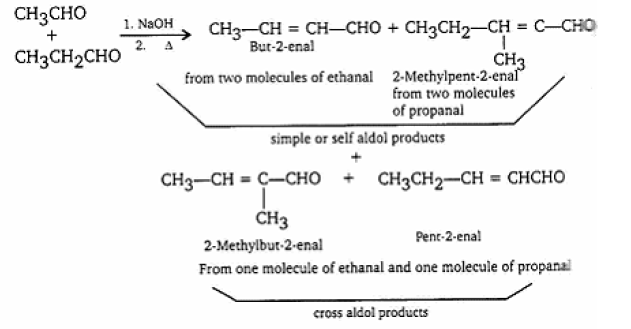
$iii.$ Cross aldol condensation: When aldol condensation is carried out between two different aldehydes and $/$ or ketones, it is called cross aldol condensation. If both of them contain alpha$-$hydrogen atoms, it gives a mixture of four products. This is illustrated below by aldol reaction of a mixture of ethanal and propanal.
$iv.$ Decarboxylation: Carboxylic acids lose carbon dioxide to form hydrocarbon when their sodium salts are heated with soda lime $( \ce{NaOH}$ and $\ce{CaO}$ in the ratio of $3: 1)$.
This reaction is known as decarboxylation.
$\ce{R-COONa {NaOH \ } R-H+Na_2 CO_3}$
$ii.$ Cannizzaro reaction: Aldehydes which do not have an alpha$-$hydrogen atom, undergo self oxidation and reduction $($disproportionation$)$ reaction on treatment with concentrated alkali. In this reaction, one molecule of the aldehyde is reduced to alcohol while another is oxidized to carboxylic acid salt.
$iii.$ Cross aldol condensation: When aldol condensation is carried out between two different aldehydes and $/$ or ketones, it is called cross aldol condensation. If both of them contain alpha$-$hydrogen atoms, it gives a mixture of four products. This is illustrated below by aldol reaction of a mixture of ethanal and propanal.
$iv.$ Decarboxylation: Carboxylic acids lose carbon dioxide to form hydrocarbon when their sodium salts are heated with soda lime $( \ce{NaOH}$ and $\ce{CaO}$ in the ratio of $3: 1)$.
This reaction is known as decarboxylation.
$\ce{R-COONa {NaOH \ } R-H+Na_2 CO_3}$