Sample QuestionsMODEL PAPER 8 questions
One sample from each question group in this chapter. Select any group above to see the full set with answer keys.
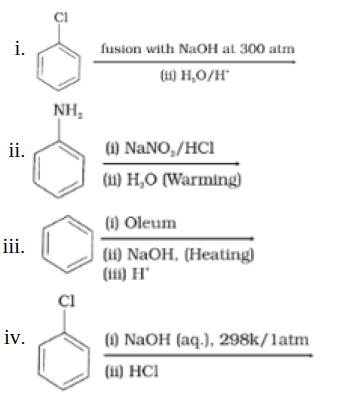
Which of the following reactions will yield phenol?
Match the items given in column I with that in column II:
| Column I | Column II |
| (a) Hypertonic | (i) NaCl. |
| (b) Hypotonic | (ii) Solution having higher osmotic pressure than other solution. |
| (c) Isotonic | (iii) Solution having lower osmotic pressure than other solution. |
| (d) Electrolyte | (iv) Solutions having same osmotic pressure. |

This reaction is known as:
$IUPAC$ name of m-cresol is $........$
View full solution →Assertion $(A): (CH_3)_3 C-O-CH_3$ gives $(CH_3)_3 C-I$ and $CH_3OH$ on treatment with $HI.$
Reason $(R):$ The reaction occurs by $S_N1$ mechanism.
View full solution →View full solution →Assertion (A): A solution of sucrose in water is dextrorotatory but on hydrolysis in presence of little hydrochloric acid it becomes laevorotatory.
Reason (R): Sucrose on hydrolysis gives unequal amounts of glucose and fructose as a result of which change in sign of rotation is observed.
Assertion (A): Di-tert-butyl ether cannot be prepared by Williamson's synthesis.
Reason (R): tert-Butyl bromide on treatment with sodium lert-butoxide preferentially undergoes elimination to form isobutylene and rert-butyl alcohol.
Consider the standard electrode potential values $\left(\frac{M^{2+}}{M}\right)$ of the elements of the first transition series.
| $Ti$ |
$V$ |
$Cr$ |
$Mn$ |
$Fe$ |
$Co$ |
$Ni$ |
$Cu$ |
$Zn$ |
| $-1.63$ |
$-1.18$ |
$-0.90$ |
$-1.18$ |
$-0.44$ |
$-0.28$ |
$-0.25$ |
$+0.34$ |
$-0.76$ |
Explain:
i. $E^\circ$ value for copper is positive.
ii. $E^\circ$ value of $Mn$ is more negative as expected from the trend.
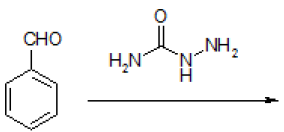
iii.$Cr^{3+}$ is a stronger reducing agent than $Fe^{2+}.$ View full solution →Complete each synthesis by giving missing starting material, reagent or products:-
A solution is prepared by dissolving $11 g$ glucose in $200 cm^3$ water at $30^{\circ} C$. What is the mass Percentage of glucose in solution? The density of water $30^{\circ} C$ is $0.996 g / cm ^3$
View full solution →What is expected Van't Hoff factor for $K _4\left[ Fe ( CN )_6\right]$ ?
View full solution →Answer the following:
(a) The time required to decompose $SO _2 Cl _2$ to half of its initial amount is 60 min . If the decomposition is a first order reaction, calculate the rate constant of the reaction?
(b) The decomposition reaction of ammonia gas on platinum surface has a rate constant $k =2.5 \times 10^{-4}$ $mol L ^{-1} s^{-1}$. What is the order of the reaction?
View full solution →Describe the following:
i. Acetylation
ii. Cannizzaro reaction
iii. Cross aldol condensation
iv. Decarboxylation
The $K _{ sp }$ for $\text{AgCl}$ at $298 K$ is $1.0 \times 10^{-10}$. Calculate the electrode potential for $Ag ^{+} / Ag$ electrode immersed in $1.0 \text{M KCl}$ solution. Given $E _{ A g ^{+} / A g }^\theta=0.80 V$
View full solution →The conductivity of $2.5 \times 10^{-4} M$ methanoic acid is $5.25 \times 10^{-5} S cm ^{-1}$ and its $\wedge_{ m }^0$ has a value $400 S cm ^2 mol^{-}$ 1. Calculate its molar conductivity and degree of dissociation.
View full solution →What happens when
i. n-butyl chloride is treated with alcoholic KОН.
ii. bromobenzene is treated with Mg in the presence of dry ether.
iii. chlorobenzene is subjected to hydrolysis.
In the button cell widely used in watches and other devices the following reaction takes place:
$Zn(s)+Ag_2 O(s)+H_2 O(l) \rightarrow Zn^{2+}(a q)+2 Ag(s)+2 OH^{-}(a q)$
Determine $\Delta_r G^{(-)}$and $E ^{(-)}$for the reaction
Given $Z n \rightarrow Z n^{2+}+2 e^{-}, E ^0=0.76 V$
Given $Ag \rightarrow Ag ^{+}+2 e^{-}, E ^0=0.344 V$
View full solution →(a) What type of protein is present in keratin?
(b) Write the reactions showing the presence of following in the open structure of glucose:
i. an aldehyde group
ii. a primary alcohol
(c) What products would be formed when a nucleotide from DNA containing thymine is hydrolysed?
(d) Amino acids show amphoteric behaviour. Why?
(e) What are a Amino Acids? Give examples.
(f) a. How can you explain the absence of an aldehyde group in the pentaacetate of D-glucose?
b. Name the bases present in RNA. Which one of these is not present in DNA?
(g) Which monosaccharide units are present in starch, cellulose and glycogen and which linkages link these units?
i. Give reasons :
a. Although $- \ce{NH2}$ group is o/p directing in electrophilic substitution reactions, yet aniline, on nitration gives good yield of $m-$nitroaniline.
b. $(\ce{CH 3)2NH}$ is more basic than $(\ce{CH3)3N}$ in an aqueous solution.
c. Ammonolysis of alkyl halides is not a good method to prepare pure primary amines.
ii. Distinguish between the following:
a. $\ce{CH 3 CH 2 NH 2}$ and $(\ce{CH 3 CH 2)2NH}$
b. Aniline and $\ce{CH3NH2}$
View full solution →I. Show how p-aminoazobenzene can be obtained from aniline.
II. Write structures for the following compounds:
a. Benzene diazonium chloride
b. p-Nitrotoluene
c. Sulphanilic acid
Draw the structures of optical isomers of:
i. $\left[ Cr \left( C _2 O _4\right)_3\right]^{3-}$
ii. $\left[ PtCl _2( en )_2\right]^{2+}$
iii. $\left[ Cr \left( NH _3\right)_2 Cl _2( en )\right]^{+}$
View full solution →Explain on the basis of valence bond theory that $\left[ Ni ( CN )_4\right]^{2-}$ ion with square planar structure is diamagnetic and the $\left[ NiCl _4\right]^{2-}$ ion with tetrahedral geometry is paramagnetic.
View full solution →Read the following text carefully and answer the questions that follow:
Raoult's law for volatile liquids states that the partial vapour pressure of each component in the solution is directly proportional to its mole fraction, whereas for a non$-$volatile solute, it states that the vapour pressure of a solution of a non$-$volatile solute is equal to the vapour pressure of the pure solvent at that temperature multiplied by its mole fraction. Two liquids $A$ and $B$ are mixed with each other to form a solution, the vapour phase consists of both components of the solution. Once the components in the solution have reached equilibrium, the total vapour pressure of the solution can be determined by combining Raoult's law with Dalton's law of partial pressures. If a non$-$volatile solute $B$ is dissolved into a solvent $A$ to form a solution, the vapour pressure of the solution will be lower than that of the pure solvent. The solutions which obey Raoult's law over the entire range of concentration are ideal solutions, whereas the solutions for which vapour pressure is either higher or lowerthan that predicted by Raoult's law are called non$-$ideal solutions. Non$-$ideal solutions are identified by determining the strength of the intermolecular forces between the different molecules in that particular solution.They can either show positive or negative deviation from Raoult's law depending on whether the $A - B$ interactions in solution are stronger or weaker than $A - A$ and $B - B$ interactions.
$i. 20\ mL$ of a liquid $A$ was mixed with $20\ mL$ of liquid $B$. The volume of resulting solution was found to be less than $40\ mL$. What do you conclude from the above data?
$ii.$ Which of the following show positive deviation from Raoult's law? Carbon disulphide and Acetone; Phenol and Aniline; Ethanol and Acetone.
$iii.$ The vapour pressure of a solution of glucose in water is $750\ mm\ Hg$ at $100^\circ C.$ Calculate the mole fraction of solute.
$($Vapour pressure of water at $373 K = 760\ mm\ Hg)$
$OR$
$iii.$ The boiling point of solution increases when $1$ mol of $\text{NaCl}$ is added to $1$ litre of water while addition of $1$ mol of methanol to one litre of water decreases its boiling point. Explain the above observations.
View full solution →Read the following text carefully and answer the questions that follow:
$KMnO _4$ and $K _2 Cr _2 O _7$ are most important chemicals which are used as oxidising agents and disinfectants. $K _2 MnO _4$ is prepared by fusing $MnO _2$ with KOH in presence of $O _2 \cdot K_2 MnO _4$ is electrolysed to get purple coloured $KMnO _4 \cdot Na _2 CrO _4$ is prepared by heating chromite ore with $Na _2 CO _3$ in presence of $O _2 \cdot Na _2 CrO _4$ is converted into $Na _2 Cr _2 O _7$ by reacting with concentrated $H _2 SO _4 \cdot Na _2 Cr _2 O _7$ is reacted with KCl to get $K _2 Cr _2 O _7$, orange coloured solid, soluble in water, changes to yellow coloured $CrO _4^{2-}$ in basic medium, $KMnO _4$ acts as oxidising agent in acidic, neutral as well basic medium. In acidic medium, it converts $Fe ^{2+}$ to $Fe ^{3+}, Sn ^{2+}$ to $Sn ^{4+}, COO ^{-}$to $CO ^2$. In basic medium it converts $I ^{-}$to $IO ^{3-} . K _2 Cr _2 O _7$ acts as oxidising agent only in acidic medium, converts $H _2 S$ to $S , SO _2$ to $SO ^{2-}, I ^{-}$to $I _2$. Lanthanoids and actinoids belong to f-block elements with general electronic configuration $(n-2) f^1$ to $14(n-1) d^{0-2} n s^2$. All actinoids are radioactive. Both show contraction in atomic and ionic radii but actinoid contraction is more than lanthanoid contraction. Lanthanoid show +3 oxidation state, few elements show +2 and +4 oxidation states also. Actinoids show $+3,+4,+5,+6,+7$ oxidation states.
i. Which lanthanoid shows +4 oxidation state and why?
ii. Give two similarities between lanthanoids and actinoids.
iii. Complete the equation and balance:
$
Cr_2 O_7^{2-}+Fe^{2+}+H^{+} \rightarrow ?
$
OR
iii. Convert sodium chromate to sodium dichromate. Give chemical equation.
$2 Na _2 CrO _4+ H _2 SO _4$ (conc.) $\rightarrow$ ?
View full solution →