Question 15 Marks
(a) What type of protein is present in keratin?
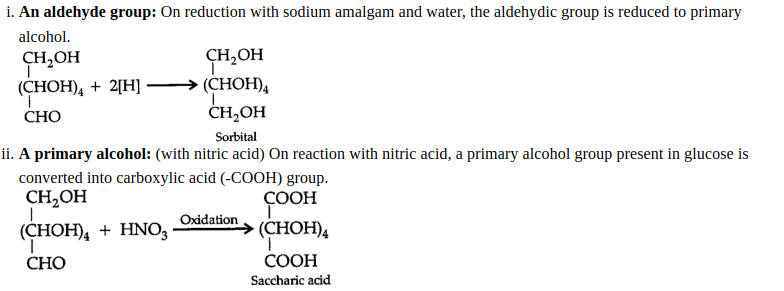
(b) Write the reactions showing the presence of following in the open structure of glucose:
i. an aldehyde group
ii. a primary alcohol
(c) What products would be formed when a nucleotide from DNA containing thymine is hydrolysed?
(d) Amino acids show amphoteric behaviour. Why?
(e) What are a Amino Acids? Give examples.
(f) a. How can you explain the absence of an aldehyde group in the pentaacetate of D-glucose?
b. Name the bases present in RNA. Which one of these is not present in DNA?
(g) Which monosaccharide units are present in starch, cellulose and glycogen and which linkages link these units?
(b) Write the reactions showing the presence of following in the open structure of glucose:
i. an aldehyde group
ii. a primary alcohol
(c) What products would be formed when a nucleotide from DNA containing thymine is hydrolysed?
(d) Amino acids show amphoteric behaviour. Why?
(e) What are a Amino Acids? Give examples.
(f) a. How can you explain the absence of an aldehyde group in the pentaacetate of D-glucose?
b. Name the bases present in RNA. Which one of these is not present in DNA?
(g) Which monosaccharide units are present in starch, cellulose and glycogen and which linkages link these units?
Answer
View full question & answer→(i) Fibrous Proteins
(ii)
(iii) When a nucleotide from the DNA containing thymine is hydrolyzed, thymine $\beta$-D-2-deoxyribose and phosphoric acid are obtained as products.
(iv) Amino acids contain both amino $\left(- NH _2\right)$ and carboxyl $(- COOH )$ groups, thus they react with both acids and bases. Hence, amino acids are amphoteric in nature.
(v) Those amino acids in which $- NH _2$ group and - COOH group are attached to same carbon are called $\alpha$-amino acids. These are obtained by hydrolysis of proteins. e.g., glycine.
(vi) a. The pentaacetate of glucose does not react with hydroxylamine / HCN / Schiff's reagent indicating the absence of free - CHO group. b. Adenine, Guanine, Uracil and Cytosine Uracil
(vii) n starch $\alpha$-glucose units are present, in cellulose $\beta$-D glucose units are present. In starch and glycogen glycosidic $\alpha$ linkage is present between $C 1- C 4$ and in cellulose glycosidic $\beta$-linkage is present between glucose units.
(ii)
(iii) When a nucleotide from the DNA containing thymine is hydrolyzed, thymine $\beta$-D-2-deoxyribose and phosphoric acid are obtained as products.
(iv) Amino acids contain both amino $\left(- NH _2\right)$ and carboxyl $(- COOH )$ groups, thus they react with both acids and bases. Hence, amino acids are amphoteric in nature.
(v) Those amino acids in which $- NH _2$ group and - COOH group are attached to same carbon are called $\alpha$-amino acids. These are obtained by hydrolysis of proteins. e.g., glycine.
(vi) a. The pentaacetate of glucose does not react with hydroxylamine / HCN / Schiff's reagent indicating the absence of free - CHO group. b. Adenine, Guanine, Uracil and Cytosine Uracil
(vii) n starch $\alpha$-glucose units are present, in cellulose $\beta$-D glucose units are present. In starch and glycogen glycosidic $\alpha$ linkage is present between $C 1- C 4$ and in cellulose glycosidic $\beta$-linkage is present between glucose units.