Questions

5 Marks Questions

Take a timed test

5 questions · self-marked practice — reveal the answer and mark yourself.

Question 15 Marks
Indicate the types of isomerism exhibited by the following complexes and draw the structures for these isomers:
i. $\ce{k \left[ Cr \left( H _2 O \right)_2\left( C _2 O _4\right)_2\right]}$
ii. $\ce{\left[ Co ( en )_3\right] Cl _3}$
iii. $\ce{\left[ Co \left( NH _3\right)_5\left( NO _2\right)\left( NO _3\right)_2\right]}$
iv. $\ce{ \left [ Pt ( NH _3) ( H _2 O ) Cl _2\right].}$
Answer
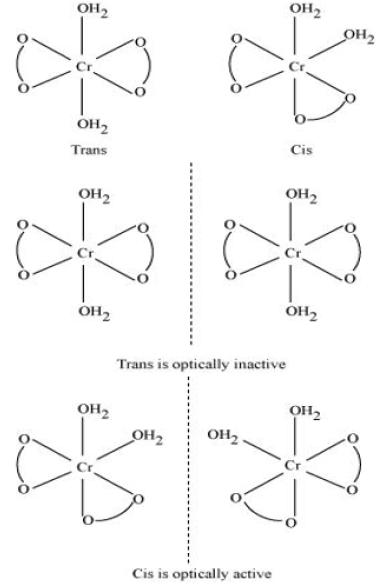
i. Both geometrical $($cis$-,$ trans$-)$ isomers for $\ce{k [Cr(H_2O)_2(C_2O_4)}$Image
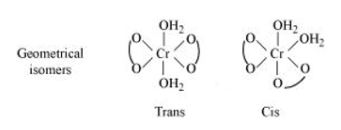
Trans $-$ isomer is optically inactive. On the other hand, cis $-$ isomer is optically active.
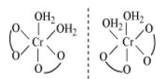
Image
ii.Two optical isomers for $\ce{[Co(en)_{3}]Cl_3}​​​​​​$ exist.
Image
Two optical isomers are possible for this structure.
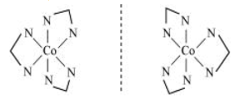
Image
iii. $\ce{[CO( NH_3)_5( NO_2)]( NO _3)_2[ Co( NH_3)_5( NO_2)( NO_3)_2]}$ A pair of optical isomers:
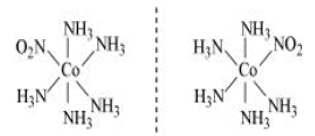
Image
It can also show linkage isomerism. $\ce{[Co(NH_3)_5(NO_2)(NO_3)_2]}$ and $\ce{[CO (NH_3)_5(ONO )](NO_3)_2}$ It can also show ionization isomerism.$\ce{[Co( NH_3)_5( NO_2)(NO_3)_2][ CO (NH_3)_5(NO_3)](NO_3)(NO_2)}$
iv. Geometrical $($cis$-,$ trans$-)$ isomers of $\ce{[ Pt(NH_3(H_2 O )Cl_2}.$ can exist.
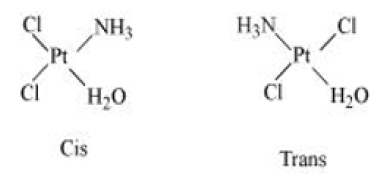
Image
View full question & answer
Question 25 Marks
Attempt any five of the following:
(a) Why are polysaccharides considered non-sugars?
(b) What is meant by invert sugars?
(c) Write the name of the component of starch which is water-soluble.
(d) Write the products obtained after hydrolysis of DNA.
(e) Name the deficiency disease resulting from lack of vitamin A and E in the diet.
(f) Which vitamin is linked with anti-sterility?
(g) a. What is the difference between a nucleoside and nucleotide?
     b. What products would be formed when a nucleotide from DNA containing thymine is hydrolysed?
Answer
Attempt any five of the following:
(i) Polysaccharides are not sweet in taste & hence are called non-sugars.
(ii) Hydrolysis of sucrose brings about a change in sign of rotation from dextro (+) to laevo (-) and hence, it is known as invert sugar.
(iii) The component of starch which is water-soluble - Amylose.
(iv) Hydrolysis of DNA gives 2-deoxyribose, nitrogen containing heterocyclic base( Adenine, Guanine, Cytosine and Thymine), phosphoric acid.
(v) Deficiency of A cause Xerophthalmia and E causes muscular weakness.
(vi) Vitamin E.
(vii) a. Nucleoside → Nitrogenous base + Sugar whereas
Nucleotide → Nitrogenous base + Sugar + Phosphate group.
b. Thymine base, 2-Deoxyribose sugar, and a Phosphoric acid.
View full question & answer
Question 35 Marks
i. Write the structure of main products when aniline reacts with the following reagents :
a. $Br _2$ water
b. HCl
c. $\left( CH _3 CO \right)_2 O /$ pyridine
ii. Arrange the following in the increasing order of their boiling point:$C _2 H _5 NH _2, C _2 H _5 OH ,\left( CH _3\right)_3 N$
iii. Give a simple chemical test to distinguish between the following pair of compounds : $\left( CH _3\right)_2 NH$ and $\left( CH _3\right)_3 N$.
Answer

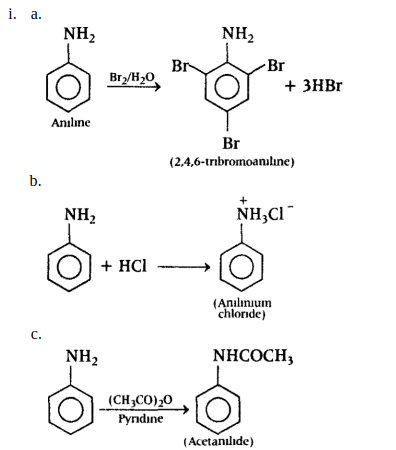
Image
ii. Increasing order of boiling point $\left( CH _3\right)_3 N< C _2 H _5 NH _2< C _2 H _5 OH$ Alcohols have a higher boiling point as compared to that of amines because oxygen being more electronegative forms stronger hydrogen bond as compared to that of nitrogen. In tertiary amine, there is no hydrogen bond formation due to the absence of H -atoms and hence, has the lowest boiling point.
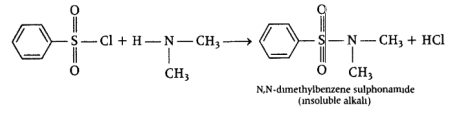
iii. $\left( CH _3\right)_2 NH$ and $\left( CH _3\right)_3 N$ are secondary and tertiary amines respectively. These are distinguished by Hinsberg's reagent which gives sulphonamide with secondary amines and no reaction with tertiary amines. $\left( CH _3\right)_2 NH$ reacts with benzene sulphonyl chloride to give N, N-dimethyl benzene sulphonamide, which is insoluble in alkali. The reaction is as follows:
Image
View full question & answer
Question 55 Marks
Write down the IUPAC name for each of the following complexes and indicate the oxidation state, electronic configuration, and coordination number. Also, give stereochemistry and magnetic moment of the complex:
a. $\left.K \left[ Cr \left( H _2 O \right)_2\right\}\left( C _2 O _4\right)_2\right] \cdot 3 H _2 O$
b. $\left[ Co \left( NH _3\right)_5 Cl \right] Cl _2$
c. $CrCl _3( py )_3$
d. $Cs \left[ FeCl _4\right]$
e. $K _4\left[ Mn ( CN )_6\right]$
Answer
a. $\left.K \left[ Cr \left( H _2 O \right)_2\right\}\left( C _2 O _4\right)_2\right] \cdot 3 H _2 O$ The IUPAC name = Potassium diaquadioxalatochromate (III) trihydrate
The Oxidation state of chromium $=3$
Electronic configuration: $3 d^3: t_{2 g}{ }^3$
Coordination number od compound $=6$
Shape: octahedral
Stereochemistry:
Image
$
\begin{array}{l}
\text { Magnetic moment, } \mu=\sqrt{n(n+2)} \\
=\sqrt{3(3+2)} \\
=\sqrt{15} \sim 3.87 B M
\end{array}
$
b. $\left[ Co \left( NH _3\right)_5 Cl \right] Cl _2$ The IUPAC name: Pentaamminechloridocobalt(III) chloride
The oxidation state of $Co =+3$
Coordination number of compound $=6$
Shape: octahedral.
Electronic configuration: $
d^6: t_{2 g}{ }^6
$
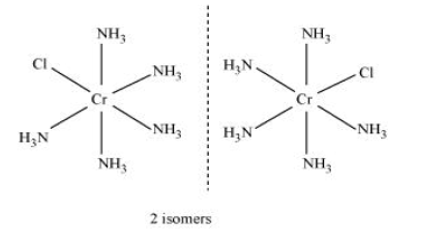
Stereochemistry:
Image
Magnetic Moment $=0$
c. $CrCl _3( py ) 3$ The IUPAC name: Trichloridotripyridinechromium (III)
The oxidation state of chromium $=+3$
Electronic configuration for $d^3=t_{2 g}{ }^3$
Coordination number of compound $=6$
Shape: octahedral.
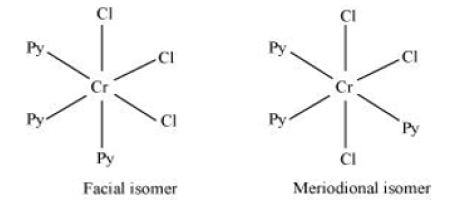
Stereochemistry:
Image
Both isomers are optically active. Therefore, a total of 4 isomers exist. Magnetic moment,
$
\begin{array}{l}
\mu=\sqrt{n(n+2)}=\sqrt{3(3+2)} \\
=\sqrt{15} \sim 3.87 B M
\end{array}
$
d. $Cs \left[ FeCl _4\right]$ The IUPAC name : Caesium tetrachloroferrate (III)
The oxidation state of $Fe =+3$
Electronic configuration of $d^6=e_g{ }^2 t_{2 g}{ }^3$
Coordination number of compound $=4$
Shape: tetrahedral
Stereochemistry: optically inactive
Magnetic moment:
$
\begin{array}{l}
\mu=\sqrt{n(n+2)}=\sqrt{5(5+2)} \\
=\sqrt{35} \sim 6 B M
\end{array}
$
e. $K _4\left[ Mn ( CN )_6\right]$ The IUPAC name $=$ Potassium hexacyanomanganate (II)
The oxidation state of manganese $=+2$
Electronic configuration: $d^{5+}: t_{2 g}{ }^5$
Coordination number of compound $=6$ Shape: octahedral.
Stereochemistry: optically inactive Magnetic moment, $\mu=\sqrt{n(n+2)}$
$
\begin{array}{l}
=\sqrt{1(1+2)}=\sqrt{3} \\
=1.732
\end{array}
$
View full question & answer