MCQ 11 Mark
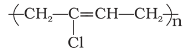
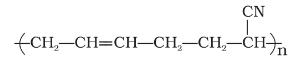
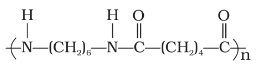
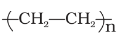
The condensation polymer among the following is:
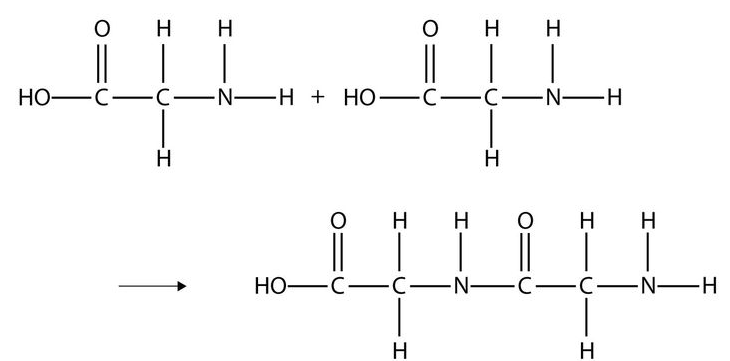
AnswerProteins are polymers of amino acids covalently linked through peptide bonds into a chain. These are formed by removal of water molecule and through condensation reaction.
$\text{PVC},$ rubber and polyethene are formed through addition polymerisation.
View full question & answer→MCQ 21 Mark
Which of the following is wrong?
- A
$\text{PMMA}$ is called plexiglass
- B
$\text{PTFE}$ is called teflon
- ✓
$\text{SBR}$ is natural rubber
- D
$\text{LDPE}$ is called low density polythene
AnswerCorrect option: C. $\text{SBR}$ is natural rubber
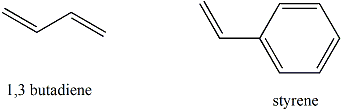
$\text{SBR}$ stands for styrene $-$ butadiene rubber.
It is a copolymer but it is a synthetic polymer and not natural rubber.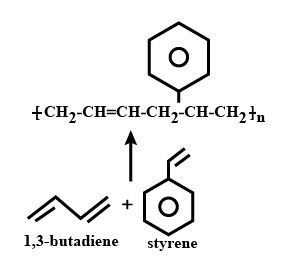
View full question & answer→MCQ 31 Mark
- A
Carbon, flourine $\ \&\ $ hydrogen
- B
Carbon, chlorine $\ \&\ $ hydrogen
- ✓
Carbon $\ \&\ $ flourine
- D
Carbon $\ \&\ $ chlorine
AnswerCorrect option: C. Carbon $\ \&\ $ flourine
Teflon is the brand name of Polytetrafluoroethylene $\text{(PTFE)}$ is a synthetic fluoropolymer of tetrafluoroethylene.
The constituents of tetrafluoroethylene are carbon and fluorine formula is $\left(\mathrm{C}_2 \mathrm{F}_4\right)_n$.
View full question & answer→MCQ 41 Mark
Which one is resistant to vegetable and mineral oils?
AnswerNeoprene has superior resistance to vegetable and mineral oils.
The material used in the neoprene is nothing but the rubber which has strong resistant towards vegetable and mineral oil.
View full question & answer→MCQ 51 Mark
Which of the following statements is not true about low density polythene?
- A
- ✓
- C
Poor conductor of electricity.
- D
Highly branched structure.
AnswerLow density polythene: It is obtained by the polymerisation of ethane under high pressure of $1000$ to $2000$ atmosphere at a temperature of $350K$ to $570K$ in the presence of traces of dioxygen or a peroxide initiator $($catalyst$).$ They are flexible in nature.
View full question & answer→MCQ 61 Mark
Polyacrylamide gel is prepared by mixing acrylamide and $........$ at fixed proportions.
AnswerPolyacrylamide gel $=$ Acerylamide $+$ Bisacrylamide.
View full question & answer→MCQ 71 Mark
Which of the following polymers are thermoplastic?
$a.$ Teflon.
$b.$ Natural rubber.
$c.$ Neoprene.
$d.$ Polystyrene.
- A
$a$ and $b$
- B
$a$ and $c$
- C
$b$ and $c$
- ✓
$a$ and $d$
AnswerCorrect option: D. $a$ and $d$
Teflon and polystyrene are thermoplastics since they can be moulded again by heating and melting.
View full question & answer→MCQ 81 Mark
Common application of $\text{GRN}$ in life is:
- ✓
- B
Manufacture of hose pipes
- C
- D
View full question & answer→MCQ 91 Mark
Dacron $($a polymer$)$ is obtained by the condensation polymerization of:
- A
- B
- C
Terepthalic acid and formaldehyde
- ✓
Dimethyl terephthalate and ethylene glycol
AnswerCorrect option: D. Dimethyl terephthalate and ethylene glycol
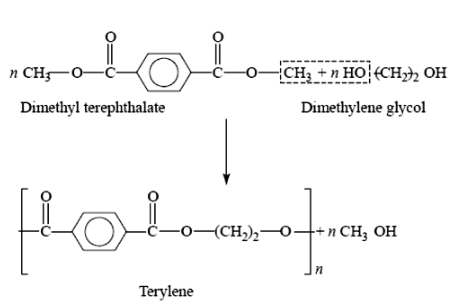
The polymer of ethylene glycol and terephthalic acid is known as terylene or dacron.
View full question & answer→MCQ 101 Mark
Which of the following statements is not true about polymers?
- A
Polymers have high viscosity.
- B
Polymers do not carry any charge.
- C
- ✓
Polymers have low molecular weight.
AnswerCorrect option: D. Polymers have low molecular weight.
Polymers have very high molecular weight $\left(10^3=10^7 \mu\right)$.
Hence, they are called macromolecules. The rest of the properties are given in option $A, B$ and $C$ are true.
View full question & answer→MCQ 111 Mark
Polymer formation from monomers starts by:
- ✓
Condensation reaction between monomers.
- B
Coordination reaction between monomers.
- C
Conversion of one monomer into other monomer.
- D
AnswerCorrect option: A. Condensation reaction between monomers.
Polymer formation is caused by the condensation of $2$ or more bifunctional monomers with the elimination of simple molecules like water, ammonia, alcohol etc.
In these reactions, the product of each step is again a bifunctional species $\ \&\ $ the sequence of condensation goes on.
View full question & answer→MCQ 121 Mark
Rubber is heated with sulphur and the process is known as:
AnswerNatural Rubber is heated in the presence of sulphur. This produces cross$-$linking and leads to a harder material that is markedly more resistant to heat and relatively more elastic. This process is called vulcanization.
View full question & answer→MCQ 131 Mark
What is not true regarding free radical polymerisation of propene?
AnswerCorrect option: C. During polymerisation, a linear unbranched, crystalline polymer is usually obtained.
The statement $(C)$ is not true. During polymerization, a branched polymer is usually obtained. Chain branching always occur during olefenic polymerization due to abstraction of some $H-$radical from the growing polymer chain.
Note$:\ 1^\circ $ free radical forms $2^\circ $ free radical by abstracting hydrogen at middle of another chain, which further adds to propene and there is growing of the branch. Ziegler Natta catalyst is titanium chloride and triethyl aluminum $\left[\mathrm{TiCl}_4+\mathrm{Al}\left(\mathrm{C}_2 \mathrm{H}_5\right)_3\right]$
View full question & answer→MCQ 141 Mark
- A
Mixture of two natural fibres
- B
Mixture of two synthetic fibre
- C
Mixture of natural and synthetic fibres
- ✓
AnswerBlended fibres are made by combining various fibres to enhance the property of the product.
For eg: spandex and cotton is a natural mix for sports clothing and undergarments to improve stretching properties and prevent odour.
A blended fabric helps overcome the disadvantages of natural and synthetic fibre.
View full question & answer→MCQ 151 Mark
Polymerisation in which two or more chemically different monomers take part is called:
AnswerCopolymerisation is a polymerization reaction in which a mixture of more than one monomeric species is allowed to polymerize to form a copolymer.
View full question & answer→MCQ 161 Mark
When formaldehyde is heated with phenol in the presence of an alkali, the product formed is:
AnswerBakelite forms in a condensation reaction of phenol and formaldehyde, with wood flour or asbestos fiber as a filler, under high pressure and heat in a time frame of a few minutes of curing. The result is a hard plastic material.
Molecular Formula$:\ \left(\mathrm{C}_6 \mathrm{H}_6 \mathrm{O} \cdot \mathrm{CH}_2 \mathrm{O}\right)_n$
Making Bakelite was a multi-stage process. It began with the heating of phenol and formaldehyde in the presence of a catalyst such as hydrochloric acid, zinc chloride, or the base ammonia
View full question & answer→MCQ 171 Mark
The process involving heating of rubber with sulphur is called $.......$
AnswerVulcanisation of Rubber $-$ Natural rubber becomes soft at high temperature $(>335 K)$ and brittle at low temperature $(<283 K)$ and shows high water absorption capacity.
The process of vulcanisation includes heating of raw rubber with sulphur and an appropriate additive at temperature range between $373 K$ to $415 K.$ Sulphur foms crosslinks at reactive sites of double bonds and thus, rubber gets stiffened.
View full question & answer→MCQ 181 Mark
- A
- B
- C
- ✓
Glycol and terephthalic acid
AnswerCorrect option: D. Glycol and terephthalic acid
Dacron, also known as Terylene; a polymer formed from polymerization of ethylene glycol and Terephthalic acid.

View full question & answer→MCQ 191 Mark
Which of the following monomers are unsuitable for condensation polymerization?
AnswerCorrect option: D. Propanoic acid and ethanol.
Propanoic acid and ethanol, both are monofunctional monomers $\mathrm{CH} 3-\mathrm{CH}_2-\mathrm{OH}, \mathrm{CH}_3-\mathrm{CH}_2 \mathrm{COOH}$ which are not suitable for a polycondensation reaction to take place because once they combine by condensation polemerisation further polymerisation is not possible.
View full question & answer→MCQ 201 Mark
Cellulose, protein and starch are classified as:
AnswerCellulose, protein and starch are classified as natural polymers. They are obtained from either plants or animals.
They are named as plant polymers and animal polymers.
Other examples of natural polymers include jute, linen, silk and wool etc.
View full question & answer→MCQ 211 Mark
The polymer, which is the constituent of cotton is:
AnswerCotton is $99\%$ cellulose. Cellulose is a macromolecule. A polymer made up of a long chain of glucose molecules linked by $C−1$ to$ C−4$ oxygen bridges with an elimination of water.
Wood pulp, rayon, and cellophane are also constructed of cellulose polymers.
View full question & answer→MCQ 221 Mark
The process by which smaller molecules combine to give a molecule with a higher molecular weight is known as:
AnswerPolymerisation is the joining together of two or more simple molecules called Monomers to form a new compound of the same empirical formula called a polymer which has higher molecular weight.
View full question & answer→MCQ 231 Mark
Chloroprene is the monomer of:
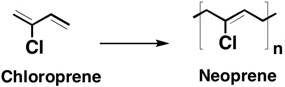
AnswerNeoprene polymerizes from its monomer unit chloroprene.
View full question & answer→MCQ 241 Mark
$.......$ is used for making parachutes and stockings.
AnswerNylon is the strongest man-made fiber prepared by polymerizing amide molecules.
Nylon is used in the making of different types of clothes, ropes, sleeping bags, parachutes, tents etc because the fiber of nylon is stronger than a steel wire of the same thickness.
View full question & answer→MCQ 251 Mark
Which of the following are addition polymers?
$a.$ Nylon.
$b.$ Melamine formaldehyde resin.
$c.$ Orlon.
$d.$ Polystyrene.
- A
$a$ and $b$
- B
$a$ and $c$
- C
$b$ and $c$
- ✓
$a$ and $d$
AnswerCorrect option: D. $a$ and $d$
The addition polymers are formed by the repeated addition of monomer molecules possessing double or triple bonds, e.g., the formation of polythene from ethene and polypropene from propene. However, the addition polymers formed by the polymerisation of a single monomeric species are known as homopolymers.
View full question & answer→MCQ 261 Mark
Which of the following polymers are used as fibre?
$a.$ Polytetrafluoroethane.
$b.$ Polychloroprene.
$c.$ Nylon.
$d.$ Terylene.
- A
$a$ and $b$
- B
$a$ and $c$
- C
$b$ and $c$
- ✓
$c$ and $d$
AnswerCorrect option: D. $c$ and $d$
Fibres are the thread forming solids which possess high tensile strength and high modulus. These characteristics can be attributed to the strong intermolecular forces like hydrogen bonding. These strong forces also lead to close packing of chains and thus impart crystalline nature. The examples are polyamides $($nylon $6, 6),$ polyesters $($terylene$),$ etc.
View full question & answer→MCQ 271 Mark
Polymer used to make gasket of pressure cooker is:
AnswerPolymer used to make gasket of pressure cooker is teflon. Teflon is formed by free radical vinyl polymerisation of the monomer tetrafluoroethylene.
View full question & answer→MCQ 281 Mark
Generally, polyamides are $.......$
AnswerPolyamides are generally fibers because of the intermolecular forces like hydrogen bonding which gives them high tensile strength.
View full question & answer→MCQ 291 Mark
The tensile strength, elasticity and resistance to abrasion can be increased by a process called:
AnswerIn vulcanization, there is formation of crosslinks of sulphur at the reactive sites of the double bond which stiffens the rubber and also increase the resistance to abrasion and tensile strength, the elasticity of the rubber.
View full question & answer→MCQ 301 Mark
Polymer used in making capsules is:
AnswerCorrect option: D. $\text{PHBV}$
$\text{PHBV}$ is Poly ($−3−$ hydroxy butyrate $- co -3-$hydroxy valerate).
$\text{PHBV}$ is used in speciality packaging, orthropaedic devices and in controlled release of drugs.
$\text{PHBV}$ undergoes bacterial degradation in the environment.
View full question & answer→MCQ 311 Mark
Which of the following polymer is used in pigment?
AnswerCorrect option: A. Buna $- S$
Buna $- S$ is used to bind pigmented coatings.
It is the polymer derived from styrene and buta $-$ diene.
View full question & answer→MCQ 321 Mark
The people who weave the clothes are called:
AnswerPeople who weave clothes are called weavers. The person makes fabric by weaving fibre. Weaving is a method of textile production consisting of two different types of thread that are interlaced at right angles to form the cloth
View full question & answer→MCQ 331 Mark
Which one of these is a monomer of Bakelite?
AnswerBakelite is a condensation polymer of phenol and formaldehyde.
Bakelite is widely used for making molded products.
It was the first plastic made from synthetic components.
View full question & answer→MCQ 341 Mark
Which of the following polymer is biodegradable?
AnswerPoly $\beta-$ hydroxybutyrate-co $\beta-$ hydroxy valerate (PHBV):
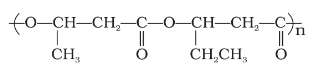
It is obtained by the copolymerization of 3-hydroxybutanoic acid and 3-hydroxypentanoic acid. PHBV is used in speciality packaging orthopaedic devices and in controlled release of drugs. PHBV undergoes bacterial degradation in the environment. View full question & answer→MCQ 351 Mark
In vulcanisation of rubber,
- A
Sulphur reacts to form new compound.
- ✓
Sulphur cross links are introduced.
- C
Sulphur forms a very thin protective layer over rubber.
- D
AnswerCorrect option: B. Sulphur cross links are introduced.
In vulcanisation of rubber, sulphur cross links are introduced. Natural rubber is mixed with $3$ to $5\%$ sulphur and heated at $100−150^\circ C$ to form cross linking of cis$-1, 4$ polyisoprene chains through disulphide bonds $(-S-S-).$ Vulcanization of rubber makes it more strong, tough and elastic.
View full question & answer→MCQ 361 Mark
Which of the following is an elastomer?
AnswerAn elastomer is a polymer with viscoelasticity $($colloquially "elasticity"$),$ generally having low Young's modulus and high failure strain compared with other materials.
Vulcanized rubber is a natural elastomer that has been made more durable by a biochemical process that cures the rubber.
Vulcanized rubber is an elastomer.
View full question & answer→MCQ 371 Mark
The non$-$metal used to treat rubber in the process of vulcanization is:
AnswerThe nonmetal used to treat rubber in the process of vulcanization is sulphur. Natural rubber is soft, sticky and has less tensile strength. Vulcanization makes rubber more strong, tough and elastic.
Natural rubber is mixed with $3$ to $5 \%$ sulphur and heated at $100$ to $\text{150 deg C,}$ which results in cross linking of chains of cis$-1,4-$polyisoprene through disulphide $(−S−S−)$ bonds.
View full question & answer→MCQ 381 Mark
Which one of the following is not an example of chain growth polymer?
- A
- B
Buna $- S$
- C
$\text{PMMA}$
- ✓
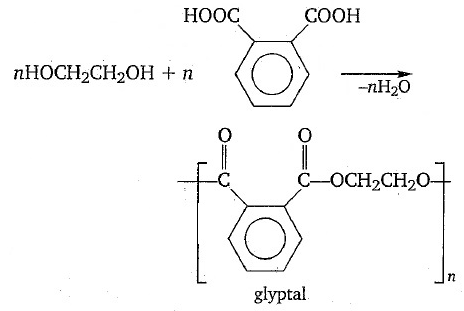
AnswerGlyptal is a condensation or step growth polymer of ethylene glycol and phthalic acid.
Neoprene, buna $- S$ and $\text{PMMA}$ are chain growth polymers.
View full question & answer→MCQ 391 Mark
- A
- B
- ✓
- D
The manufacture of paints
AnswerVulcanization is addition of sulphur in natural rubber by chemical process to improve its durability.
View full question & answer→MCQ 401 Mark
During long distance travel you would like to take drinking water in a bottle made up of:
AnswerPlastic have low toxicity due to their insolubility in water and because they are biochemically inert due to large molecular weight. Plastic products contain a variety of additives. Plastic is light, durable and doesn't react chemically with water.
View full question & answer→MCQ 411 Mark
Polymers may also be made up of:
AnswerPolymers are made of repeat units derived from natural gas or coal or crude oil. But building block repeat units can sometimes be made from renewable materials such as polylactic acid from corn or cellulosics from cotton linters.
Some plastics have always been made from renewable materials such as cellulose acetate used for screwdriver handles and gift ribbon.
View full question & answer→MCQ 421 Mark
Which one of the following is not a correct match?
- A
Teflon $-$ Tetrafluoroethylene.
- B
Plexi glass $-$ Methyl methacrylate.
- ✓
Orlon $-$ Glycerol, phthalic anhydride.
- D
Buna$-S -$ Styrene$, 1-3$ butadiene.
AnswerCorrect option: C. Orlon $-$ Glycerol, phthalic anhydride.
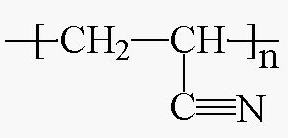
Acrylonitrile $\left(\mathrm{CH}_2=\mathrm{CHCN}\right)$ is the monomer unit of orlon polymer.
View full question & answer→MCQ 431 Mark
The s-block element used as a catalyst in the manufacture of Buna$-S$ rubber is:
AnswerThe $s -$ block element used as a catalyst in the manufacture of Buna$-S$ rubber is sodium $(Na)$ metal.
Buna $- S$ or styrene butadiene rubber $\text{(SBR)}$ is a copolymer of styrene and $1, 3 -$ butadiene.
View full question & answer→MCQ 441 Mark
$PP\ ($Polypropylene$)$ is used for making $.......$
Answer$PP\ ($Polypropylene$)$ is used for making disposable cups.
View full question & answer→MCQ 451 Mark
Bakelite is a product of the reaction between:
AnswerBakelite is formed by co$-$polymerization of phenol and formaldehyde $($methanal$).$

View full question & answer→MCQ 461 Mark
Which of the following is a fully flourinated polymer?
AnswerPolytetrafluoroethylene $\text{(PTFE)}$ or Teflon is formed by tetrafluoroethylene. Thiokol, Neoprene, and $\text{PVC}$ are formed by polysulphide, chloroprene, vinylchloride.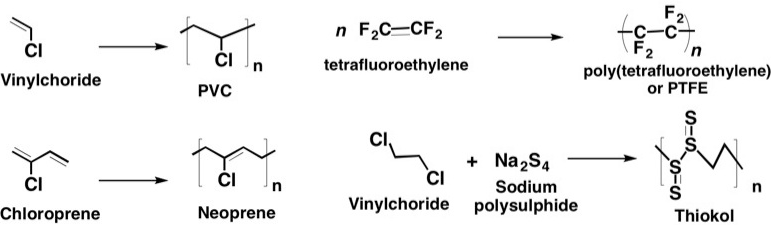
View full question & answer→MCQ 471 Mark
Fomaldehyde is the starting material for the manufacture of :
MCQ 481 Mark
Synthetic human hair wigs are made from a copolymer of vinyl chloride and acrylonitrile and is called:
AnswerDynel is a co $-$ polymer of vinyl chloride and acrylonitrile.
View full question & answer→MCQ 491 Mark
Which of the following statements is incorrect?
- A
Polypropylene is a thermoplastic polymer.
- B
Melamine-formaldehyde is a thermosetting polymer.
- ✓
Mixture of styrene and methyl methacrylate can form ionic addition polymer.
- D
Low density polythene is a poor conductor of electricity.
AnswerCorrect option: C. Mixture of styrene and methyl methacrylate can form ionic addition polymer.
Mixture of styrene and methyl methacrylate can form a copolymer and not an ionic addition polymer.
Hence, the statement in option is incorrect.
Other statements are correct.
View full question & answer→MCQ 501 Mark
Which of the following polymers is used to manufacture clothes for firefighters?
AnswerNomex is used to manufacture clothes for firefighters . It is also used to prepare protective clothes for race car drivers. Dynel is used in the preparation of human hair wigs.
Thiokol is used in rubber. Kevlar is used to prepare bullet proof vests and helmets.
View full question & answer→MCQ 511 Mark
Which of the following is an example of condensation polymers?
AnswerCondensation polymerization: This type of polymerization generally involves a repetitive condensation reactions between two bi$-$functional monomers. These poly$-$condensation reactions may result in the loss of simple molecule as water, alcohol etc.
Example: Terylene $($as shown in the figure$).$

View full question & answer→MCQ 521 Mark
Pick out the incorrect statement amongst the following.
AnswerCorrect option: A. Nylon clothing can stand high temperature and are therefore good to wear in summers.
Nylon is very much suitable for hosiery and the knitted fabrics because of its smoothness, light weight and high strength. Nylon is a lustrous fibre.
Thermoset materials are generally stronger than thermoplastic materials due to this three$-$dimensional network of bonds $($cross$-$linking$),$ and are also better suited to high-temperature applications up to the decomposition temperature.
Natural rubber is obtained as latex from rubber trees.
An addition polymer is a polymer which is formed by an addition reaction, where many monomers bond together via rearrangement of bonds without the loss of any atom or molecule.
View full question & answer→MCQ 531 Mark
Vulcanisation makes rubber $.......$
$a.$ More elastic.
$b.$ Soluble in inorganic solvent.
$c.$ Crystalline.
$d.$ More stiff.
- A
$a$ and $b$
- B
$a$ and $c$
- C
$b$ and $c$
- ✓
$a$ and $d$
AnswerCorrect option: D. $a$ and $d$
To improve upon physical properties of natural rubber a process of vulcanisation is carried out. This process consists of heating a mixture of raw rubber with sulphur and an appropriate additive at a temperature range between $373K$ to $415K.$ On vulcanisation, sulphur forms cross links at the reactive sites of double bonds and thus the rubber gets stiffened.
View full question & answer→MCQ 541 Mark
The plastic product which can be remoulded is:
AnswerChain growth polymerization is involved in the manufacture of polymers such as polyethylene. Free radical mechanism for ethylene takes place at high temperature and pressure which can be remoulded by its repeating carbon chain.
View full question & answer→MCQ 551 Mark
Natural rubber is not used in making footwear for polar regions because:
- A
Natural rubber becomes soft at temperature lower than $10^\circ C.$
- ✓
Natural rubber becomes brittle at temperature lower than $10^\circ C.$
- C
Natural rubber melts at temperature lower than $10^\circ C.$
- D
Natural rubber becomes stronger at temperature lower than $10^\circ C.$
AnswerCorrect option: B. Natural rubber becomes brittle at temperature lower than $10^\circ C.$
Natural rubber is a thermoplastic. It becomes soft and sticky when heated at high temperature $($lower than $62^\circ C)$ and brittle at low temperature $(10^\circ C).$
So that's why natural rubber is not used in making footwear for the polar region.
View full question & answer→MCQ 561 Mark
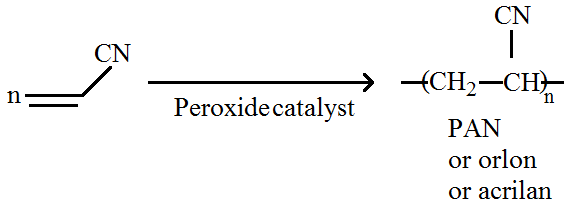
The commercial name of polyacrylonitrile is $........$
- A
- ✓
Orlon $($acrilan$).$
- C
$\text{PVC}.$
- D
AnswerCorrect option: B. Orlon $($acrilan$).$
The commercial name of polyacrylonitrile is Orion or acrilan.
View full question & answer→MCQ 571 Mark
Which of the following type of forces are present in vulcanized rubber?
- ✓
Weakest intermolecular forces
- B
- C
Three dimensional network of bonds
- D
AnswerCorrect option: A. Weakest intermolecular forces
Vulcanised rubber is highly elastic, so weakest intermolecular forces present in it.
View full question & answer→MCQ 581 Mark
Which of the following happens in initiation step of the free radical polymerisation?
- ✓
Decomposition of initiator.
- B
- C
Addition of monomer molecules to the growing chains.
- D
AnswerCorrect option: A. Decomposition of initiator.
View full question & answer→MCQ 591 Mark
Bubble gum contains $.......$
- A
- ✓
Styrene $-$ butadiene rubber
- C
Isobutylen $-$ isoprene rubber
- D
Acrylonitrile $-$ butadiene rubber
AnswerCorrect option: B. Styrene $-$ butadiene rubber
Bubble gum is a soft cohesive substance made up of butadiene$-$based synthetic rubber because it is cheaper to manufacture.
View full question & answer→MCQ 601 Mark
The method preferred for determining the molecular weight of a polymer is $.........$
- ✓
- B
- C
Lowering of freezing point
- D
Direct weighing of a single molecule
AnswerOsmotic pressure method is the best method for the determination of molecular weight of polymers and proteins, since osmotic pressure, though very small, is measurable.
On the other hand, in other colligative properties $\ce{(\triangle Tb, \triangle Tf, \triangle p/po)},$ the difference is very small and cannot be measured.
Morever, in osmotic pressure method, heating is not required. While in other methods, heating is required which changes the properties of polymers and proteins.
View full question & answer→MCQ 611 Mark
Which of the following polymers, need atleast one diene monomer for their preparation?
Dacron.
Buna$-S.$
Neoprene.
Novolac.
- A
$a$ and $b$
- B
$b$ and $c$
- ✓
$a$ and $c$
- D
$b$ and $d$
AnswerCorrect option: C. $a$ and $c$
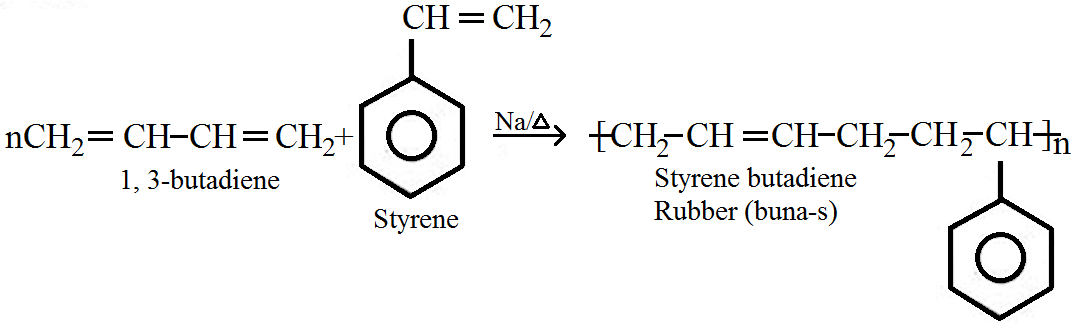
Buna$-S$ and neoprene are two such polymers which need at least one diene monomer for their preparation.
- Buna$-S$ is prepared by copolymerization of $1, 3-$butadierie and styrene.
- Neoprene is prepared by polymerisation of chloroprene.

View full question & answer→MCQ 621 Mark
AnswerPlastics are polymers formed from small molecular fragments which are known as monomers and plastic is the macromolecular fragment.
All polymers are not plastics but all plastics are polymers.
View full question & answer→MCQ 631 Mark
Sulphur is used for vulcanization of rubber to make it:
AnswerSulphur is used for vulcanization of rubber to make it more strong, tough and elastic.
Note: Natural rubber is soft, sticky and has less tensile strength.
View full question & answer→MCQ 641 Mark
Which of the following is resistant to petrol, lubricating oils and organic solvents?
- A
- B
Buna $- N$
- C
$\text{GRN}$
- ✓
AnswerAll the three nitrile rubber, buna $n$ and $\text{grn}$ are resistant to petrol, lubricant oil and organic solvent.
View full question & answer→MCQ 651 Mark
Which of the following kind of polymers are known for their high crystallinity?
AnswerThere is high steric regularity in isotactic polymers which fosters close packing of molecular chains. Thus, they are highly crystalline.
View full question & answer→MCQ 661 Mark
Dacron is obtained by the condensation polymerisation of:
- ✓
Dimethyl terephthalate and ethylene glycol.
- B
Terephthalic acid and formaldehyde.
- C
Phenol and phthalic acid.
- D
AnswerCorrect option: A. Dimethyl terephthalate and ethylene glycol.
Dacron is obtained by the condensation polymerisation of dimethyl terephthalate and ethylene glycol.
Dacron is polyester and is also called terylene.
View full question & answer→MCQ 671 Mark
Rubber is hardened for making tyres by:
- A
Adding $\mathrm{H}_2$
- ✓
- C
- D
AnswerCarbon black is used in various formulations with different rubber types to customize the performance properties of tyres.
Different grades of carbon black are used to optimize properties like handling,tradewear, fuel mileage and abrasion resistance.
View full question & answer→MCQ 681 Mark
Synthetic polymer that resembles natural rubber is:
MCQ 691 Mark
Which of the following is a way to dispose non$-$biodegradable materials?
AnswerPolymers can be recycled mechanically or chemically. In land fill polymers are buried in the ground so that they do not accumulate and cause pollution. Incineration is heating at high temperature.
Heat energy released by polymers is used to generate electricity.
View full question & answer→MCQ 701 Mark
Bakelite polymer is formed by the polymerization of:
- A
Methanol and salicyladehyde.
- ✓
Methanal and hydroxy benzene.
- C
Ethanal and hydroxy benzene.
- D
Ethanal and cinnamic acid.
AnswerCorrect option: B. Methanal and hydroxy benzene.
Bakelite is a thermosetting phenol formaldehyde resin, formed from elimination reaction of phenol with formaldehyde.
View full question & answer→MCQ 711 Mark
Which of the following is used in making automobile tyres and foot wear?
AnswerVulcanised rubber is used in making automobile tyres and foot wear.
Heating of rubber with sulphur is called as vulcanisation. It makes the rubber hard and more flexible.
View full question & answer→MCQ 721 Mark
Which type of polymer is natural rubber?
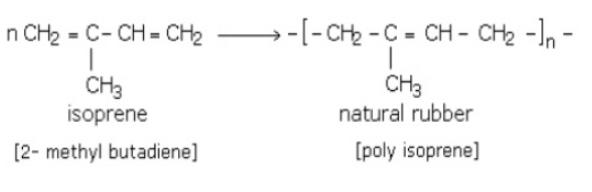
AnswerNatural rubber is an addition polymer that is obtained as a milky white fluid known as latex from a tropical rubber tree.
Natural rubber is the polymer of isoprene $(2-$methyl$-1,3-$butadiene$).$
View full question & answer→MCQ 731 Mark
Polymer formation form monomers starts by:
- ✓
Condensation reaction between monomers.
- B
Conversion of monomer to monomer ions by protons.
- C
Coordination reaction between monomers.
- D
AnswerCorrect option: A. Condensation reaction between monomers.
Polymerization occurs by a condensation reaction, which is a chemical reaction in which two molecules or moieties $($functional groups$)$ combine to form a larger molecule, together with the loss of a small molecule such as water$, \text{HCl}$ etc.
View full question & answer→MCQ 741 Mark
Which of the following correctly describes teflon?
AnswerCorrect option: C. It is an anti$-$corrosive plastic.
Teflon $($tetrafluoroethylene$)$ is an anti$-$corrosive plastic. It is flexible and inert to solvent acids.
Hence, it is used in making non$-$stick utensils.
View full question & answer→MCQ 751 Mark
The product that you would expect to obtain from catalytic hydrogenation of natural rubber is $........$
- A
- ✓
- C
- D
Either atatic or isotatic
AnswerThese are the polymers formed by free radical mechanisms with a random orientation of groups.
View full question & answer→MCQ 761 Mark
Polymer used in bullet proof glass is:
AnswerCorrect option: B. $\text{PMMA}$
Lexan is a kind of polycarbonate i.e. thermosetting polymers containing carbonate groups.
They are strong, tough materials, and are optically transparent.
This is why a laminated polycarbonate $($Lexan$)$ is used to make bulletproof glass.
View full question & answer→MCQ 771 Mark
Which of the following is monomer of natural rubber?
MCQ 781 Mark
A polymer used in paints is:
AnswerNomex is used in protective clothing for race car drivers and firefighters.
Thiokol is used in rubber.
Saran is used in bumpers.
Glyptal used in the manufacture of paints and lacquers.
View full question & answer→MCQ 791 Mark
In fractional distillation of petroleum, the vapours with highest boiling point:
- A
Condense in uppermost portion.
- ✓
Condense in lowermost portion.
- C
Condense in middle portion.
- D
AnswerCorrect option: B. Condense in lowermost portion.
In fractional distillation of petroleum, the vapours with highest boiling point condense in lowermost portion.
As the vapors of highest boiling point evaporates later and condenses later at lower portion.
View full question & answer→MCQ 801 Mark
AnswerA polymer is formed by Dehydration synthesis means removal of water molecule.
View full question & answer→MCQ 811 Mark
Which polymer is used in controlled drugs capsules?
- A
$\text{SBR}$
- B
$\text{PTFE}$
- ✓
$\text{PHBV}$
- D
$\text{PAN}$
AnswerCorrect option: C. $\text{PHBV}$
$\text{PHBV}$ helps in controlled release of drugs, medical implants and repairs, speciality packaging orthopaedic devices and manufacturing bottles.
View full question & answer→MCQ 821 Mark
Which of the following polymers of glucose is stored by animals?
AnswerGlycogen is a polymer of glucose found in lever, brain and muscles of animals.
View full question & answer→MCQ 831 Mark
Which among the following is not a natural polymer?
AnswerCorrect option: D. $\text{PVC}$
There are two types of polymers: synthetic and natural.
Synthetic polymers are derived from petroleum oil and made by scientists and engineers.
Examples of synthetic polymers include nylon, polyethene, polyester, Teflon, and epoxy.
Polyvinyl chloride, commonly abbreviated $\text{PVC},$ is the third$-$most widely produced synthetic plastic polymer.
Natural polymers occur in nature and can be extracted. Examples of naturally occurring polymers are silk, wool$, \text{DNA},$ cellulose and proteins and rubber.
View full question & answer→MCQ 841 Mark
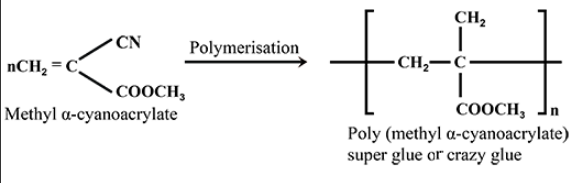
Super glue or crazy glue is:
- A
- B
- ✓
Polymethyl α-cyanoacrylate
- D
AnswerCorrect option: C. Polymethyl α-cyanoacrylate
Super glue is poly$($methyl $\alpha -$cyanoacrylate$).$
View full question & answer→MCQ 851 Mark
Polymer obtained by condensation polymerization is:
AnswerBakelite $($as shown in the figure$)$ is formed by condensation reaction of phenol with formaldehyde.
Polythene is an addition polymer formed by addition of ethene monomer.
Teflon is an addition polymer formed by carbon tetraflouride.
Polyvinyl chloride $\text{(PVC)}$ is formed by addition of vinyl chloride molecules. It is an addition polymer.

View full question & answer→MCQ 861 Mark
Bakelite is a polymer of:
- A
- B
- ✓
- D
Formaldehyde and benzyl alcohol
AnswerBakelite is a cross $-$ linked condensation polymer of phenol $\left(\mathrm{C}_6 \mathrm{H}_5-\mathrm{OH}\right)$ and formaldehyde $\text{(HCHO)}.$ It is thermosetting plastic used for making electrical switches and switch boards.
View full question & answer→MCQ 871 Mark
Teflon, a polymer of tetrafluoroethylene, is an excellent plastic material for films and coatings. Which of the following is not the property of Teflon?
AnswerCorrect option: A. It is unaltered by radiation
$\text{PTFE}\ ($Poly tetra fluoro ethylene$)$ is very sensitive and is therefore not suitable for applications involving exposure of any radiation as it will degrade.
View full question & answer→MCQ 881 Mark
Emulsions of polyvinyl acetate are used in?
AnswerPolyvinyl acetate is synthesized by the emulsion polymerization of vinyl acetate monomer $\text{(VAM)}.$
Polyvinyl acetate serves as the film$-$forming ingredient in water$-$based $($latex$)$ paints.
View full question & answer→MCQ 891 Mark
- A
Macromolecules composed of many repeated sub units.
- B
Monomers bonded together in a long chain.
- ✓
Both $A$ and $B.$
- D
AnswerCorrect option: C. Both $A$ and $B.$
A polymer is a substance or material consisting of very large molecules, or macromolecules, composed of many repeating subunits.
The word polymer comes from the Greek words for “many parts.” Each of those parts is scientists call a monomer $($which in Greek means “one part”$).$ Think of a polymer as a chain, with each of its links a monomer.
Due to their broad spectrum of properties, both synthetic and natural polymers play essential and ubiquitous roles in everyday life.
View full question & answer→MCQ 901 Mark
The abbreviation $\text{PDI}$ refers to $.........$
- A
- ✓
Polydispersity index of the polymer
- C
Application of the polymer
- D
AnswerCorrect option: B. Polydispersity index of the polymer
The polydispersity index $\text{(PDI)}$ is a measure of the distribution of molecular mass in a given polymer sample.
The $\text{PDI}$ calculated is the weight average molecular weight divided by the number average molecular weight.
It indicates the distribution of individual molecular masses in a batch of polymers.
The $\text{PDI}$ has a value equal to or greater than $1,$ but as the polymer chains approach uniform chain length, the $\text{PDI}$ approaches unity.
View full question & answer→MCQ 911 Mark
Trans-form of rubber is called $........$
AnswerGutta percha is called trans-form of rubber, as it is a polymer of isoprene, the basic sub unit in natural rubber.
View full question & answer→MCQ 921 Mark
Which of the following polymers are condensation polymers?
$a.$ Bakelite.
$b.$ Teflon.
$c.$ Butyl rubber.
$d.$ Melamine formaldehyde resin.
- A
$a$ and $b$
- B
$a$ and $c$
- C
$b$ and $c$
- ✓
$a$ and $d$
AnswerCorrect option: D. $a$ and $d$
Bakelite is a condensation polymer of phenol and formaldehyde. Melamine formaldehyde resin is a condensation polymer of melamine $(2, 4, 6-$triamino$-1, 3, 5-$triazine$)$ and formaldehyde.
View full question & answer→MCQ 931 Mark
Which polymer is used in the preparation of hose $-$ pipe?
AnswerTeflon is used to prepare hose$-$pipe. Teflon inner layer excels in corrosion resistance and ensures flexibility.
View full question & answer→MCQ 941 Mark
Which of the following is incorrect regarding natural rubber?
- A
It is cis$-$polyisoprene
- B
It is amorphous in nature
- ✓
It has syndiotactic stereochemistry
- D
Molecules of rubber have coiled conformation
AnswerCorrect option: C. It has syndiotactic stereochemistry
Rubber has isotactic stereochemistry, not syndiotactic.
Tacticity refers to the orderliness of succession of configurational repeating units in the main chain of a macromolecule.
This is an application of stereochemistry as it concerns the spatial arrangement of substituent groups.
View full question & answer→MCQ 951 Mark
Which of the following polymer is not an addition polymer?
- A
- ✓
$\text{BUNA - N}$
- C
$\text{PAN}$
- D
AnswerCorrect option: B. $\text{BUNA - N}$
$\text{BUNA - N}$ is formed by removal of water molecule so it is condensation polymer.
View full question & answer→MCQ 961 Mark
Nylon threads are made of $.......$
AnswerNylon threads are polymer of polyamides obtained by condensing amides and /or carboxylic acids
Examples are nylon $- 6,$ nylon $- 6, 6.$
View full question & answer→MCQ 971 Mark
Which of the following is correct about cellulose?
AnswerCellulose fibers can be obtained from the bark, wood or leaves of plants, or from a plant$-$based material. Cotton is a polymer of cellulose. It is made up of large number of glucose units.
View full question & answer→MCQ 981 Mark
Plexiglass is a polymer of $......$
AnswerPlexiglass is a very important commercial polymer because of its high resisting properties.
It is a polymer of methyl methacrylate.
The structure of the methylmethacrylate is given above.

View full question & answer→MCQ 991 Mark
Which one of the following statements is not true?
AnswerCorrect option: D. Natural rubber has the trans-configuration at every double bond.
View full question & answer→MCQ 1001 Mark
Which of the folloiwng are characteristics of thermosetting polymers?
$a.$ Heavily branched cross linked polymers.
$b.$ Linear slightly branched long chain molecules.
$c.$ Become infusible on moulding so cannot be reused.
$d.$ Soften on heating and harden on cooling, can be reused.
- A
$a$ and $b$
- B
$b$ and $c$
- ✓
$a$ and $c$
- D
$a$ and $d$
AnswerCorrect option: C. $a$ and $c$
Thermosetting polymers: These polymers are cross linked or heavily branched molecules, which on heating undergo extensive cross linking in moulds and again become infusible. These cannot be reused.
View full question & answer→MCQ 1011 Mark
The process of vulcanization was introduced by $......$
AnswerCharles Goodyear invented vulcanization process in $1839.$
Vulcanisation is a process involving heating of rubber with sulphur is called vulcanisation.
View full question & answer→MCQ 1021 Mark
Which polymer among the following polymers does $\text{NOT}$ soften on heating?
AnswerThermoplastics:
A plastic material, which can be repeatedly melted$-$molded again and again by simple heating, is called a thermoplastic. Thermoplastics become soft and moldable on heating. They can then be recast in different shapes and cooled. On cooling the thermoplastic material hardens.
Polyethylene, polystyrene and $\text{PVC}$ are examples.
Thermosetting plastics:
A plastic material, which cannot be repeatedly melted$-$molded again, is called a thermosetting plastic.thermosetting plastics do not become soft on heating and they do not change their shape on heating.
Bakelite is one example of a thermosetting plastic.
View full question & answer→MCQ 1031 Mark
Which of the following is/are true statement$(s)$ for the preparation of Teflon?
- A
It is produced by condensation polymerization.
- ✓
- C
The monomer used is tetrafluoroethane.
- D
The monomer is obtained from carbon tetrachloride.
AnswerIt is produced by addition polymerization. Water acts as a catalyst. The monomer used is tetrafluoroethylene. It is obtained from chloroform.
The option $(B)$ represents a true statement for the preparation of Teflon.
View full question & answer→MCQ 1041 Mark
The following are synthetic polymers except:
AnswerProteins are natural polymers. Rest of them are synthetic polymers.
View full question & answer→MCQ 1051 Mark
Polyester is made up of the repeating units of a chemical called:
AnswerPolyester is a man$-$made or synthetic fibre made up of repeating units of a chemical substance called esters.
Esters are sweet smelling compounds, which are primarily made of carbon, hydrogen, and oxygen.
View full question & answer→MCQ 1061 Mark
Which of the following is not a polymer?
AnswerIce is not a polymer. Whereas all the others are polymers of glucose and/or fructose.
View full question & answer→MCQ 1071 Mark
Natural rubber is obtained as 'latex', which is a milky, white fluid from rubber trees. Latex is a:
- A
Mixture of rubber and gum
- ✓
Colloidal dispersion of rubber in water
- C
Solution of rubber in water
- D
Paste of rubber, clay and water
AnswerCorrect option: B. Colloidal dispersion of rubber in water
Natural rubber latex is basically a colloidal dispersion of rubber hydrocarbon in an aqueous medium. Ammonium and potassium alums are used as a coagulant in latex.
View full question & answer→MCQ 1081 Mark
For natural polymers$, \text{PDI}$ is generally $.......$
AnswerFor natural polymers$, \text{PDI}\ ($Polydispersity Index$)$ is generally equal to $1,$ which means that they are monodisperse. Such polymers are more homogeneous.
View full question & answer→MCQ 1091 Mark
Dacron is an example of a/an:
AnswerFibres are thread forming solids which possess high tensile strength.
Dacron is formed by the interaction of ethylene glycol and terephthalic acid.
View full question & answer→MCQ 1101 Mark
Synthetic fibres are synthesized from raw material called:
AnswerSynthetic fibres are synthesized from a raw material called polymers.
View full question & answer→MCQ 1111 Mark
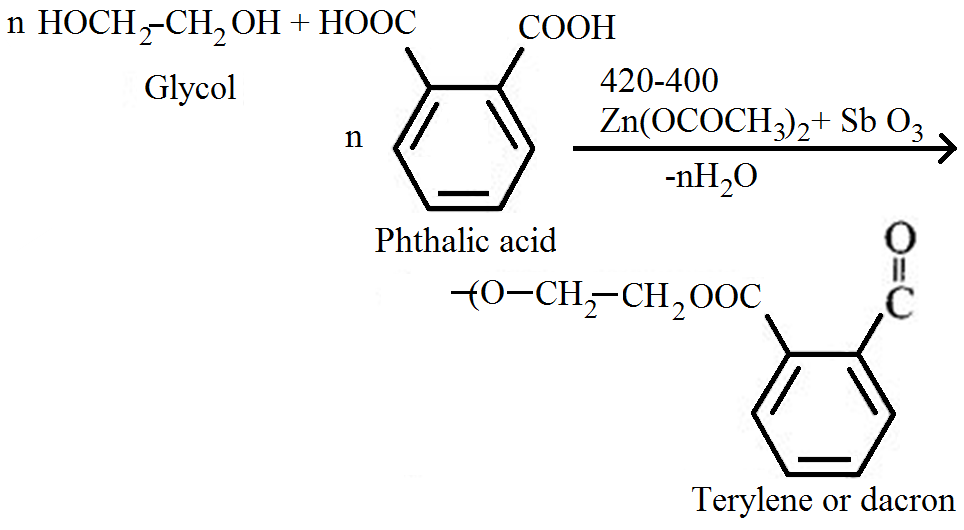
In which of the following polymers ethylene glycol is one of the monomer units?
Answer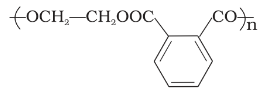
Given polymer can be obtained condensation polymerization of ethylene glycol and phthalic acid with the elimination of water molecule.
View full question & answer→MCQ 1121 Mark
'Guttapercha' is a tough, crystalline, thermoplastic. It is:
- ✓
An isomer of natural rubber
- B
- C
- D
AnswerCorrect option: A. An isomer of natural rubber
Guttapercha is a tough plastic substance obtained from the latex of several trees.
Guttapercha is also called as polyterpene$-$ a polymer of isoprene or polyisoprene.
Guttapercha is a thermoplastic of natural rubber $($isoprene$).$
It is an excellent non$-$conductor and is used in insulating marine and underground cables.
View full question & answer→MCQ 1131 Mark
A condensation polymer among the following polymers is:
AnswerTeflon, Polystrene, and $\text{PVC}$ are addition polymers. while Dacron $($also called Terylene$)$ is a condensation polymer. Condensation polymer is defined as a polymer that is formed by the combination of two or more monomer units and the elimination of water takes place.
In dacron, ethylene glycol and terephthalic acid reacts and removal of water molecule takes place,
Hence, dacron is an example of condensation polymer.
View full question & answer→MCQ 1141 Mark
Fishing nets are made of:
AnswerNylon is strong enough to bear heavy weights, extend and then regain its original shape and length, making it very resourceful in fishing nets and also durable.
View full question & answer→MCQ 1151 Mark
The cross$-$linked polymers possess the property of:
- A
Being soluble in common organic solvents.
- B
Not undergoing change while being heated.
- C
Forming a hard mass which can be remoulded.
- ✓
High resistance to heat and mechanical deformation.
AnswerCorrect option: D. High resistance to heat and mechanical deformation.
The cross$-$linked polymers possess the property of high resistance of heat and mechanical deformation.
Cross$-$links are the characteristic property of thermosetting plastic materials.
View full question & answer→MCQ 1161 Mark
The polymer that can be classified as polyester polymer is:
MCQ 1171 Mark
Most balloons, tyres and footballs are made$-$of rubber. This is because rubber is:
AnswerPrior to rubber tires, metal and wood were the materials in use. However it was found that natural Rubber provides better cushioning, makes less noise.
Further rubber deforms under weight /force which results in larger contact patch with the road than with metal/wood tires of same diameter/width.
During cornering at high speeds, the deformation of sidewall and larger contact area improves the traction or grip on the road increasing safety.
View full question & answer→MCQ 1181 Mark
The $S$ in Buna$- S$ refers to:
AnswerThe $S$ in Buna$- S$ refers to styrene. Buna stands for butadiene and $Na$ for sodium.
Buna$-S$ refers to styrene Butadiene Rubber $\text{(SBR)}.$
It is copolymer of buta$-1,3-$diene and styrene in the ratio of $3 : 1$ in the presence of sodium.
View full question & answer→MCQ 1191 Mark
As plastics and synthetic fibers consist of repeating monomer units, they are known as $.........$
AnswerAs plastics and synthetic fibers consist of repeating monomer units, they are known as polymers.
Polymers are macro$-$molecules having high molecular weights and composed of smaller repeating units called monomers.
'Poly' means 'many' and 'meros' means 'part'.
View full question & answer→MCQ 1201 Mark
Which among the following is a polymer of cellulose?
AnswerThe cotton$-$ball part of the cotton plant has a lot of cellulose. Cellulose makes great fibres.
Due to cellulose, cotton fibres can be twisted into thread and woven into cloth.
Cotton fibres are even found in some fancy kinds of paper, and that makes the paper feel more cloth-like.
View full question & answer→MCQ 1211 Mark
Natural rubber is heated with an element $X$ to make it hard, strong and more elastic$. X$ is:
AnswerNatural Rubber is heated in the presence of sulphur. This produces cross$-$linking and leads to a harder material that is markedly more resistant to heat and relatively more elastic. This process is called vulcanization.
View full question & answer→MCQ 1221 Mark
Which of the following are example of synthetic rubber?
$a.$ Polychloroprene.
$b.$ Polyacrylonitrile.
$c.$ Buna$-N.$
$d.$ cis$-$polyisoprene.
- A
$a$ and $b$
- ✓
$a$ and $c$
- C
$b$ and $c$
- D
$b$ and $d$
AnswerCorrect option: B. $a$ and $c$
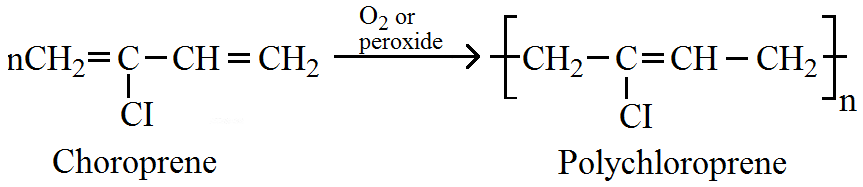
- Polychloroprene is a polymer of chloroprene and it is synthetic rubber.
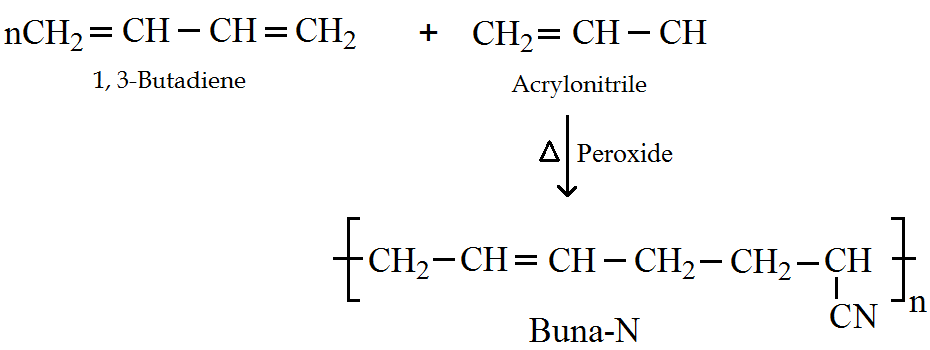
- Buna$-N$ is a synthetic rubber made from the polymerisation of $1, 3-$butadiene acrylonitrile.
View full question & answer→MCQ 1231 Mark
Which polymer among the following does not soften on heating?
AnswerBakelite is a highly cross$-$linked thermosetting polymer. It does not soften on heating because it is heat resistant in nature. Remaining other polymers are thermoplastics which gets soften on heating.
View full question & answer→MCQ 1241 Mark
The monomeric repeating units of nylon $- 6$ is:
AnswerMonomer $($repeating unit$)$ of Nylon $- 6$ is caprolactam.
Monomer $($repeating unit$)$ of Nylon $- 6, 6$ is derived from two monomers, hexamethylenediamine, and adipic acid.
View full question & answer→MCQ 1251 Mark
The polymer used in making handles of cookers and frying pans is:
AnswerThe polymer used in making handles of cookers and frying pans is Bakelite.
It is also used in making switches, combs etc. It is phenol formaldehyde polymer.
View full question & answer→MCQ 1261 Mark
- A
Polymerization of phenol and formaldehyde.
- B
Polymerization of alcohol and acetaldehyde.
- ✓
Condensation of phenol and formaldehyde.
- D
Condensation of phenol and acetaldehyde.
AnswerCorrect option: C. Condensation of phenol and formaldehyde.
Bakelite is a thermosetting phenol formaldehyde resin, formed from a condensation reaction of phenol with formaldehyde.
View full question & answer→MCQ 1271 Mark
Which compound is condensation polymer?
AnswerTeflon is a condensation polymer.
View full question & answer→MCQ 1281 Mark
Rubber is very soft. Therefore, it is vulcanized and used in tires. Vulcanised rubber resists:
- A
- B
- C
- ✓
Wear and tear due to friction
AnswerCorrect option: D. Wear and tear due to friction
Vulcanization is the process by which rubber molecules are cross linked with each other by heating the liquid rubber with sulphur. Crosslinking increases the strength and elasticity of rubber.
It is very elastic such that it can be stretched reversible.
View full question & answer→MCQ 1291 Mark
Woolen clothes are prepared from:
AnswerSheep have soft, woolly coats called a fleece. In the summertime the farmer cuts off the sheep's fleece. The fleece is then spun and made into $\text{WOOL}.$ Clothes made from wool keep us warm.
View full question & answer→MCQ 1301 Mark
Which of the following statements about low density polythene is $\text{FALSE}\ ?$
- A
It is a poor conductor of electricity.
- B
Its synthesis requires dioxygen or a peroxide initiator as a catalyst.
- ✓
It is used in the manufacture of buckets, dust-bins etc.
- D
Its synthesis requires high pressure.
AnswerCorrect option: C. It is used in the manufacture of buckets, dust-bins etc.
Low density polythene is a poor conductor of electricity.
For the preparation of this low density polythene dioxygen or a peroxide initiator is used as a catalyst and its synthesis requires high pressure but it is not used in preparation of buckets, dust$-$bins etc.
The preparation of Low density polythene is exothermic process.
View full question & answer→MCQ 1311 Mark
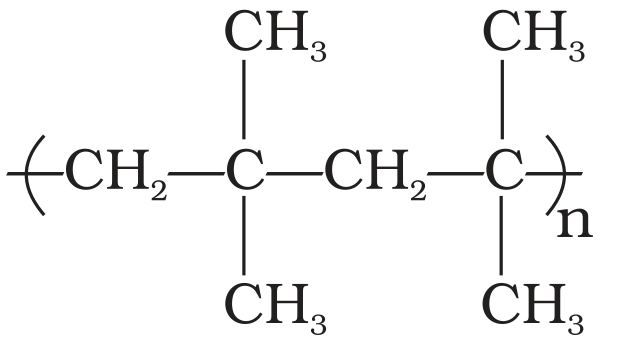
is a polymer having monomer units ____________.
MCQ 1321 Mark
Bakelite is obtained from phenol by reacting with:
- A
$\left(\mathrm{CH}_2 \mathrm{OH}\right)_2$
- B
$\mathrm{CH}_3 \mathrm{CHO}$
- C
$\mathrm{CH}_3 \mathrm{COCH}_3$
- ✓
$\text{HCHO}$
AnswerCorrect option: D. $\text{HCHO}$
Bakelite was the first plastic made from synthetic components.
It is a thermosetting phenol formaldehyde resin, formed from a condensation reaction of phenol $\left(\mathrm{C}_6 \mathrm{H}_5 \mathrm{OH}\right)$ with formaldehyde $\text{(HCHO)}.$
View full question & answer→MCQ 1331 Mark
Acrylonitrile, butadiene and styrene are a kind of:
AnswerCorrect option: B. $Co -$ polymer
$\text{ABS}$ or acrylonitrile, butadiene and styrene are a common thermoplastic polymer formed by copolymerization of these three monomers as shown.

View full question & answer→MCQ 1341 Mark
What is the monomer unit of natural rubber?
AnswerIsoprene $(2-$Methylbuta$-1,3-$diene$)$ is the monomer unit of natural rubber.
View full question & answer→MCQ 1351 Mark
AnswerNylon is an example of Polyamide.
For example, Nylon$-6, 6$ is a copolymer of adipic acid $\left[\mathrm{HOOC}-\left(\mathrm{CH}_2\right)_4-\mathrm{COOH}\right]$ and hexamethylenediamine $\left[\mathrm{H}_2 \mathrm{~N}-\left(\mathrm{CH}_2\right)_6-\mathrm{NH}_2\right]$.
It is a polyamide represented as $\left[-\mathrm{CO}-\left(\mathrm{CH}_2\right)_4-\mathrm{CO}-\mathrm{NH}-\left(\mathrm{CH}_2\right)_6-\mathrm{NH}-\right]_n$.
View full question & answer→MCQ 1361 Mark
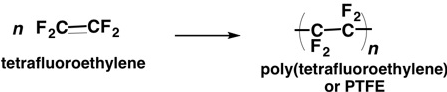
Which of the following is coated as a thin layer on the inner side of non$-$stick pans?
AnswerPolytetrafluoroethylene $\text{(PTFE)}$ or Teflon is used to make non$-$stick cookware. Given image explains the formation of $\text{PTFE}.$
View full question & answer→MCQ 1371 Mark
The process of addition of sulphur to rubber is called $........$
AnswerVulcanization is a chemical process of addition of sulphur.
By this method physical properties of natural rubber are improved. Finished rubber has higher tensile strength and resistance to swelling and abrasion.
View full question & answer→MCQ 1381 Mark
The two monomers used in the preparation of dextron are:
AnswerCorrect option: D. lactic acid and glycolic acid.
Dextron is a polyacetic acid polyglycolic acid polymer. The monomers used are lactic acid and glycolic acid. It is copolymer and has ester linkage. It is used as friction modifier. It is added to lubricants to reduce surface friction.
View full question & answer→MCQ 1391 Mark
Which of the following fibres is made of polyamides?
AnswerNylon is a generic designation for a family of synthetic polymers, based on aliphatic or semi$-$aromatic polyamides.
Nylon is a thermoplastic silky material that can be melt$-$processed into fibers, films, or shapes.
Nylon$−66 \ \&\ $ nylon$−6$ are examples of condensation polymers made of polyamides.
View full question & answer→MCQ 1401 Mark
Which is used in making of thermocol?
- A
- B
- ✓
- D
High density polyethylene
AnswerPolystyrene is used to make disposal plastic such as thermocol.
View full question & answer→MCQ 1411 Mark
Acetaldehyde can be used for making synthetic:
AnswerAcetaldehyde is primarily used as an intermediate in the manufacture of a range of chemicals, perfumes, aniline dyes, plastic and synthetic rubber, etc.
View full question & answer→MCQ 1421 Mark
The most common type of molecular weights used in the case of polymer is:
AnswerCorrect option: A. Number average molecular weight method.
The most common type of molecular weights used in the case of polymers is number average molecular weight method.
It gives the relationship between the number of moles of each polymer species $\left(\mathrm{N}_{\mathrm{i}}\right)$ and the molar mass $\left(\mathrm{M}_{\mathrm{i}}\right)$ of that species as$, \text{M}_\text{n}=\frac{\sum\text{M}_\text{i}\text{N}_\text{i}}{\sum\text{Ni}}.$
View full question & answer→MCQ 1431 Mark
Which one of the following is used to make 'non$-$stick' cookware?
- A
- B
$\text{PVC}$
- C
Polyethylene terephthalate
- ✓
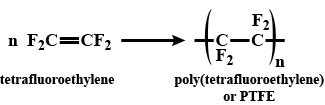
AnswerPolytetrafluoroethylene $\text{(PTFE)}$ or Teflon is used to make non$-$stick cookware.
Above given image explains formation of $\text{PTFE}.$
View full question & answer→MCQ 1441 Mark
Which one of the following polymer is prepared by condensation polymerization?
AnswerCorrect option: B. Nylon$ - 6, 6$
Condensation polymers are formed through a condensation reaction, where molecules join together, losing small molecules as byproducts. For e.g., Nylon$ - 6, 6$ is formed by condensation polymerization of adipic acid and hexamethylenediamine.
Whereas Polystyrene, Teflon and Rubber all are formed by chain$-$growth polymerization of monomers styrene, tetrafluoroethylene and isoprene respectively.
Here, an unsaturated monomer molecule adds to the active site of a growing polymeric chain one at a time.
View full question & answer→MCQ 1451 Mark
Which of the following is a condensation homopolymer?
- ✓
Nylon $- 6$
- B
Nylon $- 6, 6$
- C
Nylon $- 6, 10$
- D
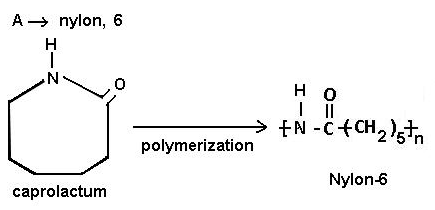
AnswerCorrect option: A. Nylon $- 6$
Condensation homo polymer is the polymer which is formed by only one monomer and get polymerizes by condensation and loss of small compounds such as water, alcohol, etc. whereas all other examples given are examples of $co-$polymer.
View full question & answer→MCQ 1461 Mark
Which type of polymer is the Buna $- S -$ rubber?
AnswerBuna $- S$ Rubber: It is a random $co -$ polymer formed by the emulsion polymerisation of a mixture of $1, 3$ butadiene and styrene in the presence of peroxide catalyst at $5$ degree Celsius and therefore the product is called as cold rubber.
Copolymer is the right answer.
View full question & answer→MCQ 1471 Mark
'Buna$-N$ rubber' is a coploymer of butadiene and acrylonitrile. In comparison to natural rubber it:
- A
- ✓
Has better resistance to wear and tear
- C
Is a poor substitute for natural rubber
- D
Does not last for a long time
AnswerCorrect option: B. Has better resistance to wear and tear
Synthetic rubber is more resistant to acids, oils, heat, aging and has more strength than natural rubber.
View full question & answer→MCQ 1481 Mark
Which of the following is a step $-$ growth polymer?
AnswerStep$-$growth polymerization refers to a type of polymerization mechanism in which $bi-$functional or multifunctional monomers react to form first dimers, then trimers, longer oligomers and eventually long-chain polymers.
For example, Nylon polymerizes by the step$-$growth polymerization process in which difunctional monomers containing equal parts of amine and carboxylic acid react so that amides are formed at both ends of each monomer
Polyacrylonitrile, Polyisoprene and Polythene polymerize by chain$-$growth polymerization of acrylonitrile, isoprene $(2-$methyl$-1, 3-$butadiene$)$ and ethene, respectively.
Chain-growth polymerization $($or addition polymerization$)$ involves the linking together of molecules incorporating double or triple carbon$-$carbon bonds.
View full question & answer→MCQ 1491 Mark
In the process of vulcanization:
- ✓
Natural rubber is heated with sulphur.
- B
Natural rubber is heated with carbon.
- C
Natural rubber is heated with phosphorous.
- D
Natural rubber is heated with sodium.
AnswerCorrect option: A. Natural rubber is heated with sulphur.
Vulcanization is a chemical process by which the physical properties of natural or synthetic rubber are improved. In its simplest form, vulcanization is brought about by heating rubber with sulfur.
View full question & answer→MCQ 1501 Mark
Nylon$-6$ is manufactured from which of the following?
- A
Maleic anhydride and hexamethylene diamine.
- ✓
- C
Adipic acid and hexamethylene diamine.
- D
Sebasic acid and hexamethylene diamine.
AnswerNylon$-6$ is manufactured from the monomer called caprolactum. The monomer caprolactum is heated at $533 K$ in an inert atmosphere, it polymerises to give nylon$-6.$

View full question & answer→MCQ 1511 Mark
$1, 3 -$ butadiene and acrylonitrile undergo $co -$ polymerization to give $.......$
- A
Buna $- S$
- ✓
Buna $- N$
- C
Buna $- A$
- D
AnswerCorrect option: B. Buna $- N$
Buna $- N$ is $co -$ polymer of $1, 3$ butadiene and acrylonitrile.

View full question & answer→MCQ 1521 Mark
Teflon is most commonly used in:
- A
Making water pipes and electrical cable insulation
- B
- ✓
Non $-$ sticky coating
- D
Latex paints and adhesives
AnswerCorrect option: C. Non $-$ sticky coating
Teflon is best known for its use in coating non$-$stick frying $-$ pans and other cookware, as it is hydrophobic and possesses fairly high heat resistance.
View full question & answer→MCQ 1531 Mark
The natural rubber is the polymer of:
AnswerThe monomer of natural rubber is Isoprene. Polyisoprene, a polymer of isoprene $\left(\mathrm{C}_5 \mathrm{H}_8\right)$ that is the primary chemical constituent of natural rubber.
The chemical structure of isoprene can be represented as $\mathrm{CH}_2=\mathrm{C}\left(\mathrm{CH}_3\right)-\mathrm{CH}=\mathrm{CH}_2$.
View full question & answer→MCQ 1541 Mark
Methanal and Phenol react in the presence of base to give:
AnswerBakelite is formed by condensation reaction of phenol with formaldehyde, i.e., methanal.

View full question & answer→MCQ 1551 Mark
Low density polythene is prepared by:
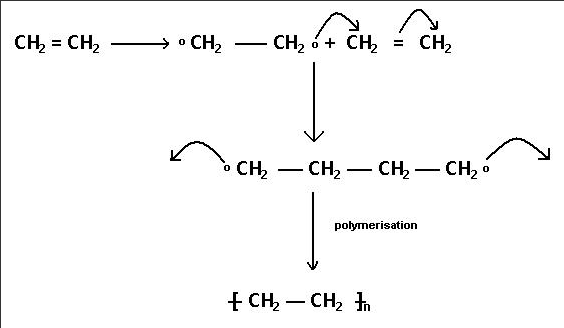
AnswerCorrect option: A. Free radical polymerizaiton.
The polymerization of ethene to polythene consists of heating or exposing to light, a mixture of ethene with a small amount of benzoyl peroxide initiator.
View full question & answer→MCQ 1561 Mark
Which of the following polymer is condensation as well as cross$-$linked polymer?
- ✓
- B
Nylon$-6.6$
- C
Nylon$-2,$Nylon$-6$
- D
AnswerThe structure of cross linked polymer, Bakelite is shown above. It is formed by condensation polymerization of Phenol and formaldehyde monomers.

View full question & answer→MCQ 1571 Mark
The synthetic polymer which resembles natural rubber is:
AnswerNeoprene resembles natural rubber.
Natural rubber is a linear polymer of $2-$methyl$-1, 3-$butadiene called as isoprene and Neoprene is a linear polymer of $2-$chloro$-1, 3-$butadiene called as chloroprene.
View full question & answer→MCQ 1581 Mark
The monomer of Buna$-S$ are:
- ✓
- B
- C
Vinyl chloride and Sulphur
- D
AnswerStyrene and $1,3 -$ Butadiene.
Styrene$-$butadiene or styrene$-$butadiene rubber $\text{(SBR)}$ describe families of synthetic rubbers derived from styrene and butadiene $($the version developed by Goodyear is called Neolite$).$
These materials have good abrasion resistance and good ageing stability when protected by additives.
About $50\%$ of car tires are made from various types of $\text{SBR}.$ The styrene/butadiene ratio influences the properties of the polymer: with high styrene content, the rubbers are harder and less rubbery.
View full question & answer→MCQ 1591 Mark
A high molecular weight molecule built from a large number of small molecules is called a $......$
AnswerA polymer is a large molecule composed of many repeated subunits, known as monomers. Because of their broad range of properties, both synthetic and natural polymers play an essential and ubiquitous role in everyday life.
Polymers range from familiar synthetic plastics such as polystyrene to natural biopolymers such as $\text{DNA}$ and proteins, that are fundamental to biological structure and function.
Polymers, both natural and synthetic, are created via polymerisation of many monomers. Their large molecular mass relative to small molecular compounds produces unique physical properties, including toughness, viscoelasticity and a tendency to form glasses and semicrystalline structures rather than crystals.
View full question & answer→MCQ 1601 Mark
Which of the following monomers form biodegradable polymers?
$a. 3-$hydroxybutanoic acid $+ 3-$hydroxypentanoic acid.
$b.$ Glycine $+$ amino caproic acid.
$c.$ Ethylene glycol $+$ phthalic acid.
$d.$ Caprolactum.
- ✓
$a$ and $b$
- B
$a$ and $c$
- C
$b$ and $c$
- D
$b$ and $d$
AnswerCorrect option: A. $a$ and $b$
Poly$-\beta-$hydroxybutyrate $co-\beta-$hydroxy valerate $\text{(PHBV)}$ It is obtained by the copolymerisation of $3$ hydroxybutanoic acid and $3-$hydroxypentanoic acid$. \text{PHBV}$ is used in speciality packaging orthopaedic devices and in controlled release of drugs$. \text{PHBV}$ undergoes bacterial degradation in the environment.
Nylon$-2-$nylon $6:$ It is an alternating polyamide copolymer of glycine $\left(\mathrm{H}_2 \mathrm{N}-\mathrm{CH}_2-\mathrm{COOH}\right)$ and amino caproic acid $\left[\mathrm{H}_2 \mathrm{N}\left(\mathrm{CH}_2\right)_5 \mathrm{COOH}\right]$ and is biodegradable.
View full question & answer→MCQ 1611 Mark
Which of the following is not a semisynthetic polymer?
AnswerCorrect option: A. Cis$-$polyisoprene.
Cis$-$polyisoprene is not a semisynthetic polymer whereas other is semisynthetic polymers.
View full question & answer→MCQ 1621 Mark
Which of the following polymers can have strong intermolecular forces?
$A.$ Nylon.
$B.$ Polystyrene.
$C.$ Rubber.
$D.$ Polyesters.
- A
$A$ and $B$
- B
$A$ and $C$
- C
$B$ and $C$
- ✓
$A$ and $D$
AnswerCorrect option: D. $A$ and $D$
Polyamides: These polymers possessing amide linkages are important examples of synthetic fibres and are termed as nylons.
Polyesters: These are the polycondensation products of dicarboxylic acids and diols. Dacron or terylene is the best$-$known example of polyesters.
View full question & answer→MCQ 1631 Mark
Which one of the following statements is wrong?
- A
The repeating monomer units in bakelite are phenol and formaldehyde.
- B
Low density polythene is an example of branched chain polymers.
- C
Homopolymer contains a single type of monomer.
- ✓
Vulcanizatoin is the process of heating natural rubber with carbon.
AnswerCorrect option: D. Vulcanizatoin is the process of heating natural rubber with carbon.
Vulcanization is the of heating natural rubber with sulphur in order to develop some specific qualities such as abrasion resistance, heat resistance and elasticity.
Hence, it is an incorrect statement.
View full question & answer→