Questions

2 Marks Questions

Take a timed test

27 questions · self-marked practice — reveal the answer and mark yourself.

Question 22 Marks
Calculate the mole fraction of gas $A$ is the soltuion made an mixing 0.5 moles of gas $A$ and 4.5 moles of gas B.
View full question & answer
Question 32 Marks
Define osmosis. Write the name of the method used in desalination of sea-water.
Answer
Osmosis: When a solvent and a solution formed by dissolving a solute in it are separated by a semi- permeable membrane, then in this situation, the spontaneous movement (flow) of the solvent towards the solution through the semi-permeable membrane is called osmosis or when two solutions of different concentration are sparated by a semipermeable membrane, then the spontaneous movement of solvent from lower concentration to higher concentration of solution is called osmosis. The method used to desaline the sea-water is reverse osmosis.
View full question & answer
Question 42 Marks
1.25 g of protein is present in 300 mL aqueous solution of a protein. The osmotic pressure of this solution at 300 K was found to be $2.50 \times 10^{-3}$ bar. Calculate the molar mass of protein. $[R=0.083 L$ bar $\operatorname{mol}^{-1} K^{-1}$ ].
View full question & answer
Question 52 Marks
(i) What are anti-freezing agents?
(ii) What is called de-icing agent?
Answer
(i) The substance which when mixed with water reduces its freezing point is called anti-freezing.Example : Ethylene glycol
.(ii) The substance which reduces the freezing point of water and which when poured on ice melt it quickly, is called de-icing agent. For example : $NaCl , CaCl _2$ etc.
View full question & answer
Question 62 Marks
For any solvent, the molal gradient constants value is certain. Why?
Answer
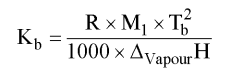
The molal elevation constant is calculated from the following formula :
Image
All the value present in this formula, R (gas constant or solution constant), $M _1$ (Molar mass of solvent, $T _{ b }$ (boiling point of solvent) and $\Delta_{\text {vaporisation }} H$ (enthalpy of vaporisation) of solvent are fixed, hence molar elevation constant $\left( K _{ b }\right)$ is also fixed.
View full question & answer
Question 72 Marks
Food cooks quickly in pressure cooker but slowly in mountains. Explain it.
Answer
The boiling point of every liquid is fixed and on increasing the pressure, the boiling point increases, Due to high pressure in a pressure cooker, the boiling point of water increases, hence it boils at a higher temperature, due to which food receives more heat, hence cooked quickly whereas the atmospheric pressure is less on mountains, due to which boiling point also reduces. Therefore, food get boiled quickly but food receives less heat due to which it cooks slowly.
View full question & answer
Question 82 Marks
Why is it more important to take $\ce{CaCl2}$ instead of $\ce{NaCl}$ to remove snow accumulated on roads?
Answer
Both $\ce{NaCl}$ and $\ce{CaCl2}$ acts as anti$-$freezing agents because mixing them reduces the freezing point of water. But freezing point depression is a particle number property which depends on the number of particles.
By inonization of $\ce{CaCl2}$, ice melts more rapidly due to greater decrease in freezing point, the time of freezing of ice increases.
View full question & answer
Question 92 Marks
Why does ethylene glycol is mixed with water to be used in car radiator during winter season?
Answer
In winter season, water alone cannot be used to cool the car engine because water freezes at 0°C (273K) whereas the freezing point of 35% (V/V) aqueous solution of ethylene glycol is 17.6°C, hence it does not freeze even at low temperatures, hence, is used as a coolant. Here, ethylene glycol acts as an anti-freezing agent. That is the reason for which ethylene glycol is added in water to be used in car radiator in winter season.
View full question & answer
Question 102 Marks
The molar mass of a volatile substance cannot be determined from boiling point elevation. Why?
Answer
Boiling point elevation methods are suitable for only non-volatile substances because when a volatile substance is added to a solution and heated, then the volatile substance comes out as a vapour due to which there will be no elevation in boiling point, hence molar mass of volatile substance cannot be determined by this method.
View full question & answer
Question 112 Marks
The melting point and boiling point of a substance provides a very information about impurities present in a substance. Explain this statement.
Answer
In pure state, the melting and boiling point of a substance is fixed. When non-volatile impurities are found in it, the boiling point increases and melting point decreases, as the amount of impurity increases, these values also change in the same proportion, hence information about the impurities present in a substance is obtained from melting and boiling point.
View full question & answer
Question 122 Marks
When fresh grapes are kept in concentrated salt solution they shrink, whereas when they are kept back in water they swell up. Why?
Answer
Due to post-osmosis, the solvent moves from the solution of lower concentration to a solution of higher concentration, the grapes cell membrane here acts as semipermeable membrane, when grapes are kept in concentrated solution of salt, water comes out of the grapes and they shrink and after putting them back in water, they swell up and becomes fresh again.
View full question & answer
Question 132 Marks
Explain the limitations of Raoult's law.
Answer
(i) This law applies only to dilute solutions.
(ii) This law does not get applied to the solution of electrolytes.
(iii) Raoult's law does not apply even when there is condensation or dissociation of substances in solution.
View full question & answer
Question 142 Marks
The mixture of ethyl alcohol and cyclohexane shows positive deviation from Raoult's law. Why?
Answer
Van der Waals force is found between the molecules of cyclohexane and hydrogen bond is found between ethyl alcohol molecule (ethanol), but when ethanol and cyclohexane are mixed the hydrogen bond present between the molecules of ethanol are broken i.e. A-B attraction, is less than the A-A and B-B attraction, hence molecules moves farther apart and is an example of positive deviation.
View full question & answer
Question 152 Marks
A solution is obtained by mixing 300 g of 25% solution and 400 g of 40% solution by mass. Calculate the mass percentage of the resulting solution.
Answer
Weight of solute in 25% (w/w), 300 g solution = (25 × 3) = 75 g
Weight of solute in 40% (w/w), 400 g solution = (40 x 4) = 160 g 
On mixing, total weight of solute = 75 + 160 = 235 g
And, Total weight of solution = 300 + 400 = 700 g
Hence, Mass of solute in the mixture % 
$\qquad\qquad\qquad$$\begin{array}{l}=\frac{\text { Weight of solute }}{\text { Weight of solution }} \times 100 \\ =\frac{235}{700} \times 100\end{array}$
Therefore, Mass percent concentration of mixture = 33.5%
View full question & answer
Question 162 Marks
Define the term : Mass percentage.
Answer
Mass percentage : The number of weight parts of a solute which is present in 100 weight parts of the solution is called mass percentage.
Mass % of any component in the solution 
$=\frac{\text { Mass of the component present in the solution }}{\text { Total mass of the solution }} \times 100$
View full question & answer
Question 172 Marks
Define the term : Mole fraction
Answer
Mole fraction (x) : The mole fraction of an element present in a mixture is the ratio of the mole of that element to the total moles of all the elements present in the mixture.
Mole fraction of any component in the mixture 
$=\frac{\text { Number of moles of the component }}{\text { Total number of moles of all the component }}$
View full question & answer
Question 182 Marks
The depression in freezing point of water observed for the same amount of acetic acid, trichloroacetic acid and trifluoroacetic acid increases in the order given above. Explain briefly.
Answer
Freezing point depression is a molecular property, ie, as the number of particles increases, the freezing point depression also increases. The sequence acetic acid (CH3COOH), trichloroacetic acid (CCl3COOH) and trifluoroacetic acid (CF3COOH) is the increasing order of acidic properties, that is, they are in also increasing order of dissociation, hence the number of particles will increase. Therefore, the above sequence is the increasing sequence of depression in freezing point.
View full question & answer
Question 192 Marks
Calculate the amount of benzoic acid (C6H5COOH) required for preparing 250 mL of 0.15 M solution in methanol.
Answer
Molarity (M) 
$=\frac{\text { Mass of solute }( g ) \times 1000}{\text { Molar mass of solute } \times \text { Volume of solvent }( mL )}$
Mass of solute = ?
Molar mass of benozic acid (C6H5COOH)
$=(6 \times 12)+5+12+16+16+1=122$
$M=0.15$
Therefore, $0.15=\frac{\text { Mass of solute } \times 1000}{122 \times 250}$
Mass of solute $=\frac{0.15 \times 122 \times 250}{1000}$
Mass of solute $=4.575 g$
View full question & answer
Question 202 Marks
Calculate the mass percentage of aspirin (C9H8O4) in acetonitrile (CH3CN) when 6.5 g of C9H8O4 is dissolved in 450 g of CH3CN.
Answer
Weight percentage
$=\frac{\text { Mass of component in the solution }}{\text { Total mass of the solution }} \times 100$
Weight of component (aspirin) = 6.5 g
Weight of solvent = 450 g
Total mass of solution = 450 + 6.5 g
= 456.5 g
Hence weight % of aspirin = $\frac{6.5}{456.5} \times 100$
$\begin{array}{l}= 1.4238 \\ = 1.424 \%\end{array}$
View full question & answer
Question 212 Marks
If the solubility product of CuS is 6 x 10-16, calculate the maximum molarity of CuS in aqueous solution.
Answer
Solubility coefficient of $CuS \left( k _{ sp }\right)=\left[ Cu ^{2+}\right]\left[ S ^{2-}\right]$
Maximum molarity of CuS = Solubility of CuS
$k _{ sp }$ of $CuS =6 \times 10^{-16}$
and $\quad k _{ sp } = S ^2 $
$S = mol L ^{-1} \text { solubility } $
$S =\left( k _{ sp }\right)^{1 / 2}=\left(6 \times 10^{-16}\right)^{1 / 2} $
$S =2.45 \times 10^{-8} M $
Therefore, in aqueous solution, maximum solubity of CuS
= 2.45 x 10⁻⁸ M
View full question & answer
Question 222 Marks
Amongst the following compounds, identify which are insoluble, partially soluble and highly soluble in water?
(i) phenol $\quad$(ii) toluene $\quad$(iii) formic acid
(iv) ethylene glycol $\quad$(v) chloroform $\quad$(vi) pentanol.
Answer
Water is a polar solvent in which hydrogen bond is found between molecules.
(a) (ii) Toluene and (v) chloroform are insoluble in water because these are covalent compounds, hence they do not form hydrogen bond with water.
(b) (i) Phenol and (vi) Pentanol are partially soluble in water because these compounds have polarity but their non-polar part is large, hence they form very weak hydrogen bond with water.
(c) (iii) Formic acid and (iv) Ethylene glycol are highly soluble in water in large doses because they form strong bonds of hydrogen with water.
View full question & answer
Question 232 Marks
The vapour pressure of water is 12.3 kPa at 300 K. Calculate vapour pressure of 1 molal solution of a non-volatile solute in it.
Answer
Vapour pressure of pure water
$p_1^0\left( H _2 O \right)=12.3 kPa$
Since, there is 1 molal solution, hence
Moles of solute (n2) = 1 mol
Moles of solvent $\left( H _2 O \right)\left(n_1\right)=\frac{1000}{18}=55.5$
Mole fraction of water $\left(x_1\right)=\frac{55.5}{55.5+1}=0.982$
Vapour pressure of solution $\left(p_1\right)=x_1 \times p_1^0$
$\qquad\qquad\qquad$$ p_1 =0.982 \times 12.3 =12.08$ $kPa $
Hence, vapour pressure of solution = 12.08 kPa
View full question & answer
Question 242 Marks
What is meant by positive and negative deviations from Raoult's law and how is the sign of $\Delta_{\text {mix }} H$ related to positive and negative deviations from Raoult's law?
Answer
When a solution does not follow Raoult's law at all concentrations then it is called non-ideal solution. The vapour pressure of these solutions is either higher or lower than the vapour pressure calculated by Raoult's law. If it is more than it shows positive deviation from Raoult's law and if it is less than, it shows negative deviation.
For positive deviation,$\Delta H _{\text {mix. }}=+ ve$
$\qquad\qquad\qquad\qquad$$\Delta V _{\text {mix. }}=+ ve$
And for negative deviation $\Delta H _{\text {mix. }}=- ve$
$\qquad\qquad\qquad\qquad\qquad$$\Delta V _{\text {mix. }}=- ve$
View full question & answer
Question 252 Marks
The partial pressure of ethane over a solution containing $6.56 \times 10^{-3} g$ of ethane is 1 bar. If the solution contains $5.00 \times 10^{-2} g$ of ethane, then what shall be the partial pressure of the gas?
Answer
According to Henry's law $=p= K _H x$
The mole fraction of a gas is proportional to its mass (m), hence $\quad m \propto x$
Alternative form of Henry's law
$\quad\quad m= K _{ H } p$
In the first state : $K _{ H }=\frac{m}{p}=\frac{6.56 \times 10^{-3}(g)}{ 1 ( bar )}$
$\qquad\qquad\qquad$$=6.56 \times 10^{-3} g$ $bar ^{-1}$
In the second state : $p=\frac{m}{K_{ H }}=\frac{5.0 \times 10^{-2}(g)}{6.56 \times 10^{-3}\left(g bar ^{-1}\right)}$
$\qquad\qquad\qquad$$=7.62$ $bar$
Therefore, partial pressure of ethane = 7.62 bar.
View full question & answer
Question 262 Marks
Why do gases always tend to be less soluble in liquids as the temperature is raised?
Answer
On increasing the temperature, the solubility of gases in liquids decreases because when dissolved, the molecules of gases dissolve in the liquid phase and are present in it, hence it is similiar to condensation reaction and in this process, heat is emitted (exothermic process). Solubility of gases in liquid is in dynamic equilibrium hence according to Le Chatelier's law, as the temperature increases, the solubility will decrease, that is, the equilibrium will move in reverse direction.
View full question & answer
Question 272 Marks
What role does the molecular interaction play in a solution of alcohol and water?
Answer
The solution of alcohol and water shows positive deviation because both alcohol and water have intermolecular hydrogen bonds. But when both are mixed, the hydrogen bond formed between alcohol and water is weaker than the hydrogen bond of pure water. Therefore, for this solution $\Delta H _{\text {(mixture) }}=+ ve$ and $\Delta V _{\text {(mixture) }}=+ ve$.
The vapour pressure of the mixture will be higher and the boiling point will be lower. Therefore, this is an example of positive deviation from Raoult's law.
View full question & answer