Questions

3 Marks Question

Take a timed test

13 questions · self-marked practice — reveal the answer and mark yourself.
Question 23 Marks
A special thermometer (Beckmann thermometer) is used to determine molecular weight by freezing point depression method instead of ordinary thermometer. Why?
Answer
The freezing point depression occurs when a solute is added to a solvent is of a very small amount that cannot be measured by an ordinary thermometer because its minimum measurement is more than 0.01°C, whereas Beckmann made a special thermometer for this work which is very sensitive in which the minimum measurement is 0.01°C, due to which even a small amount of feezing point depression can be measured, hence the freezing point depression method, this special thermometer (Beckmann thermometer) is used instead of the ordinary thermometer.
View full question & answer
Question 33 Marks
Explain negative deviation from Raoult's law with an example.
Answer
In case of negative deviation in the mixtures of two liquids A and B, the force of attraction between A-A an B-B is weaker than that between A-B. Due to this vapour pressure decreases.
Example: Mixture of phenol and aniline. In this situation the intermolecular hydrogen bond between the phenolic proton and the lone pair of electron of the nitrogen atom of aniline is stronger than the hydrogen bond between similar molecules.
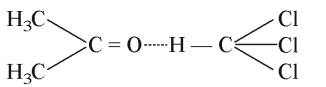
Similarly, the mixture of chloroform and acetone also shows negative deviation from Raoult's law. This is because the chloroform forms hydrogen bond with acetone.
Image
View full question & answer
Question 43 Marks
Explain positive deviation from Raoult's law with an example.
Answer
When the is a positive deviation in the mixture of two liquids A and B, the A-B attraction is weaker than the attraction between A-A and B-B, that is, in this situation the intermolecular force between the solute solvent molecules is less than that of the solute-solute and solvent-solvent molecules. Therefore, form such solutions, molecules of A and B can escape more easily than the pure component, due to whih the vapour pressure increases.
Example: Mixture of pure ethanol and acetone, there are hydrogen bonds between the molecules. When acetone is added to pure ethanol, its molecules comes between the hydrogen bonds of ethanol molecule and breaks them. Due to this intermolecular forces of attraction, this mixture shows positive deviation from Raoult's law.
View full question & answer
Question 53 Marks
A sample of drinking water was found to be severely contaminated with chloroform (CHCl3) supposed to be a carcinogen. The level of contamination was 15 ppm (by mass) :
(i) express this in percent by mass
(ii) determine the molality of chloroform in the water sample.
Answer
(i) 15 ppm CHCl3 means that 106 parts solvent contains 15 parts CHCl3. Hence, Mass of solute = 15 g
Volume of solution = 106g
Mass percent $\%=\frac{\text { Mass of solute }}{\text { Mass of solution }} \times 100$
$\qquad\qquad\qquad$$\begin{array}{l}=\frac{15 \times 100}{10^6}=15 \times 10^{-4} \\ =1.5 \times 10^{-3} \%\end{array}$
(ii) Mass of solvent = Mass of solution - Mass of solute
= 106 - 15 = 999985g
= 9.99985 x 10⁵
Molality of solution (m)
$=\frac{\text { Weight of substance } \times 100}{\text { Molar mass of substance } \times \text { Mass of solvent }( g )}$
Molar mass of CHCl3 = 12 + 1 + (3 × 35.5)
$\qquad\qquad\qquad$= 119.5 g mol-1
Hence,$m=\frac{15(g) \times 1000}{119.5\left(g mol ^{-1}\right) \times 9.99985 \times 10^5 g}$
$\qquad\qquad\qquad$$\begin{array}{l}m=0.0125 \times 10^{-2} \\ m=1.25 \times 10^{-4}\end{array}$
Molality of CHCl3 in water sample = 1.25 × 10⁻⁴ m
View full question & answer
Question 63 Marks
An antifreeze solution is prepared from 222.6 g of thylene glycol (C2H6O2) and 200 g of water. Calculate the molality of the solution. If the density of the solution is $1.072 g mL ^{-1}$ , then what shall be the molarity of the solution?
Answer
(i) Molality (m) $=\frac{\text { Moles of solute }}{\text { Mass of solvent }( kg )}$
Mass of solute ehtylene glycol = 222.6 g
Molar mass of ethylene glycol [(C2H4(OH)2] = 62
Mass of solvent (water) = 200 g = 0.2 kg
Therefore, $m=\frac{222.6}{62 \times 0.2}=17.95$ $mol kg ^{-1}$
(ii) Molarity of solution (M) $=\frac{\text { Moles of solute }}{\text { Volume of solution (L) }}$
Total mass of solution = 200 + 222.6 = 422.6
Hence, Volume of solution $( V )=\frac{\text { Mass }}{\text { Density }}$
$=\frac{422.6}{1.072}=394.22 mL $
$=0.39422 L$
Therefore, $ M=\frac{222.6}{62 \times 0.39422(L)} $
$M=9.107$ $mol L^{-1}$
Therefore, Molarity of solution (M) 9.107 M or mol L-1
View full question & answer
Question 73 Marks
Determine the amount of CaCl2 (i = 2.47) dissolved in 2.5 litre of water such that its osmotic pressure is 0.75 atm at 27°C. 
Answer
Osmotic pressure $(\Pi)=i CRT$
$\Pi=0.75 atm ., \quad i=2.47$
$\begin{array}{l} C =?, R =0.0821 L \text { atm } mol ^{-1} K^{-1} \\ T=27^{\circ} C =27^{\circ} C +273.15=300.15 K\end{array}$
Hence, concentration (C) $=\frac{\Pi}{ iRT }=\frac{0.75}{2.47 \times 0.0821 \times 300.15}$
Concentration of solution, M = C = 0.0123 mol L-1 
Molarity $=\frac{\text { Mass of solute }}{\text { Volue of solution }( L )}$
Moles of solute = Molarity (concentration) × Volume (L)
= 0.0123 x 2.5 L = 0.030
Hence, amount of CaCl2 dissolved in 2.5 litres of water 0.030 mol
View full question & answer
Question 83 Marks
Concentrated nitric acid used in laboratory work is 68% nitric acid by mass in aqueous solution. What should be the molarity of such a sample of the acid if the density of the solution is 1.504 g mL-1?
Answer
68% (mass) of HNO3 means 68 g of HNO3 is present in 100 g of solution.
Hence, Volume of solution $=\frac{\text { Mass }}{\text { Density }}=\frac{100}{1.504}$
$\qquad\qquad\qquad\qquad\qquad$$=66.49 mL$
Molarity (M) $=\frac{\text { Weight of solute }( g ) \times 1000}{\text { Molar mass of solute } \times \text { Volume of solution }( mL )}$
Weight of solute HNO3 = 68 g
Molar mass of solute = 1 + 14 + 48 = 63
Volume of solution = 66.49mL
$\begin{array}{l} M =\frac{68 \times 1000}{63 \times 66.49} \\ M =16.23\end{array}$
Therefore, Molarity of this sample HNO3
= 16.23 M
It can also be determined by the following formula :
Molarity $( m )=\frac{\text { Mass } \% \times \text { Density } \times 10}{\text { Molar mass of solute }}$
View full question & answer
Question 93 Marks
Nalorphene $\left( C _{19} H _{21} NO _3\right)$, similar to morphine, is used to combat withdrawal symptoms in narcotic users. Dose of nalorphene generally given is 1.5 mg. Calculate the mass of $1.5 \times 10^{-3} m$ aqueous solution required for the above dose.
Answer
Molality (m) $=\frac{\text { Mass of solute }( g ) \times 1000}{\text { Molar mass of solute } \times \text { Mass of solvent }( g )}$
Mass of solute = 1.5 mg = 1.5 × 10⁻³ (g)
Molar mass of solute $\left( C _{19} H _{21} NO _3\right)$
$
\begin{aligned}
& =(12 \times 19)+(1 \times 21)+14+(3 \times 16) \\
& =228+21+14+48 \\
& =311 \\
& m =1.5 \times 10^{-3}, \text { Mass of solvent }= ?
\end{aligned}
$
On putting values,
$1.5 \times 10^{-3}=\frac{1.5 \times 10^{-3} \times 1000}{311 \times \text { Mass of solvent }( g )}$
$\begin{aligned} \text { Mass of solvent } & =\frac{1.5 \times 10^{-3} \times 1000}{1.5 \times 10^{-3} \times 311} \\ & =3.215 g\end{aligned}$
$\begin{aligned} \text { Total mass of solution } & =3.25(g)+1.5 \times 10^{-3}(g) \\ & =3.45+0.0015 \\ & =3.2165=3.217 g\end{aligned}$
View full question & answer
Question 103 Marks
Suggest the most important type of intermolecular attractive interaction in the following pairs.
(i) n-hexane and n-octane
(ii) I2 and CCl4
(iii) NaClO4, and water
(iv) methanol and acetone
(v) acetonitrile (CH3CN) and acetone (C3H6O).
Answer
n-hexane and n-octane :
Both of these are non-polar molecules, there is Van der Waals forces between them which is dispersion force or London force. It is also called instantaneous dipole induced dipole attraction force.
(ii) The above mentioned type of force i.e. Van der Waals force is also found between I₂ and CCl4.
(iii) There is ion-dipole attraction force between NaClO4 and H2O because NaClO4, dissociates in to Na+ and ClO4-
(iv) Dipole-dipole attraction force is found between methanol and acetone and there is also some amount of hydrogen bonding between them.
(v) There is also a dipole-dipole attraction force between acetonitrile (CH3CN) and acetone (CH3COCH3).
View full question & answer
Question 113 Marks
At 300 K, 36 g of glucose present in a litre of its solution has an osmotic pressure of 4.98 bar. If the osmotic pressure of the solution is 1.52 bars at the same temperature, what would be its concentration?
Answer
Osmotic pressure $(\Pi)= CRT$
Since, R and T are constant, then
$\Pi \propto C$
Therefore, for two solutions of a substance with different concentrations 
$\frac{\Pi_1}{\Pi_2}=\frac{ C _1}{ C _2}$$\quad \quad \ldots \ldots(1)$
$C_1=\frac{\text { Weight of substance }}{\text { Molar mass } \times \text { Volume of solution }(L)}$
Molar mass of glucose (C6H12O6) = 180
$C_1=\frac{36}{180 \times 1}=0.2 mol L ^{-1}$
Now, $\Pi_1=4.98 bar , \Pi_2=1.52 bar , C _1=0.2 mol L ^{-1}$,C2=?
On putting values in equation (1)
$\begin{aligned} \frac{4.98}{1.52} & =\frac{0.2}{C_2} \\ C_2 & =\frac{1.52 \times 0.2}{4.98}=0.061 mol L ^{-1}\end{aligned}$
Hence, in second situation, concentration of solution 0.061 mol L-1.
View full question & answer
Question 123 Marks
An aqueous solution of 2% non-volatile solute exerts a pressure of 1.004 bar at the normal boiling point of the solvent. What is the molar mass of the solute?
Answer
Vapour pressure of pure water$\left(p_1^0\right)$ =1.013bar
Vapour pressure of solution (P1) = 1.004 bar
Solute is 2% aqueous solution, hence,
w2 = 2 gm and (w1 + w2)= 100 g
SO,
Relative depression in vapour pressure
$=\frac{p_1^0-p_1}{p_1^0}=\frac{n_2}{n_1}$
$\frac{p_1^0-p_1}{p_1^0}=\frac{ W _2 \times M _1}{ M _2 \times W _1}$
M1 = Molar mass of solvent (H2O) = 18
M2 = Molar mass of solute =?
$M _2=\frac{ p _1^0 \times W _2 \times M _1}{\left( p _1^0- p _1\right) \times W _1}$
On putting values,
$ M _2 =\frac{1.013 \times 2 \times 18}{(1.013-1.004) \times 98}=\frac{1.013 \times 2 \times 18}{(0.009) \times 98} $
$= 41.346 = 41.35$ $g mol ^{-1}$
Therefore, molar mass of solute = 41.35 g mol-1
View full question & answer
Question 133 Marks
Define the term solution. How many types of solutions are formed? Write briefly about each type with an example.
Answer
A homogeneous mixture of two or more substances is called solution.
Homogeneous mixture means that all parts of the mixture have the same composition and properties. Depending on the physical state of the solvent, there are mainly three types of solution :
(1) Solid solution
(2) Liquid solution
(3) Gaseous solution
These can be reclassified depending on the physical state of the solute. Therefore, there are actually 9 types of solution which are as follows :
Type of SolutionSoluteSolventCommon Examples
Gaseous SolutionsGasGasMixture of oxygen and nitrogen gases
LiquidGasChloroform mixed with nitrogen gas
SolidGasCamphor in nitrogen gas
Liquid SolutionsGasLiquidOxygen dissolved in water
LiquidLiquid in waterEthanol dissolved
SolidLiquidGlucose dissolved in water
Solid SolutionsGasSolidSolution of hydrogen in palladium
LiquidSolidAmalgam of mercury with sodium
SolidSolidCopper dissolved in gold
View full question & answer