Question
Explain negative deviation from Raoult's law with an example.
Answer

In case of negative deviation in the mixtures of two liquids A and B, the force of attraction between A-A an B-B is weaker than that between A-B. Due to this vapour pressure decreases.
Example: Mixture of phenol and aniline. In this situation the intermolecular hydrogen bond between the phenolic proton and the lone pair of electron of the nitrogen atom of aniline is stronger than the hydrogen bond between similar molecules.
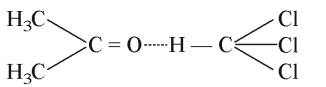
Similarly, the mixture of chloroform and acetone also shows negative deviation from Raoult's law. This is because the chloroform forms hydrogen bond with acetone.
Image

Need a full question paper?

Generate a complete, print-ready paper with questions like this in minutes — across 16+ boards, with answer keys.

Start Generating Free

Similar questions

Explain the nomenclature of phenols by giving examples.
The monoamino monocarboxylic acids have two $\ce{pK_a}$ values.
How do you explain the amphoteric behaviour of amino acids?
Suggest the most important type of intermolecular attractive interaction in the following pairs.
(i) n-hexane and n-octane
(ii) I2 and CCl4
(iii) NaClO4, and water
(iv) methanol and acetone
(v) acetonitrile (CH3CN) and acetone (C3H6O).
Complete the following reactions $:$
  1. $\text{C}_6\text{H}_5-\text{COO}^-\text{NH}^+_4\xrightarrow{\text{ }\text{ }\text{ }\text{ }\text{ }\text{ }\text{ }\text{ }\triangle\text{ }\text{ }\text{ }\text{ }\text{ }\text{ }\text{ }\text{ }\text{ }}\text{A}\xrightarrow{\text{ }\text{ }\text{ }\text{ }\text{Br}_2/\text{KOH}\text{ }\text{ }\text{ }\text{ }}\text{B}\xrightarrow{\text{ }\text{ }\text{ }\text{ }\text{CH}_3\text{COC}l_3/\text{pyridine}\text{ }\text{ }\text{ }\text{ }}\text{C}$
  2. $\text{C}_6\text{H}_5\text{N}^+_2\text{BF}^-_4\xrightarrow[\triangle]{\text{ }\text{ }\text{ }\text{ }\text{ }\text{ }\text{ }\text{ }\text{NaNO}_2/\text{Cu}\text{ }\text{ }\text{ }\text{ }\text{ }\text{ }\text{ }\text{ }\text{ }}\text{A}\xrightarrow{\text{ }\text{ }\text{ }\text{ }\text{Sn}/\text{HC}l\text{ }\text{ }\text{ }\text{ }}\text{B}\xrightarrow[\triangle]{\text{ }\text{ }\text{ }\text{ }\text{CHC}l_3+\text{alc. KOH}\text{ }\text{ }\text{ }\text{ }}\text{C}$
The decomposition of $N _2 O _5$ in $CCl _4$ solution follows the first order rate law. The concentration of $N _2 O _5$ measured at different time intervals are given ahead:
Time $(t) \sec$08016041060011301720
$\left[ N _2 O _2\right] mol /$ litre5.55.04.84.03.42.41.6

Calculate its rate constant at 410 sec and 1130 sec. What does these result show?
  1. Describe the following giving suitable examples:
  2. Give a chemical test to distinguish between ethanal and propanal.
  3. Cannizzaro reaction.
  4. Aldol condensation.
How would you account for the following?
  1. The atomic radii of the metals of the third $(5d)$ series of transition elements are virtually the same as those of the corresponding members of the second $(4d)$ series.
  2. The E^o value for the $\ce{Mn^{3+}/Mn^{2+}}$ couple is much more positive than that for $\ce{Cr^{3+}/Cr^{2+}}$ couple or $\ce{Fe^{3+}/Fe^{2+}}$ couple.
  3. The highest oxidation state of a metal is exhibited in its oxide or fluoride.
Calculate the mass of a non-volatile solute $($molar mass $40\ g\ mol^{–1})$ which should be dissolved in $114 g$ octane to reduce its vapour pressure to $80\%.$
  1. Draw the pyranose structure of glucose.
  2. What type of linkage is present in proteins?
  3. Give one example each for water-soluble vitamins and fat-soluble vitamins.