Question 12 Marks
At absolute zero, an exothermic reaction is always spontaneous but at temperatures above absolute zero, we have to consider both enthalpy and entropy before we can predict spontaneity. Why?
AnswerAs ∆G = ∆H –T∆S
The process is spontaneous when ∆G is –ve. Since T = 0 so T∆S = 0, i.e ∆G = ∆H. For an exhothermic process, ∆H is –ve, therefore at absolute zero ∆G will always be –ve and hence a spontaneous process.
At temp. above absolute zero, ∆S is not zero. It may be +ve or –ve. Hence we have to consider both the ∆H and T∆S for deciding ∆G and the spontaneity.
View full question & answer→Question 22 Marks
- Gas (A) is more soluble in water than Gas (B) at the same temperature. Which one of the two gases will have the higher value of $K_H$ (Henry's constant) and why?
- In non-ideal solution, what type of deviation shows the formation of maximum boiling azeotropes?
Answer
- Gas B, Higher the value of $K_H$ lower is the solubility of gas/$\text{P} = \text{K}_{H}\text{x}$.
- Negative deviation from Raoult’s law.
View full question & answer→Question 32 Marks
- Why are aquatic species more comfortable in cold water than in warm water?
- What happens when we place the blood cell in saline water solution (hypertonic solution)? Give reason.
Answer
- As solubility of gases decreases with increase of temperature, less oxygen is available in summer in the lakes/as cold water contains more oxygen dissolved.
- They will shrink, due to osmosis.
View full question & answer→Question 42 Marks
State the following:
- Raoult's law in its general form in reference to solutions.
- Henry's law about partial pressure of a gas in a mixture.
Answer
- Raoult's law states that for a solution of volatile liquids, the partial vapour pressure of each component in the solution is directly proportional to its mole fraction.
- Henry's law states that at a constant temperature, the solubility of a gas in a liquid is directly proportional to the pressure of the gas over the solution.
View full question & answer→Question 52 Marks
Define the terms, ‘osmosis’ and ‘osmotic pressure’. What is the advantage of using osmotic pressure as compared to other colligative properties for the determination of molar masses of solutes in solutions?
AnswerThe flow of solvent from solution of low concentration to higher concentration through semipermeable membrane is called osmosis. The hydrostatic pressure that has to be applied on the solution to prevent the entry of the solvent into the solution through the semipermeable membrane is called the Osmotic Pressure.
Advantage: Unlike other colligative properties, osmotic pressure is used to determine the Molar mass of macromolecules/polymers like protein.
View full question & answer→Question 62 Marks
Define the term ‘osmotic pressure’. Describe how the molecular mass of a substance can be determined on the basis of osmotic pressure measurement.
AnswerThe extra pressure applied on the solution side that just stops the flow of solvent to solution through semi-permeable membrane is called osmotic pressure of the solution.
Here r is the osmotic pressure and R is the gas constant.
$\pi = (n2/V) RT$
$\pi\text{ V}=\frac{\text{w}_{2}\text{ RT}}{\text{M}_{2}}$
or $\text{ M}_{2}=\frac{\text{w}_{2}\text{ RT}}{\pi\text{ V}}$
Thus knowing the quantities $w_2, T,\eth$ and V we can calculate the molar mass of the solute.
View full question & answer→Question 72 Marks
State Raoult’s law for solutions of volatile liquid components. Taking a suitable example, explain the meaning of positive deviation from Raoult’s law.
AnswerRaoult’s law states that for a solution of volatile liquids, the partial vapour pressure of each component in the solution is directly proprtional to its mole fraction.
When the solute-solvent interaction is weaker than those between the solute-solute and solvent-solvent molecules then solution shows positive deviation from Raoults law hence the partial pressure of each component is greater. ex. mixture of ethanol and acetone or carbondisulphide and acetone behave in this manner.
View full question & answer→Question 82 Marks
What is meant by elevation in boiling point? Why is it a colligative property?
AnswerThe increase in boiling point of the solvent in a solution when a non-volatile solute is added.
Because it depends upon molality/the number of solute particles rather than their nature/$\triangle\text{T}_{\text{b}}\propto\text{m}$
View full question & answer→Question 92 Marks
State Henry’s law. Write its one application. What is the effect of temperature on solubility of gases in liquid?
AnswerHenry’s law states that the mole fraction of gas in the solution is proportional to the partial pressure of the gas over the solution.
Applications: solubility of $\text{CO}_2$ gas in soft drinks/solubility of air diluted with helium in blood used by sea divers or any other.
Solubility of gas in liquid decreases with increase in temperature.
View full question & answer→Question 102 Marks
State Raoult’s law for a solution containing non-volatile solute. What type of deviation from Raoult’s law is shown by a solution of chloroform and acetone and why?
AnswerThe relative lowering of vapour pressure of a solution is equal to the mole fraction of the solute. / The vapour pressure of a solution of a non- volatile solute is equal to the vapour pressure of the pure solvent at that temperature multiplied by its mole fraction.
Negative deviation due to formation of Hydrogen bond between chloroform and acetone.
View full question & answer→Question 112 Marks
Define the following terms:
- Abnormal molar mass.
- van’t Hoff factor (i).
Answer
- If the molar mass calculated by using any of the colligative properties to be different than theoretically expected molar mass
- Extent of dissociation or association or ratio of the observed colligative property to calculated colligative property
View full question & answer→Question 122 Marks
State Raoult's law for the solution containing volatile components. What is the similarity between Raoult's law and Henry's law?
AnswerFor the solution containing volatile components, the partial vapour pressure of each component is directly proportional to its mole fraction. In both cases, p ∝ x/ Henry’s Law is a special case of Raoults Law.
View full question & answer→Question 132 Marks
Define the following terms :
- Ideal solution.
- Molarity $(M).$
Answer
- solution:
The solution which obey Roult's law over entire range of concentration are known as ideal solution.
For ideal solution: Enthalpy of mixing of the pure components to form the solution, $\triangle _{mix}\ H = 0$ and volume of mixing, $\triangle _{mix}\ V = 0$
- Molarity:
It is defined as the number of moles of solute present in $1000$ mL of the solution. Molarity is represented by $M.$
$\text{Molarity (M)}=\frac{\text{Number of moles of solute}}{\text{ volume of solution in mL}}\times1000$
or
$\text{M} = \frac{\text{Weight of solute}}{\text{molar mass of solute}\times \text{Volume of solution in mL}}\times1000$ View full question & answer→Question 142 Marks
Define the following terms:
- Colligative properties.
- Molality (m).
Answer
- Properties that are independent of nature of solute and depend on number of moles of solute only.
- Number of moles of solute dissolved per kg of the solvent.
View full question & answer→Question 152 Marks
What is meant by positive deviations from Raoult's law? Give an example. What is the sign of $\triangle _{mix}H$ for positive deviation?
AnswerWhen vapour pressure of solution is higher than that predicted by Raoult's law/the intermolecular attractive forces between the solute-solvent/(A-B) molecules are weaker than those between the solute-solute and solvent-solvent molecules/A-A or B-B molecules.
Eg. ethanol-acetone/ethanol-cyclohexane$/CS_2$-acetone.
View full question & answer→Question 162 Marks
Define azeotropes. What type of azeotrope is formed by positive deviation from Raoult's law? Give an example.
Answer
- Azeotropes are binary mixtures having the same composition in the liquid and vapour phase and boil at a constant temperature.
- Minimum boiling azeotrope.
eg - ethanol+water.
View full question & answer→Question 172 Marks
Define an ideal solution and write one of its characteristics.
AnswerSolutions which obey Raoult’s law over the entire range of concentration:
$\mathrm{A}-\mathrm{A}$ or $\mathrm{B}-\mathrm{B} \sim \mathrm{A}-\mathrm{B}$ interactions.
$\Delta \mathrm{H}_{\text {mix }}=0$
$\Delta \mathrm{~V}_{\text {mix }}=0$
View full question & answer→Question 182 Marks
Calculate the mass of compound $($molar mass $=256 \mathrm{~g} \mathrm{~mol}^{-1} )$ to be dissolved in $75$ g of benzene to lower its freezing point by $0.48\ K\ (K_f= 5.12\ K\ kg\ mol^{-1}).$
Answer$\Delta\text{T}_{f}=\frac{\text{K}_{f}\times\text{w}_{2}\times\text{1000}}{\text{w}_{1}\times\text{M}_{2}}$
$\text{0.48K=5.12Kkgmol}^{-1}\times\frac{\text{W}_{2}}{\text{75}\times{256}}\times1000$
$\text{W}_{2}=\frac{\text{0.48}\times\text{75}\times\text{256}}{\text{5.12}\times\text{1000}}$
$w_2= 1.8g$
View full question & answer→Question 192 Marks
$18g$ of glucose, $C_6H_{12}O_6($Molar Mass$=180g\ mol^{-1})$ is dissolved in $1\ kg$ of water in a sauce pan. At what temperature will this solution boil?
$(K_b$ for water $= 0.52\ K\ kg\ mol^{-1},$ boiling point of pure water $= 373.15\ K).$
Answer$ \Delta \mathrm{T}_{\mathrm{b}}=\mathrm{K}_{\mathrm{b}} \mathrm{~m} . $
$ \mathrm{T}_{\mathrm{b}}-\mathrm{T}_{\mathrm{b}}{ }^0=0.52\ \mathrm{K\ kg}\ \mathrm{~mol}^{-1} \times \frac{18 \mathrm{~g}}{180 \mathrm{gmol}^{-1}} \times \frac{1}{1 \mathrm{~kg}} $
$ \mathrm{~T}_{\mathrm{b}}-373.15 \mathrm{~K}=0.052 \mathrm{~K} .$
$ \mathrm{T}_{\mathrm{b}}=373.202 \mathrm{~K} .$
View full question & answer→Question 202 Marks
A $1.00$ molal aqueous solution of trichloroacetic acid $\left(\mathrm{CCl}_3 \mathrm{COOH}\right)$ is heated to its boiling point. The solution has the boiling point of $100.18{ }^{\circ} \mathrm{C}$. Determine the van't Hoff factor for trichloroacetic acid. $\left(\mathrm{K}_{\mathrm{b}}\right.$ for water $\left.=0.512 \mathrm{~K} \mathrm{~kg} \mathrm{~mol}^{-1}\right)$.
Answer$ \Delta \mathrm{T}_{\mathrm{b}}=\mathrm{i} \mathrm{~K}_{\mathrm{b}} \mathrm{~m}$
$ (100.18-100)^{\circ} \mathrm{C}=\mathrm{i} \times 0.512 \mathrm{~K} \mathrm{~kg} \mathrm{~mol}^{-1} \times 1 \mathrm{~m} $
$ 0.18 \mathrm{~K}=\mathrm{i} \times 0.512 \mathrm{~K} \mathrm{~kg} \mathrm{~mol}^{-1} \times 1 \mathrm{~m} $
$ \mathrm{i}=0.35$
View full question & answer→Question 212 Marks
Define the following terms:
- Mole fraction.
- Isotonic solutions.
- Van't Hoff factor.
- Ideal solution.
Answer
- Mole fraction is the ratio of number of moles of one component to the total number of moles in a mixture.
- Two solutions having same osmotic pressure at a given temperature are called Isotonic Solutions.
- Van’t Hoff factor is expressed as:
$\text{i}=\frac{\text{Normal molar mass}}{\text{abnormal molar mass}}$
- The solution which obeys Raoult’s law under all conditions is known as an ideal solution.
View full question & answer→Question 222 Marks
Non-ideal solutions exhibit either positive or negative deviations from Raoult’s law. What are these deviations and why are they caused? Explain with one example for each type.
AnswerWhen the vapour pressure of a non-ideal solution is either higher or lower than that predicted by Raoult’s law, the solution exhibits deviations. These deviations are caused because of unequal intermolecular attractive forces between solute-solvent molecules and solute-solute or solvent-solvent molecules. Positive deviation eg: Mixture of ethanol and acetone, Carbon-disulphide and acetone. Negative deviation eg: Chloroform and acetone, nitric acid and water.
View full question & answer→Question 232 Marks
Differentiate between molality and molarity of a solution. What is the effect of change in temperature of a solution on its molality and molarity?
AnswerMolality (m) is the number of moles of the solute per kilogram (kg) of the solvent whereas Molarity is the number of moles of solute present in one litre (or one cubic decimeter) of solution.
Molality is independent of temperature whereas Molarity is function of temperature because volume depends on temperature and the mass does not or Molarity decreases with increase in temprature.
View full question & answer→Question 242 Marks
State Henry’s law correlating the pressure of a gas and its solubility in a solvent and mention two applications for the law.
AnswerHenry’s law states that at a constant temperature, the solubility of a gas in a liquid is directly proportional to the pressure of the gas over the solution.
Applications:
- To increase the solubility of $\text{CO}_2$ in soft drinks and soda water, the bottle is sealed under high pressure.
- Scuba divers must cope with high concentrations of dissolved Nitrogen with breathing air at high pressure underwater. To avoid this air is diluted with He.
- At high altitudes the partial pressure of oxygen is less than that at the ground level. Low blood oxygen causes anoxia.
View full question & answer→Question 252 Marks
Calculate the freezing point of a solution containing $60\ g$ of glucose $($Molar mass $=180 \mathrm{~g} \mathrm{~mol}^{-1}$ $)$ in $250\ g$ of water. $\left(K_f\right.$ of water $\left.=1.86 \mathrm{~K} \mathrm{~kg} \mathrm{~mol}^{-1}\right)$
AnswerGiven,
$\mathrm{W}_2=60 \mathrm{~g} $
$ \mathrm{M}_2=180 \mathrm{~g} \mathrm{~mol}^{-1} $
$ \mathrm{~W}_1=250 \mathrm{~g} $
$ \mathrm{~K}_{\mathrm{f}}=1.86 \mathrm{~K} \mathrm{~kg} \mathrm{~mol}^{-1} $
$ \Delta \mathrm{~T}_{\mathrm{f}}=\mathrm{k}_{\mathrm{f}} \times \mathrm{m} $
$ \mathrm{~T}_{\mathrm{f}}^0-\mathrm{T}_{\mathrm{f}}=\frac{\mathrm{K}_{\mathrm{f}} \times \mathrm{w}_2 \times 1000}{\mathrm{M}_2 \times \mathrm{W}_1} $
$ 273-\mathrm{T}_{\mathrm{f}}=\frac{1.86 \times 60 \times 1000}{180 \times 250} $
$ 273.15-\mathrm{T}_{\mathrm{f}}=2.48 $
$ \mathrm{~T}_{\mathrm{f}}=273.15-2.48=270.67 \mathrm{k}$
Hence, the freezing point is $270.67\ K$ or $-2.48^{\circ} \mathrm{C}$.
View full question & answer→Question 262 Marks
State Henry’s law and write its two applications.
AnswerHenry’s law states that “the partial pressure of the gas in vapour phase (p) is proportional to the mole fraction of the gas (x) in the solution”:
- To increase the solubility of $\text{CO}_2$ in soft drinks.
- At high altitudes the partial pressure of oxygen is less than that at the ground level. This leads to low concentrations of oxygen in the blood and tissues of people living at high altitudes or climbers.
- Scuba divers must cope with high concentrations of dissolved gases while breathing air at high pressure underwater. Increased pressure increases the solubility of atmospheric gases in blood.
View full question & answer→Question 272 Marks
For a reaction
$2\text{H}_2\text{O}_2\frac{\text{I}^-}{\text{alkaline medium}}2\text{H}_2\text{O}+\text{O}_2$
the proposed mechanism is as given below:
- $\text{H}_2\text{O}_2+\text{I}^{-}\xrightarrow{\ \ \ \ \ \ \ }\text{H}_2\text{O}+\text{IO}^{-}(\text{slow})$
- $\text{H}_2\text{O}_2+\text{IO}^{-}\xrightarrow{\ \ \ \ \ \ \ }\text{H}_2\text{O}+\text{I}^{-}+\text{O}_2(\text{fast})$
- Write rate law for the reaction.
- Write the overall order of reaction.
- Out of steps (1) and (2), which one is rate determining step?
Answer$2\text{H}_2\text{O}_2\frac{\text{I}^-}{\text{alkaline medium}}2\text{H}_2\text{O}+\text{O}_2$In Some cases, the rate of reaction depends not only on the reactant but may also depend on the substance present as a catalyst. This is also seen in the above reaction. The rate of reaction depends on the slowest step in case of a complex reaction.
- $\text{H}_2\text{O}_{2} +\text{I}^- \xrightarrow{\ \ \text{Slow}\ \ }\text{H}_{2}\text{O} + \text{IO}^-$
- $\text{H}_2\text{O}_{2} +\text{IO} \xrightarrow{\ \ \text{Fast}\ \ }\text{H}_{2}\text{O} + \text{I}^-+\text{O}_2$
- Rate law:
$\text{Rate}=-\frac{1}{2}\frac{\text{d}\big[\text{H}_2\text{O}_2\big]}{\text{dt}}=\text{k}\big[\text{H}_2\text{O}_2\big]\big[\text{I}^-\big]$
- The overall order of reaction:
$\text{Rate}=\text{k}\big[\text{H}_2\text{O}_2\big]\big[\text{I}^-\big]$
$\text{Order}=1+1=2$ View full question & answer→Question 282 Marks
For a $5 \%$ solution of urea $($Molar mass $=60 \mathrm{~g} / \mathrm{mol} ),$ calculate the osmotic pressure at $300 \mathrm{~K} .\left[\mathrm{R}=0.0821 \mathrm{~L} \mathrm{~atm} \mathrm{~K}^{-1} \mathrm{~mol}^{-1}\right]$
Answer$\pi=\text{CRT} ($Volume of solution $= 100mL)$
$\pi=\frac{\text{n}}{\text{v}}\text{RT}$
$\pi=\frac{5}{60}\times\frac{0.0821\times300}{0.1}$
$\pi=20.5\text{atm}.$
View full question & answer→Question 292 Marks
Write two differences between an ideal solution and a non-ideal solution.
Answer
| Ideal |
Non-ideal |
| Obeys Roult’s law at all range of concentration. |
Does not obey. |
| $\Delta_\text{mix}\text{H}=0,\ \Delta_\text{mix}\text{V}=0$ |
$\Delta_\text{mix}\text{H}\neq0,\ \Delta_\text{mix}\text{V}\neq0$ (or any other difference) |
View full question & answer→Question 302 Marks
Visha took two aqueous solutions - one containing 7.5g of urea (Molar mass = 60g/ mol) and the other containing 42.75g of substance Z in 100g of water, respectively. It was observed that both the solutions froze at the same temperature. Calculate the molar mass of Z.
Answer$\triangle\text{T}_\text{f}(\text{urea})=\triangle\text{T}_\text{f}\text{(Z)}$
$\text{kf}\times\frac{\text{w urea}}{\text{Murea}}\times\frac{1000}{\text{w solvent}}$
$=\text{kf}\times\frac{\text{wz}}{\text{Mz}}\times\frac{1000}{\text{w solvent}}$
$=\frac{7.5}{60}\times\frac{1000}{100}=\frac{42.75}{\text{Mz}}\times\frac{1000}{100}$
$\text{Mz}=\frac{42.75\times60}{7.50}=342\text{g/ mol}.$
View full question & answer→Question 312 Marks
State Raoult’s law for a solution containing volatile components. Write two characteristics of the solution which obeys Raoult’s law at all concentrations.
AnswerRault’s law states that for a solution of volatile liquids, the partial pressure of each component is directly proportional to their mole fraction in solution.
Raoult's Law: According to Raoult's law, for a solution of two volatile liquids, the partial vapour pressure of each component of the solution is directly proportional to its mole fraction present in solution.
$\text{P}_1\alpha\text{ x}_1$
$\Rightarrow\text{P}_1=\text{P}^{0}_1\text{x}_1$
$P_1=$ partial pressure of component $1$
$x_1=$ mole fraction of component $1$
$\text{P}^0_1$ pure vapour pressure of component $1$
Ideal solution obeys Raoult's law at all concentrations. The conditions obeyed are,
- $\Delta_{\text{mix}}\text{H}=0$
- $\Delta_{\text{mix}}\text{V}=0$
Two characteristics of ideal solutions:
- They obey rault’s law at all ranges of concentration. I.e. Ptotal $= P_1 + P_2$
- Both $\Delta\text{H}$ and $\Delta\text{V}$ are zero for such solutions.
View full question & answer→Question 322 Marks
For a reaction
$2\text{H}_2\text{O}_2\xrightarrow[\text{alkaline medium}]{\text{I}^-}2\text{H}_2\text{O}+\text{O}_2$
the proposed mechanism is as given below:
- $\text{H}_2\text{O}_2+\text{I}^{-}\xrightarrow{\ \ \ \ \ \ \ }\text{H}_2\text{O}+\text{IO}^{-}(\text{slow})$
- $\text{H}_2\text{O}_2+\text{IO}^{-}\xrightarrow{\ \ \ \ \ \ \ }\text{H}_2\text{O}+\text{I}^{-}+\text{O}_2(\text{fast})$
- Write rate law for the reaction.
- Write the overall order of reaction.
- Out of steps (1) and (2), which one is rate determining step?
Answer$2\text{H}_2\text{O}_2\xrightarrow[\text{alkaline medium}]{\text{I}^-}2\text{H}_2\text{O}+\text{O}_2$In some cases, the rate of reaction depends not only on the reactant but may also depend on the substance present as a catalyst. This is also seen in the above reaction. The rate of reaction depends on the slowest step in case of a complex reaction.
- $\text{H}_2\text{O}_{2} +\text{I}^- \xrightarrow{\ \ \text{Slow}\ \ }\text{H}_{2}\text{O} + \text{IO}^-$
- $\text{H}_2\text{O}_{2} +\text{IO}^- \xrightarrow{\ \ \text{Fast}\ \ }\text{H}_{2}\text{O} + \text{I}^-+\text{O}_2$
- Rate law:
$\text{Rate}=-\frac{1}{2}\frac{\text{d}\big[\text{H}_2\text{O}_2\big]}{\text{dt}}=\text{k}\big[\text{H}_2\text{O}_2\big]\big[\text{I}^-\big]$
- The overall order of reaction:
$\text{Rate}=\text{k}\big[\text{H}_2\text{O}_2\big]\big[\text{I}^-\big]$
$\text{Order}=1+1=2$
- Slowest step is the rate determining step. Hence, step 1 is rate determining step.
View full question & answer→Question 332 Marks
The vapour pressure of water is $12.3$ kPa at $300$ K. Calculate vapour pressure of 1 molal solution of a non-volatile solute in it.
Answer$1$ molar solution of solute means $1$ mole of solute in $1000g$ of the solvent.Molar mass of water $($solvent$) = 18\ g\ mol^{-1}$
$\therefore\ \text{Moles of water}=\frac{1000}{18}=55.5\text{ moles.}$
$\therefore\ \text{Mole fraction of solute}=\frac{1}{1+55.5}=0.0177$
$\text{Now},\ \frac{\text{P}^\circ-\text{P}_{\text{s}}}{\text{P}^\circ}=\text{x}_2$
$\frac{12.3-\text{P}_\text{s}}{12.3}=0.0177$
$\Rightarrow\text{P}_\text{s}=12.08\text{ KPa}$
View full question & answer→Question 342 Marks
Explain the following phenomena with the help of Henry’s law.
Why soda water bottle kept at room temperature fizzes on opening?
AnswerWhen a soda water bottle kept at room temperature is opened to air the partial pressure of $\text{CO}_2$ above the solution decreases suddenly, (as per Henry's law).This results into a decrease in solubility of carbon dioxide, hence $\text{CO}_2$ bubbles come out of the bottle with a fizz.
View full question & answer→Question 352 Marks
Give an example of a material used for making semipermeable membrane for carrying out reverse osmosis.
AnswerMaterial used for making semipermeable membrane for carrying out reverse osmosis is- "a film of cellulose acetate placed over a suitable support."
View full question & answer→Question 362 Marks
At $300\ K, 36\ g$ of glucose present in a litre of its solution has an osmotic pressure of $4.98$ bar. If the osmotic pressure of the solution is $1.52 $ bars at the same temperature, what would be its concentration?
Answer$\pi_1=\text{C}_1\text{RT}\ ....(\text{i})$$\pi_2=\text{C}_2\text{RT}\ ....(\text{ii})$
therefore on dividing the $1$ by $2$ we get
$\frac{\pi_1}{\pi_2}=\frac{\text{C}_1}{\text{C}_2}$
Let us calculate the concentration of the first solution with osmatic pressure $4. 98$bar
mass of glucose $= 36\ g$
molar mass of gulcose $= 180\ g/\ mol$
therefore number of moles of gulcose $= 36/ 180$
$= 0.2$ moles
volume of the solution $= 1\ L$
molarity = No. of moles of glucose/ vol.of solution
molarity $= 0.2/ 1\ L$
$C_1 = 0.2$ moles/ L
$\text{C}_2=\frac{\pi_2\text{C}_1}{\pi_2}$
$\text{C}_2=\frac{1.52\times0.2}{4.98}=0.61\text{ M}$
View full question & answer→Question 372 Marks
What will happen to freezing point of a potassium iodide aqueous solution when mercuric iodide is added to solution?
Answer$\mathrm{Hgl}_2+2 \mathrm{KI} \rightarrow \mathrm{~K}_2 \mathrm{HgI}_4$
Mercuric iodide forms a complex with potassium iodide, therefore, the number of solute particles ( KI ) in the solution decreases resulting in the decrease in the value of $\Delta \mathrm{T}_{\mathrm{f}}$, i.e., depression in the freezing point. As a result, the freezing point $\mathrm{Hgl}_2+2 \mathrm{KI} \rightarrow \mathrm{K}_2 \mathrm{Hgl}_4$ of the solution will increase.
View full question & answer→Question 382 Marks
If the density of some lake water is $1.25 \mathrm{~g} \mathrm{~mL}^{-1}$ and contains 92 g of $\mathrm{Na}^{+}$ions per kg of water, calculate the molality of $\mathrm{Na}^{+}$ions in the lake.
Answernumber of moles present in $92$ g of $\mathrm{Na}^{+}$ion. $=92 / 23 \mathrm{~g} \mathrm{~mol}^{-1}=4 \mathrm{~mol}$
Molality, $\mathrm{m}=\frac{\text { No. of gm moles of solute }}{\text { wt. of solvent in } \mathrm{kg}}$
No. of gm moles of solute $=92 / 23=4$
Wt. of water (solvent) $=1 \mathrm{~kg}$
Molality $=\frac{4}{1}=4 \mathrm{~m}$.
View full question & answer→Question 392 Marks
State Henry’s law and mention some important applications?
AnswerThe effect of pressure on the solubility of a gas in a liquid is governed by Henry's Law. It states that the solubility of a gas in a liquid at a given temperature is directly proportional to the partial pressure of the gas Mathematically, $P = K_HX$ where $P$ is the partial pressure of the gas; and $X$ is the mole fraction of the gas in the solution and $K_H$ is Henry's Law constant.
Applications of Henry's law:
- In the production of carbonated beverages $($as solubility of $C02$ increases at high pressure$).$
- In the deep sea diving.
- For climbers or people living at high altitudes, where low blood $0_2$ causes climbers to become weak and make them unable to think clearly.
View full question & answer→Question 402 Marks
What is "semi permeable membrane"?
AnswerA membrane that permits the flow of solvent molecules not the solute molecules is called semi permeable membrane. During osmosis and reverse osmosis, only solvent molecules move across the semi permeable membrane.
View full question & answer→Question 412 Marks
Calculate the mass of ascorbic acid $\left(\right.$ Vitamin $\left.\mathrm{C}_1 \mathrm{C}_6 \mathrm{H}_8 \mathrm{O}_6\right)$ to be dissolved in $75$ g of acetic acid to lower its melting point by $1.5^{\circ} \mathrm{C} . \mathrm{Kf}=3.9 \mathrm{~K} \mathrm{~kg} \mathrm{~mol}^{-1}$.
Answer$\text{Given:} \ \Delta\text{T}_\text{f}=1.5^\circ$ Mass of $CH_3COOH,\ w_1 = 75\ g\ M_1 = 60g\ mol^{-1}M_2(C_6H_8O_6) = 176\ g\ mol^{-1}$
$K_f = 3.9K\ Kg\ mol^{-1}$
To find: $w_2 = ?$
Solution:
$\text{Applying M}_2=\frac{1000\text{K}_{\text{f}}\text{w}_2}{\text{w}_1\Delta\text{T}_\text{f}}$
$\text{or},\ \ \text{w}_2=\frac{\text{M}_2\times\text{w}_1\times\Delta\text{T}_\text{f}}{1000\times\text{K}_\text{f}}$
$\text{w}_2=\frac{176\times75\times1.5}{1000\times3.9}=5.077\text{g}$
View full question & answer→Question 422 Marks
Why do gases always tend to be less soluble in liquids as the temperature is raised?
AnswerWhen gases are dissolved in water, it is accompanied by a release of heat energy, i.e., process is exothermic. When the temperature is increased, according to Lechatlier's Principle, the equilibrium shifts in backward direction, and thus gases becomes less soluble in liquids.
View full question & answer→Question 432 Marks
Calculate the osmotic pressure in pascals exerted by a solution prepared by dissolving $1.0\ g$ of polymer of molar mass $185,000$ in $450$ mL of water at $37^\circ C.$
AnswerWe have given that, Volume of water, $V = 450ml = 0.450L$ Temperature, $T = (37 + 273)K = 310K$$\pi=?, \text{V}=450\text{ mL}=0.450\text{L},$
$T = 273 + 37 = 310K$ $R = 0.083\ L$ bar $mol^{-1}K^{-1},\ M_2 = 185,000,\ W_2 = 1.0\ g$
$\text{M}_2=\frac{\text{W}_2\text{RT}}{\pi\text{V}}$$185,000=\frac{1.0\times0.083\times310}{\pi\times0.450}$
$\pi=\frac{1.0\times0.083\times310}{185,000\times0.450}$
$=0.0003$ bar.
View full question & answer→Question 442 Marks
Explain the solubility rule “like dissolves like” in terms of intermolecular forces that exist in solutions.
AnswerA substance dissolves in a solvent if the intermolecular interactions are similar in both the components.
For example: Polar solutes dissolve in polar solvents and non-polar solutes in non-polar solvents. Thus, we can say “like dissolves like”.
View full question & answer→Question 452 Marks
Concentrated nitric acid used in laboratory work is $68\%$ nitric acid by mass in aqueous solution. What should be the molarity of such a sample of the acid if the density of the solution is $1.504\ g\ mL^{–1}?$
AnswerConcentrated nitric acid used in laboratory work is $68\%$ nitric acid by mass in an aqueous solution. This means that 68 g of nitric acid is dissolved in 100 g of the solution. Molar mass of nitric acid $(HNO_3) = 1 \times 1 + 1 \times 14 + 3 \times 16 = 63\ g\ mol^{-1}$ Then, number of moles of $\text{HNO}_3=\frac{68}{63}\text{ mol}= 1.079\ mol$
Given,
Density of solution $= 1.504\ g\ mL^{-1}$
Therefore, Volume of $100$ g solution $=\frac{100}{1.504}\text{ mL}$ $= 66.49\ mL = 66.49 \times 10^{-3}\ L$ Molarity of solution $=\frac{1.079\text{ moL}}{66.49\times10^{-3}\text{L}} = 16.23\ M$
View full question & answer→Question 462 Marks
Answer the following question:
Give reasons for the following:
- At higher altitudes, people suffer from a disease called anoxia. In this disease, they become weak and cannot think clearly.
- When mercuric iodide is added to an aqueous solution of KI, the freezing point is raised.
Answer
- At higher altitudes, partial pressure of oxygen is less than that at ground level, so that oxygen concentration becomes less in blood or tissues. Hence, people suffer from anoxia.
- Due to the formation of complex $\mathrm{K}_2\left[\mathrm{HgI}_4\right]$, number of particles in the solution decreases and hence the freezing point is raised.
View full question & answer→Question 472 Marks
Vapour pressure of pure water at $298$ K is $23.8$ mm Hg. $50$ g of urea $(NH_2CONH_2)$ is dissolved in $850$ g of water. Calculate the vapour pressure of water for this solution and its relative lowering.
AnswerVapor pressure of pure water (solvent) at $298\ K, p^0 = 23.8\ mm$
Vapor pressure of solution, $p = ?$
Mass of solvent, $W = 850\ g$
Mass of solute $= 50\ g$
Mol. mass of water $(H_2O),\ M = 18\ g\ mol^{–1}$
Mol. mass of urea $NH_2\ CO\ NH_2$
$= 14 + 2 + 12 + 16 + 14 + 2$
$= 60\ g\ mol^{–1}$
According to Raoult's law,
$=\frac{\text{P}^\circ-\text{P}}{\text{P}^\circ}=\frac{\omega\text{M}}{\text{WM}}$
$\text{P}=\text{P}^\circ-\frac{\omega\text{M}}{\text{Wm}}\times\text{P}^\circ$
$\text{P}=23.8-\frac{50\times18}{60\times850}$
$= 23.8 − 0.017$
$= 23.78$
Hence, $23.78$ mm Hg.
View full question & answer→Question 482 Marks
Calculate the mass percentage of aspirin $\left(\mathrm{C}_9 \mathrm{H}_8 \mathrm{O}_4\right)$ in acetonitrile $\left(\mathrm{CH}_3 \mathrm{CN}\right)$ when 6.5 g of $\mathrm{C}_9 \mathrm{H}_8 \mathrm{O}_4$ is dissolved in 450 g of $\mathrm{CH}_3 \mathrm{CN}$.
AnswerMass of solute = 6.5 g Mass of solution = 450 + 6.5 = 456.6 g$\text{Mass percentage}=\frac{\text{Mass of solute}}{\text{Mass of solution}}\times100$
$=\frac{6.5}{456.5}\times100=\frac{650}{456.5}=1.424\%$
View full question & answer→MCQ 492 Marks
Note: In the following questions a statement of assertion followed by a statement of reason is given. Choose the correct answer out of the following choices.
Assertion: When methyl alcohol is added to water, boiling point of water increases.
Reason: When a volatile solute is added to a volatile solvent elevation in boiling point is observed.
- A
Assertion and reason both are correct statements and reason is correct explanation for assertion.
- B
Assertion and reason both are correct statements but reason is not correct explanation for assertion.
- C
Assertion is correct statement but reason is wrong statement.
- ✓
Assertion and reason both are incorrect statements.
AnswerCorrect option: D. Assertion and reason both are incorrect statements.
- Methyl alcohol $\ \&\ $ water both are volatile liquids which when mixed together to form a binary solution, the vapour pressure of this solution becomes more as compared to individual pure components. This affects the boiling point of water with a decrease.
- When methyl alcohol is added to water $A-B$ interaction $< A-A$ or $B-B$ interaction that is why it will show positive deviation from Raoult’s law. Since a positive deviation from Rault's law indicates a rise in vapour pressure the boiling point decreases.
View full question & answer→Question 502 Marks
Henry’s law constant for the molality of methane in benzene at $298\ K$ is $4.27 \times 10^5\ mm$ Hg. Calculate the solubility of methane in benzene at $298$ K under $760$ mm Hg.
AnswerHere,$p = 760$ mm Hg
$k_H = 4.27 \times 105$ mm Hg
$=$ According to Henry's law,
$P = k_Hx$
$\text{x}=\frac{\text{P}}{\text{k}_\text{H}}$
$=\frac{760\text{ mm Hg}}{4.27\times10^5\text{ mm Hg}}$
$= 177.99 \times 10^{-5}$
$= 178 \times 10^{−5}$ (approximately)
Hence, the mole fraction of methane in benzene is $178 \times 10^{-5}$
View full question & answer→Question 512 Marks
Given alongside is the sketch of a plant for carrying out a process.
- Name the process occurring in the given plant.
- To which container does the net flow of solvent take place?
- Name one SPM which can be used in this plant.
- Give one practical use of the plant.
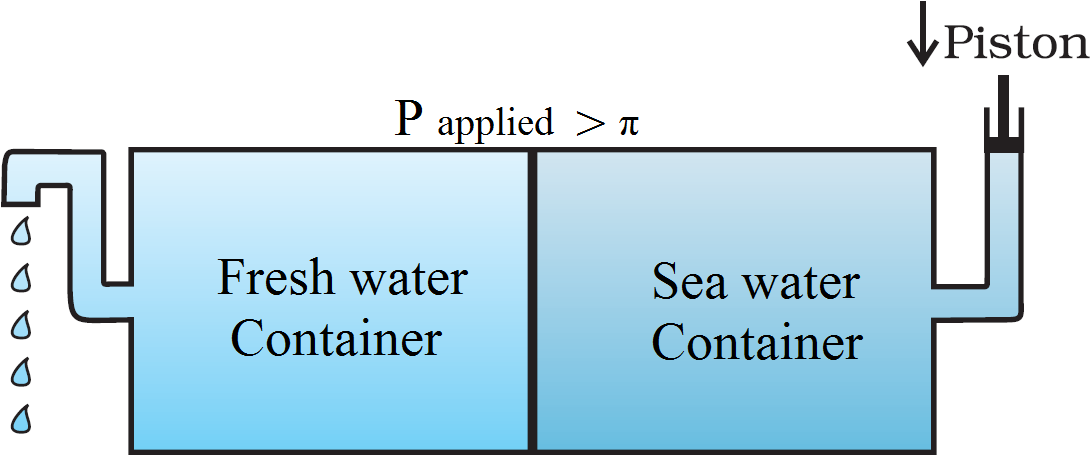
Answer
- Reverse osmosis.
- Fresh water container.
- Cellulose acetate placed on a suitable support.
- Desalination of sea water.
View full question & answer→Question 522 Marks
The depression in freezing point of water observed for the same amount of acetic acid, trichloroacetic acid and trifluoroacetic acid increases in the order given above. Explain briefly.
Answer
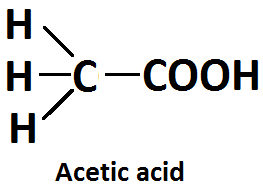
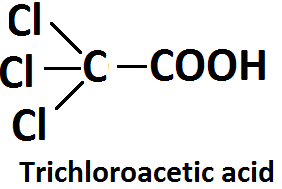
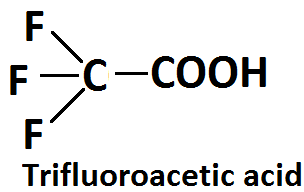
Among H, Cl, and F, H is least electronegative while F is most electronegative. Then, F can withdraw electrons towards itself more than Cl and H. Thus, trifluoroacetic acid can easily lose H + ions i.e., trifluoroacetic acid ionizes to the largest extent. Now, the more ions produced, the greater is the depression of the freezing point. Hence, the depression in the freezing point increases in the order:
Acetic acid < trichloroacetic acid < trifluoroacetic acid.
View full question & answer→Question 532 Marks
After removing the outer shell of two eggs in dil. HCl, one is placed in distilled water and the other in a saturated solution of NaCl. What will you observe and why?
AnswerEgg in water will swell whereas in NaCl solution it will shrink. This is because due to osmosis, the net flow of solvent is from less concentrated to more concentrated solution.
View full question & answer→Question 542 Marks
Calculate the mole fraction of benzene in solution containing $30\%$ by mass in carbon tetrachloride.
Answer$30\% $ by mass of $C_6H_6$ in $CCl_4 => 30 g C_6H_6$ in $100\ g$ solution
$\therefore$ no. of moles of $C_6H_6, (^nC_6H_6) = 30/78 = 0.385$
$($molar mass of $C_6H_6 = 78g)$
no. of moles of,
$\text{CCl}_4 (^\text{n}\text{CCl}_4)=\frac{70}{154}=0.455$
$^\text{x}\text{C}_6\text{H}_6=\frac{^\text{n}\text{C}_6\text{H}_6}{^\text{n}\text{C}_6\text{H}_6+^\text{n}\text{CCl}_4}$
$=\frac{0.385}{0.385+0.455}=\frac{0.385}{0.84}=0.458$
$^\text{x}\text{CCl}_4=1-0.458=0.542$
View full question & answer→Question 552 Marks
If the solubility product of $CuS$ is $6 \times 10^{–16},$ calculate the maximum molarity of $CuS$ in aqueous solution.
AnswerSolubility product of $CuS$, $K_{sp} = 6 x 10^{-16}$ $\text{CuS}\rightleftharpoons\text{Cu}^{2+}+\text{S}^{2-}$ Suppose solubility of $CuS$ is $x\ mol^{-1}$ This would give $x\ mol^{-1}$ of $Cu^{2+}$ ions and $x\ mol\ L^{-1}$ of $S^{2-}$ ions on dissociation. $[Cu^{2+}] = x\ mol^{-1}\ [S^{2-}] = x\ mol^{-1}$ $\text{K}_\text{sp}=[\text{Cu}^{2+}][\text{S}^{2-}]=(\text{x})(\text{x})=\text{x}^2$
$\text{K}_\text{sp}=6\times10^{-16}$
$\therefore\ 6\times10^{-16}=\text{x}^2$
$\text{or}\ \text{ x}=\sqrt{6\times10^{-16}}=2.45\times10^{-8}$
Maximum molarity $= 2.45 x 10^{-8}\ M.$
View full question & answer→Question 562 Marks
Components of a binary mixture of two liquids A and B were being separated by distillation. After some time separation of components stopped and composition of vapour phase became same as that of liquid phase. Both the components started coming in the distillate. Explain why this happened.
AnswerSince both the components are appearing in the distillate and composition of liquid and vapour is same, this shows that liquids have formed azeotropic mixture and hence cannot be separated at this stage by distillation.
View full question & answer→Question 572 Marks
A sample of drinking water was found to be severely contaminated with chloroform $(CHCl_3)$ supposed to be a carcinogen. The level of contamination was $15$ ppm (by mass):
- Express this in percent by mass.
- Determine the molality of chloroform in the water sample.
Answer
- $15$ ppm (by mass) means $15$ parts per million $(106)$ of the solution.
Therefore, percent by mass $=\frac{15}{10^6}\times100\%$
$= 1.5 \times 10^{-3}%$
- Molar mass of chloroform $(CHCl_3) = 1 \times 12 + 1 \times 1 + 3 \times 35.5$
$= 119.5\ g\ mol^{-1}$
Now, according to the question,
$15$ g of chloroform is present in 106 g of the solution.
i.e., $15\ g$ of chloroform is present in $(106 - 15) â‰ED † 106$ g of water.
Therefore, Molality of the solution = $\frac{\frac{15}{119.5}\text{mol}}{10^6\times10^{-3}\text{Kg}}$
$= 1.26 \times 10^{-4}m.$ View full question & answer→Question 582 Marks
A solution is obtained by mixing 300 g of 25% solution and 400 g of 40% solution by mass. Calculate the mass percentage of the resulting solution.
AnswerTotal amount of solute present in the mixture is given by,$300\times\frac{25}{100}+400\times\frac{40}{100}$
= 75 + 160
= 235 g
Total amount of solution = 300 + 400 = 700 g
Therefore, mass percentage (w/w) of the solute in the resulting solution, $=\frac{235}{700}\times100\%$
= 33.57%
And, mass percentage (w/w) of the solvent in the resulting solution,
= (100 - 33.57)%
= 66.43%
View full question & answer→Question 592 Marks
The partial pressure of ethane over a solution containing $6.56 \times 10^{–3}\ g$ of ethane is 1 bar. If the solution contains $5.00 \times 10^{–2}\ g$ of ethane, then what shall be the partial pressure of the gas?
AnswerWe know that, $m = K_H \times P$
$\therefore 6.56 \times 10^{-2}g = K_H \times 1$ bar $.... (i)$
$\therefore 5.00 \times 10^{-2}g = K_H \times P .... (ii)$
$K_H= 6.56 \times 10^{-2}/1$ bar $($from $i)$
$K_H = 5.00 \times 10^{-2}/P$ bar $($from $ii)$
$\therefore\ \frac{6.56\times10^{-2}}{1}=\frac{5.00\times10^{-2}}{\text{P}}$
$\therefore\ \text{P}=\frac{5.00}{6.56}=0.762\text{ bar.}$
View full question & answer→Question 602 Marks
Answer the following question:
Why a person suffering from high blood pressure is advised to take minimum quantity of common salt?
AnswerOsmotic pressure is directly proportional to the concentration of the solutes. Our body fluid contains a number of solutes. On taking large amount of common salt, $\mathrm{Na}^{+}$and $\mathrm{Cl}^{-}$ions enter into the body fluid thereby raising the concentration of the solutes. As a result, osmotic pressure increases which may rupture the blood cells.
View full question & answer→Question 612 Marks
What is meant by positive and negative deviations from Raoult's law and how is the sign of $\triangle _{mix}H$ related to positive and negative deviations from Raoult's law?
AnswerSolutions having vapour pressures more than that expected from Raoult's law are said to exhibit positive deviation. In these solutions solvent-solute interactions are weaker and $\Delta_{\text{Sol}}\text{H}$ is positive because stronger $A - A$ or $B - B$ interactions are replaced by weaker $A - B$ interactions. Breaking of the stronger interactions requires more energy & less energy is released on formation of weaker interactions. So overall $\Delta_{\text{Sol}}\text{H}$ is positive. Similarly $\Delta_{\text{Sol}}\text{V}$ is positive i.e. the volume of solution is some what more than sum of volumes of solvent and solute.
So there is expansion in volume on solution formation. Similarly in case of solutions exhibiting negative deviations, $A - B$ interactions are stronger than $A - A\ \&\ B - B.$ So weaker interactions are replaced by stronger interactions so, there is release of energy i.e. $\Delta_{\text{Sol}}\text{H}$ is negative.
View full question & answer→