Questions

5 Marks Questions

Take a timed test

8 questions · self-marked practice — reveal the answer and mark yourself.

Question 15 Marks
Method of formation of solution is given in Column I. Match it with the type of solution given in Column II.
  Column I   Column II
(i) Sulphur vapours passed through cold water. (a) Normal electrolyte solution.
(ii) Soap mixed with water above critical micelle concentration. (b) Molecular colloids.
(iii) White of egg whipped with water. (c) Associated colloid.
(iv) Soap mixed with water below critical micelle concentration. (d) Macro molecular colloids.
Answer
  Column I   Column II
(i) Sulphur vapours passed through cold water. (b) Molecular colloids.
(ii) Soap mixed with water above critical micelle concentration. (c) Associated colloid.
(iii) White of egg whipped with water. (d) Macro molecular colloids.
(iv) Soap mixed with water below critical micelle concentration. (a) Normal electrolyte solution.
Explanation:
  1. By passing vapours of Sulphur through cold water sulphur sol can be prepared which is a molecular colloid.
  2. When soap is mixed with water above critical micelle concentration forms associated colloid.
  3. White of egg whipped with water forms macromolecular colloid.
  4. Soap mixed with water below critical micelle concentration behave as normal electrolyte.
View full question & answer
Question 25 Marks
Match the items of Column I and Column II.
  Column I   Column II
(i) Butter. (a) Dispersion of liquid in liquid.
(ii) Pumice stone. (b) Dispersion of solid in liquid.
(iii) Milk. (c) Dispersion of gas in solid.
(iv) Paints. (d) Dispersion of liquid in solid.
Answer
  Column I   Column II
(i) Butter. (d) Dispersion of liquid in solid.
(ii) Pumice stone. (c) Dispersion of gas in solid.
(iii) Milk. (a) Dispersion of liquid in liquid.
(iv) Paints. (b) Dispersion of solid in liquid.
Explanation:
  1. Butter is an example of dispersion of liquid in solid.
  2. Pumice stone is an example of dispersion of gas in solid in which gas bubbles are pierced within solid particles.
  3. Milk is a dispersion of liquid in which fats and protein are dissolved in milk.
  4. Paint is an example of solid in liquid.
View full question & answer
Question 35 Marks
Match the items given in Column $I$ and Column $II.$
  Column $I$   Column $II$
$(i)$ Protective colloid. $(a)$ $FeCl_3 + NaOH.$
$(ii)$ Liquid - liquid colloid. $(b)$ Lyophilic colloids.
$(iii)$ Positively charged colloid. $(c)$ Emulsion.
$(iv)$ Negatively charged colloid. $(d)$ $FeCl_3 +$ hot water.
Answer
  Column $I$   Column $II$
$(i)$ Protective colloid. $(b)$ Lyophilic colloids.
$(ii)$ Liquid - liquid colloid. $(c)$ Emulsion.
$(iii)$ Positively charged colloid. $(d)$ $FeCl_3 +$ hot water.
$(iv)$ Negatively charged colloid. $(a)$ $FeCl_3 + NaOH.$
Explanation:
  1. Lyophilic colloids have a unique property of protecting lyophobic colloids. When a lyophilic sol is added to the lyophobic sol, the lyophilic particles form a layer around lyophobic particles and thus protect colloid.
  2. If a mixture of two immiscible or partially miscible liquids is shaken, a coarse dispersion of one liquid in the other is obtained which is called emulsion.
  3. If $FeCl_3$ is added to excess of hot water, a positively charged sol of hydrated ferric oxide is formed due to adsorption of $Fe^{3+}$ ions.
  4. When ferric chloride is added to $NaOH$ a negatively charged sol is obtained with adsorption of $OH^-$ ions.
View full question & answer
Question 45 Marks
Match the statement given in Column I with the phenomenon given in Column II.
  Column I   Column II
(i) Dispersion medium moves in an electric field. (a) Osmosis.
(ii) Solvent molecules pass through semi permeable membrane towards solvent side. (b) Electrophoresis.
(iii) Movement of charged colloidal particles under the influence of applied electric potential towards oppositely charged electrodes. (c) Electroosmosis.
(iv) Solvent molecules pass through semi permeable membranes towards solution side. (d) Reverse osmosis.
Answer
  Column I   Column II
(i) Dispersion medium moves in an electric field. (c) Electroosmosis.
(ii) Solvent molecules pass through semi permeable membrane towards solvent side. (d) Reverse osmosis.
(iii) Movement of charged colloidal particles under the influence of applied electric potential towards oppositely charged electrodes. (b) Electrophoresis.
(iv) Solvent molecules pass through semi permeable membranes towards solution side. (a) Osmosis.
Explanation:
  1. Dispersion medium moves in an electric field is known as electroosmosis.
  2. Solvent molecules pass through semipermeable membrane towards
  3. solvent side is known as reverse osmosis.
  4. Movement of charged colloidal particles under the influence of applied electric potential towards oppositely charge electrodes is known as electrophoresis.
  5. Solvent molecules pass through semipermeable membranes towards solution side is known as osmosis.
View full question & answer
Question 55 Marks
Match the types of colloidal systems given in Column I with the name given in Column II.
  Column I   Column II
(i) Solid in liquid. (a) Foam.
(ii) Liquid in solid. (b) Sol.
(iii) Liquid in liquid. (c) Gel.
(iv) Gas in liquid. (d) Emulsion.
Answer
  Column I   Column II
(i) Solid in liquid. (b) Sol.
(ii) Liquid in solid. (c) Gel.
(iii) Liquid in liquid. (d) Emulsion.
(iv) Gas in liquid. (a) Foam.
Explanation:

Colloids are classified on the basis of types of dispersed phase and dispersion medium.
  Dispersed phase Dispersion medium Name
(i) Solid Liquid Sol
(ii) Liquid Solid Gal
(iii) Liquid Liquid Emulsion
(iv) Gas Liquid Foam
View full question & answer
Question 65 Marks
Match the items of Column I and Column II.
  Column I   Column II
(i) Dialysis. (a) Cleansing action of soap.
(ii) Peptisation. (b) Coagulation.
(iii) Emulsification. (c) Colloidal sol formation.
(iv) Electrophoresis. (d) Purification.
Answer
  Column I   Column II
(i) Dialysis. (d) Purification.
(ii) Peptisation. (c) Colloidal sol formation.
(iii) Emulsification. (a) Cleansing action of soap.
(iv) Electrophoresis. (b) Coagulation.
Explanation:
  1. Dialysis: Process used for the purification of colloid.
  2. Peptisation: Peptisation may be defined as the process of converting a precipitate into colloidal sol by shaking it with dispersion medium in the presence of small amount of electrolyte.
  3. Emulsification: Process of cleansing of oil and dirt from soap by emulsification.
  4. Electrophoresis: The movement of colloidal particles under an applied electric potential is called electrophoresis.
View full question & answer
Question 75 Marks
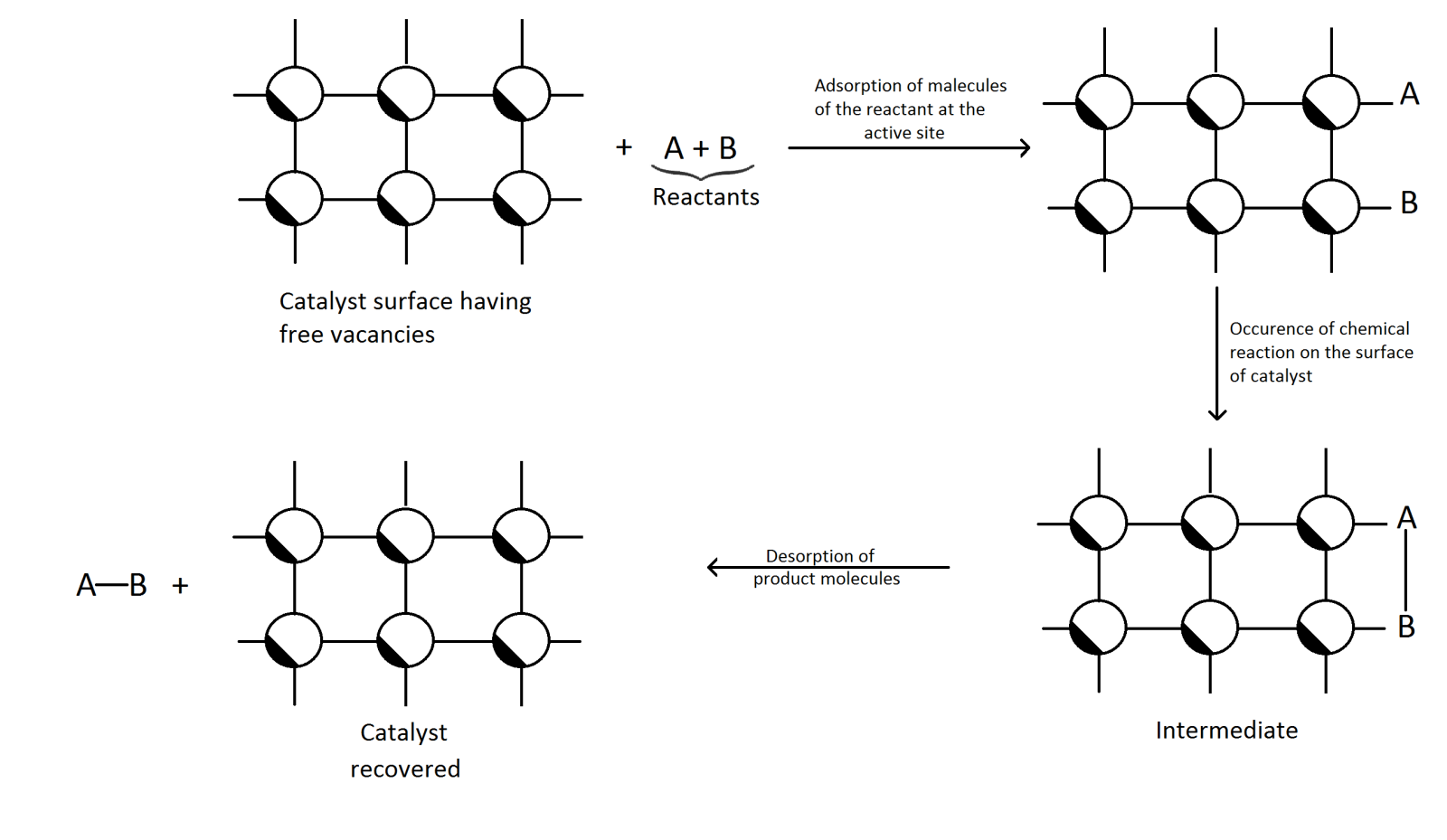
What is the role of adsorption in heterogenous catalysis?
Answer
The role of heterogeneous catalysts can be explained in terms of adsorption of reactants on the surface of the catalyst. The adsorption helps the reaction in the following ways:
  1. Adsorption increases the concentration of reactants on the surface of the catalyst. Due to increased concentration of the reactants, the reactions proceed rapidly.
  2. Adsorbed molecules get dissociated to form active species like free radicals which react faster than molecules.
  3. The adsorbed molecules are not free to move about and, therefore, they collide with other molecules on the surface.
  4. The heat of adsorption evolved acts as energy of activation for the reaction (chemisorptions).
Example:

Adsorption of molecules of the reactant at the active site. Occurrence of chemical reaction on the surface of catalyst Desorption of product molecules.
View full question & answer
Question 85 Marks
What do you understand by shape selective catalysis? Why are zeolites good shape selective catalysts?
Answer
The catalytic reaction which depends upon the pore structure of the catalyst and the size of the reactant and product molecules is called shape selective catalysis. Zeolites are good shape selective catalysts because of their honey comb like structures.
  1. Zeolites are microporous aluminosilicates of the general formula $\text{M}\frac{\text{x}}{\text{n}}[(\text{AlO}_2)_\text{x}(\text{SiO}_2)_\text{y}]\text{m}\text{H}_2\text{O}$
  2. Zeolites have an enormous surface area which is largely on the inside of the solid. The zeolites can permit the entry and exit of molecules of a certain size into the active regions within the holes.
  3. They are used in petrochemical industries for cracking of hydrocarbons and isomerization.
  4. The reactions in zeolites depend upon the size of the cavities (cages) and pores (tunnels) present in them. The pore size in zeolites generally varies between 260 pm and 740 pm.
  5. Zeolite catalyst known as ZSM-5 converts alcohols to gasoline. The alcohol is dehydrated in the cavities and the hydrocarbons are formed.
View full question & answer