Questions

2 Marks Questions

🎯

Test yourself on this topic

18 questions · timed · auto-graded

Question 12 Marks
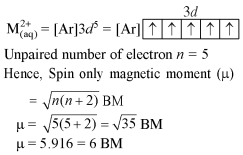
Calculate the 'spin only' magnetic moment for $M _{( aq )}^{2+}( Z =25)$.
Answer
$M _{( aq )}^{2+}$ Atomic number $( Z =25)$ electronic configuration is as follows :
Image
View full question & answer
Question 22 Marks
What do you understand by lanthanoid contraction?
Answer
Atomic number increases in lanthanoids, there is an overall decrease in atomic radius and ionic radius from La to Lu (lanthanum to lutetium), this is called lanthanoid contraction. This decrease in the values of atomic radii is not regular as is the regular decrease in $M ^{+3}$ ions. This contraction is also similar to the normal transition ranges. The reason for this is the increasing nuclear charge and shielding effect.
View full question & answer
Question 32 Marks
(i) $Ce ^{+4}$ is a strong oxidant, why?
(ii) $Eu ^{2+}$ is a strong reducing agent, why?
Answer
(i) Despite $Ce ^{+4}$ having excellent gas configuration, it is a strong oxidant because the value of standard electrode potential for $Ce ^{+4} / Ce ^{+3}$ is high, hence it easily accepts electrons and transforms into $Ce ^{+3}$ (normal oxidation state). Hence it oxidizes water also.
(ii) $Eu ^{2+}$ is a strong reducing agent because it gets converted into +3 , the normal oxidation state of lanthanoids by giving up an electron.
View full question & answer
Question 42 Marks
Anhydrous $CuSO _4$ is white but hydrated $CuSO _4$ is blue while both contain $Cu ^{2+}$ ions. Why?
Answer
Anhydrous $CuSO _4$ and $CuSO _4 .5 H _2 O$ (hydrated copper sulphate) both have $Cu ^{+2}$ which has one unpaired electrons ( $3 d^9$ ) but in anhydrous $CuSO _4$, without $H _2 O$ (ligand), there is no splitting of $d$-orbitals into $t _{2 g}$ and $e _{ g }$ orbitals, could happen. Hence $d-d$ transition does not occur hence it is colourless. Whereas $d-d$ transition occurs in hydrated $CuSO _4$, hence it is blue.
View full question & answer
Question 52 Marks
(a) $CuI _2$ is temporary. Why?
(b) Why manganese shows highest oxidation state of +4 with fluorine $\left( MnF _4\right)$ while +7 with oxygen $\left( Mn _2 O _7\right)$ ?
Answer
(a) Due to the large size of iodine in $CuI _2$, the bond is weak and $Cu ^{2+}$ oxidizes $I ^{-}$to $I _2$, hence $CuI _2$ is unstable.
$
2 Cu^{2+}+4 I^{-} \rightarrow Cu_2 I_2(s)+I_2
$
(b) Manganese (Mn), shows highest oxidation state of $+4\left( Mn _2 O _7\right)$ because of higher oxidation state of oxygen than Fluorine the ability to provide stability is high to form multiple bonds with metals.
View full question & answer
Question 62 Marks
In what way is the electronic configuration of the transition elements different from to that of the non-transition elements?
Answer
In the electronic configuration of post-transition elements, there are partially filled d subshells in the terminal shell, whereas non-transition elements do not have partially filled d subshell, but they have completely filled d subshells in their internal configuration.
In transition elements , the last electron is filled in the d subshell of the outermost shell, whereas in non-transition elements, the last electron is filled in the s or p subshell.
View full question & answer
Question 72 Marks
What are the characteristics of the transition elements and why are they called transition elements? Which of the d-block elements may not be regarded as the transition elements?
Answer
The general characteristics of post-transition metals are as follows : Transition elements show typical metallic properties, such as high tensile strength, ductility, malleability, high thermal and electrical conductivity and metallic lustre. With the exception of Zn, Cd, Hg and Mn, they have one or more typical metallic structures at normal temperature.
Transition elements are those elements of d-block whose atoms or any oxidation state have unfilled-orbitals. Groups 12 elements Zinc, Cadmium and Mercury (Zn, Cd, and Hg) have completely filled (d10) configuration in their basic state and normal oxidation state, hence they are not considered transition elements.
View full question & answer
Question 82 Marks
What may be the stable oxidation state of the transition element with the following d electron configurations in the ground state of their atoms : $3 d^3, 3 d^5, 3 d^8$ and $3 d^4 ?$
Answer
The stable oxidation states for these d electronic configurations in the ground state of post-transition elements will be as follows : 
$3 d^3($ vanadium $)(+2),+3,+4,+5,(+5$ very stable$)$
$3 d^5$ (chromium) $+3,+4,+6, \quad(+3$ very stable$)$
$3 d^5$ (cobalt) $\quad+2,+4,+6,+7, \quad(+2$ very stable$)$
$3 d^8$ (cobalt) $\quad+2,+3 \quad$ (in complexes)
There is no d4 configuration in 3d4 state.
View full question & answer
Question 92 Marks
To what extent do the electronic configurations decide the stability of oxidation states in the first series of the transition elements? Illustrate your answer with examples.
Answer
The stability of the oxidation state of the first transition series elements depends to a great extent on the electronic configuration. Those oxidation states which have noble gas configuration or half filled (d5) and fully flled stable configuration (d10) are relatively more stable.
Example : $Sc ^{3+}, Mn ^{+2}$ and $Zn ^{+2}$.
$Sc :[ Ar ] 3 d^1 4 s^2 \quad; Sc ^{3+}\quad:[ Ar ]$ $\quad\quad$(Noble gas configuration)
$Mn :[ Ar ] 3 d^5 4 s^2 \quad ; Mn ^{2+}:[ Ar ] 3 d^5$ $\quad$(Half filled)
$Zn :[ Ar ] 3 d^{10} 4 s^2 \quad; Zn ^{2+}\quad:[ Ar ] 3 d^{10}$ $\qquad$(Completely filled)
View full question & answer
Question 102 Marks
Name the members of the lanthanoid series which exhibit +4 oxidation states and those which exhibit +2 oxidation states. Try to correlate this type of behaviour with the electronic configurations of these elements.
Answer
Following are the elements showing +4 oxidation state in Lanthanoid series :
Cerium $({ }_{58} Ce)$, Praseodymium $({ }_{59} Pr)$, Neodymium $({ }_{60} Nd)$, Terbium $({ }_{65} Tb)$ Dysprosium $({ }_{66} dY)$. Similarly, the main lanthanoids showing +2 oxidation state are Europium (Eu) and Iturbius $({ }_{70} Yb)$.
In lanthanoids, +4 and +2 oxidation states occur due to greater stability of vacant, half-filled and completely filled f subshells. Just as the noble gas configuration of $Ce^{+4}$ is $4 f^0$, similarly Tb4+ and Eu2+ have 4f7(half filled) and Yb+2 has $4 f^{14}$ (completely filled).
View full question & answer
Question 112 Marks
Use Hund's rule to derive the electronic configuration of Ce3+ ion, and calculate its magnetic moment on the basis of 'spin-only' formula.
Answer
The atomic number of Ce is 58 and its electronic configuration is ${ }_{54} Ce =[ Xe ] 4 f^1 5 d^1 6 s^2$, hence the electronic configuration of $Ce ^{3+}$ ion will be $=[ Xe ] 4 f^1$ in which there is only one unpaired electron, hence its magnetic moment (μ) 
$\mu=\sqrt{n(n+2)}$ B.M.
n = Number of unpaired electrons = 1
$\mu=\sqrt{1(1+2)}=\sqrt{3}=1.732$ B.M.
Hence, Magnetic moment of Ce3+ = 1.732 B.M.
View full question & answer
Question 122 Marks
Explain briefly how +2 state becomes more and more stable in the first half of the first row transition elements with increasing atomic number?
Answer
The common oxidation state of the first transition series (except Sc) is +2 which is formed due to the loss of two electrons from 4s orbital. In the first half of the first transition series, the +2 oxidation state becomes more stable with increasing atomic number because there is one electron in minimum of the 3d orbitals, hence each orbital is half filled in which the inter electronic repulsion is minimum and the nuclear charge increases. But in the second half of the series, paring of electrons in 3d orbital starts.
View full question & answer
Question 132 Marks
The chemistry of the actinoid elements is not so smooth as that of the lanthnoids. Justify this statement by giving some examples from the oxidation state of these elements.
Answer
There is less regularity in the chemistry of actinoid elements as compared to the chemistry of lanthanoids because the range of oxidation states is greater in the actinoid series. The reason for this is 5f, 6d and 7s levels have same energy.
Actinoids generally show +3 oxidation state. Elements in the initial earth part of the series generally exhibit higher oxidation states. For examples, Th has +4, Pa, U and Np have +5, +6 and +7 oxidation states respectively, but in the later elements the oxidation states decrease, hence the initial and later actinoids have more irregularity in the oxidation states.
View full question & answer
Question 142 Marks
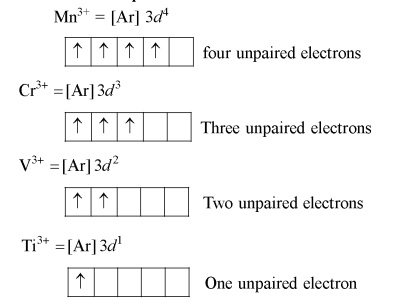
Calculate the number of unpaired electrons in the following gaseous ions :
$Mn ^{3+}, Cr ^{3+}, V ^{3+}$ and $Ti ^{3+}$. Which one of these is the most stable in aqueous solution?
Answer

Image
Among these ions, Cr3+ is the most stable in aqueous solution. Because it has half-filled configuration $\left( t _{2 g}{ }^3\right)$,which is stable.
View full question & answer
Question 152 Marks
What is meant by 'disproportionation'? Give two examples of disproportionation reaction in aqeuous solution.
Answer
Disproportionation: When one oxidation state of an element in a species is less stable than other oxidation states (lower and higher), then one atom of the species gets oxidized and the other atom gets reduced. This action is called disporoportionation.
Example :
$\underset{( V )}{3 CrO _4^{3-}}+8 H ^{+} \rightarrow \underset{( VI )}{2 CrO _4^{2-}}+\underset{( III )}{ Cr ^{3+}}+4 H _2 O$
Here, Cr(III) and Cr(IV) are obtained from Cr(VI).
$3 MnO_4^{2-}+4 H^{+} \rightarrow 2 MnO_4^{-}+MnO_2+4H_2 O$
(VI) $\qquad\qquad\qquad\qquad$(VII)$\quad\qquad$(IV)
Here, Mn(VII) and Mn(V) are obtained from Mn(VI).
View full question & answer
Question 162 Marks
Why are Mn2+ compounds more stable than Fe2+ towards oxidation to their +3 state?
Answer
The electronic configuration of Mn2+ [Ar] 3d5 which is more stable due to half filled subshell, hence Mn+2 does not give electrons easily, that is, it has less tendency to get oxidized. But the electronic configuration of Fe+2 is [Ar] 3d6, hence it forms 3d stable configuration by giving one electron, hence it gets easily oxidized.
$\underset{\left(3 d^5\right) \text { stable }}{ Mn ^{2+}} \xrightarrow{- e ^{-}} \underset{\left(3 d^4\right)}{ Mn ^{3+}}$
$\underset{\left(3 d^6\right)}{ Fe ^{2+}} \xrightarrow{- e ^{-}} \underset{\left(3 d^5\right) \text { more stable }}{ Fe ^{3+}}$
View full question & answer
Question 172 Marks
Compare the stability of +2 oxidation state for the elements of the first transition series.
Answer
In the first transition series metals, the stability of +2 oxidation states increases while going from left to right and decreases after reacting the maximum in the middle because initially there are unpaired electrons in the d-orbitals due to which the inter electronic repulsion is minimum. After that the pairing of electrons in the orbitals starts Zn+2 is an exception because it has a completely filled (3d10) stable configuration.
View full question & answer
Question 182 Marks
What are interstitial compounds? Why are such compounds well known for transition metals?
Answer
In the crystal lattice of post-transition metals,when small sized atoms like H, N, B or C are arranged in the spaces (interspaces) between the atoms, then the compounds formed are called interstitial compounds.
Example : $TiC , Mn _4 N, Fe _3 H , VH _{0,56}$ and $TiH _{1,7}$ etc. metals in these compounds do not have any normal oxidation state. Transition elements have vacant orbitals, hence they form interstitial compounds easily.
View full question & answer
2 Marks Questions - Chemistry STD 12 Science Questions - Vidyadip