Questions

3 Marks Question

Take a timed test

7 questions · self-marked practice — reveal the answer and mark yourself.

Question 13 Marks
Permanganate ion $\left( MnO _4^{-}\right)$gives different reduction products at different concentration of hydrogen ions, write their equations.
Answer
The products formed in the reduction reaction of permanganate ion depend on the concentration of hydrogen ion. The reactions occurring at different concentration of $H ^{+}$ are as follows:
$
\begin{aligned}
MnO_{+7}^{-}+e^{-} & \rightarrow \underset{+6}{MnO_4^{2-}} \\
MnO_4^{-}+4 H^{+}+3 e^{-} & \rightarrow \underset{+4}{MnO_2}+2 H_2 O \\
MnO_4^{-}+8 H^{+}+5 e^{-} & \rightarrow Mn^{2+}+4 H_2 O
\end{aligned}
$
Water should be oxidized by permanganate ion at $\left[ H ^{+}\right]$ $=1$ but this reaction happens very slowly but in this. The rate of reaction increases by using $Mn ^{2+}$ ion as a catalyst or by increasing the temperature.
View full question & answer
Question 23 Marks
(a) Which is the salt of Mn which is isostructural to $KClO _4$ ?
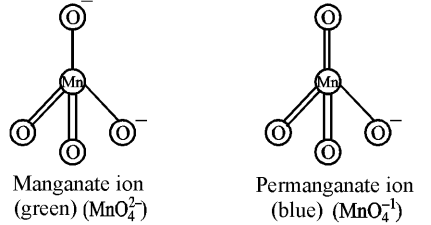
(b) Explain the structure and magnetic properties of manganese and permanganate ions.
Answer
(a) $KMnO _4$ (potassium permanganate) is isostructural to $KClO _4$ (potassium chlorate), that is, both have the same structure.
(b) Manganate and permanganate ions are tetrahedral in which $\pi$-bond is formed due to overlap between the $p$ orbital of oxygen and $d$-orbitals of Mn and $sp ^3$ hybridization occurs on Mn . Their structure is as follows :
Image
Permanganate ion is diamagnetic, when heated at 513 K it gets converted into manganese ion which is paramagnetic because it has one unpaired electron.
View full question & answer
Question 33 Marks
(a) $Cu ^{+} X ^{-}$is unstable, why?
(b) Explain the structure of $Mn _2 O _7$ and $MnO _4^{-}$.
Answer
(a) $Cu ^{+} X ^{-}$is unstable because the disproportionation of Cu in aqueous solution occurs.
$
2 Cu_{(aq)}^{+} \longrightarrow Cu_{(aq)}^{2+}+Cu_{(s)}
$
Therefore, $Cu ^{2+}$ is more stable than $Cu ^{+}$in aqueous solution because the value of hydration enthalpy of $Cu ^{2+}$ is much more negative than that of $Cu ^{+}$, which can easily balance the energy (second ionization enthalpy) required to form $Cu ^{2+}$ from $Cu ^{+}$.
(b) In $Mn _2 O _7$, each Mn atom is tetrahedrally surrounded by oxygen atoms and an $Mn - O - Mn$ bridge is also found in it and the structure of $MnO _4^{-}$is also tetrahedral.
View full question & answer
Question 43 Marks
Write down the number of 3d electrons in each of the following ions :
$Ti ^{2+}, V ^{2+}, Cr ^{3+}, Mn ^{2+}, Fe ^{2+}, Fe ^{3+}, Co ^{2+}, Ni ^{2+}, Cu ^{2+}$.
Indicate how would you expect the five 3d orbitals to be occupied for these hydrated ions (octahedral).
Answer
In hydrated ions, water H2O acts as a liquid due to which the five 3d orbitals of equal energy get divided into two parts- t2g and eg. The energy of t2g orbitals is less : than that of t2g orbitals. The energy difference between t2g orbitals is less because H2O is a weak ligand. Electrons of different ions are filled in these orbitals in the following manner : 
(i) $ Ti ^{2+}:[ Ar ] 3 d^2=\left( t _{2 g}{ }^2\right)$
(ii) $ V ^{2+}:[ Ar ] 3 d^3=\left( t _{2 g}\right)^3$
(iii) $ Cr ^{3+}:[ Ar ] 3 d^3=\left( t _{2 g}\right)^3$
(iv) $ Mn ^{2+}:[ Ar ] 3 d^5=\left( t _{2 g}\right)^3\left( e _{ g }\right)^2$
(v) $ Fe ^{2+}:[ Ar ] 3 d^6=\left( t _{2 g}\right)^4\left( e _{ g }\right)^2$
(vi) $ Fe ^{3+}:[ Ar ] 3 d^5=\left( t _{2 g}\right)^3\left( e _{ g }\right)^2$
(vii) $ Co ^{2+}:[ Ar ] 3 d^7=\left( t _{2 g}\right)^5\left( e _{ g }\right)^2$
(viii) $ Ni ^{2+}:[ Ar ] 3 d^8=\left( t _{2 g}\right)^6\left( e _{ g }\right)^2$
(ix) $ Cu ^{2+}:[ Ar ] 3 d^9=\left( t _{2 g}\right)^6\left( e _{ g }\right)^3$
View full question & answer
Question 53 Marks
For M2+/M and M3+/M2+ systems the $E ^{\circ}$ values for some metals are as follows : 
$\begin{array}{llll} Cr ^{2+} / Cr & -0.9 V & Cr ^3 / Cr ^{2+} & -0.4 V \\ Mn ^{2+} / Mn & -1.2 V & Mn ^{3+} / Mn ^{2+} & +1.5 V \\ Fe ^{2+} / Fe & -0.4 V & Fe ^{3+} / Fe ^{2+} & +0.8 V\end{array}$
Use this data to comment upon :
(i) the stability of Fe3+ in acid solution are compared to that of Cr3+or Mn3+ and
(ii) the case with which iron can be oxidised as compared to a similar process for either chromium or manganese metal.
Answer
(i) When the reduction potential (electrode potential) of a species is high, then its tendency to be reduced is high. Reduction potential of Mn+3 is maximum hence it gets easily reduced to Mn2+ hence Mn+3 is less stable than Fe+3 But Cr+3 is much lower than the reduction potential of Fe+3.
(ii) When the value of electrode potential (reduction potential) of a metal ion is low, then the tendency of that metal atom to be oxidized will the more, hence Mn will have the highest tendency to be oxidized to Mn+2 and Fe will have the highest tendency to be oxidized to Fe+2. The tendency for oxidation will be minimum in +2. Therefore the order of their oxidation is as follows - $Mn > Cr > Fe$.
View full question & answer
Question 63 Marks
Describe the oxidising action of potassium dichromate and write the ionic equation for its reaction with : 
(i) Iodide, (ii) Iron, (II) solution and (iii) H2S
Answer
Potassium dichromate is a strong oxidant. The oxidation action of dichromate ion in acidic medium is shown as follows, in this Cr+6 changes into Cr+3.
$Cr _2 O _7^{2-}+14 \stackrel{+}{ H }+6 e ^{-} \rightarrow 2 Cr ^{3+}+7 H _2 O \left( E ^{\circ}=1.33 V\right)$
(i) Iodide ion : $K _2 Cr _2 O _7$, Oxidizes iodide ion to iodine.
$Cr _2 O _7^{2-}+14 \stackrel{+}{ H }+6 I ^{-} \rightarrow 2 Cr ^{3+}+7 H _2 O +3 I _2$
(ii) Iron(II) solution : $K _2 Cr _2 O _7$, oxidises $Fe ^{2+}$ to $Fe ^{3+}$.
$Cr _2 O _7^{2-}+14 \stackrel{+}{ H }+6 Fe ^{2+} \rightarrow 2 Cr ^{3+}+6 Fe ^{+3}+7 H _2 O$
(iii) H2S : Dichromate oxidizes H2S to sulphur.
$Cr _2 O _7^{2-}+8 H ^{+}+3 H _2 S \rightarrow 2 Cr ^{3+}+7 H _2 O +3 S$
View full question & answer
Question 73 Marks
Describe the preparation of potassium dichromate from iron chromite ore. What is the effect of increasing pH on a solution of potassium dichromate?
Answer
Making potassium dichromate from iron chromite ore : When iron chromite [chromite ore (FeCr2O4)] is fused with sodium carbonate in the presence of air, sodium chromate is obtained. The reaction of chromite with sodium carbonate is as follows :
$ 4 FeCr _2 O _4+8 Na _2 CO _3+7 O _2 \rightarrow  8 Na _2 CrO _4  +2 Fe _2 O _3+8 CO _2$
The sodium chromate solution is filtered and made acidic by sulphuric acid from which orange sodium dichromate (Na2Cr2O7. 2H2O) is crystallized.
$2 Na _2 CrO _4+2 H ^{+} \rightarrow Na _2 Cr _2 O _7+2 Na ^{+}+ H _2 O$
The solubility of sodium dichromate is more than that of potassium dichromate. Therefore, when potassium chloride is added to sodium dichromate solution, potassium dichromate is obtained.
$Na _2 Cr _2 O _7+2 KCl \rightarrow K _2 Cr _2 O _7+2 NaCl$
Orange coloured crystals crystallize from solution. On increasing the pH of potassium dichromate solution, i.e. on making alkaline medium, it gets converted into chromate.
$Cr _2 O _7^{2-}+2 \overline{ O } H \rightarrow 2 CrO _4^{2-}+ H _2 O$
View full question & answer