Question
Permanganate ion $\left( MnO _4^{-}\right)$gives different reduction products at different concentration of hydrogen ions, write their equations.

Answer

The products formed in the reduction reaction of permanganate ion depend on the concentration of hydrogen ion. The reactions occurring at different concentration of $H ^{+}$ are as follows:
$
\begin{aligned}
MnO_{+7}^{-}+e^{-} & \rightarrow \underset{+6}{MnO_4^{2-}} \\
MnO_4^{-}+4 H^{+}+3 e^{-} & \rightarrow \underset{+4}{MnO_2}+2 H_2 O \\
MnO_4^{-}+8 H^{+}+5 e^{-} & \rightarrow Mn^{2+}+4 H_2 O
\end{aligned}
$
Water should be oxidized by permanganate ion at $\left[ H ^{+}\right]$ $=1$ but this reaction happens very slowly but in this. The rate of reaction increases by using $Mn ^{2+}$ ion as a catalyst or by increasing the temperature.

Need a full question paper?

Generate a complete, print-ready paper with questions like this in minutes — across 16+ boards, with answer keys.
Start Generating Free

Similar questions

What is crystal field splitting energy? How does the magnitude of $\triangle o$ decide the actual configuration of d orbitals in a coordination entity?
An organic compound with the molecular formula $C _9 H _{10} O$ forms 2,4-DNP derivative, reduces Tollens' reagent and undergoes Cannizzaro reaction. On vigorous oxidation it gives 1,2-benzene dicarboxylic acid. Identify the compound.
Discuss the method to determine electrode potential of copper and zine by using standard hydrogen electrode.
Calculate the boiling point of a $1M$ aqueous solution $($density $1.04g\ mL^{-1})$ of potassium chloride $(K_b$ for water $= 0.52K \ kg\ mol^{-1},$ Atomic masses: $K = 39u, Cl = 35.5u)$ Assume, potassium chloride is completely dissociated in solution.
Write a note on esterification of alcohols and phenols.
Complete the following chemical equations:
  1. $\text{MnO}_{4}^{-}+\text{C}_{2}\text{O}_{4}^{2-}+\text{H}+\rightarrow$
  2. $\text{KMnO}_{4}\xrightarrow{\text{heated}}$
  3. $\text{Cr}_{2}\text{O}_{4}^{2-}+\text{H}_{2}\text{S}+\text{H}^{+}+\rightarrow$
The rate constant for the first order decomposition of $\ce{H2O2}$ is given by the following equation:$\log{k}=14.2-\frac{\text{1.0}\times\text{10}^{4}}{\text{T}}K$
Calculate $E_a$ for this reaction and rate constant $k$ if its half$-$life period be $200$ minutes.
$($Given: $R = 8.314\ JK^{–1}\ mol^{–1})$
The cell in which the following reaction occurs:
$2\text{Fe}^{3+}(\text{aq})+2\text{I}^-(\text{aq})\rightarrow2\text{Fe}^{2+}(\text{aq})+\text{I}_2(\text{s})\ \text{has}\ \text{E}^\circ_{\text{cell}}= 0.236\ V$  at $298\ K.$ Calculate the standard Gibbs energy and the equilibrium constant of the cell reaction.
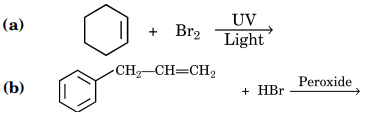
Write the major monohalo product(s) in each of the following reactions :
Image
Calculate $E _{ cell }^0$ for the following reaction at 298 K.
$2 Cr _{(s)}+3 Fe ^{2+}\left(0.1 M \rightarrow 2 Cr ^{3+}(0.01 M )+3 Fe _{(s)}\right.$
Given : $E _{\left( Cr ^{3+} / Cr \right)}^{\circ}=-0.74 V, E _{\left( Fe ^{2+} / Fe \right)}^{\circ}=-0.44 V$