Sample QuestionsAPPLICATION OF DERIVATIVES questions
One sample from each question group in this chapter. Select any group above to see the full set with answer keys.
Every invertible function is:
- ✓
- B
- C
- D
Not necessarily monotonic function.
Answer: A.
View full solution →Choose the correct answer from the given four options$:\ f(x) = x^x$ has a stationary point at:
Answer: B.
View full solution →If $s = t^3- 4t^2+ 5$ describes the motion of a particle, then its velocity when the acceleration vanishes, is:
- A
$\frac{16}{2}\ \text{unit}/\text{sec}.$
- B
$\frac{\text{-32}}{3}\ \text{unit}/\text{sec}.$
- C
$\frac{4}{3}\ \text{unit}/\text{sec}.$
- ✓
$-\frac{16}{3}\ \text{unit}/\text{sec}.$
Answer: D.
View full solution →If the function $\text{f}(\text{x})=\frac{-\text{x}}{2}+\sin\text{x}$ defined on $\Big[\frac{-\pi}{3},\frac{\pi}{3}\Big]$ is:
Answer: A.
View full solution →If $\text{f}(\text{x})=\frac{1}{4\text{x}^{2}+2\text{x}+1}$, then its maximum value is :
- ✓
$\frac{4}{3}$
- B
$\frac{2}{3}$
- C
$1$
- D
$\frac{3}{4}$
Answer: A.
View full solution →Directions : In the following questions, the Assertions $(A)$ and Reason $(s)\ (R)$ have been put forward. Read both the statements carefully and choose the correct alternative from the following :
Assertion $(A)$ : Let $\text{f(x)}=\text{e}^\frac{1}{\text{x}}$ is defined for all real values of $x.$
Reason $(R) : \text{f(x)}=\text{e}^\frac{1}{\text{x}}$ is always decreasing as $\text{f'(x)} < 0$ is $\text{x }\in\text{ R}$
- ✓
$A$ is true, $R$ is true: $R$ is a correct explanation for $A.$
- B
$A$ is true $R$ is true; $R$ is not a correct explanation for $A.$
- C
$A$ is true: $R$ is false.
- D
$A$ is false: $R$ is true.
Answer: A.
View full solution →Directions : In the following questions, the Assertions $(A)$ and Reason $(s)\ (R)$ have been put forward. Read both the statements carefully and choose the correct alternative from the following :
Assertion $(A) :$ if $\text{f(x)}=\text{a}(\text{x}+\sin\text{x})$ is increasing function if $a \in(0,\infty)$
Reason $(R) :$ The given function $\text{f(x) }$is increasing only if $a \in(0,\infty)$
- A
$A$ is true, $R$ is true: $R$ is a correct explanation for $A.$
- B
$A$ is true $R$ is true; $R$ is not a correct explanation for $A.$
- C
$A$ is true: $R$ is false.
- ✓
$A$ is false: $R$ is true.
Answer: D.
View full solution →Directions : In the following questions, the Assertions $(A)$ and Reason $(s)\ (R)$ have been put forward. Read both the statements carefully and choose the correct alternative from the following :
Assertion $(A) :$ The curve $y = x^2$ represents a parabola with vertex at origin.
Reason $(R) :$ For a curve Tangent and Normal lines are always perpendicular at thepoint of contact.
- A
Both $A$ and $R $ are true and $R$ is the correct explanation of $A$
- ✓
Both $A$ and $R$ are true but $R$ is $\text{NOT}$ the correct explanation of $A$
- C
$A$ is true but $R$ is false.
- D
$A$ is false but $R$ is true.
Answer: B.
View full solution →Directions : In the following questions, the Assertions $(A)$ and Reason $(s)\ (R)$ have been put forward. Read both the statements carefully and choose the correct alternative from the following:
Assertion $(A) :$ The function $\text{y}=\log(1+\text{x)}\ \frac{2\text{x}}{2+\text{x}}$ is decreasing throughout its domain
Reason $(R) :$ The domain of the function $\text{y}=\log(1+\text{x)} \ \frac{2\text{x}}{2+\text{x}}$ is $(-1,\infty).$
- A
Both $A$ and $R$ are true and $R$ is the correct explanation of $A$
- B
Both $A$ and $R$ are true but $R$ is $\text{NOT}$ the correct explanation of $A$
- C
$A$ is true but $R$ is false.
- ✓
$A$ is false but $R$ is true.
Answer: D.
View full solution →Directions : In the following questions, the Assertions $(A)$ and Reason $(s)\ (R)$ have been put forward. Read both the statements carefully and choose the correct alternative from the following :
Assertion $(A) :$ The equation of tangent to the curve $ \text{y} = \sin\text{x}$ at the point $(0, 0)$ is $y = x.$
Reason $(R) :$ if $\text{y}=\sin$ then $\frac{\text{dy}}{\text{dx}}$ at $x = 0$ is $1.$
- ✓
$A$ is true, $R$ is true: $R$ is a correct explanation for $A.$
- B
$A$ is true $R$ is true; $R$ is not a correct explanation for $A.$
- C
$A$ is true: $R$ is false.
- D
$A$ is false: $R$ is true.
Answer: A.
View full solution →Find the distance between the planes $\overrightarrow{\text{r}}.(2\hat{i} - 3\hat{j} +6\hat{k}) - 4 = 0 \text{ and}\overrightarrow{\text{r}}.(6\hat{i} - 9\hat{j} +18\hat{k}) + 30 = 0.$
View full solution →$\text{If A} = \begin{bmatrix} 2 & 3 \\ 5 & -2 \\ \end{bmatrix}, \text{then write A}^{-1}. $
View full solution →If $\overrightarrow{\text{a}} = 2\hat{\text{i}} + \hat{\text{j}} + 3\hat{\text{k}}$ and $ \overrightarrow{\text{b}} = 3\hat{\text{i}}+ 5\hat{\text{j}} - 2\hat{\text{k}},$ then find $|\overrightarrow{\text{a}}\times|\overrightarrow{\text{b}|}.$
View full solution →$\text{If A} = \begin{bmatrix} \cos\alpha & \sin\alpha \\ -\sin\alpha & \cos\alpha \\ \end{bmatrix}. \text{find } \alpha \text{ satisfying } 0 < \alpha < \frac{\pi}{2} \text{when A+ A}^{\text{T}} = \sqrt{2}\text{ I}_{2} : $ where $\text{A}^{\text{T}}$ is transpose of $\text{A}$
View full solution →If A is a matrix $3\times3$ If A is a and $\text{|3A| = K|A|,}$ then write the value of k.
View full solution →Show that the function $f(x) = x^3 – 3x^2 + 6x – 100$ is increasing on R.
View full solution →The volume of a sphere is increasing at the rate of 8cm3/s. Find the rate at which its surface area is increasing when the radius of the sphere is 12cm.
The length x, of a rectangle is decreasing at the rate of 5 cm/minute and the width y, is increasing at the rate of 4 cm/minute. When x = 8 cm and y = 6 cm, find the rate of change of the area of the rectangle.
The volume of a cube is increasing at the rate of $9 cm^3/s$. How fast is its surface area increasing when the length of an edge is $10 cm$?
View full solution →Show that the function f given by $f(x) = \tan^{–1} (sin\ x + cos\ x)$ is decreasing for all $\text{x} \in \bigg(\frac{\pi}{4}, \frac{\pi}{2}\bigg).$
View full solution →Find the equations of the tangent and normal to the given curves at the indicated points:
$y = x^3 $ at $(1, 1)$
View full solution →If $y = \log_e x$, then find $\triangle\text{y}$ when $x = 3$ and $\triangle\text{x} = 0.03.$
View full solution →Find the point on the curve $y = x^2$ where the slope of the tangent is equal to the x-coordinate of the point.
View full solution →Find the equations of the tangent and normal to the parabola $y^2 = 4ax$ at the point $(at^2, 2a.t)$
View full solution →Write the coordinates of the point at which the tangent to the curve $y = 2x^2 - x + 1$ is parallel to the line $y = 3x + 9.$
View full solution →Solve the differential equation: $(x + 1)\frac{dy}{dx} -y = e^{3x} (x + 1)^{3}$
View full solution →Give that vectors $\overrightarrow{\text{a}}, \overrightarrow{\text{b}}, \overrightarrow{\text{c}}.$ form a triangle such that $\overrightarrow{\text{a}} = \overrightarrow{\text{b}} + \overrightarrow{\text{c}}.$ Find p, q, r, s such that area of triangle is $5\sqrt{6}$ where $\overrightarrow{\text{a}} = \text{p }\hat{i} + \text{q }\hat{j} + \text{r }\hat{k} = \overrightarrow{\text{b}} = \text{s }\hat{i} + \text{3 }\hat{j} + \text{4 }\hat{k} \text{ and} \overrightarrow{\text{c}} = \text{3 }\hat{i} + \hat{j} - \text{2}\hat{k}.$
View full solution →Differentiate $(\sin 2x)^{x} + \sin^{-1}\sqrt{3x}$ with respect to $x.$
View full solution →$\text{Find k, if}\ f(x) = \begin{cases} k\sin\frac{\pi}{2}(x + 1), & x\leq0 \\ \frac{\tan x - \sin x}{x^{3}}, & x\geq0 \end{cases}$ is continuous at $x = 0.$
View full solution →Using elementary row operations, find the inverse of the following matrix:
$\text{A} = \begin{pmatrix} 2 & -1 & 3 \\ -5 & 3 & 1 \\ -3 & 2 & 3 \end{pmatrix}$
View full solution →A magazine company in a town has $5000$ subscribers on its list and collects fix charges of $₹ 3000$ per year from each subscriber. 'The company proposes to increase the annual charges, and it is believed that for every increase of $₹ 1$ one subscriber will discontinue service.

Based on the above information, answer the following questions.
- If $x$ denote the amount of increase in annual charges, then revenue $R,$ as a function of $x$ can be represented as.
- $R(x) = 3000 × 5000 × x$
- $R(x) = (3000 - 2x)(5000 + 2x)$
- $R(x) = (5000 + x)(3000 - x)$
- $R(x) = (3000 + x)(5000 - x)$
- If magazine company increases $₹\ 500$ as annual charges, then R is equal to.
- $₹\ 15750000$
- $₹\ 16750000$
- $₹\ 17500000$
- $₹\ 15000000$
- If revenue collected by the magazine company is $₹\ 15640000$, then value of amount increased as annual charges for each subscriber, is.
- $400$
- $1600$
- Both $(a)$ and $(b)$
- None of these
- What amount of increase in annual charges will bring maximum revenue?
- $₹\ 1000$
- $₹\ 2000$
- $₹\ 3000$
- $₹\ 4000$
- Maximum revenue is equal to.
- $₹\ 15000000$
- $₹\ 16000000$
- $₹\ 20500000$
- $₹\ 25000000$
View full solution →Shreya got a rectangular parallelepiped shaped box and spherical ball inside it as return gift. Sides of the box are x, 2x, and $\frac{\text{x}}{3},$ while radius of the ball is r.
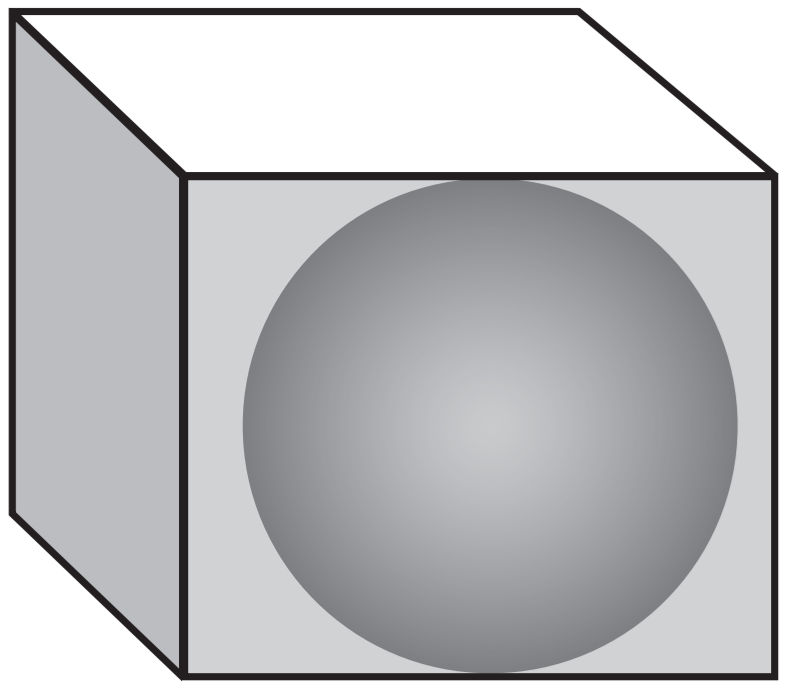
Based on the above information, answer the following questions.
- If S represents the sum of volume of parallelepiped and sphere, then Scan be written as.
- $\frac{4\text{x}^3}{3}+\frac{2}{2}\pi\text{r}^2$
- $\frac{2\text{x}^2}{3}+\frac{4}{3}\pi\text{r}^2$
- $\frac{2\text{x}^3}{3}+\frac{4}{3}\pi\text{r}^3$
- $\frac{2}{3}\text{x}+\frac{4}{3}\pi\text{r}$
- If sum of the surface areas of box and ball are given to be constant $k^2$ then x is equal to.
- $\sqrt{\frac{\text{k}^2-4\pi\text{r}^2}{6}}$
- $\sqrt{\frac{\text{k}^2-4\pi\text{r}}{6}}$
- $\sqrt{\frac{\text{k}^2-4\pi}{6}}$
- $\text{None of these}$
- The radius of the ball, when Sis minimum, is.
- $\sqrt{\frac{\text{k}^2}{54+\pi}}$
- $\sqrt{\frac{\text{k}^2}{54+4}}$
- $\sqrt{\frac{\text{k}^2}{64+3\pi}}$
- $\sqrt{\frac{\text{k}^2}{4\pi+3}}$
- Relation between length of the box and radius of the ball can be represented as.
- $\text{x} = \frac{2}{\text{r}}$
- $\text{x}=\frac{\text{r}}{2}$
- $\text{x}=\frac{2}{\text{r}}$
- $\text{x}=3\text{r}$
- Minimum value of S is.
- $\frac{\text{k}^2}{2(3\pi+54)^\frac{2}{3}}$
- $\frac{\text{k}}{2(3\pi+54)^\frac{3}{2}}$
- $\frac{\text{k}^3}{2(4\pi+54)^\frac{1}{2}}$
- $\text{None of these}$
View full solution →A tin can manufacturer designs a cylindrical tin can for a company making sanitizer and disinfector. The tin can is made to hold 3 litres of sanitizer or disinfector.
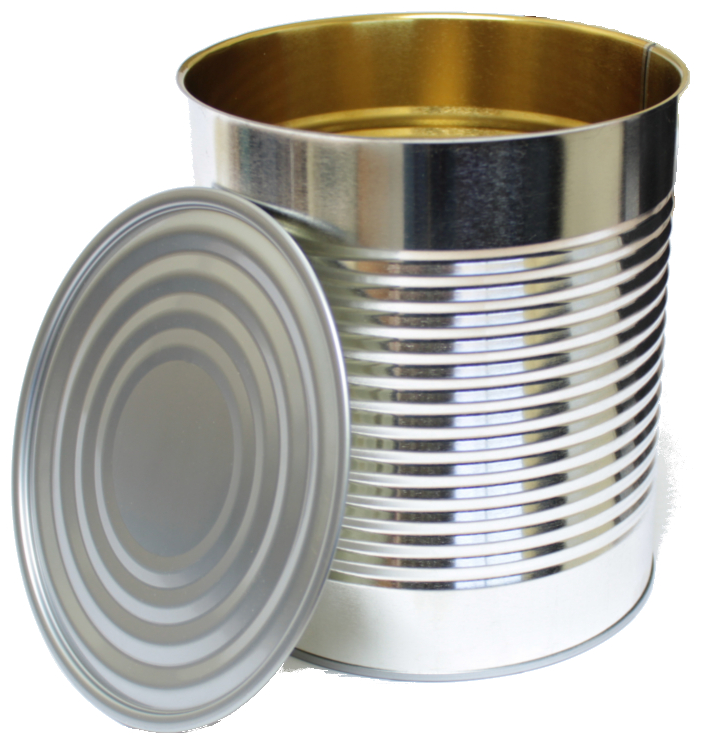
Based on the above in formation, answer the following questions.
- If r cm be the radius and h cm be the height of the cylindrical tin can, then the surface area expressed as a function of r as.
- $2\pi\text{r}^2$
- $2\pi\text{r}^2+6000$
- $2\pi\text{r}^2+\frac{5000}{\text{r}}$
- $2\pi\text{r}^2+\frac{6000}{\text{r}}$
- The radius that will minimize the cost of the material to manufacture the tin can is.
- $\sqrt[3]{\frac{600}{\pi}}\text{cm}$
- $\sqrt{\frac{500}{\pi}}\text{cm}$
- $\sqrt[3]{\frac{1500}{\pi}}\text{cm}$
- $\sqrt{\frac{1500}{\pi}}\text{cm}$
- The height that will minimize the cost of the material to manufacture the tin can is.
- $\sqrt[3]{\frac{600}{\pi}}\text{cm}$
- $2\sqrt[3]{\frac{1500}{\pi}}\text{cm}$
- $\sqrt{\frac{1500}{\pi}}$
- $2\sqrt{\frac{1500}{\pi}}$
- If the cost of material used to manufacture the tin can is $₹\frac{100}{\text{m}^2}$ and $\sqrt[3]{\frac{1500}{\pi}}\approx7.8,$ then minimum cost is approximately.
- ₹ 11.538
- ₹ 12
- ₹ 13
- ₹ 14
- To minimize the cost of the material used to manufacture the tin can, we need to minimize the.
- Volume.
- Curved surface area.
- Total surface area.
- Surface area of the base.
View full solution →An open water tank of aluminium sheet of negligible thickness, with a square base and vertical sides, is to be constructed in a farm for irrigation. It should hold $32000$ l of water, that comes out from a tube well.
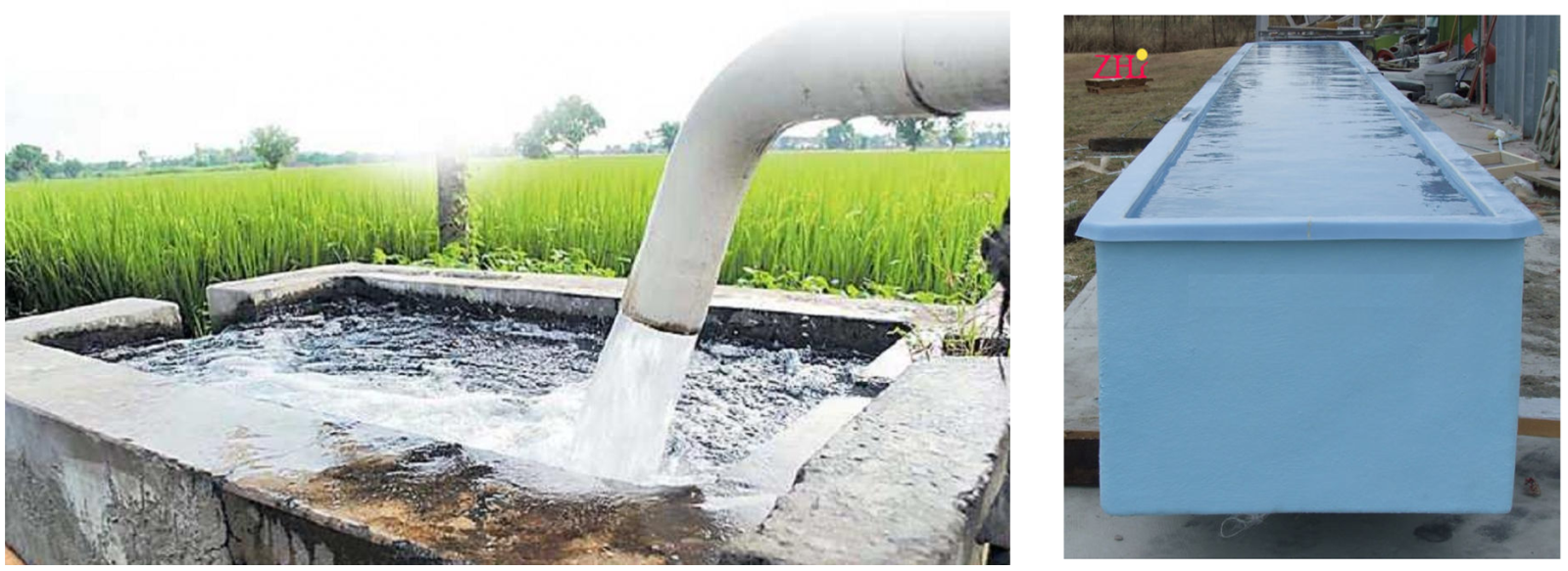
Based on above information, answer the following questions.
- If the length, width, and height of the open tank be $x, x$ and $y$ $m$ respectively, then total surface area of tank is.
- $(x^2 + 2xy)m^2$
- $(2x^2 + 4xy)m^2$
- $(2x^2 + 2xy)m^2$
- $(2x^2 + 8xy)m^2$
- The relation between $x$ and $y$ is.
- $x^2y = 32$
- $xy^2 = 32$
- $x^2y^2 = 32$
- $xy = 32$
- The outer surface area of tank will be minimum when depth of tank is equal to.
- Half of its width.
- Its width.
- $\big(\frac{1}{4}\big)^\text{th}$ of its Width
- $\big(\frac{1}{3}\big)^\text{rd}$ of its Width
- The cost of material will be least when width of tank is equal to.
- Half of its depth
- Twice of its depth
- $\big(\frac{1}{4}\big)^\text{th}$ of its depth
- Thrice of its depth
- If cost of aluminium sheet is $ ₹ \frac{360}{\text{m}^2}$ then the minimum cost for the construction of tank will be.
- $₹\ 15, 000$
- $₹\ 16, 280$
- $₹\ 17, 280$
- $₹\ 18, 280$
View full solution →Western music concert is organised every year in the stadium that can hold 36000 spectators. With ticket price of ₹ 10, the average attendance has been 24000. Some financial expert estimated that price of a ticket should be determined by the function.
$\text{p}(\text{x})=15-\frac{\text{x}}{3000}$ where x is the number of tickets sold.

Based on the above information, answer the following questions.
- The revenue, R as a function of x can be represented as.
- $15\text{x}-\frac{\text{x}^2}{3000}$
- $15-\frac{\text{x}^2}{3000}$
- $15\text{x}-\frac{1}{3000}$
- $15\text{x}-\frac{\text{x}}{3000}$
- The range of x is.
- [24000, 36000]
- [0, 24000]
- [0, 36000]
- None of these
- The value of x for which revenue is maximum, is.
- 20000
- 21000
- 22500
- 25000
- When the revenue is maximum, the price of the ticket is.
- ₹ 5
- ₹ 5.5
- ₹ 7
- ₹ 7.5
- How many spectators should be present to maximize the revenue?
- 21500
- 21000
- 22000
- 22500
View full solution →Fill in the blanks:
The equation of normal to the curve y = tan x at (0, 0) is ________.
Fill in the blanks:
The values of a for which the function f(x) = sinx - ax + b increases on R are ______.
Fill in the blanks:
The function $\text{f(x)}=\frac{2\text{x}^2-1}{\text{x}^4},\text{ x}>0,$ decreases in the interval _______.
View full solution →Fill in the blanks:
The least value of the function $\text{f(x)}=\text{ax}+\frac{\text{b}}{\text{a}}(\text{a}>0,\text{b}>0,\text{x}>0)$ is ______.
View full solution →Fill in the blanks:
The curves $y = 4x^2+ 2x - 8$ and $y = x^3- x + 13$ touch each other at the point _____.
View full solution →