Questions

2 Marks Questions

🎯

Test yourself on this topic

15 questions · timed · auto-graded

Question 12 Marks
Integrate $\frac{1}{x^2-6 x+13}$ with respect to $x$.
Answer
Here $
\begin{aligned}
x^2-6 x+13 & =x^2-6 x+3^2-3^2+13 \\
& =(x-3)^2+4
\end{aligned}
$
So, $\int \frac{d x}{x^2-6 x+13}=\int \frac{d x}{(x-3)^2+2^2}$
Let $x-3=t$ then $d x=d t$
$
\begin{aligned}
\text { So, } \int \frac{d x}{x^2-6 x+13}=\int & \frac{d t}{t^2+(2)^2} \\
=\frac{1}{2} \tan ^{-1}\left(\frac{t}{2}\right)+C \\
=\frac{1}{2} \tan ^{-1}\left(\frac{x-3}{2}\right)+C \text { }
\end{aligned}
$
View full question & answer
Question 22 Marks
Find the antiderivative $F (x)$ of the function defined by $f(x)=5 x^4-5$ where $F (0)=2$.
Answer
The antiderivative of $f(x)$ is given by
$F(x)=\int f(x) d x$
$=\int\left(5 x^4-5\right) d x$
$=\frac{5 x^5}{5}-5 x+C$
$\text { at } x=0 \quad$
$F(0)=\frac{5 \times 0}{5}-5 \times 0+C$
$2=C$
$\therefore F(x)=\left(x^5-5 x+2\right)$
View full question & answer
Question 32 Marks
Evaluate $\int_0^\pi \frac{e^{\cos x}}{e^{\cos x}+e^{-\cos x}} d x$.
Answer
Let $ I =\int_0^\pi \frac{e^{\cos x}}{e^{\cos x}+e^{-\cos x}} d x$
Using property $P _5$
$I=\int_0^\pi \frac{e^{\cos (\pi-x)}}{e^{\cos (\pi-x)}+e^{-\cos (\pi-x)}} d x$
$I=\int_0^\pi \frac{e^{-\cos x}}{e^{-\cos x}+e^{\cos x}} d x \ldots \ldots(1)$
Adding eqns $(1)$ and $(2),$
$2 I =\int_0^\pi \frac{\left(e^{\cos x}+e^{-\cos x}\right)}{\left(e^{\cos x}+e^{-\cos x}\right)} d x$
$ =\int_0^\pi d x=(x)_0^\pi=\pi-0$
$2 I =\pi$
$\therefore I =\frac{\pi}{2} .$
View full question & answer
Question 62 Marks
Find the value of $\int \frac{\sin 2 x}{a \sin ^2 x+b \cos ^2 x} d x$.
Answer
Let $ I=\int \frac{\sin 2 x}{a \sin ^2 x+b \cos ^2 x} d x$
Putting $ a  \ \sin ^2 x+b \cos ^2 x=t$
$\{2 a \sin x \cos x+2 b \cos x(-\sin x)\} d x=d t$
$\Rightarrow \quad(a-b) \sin 2 x \ d x=d t$
$\Rightarrow \frac{1}{(a-b)} \int \frac{d t}{t}=\frac{1}{(a-b)} \log t+C$
$=\frac{1}{(a-b)} \log \left(a \sin ^2 x+b \cos ^2 x\right)+C$
View full question & answer
Question 72 Marks
Evaluate $\int \frac{d x}{\sqrt{9+8 x-x^2}}$.
Answer
Let $I =\int \frac{d x}{\sqrt{9+8 x-x^2}}$
$=\int \frac{d x}{\sqrt{9-\left(x^2-8 x\right)}}$
$I=\int \frac{d x}{\sqrt{9-\left(x^2-8 x+16\right)+16}}$
$=\int \frac{d x}{\sqrt{25-(x-4)^2}}$
$I=\int \frac{d x}{\sqrt{(5)^2-(x-4)^2}}$
We know that
$\int \frac{1}{\sqrt{a^2-x^2}} d x$
$=\sin ^{-1} \frac{x}{a}+C$
$\therefore I=\int \frac{d x}{\sqrt{(5)^2-(x-4)^2}}$
$=\sin ^{-1} \frac{x-4}{5}+C$
So $, I=\sin ^{-1} \frac{x-4}{5}+C$
View full question & answer
Question 82 Marks
Evaluate $\int_0^1 \frac{d x}{x^2+2 x+2}$.
Answer
Let
$I =\int_0^1 \frac{d x}{x^2+2 x+2}$
$ =\int_0^1 \frac{d x}{x^2+2 x+1+1}$
$=\int_0^1 \frac{d x}{(x+1)^2+1}$
$ =\int_0^1 \frac{d x}{(x+1)^2+(1)^2}$
Let $ x+1=t $
$\therefore d x=d t$
If
$x=0 $ then $ t=1$
$x=1$ then $ t=2$
So
$I =\int_1^2 \frac{d t}{t^2+1}$
$=\left(\tan ^{-1} t\right)_1^2$
$ =\tan ^{-1} 2-\tan ^{-1} 1$
$ =\left(\tan ^{-1} 2-\frac{\pi}{4}\right) \text { }$
View full question & answer
Question 92 Marks
Find the value of $\int_0^{\frac{\pi}{2}} \sqrt{1+\sin x} d x$.
Answer
Let
$I =\int_0^{\frac{\pi}{2}} \sqrt{1+\sin x} d x$
$ =\int_0^{\frac{\pi}{2}} \sqrt{\sin ^2 \frac{x}{2}+\cos ^2 \frac{x}{2}+2 \sin \frac{x}{2} \cos \frac{x}{2}} d x$
$ =\int_0^{\frac{\pi}{2}}\left(\sin \frac{x}{2}+\cos \frac{x}{2}\right) d x$
$ =\left[-\frac{\cos \frac{x}{2}}{1 / 2}+\frac{\sin \frac{x}{2}}{1 / 2}\right]_0^{\frac{\pi}{2}}$
$ =2\left[\sin \frac{x}{2}-\cos \frac{x}{2}\right]_0^{\frac{\pi}{2}}$
$=2\left[\left(\sin \frac{\pi}{4}-\cos \frac{\pi}{4}\right)-(\sin 0-\cos 0)\right]$
$=2\left[\left(\frac{1}{\sqrt{2}}-\frac{1}{\sqrt{2}}\right)-(0-1)\right]$
$=2 \text { Ans. }$
View full question & answer
Question 102 Marks
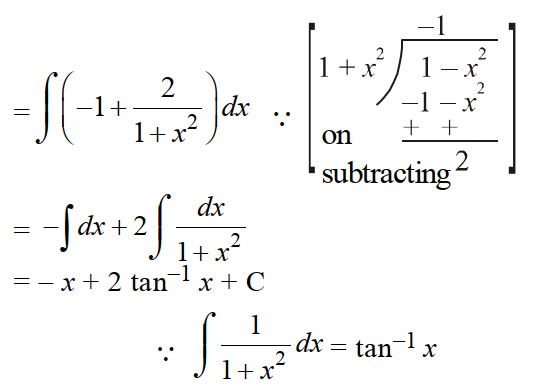
Integrate with respect to $x$ :
$\frac{1-x^2}{1+x^2}$
Answer
Let $I =\int \frac{1-x^2}{1+x^2} d x$
Here degree of numerator is same as that of denominator. So integration can be done by dividing the numerator by denominator.
$
\therefore I=\int \frac{1-x^2}{1+x^2} d x
$
Image
View full question & answer
Question 122 Marks
Integrate the function $\frac{\log x}{(1+\log x)^2}$ with respect to $x$.
Answer
Let $ I =\int \frac{\log x}{(1+\log x)^2} d x$
Adding and subtracting $1$ from numerator
$I=\int \frac{(\log x+1-1)}{(1+\log x)^2} d x$
$I=\int \frac{1}{(1+\log x)} d x-\int \frac{d x}{(1+\log x)^2}$
$I=\int \frac{1}{(1+\log x)} \cdot 1 d x-\int \frac{d x}{(1+\log x)^2}$
Assuming $"1\ "$ as second function integrating by parts :
$I=\frac{1}{(1+\log x)} \cdot x-\int \frac{-1}{(1+\log x)^2} \cdot \frac{1}{x} \times x d x-$
$\int \frac{d x}{(1+\log x)^2}+C$
$I=\frac{x}{(1+\log x)}+\int \frac{1}{(1+\log x)^2} d x-$
$\int \frac{1}{(1+\log x)^2} d x+C$
$I=\frac{x}{(1+\log x)}+C $
View full question & answer
Question 132 Marks
Evaluate $\int \frac{\sin x-x \cos x}{x(x+\sin x)} d x$.
Answer
Let
$
\begin{aligned}
I & =\int \frac{\sin x-x \cos x}{x(x+\sin x)} d x \\
& =\int \frac{(x+\sin x)-x(1+\cos x)}{x(x+\sin x)} d x \\
& =\int \frac{x+\sin x}{x(x+\sin x)} d x-\int \frac{x(1+\cos x)}{x(x+\sin x)} d x \\
& =\int \frac{1}{x} d x-\int \frac{1+\cos x}{x+\sin x} d x \\
& =\log |x|-\log |x+\sin x|+\text { C Ans. }
\end{aligned}
$
View full question & answer
Question 142 Marks
Find the value of $\int \operatorname{cosec}^2 x \sec ^2 x \ d x$.
Answer
$\int \operatorname{cosec}^2 x \sec ^2 x\ d x$
$=\int \frac{1}{\sin ^2 x} \times \frac{1}{\cos ^2 x}\ d x$
$=\int \frac{1}{\sin ^2 x \cdot \cos ^2 x} \ d x$
$=\int \frac{\sin ^2 x+\cos ^2 x}{\sin ^2 x \cdot \cos ^2 x}\ d x$
$=\int \frac{\sin ^2 x}{\sin ^2 x \cdot \cos ^2 x} d x+\int \frac{\cos ^2 x d x}{\sin ^2 x \cdot \cos ^2 x}$
$=\int \frac{1}{\cos ^2 x} d x+\int \frac{1}{\sin ^2 x}\ d x$
$=\int \sec x\  d x+\int \operatorname{cosec} x\  d x$
$=\tan x-\cot x+C \operatorname{sins}^2 x$
View full question & answer
Question 152 Marks
Evaluate $\int \frac{\sin ^3 x+\cos ^3 x}{\sin ^2 x \cos ^2 x} d x$.
Answer
$\int \frac{\sin ^3 x+\cos ^3 x}{\sin ^2 x \cos ^2 x}\ d x$
$=\int\left(\frac{\sin ^3 x}{\sin ^2 x \cos ^2 x}+\frac{\cos ^3 x}{\sin ^2 x \cos ^2 x}\right) d x$
$=\int\left(\frac{\sin x}{\cos ^2 x}+\frac{\cos x}{\sin ^2 x}\right) d x$
$=\int(\tan x \sec x+\cot x \operatorname{cosec} x)\  d x$
$=\int \tan x \sec x\ d x+\int \cot x \operatorname{cosec} x\  d x$
$=\sec x-\operatorname{cosec} x+C$
View full question & answer
2 Marks Questions - MATHS STD 12 Science Questions - Vidyadip