Question 513 Marks
Evaluate the following:
$\tan\frac{1}{2}\Big(\cos^{-1}\frac{\sqrt5}{3}\Big)$
AnswerLet $\frac{1}{2}\sin^{-1}\frac{3}{4}=\text{x}$
$ \sin^{-1}\frac{3}{4}=2\text{x}$
$ \sin2\text{x}=\frac{3}{4}$
$\cos2\text{x}=\frac{\sqrt7}{4}$
$\tan\Big(\frac{1}{2}\sin^{-1}\frac{3}{4}\Big)$
$=\tan\text{x}$
$ =\sqrt{\frac{1-\cos2\text{x}}{1+\cos2\text{x}}}$
$=\sqrt{\frac{1-\frac{\sqrt7}{4}}{1+\frac{\sqrt7}{4}}}$
$=\sqrt{\frac{4-\sqrt7}{4+\sqrt7}}$
$=\sqrt{\frac{\big(4-\sqrt7\big)\big(4-\sqrt7\big)}{\big(4+\sqrt7\big)\big(4-\sqrt7\big)}}$
$=\sqrt{\frac{\big(4-\sqrt7\big)^2}{9}}$
$ =\frac{4-\sqrt7}{3}$
View full question & answer→Question 523 Marks
Solve the following equation for x:
$\tan^{-1}2\text{x}+\tan^{-1}3\text{x}=\text{n}\pi+\frac{3\pi}{4}$
AnswerGiven$\tan^{-1}2\text{x}+\tan^{-1}3\text{x}=\text{n}\pi+\frac{3\pi}{4}....(1)$
$\Rightarrow\tan^{-1}\Big(\frac{2\text{x}+3\text{x}}{1-2\text{x}\times3\text{x}}\Big)=\text{n}\pi+\frac{3\pi}{4}$
$\Big\{\text{Since}\tan^{-1}\text{x}+\tan^{-1}\text{y}=\tan^{-1}\Big(\frac{\text{x+y}}{1-\text{xy}}\Big)\text{ if }\text{xy}<1\Big\}$
$\Rightarrow\tan^{-1}\Big(\frac{5\text{x}}{1-6\text{x}^2}\Big)=\text{n}\pi+\frac{3\pi}{4},6\text{x}^2<1$
$\Rightarrow\frac{5\text{x}}{1-6\text{x}^2}=\tan\Big(\text{n}\pi+\frac{3\pi}{4}\Big),6\text{x}^2<1$
$\Rightarrow\frac{5\text{x}}{1-6\text{x}^2}-1,6\text{x}^2<1$
$\Rightarrow5\text{x}=-1+6\text{x}^2,6\text{x}^2<1$
$\Rightarrow6\text{x}^2-5\text{x}-1=0,\text{x}^2<\frac{1}{6}$
$\Rightarrow6\text{x}^2-6\text{x}+\text{x}-1=0,-\frac{1}{\sqrt6}<\text{x}<\frac{1}{6}$
$\Rightarrow6\text{x}(\text{x}-1)+1(\text{x}-1)=0,-\frac{1}{\sqrt6}<\text{x}<\frac{1}{6}$
$\Rightarrow(6\text{x}+1)(\text{x}-1)=0$
$\Rightarrow6\text{x}+1=0$ or $\text{x}-1=0$
$\Rightarrow\text{x}=-\frac{1}{6}$ or $\text{x}=1$
Since, $\text{x}=1\notin\Big(-\frac{1}{\sqrt6},\frac{1}{\sqrt6}\Big)$
So,
x = 1 is not root of the given equation (i).
Since,
$\text{x}=1\in\Big(-\frac{1}{\sqrt6},\frac{1}{\sqrt6}\Big)$
So,
$\text{x}=-\frac{1}{6}$ is the root of the given equation (i).
Hence,
$\text{x}=-\frac{1}{6}$
View full question & answer→Question 533 Marks
Evaluate the following:
$\tan\Big\{2\tan^{-1}\frac{1}{5}-\frac{\pi}{4}\Big\}$
Answer$\tan\Big(2\tan^{-1}\frac{1}{5}-\frac{\pi}{4}\Big)=\tan\Big(2\tan^{-1}\frac{1}{5}-\tan^{-1}1\Big)$
$=\tan\begin{bmatrix}\tan^{-1}\begin{Bmatrix}\frac{2\times\frac{1}{5}}{1-\Big(\frac{1}{5}\Big)^2}\end{Bmatrix}-\tan^{-1}1\end{bmatrix}$
$ \Big[\because\ 2\tan^{-1}\text{x}=\tan^{-1}\Big\{\frac{2\text{x}}{1-\text{x}^2}\Big\}\Big]$
$=\tan\Bigg[\tan^{-1}\Bigg\{\frac{\frac{2}{5}}{\frac{24}{25}}\Bigg\}-\tan^{-1}1\Bigg]$
$ =\tan\Big[\tan^{-1}\frac{5}{12}+\tan^{-1}1\Big]$
$=\tan^{-1}\Bigg[\tan^{-1}\Bigg(\frac{\frac{15}{12}-1}{1+\frac{5}{12}}\Bigg)\Bigg]$
$\Big[\because\tan^{-1}\text{x}-\tan^{-1}\text{y}=\tan^{-1}\Big(\frac{\text{x}-\text{y}}{1+\text{xy}}\Big)\Big]$
$ =\tan\Bigg[\tan^{-1}\Bigg(\frac{\frac{-7}{12}}{\frac{17}{12}}\Bigg)\Bigg]$
$=\tan\Big[\tan^{-1}\frac{-7}{17}\Big]$
$=\frac{-7}{17}$
View full question & answer→Question 543 Marks
Prove that:
$\tan^{-1}\frac{1}{5}+\tan^{-1}\frac{1}{7}+\tan^{-1}\frac{1}{3}+\tan^{-1}\frac{1}{8}=\frac{\pi}{4}$
Answer$\text{L.H.S.}=\tan^{-1}\frac{1}{5}+\tan^{-1}\frac{1}{7}+\tan^{-1}\frac{1}{3}+\tan^{-1}\frac{1}{8}$
$=\tan^{-1}\Bigg(\frac{\frac{1}{5}+\frac{1}{7}}{1-\frac{1}{5}\times\frac{1}{7}}\Bigg)+\tan^{-1}\Bigg(\frac{\frac{1}{3}+\frac{1}{8}}{1-\frac{1}{3}\times\frac{1}{8}}\Bigg)$ $\left[\tan^{-1}x+\tan^{-1}y=\tan^{-1}\frac{x+y}{1-xy}\right]$
$ =\tan^{-1}\bigg(\frac{7+5}{35-1}\bigg)+\tan^{-1}\bigg(\frac{8+3}{24-1}\bigg)$
$=\tan^{-1}\frac{12}{34}+\tan^{-1}\frac{11}{23}$
$=\tan^{-1}\frac{6}{17}+\tan^{-1}\frac{11}{23}$
$=\tan^{-1}\Bigg(\frac{\frac{6}{17}+\frac{11}{23}}{1-\frac{6}{17}\times\frac{11}{23}}\Bigg)$
$=\tan^{-1}\bigg(\frac{138+187}{391-66}\bigg)$
$=\tan^{-1}\left(\frac{325}{325}\right)=\tan^{-1}1$
$ =\frac{\pi}{4}=\text{R.H.S.}$
View full question & answer→Question 553 Marks
Prove the following results:
$2\sin^{-1}\frac{3}{5}=\tan^{-1}\frac{24}{7}$
Answer$2\sin^{-1}\frac{3}{5}=\tan^{-1}\frac{24}{7}$ $\text{L.H.S}=2\sin^{-1}\frac{3}{5}$ $=2\times\tan^{-1}\begin{bmatrix}\frac{\frac{3}{5}}{\sqrt{1-\Big(\frac{3}{5}\Big)^2}}\end{bmatrix}$ $\bigg\{\text{Since }\sin^{-1}\text{x}=\tan^{-1}\frac{\text{x}}{\sqrt{1-\text{x}^2}}\bigg\}$ $=2\tan^{-1}\Bigg(\frac{\frac{3}{5}}{\frac{4}{5}}\Bigg)$ $=2\tan^{-1}\Big(\frac{3}{4}\Big)$ $=\tan^{-1}\Bigg(\frac{2\times\frac{3}{4}}{1-\big(\frac{3}{4}\big)^2}\Bigg)$ $\Big\{\text{Since }2\tan^{-1}\text{x}=\tan^{-1}\frac{2\text{x}}{1-\text{x}^2}\Big\}$ $=\tan^{-1}\bigg(\frac{\frac{3}{2}}{\frac{7}{16}}\bigg)$ $=\tan^{-1}\Big(\frac{24}{7}\Big)$ $=\text{R.H.S}$So,
$2\sin^{-1}\frac{3}{5}=\tan^{-1}\frac{24}{7}$
View full question & answer→Question 563 Marks
Prove that
$\text{L.H.S}=\sin\Big\{\tan^{-1}\frac{1-\text{x}^2}{2\text{x}}+\cos^{-1}\frac{1-\text{x}^2}{1+\text{x}^2}\Big\}=1$
Answer$\text{L.H.S}=\sin\Big[\tan^{-1}\Big(\frac{1-\text{x}^2}{2\text{x}}\Big)+\cos^{-1}\Big(\frac{1-\text{x}^2}{1+\text{x}^2}\Big)\Big]=1$
$\text{L.H.S}=\sin\Big[\tan^{-1}\Big(\frac{1-\text{x}^2}{2\text{x}}\Big)+\cos^{-1}\Big(\frac{1-\text{x}^2}{1+\text{x}^2}\Big)\Big]$
$=\sin\Big[\tan^{-1}\Big(\frac{1-\text{x}^2}{2\text{x}}\Big)+2\tan^{-1}\text{x}\Big]$
$\Big\{\text{Since }2\tan^{-1}\text{x}=\cos^{-1}\Big(\frac{1-\text{x}^2}{1+\text{x}^2}\Big)\Big\}$
$=\sin\big[\tan^{-1}\big]\Big(\frac{1-\text{x}^2}{2\text{x}}\Big)+\tan^{-1}\Big(\frac{2\text{x}}{1-\text{x}^2}\Big)$
$\Big\{\text{Since }2\tan^{-1}\text{x}=\tan\frac{2\text{x}}{1-\text{x}^2}\Big\}$
$=\sin\begin{bmatrix}\tan^{-1}\begin{pmatrix}\frac{\frac{1-\text{x}^2}{2\text{x}}+\frac{2\text{x}}{1-\text{x}^2}}{1-\frac{1-\text{x}^2}{2\text{x}}\times\frac{2\text{x}}{1-\text{x}^2}}\end{pmatrix}\end{bmatrix}$
$\Big\{\text{Since }\tan^{-1}\text{x}+\tan^{-1}\text{y}=\tan^{-1}\Big(\frac{\text{x}+\text{y}}{1-\text{xy}}\Big)\Big\}$
$=\sin\Bigg[\tan^{-1}\Bigg(\frac{\frac{1+\text{x}^4-2\text{x}^2+4\text{x}^2}{2\text{x}(1-\text{x}^2)}}{0}\Bigg)\Bigg]$
$=\sin\big[\tan^{-1}(\infty)\big]$
$=\sin\Big[\frac{\pi}{2}\Big]$
$=1$
$=\text{R.H.S}$
Hence,
$\text{L.H.S}=\sin\Big[\tan^{-1}\Big(\frac{1-\text{x}^2}{2\text{x}}\Big)+\cos^{-1}\Big(\frac{1-\text{x}^2}{1+\text{x}^2}\Big)\Big]=1$
View full question & answer→Question 573 Marks
Solve the following equation for x:
$\tan^{-1}\frac{\pi}{2}+\tan^{-1}\frac{\pi}{3}=\frac{\pi}{4},0<\text{x}<\sqrt6$
AnswerGiven,
$\tan^{-1}\frac{\pi}{2}+\tan^{-1}\frac{\pi}{3}=\frac{\pi}{4},0<\text{x}<\sqrt6$
$\Rightarrow\tan^{-1}\bigg[\frac{\frac{\text{x}}{2}+\frac{\text{x}}{3}}{1-\frac{\text{x}}{2}\times\frac{\text{x}}{3}}\bigg]=\frac{\pi}{4}$
$\Big\{\text{Since},\tan^{-1}\text{x}+\tan^{-1}\text{y}=\tan^{-1}\Big(\frac{\text{x}+\text{y}}{1-\text{xy}}\Big)\Big\}$
$\Rightarrow\tan^{-1}\Bigg[\frac{\frac{5\text{x}}{6}}{\frac{(6-\text{x}^2)}{16}}\Bigg]=\frac{\pi}{4}$
$\Rightarrow\tan^{-1}\Big[\frac{5\text{x}}{6-\text{x}^2}\Big]=\frac{\pi}{4}$
$\Rightarrow\frac{5\text{x}}{6-\text{x}^2}=\tan\frac{\pi}{4}$
$\Rightarrow\frac{5\text{x}}{6-\text{x}^2}=1$
$\Rightarrow5\text{x}=6\text{x}^2$
$\Rightarrow\text{x}^2+5\text{x}-6=0$
$\Rightarrow\text{x}^2+6\text{x}-\text{x}-6=0$
$\Rightarrow\text{x}(\text{x}+6)-1(\text{x}+6)=0$
$\Rightarrow(\text{x}+6)(\text{x}-1)=0$
$\Rightarrow\text{x}=-6\text{ or }\text{x}=1$
But, $0<\text{x}<\sqrt6,$ so,
$\text{x}=1$
View full question & answer→Question 583 Marks
Solve the following:
$\sin^{-1}\text{x}+\sin^{-1}2\text{x}=\frac{\pi}{3}$
AnswerWe know $\sin^{-1}\text{x}+\sin^{-1}\text{y}=\sin^{-1}\Big[\text{x}\sqrt{1-\text{y}^2}+\text{y}\sqrt{1-\text{x}^2}\Big]$ $\therefore\ \sin^{-1}\text{x}+\sin^{-1}2\text{x}=\frac{\pi}{3}$ $\Rightarrow\sin^{-1}\text{x}+\sin^{-1}2\text{x}=\sin^{-1}\Big(\frac{\sqrt{3}}{2}\Big)$$\Rightarrow\sin^{-1}\text{x}-\sin^{-1}\Big(\frac{\sqrt{3}}{2}\Big)=-\sin^{-1}2\text{x}$
$\Rightarrow\sin^{-1}\bigg[\text{x}\sqrt{1-\frac{3}{4}}+\frac{\sqrt3}{2}\sqrt{1-\text{x}^2}\bigg]=-\sin^{-1}2\text{x}$
$\Rightarrow\sin^{-1}\Big[\frac{\text{x}}{2}+\frac{\sqrt3}{2}\sqrt{1-\text{x}^2}\Big]=\sin^{-1}(-2\text{x})$
$\Rightarrow\frac{\text{x}}{2}+\frac{\sqrt3}{2}\sqrt{1-\text{x}^2}=-2\text{x}$
$\Rightarrow5\text{x}=-\sqrt3\sqrt{1-\text{x}^2}$
Squaring both the sides, $25\text{x}^2=3-3\text{x}^2$ $\Rightarrow28\text{x}^2=3$ $\Rightarrow\text{x}=\pm\frac{1}{2}\sqrt{\frac{3}{7}}$
View full question & answer→Question 593 Marks
Evaluate: $\sin\Big\{\cos^{-1}\Big(-\frac{3}{5}\Big)+\cot^{-1}\Big(-\frac{5}{12}\Big)\Big\}$
Answer$\sin\Big\{\cos^{-1}\Big(-\frac{3}{5}\Big)+\cot^{-1}\Big(-\frac{5}{12}\Big)\Big\}$
$=\sin\Big\{\pi-\cos^{-1}\Big(\frac{3}{5}\Big)+\pi-\cot^{-1}\Big(\frac{5}{12}\Big)\Big\}$
$=\sin\Big\{2\pi-\Big[\cos^{-1}\Big(\frac{3}{5}\Big)+\cot^{-1}\Big(\frac{5}{12}\Big)\Big]\Big\}$
$=-\sin\Big\{\cos^{-1}\Big(\frac{3}{5}\Big)+\cot^{-1}\Big(\frac{5}{12}\Big)\Big\}$
$=-\sin\begin{Bmatrix}\sin^{-1}\Bigg[\sqrt{1-\Big(\frac{3}{5}\Big)^2}\Bigg]=\sin^{-1}\begin{bmatrix}\frac{\frac{12}{5}}{\sqrt{1+\big(\frac{12}{5}\big)^2}}\end{bmatrix}\end{Bmatrix}$
$=-\sin\Big(\sin^{-1}\frac{4}{5}+\sin^{-1}\frac{12}{13}\Big)$
$=-\sin\Bigg\{\sin^{-1}\Bigg[\frac{4}{5}\times\sqrt{1-\Big(\frac{12}{13}\Big)^2}+\frac{12}{13}\times\sqrt{1-\Big(\frac{4}{5}\Big)^2}\Bigg]\Bigg\}$
$=-\sin\Big[\sin^{-1}\Big(\frac{20}{65}+\frac{36}{64}\Big)\Big]$
$=-\sin\Big[\sin^{-1}\Big(\frac{56}{65}\Big)\Big]$
$=-\frac{56}{65}$
View full question & answer→Question 603 Marks
Prove the following results:
$2\tan^{-1}\Big(\frac{1}{2}\Big)+\tan^{-1}\Big(\frac{1}{7}\Big)=\tan^{-1}\Big(\frac{31}{17}\Big)$
Answer$\text{L.H.S}=2\tan^{-1}\frac{1}{2}+\tan^{-1}\frac{1}{7}$ $=\tan^{-1}\Bigg\{\frac{2\times\frac{1}{2}}{1-\big(\frac{1}{2}\big)^2}\Bigg\}+\tan^{-1}\frac{1}{7}$ $\Big[\because\ 2\tan^{-1}\text{x}=\tan^{-1}\Big\{\frac{2\text{x}}{1-\text{x}^2}\Big\}\Big]$ $=\tan^{-1}\Bigg\{\frac{1}{\frac{3}{4}}\Bigg\}+\tan^{-1}\frac{1}{7}$ $=\tan^{-1}\frac{4}{3}+\tan^{-1}\frac{1}{7}$ $=\tan^{-1}\Bigg(\frac{\frac{4}{3}+\frac{1}{7}}{1-\frac{4}{3}\times\frac{1}{7}}\Bigg)$ $\Big[\because\ \tan^{-1}\text{x}+\tan^{-1}\text{y}=\tan^{-1}\Big(\frac{\text{x}+\text{y}}{1-\text{xy}}\Big)\Big]$$=\tan^{-1}\Bigg(\frac{\frac{31}{21}}{\frac{17}{21}}\Bigg)$
$=\tan^{-1}\frac{31}{17}=\text{R.H.S}$
View full question & answer→Question 613 Marks
Solve $\cos^{-1}\sqrt3\text{x}+\cos^{-1}\text{x}=\frac{\pi}{2}$
Answer$\cos^{-1}\sqrt3\text{x}+\cos^{-1}\text{x}=\frac{\pi}{2}$
$ \Rightarrow\cos^{-1}\Big[\sqrt3\text{x}\times\text{x}-\sqrt{1-\big(\sqrt3\text{x}\big)^2}\sqrt{1-\text{x}^2}\Big]=\frac{\pi}{2}$
$\Big[\because\ \cos^{-1}\text{x}+\cos^{-1}\text{y}=\cos^{-1}\Big(\text{xy}-\sqrt{1-\text{x}^2}\sqrt{1-\text{y}^2}\Big)\Big]$
$ \Rightarrow\cos^{-1}\Big[\sqrt3\text{x}^2-\sqrt{1-3\text{x}^2}\sqrt{1-\text{x}^2}\Big]=\frac{\pi}{2}$
$\Rightarrow\sqrt3\text{x}^2-\sqrt{1-3\text{x}^2}\sqrt{1-\text{x}^2}=\cos\frac{\pi}{2}$
$ \Rightarrow\sqrt3\text{x}^2=\sqrt{1-3\text{x}^2}\sqrt{1-\text{x}^2}$
$ \Rightarrow3\text{x}^2=\big(1-3\text{x}^2\big)\big(1-\text{x}^2\big)$
$ \Rightarrow3\text{x}^4=1-3\text{x}^2+3\text{x}^4-\text{x}^2$
$ \Rightarrow4\text{x}^2=1$
$ \Rightarrow\text{x}^2=\frac{1}{4}$
$ \Rightarrow\text{x}=\pm\frac{1}{2}$
View full question & answer→Question 623 Marks
If $\sin^{-1}\text{x}+\sin^{-1}\text{y}+\sin^{-1}\text{z}+\sin^{-1}\text{t}=2\pi,$ then find the value of $x^2 + y^2 + z^2 + t^2$
AnswerWe know that the maximum value of $\sin^{-1}\text{x}+\sin^{-1}\text{y}+\sin^{-1}\text{z}$ and $\sin^{-1}\text{t}$ is $\frac{\pi}{2}$ Now,$\text{L.H.S}=\sin^{-1}\text{x}+\sin^{-1}\text{y}+\sin^{-1}\text{z}+\sin^{-1}\text{t}$
$=\frac{\pi}{2}+\frac{\pi}{2}+\frac{\pi}{2}+\frac{\pi}{2}$ $=2\pi=\text{R.H.S}$
Now, $\sin^{-1}\text{x}=\frac{\pi}{2},\sin^{-1}\text{y}=\frac{\pi}{2},\sin^{-1}\text{z}=\frac{\pi}{2}$ and
$\sin^{-1}\text{t}=\frac{\pi}{2}$
$\Rightarrow\text{x}=\sin\frac{\pi}{2},\text{y}=\sin\frac{\pi}{2},\text{z}=\sin\frac{\pi}{2}$ and
$\text{t}=\sin\frac{\pi}{2}$
$\Rightarrow x = 1, y = 1, z= 1$ and $t = 1$
$\therefore x^2 + y^2 + z^2 + t^2 = 1 + 1 + 1 + 1 = 4$
View full question & answer→Question 633 Marks
Solve the equation
$\cos^{-1}\frac{\text{a}}{\text{x}}-\cos^{-1}\frac{\text{b}}{\text{x}}=\cos^{-1}\frac{1}{\text{b}}-\cos^{-1}\frac{1}{\text{b}}-\cos^{-1}\frac{1}{\text{a}}$
Answer$\cos^{-1}\frac{\text{a}}{\text{x}}-\cos^{-1}\frac{\text{b}}{\text{x}}=\cos^{-1}\frac{1}{\text{b}}-\cos^{-1}\frac{1}{\text{b}}-\cos^{-1}\frac{1}{\text{a}}$
$\cos^{-1}\frac{\text{a}}{\text{x}}-\cos^{-1}\frac{\text{1}}{\text{a}}=\cos^{-1}\frac{\text{b}}{\text{x}}-\cos^{-1}\frac{\text{1}}{\text{b}}$
$\cos^{-1}\bigg[\frac{1}{\text{x}}-\sqrt{1-\frac{\text{a}^2}{\text{x}^2}}\sqrt{1-\frac{1}{\text{a}^2}}\bigg]$ $=\cos^{-1}\bigg[\frac{1}{\text{x}}-\sqrt{1-\frac{\text{b}^2}{\text{x}^2}}\sqrt{1-\frac{1}{\text{b}^2}}\bigg] $
$\Rightarrow\frac{1}{\text{x}}-\sqrt{1-\frac{\text{a}^2}{\text{x}^2}}\sqrt{1-\frac{1}{\text{a}^2}}=\frac{1}{\text{x}}-\sqrt{1-\frac{\text{b}^2}{\text{x}^2}}\sqrt{1-\frac{1}{\text{b}^2}} $
$\Rightarrow\sqrt{1-\frac{\text{a}^2}{\text{x}^2}}\sqrt{1-\frac{\text{1}}{\text{a}^2}}=\sqrt{1-\frac{\text{b}^2}{\text{x}^2}}\sqrt{1-\frac{\text{1}}{\text{b}^2}}$
$\Rightarrow \Big(1-\frac{\text{a}^2}{\text{x}^2}\Big)\Big(1-\frac{1}{\text{a}^2}\Big)=\Big(1-\frac{\text{b}^2}{\text{x}^2}\Big)\Big(1-\frac{\text{1}}{\text{b}^2}\Big)$
$\Rightarrow1-\frac{1}{\text{a}^2}-\frac{\text{a}^2}{\text{x}^2}+\frac{1}{\text{x}^2}=1-\frac{1}{\text{b}^2}-\frac{\text{a}^2}{\text{x}^2}+\frac{1}{\text{x}^2}$
$\Rightarrow\frac{\text{b}^2}{\text{x}^2}-\frac{\text{a}^2}{\text{x}^2}=\frac{1}{\text{a}^2}-\frac{1}{\text{b}^2}$
$\Rightarrow\big(\text{b}^2-\text{a}^2\big)\text{a}^2\text{b}^2=\text{x}^2\big(\text{b}^2-\text{a}^2\big) $
$\Rightarrow\text{x}^2=\text{a}^2\text{b}^2$
$\Rightarrow\text{x}=\text{ab}$
View full question & answer→Question 643 Marks
Prove the following results:
$\tan^{-1}\frac{1}{4}+\tan^{-1}\frac{2}{9}=\frac{1}{2}\cos^{-1}\frac{3}{5}=\frac{1}{2}\sin^{-1}\Big(\frac{4}{5}\Big)$
Answer$\text{L.H.S}=\tan^{-1}\frac{1}{4}+\tan^{-1}\frac{2}{9}$
$=\tan^{1}\Bigg(\frac{\frac{1}{4}+\frac{2}{9}}{1-\frac{1}{4}\times\frac{2}{9}}\Bigg)$ $ \Big[\because\ \tan^{-1}\text{x}+\tan^{-1}\text{y}=\tan^{-1}\Big(\frac{\text{x}+\text{y}}{1-\text{xy}}\Big)\Big]$
$ =\tan^{-1}\bigg(\frac{\frac{17}{36}}{\frac{34}{36}}\bigg)$
$ =\tan^{-1}\frac{1}{2}$
$=\frac{1}{2}\cos^{-1}\Bigg(\frac{1-\frac{1}{4}}{1+\frac{1}{4}}\Bigg)$ $\Big[\because\ \tan^{-1}\text{x}=\frac{1}{2}\cos^{-1}\Big(\frac{1-\text{x}^2}{1+\text{x}^2}\Big)\Big]$
$=\frac{1}{2}\cos^{-1}\Bigg(\frac{\frac{3}{4}}{\frac{5}{4}}\Bigg)$
$=\frac{1}{2}\cos^{-1}\Big(\frac{3}{5}\Big)$
Now,
$\tan^{-1}\frac{1}{2}=\frac{1}{2}\sin^{-1}\Bigg(\frac{\frac{2}{2}}{1+\frac{1}{4}}\Bigg)$ $\Big[\because\ \tan^{-1}\text{x}=\frac{1}{2}\sin^{-1}\Big(\frac{2\text{x}}{1+\text{x}^2}\Big)\Big]$
$=\frac{1}{2}\sin^{-1}\bigg(\frac{1}{\frac{5}{4}}\bigg)$
$=\frac{1}{2}\sin^{-1}\Big(\frac{4}{5}\Big)$
View full question & answer→Question 653 Marks
Prove that:
$\cot^{-1}\bigg(\frac{\sqrt{1+\sin x}+\sqrt{1-\sin x}}{\sqrt{1+\sin x}-\sqrt{1-\sin x}}\bigg)=\frac{x}{2},x\in\bigg(0,\frac{\pi}{4}\bigg)$
Answer$\text{Consider}\ \frac{\sqrt{1+\sin x}+\sqrt{1-\sin x}}{\sqrt{1+\sin x}-\sqrt{1-\sin x}}$
$=\frac{\left(\sqrt{1+\sin x}+\sqrt{1-\sin x}\right)^2}{\left(\sqrt{1+\sin}\right)^2-\left(\sqrt{1-\sin x}\right)^2}$ (by rationalizing)
$=\frac{\left(1+\sin x\right)+\left(1-\sin x\right)+2\sqrt{\left(1+\sin x\right)\left(1-\sin x\right)}}{1+\sin x-1+\sin x}$
$=\frac{2\left(1+\sqrt{1-\sin^2x}\right)}{2\sin x}=\frac{1+\cos x}{\sin x}=\frac{2\cos^2\frac{x}{2}}{2\sin\frac{x}{2}\cos\frac{x}{2}}$
$=\cot\frac{x}{2}$
$\therefore\text{L.H.S.}=\cot^{-1}\bigg(\frac{\sqrt{1+\sin x}+\sqrt{1-\sin x}}{\sqrt{1+\sin x}-\sqrt{1-\sin x}}\bigg)$
$=\cot^{-1}\left(\cot\frac{x}{2}\right)=\frac{x}{2}=\text{R.H.S.}$
View full question & answer→Question 663 Marks
If $\sin^{-1}\frac{2\text{a}}{1+\text{a}^2}-\cos^{-1}\frac{1-\text{b}^2}{1+\text{b}^2}=\tan^{-1}\frac{2\text{x}}{1-\text{x}^2},$ then prove that $\text{x}=\frac{\text{a}-\text{b}}{1+\text{ab}}$
AnswerLet:
$\text{a}=\tan\text{m}$
$\text{b}=\tan\text{n}$
$\text{x}=\tan\text{y}$
Now,
$\sin^{-1}\frac{2\text{a}}{1+\text{a}^2}-\cos^{-1}\frac{1-\text{b}^2}{1+\text{b}^2}=\tan^{-1}\frac{2\text{x}}{1-\text{x}^2},$
$\Rightarrow\sin^{-1}\frac{2\tan\text{m}}{1+\tan^2\text{m}}-\cos^{-1}\frac{1-\tan^{2}\text{n}}{1+\tan^{2}\text{n}}=\tan^{-1}\frac{2\tan\text{y}}{1-\tan^2\text{y}}$
$\Rightarrow\sin^{-1}(\sin2\text{m})-\cos^{-1}(\cos2\text{n})=\tan^{-1}(\tan2\text{y})$
$\Big[\because\ \sin2\text{x}=\frac{2\tan\text{x}}{1+\tan^2\text{x}},\cos2\text{x}=\frac{1-\tan^2\text{x}}{1+\tan^2\text{x}}\Big]$
$\Rightarrow2\text{m}-2\text{n}=2\text{y}$
$\Rightarrow\text{m}-\text{n}=\text{y}$
$\Rightarrow\tan^{-1}\text{a}-\tan^{-1}\text{b}=\tan^{-1}\text{x}$
$[\because\ \text{a}=\tan\text{m},b=\tan\text{n}\text{ and }\text{x}=\tan\text{y}]$
$\Rightarrow\tan^{-1}\frac{\text{a}-\text{b}}{1+\text{ab}}=\tan^{-1}\text{x}$
$\Big[\because\ \tan^{-1}\text{x}-\tan^{-1}\text{y}=\tan^{-1}\frac{\text{x}-\text{y}}{1+\text{xy}}\Big]$
$\Rightarrow\frac{\text{a}-\text{b}}{1+\text{ab}}=\text{x}$
View full question & answer→Question 673 Marks
Prove that $\cot\Big(\frac{\pi}{4}-2\cot^{-1}3\Big)=7$
AnswerWe have, $\cot\Big(\frac{\pi}{4}-2\cot^{-1}3\Big)=7$
$\Rightarrow\ \Big(\frac{\pi}{4}-2\cot^{-1}3\Big)=\cot^{-1}7$
$\Rightarrow\ (2\cot^{-1}3)=\frac{\pi}{4}-\cot^{-1}7$
$\Rightarrow\ 2\tan^{-1}\frac{1}{3}=\frac{\pi}{4}-\tan^{-1}\frac{1}{7}$
$\Big[\because\ \cot^{-1}\text{x}=\tan^{-1}\frac{1}{\text{x}}\Big]$
$\Rightarrow\ 2\tan^{-1}\frac{1}{3}+\tan^{-1}\frac{1}{7}=\frac{\pi}{4}$
$\Rightarrow\ \tan^{-1}\frac{\frac{2}{3}}{1-\big(\frac{1}{3}\big)^2}+\tan^{-1}\frac{1}{7}=\frac{\pi}{4}$
$\Big[\because\ 2\tan^{-1}\text{x}=\tan^{-1}\frac{2\text{x}}{1-\text{x}^2}\Big]$
$\Rightarrow\ \tan^{-1}\frac{3}{4}+\tan^{-1}\frac{1}{7}=\frac{\pi}{4}$
$\Rightarrow\ \tan^{-1}\frac{\frac{3}{4}+\frac{1}{7}}{1-\frac{3}{4}.{\frac{1}{7}}}=\frac{\pi}{4}$
$\Big[\because\ \tan^{-1}\frac{\text{A}+\text{B}}{1-\text{AB}}\Big]$
$\Rightarrow\ \tan^{-1}\frac{25}{25}=\frac{\pi}{4}$
$\Rightarrow\ 1=\tan\frac{\pi}{4}$
$\Rightarrow\ 1=1$
$\Rightarrow\ \text{LHS}=\text{RHS}$
View full question & answer→Question 683 Marks
If $\cos^{-1}\frac{\text{x}}{2}+\cos^{-1}\frac{\text{y}}{3}=\alpha,$ then prove that $9\text{x}^2-12\text{xy}\cos\alpha+4\text{y}^2=36\sin^2\alpha.$
AnswerWe know
$\cos^{-1}\text{x}+\cos^{-1}\text{y}=\cos^{-1}\Big[\text{xy}-\sqrt{1-\text{x}^2}\sqrt{1-\text{y}^2}\Big]$
Now,
$\cos^{-1}\frac{\text{x}}{2}+\cos^{-1}\frac{\text{y}}{3}=\alpha$
$\Rightarrow\cos^{-1}\bigg[\frac{\text{x}}{2}\frac{\text{y}}{3}-\sqrt{1-\frac{\text{x}^2}{4}}\sqrt{1-\frac{\text{y}^2}{3}}\bigg]=\alpha$
$\Rightarrow\frac{\text{x}}{2}\frac{\text{y}}{3}-\sqrt{1-\frac{\text{x}^2}{4}}\sqrt{1-\frac{\text{y}^2}{3}}=\cos\alpha$
$\Rightarrow\text{xy}-\sqrt{4-\text{x}^2}\sqrt{9-\text{y}^2}=6\cos\alpha$
$\Rightarrow\sqrt{4-\text{x}^2}\sqrt{9-\text{y}^2}=\text{xy}-6\cos\alpha$
$\Rightarrow\big(4-\text{x}^2\big)\big(9-\text{y}^2\big)=\text{x}^2\text{y}^2+36\cos^2\alpha-12\text{xy}\cos\alpha$ [Squaring both sides]
$\Rightarrow36-4\text{y}^2-9\text{x}^2+\text{x}^2\text{y}^2=\text{x}^2\text{y}^2+36\cos^2\alpha-12\text{xy}\cos\alpha$
$\Rightarrow36-4\text{y}^2-9\text{x}^2+=36\cos^2\alpha-12\text{xy}\cos\alpha$
$\Rightarrow9\text{x}^2-12\text{xy}\cos\alpha+4\text{y}^2=36-36\cos^2\alpha$
$\Rightarrow9\text{x}^2-12\text{xy}\cos\alpha+4\text{y}^2=36\sin^2\alpha$
View full question & answer→Question 693 Marks
If $\Big(\sin^{-1}\text{x}\Big)^2+\Big(\cos^{-1}\text{x}\Big)^2=\frac{175\pi^2}{36},$ find x.
Answer$\Big(\sin^{-1}\text{x}\Big)^2+\Big(\cos^{-1}\text{x}\Big)^2=\frac{175\pi^2}{36}$ $\Rightarrow\Big(\sin^{-1}\text{x}\Big)^2+\Big(\frac{\pi}{2}-\sin^{-1}\text{x}\Big)^2=\frac{175\pi^2}{36}$ Let $\sin^{-1}\text{x}=\text{y}$ $\therefore\ (\text{y})^2+\Big(\frac{\pi}{2}-\text{y}\Big)^2=\frac{17\pi^2}{36}$ $\Rightarrow\text{y}^2+\frac{\pi^2}{4}+\text{y}^2-2\times\frac{\pi}{2}\times\text{y}=\frac{17\pi^2}{36}$ $\Rightarrow2\text{y}^2-\pi\text{y}=\frac{2\pi^2}{9}$$\Rightarrow18\text{y}^2-9\pi\text{y}-2\pi^2=0$
$\Rightarrow18\text{y}^2-12\pi\text{y}+3\pi\text{y}-2\pi\text{x}^2=0$
$\Rightarrow6\text{y}(3\text{y}-2\pi)+\pi(3\text{y}+2\pi)=0$
$\Rightarrow(3\text{y}-2\pi)(6\text{y}+\pi)=0$
$\Rightarrow\text{y}=-\frac{\pi}{6}$
[Neglecting $\text{y}=\frac{2}{3}\pi$ as it is not satisfying the question]$\therefore\text{x}=\sin\text{y}=\sin\Big(-\frac{\pi}{6}\Big)=-\frac{1}{2}$
View full question & answer→Question 703 Marks
Prove that $\sin^{-1}\frac{8}{17}+\sin^{-1}\frac{3}{5}=\sin^{-1}\frac{77}{85}.$
AnswerWe have, $\sin^{-1}\frac{8}{17}+\sin^{-1}\frac{3}{5}=\sin^{-1}\frac{77}{85}$ $\therefore$ LHS $=\sin^{-1}\frac{8}{17}+\sin^{-1}\frac{3}{5}$ $=\sin^{-1}\Bigg(\frac{8}{17}\sqrt{1-\Big(\frac{3}{5}\Big)^2}+\frac{3}{5}\sqrt{1-\Big(\frac{8}{17}\Big)^2}\Bigg)$ $\Big[\because\ \sin^{-1}\text{x}+\sin^{-1}\text{y}=\sin^{-1}\Big(\text{x}\sqrt{1-\text{y}^2}+\text{y}\sqrt{1-\text{x}^2}\Big)\Big]$ $=\sin^{-1}\Big(\frac{8}{17}\times\frac{4}{5}+\frac{3}{5}\times\frac{15}{17}\Big)$$=\sin^{-1}\Big(\frac{32}{85}+\frac{45}{85}\Big)$
$=\sin^{-1}\Big(\frac{77}{85}\Big)$ = RHS
View full question & answer→Question 713 Marks
Show that $\cos\Big(2\tan^{-1}\frac{1}{7}\Big)=\sin\Big(4\tan^{-1}\frac{1}{3}\Big).$
AnswerWe have, $\cos\Big(2\tan^{-1}\frac{1}{7}\Big)=\sin\Big(4\tan^{-1}\frac{1}{3}\Big)$
$\Rightarrow\ \cos\begin{bmatrix}\cos^{-1}\begin{pmatrix}\frac{1-\big(\frac{1}{7}\big)^2}{1+\big(\frac{1}{7}\big)^2} \end{pmatrix}\end{bmatrix}=\sin\Big[2.2\tan^{-1}\frac{1}{3}\Big]$
$\Big[\because\ 2\tan^{-1}\text{x}=\cos^{-1}\Big(\frac{1-\text{x}^2}{1+\text{x}^2}\Big)\Big]$
$\Rightarrow\ \cos\begin{bmatrix}\cos^{-1}\begin{pmatrix}\frac{\frac{48}{49}}{\frac{50}{49}} \end{pmatrix}\end{bmatrix}=\sin\begin{bmatrix}2.\begin{pmatrix}\tan^{-1}\frac{\frac{2}{3}}{1-\big(\frac{1}{3}\big)^2} \end{pmatrix}\end{bmatrix}$
$\Big[\because\ 2\tan^{-1}\text{x}=\tan^{-1}\Big(\frac{2\text{x}}{1-\text{x}^2}\Big)\Big]$
$\Rightarrow\ \cos\Big[\cos^{-1}\Big(\frac{24}{25}\Big)\Big]=\sin\Big(2\tan^{-1}\frac{3}{4}\Big)$
$\Rightarrow\ \cos\Big[\cos^{-1}\Big(\frac{24}{25}\Big)\Big]=\sin\Bigg(\sin^{-1}\frac{2\times\frac{3}{4}}{1+\frac{9}{16}}\Bigg)$
$\Big[\because\ 2\tan^{-1}\text{x}=\sin^{-1}\Big(\frac{2\text{x}}{1+\text{x}^2}\Big)\Big]$
$\Rightarrow\ \frac{24}{25}=\sin\Bigg(\sin^{-1}\frac{\frac{3}{2}}{\frac{25}{16}}\Bigg)$
$\Rightarrow\ \frac{24}{25}=\frac{48}{50}$
$\Rightarrow\ \frac{24}{25}=\frac{24}{25}$
$\therefore\ \text{LHS}=\text{RHS}$
View full question & answer→Question 723 Marks
Write the value of $\tan^{-1}\text{x}+\tan^{-1}\Big(\frac{1}{\text{x}}\Big)$ x < 0.
Answer$\tan^{-1}\text{x}+\tan^{1}\text{y}=\tan^{-1}\Big(\frac{\text{x}+\text{y}}{1-\text{xy}}\Big)$
When $\text{x}<0,\frac{1}{\text{x}}<0,$ then both are negative.
Let x = -y, y>0
Then,
$\tan^{1}{\text{x}}+\tan^{-1}\frac{1}{\text{x}}=\tan^{-1}(-\text{y})+\tan^{-1}\Big(-\frac{1}{\text{y}}\Big)$
$=-\Big(\tan^{-1}\text{y}+\tan^{-1}\frac{1}{\text{y}}\Big)$
$=-\tan^{-1}\bigg(\frac{\text{y}+\frac{1}{\text{y}}}{1-\text{y}\frac{1}{\text{y}}}\bigg),\text{y}>0$
$=-\tan^{-1}\Big(\frac{\text{y}^2+1}{0}\Big)$
$=-\tan^{-1}(\infty)$
$=-\tan^{-1}\Big(\tan\frac{\pi}{2}\Big)$
$=-\frac{\pi}{2}$
$\therefore\ \tan^{-1}\text{x}+\tan^{-1}\frac{1}{\text{x}}=-\frac{\pi}{2},\text{x}<0$
View full question & answer→Question 733 Marks
Write the following in the simplest form:
$\tan^{-1}\sqrt{\frac{\text{a}-\text{x}}{\text{a}+\text{x}}},-\text{a}<\text{x}<\text{a}$
AnswerLet, $\text{x}=\text{a}\cos\theta$
Now,
$\tan^{-1}\sqrt{\frac{\text{a}-\text{x}}{\text{a}+\text{x}}}=\tan^{-1}\sqrt{\frac{\text{a}-\text{a}\cos\theta}{\text{a}+\text{a}\cos\theta}}$
$=\tan^{-1}\sqrt{\frac{1-\cos\theta}{1+\cos\theta}}$
$=\tan^{-1}\sqrt{\frac{2\sin^2\frac{\theta}{2}}{2\cos^2\frac{\theta}{2}}}$
$=\tan^{-1}\Big(\tan\frac{\theta}{2}\Big)$
$=\frac{\theta}{2}$
$=\frac{1}{2}\cos^{-1}\Big(\frac{\text{x}}{\text{a}}\Big)$
$\therefore\ \tan^{-1}\sqrt{\frac{\text{a}-\text{x}}{\text{a}+\text{x}}}=\frac{\cos^{-1}\big(\frac{\text{x}}{\text{a}}\big)}{2}$
View full question & answer→Question 743 Marks
Show that $\sin^{-1}\frac{5}{13}+\cos^{-1}\frac{3}{5}=\tan^{-1}\frac{63}{16}.$
AnswerLet us suppose, $\sin^{-1}\frac{5}{13}=\text{x},\ \cos^{-1}\frac{3}{5}=\text{y}$ $\Rightarrow\ \sin\text{x}=\frac{5}{13}$ and $\cos\text{y}=\frac{3}{5}$$\Rightarrow\ \cos\text{x}=\sqrt{1-\Big(\frac{5}{13}\Big)^2}=\frac{12}{13}$ and $\sin\text{y}=\sqrt{1-\Big(\frac{3}{5}\Big)^2}=\frac{4}{5}$
Now, $\tan\text{x}=\frac{\sin\text{x}}{\cos\text{x}}=\frac{\frac{5}{13}}{\frac{12}{13}}=\frac{5}{12}$ $\Rightarrow\ \tan\text{x}=\frac{5}{12}$ $\Rightarrow\ \text{x}=\tan^{-1}\frac{5}{12}$ And $\tan\text{y}=\frac{\sin\text{y}}{\cos\text{y}}=\frac{\frac{4}{5}}{\frac{3}{5}}=\frac{4}{3}$ $\Rightarrow\ \text{y}=\tan^{-1}\frac{4}{3}$ Now, LHS $=\sin^{-1}\frac{5}{13}+\cos^{-1}\frac{3}{5}$ $=\text{x}+\text{y}$ $=\tan^{-1}\text{x}+\tan^{-1}\text{y}$ $=\tan^{-1}\frac{\frac{5}{12}+\frac{4}{3}}{1-\frac{5}{12}.\frac{4}{3}}$ $=\tan^{-1}\Bigg(\frac{\frac{5}{12}+\frac{4}{3}}{1-\frac{5}{12}.\frac{4}{3}}\Bigg)$ $=\tan^{-1}\frac{63}{16}$ = RHS
View full question & answer→Question 753 Marks
Prove the following results:
$2\tan^{-1}\frac{1}{5}+\tan^{-1}\frac{1}{8}=\tan^{-1}\frac{4}{7}$
Answer$\text{L.H.S}=2\tan^{-1}\frac{1}{5}+\tan^{-1}\frac{1}{8}$
$=\tan^{-1}\frac{2\times\frac{1}{5}}{1-\big(\frac{1}{5}\big)^2}+\tan^{-1}\frac{1}{8}$ $\Big[\because\ 2\tan^{-1}\text{x}=\tan^{-1}\frac{2\text{x}}{1-\text{x}^2}\Big]$
$=\tan^{-1}\Bigg(\frac{\frac{2}{5}}{\frac{24}{25}}\Bigg)+\tan^{-1}\Big(\frac{1}{8}\Big)$
$=\tan^{-1}\Big(\frac{5}{12}\Big)+\tan^{-1}\Big(\frac{1}{8}\Big)$
$=\tan^{-1}\Bigg(\frac{\frac{5}{12}+\frac{1}{8}}{1-\frac{5}{12}\times\frac{1}{8}}\Bigg)$ $\Big[\text{Since }\tan^{-1}\text{x}+\tan^{-1}\text{y}=\tan^{-1}\frac{\text{x}+\text{y}}{1-\text{xy}}\Big]$
$=\tan^{-1}\Bigg(\frac{\frac{10+3}{24}}{\frac{96-5}{96}}\Bigg)$
$=\tan^{-1}\Big(\frac{13}{24}\times\frac{96}{91}\Big)$
$=\tan^{-1}\Big(\frac{4}{7}\Big)$
$=\text{R.H.S}$
Hence, $2\tan^{-1}\Big(\frac{1}{5}\Big)+\tan^{-1}\Big(\frac{1}{8}\Big)=\tan^{-1}\Big(\frac{4}{7}\Big)$
View full question & answer→Question 763 Marks
Solve the following equation $\cos(\tan^{-1}\text{x})=\sin\Big(\cot^{-1}\frac{3}{4}\Big).$
Answer
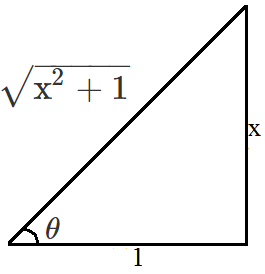 We have, $\cos(\tan^{-1}\text{x})=\sin\Big(\cot^{-1}\frac{3}{4}\Big)$
L.H.S. $=\cos(\tan^{-1}\text{x})$
$=\cos\Big(\cos^{-1}\frac{1}{\sqrt{\text{x}^2+1}}\Big)$
$=\frac{1}{\sqrt{\text{x}^2+1}}$
$(\because\ \cos(\cos^{-1}\text{x})=\text{x},\ \text{x}\in[-1,1])$
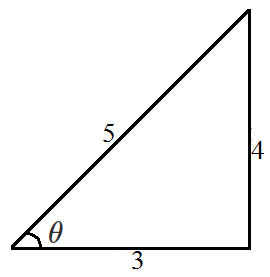 R.H.S. $=\sin\Big(\cot^{-1}\frac{3}{4}\Big)$
$=\sin\Big(\sin^{-1}\frac{4}{5}\Big)$
$=\frac{4}{5}$
$(\because\ \sin(\sin^{-1}\text{x})=\text{x},\ \text{x}\in[-1,1])$
$\therefore$ From given equation we get $\frac{1}{\sqrt{\text{x}^2+1}}=\frac{4}{5}$
$\Rightarrow\ 16(\text{x}^2+1)=25$
$\Rightarrow\ 16\text{x}^2=9$
$\Rightarrow\ \text{x}^2=\frac{9}{16}$
$\therefore\ \text{x}=\pm\frac{3}{4}$ View full question & answer→Question 773 Marks
Solve the following equation for x:
$\tan^{-1}\Big(\frac{\text{x}-2}{\text{x}-4}\Big)+\tan^{-1}\Big(\frac{\text{x}+2}{\text{x}+4}\Big)=\frac{\pi}{4}$
Answer$\tan^{-1}\Big(\frac{\text{x}-2}{\text{x}-4}\Big)+\tan^{-1}\Big(\frac{\text{x}+2}{\text{x}+4}\Big)=\frac{\pi}{4}$
We know
$\because\ \tan^{-1}\text{x}+\tan^{-1}\text{y}=\tan^{-1}\Big(\frac{\text{x}+\text{y}}{1-\text{xy}}\Big)$
$\Rightarrow\tan^{-1}\Bigg(\frac{\frac{\text{x}-2}{\text{x}-4}+\frac{\text{x}+2}{\text{x}+4}}{1-\frac{\text{x}-2}{\text{x}-4}\times\frac{\text{x}+2}{\text{x}+4}}\Bigg)=\frac{\pi}4{}$
$\Rightarrow\tan^{-1}\Bigg(\frac{\frac{\text{x}^2+2\text{x}-8+\text{x}^2-2\text{x}-8}{(\text{x}-4)(\text{x}+4)}}{\frac{\text{x}^2-16-\text{x}^2+4}{(\text{x}-4)(\text{x}+4)}}\Bigg)=\frac{\pi}{4}$
$\Rightarrow\frac{2\text{x}^2-16}{-12}=\tan\frac{\pi}{4}$
$\Rightarrow\frac{2\text{x}^2-16}{-12}=1$
$\Rightarrow2\text{x}^2-16=-12$
$\Rightarrow2\text{x}^2=4$
$\Rightarrow\text{x}^2=2$
$\Rightarrow\text{x}=\pm\sqrt2$
View full question & answer→Question 783 Marks
Show that $2\tan^{-1}(-3)=\frac{-\pi}{2}+\tan^{-1}\Big(\frac{-4}{3}\Big).$
AnswerLHS $=2\tan^{-1}(-3)=-2\tan^{-1}3$$[\because\ \tan^{-1}(-\text{x})=-\tan^{-1}\text{x},\ \text{x}\in\text{R}]$
$=-\Big[\cos^{-1}\frac{1-3^2}{1+3^2}\Big]$
$\Big[\because\ 2\tan^{-1}\text{x}=\cos^{-1}\frac{1-\text{x}^2}{1+\text{x}^2},\ \text{x}\geq0\Big]$
$=-\Big[\cos^{-1}\Big(\frac{-8}{10}\Big)\Big]=-\Big[\cos^{-1}\Big(\frac{-4}{5}\Big)\Big]$
$=-\Big[\pi-\cos^{-1}\Big(\frac{4}{5}\Big)\Big]$
$\{\because\ \cos^{-1}(-\text{x})=\pi-\cos^{-1}\text{x},\ \text{x}\in[-1,1]\}$
$=-\pi+\cos^{-1}\Big(\frac{4}{5}\Big)$
$\Big[\text{let}\ \cos^{-1}\Big(\frac{4}{5}\Big)=\theta\Rightarrow\ \cos\theta=\frac{4}{5}\Rightarrow\ \tan\theta=\frac{3}{4}\Rightarrow\ \theta=\tan^{-1}\frac{3}{4}\Big]$
$=-\pi+\tan^{-1}\Big(\frac{3}{4}\Big)=-\pi+\Big[\frac{\pi}{2}-\cot^{-1}\Big(\frac{3}{4}\Big)\Big]$
$=-\frac{\pi}{2}-\cot^{-1}\frac{3}{4}=-\frac{\pi}{2}-\tan^{-1}\frac{4}{3}$
$=-\frac{\pi}{2}+\tan^{-1}\Big(\frac{-4}{3}\Big)$
$[\because\ \tan^{-1}(-\text{x})=-\tan^{-1}\text{x}]$
= RHS (Hence proved)
View full question & answer→Question 793 Marks
Solve the following equation for x:
$\tan^{-1}(\text{x}+2)+\tan^{-1}(\text{x}-2)=\tan^{-1}\Big(\frac{8}{79}\Big),\text{x}>0$
AnswerWe know
$\tan^{-1}\text{x}+\tan^{-1}\text{y}=\tan^{-1}\Big(\frac{\text{x}+\text{y}}{1-\text{xy}}\Big)$
$\therefore\ \tan^{-1}(\text{x}+2)+\tan^{-1}(\text{x}-2)=\tan^{-1}\Big(\frac{8}{79}\Big)$
$\Rightarrow\tan^{-1}\Big(\frac{\text{x}+2+\text{x}-2}{1-(\text{x}+2)\times(\text{x}-2)}\Big)=\tan^{-1}\frac{8}{79}$
$\Rightarrow\frac{2\text{x}}{1-\text{x}^2+4}=\frac{8}{79}$
$\Rightarrow\frac{\text{x}}{5-\text{x}^2}=\frac{4}{79}$
$\Rightarrow79\text{x}=20-4\text{x}^2$
$\Rightarrow4\text{x}^2+79\text{x}-20=0$
$\Rightarrow4\text{x}^2+80\text{x}-\text{x}-20=0$
$\Rightarrow(4\text{x}-1)(\text{x}+20)=0$
$\Rightarrow\text{x}=\frac{1}{4}\text{ or }-20$
$\therefore\ \text{x}=\frac{1}{4}\ [\because\ \text{x}>0]$
View full question & answer→Question 803 Marks
Find the value of $\tan^{-1}\Big(\frac{\text{x}}{\text{y}}\Big)-\tan^{-1}\Big(\frac{\text{x-y}}{\text{x+y}}\Big)$
AnswerWe know
$\tan^{-1}\text{x}-\tan^{-1}\text{y}=\tan^{-1}\Big(\frac{\text{x-y}}{\text{1+xy}},\text{xy}\Big)>-1$
Now,
$\tan^{-1}\Big(\frac{\text{x}}{\text{y}}\Big)-\tan^{-1}\Big(\frac{\text{x-y}}{\text{x+y}}\Big)$
$=\tan^{-1}\begin{Bmatrix}\frac{\frac{\text{x}}{\text{y}}-\frac{\text{x-y}}{\text{x+y}}}{1+\frac{\text{x}}{\text{y}}\Big(\frac{\text{x-y}}{\text{x+y}}\Big)}\end{Bmatrix}$
$=\tan^{-1}\begin{Bmatrix}\frac{\frac{\text{x}^2+\text{xy}-\text{xy}+\text{y}^2}{\text{y}(\text{x+y})}}{\frac{\text{x}^2+\text{xy}-\text{xy}+\text{y}^2}{\text{y}(\text{x+y})}}\end{Bmatrix}$
$=\tan^{-1}1$
$=\tan^{-1}\Big(\tan\frac{\pi}{4}\Big)$
$=\frac{\pi}{4}$
$\therefore\ \tan^{-1}\Big(\frac{\text{x}}{\text{y}}\Big)-\tan^{-1}\Big(\frac{\text{x-y}}{\text{x+y}}\Big)=\frac{\pi}{4}$
View full question & answer→Question 813 Marks
Prove that $\tan^{-1}\frac{1}{4}+\tan^{-1}\frac{2}{9}=\sin^{-1}\frac{1}{\sqrt{5}}.$
AnswerWe have, $\tan^{-1}\frac{1}{4}+\tan^{-1}\frac{2}{9}=\sin^{-1}\frac{1}{\sqrt{5}}$
LHS $=\tan^{-1}\frac{1}{4}+\tan^{-1}\frac{2}{9}$
$=\tan^{-1}\bigg(\frac{\frac{1}{4}+\frac{2}{9}}{1-\frac{1}{4}\times\frac{2}{9}}\bigg)$
$\Big[\because\ \tan^{-1}\text{x}+\tan^{-1}\text{y}=\tan^{-1}\Big(\frac{\text{x}+\text{y}}{1-\text{xy}}\Big)\Big]$
$=\tan^{-1}\Big(\frac{17}{34}\Big)$
$=\tan^{-1}\Big(\frac{1}{2}\Big)$
$=\sin^{-1}\begin{pmatrix}\frac{\frac{1}{2}}{\sqrt{1+\big(\frac{1}{2}\big)^2}}\end{pmatrix}$
$\Big[\because\ \tan^{-1}\text{x}=\sin^{-1}\Big(\frac{\text{x}}{\sqrt{1+\text{x}^2}}\Big)\Big]$
$=\sin^{-1}\Big(\frac{1}{\sqrt{5}}\Big)$
= RHS
Hence proved.
View full question & answer→Question 823 Marks
Find the simplified form of $\cos^{-1}\Big(\frac{3}{5}\cos\text{x}+\frac{4}{5}\sin\text{x}\Big),$ where $\text{x}\in\Big[\frac{-3\pi}{4},\frac{\pi}{4}\Big].$
Answer$\cos^{-1}\Big(\frac{3}{5}\cos\text{x}+\frac{4}{5}\sin\text{x}\Big),$ where $\text{x}\in\Big[\frac{-3\pi}{4},\frac{\pi}{4}\Big]$ Let $\cos\text{y}=\frac{3}{5}$ $\Rightarrow\ \sin\text{y}=\frac{4}{5}$ $\Rightarrow\ \text{y}=\cos^{-1}\frac{3}{5}=\sin^{-1}\frac{4}{5}=\tan^{-1}\Big(\frac{4}{3}\Big)$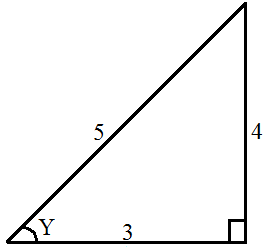
$\therefore\ \cos^{-1}[\cos\text{y}.\cos\text{x}+\sin\text{y}.\sin\text{x}]$ $=\cos^{-1}[\cos(\text{y}-\text{x})]$ $[\therefore\ \cos(\text{A}-\text{B})]=\cos\text{A}.\cos\text{B}+\sin\text{A}.\sin\text{B}]$$=\text{y}-\text{x}=\tan^{-1}\frac{4}{3}-\text{x}$
$\Big[\because\ \text{y}=\tan^{-1}\frac{4}{3}\Big]$ View full question & answer→Question 833 Marks
Prove the following results:
$\tan^{-1}\frac{1}{7}+2\tan^{-1}\frac{1}{3}=\frac{\pi}{4}$
Answer$\tan^{-1}\Big(\frac{1}{7}\Big)+2\tan^{-1}\Big(\frac{1}{3}\Big)=\frac{\pi}{4}$ $\text{L.H.S}=\tan^{-1}\Big(\frac{1}{7}\Big)+2\tan^{-1}\Big(\frac{1}{3}\Big)$ $=\tan^{-1}\Big(\frac{1}{7}\Big)=\tan^{-1}\Bigg(\frac{2\big(\frac{1}{3}\big)}{1-\big(\frac{1}{3}\big)^2}\Bigg)$ $\Big\{\text{Since }2\tan^{-1}\text{x}=\frac{1}{2}\tan^{-1}\Big(\frac{2\text{x}}{1-\text{x}^2}\Big)\Big\}$ $=\tan^{-1}\Big(\frac{1}{7}\Big)+\tan^{-1}\Big(\frac{2}{3}\times\frac{9}{8}\Big)$ $=\tan^{-1}\Big(\frac{1}{7}\Big)+=\tan^{-1}\Big(\frac{3}{4}\Big)$ $=\tan^{-1}\Bigg(\frac{\frac{1}{7}+\frac{3}{4}}{1-\frac{1}{7}\times\frac{3}{4}}\Bigg)$ $\Big\{\text{Since}\tan^{-1}\text{x}+\tan^{-1}\text{y}=\tan^{-1}\Big(\frac{\text{x}+\text{y}}{1-\text{xy}}\Big)\Big\}$ $=\tan^{-1}\Bigg(\frac{\frac{25}{20}}{\frac{25}{20}}\Bigg)$ $=\tan^{-1}(1)$ $=\frac{\pi}{4}$ $=\text{R.H.S}$Hence, proved
View full question & answer→Question 843 Marks
Evaluate:
$\cos\Big(\sin^{-1}\frac{3}{5}+\sin^{-1}\frac{5}{13}\Big)$
Answer$\cos\Big(\sin^{-1}\frac{3}{5}+\sin^{-1}\frac{5}{13}\Big)$
$=\cos\Bigg[\sin^{-1}\Bigg(\frac{3}{5}\sqrt{1-\Big(\frac{5}{13}\Big)^2}+\frac{5}{13}\sqrt{1-\Big(\frac{3}{5}\Big)^2}\Bigg)\Bigg]$
$\Big\{\text{Since }\sin^{-1}\text{x}+\sin^{-1}\text{y}=\sin^{-1}\Big[\text{x}\sqrt{1-\text{y}^2}+\text{y}\sqrt{1-\text{x}^2}\Big]\Big\}$
$=\cos\Big[\sin^{-1}\Big(\frac{3}{5}\times\frac{12}{13}+\frac{5}{13}\times\frac{4}{5}\Big)\Big]$
$=\cos\Big[\sin^{-1}\Big(\frac{56}{65}\Big)\Big]$
$=\cos\Bigg[\cos^{-1}\Bigg(\sqrt{1-\Big(\frac{56}{65}\Big)^2}\Bigg]$
$\Big\{\text{Since }\sin^{-1}\text{x}=\cos^{-1}\Big(\sqrt{1-\text{x}^2}\Big)\Big\}$
$=\cos\Big[\cos^{-1}\Big(\frac{33}{65}\Big)\Big]$
$=\frac{33}{65}$ $\Big\{\text{Since }\cos\big(\cos^{-1}\text{x}\big)=\text{x}\text{ as }\text{x}\in[0,1]\Big\}$
Hence,
$\cos\Big(\sin^{-1}\frac{3}{5}+\sin^{-1}\frac{5}{13}\Big)=\frac{33}{65}$
View full question & answer→Question 853 Marks
Find the value of the expression $\sin\Big(2\tan^{-1}\frac{1}{3}\Big)+\cos(\tan^{-1}2\sqrt{2}).$
Answer
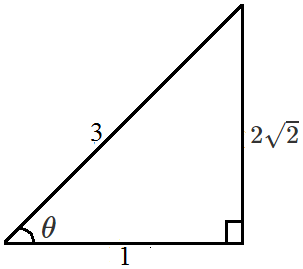 We have, $\sin\Big(2\tan^{-1}\frac{1}{3}\Big)+\cos(\tan^{-1}2\sqrt{2})$
$\sin\Big(2\tan^{-1}\frac{1}{3}\Big)=\sin\begin{pmatrix}\sin^{-1}\frac{2\times\frac{1}{3}}{1+\big(\frac{1}{3}\big)^2}\end{pmatrix}$
$\Big(\because\ 2\tan^{-1}\text{x}=\sin^{-1}\frac{2\text{x}}{1+\text{x}^2}\Big)$
$=\sin\Bigg(\sin^{-1}\frac{\frac{2}{3}}{\frac{10}{9}}\Bigg)$
$=\sin\Big(\sin^{-1}\frac{3}{5}\Big)=\frac{3}{5}$
$(\because\ \sin(\sin^{-1}\text{x})=\text{x},\ \text{x}\in[-1,1])$
$\cos(\tan^{-1}2\sqrt{2})=\cos\Big(\cos^{-1}\frac{1}{3}\Big)=\frac{1}{3}$
$(\because\ \cos(\cos^{-1}\text{x})=\text{x},\ \text{x}\in[-1,1])$
$\therefore\ \sin\Big(2\tan^{-1}\frac{1}{3}\Big)+\cos(\tan^{-1}2\sqrt{2})$
$=\frac{3}{5}+\frac{1}{3}=\frac{9+5}{15}=\frac{14}{15}$ View full question & answer→Question 863 Marks
Solve the following equation for x:
$2\tan^{-1}(\sin\text{x})=\tan^{-1}(2\sin\text{x}),\text{x}\neq\frac{\pi}{2}.$
Answer$2\tan^{-1}(\sin\text{x})=\tan^{-1}(2\sec\text{x})$
$\tan^{-1}\Big(\frac{2\sin\text{x}}{1-\sin^{2}\text{x}}\Big)=\tan^{-1}(2\sec\text{x})$ $\Big[\text{Since }2\tan^{-1}\text{x}=\tan^{-1}\Big(\frac{2\text{x}}{1-\text{x}^2}\Big)\Big]$
$\frac{2\sin\text{x}}{\cos^2\text{x}}=2\sec\text{x}$
$\frac{\sin\text{x}}{\cos\text{x}.\cos\text{x}}=\sec\text{x}$
$\tan\text{x}\sec\text{x}=\sec\text{x}$
$\tan\text{x}=1$
$\text{x}=\frac{\pi}{4}$
Hence the value of x is $\frac{\pi}{4}$
Thus, the solution is $\text{x}=\text{n}\pi+\frac{\pi}{4}$
View full question & answer→Question 873 Marks
Prove the following results
$\tan\Big(\cos^{-1}\frac{4}{5}+\tan^{-1}\frac{2}{3}\Big)=\frac{17}{6}$
Answer$\text{L.H.S=}\tan\Big(\cos^{-1}\frac{4}{5}+\tan^{-1}\frac{2}{3}\Big)$
$=\tan\begin{pmatrix}\tan^{-1}\frac{\sqrt{1-\big(\frac{4}{5}\big)^2}}{\frac{4}{5}}+\tan^{-1}\frac{2}{3}\end{pmatrix}$
$\bigg[\because\ \cos^{-1}\text{x}=\tan^{-1}\bigg(\frac{\sqrt{1-\text{x}^2}}{\text{x}}\bigg)\bigg]$
$=\tan\Big(\tan^{-1}\frac{3}{4}+\tan^{-1}\frac{2}{3}\Big)$
$=\tan\Bigg[\tan^{-1}\bigg(\frac{\frac{3}{4}+\frac{2}{3}}{1-\frac{3}{4}\times\frac{2}{3}}\bigg)\Bigg]$
$\Big[\because\ \tan^{-1}\text{x}+\tan^{-1}\text{y}=\tan^{-1}\Big(\frac{\text{x+y}}{1-\text{xy}}\Big)\Big]$
$=\tan\Bigg[\tan^{-1}\bigg(\frac{\frac{17}{12}}{\frac{6}{12}}\bigg)\Bigg]$
$=\tan\Big[\tan^{-1}\frac{17}{6}\Big]$
$=\frac{17}{6}=\text{R.H.S}$
View full question & answer→Question 883 Marks
Write the following in the simplest form:
$\tan^{-1}\Big\{\sqrt{1+\text{x}^2}-\text{x}\Big\},\text{x}\in\text{R}$
AnswerLet $\text{x}=\cot\theta$
Now,
$\tan^{-1}\Big\{\sqrt{1+\text{x}^2}-\text{x}\Big\}$
$\tan^{-1}\Big\{\sqrt{1+\cot^2\theta}-\cot\theta\Big\}$
$=\tan^{-1}\{\text{cosec }\theta-\cot\theta\}$
$=\tan^{-1}\Big\{\frac{1-\cos\theta}{\sin\theta}\Big\}$
$=\tan^{-1}\Bigg\{\frac{2\sin^2\frac{\theta}{2}}{2\sin\frac{\theta}{2}\cos\frac{\theta}{2}}\Bigg\}$
$=\tan^{-1}\Big\{\tan\Big(\frac{\theta}{2}\Big)\Big\}$
$=\frac{\theta}{2}$
$=\frac{\cot^{-1}\text{x}}{2}$
View full question & answer→Question 893 Marks
Write the following in the simplest form:
$\tan^{-1}\Big\{\text{x}+\sqrt{1+\text{x}^2}\Big\},\text{x}\in\text{R}$
AnswerLet $\text{x}=\cot\theta$
Now,
$\tan^{-1}\Big\{\text{x}+\sqrt{1+\text{x}^2}\Big\}$
$=\tan^{-1}\Big\{\cot\theta+\sqrt{1+\cot^2\theta}\Big\}$
$=\tan^{-1}\{\cot\theta+\text{cosec}\theta\}$
$=\tan^{-1}\Big\{\frac{\cos\theta+1}{\sin\theta}\Big\}$
$=\tan^{-1}\Bigg\{\frac{2\cos^2\frac{\theta}{2}}{2\sin\frac{\theta}{2}\cos\frac{\theta}{2}}\Bigg\}$
$=\tan^{-1}\Big\{\cot\frac{\theta}{2}\Big\}$
$=\tan^{-1}\Big\{\tan\Big(\frac{\pi}{2}-\frac{\theta}{2}\Big)\Big\}$
$=\Big(\frac{\pi}{2}-\frac{\theta}{2}\Big)$
$=\frac{\pi}{2}-\frac{\cot^{-1}\text{x}}{2}$
View full question & answer→Question 903 Marks
Find the principal value of the following:
$\cos^{-1}\Big(-\frac{\sqrt3}{2}\Big)$
AnswerLet $\cos^{-1}\Big(-\frac{\sqrt3}{2}\Big)=\text{y}$ Then, $\cos^{-1}\Big(-\frac{\sqrt3}{2}\Big)=\text{y}$We know that the range of the principal value branch is $[0,\pi].$
Thus, $\cos\text{y}=-\frac{\sqrt3}{2}=\cos\Big(\frac{5\pi}{6}\Big)$ $\Rightarrow\text{y}=\frac{5\pi}{6}\in[0,\pi]$ Hence, the pricipal value of $\cos^{-1}\Big(-\frac{\sqrt3}{2}\Big)$ is $\frac{5\pi}{6}.$
View full question & answer→Question 913 Marks
For the principal values, evaluate the following:
$\sin^{-1}\Big(-\frac{1}{2}\Big)+2\cos^{-1}\Big(-\frac{\sqrt3}{2}\Big)$
Answer$\sin^{-1}\Big(-\frac{1}{2}\Big)+2\cos^{-1}\Big(-\frac{\sqrt3}{2}\Big)$
$=\sin^{-1}\Big\{\sin\Big(-\frac{\pi}{6}\Big)\Big\}+2\cos^{-1}\Big(\cos\frac{5\pi}{6}\Big)$ $\begin{bmatrix}\because\text{Range of shine is}\Big[-\frac{\pi}{2},\frac{\pi}{2}\Big];-\frac{\pi}{6}\in\Big[-\frac{\pi}{2},\frac{\pi}{2}\Big] \\\ \\\text{and range of cosine is}[0,\pi];\frac{5\pi}{6}\in\Big[-\frac{\pi}{2},\frac{\pi}{2}\Big] \end{bmatrix}$
$=-\frac{\pi}{6}+2\Big(\frac{5\pi}{6}\Big)$
$=-\frac{\pi}{6}+\frac{5\pi}{3}$
$=\frac{9\pi}{6}$
$=\frac{3\pi}{2}$
$\therefore\sin^{-1}\Big(-\frac{1}{2}\Big)+2\cos^{-1}\Big(-\frac{\sqrt3}{2}\Big)=\frac{3\pi}{2}$$$
View full question & answer→Question 923 Marks
For the principal values, evaluate the following:
$\tan^{-1}\big(\sqrt3\big)-\sec^{-1}(-2)$
AnswerLet $\tan^{-1}\big(\sqrt3\big)=\text{x}.$ Then, $\tan\text{x}=\sqrt3=\tan\Big(\frac{\pi}{3}\Big)$
$\therefore\tan^{-1}\big(\sqrt3\big)=\frac{\pi}{3}$
Let $\sec^{-1}(-2)=\text{y}.$ Then, $\sec\text{y}=-2=\sec\Big(\pi-\frac{\pi}{3}\Big)$
$\therefore\sec^{-1}(-2)=\frac{2\pi}{3}$
$\therefore\tan^{-1}\big(\sqrt3\big)-\sec^{-1}(-2)=\frac{\pi}{3}-\frac{2\pi}{3}$
$=\frac{\pi-2\pi}{3}=-\frac{\pi}{3}$
View full question & answer→Question 933 Marks
Prove that:
$\frac{9\pi}{8}-\frac{9}{4}\sin^{-1}\frac{1}{3}=\frac{9}{4}\sin^{-1}\frac{2\sqrt{2}}{3}$
Answer$\text{L.H.S.}=\frac{9\pi}{8}-\frac{9}{4}\sin^{-1}\frac{1}{3}$
$=\frac{9}{4}\bigg(\frac{\pi}{2}-\sin^{-1}\frac{1}{3}\bigg)$
$=\frac{9}{4}\bigg(\cos^{-1}\frac{1}{3}\bigg) \dots\dots(1)$ $\bigg[\sin^{-1}x+\cos^{-1}x=\frac{\pi}{2}\bigg]$
$\text{Now, let}\cos^{-1}\frac{1}{3}=x.\text{Then},\cos x=\frac{1}{3}$
$\Rightarrow\sin x=\sqrt{1-\bigg(\frac{1}{3}\bigg)^2}=\frac{2\sqrt{2}}{3}.$
$\therefore x=\sin^{-1}\frac{2\sqrt{2}}{3}\Rightarrow\cos^{-1}\frac{1}{3}=\sin^{-1}\frac{2\sqrt{2}}{3}$
$\therefore\text{L.H.S.}=\frac{9}{4}\sin^{-1}\frac{2\sqrt{2}}{3}=\text{R.H.S.}$
View full question & answer→Question 943 Marks
What is the value of $\cos^{-1}\Big(\cos\frac{2\pi}{3}\Big)+\sin^{-1}\Big(\sin\frac{2\pi}{3}\Big)$
Answer$\cos^{-1}\Big(\cos\frac{2\pi}{3}\Big)+\sin^{-1}\Big(\sin\frac{2\pi}{3}\Big)$
$=\frac{2\pi}{3}+\Big(\pi-\frac{2\pi}{3}\Big)=\pi$
$\begin{Bmatrix}\text{Since},\sin^{-1}(\sin\theta)=\begin{cases}-\pi-\theta,&\text{if }\theta\in\Big[\frac{-3\pi}{2},\frac{-\pi}{2}\Big]\\\theta,&\text{if }\theta\in\Big[\frac{-\pi}{2},\frac{\pi}{2}\Big]\\\pi-\theta,&\text{if }\theta\in\Big[\frac{\pi}{2},\frac{3\pi}{2}\Big]\\-2\theta+\theta&\text{if }\theta\in\Big[\frac{3\pi}{2},\frac{5\pi}{2}\Big]\end{cases}\\\text{And }\cos^{-1}(\cos\theta)\begin{cases}-\theta,&\text{if }\theta\in[-\pi,0]\\\theta,&\text{if }\theta\in[0,\pi]\\2\pi-\theta,&\text{if }\theta\in[\pi,2\pi]\\-2\theta+\theta&\text{if }\theta\in[2\pi,3\pi]\end{cases}\end{Bmatrix}$
Hence,
$\cos^{-1}\Big(\cos\frac{2\pi}{3}\Big)+\sin^{-1}\Big(\sin\frac{2\pi}{3}\Big)=\pi$
View full question & answer→Question 953 Marks
Prove the following:
$\tan^{-1}\frac{2}{11}+\tan^{-1}\frac{7}{24}=\tan^{-1}\frac{1}{2}$
Answer$\text{L.H.S.}=\tan^{-1}\frac{2}{11}+\tan^{-1}\frac{7}{24}=\tan^{-1}\frac{\frac{2}{11}+\frac{7}{24}}{1-\frac{2}{11}\times\frac{7}{24}}$ $\bigg[\because\tan^{-1}x+\tan^{-1}y=\tan^{-1}\frac{x+y}{1-xy}\bigg]$
$=\tan^{-1}\frac{48+77}{264-14}=\tan^{-1}\frac{125}{250}=\tan^{-1}\frac{1}{2}=\text{R.H.S.}$ Proved.
View full question & answer→Question 963 Marks
Evaluate the following:
$\tan^{-1}1+\cos^{-1}\Big(-\frac{1}{2}\Big)+\sin^{-1}\Big(-\frac{1}{2}\Big)$
AnswerLet $\tan^{-1}=\text{x}.$ Then, $\tan\text{x}=1=\tan\frac{\pi}{4}$ $\therefore\tan^{-1}(1)=\frac{\pi}{4}$Let $\cos^{-1}\Big(-\frac{1}{2}\Big)=\text{y.}$ Then,
$\cos\text{y}=-\frac{1}{2}=-\cos\Big(\frac{\pi}{3}\Big)=\cos\Big(\pi-\frac{\pi}{3}\Big)=\cos\Big(\frac{2\pi}{3}\Big)$
$\therefore\cos^{-1}\Big(-\frac{1}{2}\Big)=\frac{2\pi}{3}$Let $\sin^{-1}\Big(-\frac{1}{2}\Big)=\text{z.}$ Then, $\sin\text{z}=-\frac{1}{2}=-\sin\Big(\frac{\pi}{6}\Big)=\sin\Big(-\frac{\pi}{6}\Big)$
$\therefore\sin^{-1}\Big(-\frac{1}{2}\Big)=-\frac{\pi}{6}$
$\therefore\tan^{-1}(1)+\cos^{-1}\Big(-\frac{1}{2}\Big)+\sin^{-1}\Big(-\frac{1}{2}\Big)$
$=\frac{\pi}{4}+\frac{2\pi}{3}-\frac{\pi}{6}$
$=\frac{3\pi+8\pi-2\pi}{12}=\frac{9\pi}{12}=\frac{3\pi}{4}$
View full question & answer→Question 973 Marks
Write the value of $\cos^{-1}(\cos350^\circ)-\sin^{-1}(\sin350^\circ)$
Answer$\cos^{-1}(\cos350^\circ)-\sin^{-1}(\sin350^\circ)$
$=\cos^{-1}\{\cos(360^\circ-10^\circ)\}-\sin^{-1}\{\sin(360^\circ-10^\circ)\}$
$=\cos^{-1}\{\cos10^\circ\}-\sin^{-1}\{\sin10^\circ\}$
$\{\text{Since},\cos(2\pi-\theta)=\cos\theta,\sin(2\pi-\theta)=-\sin\theta\}$
$=10^\circ-\sin^{-1}\{\sin(-10^\circ)\}$
$\{\text{Since},\cos^{-1}(\cos\theta),\text{ if }\theta\in[0,\pi]\text{ and }\sin(-\theta)=-\sin\theta\}$
$=10^\circ-(-10^\circ)$ $\Big\{\text{Since},\sin^{-1}(\sin\theta)=\theta,\text{ if }\theta\in\Big[-\frac{\pi}{2},\frac{\pi}{2}\Big]\Big\}$
$=10^\circ+10^\circ$
$=20^\circ$
Hence,
$\cos^{-1}(\cos350^\circ)-\sin^{-1}(\sin350^\circ)=20^\circ$
View full question & answer→Question 983 Marks
Prove the following results
$\sin\Big(\cos^{-1}\frac{3}{5}+\sin^{-1}\frac{5}{13}\Big)=\frac{63}{65}$
Answer$\text{L.H.S}=\sin\Big(\cos^{-1}\frac{3}{5}+\sin^{-1}\frac{5}{13}\Big)=\frac{63}{65}$
$=\sin\Bigg[\sin6{-1}\sqrt{1-\Big(\frac{3}{5}\Big)^2}+\sin^{-1}\frac{5}{13}\Bigg]$
$=\sin\Big[\sin^{-1}\frac{4}{5}+\sin^{-1}\frac{5}{13}\Big]$
$=\sin\Bigg\{\sin^{-1}\Bigg[\frac{4}{5}\times\sqrt{1-\Big(\frac{5}{13}\Big)^2}+\frac{5}{13}\times\sqrt{1-\Big(\frac{4}{5}\Big)^2}\Bigg]\Bigg\}$
$=\sin\Big[\sin^{-1}\Big(\frac{48}{65}+\frac{15}{65}\Big)\Big]$
$=\sin\Big(\sin^{-1}\frac{63}{65}\Big)$
$=\frac{63}{65}=\text{R.H.S}$
View full question & answer→Question 993 Marks
Solve the following equation for x:
$3\sin^{-1}\frac{2\text{x}}{1+\text{x}^2}-4\cos^{-1}\frac{1-\text{x}^2}{1+\text{x}^2}+2\tan^{-1}\frac{2\text{x}}{1-\text{x}^2}=\frac{\pi}{3}$
Answer$3\sin^{-1}\frac{2\text{x}}{1+\text{x}^2}-4\cos^{-1}\frac{1-\text{x}^2}{1+\text{x}^2}+2\tan^{-1}\frac{2\text{x}}{1-\text{x}^2}=\frac{\pi}{3}$
$\Rightarrow3\big(2\tan^{-1}\text{x}\big)-4\big(2\tan^{-1}\text{x}\big)+2\big(2\tan^{-1}\text{x}\big)=\frac{\pi}{3}$
$\Big\{\text{Since},2\tan^{-1}\text{x}=\tan^{-1}\frac{2\text{x}}{1-\text{x}^2}=\sin^{-1}\frac{2\text{x}}{1+\text{x}^2}=\cos^{-1}\frac{1-\text{x}^2}{1+\text{x}^2}\Big\}$
$\Rightarrow6\tan^{-1}\text{x}-8\tan^{-1}\text{x}+4\tan^{-1}\text{x}=\frac{\pi}{3}$
$\Rightarrow2\tan^{-1}\text{x}=\frac{\pi}{3}$
$\Rightarrow\tan^{-1}\text{x}=\frac{\pi}{6}$
$\Rightarrow\tan^{-1}\text{x}=\tan^{-1}\Big(\frac{1}{\sqrt3}\Big)$
$\Rightarrow\text{x}=\frac{1}{\sqrt3}$
View full question & answer→Question 1003 Marks
Prove the following results:
$\sin^{-1}\frac{63}{65}=\sin^{-1}\frac{5}{13}+\cos^{-1}\frac{3}{5}$
Answer$\text{R.H.S}=\sin^{-1}\frac{5}{13}+\cos^{-1}\frac{3}{5}$
$=\sin^{-1}\frac{5}{13}+\sin^{-1}\frac{4}{5}$ $\Big[\because\ \cos^{-1}\text{x}=\sin^{-1}\sqrt{1-\text{x}^2}\Big]$
$=\sin^{-1}\bigg\{\frac{5}{13}\sqrt{1-\Big(\frac{4}{5}\Big)^2}+\frac{4}{5}\sqrt{1-\Big(\frac{5}{13}\Big)^2}\bigg\}$
$=\sin^{-1}\Big\{\frac{5}{13}\times\frac{3}{5}+\frac{4}{5}\times\frac{12}{13}\Big\}$
$=\sin^{-1}\Big\{\frac{15}{65}+\frac{48}{65}\Big\}$
$=\sin^{-1}\frac{63}{65}=\text{L.H.S}$
View full question & answer→