MCQ 11 Mark
The corner points of the feasible region determined by the system of linear inequalities are $(0, 0), (4, 0), (2, 4)$ and $(0, 5).$ If the maximum value of $z = ax + by,$ where $a, b > 0$ occurs at both $(2, 4)$ and $(4, 0),$ then:
- ✓
$a = 2b$
- B
$2a = b$
- C
$a = b$
- D
$3a = b$
AnswerCorrect option: A. $a = 2b$
$4a + 0b = 2a + 4b$
$4a = 2a + 4b$
$4a - 2a = 4b$
$2a = 4b$
$a = 2b$
View full question & answer→MCQ 21 Mark
Maximize $Z = 11x + 8y,$ subject to $\text{x}\leq4,\text{y}\leq6,\text{x}\geq0,\text{y}\geq0.$
- A
$44$ at $(4, 2)$
- ✓
$60$ at $(4, 2)$
- C
$62$ at $(4, 0)$
- D
AnswerCorrect option: B. $60$ at $(4, 2)$
View full question & answer→MCQ 31 Mark
The corner point of the feasible region determined by the system of linear constraints are $(0, 0), (0, 40), (20, 40), (60, 20), (60, 0).$ The objective function is $Z = 4x + 3y.$ Compare the quantity in Column $A$ and Column $B.$
|
Column $A$
|
Column $B$
|
|
Maximum of $Z$
|
$325$
|
AnswerCorrect option: B. The quantity in column $B$ is greater.
View full question & answer→MCQ 41 Mark
The value of $\frac{0.76\times0.76\times0.76+0.24\times0.24\times0.24}{0.76\times0.76-0.76\times0.24+ 0.24+0.24}$ is:
AnswerFormula used:
$a^3 + b^3= (a + b)(a^2 - ab + b^2)$
$=\frac{0.76\times0.76\times0.76+0.24\times0.24\times0.24}{0.76\times0.76-0.76\times0.24+ 0.24+0.24}$
$=\frac{(0.76)^{3}+(0.24)^{3}}{0.76\times0.76-0.76\times0.24+0.24+0.24}$
$=\frac{(0.76+0.24)(0.76\times0.76-0.76\times0.24+0.24\times0.24)}{0.76\times0.76-0.76\times0.24+0.24\times0.24}$
$=(0.76+0.24)$
$=1$
View full question & answer→MCQ 51 Mark
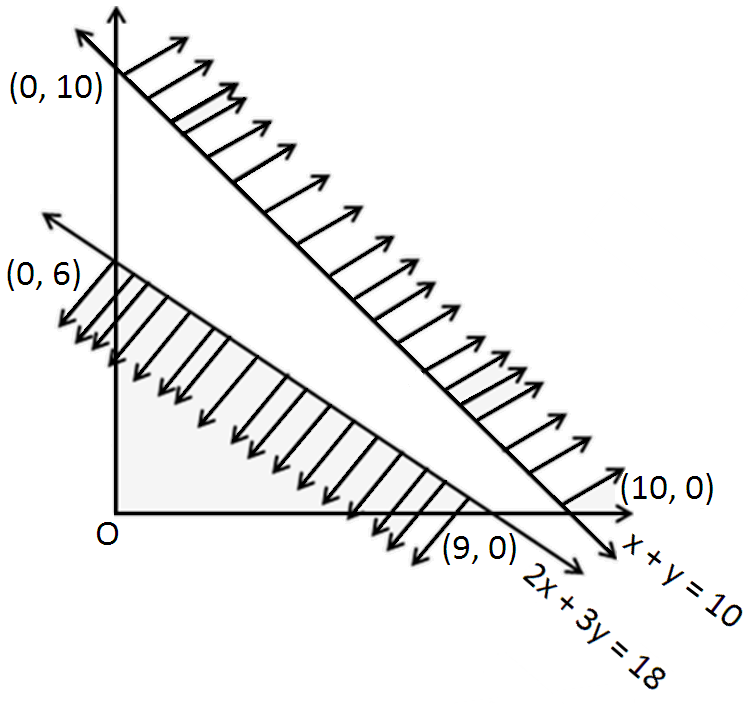
The maximum value of $Z = 4x + 2y$ Subjected to the constraints $2\text{x}+3\text{y}\leq18,\text{x}+\text{y}\geq10,\text{x},\text{y}\geq0$ is:
AnswerConsider$, 2x + 3y = 18$
| $x$ |
$y$ |
$(x, y)$ |
| $0$ |
$6$ |
$(0, 6)$ |
| $9$ |
$0$ |
$(9, 0)$ |
Consider$, x + y = 10$
| $x$ |
$y$ |
$(x, y)$ |
| $0$ |
$10$ |
$(0, 10)$ |
| $10$ |
$0$ |
$(10, 0)$ |
From the graph we conclude that no feasible region exist. View full question & answer→MCQ 61 Mark
In transportation models designed in linear programming, points of demand is classified as:
MCQ 71 Mark
Objective function of a $\text{LPP}$ is:
- A
- ✓
a function to be optimized
- C
a relation between the variables
- D
AnswerCorrect option: B. a function to be optimized
View full question & answer→MCQ 81 Mark
The maximum value of $Z = 4x + 3y$ subjected to the constraints $3x + 2y \geq 160, 5x + 2y \geq 200, x + 2y \geq 80, x, y \geq 0$ is :
AnswerWe need to maximize the function $Z = 4x + 3y$
Converting the given inequations into equations, we obtain
$3x + 2y = 160, 5x + 2y = 200, x + 2y = 80, x = 0$ and $y = 0$
Region represented by $3x + 2y \geq 160:$
The line $3x + 2y = 160$ meets the coordinate axes at $A \ 1603,0$ and $B(0, 80)$ respectively.
By joining these points we obtain the line $3x + 2y = 160.$
Clearly $(0, 0)$ does not satisfies the inequation $3x + 2y \geq 160.$
So, the region in $xy$ plane which does not contain the origin represents the solution set of the inequation $3x + 2y ≥ 160.$
Region represented by $5x +2y ≥ 200:$
The line $5x + 2y = 200$ meets the coordinate axes at $C(40, 0) $ and $D(0, 100)$ respectively.
By joining these points we obtain the line $5x + 2y = 200.$
Clearly $(0, 0)$ does not satisfies the inequation $5x +2y ≥ 200.$
So, the region which does not contain the origin represents the solution set of the inequation $5x +2y ≥ 200.$
Region represented by $x +2y \geq 80:$
The line $x + 2y = 80$ meets the coordinate axes at $E(80, 0)$ and $F(0, 40)$ respectively.
By joining these points we obtain the line $x + 2y = 80.$
Clearly $(0, 0)$ does not satisfies the inequation $x + 2y \geq 80.$
So, the region which does not contain the origin represents the solution set of the inequation $x + 2y ≥ 80.$
Region represented by $x \geq 0$ and $y \geq 0:$
Since, every point in the first quadrant satisfies these inequations.
So, the first quadrant is the region represented by the inequations $x \geq 0,$ and $y \geq 0.$
The feasible region determined by the system of constraints $3x + 2y \geq 160,5x+2y \geq 200, x +2y \geq 80, x \geq 0,$ and $y \geq 0$ are as follows.
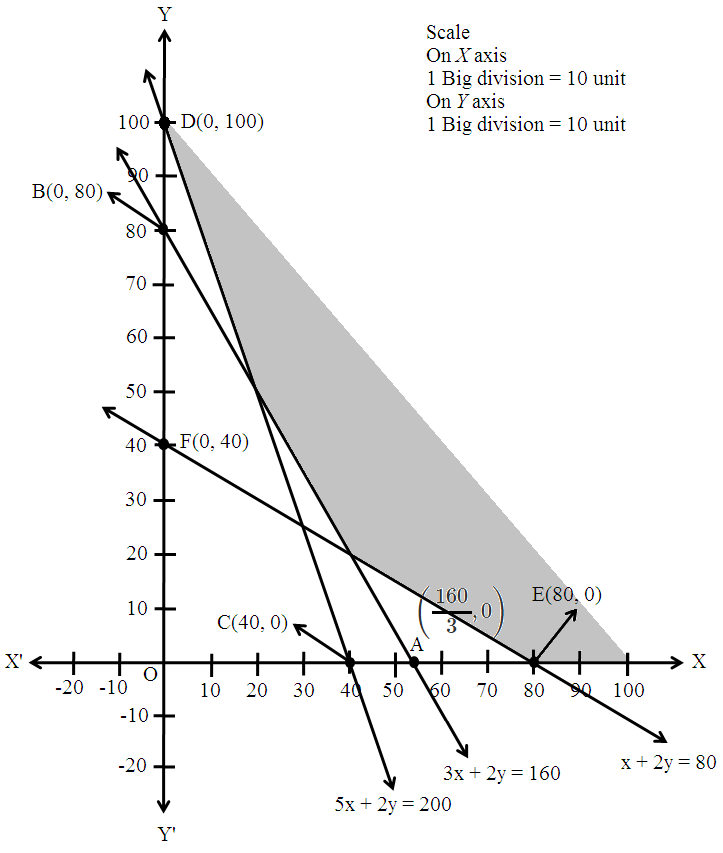
Here, we see that the feasible region is unbounded.
Therefore,maximum value is infinity. View full question & answer→MCQ 91 Mark
Graphical method can be used only when the decision variables is:
- A
More than $3.$
- B
More than $1.$
- ✓
- D
AnswerGraphical method can be used only when the decision variables is two.
View full question & answer→MCQ 101 Mark
A constraint in an $LP$ model becomes redundant because:
View full question & answer→MCQ 111 Mark
Maximize $Z = 3x + 5y,$ subject to constraints: $\text{x}+4\text{y}\leq24,3\text{x}+\text{y}\leq21,\text{x}+\text{y}\geq9,\text{x}\geq0,\text{y}\geq0.$
- A
$20$ at $(1, 0)$
- B
$30$ at $(0, 6)$
- ✓
$37$ at $(4, 5)$
- D
$33$ at $(6, 3)$
AnswerCorrect option: C. $37$ at $(4, 5)$
Find the maximum value of $Z = 3x + 5y$ referring to the explanation of $Q.5.$
View full question & answer→MCQ 121 Mark
An objective function in a linear program can be which of the following?
- ✓
- B
A nonlinear maximization function
- C
A quadratic maximization function
- D
View full question & answer→MCQ 131 Mark
The given table shows the number of cars manufactured in four different colours on a particular day. Study it carefully and answer the question.
|
|
Number of cars manufactured
|
|
Colour
|
Vento
|
Creta
|
Wagonr
|
|
Red
|
$65$ |
$88$ |
$93$ |
|
White
|
$54$ |
$42$ |
$80$ |
|
Black
|
$66$ |
$52$ |
$88$ |
|
Sliver
|
$37$ |
$49$ |
$74$ |
Which car was twice the number of silver Vento? - ✓
Silver Wagon $R$
- B
Red Wagon $R$
- C
- D
AnswerCorrect option: A. Silver Wagon $R$
The number of silver Vento car $= 37 ($from the table$)$
Twice the number of silver Vento cars $= 2 \times 37 = 74$
Now from table we can see that silver Wagon $R$ is only car type having $74$ cars
View full question & answer→MCQ 141 Mark
The corner points of the feasible region determined by the following system of linear inequalities$:2x + y \leq 10, x + 3y \leq 15, x, y \geq 0$ are $(0, 0), (5, 0), (3, 4)$ and $(0, 5).$Let $Z = px + qy,$ where $p.q > 0.$
Condition on $p$ and $q$. so that the maximum of $Z$ occurs at both $(3, 4)$ and $(0, 5)$ is:
- A
$P = q$
- B
$p = 2q$
- C
$p = 3q$
- ✓
$q = 3q$
AnswerCorrect option: D. $q = 3q$
The maximum value of $Z$ is unique.
It is given that the maximum value of $Z$ occurs at two points $(3, 4)$ and $(0,5).$
Value of $Z$ at $(3, 4) =$ Value of $Z$ at $(0,5)$
$= p(3) + q(4) = p(0) + 7(5)$
$= 3p + 4q = 5q$
$= q = 3p$
View full question & answer→MCQ 151 Mark
The objective function $Z = 4x + 3y$ can be maximised subjected to the constraints $3x + 4y \leq 24, 8x + 6y \leq 48, x \leq 5, y \leq 6, x, y \geq 0$
- A
- B
- ✓
at an infinite number of points
- D
AnswerCorrect option: C. at an infinite number of points
We need to maximize $Z = 4x + 3y$
First, we will convert the given inequations into equations, we obtain the following equations: $3x + 4y = 24,$
$8x + 6y = 48, x = 5, y = 6, x = 0$ and $y = 0.$
The line $3x + 4y = 24$ meets the coordinate axis at $A(8, 0) $ and $B(0, 6).$
Join these points to obtain the line $3x + 4y = 24.$
Clearly, $(0, 0)$ satisfies the inequation $3x + 4y \leq 24.$
So, the region in $xy-$ plane that contains the origin represents the solution set of the given equation.
The line $8x + 6y = 48$ meets the coordinate axis at $C(6, 0)$ and $D(0, 8).$
Join these points to obtain the line $8x + 6y = 48.$
Clearly, $(0, 0)$ satisfies the inequation $8x + 6y \leq 48.$
So, the region in $xy $ plane that contains the origin represents the solution set of the given equation.
$x = 5$ is the line passing through $x = 5$ parallel to the $Y$ axis.
$y = 6$ is the line passing through $y = 6$ parallel to the $X$ axis.
Region represented by $x \geq 0$ and $y \geq 0:$
Since, every point in the first quadrant satisfies these inequations.
So, the first quadrant is the region represented by the inequations.
These lines are drawn using a suitable scale.
and $B (0,6).$
The corner points of the feasible region are $O(0, 0), G(5, 0), \text{F}\Big(5,\frac{4}{3}\Big),\text{E}\Big(\frac{24}{7},\frac{24}{7}\Big)$ and $B(0, 6).$
The values of $Z$ at these corner points are as follows.
| $\text{Corner point}$ |
$\text{Z} = 4\text{x} + 3\text{y}$ |
| $\text{O}(0, 0)$ |
$4 \times 0 + 3 \times 0= 0$ |
| $\text{G}(5, 0)$ |
$4 \times 5 + 3 \times 0 = 20$ |
| $\text{F}\Big(5,\frac{4}{3}\Big)$ |
$4\times5+3\times\frac{4}{3}=24$ |
| $\text{E}\Big(\frac{24}{7},\frac{24}{7}\Big)$ |
$4\times\frac{24}{7}+3\times\frac{24}{7}=\frac{196}{7}=24$ |
| $\text{B}(0, 6)$ |
$4\times0+3\times6=18$ |
We see that the maximum value of the objective function $Z$ is $24$ which is at $F(5, 4)$ and $\text{E}\Big(\frac{24}{7},\frac{24}{7}\Big).$
Thus, the optimal value of $Z$ is $24.$
As, we know that if a $\text{LPP}$ has two optimal solution, then there are an infinite number of optimal solutions.
Therefore, the given objective function can be subjected at an infinite number of points. View full question & answer→MCQ 161 Mark
The corner points of the feasible region determined by the following system of linear inequalities$:\ 2\text{x}+\text{y}\le10,\ \text{x}+3\text{y}\le15,\ \text{x},\ \text{y}\ge0$ are $(0, 0), (5, 0), (3, 4)$ and $(0, 5).$ Let $Z = px + qy,$ where $p, q > 0.$ Condition on $p$ and $q$ .so that the maximum of $Z$ occurs at both $(3, 4)$ and $(0, 5)$ is:
- A
$p = q$
- B
$p = 2q$
- C
$p = 3q$
- ✓
$q = 3p.$
AnswerCorrect option: D. $q = 3p.$
The maximum value of $Z$ is unique.
It is given that the maximum value of $Z$ occurs at two points$, (3, 4)$ and $(0, 5).$
$\therefore$ Value of $z$ at $(3, 4) $= Value of $z$ at $(0, 5)$
$\Rightarrow p(3) + q(4) = p(0) + q(5)$
$\Rightarrow 3p + 4q = 5q$
$\Rightarrow q = 3p$
Hence, the correct answer is $D.$
View full question & answer→MCQ 171 Mark
In an $\text{LPP},$ if the objective function $Z = ax + by$ has the same maximum value on two corner points of the feasible region, then the number of points of which $Z$ max occurs is:
View full question & answer→MCQ 181 Mark
A linear programming of linear functions deals with:
MCQ 191 Mark
Maximize $Z = 4x + 6y,$ subject to $3\text{x}+2\text{y}\leq12,\text{x}+\text{y}\geq4,\text{x},\text{y}\geq0.$
- A
$16$ at $(4, 0)$
- B
$24$ at $(0, 4)$
- C
$24$ at $(6, 0)$
- ✓
$36$ at $(0, 6)$
AnswerCorrect option: D. $36$ at $(0, 6)$
View full question & answer→MCQ 201 Mark
The $...........$ is the method available for solving an $\text{L.P.P.}$
AnswerThere are different methods to solve an linear programming problem.
Such as Graphical method, Simplex method, Ellipsoid method, Interior point methods.
View full question & answer→MCQ 211 Mark
Linear programming model which involves funds allocation of limited investment is classified as:
- A
Ordination budgeting model
- ✓
- C
- D
View full question & answer→MCQ 221 Mark
The problem associated with $\text{LPP}$ is:
- ✓
Single objective function
- B
Double objective function
- C
No any objective function
- D
AnswerCorrect option: A. Single objective function
View full question & answer→MCQ 231 Mark
Choose the correct answer from the given four options.
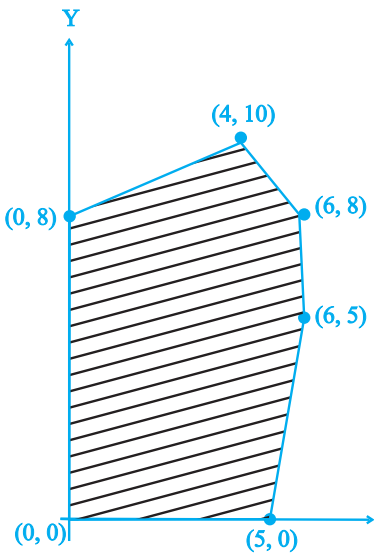
The feasible solution for a $\text{LPP}$ shown in Fig. $12.12.$ Let $z = 3x - 4y$ be objective functio. $($Maximum value of $Z +$ Minimum value of $Z)$ is equal to: - A
$13.$
- B
$1.$
- C
$-13.$
- ✓
$-17.$
AnswerCorrect option: D. $-17.$
|
Corner points
|
Corresponding value of $Z = 3x - 4y$
|
|
$(0, 0)$
$(5, 0)$
$(6, 5)$
$(6, 8)$
$(4, 10)$
$(0, 8)$
|
$0$
$15 ($Maximum$)$
$-2$
$-14$
$-28$
$-32 ($Minimum$)$
|
Here, maximum value of $Z +$ minimum value of $Z = 15 - 32 = -17.$ View full question & answer→MCQ 241 Mark
In order for a linear programming problem to have a unique solution, the solution must exist.
- A
At the intersection of the nonnegativity constraints.
- B
At the intersection of a nonnegativity constraint and a resource constraint.
- C
At the intersection of the objective function and a constraint.
- ✓
At the intersection of two or more constraints.
AnswerCorrect option: D. At the intersection of two or more constraints.
In order for a linear programming problem to have a unique solution, the solution must exist at the intersection of two or more constraints.
Then the problem becomes convex and has a single optimum $($maximum or minimum$).$
View full question & answer→MCQ 251 Mark
The feasible region for an $\text{LPP}$ is shown shaded in the following figure. Minimum of $Z = 4x + 3y$ occurs at the point.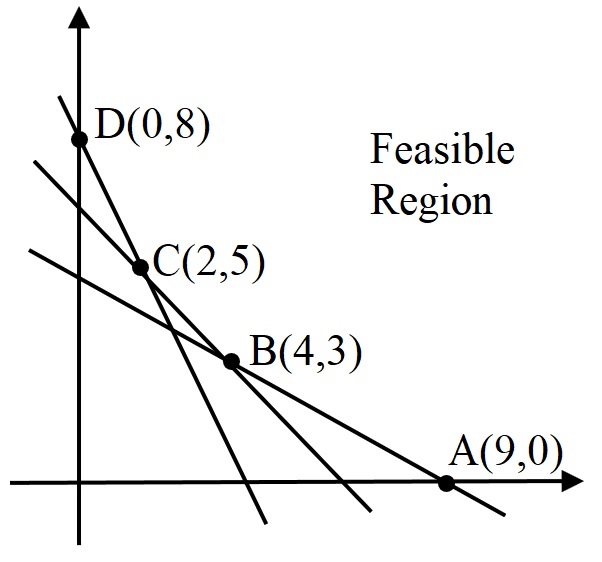
- A
$(0, 8)$
- ✓
$(2, 5)$
- C
$(4, 3)$
- D
$(9, 0)$
AnswerCorrect option: B. $(2, 5)$
View full question & answer→MCQ 261 Mark
The solution set of the inequation $2x + y > 5$ is:
AnswerCorrect option: B. open half plane not containing the origin
On putting $x = 0, y = 0$ in the given inequality, we get $0 > 5,$ which is absurd.
Therefore, the solution set of the given inequality does not include the origin.
Thus, the solution set of the given inequality consists of the open half plane not containing the origin.
View full question & answer→MCQ 271 Mark
Which of the following statements about an $LP$ problem and its dual is false?
- A
If the primal and the dual both have optimal solutions, the objective function values for both problems are equal at the optimum.
- B
If one of the variables in the primal has unrestricted sign, the corresponding constraint in the dual is satisfied with equality.
- C
If the primal has an optimal solution, so has the dual.
- ✓
The dual problem might have an optimal solution, even though the primal has no $($bounded$)$ optimum.
AnswerCorrect option: D. The dual problem might have an optimal solution, even though the primal has no $($bounded$)$ optimum.
If one of the problems $($primal, dual$)$ is infeasible then the other problem is infeasible.
View full question & answer→MCQ 281 Mark
Objective of linear programming for an objective function is to:
- ✓
- B
Subset or proper set modeling.
- C
- D
View full question & answer→MCQ 291 Mark
Minimise $\text{Z}=\sum\limits^{\text{n}}_{\text{j}=1}\sum\limits^{\text{m}}_{\text{i}=1}\text{c}_{\text{ij}}\cdot\text{x}_{\text{ij}}$ Subject to $\sum\limits^{\text{m}}_{\text{i}=1}\text{x}_{\text{ji}}=\text{b}_{\text{j}},\text{j}=1,2,....\text{n}$ $\sum\limits^{\text{n}}_{\text{j}=1}\text{x}_{\text{ji}}=\text{b}_{\text{j}},\text{j}=1,2,.....,\text{m}$ is a $\text{LPP}$ with number of constraints.
AnswerCorrect option: C. $\text{m}+\text{n}$
Constraints will be
$ x_{11}+x_{21}+\ldots \ldots+x_{m _1}=b_1 $
$ x_{12}+x_{22}+\ldots \ldots+x_{m_ 2}=b_2 $
$ x_{1_ n}+x_{2 n}+\ldots \ldots+x_{m_ n}=b_n $
$ x_{11}+x_{12}+\ldots \ldots+x_{1_ n}=b_1 $
$ x_{21}+x_{22}+\ldots \ldots+x_{2_ n}=b_2 $
$ x_{m _1}+x_{m _2}+\ldots \ldots+x_{m_ n}=b_n $
So the total number of constraints $= m + n$
View full question & answer→MCQ 301 Mark
The first step in formulating an LP problem is:
- A
- B
Perform a sensitivity analysis.
- C
Define the decision variables.
- ✓
Understand the managerial problem being faced.
AnswerCorrect option: D. Understand the managerial problem being faced.
d. Understand the managerial problem being faced
.Solution:
The first step in formulating an linear programming problem is to understand the managerial problem being faced i.e., determine the quantities that are needed to solve the problem.
View full question & answer→MCQ 311 Mark
Maximize $Z = 10 x_1 + 25 x_2,$ subject to $0\leq\text{x}_{1}\leq3,0\leq\text{x}_{2}\leq3,\text{x}_{1}+\text{x}_{2}\leq5.$
- A
$\text{80 at (3, 2)}$
- B
$\text{75 at (0, 3)}$
- C
$\text{30 at (3, 0)}$
- ✓
$\text{95 at (2, 3)}$
AnswerCorrect option: D. $\text{95 at (2, 3)}$
View full question & answer→MCQ 321 Mark
The maximum value of $Z = 4x + 2y$ subject to the constraints $2\text{x}+3\text{y}\leq18,\text{x}+\text{y}\geq10,\text{x},\text{y}\leq0$ is:
View full question & answer→MCQ 331 Mark
If the constraints in a linear programming problem are changed
AnswerCorrect option: A. the problem is to be re$-$evaluated
View full question & answer→MCQ 341 Mark
Objective of $\text{LPP}$ is:
- A
- ✓
A function to be optimized
- C
A relation between the variables
- D
AnswerCorrect option: B. A function to be optimized
View full question & answer→MCQ 351 Mark
Which of the termis not used in a linear programming problem:
MCQ 361 Mark
In linear programming, oil companies used to implement resources available is classified as:
MCQ 371 Mark
$Z = 20x_1 + 20x_2$, subject to $\text{x}1\geq0,\text{x}_{2}\geq0,\text{x}_{1}+2\text{x}_{2}\geq8,3\text{x}_{1}+2\text{x}_{2}\geq15,5\text{x}_{1}+2\text{x}_{2}\geq20.$ The minimum value of $Z$ occurs at
- A
$(8, 0)$
- B
$\Big(\frac{5}{2},\frac{15}{4}\Big)$
- ✓
$\Big(\frac{7}{2},\frac{9}{4}\Big)$
- D
$(0, 10)$
AnswerCorrect option: C. $\Big(\frac{7}{2},\frac{9}{4}\Big)$
View full question & answer→MCQ 381 Mark
The corner points of the feasible region determined by the system of linear constraints are $(0, 10),(5, 5),(15, 15),(0, 20).$ Let $z = px + qy$ where $p, q > 0.$ Condition on $p$ and $q$ so that the maximum of $z$ occurs at both the points $(15, 15)$ and $(0, 20)$ is $.......$
- A
$q = 2p$
- B
$p = 2p$
- C
$p = q$
- ✓
$q = 3p$
AnswerCorrect option: D. $q = 3p$
Let $z0$ be the maximum value of $z$ in the feasible region.
Since maximum occurs at both $(15, 15)$ and $(0, 20),$ the value $z0$ is attained at both $(15, 15)$ and $(0, 20).$
$\Longrightarrow z0 = p(15) + q(15)$ and $z0 = p(0) + q(20)$
$\Longrightarrow p(15) + q(15) = p(0) + q(20)$
$\Longrightarrow 15p = 5q$
$\Longrightarrow 3p = q$
View full question & answer→MCQ 391 Mark
The ratio of the rate of flow of water in pipes varies inversely as the square of the radius of the pipes. What is the ratio of the rates of flow in two pipes diameters $2\ cm$ and $4\ cm?$
- A
$1 : 6$
- ✓
$1 : 4$
- C
$1 : 2$
- D
AnswerCorrect option: B. $1 : 4$
Given$:\ d_1= 2\ cm$
$d_2 = 4\ cm$
Since the diameter are $2\ cm$ and $4\ cm.$
The replacement ratio of the two pipes are $1\ cm$ and $2\ cm\ r_1 = 1\ cm$
$r_2 = 2\ cm$
Square of the ratio of the pipes are $1$ and $4$
$\therefore$ The ratio of rates of flow in two pipes $=1:\frac{1}{4}$
$\Rightarrow\frac{1}{4}$
View full question & answer→MCQ 401 Mark
The corner points of the feasible region are $A(0, 0), B(16, 0), C(8, 16)$ and $D(0, 24).$ The minimum value of the objective function $z = 300x + 190y$ is $........$
AnswerWe know that, for a cartesian polygon, the maximum value occurs at the corner points or vertices of the polygon.
Given $z = 300x + 190y$
By substituting $A(0, 0)$ in the equation we get $z = 0$
By substituting $B(16, 0)$ in the equation we get $z = 4800$
By substituting $C(8,16)$ in the equation we get $z = 5440$
By substituting $D(0, 24)$ in the equation we get $z = 4560$
Hence the minimum value of $Z$ occured at $C(0, 0)$ with $z = 0$
View full question & answer→MCQ 411 Mark
If $a = b$ then $ax = ...........$
AnswerGiven, $a = b$ Multiplying both sides by $x.$
$ax = bx.$
View full question & answer→MCQ 421 Mark
What is the solution of $\text{x}\leq4,\text{y}\geq0$ and $\text{x}\leq-4,\text{y}\geq0?$
- A
$\text{x}\geq-4,\text{y}\leq0$
- B
$\text{x}\leq4,\text{y}\geq0$
- ✓
$\text{x}\leq-4,\text{y}=0$
- D
$\text{x}\geq-4,\text{y}=0$
AnswerCorrect option: C. $\text{x}\leq-4,\text{y}=0$
$\text{x}\leq4$ and $\text{x}\leq-4$
$\Rightarrow\text{x}\leq-4$
Also, $\text{y}\geq0$ and $\text{y}\leq0$
$\Rightarrow\text{y}=0$
Hence the solutione is $\text{x}\leq-4,\text{y}=0.$
View full question & answer→MCQ 431 Mark
The corner points of the feasible region determined by the system of linear constraints are $(0, 10), (5, 5), (15, 15), (0, 20).$ Let $Z = px + qy, $ where $p, q > 0.$ Condition on $p$ and $q$ so that the maximum of $Z$ occurs at both the points $(15, 15)$ and $(0, 20)$ is:
- A
$p = q$
- B
$p = 2q$
- C
$q = 2p$
- ✓
$q = 3p$
AnswerCorrect option: D. $q = 3p$
View full question & answer→MCQ 441 Mark
Which of the following statements is correct?
- A
Every $\text{LPP}$ admits an optimal solution
- B
A $\text{LPP}$ admits unique optimal solution
- ✓
If a $\text{LPP}$ admits two optimal solution it has an infinite number of optimal solutions
- D
The set of all feasible solutions of a $\text{LPP}$ is not a converse set
AnswerCorrect option: C. If a $\text{LPP}$ admits two optimal solution it has an infinite number of optimal solutions
Optimal solution of $\text{LPP}$ has three types.
- Unique
- Infinite
- Does not exist.
Hence, it has infinite solution if it admits two optimal solution. View full question & answer→MCQ 451 Mark
In order to maximize the profit of the company, the optimal solution of which of the following equations is required?
- A
$P = x + y - 200$
- ✓
$P = 5y - 2x$
- C
$P = y - 80$
- D
$P = 200 - x$
AnswerCorrect option: B. $P = 5y - 2x$
Let the number of normal calculators produced in a day be $x$ andthe number of scientific calculators produced in a day be $y$ the minimum of total calculators to be produced per day is $200$
$\Rightarrow\text{x}+\text{y}\leq200$
Given, the minimum number of normal calculators to be produced per day is $100$
$\Rightarrow\text{x}\geq100$
andthe minimum number of scientific calculators to be produced per day is $80$
$\Rightarrow\text{y}\geq80$
Also given, the maximum number of normal calculators can be produced per day is $200$
$\Rightarrow\text{x}\leq200$
andthe maximum number of scientific calculators can be produced per day is $170$
$\Rightarrow\text{x}\leq170$
A normal calculator incurred a loss of $Rs. 2$
For $x$ normal calculators, the loss is $Rs. 2x$
A scientific calculator gained a profit of $Rs. 5$
For $xy$ scientific calculators, the gain is $Rs. 5y$
Therefore, profit of the manufacturer $P = 5y - 2x.$
View full question & answer→MCQ 461 Mark
Choose the correct answer from the given four options. Corner points of the feasible region for an $\text{LPP}$ are $\{(0, 2), (3, 0), (6, 0), (6, 8)\}$ and $(0, 5).$ Let $F = 4x + 6y$ be the objective function.
The Minimum value of $F$ occurs at.
- A
$(0, 2) $ only.
- B
$(3, 0)$ only.
- C
The mid point of the line sgment joining the points $(0, 2)$ and $(3, 0)$ only.
- ✓
Any point on the line segment joining the points $(0, 2)$ and $(3, 0).$
AnswerCorrect option: D. Any point on the line segment joining the points $(0, 2)$ and $(3, 0).$
|
Corner points
|
Corresponding value of $F = 4x + 6y$
|
| $(0, 2)$ |
$12 ($Minimum$)$
|
| $(3, 0)$ |
$12 ($Minimum$)$
|
| $(6, 0)$ |
$24$
|
| $(6, 8)$ |
$72 ($Maxmimum$)$
|
| $(0, 5)$ |
$30$
|
View full question & answer→MCQ 471 Mark
Corner points of the bounded feasible region for an $ LP$ problem are $A(0, 5)\ B(0, 3)\ C(1, 0)\ D(6, 0).$ Let $z = -50x + 20y$ be the objective function. Minimum value of $z$ occurs at $.......$ center point.
- A
$(0, 5)$
- B
$(1, 0)$
- ✓
$(6, 0)$
- D
AnswerCorrect option: C. $(6, 0)$
We check the value of the $z$ at each of the corner points.
$A (0, 5) -z = -50x + 20y = -50(0) + 20(5) = 100$
At $B (0, 3) -z = -50x + 20y = -50(0) + 20(3) = 60$
At $C (1, 0) -z = -50x + 20y = -50(1) + 20(0) = -50$
At $D (6, 0) -z = -50x + 20y = -50(6) + 20(0) = -300$
Hence, we see that $z$ is minimum at $D(6, 0)$ and minimum value is $-300.$
View full question & answer→MCQ 481 Mark
Which of the following is an essential condition in a situation for linear programming to be useful?
- ✓
- B
Bottlenecks in the objective function
- C
Non $-$ homogeneity
- D
View full question & answer→MCQ 491 Mark
Corner points of the feasible region determined by the system of linear constraints are $(0, 3), (1, 1)$ and $(3, 0).$ Let $Z = px + qy,$ where $p, q > 0.$ Condition on p and q so that the minimum of $Z$ occurs at $(3, 0)$ and $(1, 1)$ is:
AnswerCorrect option: B. $\text{p}=\frac{\text{q}}{2}$
View full question & answer→MCQ 501 Mark
A set of values of decision variables that satisfies the linear constraints and non $-$ negativity conditions of an $\text{L.P.P.}$ is called its:
View full question & answer→