MCQ 511 Mark
If $A = \{1, 2, 3\}; B = \{3, 4, 5\}; C = \{4, 6\},$ then $\text{A}\times(\text{B}\cap\text{C})=?$
- A
$\{(2, 4)(1, 4)\}$
- B
$\{(2, 4)(3, 4)(5, 6)\}$
- ✓
$\{(1, 4)(2, 4)(3, 4)\}$
- D
AnswerCorrect option: C. $\{(1, 4)(2, 4)(3, 4)\}$
Given,
$A = \{1, 2, 3\}$
$B = \{3, 4, 5\}$
$C = \{4, 6\}$
Now, $\text{B}\cap\text{C}=\{{4\}}$
$\therefore\text{A}\times(\text{B}\cap\text{C})=\{(1,4),(2,4),(3,4)\}$
View full question & answer→MCQ 521 Mark
The optimal value of the objective function is attained at the points
AnswerCorrect option: C. given by corner points of the feasible region
View full question & answer→MCQ 531 Mark
The feasible solution of a $\text{LPP}$ belongs to:
- A
First and second quadrants
- B
First and third quadrants.
- C
- ✓
View full question & answer→MCQ 541 Mark
The given table shows the number of cars manufactured in four different colours on a particular day. Study it carefully and answer the question.
|
|
Number of cars manufactured
|
|
Colour
|
Vento
|
Creta
|
Wagonr
|
|
Red
|
$65$ |
$88$ |
$93$ |
|
White
|
$54$ |
$42$ |
$80$ |
|
Black
|
$66$ |
$52$ |
$88$ |
|
Sliver
|
$37$ |
$49$ |
$74$ |
What was the total number of black cars manufactured? AnswerThe number of Black cars manufactured.
$=$ no. of black $V$ ento $+$ no. of black Creta $+$ no. of black $W$ agon $R.$
$= 66 + 52 + 88 = 206$
View full question & answer→MCQ 551 Mark
Minimize $Z = 20x_1+ 9x_2,$ subject to $\text{x}_{1}\geq0,\text{x}_{2}\geq0,2\text{x}_{1}+2\text{x}_{2}\geq36,6\text{x}_{1}+\text{x}_{2}\geq60.$
- A
$\text{360 at (18, 0)}$
- ✓
$\text{336 at (6, 4)}$
- C
$\text{540 at (0, 60)}$
- D
$\text{0 at (0, 0)}$
AnswerCorrect option: B. $\text{336 at (6, 4)}$
View full question & answer→MCQ 561 Mark
The linear inequalities or equations or restrictions on the variables of a linear programming problem are called:
MCQ 571 Mark
While plotting constraints on a graph paper, terminal points on both the axes are connected by a straight line because:
- A
The resources are limited in supply.
- B
The objective function as a linear function.
- ✓
The constraints are linear equations or inequalities.
- D
AnswerCorrect option: C. The constraints are linear equations or inequalities.
The graph of the linear equation is a straight line.
If the terminal points are connected by a straight line then the given constraints are linear equations which may include inequalities.
View full question & answer→MCQ 581 Mark
Choose the correct answer from the given four options.
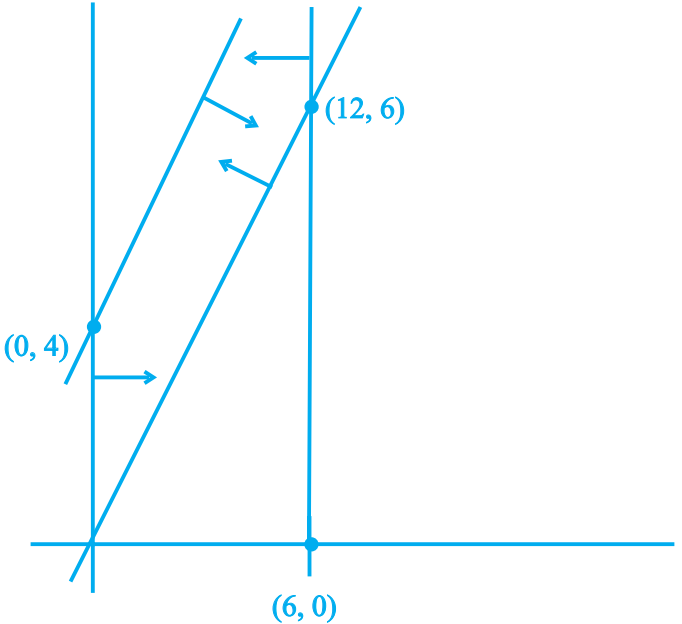
Let $F = 3x - 4y$ be the objective function. Maximum value of $F$ is: AnswerThe feasible region as shown in the figure, has objective function $F = 3x - 4y$
|
Corner points
|
Corresponding value of $Z = 3x - 4y$
|
|
$(0, 0)$
$(12, 6)$
$(0, 4)$
|
$0$
$12 ($maximum$)$
$-16 ($minimum$)$
|
Hence, the maximum value of $F$ is $12.$ View full question & answer→MCQ 591 Mark
Feasible region $($shaded$)$ for a $\text{LPP}$ is shown in the given figure. Minimum of $z = 4x + 3y$ occurs at the point.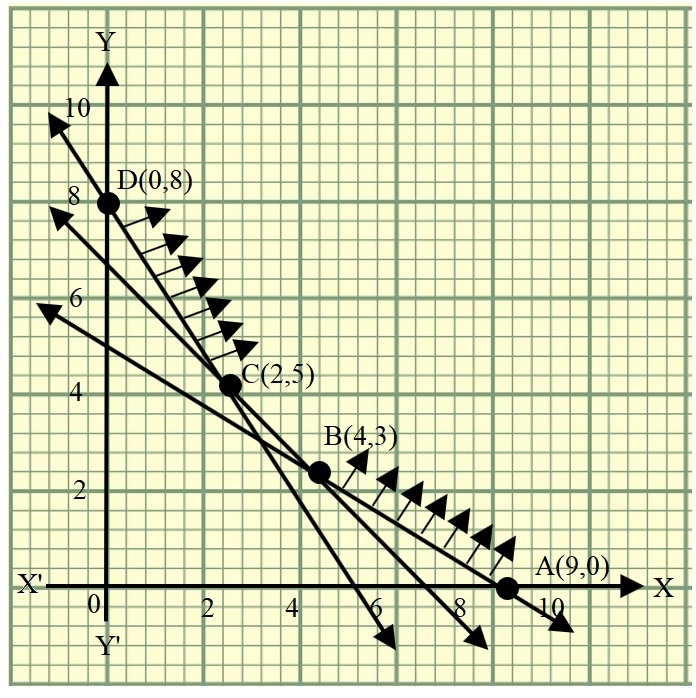
- A
$(0, 8)$
- ✓
$(2, 5)$
- C
$(4, 3)$
- D
$(9, 0)$
AnswerCorrect option: B. $(2, 5)$
View full question & answer→MCQ 601 Mark
The corner points of the feasible region determined by the system of linear constraints are $(0, 10), (5, 5), (25, 20)$ and $(0, 30).$ Let $Z = px + qy,$ where $p, q > 0$. Condition on $p$ and $q $ so that the maximum of $Z$ occurs at both the points $(25, 20)$ and $(0, 30)$ is $ ..........$
- ✓
$5p = 2q$
- B
$2p = 5q$
- C
$p = 2q$
- D
$q = 3p$
AnswerCorrect option: A. $5p = 2q$
Maximum of $Z$ occurs at $(25, 20)$ and at $(0, 30).$
Hence, equating the vales of $Z$ at these points, we get $25p + 20q = 30q$
$\therefore 5p = 2q$
This is the required relation.
Also as $p, q > 0,$ the value of $Z$ is always positive and hence, is greater at $(25, 20)$ and at $(0, 30)$ than at $(0,10)$ and $(5, 5).$
View full question & answer→MCQ 611 Mark
Choose the most correct of the following statements relating to primal$-$dual linear programming problems:
- A
Shadow prices of resources in the primal are optimal values of the dual variables.
- B
The optimal values of the objective functions of primal and dual are the same.
- C
If the primal problem has unbounded solution, the dual problem would have infeasibility.
- ✓
View full question & answer→MCQ 621 Mark
Linear programming used to optimize mathematical procedure and is:
- ✓
Subset of mathematical programming
- B
Dimension of mathematical programming
- C
Linear mathematical programming
- D
AnswerCorrect option: A. Subset of mathematical programming
View full question & answer→MCQ 631 Mark
The maximum value of $Z = 3x + 2y,$ subjected to $\text{x}+2\text{y}\leq2,\text{x}+2\text{y}\geq8;\text{x},\text{y}\geq0 $ is:
View full question & answer→MCQ 641 Mark
If $\text{x}+\text{y}\leq2,$ $\text{x}\leq0,$ $\text{y}\leq0$ the point at which maximum value of $3x + 2y$ attained will be.
AnswerCorrect option: A. $(0,0)$
View full question & answer→MCQ 651 Mark
The region represented by the inequalities $\text{x}\geq6,\text{y}\geq2,2\text{x}+\text{y}\leq0,\text{x}\geq0,\text{y}\geq{0}$ is:
View full question & answer→MCQ 661 Mark
The objective function $Z = 4x + 3y$ can be maximised subjected to the constraints $ 3\text{x}+4\text{y}\leq24,$ $8\text{x}+6\text{y}\leq48,$ $\text{x}\leq5,\text{y}\leq6;\text{x},\text{y}\leq0.$
- A
- B
- ✓
At an infinite number of points.
- D
AnswerCorrect option: C. At an infinite number of points.
View full question & answer→MCQ 671 Mark
The corner points of the feasible region determined by the system of linear constraints are $(0, 10), (5, 5), (15, 15), (0, 20).$ Let $Z = px + qy,$ where $p, q > 0.$ Condition on $p$ and $q$ so that the maximum of $Z$ occurs at both the points $(15, 15)$ and $(0, 20)$ is Maximum of $Z$ occurs at:
- ✓
$(5, 0)$
- B
$(6, 5)$
- C
$(6, 8)$
- D
$(4, 10)$
AnswerCorrect option: A. $(5, 0)$
View full question & answer→MCQ 681 Mark
Which of the following is a type of Linear programming problem?
MCQ 691 Mark
The corner points of the feasible region are $A(0, 0), B(16, 0), C(8, 16)$ and $D(0, 24)$. The minimum value of the objective function $z = 300x + 190y$ is $ .........:$
- A
$5440$
- B
$4800$
- C
$4560$
- ✓
$0$
AnswerWe know that, for a cartesian polygon , the maximum value occurs at the corner points or vertices of the polygon.
Given $z = 300x + 190y$
By substituting $A(0, 0)$ in the equation we get $z = 0$
By substituting $B(16, 0)$ in the equation we get $z = 4800$
By substituting $C(8, 16)$ in the equation we get $z = 5440$
By substituting $D(0, 24)$ in the equation we get $z = 4560$
Hence the minimum value of $Z$ occured at $C(0, 0)$ with $z = 0$
View full question & answer→MCQ 701 Mark
In solving the $\text{LPP} :$ “minimize $f = 6x + 10y$ subect to constraints $\text{x}\geq6,\text{y}\geq2,2\text{x}+\text{y}\geq10,\text{x}\geq0,\text{y}\geq0”$ redundant constraints are :
- A
$\text{x}\geq6,\text{y}\geq2$
- ✓
$2\text{x}+\text{y}\geq10,\text{x}\geq0,\text{y}\geq0$
- C
$\text{x}\geq6$
- D
AnswerCorrect option: B. $2\text{x}+\text{y}\geq10,\text{x}\geq0,\text{y}\geq0$
View full question & answer→MCQ 711 Mark
The optimal value of the objective function is attained at the points:
- A
On $x -$ axis
- B
On $y -$ axis
- ✓
Which are corner points of the feasible region
- D
AnswerCorrect option: C. Which are corner points of the feasible region
View full question & answer→MCQ 721 Mark
Consider the objective function $Z = 40x + 50y$ The minimum number of constraints that are required to maximize $Z$ are :
AnswerSince in the given function $Z = 40x + 50y,$ two variables are used.
So, the two constraints will be $\text{x}\geq0,\text{y}\geq0$ and the third one will be of the type
$\text{ax}+\text{by}\geq\text{c}.$
Hence, at least $3$ constraints are required.
View full question & answer→MCQ 731 Mark
$Z = 7x + y,$ subject to $ 5\text{x}+\text{y}\geq5,\text{x}+\text{y}\geq3,\text{x}\geq0, y\geq0.$ The minimum value of $Z$ occurs at:
AnswerCorrect option: D. $(0,5)$
View full question & answer→MCQ 741 Mark
The optimal value of the objective function is attained at the points:
- A
On $X -$ axis
- B
On $Y -$ axis
- ✓
Corner points of the feasible region
- D
AnswerCorrect option: C. Corner points of the feasible region
Any point in the feasible region that gives the optimal value $($maximum or minimum$)$ of the objective function is called an optimal solution.
View full question & answer→MCQ 751 Mark
An iso$-$profit line represents:
- ✓
An infinite number of solutions all of which yield the same profit.
- B
An infinite number of solution all of which yield the same cost.
- C
An infinite number of optimal solutions.
- D
A boundary of the feasible region.
AnswerCorrect option: A. An infinite number of solutions all of which yield the same profit.
View full question & answer→MCQ 761 Mark
Maximize $Z = 7x + 11y,$ subject to $3\text{x}+5\text{y}\leq26,5\text{x}+3\text{y}\leq30,\text{x}\geq0,\text{y}\geq0.$
- ✓
$\text{59 at}\Big(\frac{9}{2},\frac{5}{2}\Big)$
- B
$\text{42 at (6, 0)}$
- C
$\text{49 at (7, 0)}$
- D
$\text{57.2 at (0, 5.2)}$
AnswerCorrect option: A. $\text{59 at}\Big(\frac{9}{2},\frac{5}{2}\Big)$
View full question & answer→MCQ 771 Mark
Choose the correct answer from the given four options. The corner points of the feasible region determined by the system of linear constraints are $\{(0, 0), (0, 40), (20, 40), (60, 20), (60, 0)\}$. The objective function is $Z = 4x + 3y.$ Compare the quantity in Column $A$ and Column $B.$
|
Column $A$
|
Column $B$
|
|
Maximum of $Z$
|
$325$
|
AnswerCorrect option: B. The quantity in column $B$ is greater.
|
Corner points
|
Corresponding value of $Z = 4x + 3y$
|
| $(0, 0)$ |
$0$ |
| $(0, 40)$ |
$120$ |
| $(20, 40)$ |
$200$ |
| $(60, 20)$ |
$300 ($Maximum$)$
|
| $(60, 0)$ |
$240$
|
Hence, maxmimum value of $Z = 300 < 325$
So, the quantity in column $B$ is greater. View full question & answer→MCQ 781 Mark
The feasible, region for an $\text{LPP}$ is shown shaded in the figure. Let $Z = 3x - 4y$ be the objective function. a minimum of $Z$ occurs at: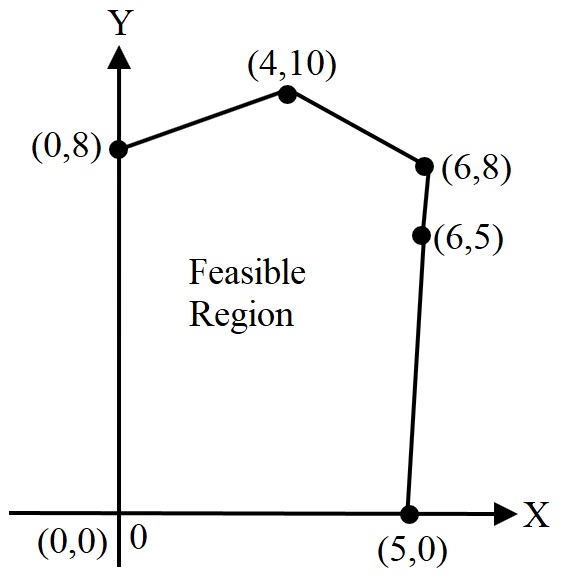
- A
$(0, 0)$
- ✓
$(0, 8)$
- C
$(5, 0)$
- D
$(4, 10)$
AnswerCorrect option: B. $(0, 8)$
View full question & answer→MCQ 791 Mark
The solution set of the inequation $3x + 2y > 3$ is:
AnswerCorrect option: A. Half plane not containing the origin
View full question & answer→MCQ 801 Mark
Consider a $\text{LPP}$ given by Minimum $Z = 6x + 10y$ Subjected to $x \geq 6, y \geq 2, 2x + y \geq 10, x \geq 0, y \geq 0$ Redundant constraints in this $\text{LPP}$ are
- A
$x \geq 0, y \geq 0$
- B
$x \geq 6$
- ✓
$2x + y \geq 10$
- D
AnswerCorrect option: C. $2x + y \geq 10$
Consider, $x = 6$
and $y = 2$
Now $2x + y = 10$
| $x$ |
$y$ |
$(x, y)$ |
| $0$ |
$10$ |
$(0, 10)$ |
| $5$ |
$0$ |
$(5, 0)$ |
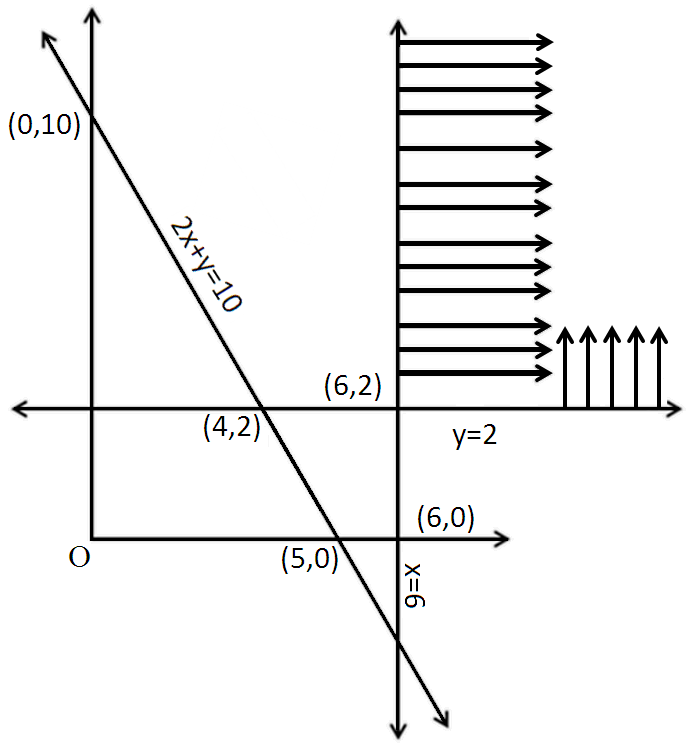
Minimum $Z$ will be at $2x + y \geq 10.$ View full question & answer→MCQ 811 Mark
If $x + y = 3$ and $xy = 2,$ then the value of $x^3 - y^3$ is equal to.
AnswerFormula used:
$\text{x}^3-\text{y}^3=(\text{x}-\text{y})(\text{x}^2+\text{xy}+\text{y}^2)$
$=(\sqrt{(\text{x}+\text{y})^{2}-4\text{xy}})[(\text{x}+\text{y})^{2}-\text{xy}]$
$=(\sqrt{(3)^{2}-4(2})[(3)^{2}-2]$
$=(\sqrt{1})(7)$
$=7$
View full question & answer→MCQ 821 Mark
The maximum value of $Z = 3x + 4y$ subjected to contraints $\text{x}+\text{y}\leq40,\text{x}+2\text{y}\leq60,\text{x}\geq0$ and $\text{y}\geq0$ is:
View full question & answer→MCQ 831 Mark
Conclude from the following : $n^2 > 10,$ and $n$ is a positive integer. $A: n^3 B: 50.$
AnswerCorrect option: A. The quantity $A$ is may be greater or smaller than $B.$
given, $n^2 > 10$ and $n > 0$ multiplying both equations we get $n^3 > 0$
so, it may be greater than or less than $50.$
Hence, quantity $A$ is may be greater or smaller than $B$
View full question & answer→MCQ 841 Mark
Solving an integer programming problem by rounding off answers obtained by solving it as a linear programming problem $($using simplex$),$ we find that.
- A
The values of decision variables obtained by rounding off are always very close to the optimal values.
- ✓
The value of the objective function for a maximization problem will likely be less than that for the simplex solution.
- C
The value of the objective function for a minimization problem will likely be less than that for the simplex solution.
- D
All constraints are satisfied exactly.
AnswerCorrect option: B. The value of the objective function for a maximization problem will likely be less than that for the simplex solution.
View full question & answer→MCQ 851 Mark
Mark the wrong statement:
AnswerCorrect option: A. The primal and dual have equal number of variables.
View full question & answer→MCQ 861 Mark
In linear programming context, sensitivity analysis is a technique to:
- A
Allocate resources optimally.
- B
Minimize cost of operations.
- C
Spell out relation between primal and dual.
- ✓
Determine how optimal solution to $\text{LPP}$ changes in response to problem inputs.
AnswerCorrect option: D. Determine how optimal solution to $\text{LPP}$ changes in response to problem inputs.
A sensitivity analysis is performed to determine the sensitivity of the solution to changes in parameters.
View full question & answer→MCQ 871 Mark
Choose the correct answer from the given four options. The feasible solution for a $\text{LPP}$ is shown in. Let $Z = 3x - 4y$ be the objective function.
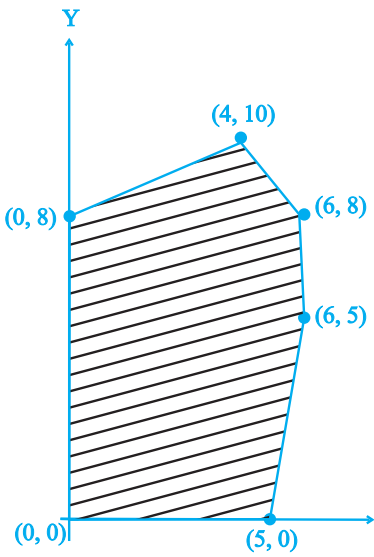
Minimum of $Z$ occurs at : - A
$(0, 0)$
- ✓
$(0, 8)$
- C
$(5, 0)$
- D
$(4, 10)$
AnswerCorrect option: B. $(0, 8)$
|
Corner points
|
Corresponding value of $Z = 3x - 4y$
|
|
$(0, 0)$
$(5, 0)$
$(6, 5)$
$(6, 8)$
$(4, 10)$
$(0, 8)$
|
$0$
$15 - 2$
$-14$
$-28$
$-32 ($Minimum$)$
|
Hence, the minimum of $Z$ occurs at $(0, 8)$ and its minimum value is $(-32).$ View full question & answer→MCQ 881 Mark
An article manufactured by a company consists of two parts $X$ and $Y$. In the process of manufacture of the part $X. 9$ out of $100$ parts may be defective. Similarly $5$ out of $100$ are likely to be defective in part $Y.$ Calculate the probability that the assembled product will not be defective.
- A
$0.86$
- B
$0.864$
- C
$0.8456$
- ✓
$0.8645$
AnswerCorrect option: D. $0.8645$
Let $A =$ Part $X$ is not defective
Probability of $A$ is $\text{P}(\text{A})=\frac{91}{100}$
$B =$ Part $Y$ is not defective.
Probability of $B$ is $\text{P}(\text{B})=\frac{95}{100}$
Required probability
$=\text{P}(\text{A}\cap\text{B})=\text{P}(\text{A})\text{P}(\text{B})$
$=\frac{91}{100}\times\frac{95}{100}=\frac{8645}{10000}$
View full question & answer→MCQ 891 Mark
The maximum value of the object function $Z = 5x + 10y$ subject to the constraints $\text{x}+2\text{y}\leq120,\text{x}+\text{y}\geq60,\text{x}-2\text{y}\geq0,\text{x}\geq0,\text{y}\geq0$ is:
View full question & answer→MCQ 901 Mark
Vikas printing company takes fee of $Rs. 28$ to print a oversized poster and $Rs. 7$ for each colour of ink used. Raaj printing company does the same work and charges poster for $Rs. 34$ and $Rs. 5.50$ for each colour of ink used. If $z$ is the colours of ink used, find the values of $z$ such that Vikas printing company would charge more to print a poster than Raaj printing company.
- A
$\text{z} < 4$
- B
$2\leq\text{z}\leq4$
- C
$4\leq\text{z}\leq7$
- ✓
$\text{z} > 4$
AnswerCorrect option: D. $\text{z} > 4$
$28+7\text{z} > 34+5.50\text{z}$
$\rightarrow1.50\text{z} > 6$
$\rightarrow\text{z} > \frac{6}{1.5}\ \text{z} > 4$
View full question & answer→MCQ 911 Mark
Which of the following statement is correct?
- A
Every $\text{LPP}$ admits an optimal solution.
- ✓
Every $\text{LPP}$ admits unique optimal solution.
- C
If a $\text{LPP}$ gives two optimal solutions it has infinite number of solutions.
- D
AnswerCorrect option: B. Every $\text{LPP}$ admits unique optimal solution.
View full question & answer→MCQ 921 Mark
The corner points of the feasible region determined by the following system of linear inequalities: $2\text{x}+\text{y}\leq10,\text{x}+3\text{y}\leq15, \text{x},\text{y}\geq0$ are $(0, 0), (5, 0), (3, 4)$ and $(0, 5).$ Let $Z = px + qy,$ where $p, q > 0.$ Conditions on $p$ and $q$ so that the maximum of $Z$ occurs at both $(3, 4)$ and $(0, 5)$ is :
- A
$p = 3q$
- B
$p = 2q$
- C
$p = q$
- ✓
$q = 3p$
AnswerCorrect option: D. $q = 3p$
View full question & answer→MCQ 931 Mark
Maximize $Z = 6x + 4y,$ subject to $\text{x}\leq2,\text{x}+\text{y}\leq3,-2\text{x}+\text{y}\leq1,\text{x}\geq0,\text{y}\geq0.$
AnswerCorrect option: C. $\frac{140}{3}$ at $\Big(\frac{2}{3},\frac{1}{3}\Big)$
View full question & answer→MCQ 941 Mark
Region represented by $\text{x}\geq0, \text{y}\geq0$ is:
AnswerAll the positive values of $x$ and $y$ will lie in the first quadrant.
View full question & answer→MCQ 951 Mark
Which of the following is not true about feasibility?
AnswerCorrect option: A. It cannot be determined in a graphical solution of an $\text{LPP}.$
View full question & answer→MCQ 961 Mark
The maximum value of $Z = 4x + 3y$ subjected to the constraints $2\text{x}+3\text{y}\leq18 \text{x}+\text{y}\geq10;\text{x},\text{y}\geq0$ is:
View full question & answer→MCQ 971 Mark
Refer to Question $18 ($Maximum value of $Z+$ Minimum value of $Z)$ is equal to:
View full question & answer→MCQ 981 Mark
$Z = 8x + 10y,$ subject to $2\text{x}+\text{y}\geq1,2\text{x}+3\text{y}\geq15,\text{y}\geq2,\text{x}\geq0,\text{y}\geq0.$ The minimum value of $Z$ occurs at.
- A
$(4.5, 2)$
- ✓
$(1.5, 4)$
- C
$(0, 7)$
- D
$(7, 0)$
AnswerCorrect option: B. $(1.5, 4)$
View full question & answer→MCQ 991 Mark
For a linear programming equations, convex set of equations is included in region of:
MCQ 1001 Mark
Which of the following is a property of all linear programming problems?
- ✓
Alternate courses of action to choose from.
- B
Minimization of some objective.
- C
- D
Usage of graphs in the solution.
AnswerCorrect option: A. Alternate courses of action to choose from.
View full question & answer→