Questions · Page 2 of 3

5 Marks Questions

Question 515 Marks
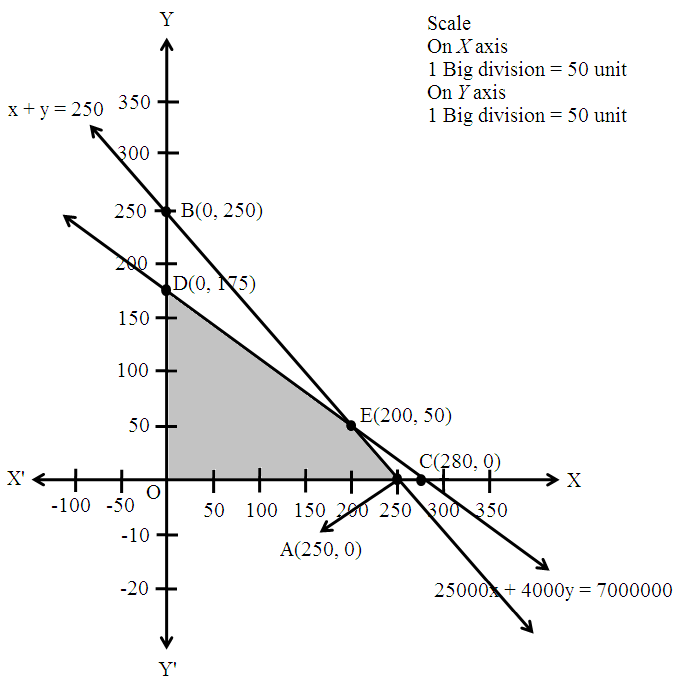
A fruit grower can use two types of fertilizer in his garden, brand P and Q. The amounts (in kg) of nitrogen, phosphoric acid, potash, and chlorine in a bag of each brand are given in the table. Tests indicate that the garden needs at least 240kg of phosphoric acid, at least 270kg of potash and at most 310kg of chlorine.
Kg per bag
 
Brand P
Brand P
Nitrogen
32
3.5
Phosphoric
1
2
Potash
3
1.5
Chlorine
1.5
2
If the grower wants to minimize the amount of nitrogen added to the garden, how many bags of each brand should be used? What is the minimum amount of nitrogen added in the garden?
Answer
Let x bags of fertilizer P and Y bags of fertilizer Q used in the garden to minimize the usage of nitrogen.
Then the mathematical modal of the LPP is as follows:
Minimise $Z = 3x + 3.5y$
Subject to
$\text{x}+2\text{y}\geq240$
$3\text{x}+1.5\text{y}\geq270$
$1.5\text{x}+2\text{y}\leq310$
$\text{x}\geq0,\text{y}\geq0$
To solve the LPP we draw the lines,
$x + 2y = 240$
$3x + 1.5y = 270$
$1.5x + 2y = 310$
The feasible region of the LPP is shaded in graph.
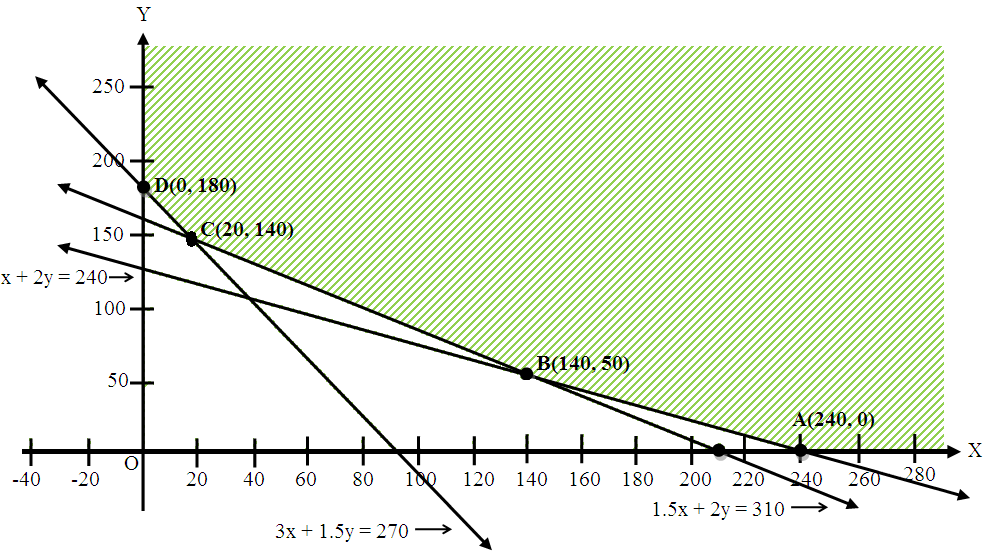
The coordinates of the vertices (corner points) of the feasible region ABC are $A(40, 100), B(140, 50),$ and $C(20, 140).$
The value of the objective function at these points are given in the following table.
Point $(x_1, x_2)$
Value of objective function Z = 3x + 3.5y
$A(40, 100)$ $Z = 470$
$B(140, 50)$
$Z = 595$
$C(20, 140)$ $Z = 550$
$D(0, 8)$ $Z = 160$
40 bags of brand P and 100 bags of brand Q should be used to minimize.
The amount of nitrogen added to the garden.
The minimum amount of notrogen added in the garden is 470kg.
View full question & answer
Question 525 Marks
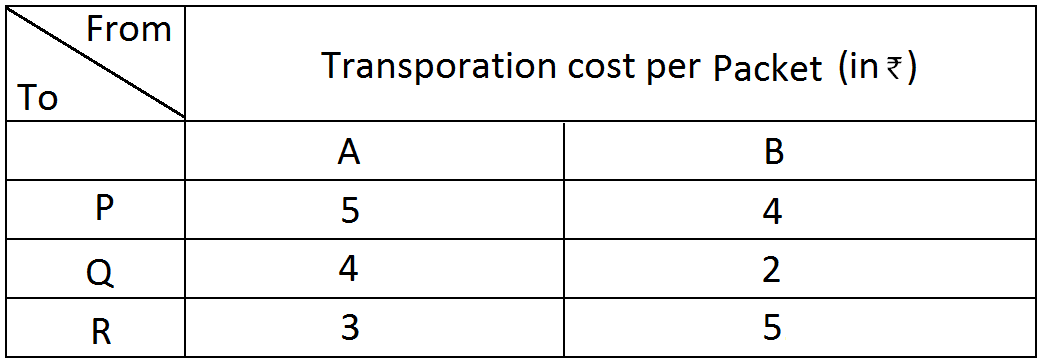
A medical company has factories at two places, A and B. From these places, supply is made to each of its three agencies situated at P, Q and R. The monthly requirements of the agencies are respectively 40, 40 and 50 packets of the medicines, while the production capacity of the factories, A and B, are 60 and 70 packets respectively. The transportation cost per packet from the factories to the agencies are given below:

How many packets from each factory be transported to each agency so that the cost of transportation is minimum? Also find the minimum cost?
Answer
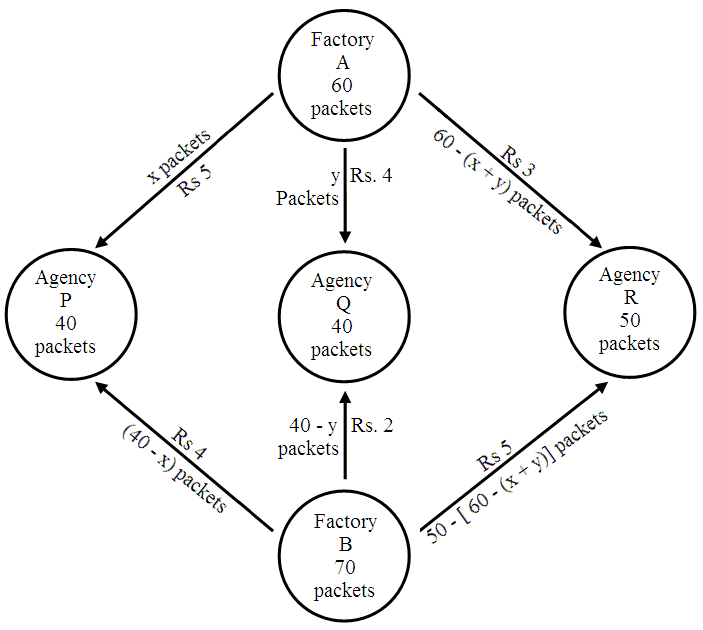
The given information can be exhibited diagramatically as below:

Let factory A transports x packets to agency P and y packet to agency Q.
Since factory A has capacity of 60 packets so, rest $ [60 - (x + y)]$ packets transported to agency R.
Since requirements are always non negative so,
$= x , y ≥ 0$ (first constraint)
and
$60 = (x + y) ≥ 0$
$(x + y) ≥ 60$ (second constraint)
Since requirement of agency P is 40 packet but it has recieved x packet, so $(40 - x)$ packets are transported from factory B, requirement of agency Q is 40 packets but it has recieved y packets, so $(40 - y)$ packets are transported from factory B.
Requirement of agency R is 50 packets but it has recieved $(60 - x - y)$ packets from factory A, so $50 - (60 - x - y) - (x + y - 10)$ is transported from factory B, As the requirements of agencies P, Q, R are always non negative, so,
$40 - x ≥ 0$
$X ≤ 40$ (third constraint)
$40- y ≥ 0$
$y ≤ 40 $(fourth constraint)
$x + y - 10 ≥ 0$
$x + y ≥ 10$ (fifth constraint)
Costs of transportation of each packet from factory A to agency P, Q, R are Rs. 5,4,3 respectively and costs of transportation of each packet from factory 8 to agency P, Q, R are Rs. 4, 2, 5 respectively,
Let Z be total cost of transportation so,
$Z = 5x + 4y + 3(60 - x - y) + 4(40 - x) + 2(40 - y) + 5(x + y - 10)$
$= 5x + 4y + 180 - 3x - 3y + 160 - 4x + 80 - 2y + 5x + 5y - 50$
$= 3x + 4y + 370$
Hence, mathematical formulation of LPP is find x and y which
Maximize $Z = 3x + 4y + 370$
Subject to constraints,
$x, y ≥ 0$
$x + y ≤ 60$
$x ≤ 40$
$y ≤ 0$
$x + y ≥ 10$
Region $x, y ≥ 0:$
$$It is represents first quandrant.
Region $ x + y ≤ 60:$
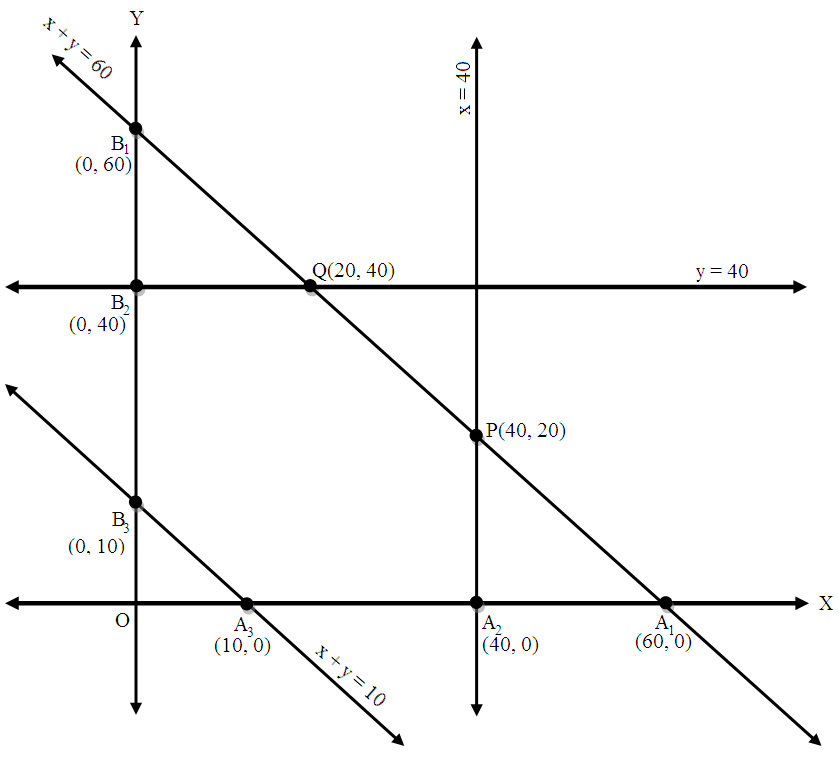
Line $x + y ≤ 60$ meets axes at $A_1(60, 0), B_1(0, 60)$ respectively.
Region containing origin represents $x +y ≤ 60$ as $(0, 0)$ satisfies $x + y ≤ 60$
Region $X ≤ 40:$
Line $x = 40$ is parallel to y-axis and meets x-axis at $A_2(40, 0).$
Region containing origin represents x ≤ 40 as $(0, 0)$ satisfies $x ≤ 40.$
Region $y \leq 40:$
line $y = 40$ is parallel to x-axis and meets y-axis at $B_2(0, 40).$
Region containing origin represents $y \leq 40$ as $(0, 0)$ satisfies $y \leq 40.$
Region $x + y \geq 10:$
Line $x + y = 10$ meets axes at $A_2(10, 0), B_3(0, 10)$ respectively.
Region containing origin represents $x + y ≥ 10$ as $(0, 0)$ does not satisfy $x + y ≥ 10.$
Shaded region $A_2A_2PQB_2B_3$ represents feasible region.
Point $P(40, 20)$ is obtained by solving x = 40 and $x + y = 60$
Point $Q(20, 40)$ is obtained by solving y = 40 and $x + y = 60$

The value of $Z = 3x + 4y + 370$ at
$A_3(10, 0) = 3(10) + 4(0) + 370 = 400$
$A_2(40, 0) = 3(40) + 4(0) + 370 = 490$
$P(40, 20) = 3(40) + 4(20) + 370 = 570$
$Q(20, 40) = 3(20) + 4(40) + 370 = 590$
$B_2(0, 40) = 3(0) + 4(40) + 370 = 530$
$B_3(0, 10) = 3(0) + 4(10) + 370 = 410$
Minimum $Z = 400$ at $x = 10, y = 0$
From $A → P = 10$ packets
From $A → Q = 0$ packets
From $A → R = 50$ packets
From $B → P = 30$ packets
From $B → Q = 40$ packets
From $B → R = O$ packets
Minimum cost $=$ Rs. $400$
View full question & answer
Question 535 Marks
A producer has 30 and 17 units of labour and capital respectively which he can use to produce two type of goods x and y. To produce one unit of x, 2 units of labour and 3 units of capital are required. Similarly, 3 units of labour and 1 unit of capital is required to produce one unit of y. If x and y are priced at Rs. 100 and Rs. 120 per unit respectively, how should be producer use his resources to maximize the total revenue? Solve the problem graphically.
Answer
Let xl and yl units of goods x and y were produced respectively.
Number of units of goods cannot be negative.
Therefore, $x_1, y_1 \geq 0$
To produce one unit of x, 2 units of labour and for one unit of y, 3 units of labour are required.
$2x_1 + 3y_1 \leq 30$
To produce one unit of x, 3 units of capital is required and 1 unit of capital is required to produce one unit of y
$3x_1 + y_1 \leq 17$
If x and y are priced at Rs. 100 and Rs. 120 per unit respectively,
Therefore, cost of $x_1$ and $y_1$ units of goods x and y is Rs. $100x_1$ and Rs. $120y_1$ respectively.
Total revenue $= Z = 100x_1 + 120y_1$ which is to be maximised.
Thus, the mathematical formulation of the given linear programmimg problem is
Max $Z = 100x_1 + 120y_1$
Subject to
$2x_1 + 3y_1 \leq 30$
$3x_1 + y_1 \leq 17$
$x_1, y_1 \geq 0$
First we will convert inequations into equations as follows:
$2x_1 + 3y_1 = 30, 3x_1 + y_1 = 17, x = 0$ and $y = 0$
Region represented by $2x_1 + 3y_1 \leq 30:$
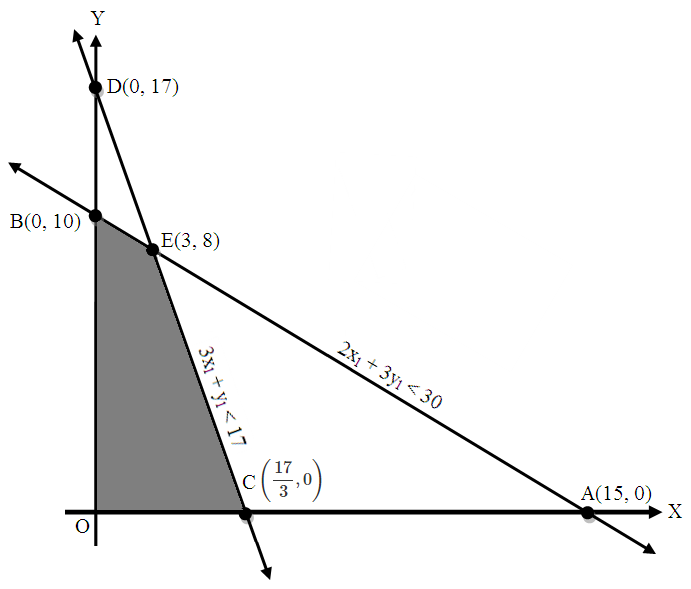
The line $2x_1 + 3y_1 = 30$ meets the coordinate axes at A(15, 0) and B(0, 10) respectively.
By joining these points we obtain the line $2x_1 + 3y_1 = 30.$
Clearly (0, 0) satisfies the $2x_1 + 3y_1 = 30.$
So, the region which contains the origin represents the solution set of the inequation $2x_1 + 3y_1 \leq 30.$
Region represented by $3x_1 + y_1 \leq 17:$
The line $3x_1 + y_1 = 17$ meets the coordinate axes at $C(173, 0)$ and $D(0, 17)$ respectively.
By joining these points we obtain the line $3x_1 + y_1 = 17.$
Clearly $(0, 0)$ satisfies the inequation $3x_1 + y_1 \leq 17.$
So, the region which contains the origin represents the solution set of the inequation $3x_1 + y_1 \leq 17.$
Region represented by$ x_1 \geq 0$ and $y_1 \geq 0:$
Since, every point in the first quadrant satisfies these inequations.
So, the first quadrant is the region represented by the inequations x$_1 \geq 0,$ and $y_1 \geq 0$.
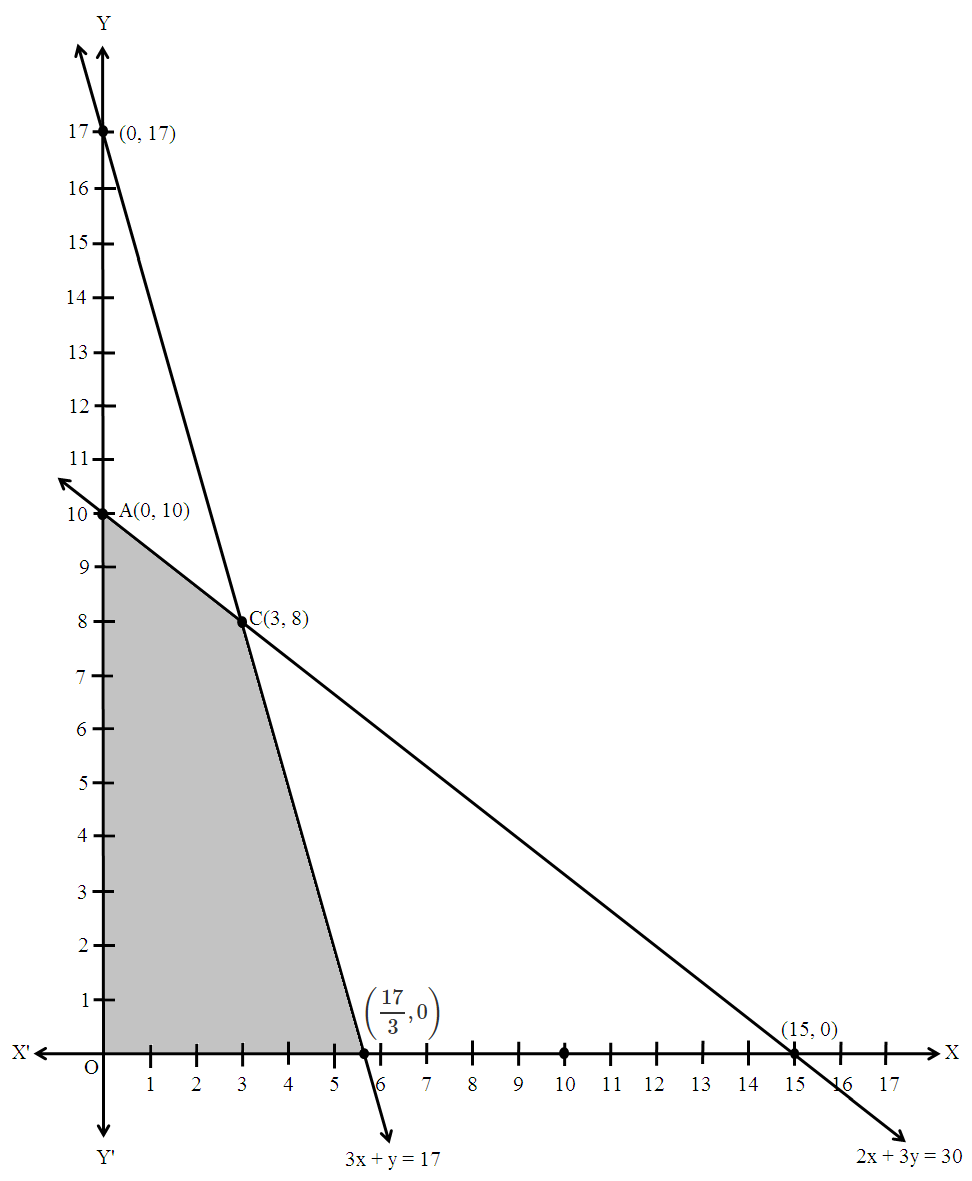
The feasible region determined by the system of constraints $2x_1 + 3y_1 \leq 30, 3x_1 + y_1 \leq 17, x_1 \geq 0$ and $y_1 \geq 0$ are as follows.

The corner points are $B(0, 10), E(3, 8)$ and $C(173, 0).$
The values of Z at these corner points are as follows.
Corner point
$Z = 100x_1 + 120y_1$
$B$
$1200$
$E$
$1260$
$C$
$17003$
The maximum value of Z is $1260$ which is attained at $E(3, 8)$.
Thus, the maximum revenue is Rs. $1260$ obtained when 3 units of x and 8 units of y were produced.
View full question & answer
Question 545 Marks
Maximize $Z = x + y$
Subject to
$-2\text{x}+\text{y}\leq1$
$\text{x}\leq2$
$\text{x}+\text{y}\leq3$
$\text{x},\text{y}\geq0$
Answer
Converting the given inequations into equation,
-2x + y = 1, x = 2, x + y = 3, x= y = 0

Region represented by $- 2x + y = 1:$
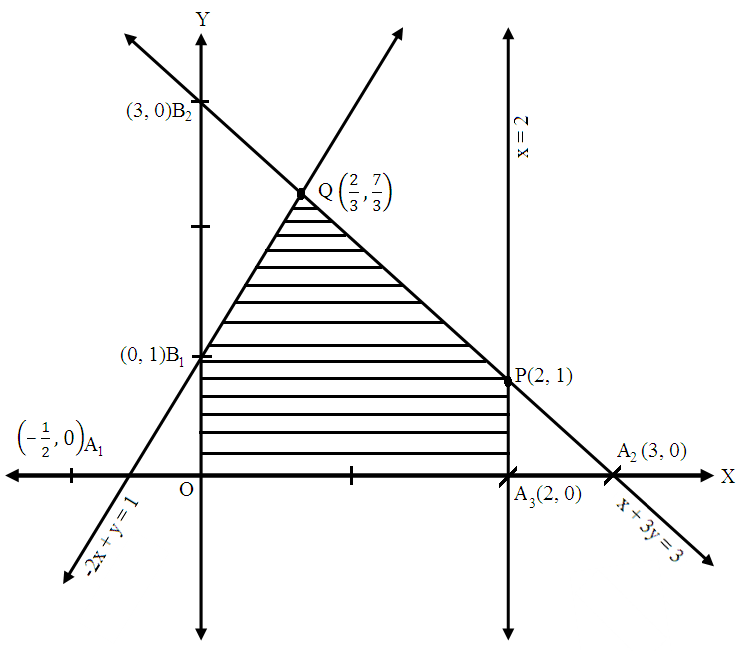
Line $- 2x + y = 1$ meets coordinate axes at $\text{A}_1\Big(\frac{-1}{2},0\Big)$ and $B_1(0, 1)$, clearly, $(0, 0) $ satisfies $-2\text{x}+\text{y}\leq1$, so region containing origin represents $-2\text{x}+\text{y}\leq1$ in xy-plane.
Region represented by $\text{x}\leq2$:
Linex - 2 is parallel to y-axis and meets x-axis at $A_3(2, 0).$
Clearly, $(0, 0)$ satisfies $\text{x}\leq2$, so region containing origin represents $\text{x}\leq2$ in xy-plane.
Region represented by $\text{x}+\text{y}\leq3$:
Line $x + y - 3$ meets coordinate axes at $A_2(3, 0)$ and $B_2(0, 3).$
Clearly, $(0, 0)$ satisfies $\text{x}+\text{y}\leq3$, so region containing origin represents $\text{x}+\text{y}\leq3$ in xy-plane.
Region represented $\text{x},\text{y}\geq0$:
It represents first quadrant in xy-plane.
So, shaded region $OA_3PQ8$, represents the feasible region.
Coordinates of $P(2, 1)$ is obtained by solving $x + y = 3$ and $x = 2$, $\text{Q}\Big(\frac{2}{3},\frac{7}{3}\Big)$ by solving $-2x + y = 1$ and $x + y = 3$.
The value of $Z = x + y$ at
$\text{O}(0, 0) = 0 + 0 = 0$
$\text{A}_3(2, 0) = 2 + 0 = 2$
$\text{P}(2, 1) = 2 +1 = 2$
$\text{Q}\Big(\frac{2}{3},\frac{7}{3}\Big)=\frac{2}{3}+\frac{7}{3}=3$
$\text{B}_1(0, 1) = 0 + 1 = 1$
So, maximum Z = 3 is at every point on the line joining PQ.
Hence, maximum z = 3 at x = 2 and y = 1 Or $\text{x}=\frac{2}{3}$ and $\text{y}=\frac{7}{3}.$
View full question & answer
Question 555 Marks
If a young man drives his scooter at a speed of 25km/hr, he has to spend Rs. 2 per km on petrol. If he drives the scooter at a speed of 40km/hr, it produces air pollution and increases his expenditure on petrol to Rs. 5 per km. He has a maximum of Rs. 100 to spend on petrol and travel a maximum distance in one hour time with less polution. Express this problem as an LPP and solve it graphically. What value do you find here.
Answer
Let the distance covered with speed 25 km/hr = x km
And, the distance covered with speed 40 km/hr = y km
We know that,
$\text{Time} = \frac{\text{Distance}}{\text{Speed}}$
Thus, Maximum speed covered within one hour $= \frac{\text{x}}{25} + \frac{\text{y}}{40} \leq 1$
Thus, According to question,
Maximum speed covered, $\text{Z}_\text{max} = \text{x} + \text{y}$
Subject to the constrains, $\text{2x + 5y} \leq 100$
$\frac{\text{x}}{25} + \frac{\text{y}}{40} \leq 1$
$\text{x} , \text{y} \geq 0$
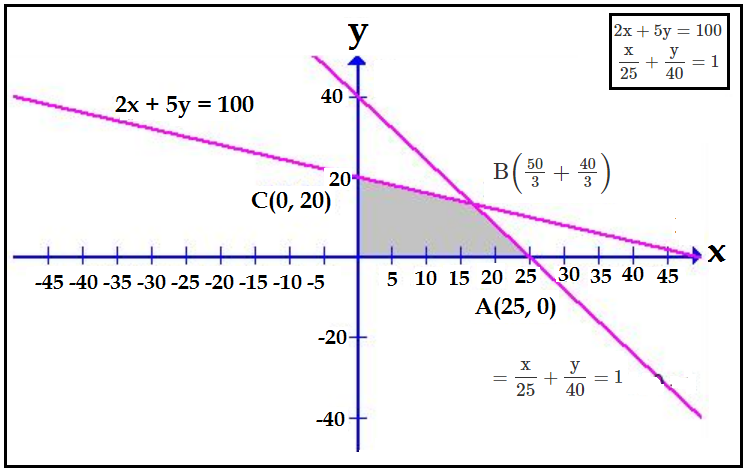
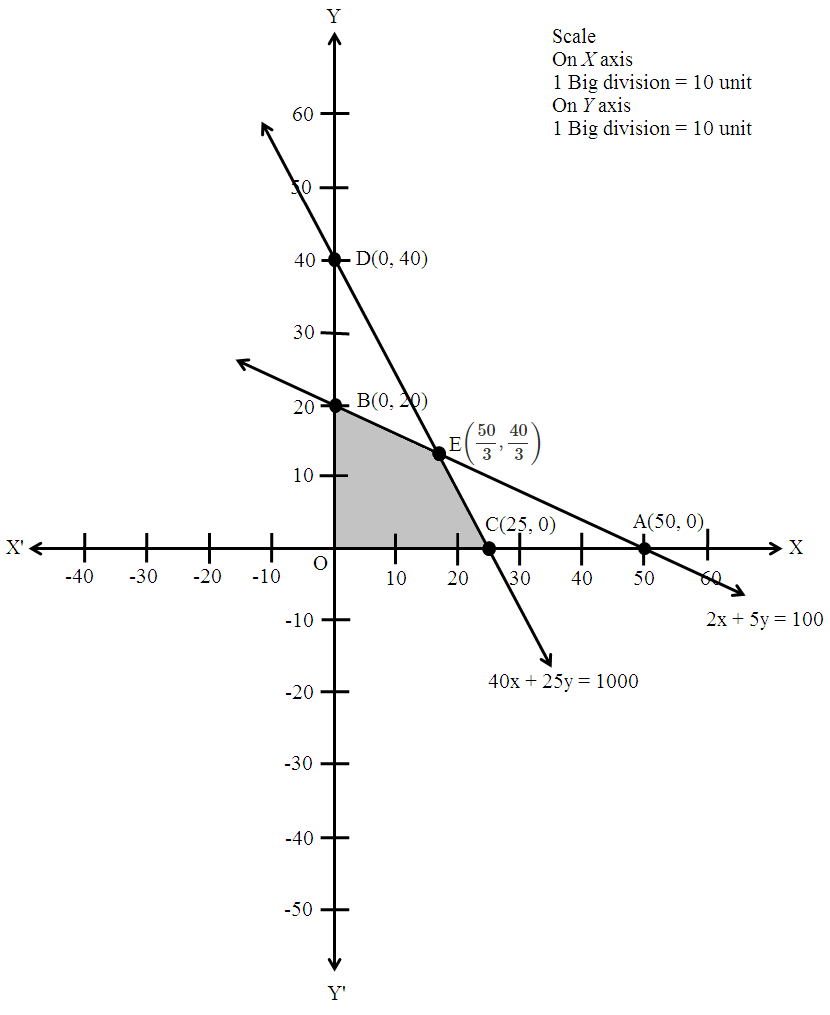
Now plotting both line on graph paper, we have,

from graph, OABC is feasible region.
Thus, maximum distance covered $= \frac{50}{3} + \frac{40}{3} = 30 \text{km}$
View full question & answer
Question 565 Marks
Maximum $Z = 3x + 5y$
Subject to
$\text{x}+2\text{y}\leq20$
$\text{x}+\text{y}\leq15$
$\text{y}\leq5$
$\text{x},\text{y}\geq0$
Answer
Converting the given inequations into equation:-
$x + 2y = 20, x + y = 15, x = y = 0$

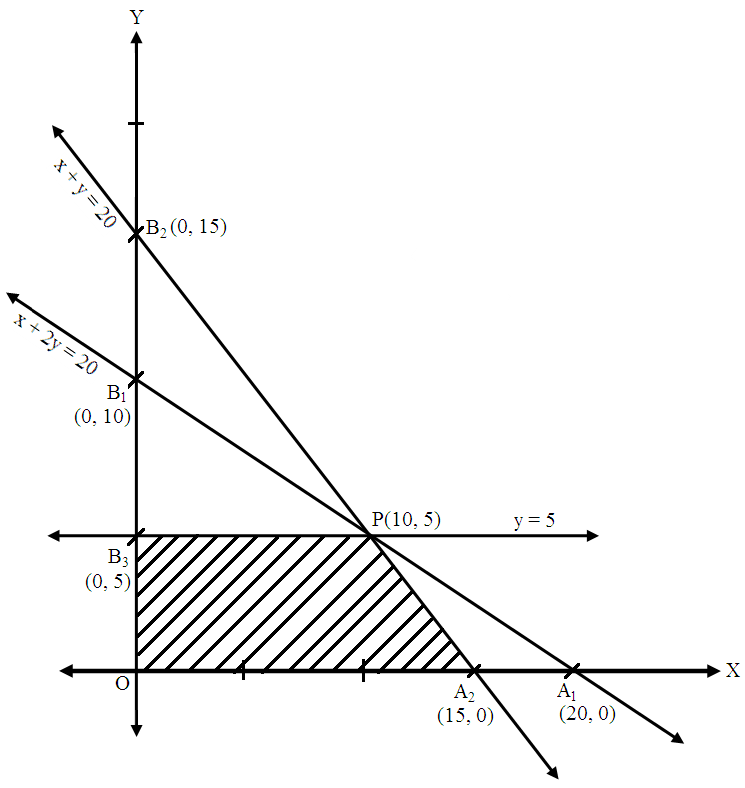
Region represented by $x + 2y = 20:$
Line $x + 2y = 20$ meets coordinate axes at $A_1(20, 0)$ and $B_1(0, 10)$, clearly, $(0, 0)$ satisfies $\text{x}+2\text{y}\leq20$, so region containing origin represents $\text{x}+2\text{y}\leq20$ in xy -plane.
Region represented by $\text{x}+\text{y}\leq15$:
Line $x + y = 15$ meets coordinate axes at $A_2(15, 0)$ and $B_2(0, 15),$ clearly, $(0, 0)$ satisfies $\text{x}+\text{y}\leq15$, so region containing origin represents $x + y = 15$ in xy-plane.
Region represented by $\text{y}\leq5$:
Line $y = 5$ is parallel to x-axis and meets at $B_3(0, 5)$ on y-axis.
Clearly $(0, 0)$ satisfies $\text{y}\leq5$, so region containing origin represents y s 5 in xy-plane.
Region represented by $\text{x},\text{y}\geq0$:
It represent the first quadrant in xy-plane.
So, shaded region $OA_2PB_3$ represents the feasible region.
Coordinate of P(10, 5) is obtained by solving $x + 2y = 20$ and $y - 5$
The value of $Z = 3x + 5y$ at
$O(0, 0) = 3(0) + 5(0) = 0$
$A_2(15, 0) = 3(15) + 5(0) = 45$
$P(10, 5) = 3(10) + 5(5) = 55$
$B_3(0, 5) = 3(0) + 5(5) = 25$
Hence, maximum $Z = 55$ at $x = 10$ and $y = 5$
View full question & answer
Question 575 Marks
A small firm manufactures gold rings and chains. The total number of rings and chains manufactured per day is at most 24. It takes 1 hour to make a ring and 30 minutes to make a chain. The maximum number of hours available per day is 16. If the profit on a ring is Rs. 300 and that on a chain is Rs. 190, find the number of rings and chains that should be manufactured per day, so as to earn the maximum profit. Make it as an LPP and solve it graphically.
Answer
Let required number of gold rings and chains are x and y respectively.
Since,profits on each ring and chains are Rs. 300 and Rs. 190 respectively, so, profit on x units of ring and y units of chains are Rs. 300x and Rs. 190y respectively
Let Z be total profit so
$Z = 300x + 190y$
Since each unit of ring and chain require 1 hr and 30 min. to make respectively, so,
X units of rings and y units of rings require 60x and 30y min. to make respectivley, but total time available to make is $16 × 60 = 960,$ so,
$60x + 30y ≤ 960$
$= 2x + y ≤ 32$ (first constraint)
Given, total number of rings and chains manufactured is at most 24, so,
$x + y ≤ 24$ (second constraint)
Hence, mathematical formulation of LPP is find x and y which
Maximize $ Z = 300x + 160y$
Subject to constriants,
$2x + y ≤ 32$
$x + y ≤ 4$
$x, y ≥ 0$ [Since production can not be less than zero]
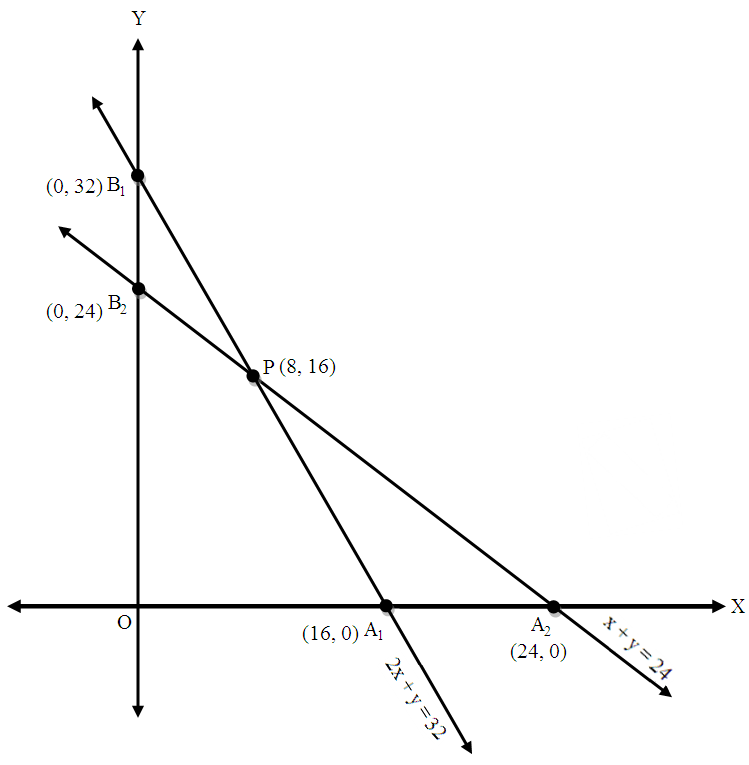
Region $2x + y ≤ 32:$
Line $2x + y = 32$ meets axes at $A_1(16, 0), B_1(0, 32)$ respectively.
Region containing origin represents $2x + y ≤ 32$ as $(0, 0)$ satisfies $2x +y ≤ 32$
Region $x + y ≤ 24:$
Line $x + y = 24$ meets axes at $A_2(24, 0), B_2(0, 24)$ respectively.
Region containing origin represents $x + y ≤ 24 $ as $(0, 0)$ satisfies $x + y ≤ 24.$
Region $x, y ≥ 0:$
It represent first quandrant
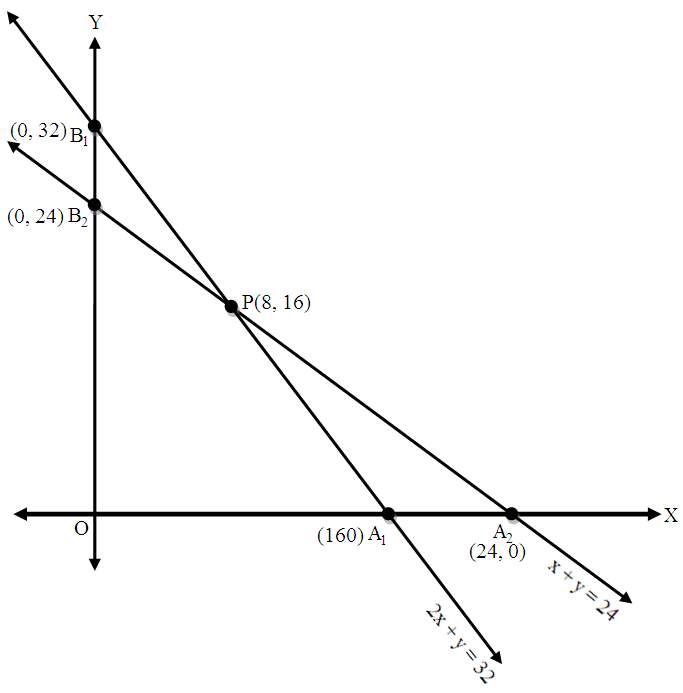
Shaded region $OA_1PB_2$ represents feasible region.
Point $P(8, 16)$ is obtained by solving $2x + y = 32$ and $x + y = 24.$

The value of $Z = 300x + 160y$ at
$O(0, 0) = 300(0) + 160(0) = 0$
$A_1(16, 0) = 300(16) + 160(0) = 4800$
$P(8, 16) = 300(8) + 160(16) = 4960$
$B_2(0, 24) = 300(0) + 160(24) = 3840$
Maximum $Z = 4960$ at $x = 8, y = 16$
Number of rings $= 8,$ chains $= 16$
Maximum profit = Rs. $4960$
View full question & answer
Question 585 Marks
Maximize Z = 50x + 30y
Subject to
$2\text{x}+\text{y}\leq18$
$3\text{x}+2\text{y}\leq34$
$\text{x},\text{y}\geq0$
Answer
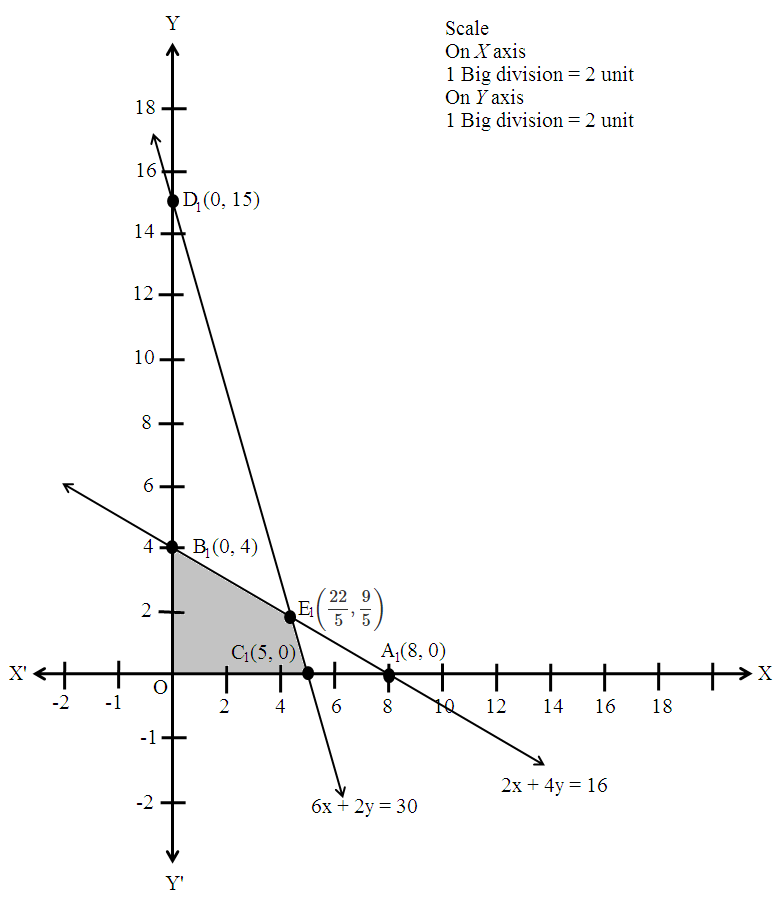
First, we will convert the given inequations into equations, we obtain the following equations:
2x + y = 18, 3x + 2y = 34
Region represented by 2x + y ≥ 18:
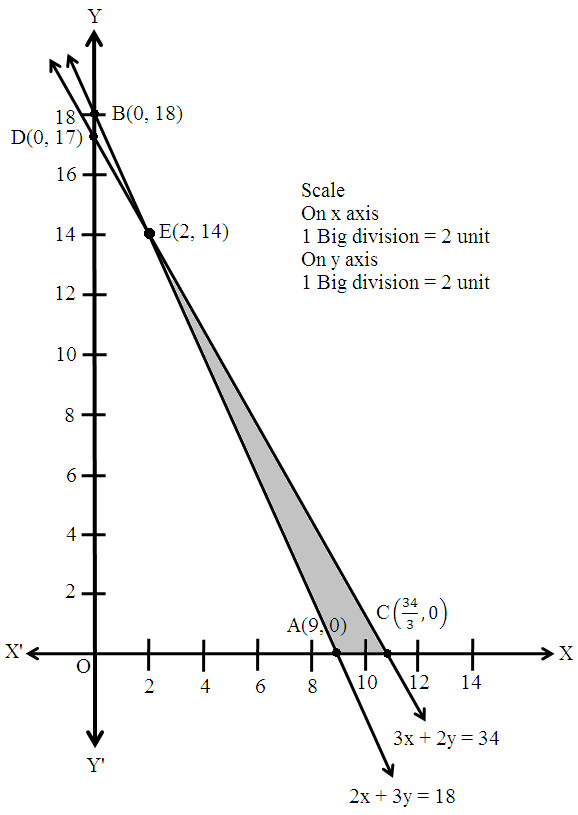
The line 2x + y = 18 meets the coordinate axes at A(9, 0) and B(0, 18) respectively. By joining these points we obtain the line 2x + y = 18.
Clearly (0,0) does not satisfies the inequation 2x + y ≥ 18.
So,the region in xy plane which does not contain the origin represents the solution set of the inequation 2x + y ≥ 18.
Region represented by 3x + 2y ≤ 34:
The line 3x + 2y = 34 meets the coordinate axes at $\text{C}\Big(\frac{34}{3},0\Big)$ and D(0, 17) respectively. By joining these points we abtain the line 3x + 2y = 34.
Clearly (0. 0) satisfies the inequation 3x + 2y ≤ 34. So, the region containing the origin represents the silution set of the inequation 3x + 2y ≤ 34.
The corner of the feasible region are A(9, 0), $\text{C}\Big(\frac{34}{3},0\Big)$ and E(2, 14).

The values of Z at these corner points are as follows.
$\text{Corner point}$
$\text{Z}=50\text{x}+30\text{y}$
$\text{A}(9, 0)$
$50\times9+3\times0=450$
$\text{C}\Big(\frac{34}{3},0\Big)$
$50\times\frac{34}{3}+30\times0=\frac{1700}{3}$
$\text{E}(2, 14)$
$50\times2+30\times14=520$
Therefore, the maximum value of Z $\frac{1700}{3}$ is at the point $\Big(\frac{34}{3},0\Big)$.
Hence, $\text{x}=\frac{34}{3}$ and $\text{y}=0$ is the optimal solution of the given LPP.
Thus, the optimal value of Z is $\frac{1700}{3}$.
View full question & answer
Question 595 Marks
There are two types of fertilisers 'A' and 'B'. 'A' consists of 12% nitrogen and 5% phosphoric acid whereas 'B' consists of 4% nitrogen and 5% phosphoric acid. After testing the soil conditions, farmer finds that he needs at least 12kg of nitrogen and 12kg of phosphoric acid for his crops. If 'A' costs Rs. 10 per kg and 'B' cost Rs. 8 per kg, then graphically determine how much of each type of fertiliser should be used so that nutrient requiremnets are met at a minimum cost.
Answer
The given information can tabulated as follows:
Fertilizer
Nitrogen
Phosphoric Acid
Cost/kg (in Rs.)
A
12%
5%
10
B
4%
5%
8
Let the requirement of fertilizer A by the farmer be x kg and that of B be y kg.
It is given that farmer requires atleast 12kg of nitrogen and 12kg of phosphoric acid for his crops.
The inequations thus formed based on the given information are as follows:
12100x + 4100y ≥ 12
⇒ 12x + 4y ≥ 1200
⇒ 3x + y ≥ 300 .....(1)
Also,
5x100 + 5y100 ≥ 12
⇒ 5x + 5y ≥ 1200
⇒ x + y ≥ 240 .....(2)
Total cost of the fertilizer Z = Rs. (10x + 8y)
Therefore, the mathematical formulation of the given linear programming problem can be stated as:
Minimize Z = 10x + 8y
Subject to the constraints
3x + y ≥ 300 .....(1)
x + y ≥ 240 .....(2)
x ≥ 0, y ≥ 0 .....(3)
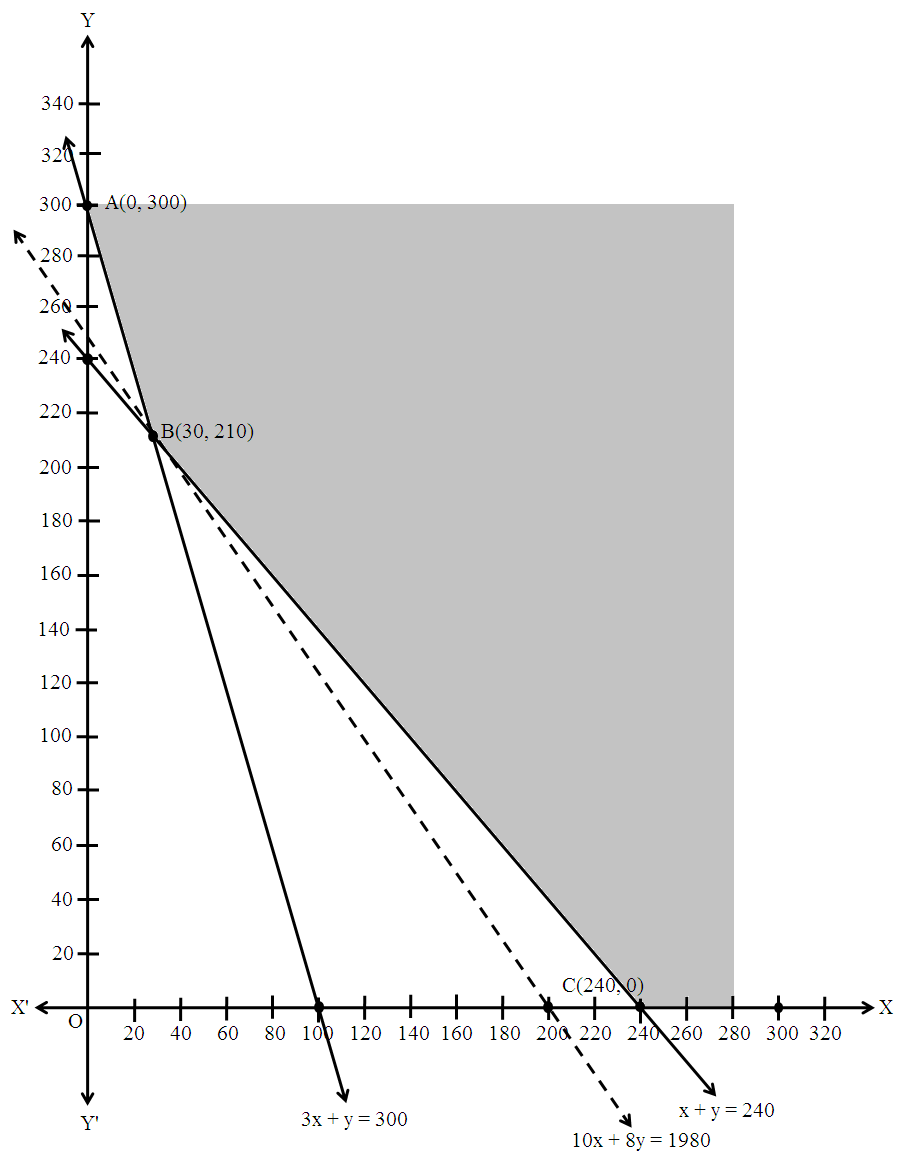
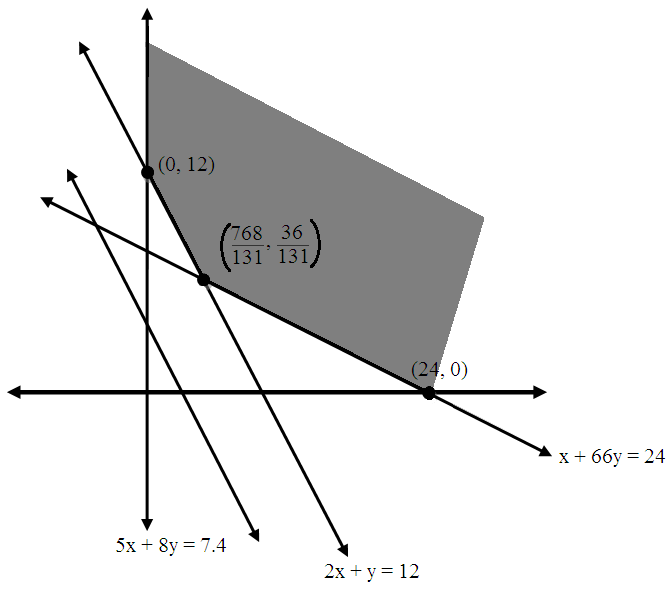
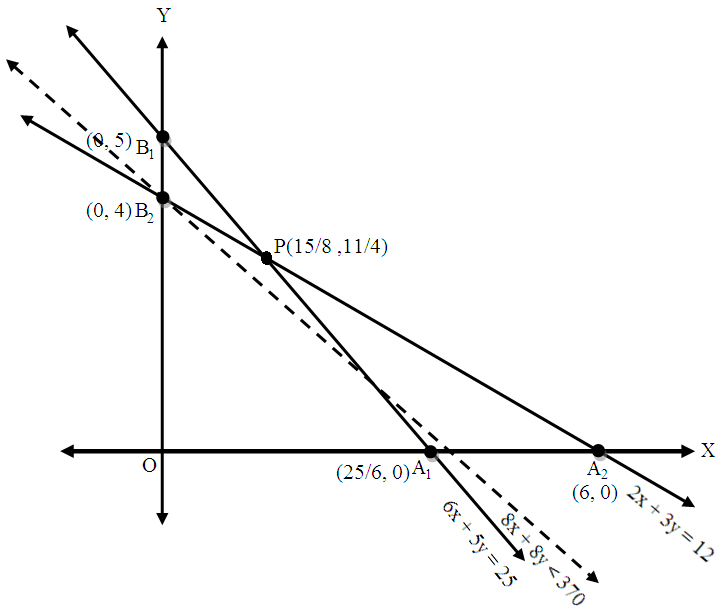
The feasible region determined by constraints (1) to (3) is graphically represented as:

Here, it is seen that the feasible region is unbounded.
The values of Z at the corner points of the feasible region are represented in tabular form as:
Corner point
Z = 10x + 8y
A(0, 300)
Z = 10 × 0 + 8 × 300 = 2400
B(30, 210)
Z = 10 × 30 + 8 × 210 =1980
C(240, 0)
Z = 7 × 240 + 8 × 0 = 2400
The open half plane determined by 10x + 8y < 1980 has no point in common with the feasible region.
So, the minimum value of Z is 1980.
The minimum value of Z is 1980, which is obtained at x = 30 and y = 210.
Thus, the minimum requirement of fertilizer of type A will be 30 kg and that of type B will be 210 kg.
Also, the total minimum cost of the fertilisers is Rs. 1980.
View full question & answer
Question 605 Marks
Two tailors, A and B earn Rs. 15 and Rs. 20 per day respectively. A can stitch 6 shirts and 4 pants while B can stitch 10 shirts and 4 pants per day. How many days shall each work if it is desired to produce (at least) 60 shirts and 32 pants at a minimum labour cost?
Answer
Suppose tailor A and B work for x and y days respectively.
Since, tailor A and B earn Rs. 15 and Rs. 20 respectively.
So, tailor A and B earn is X and Y days Rs. 15x and 20y respectively, let z denote maximum profit that gives minimum labour cost, so,
$Z = 15x + 20y$
Since, Tailor A and B stitch 6 and 10 shirts respectively in a day, so, tailor A can stitch 6x and B can stitch 10y shirts in x and y days respectively, but it is desired to produce 60 shirts at least, so
$6\text{x}+10\text{y}\geq60$
$3\text{x}+5\text{y}\geq30$ (first constraint)
Since, Tailor A and B stitch 4 pants per day each, so, tailor A can stitch 4x and B can stitch 4y pants in x and y days respectively, but it is desired to produce at least 32 pants, so
$4\text{x}+4\text{y}\geq32$
$\text{x}+\text{y}\geq8$ (second constraint)
Hence, mathematical formulation of LPP is,
Find x and y which minimize
$Z = 15x + 20y$
Subject to constraints,
$3\text{x}+5\text{y}\geq30$
$\text{x}+\text{y}\geq8$
$\text{x},\text{y}\geq0$ [Since x and y not be less than zero]
Region $3\text{x}+5\text{y}\geq30$:
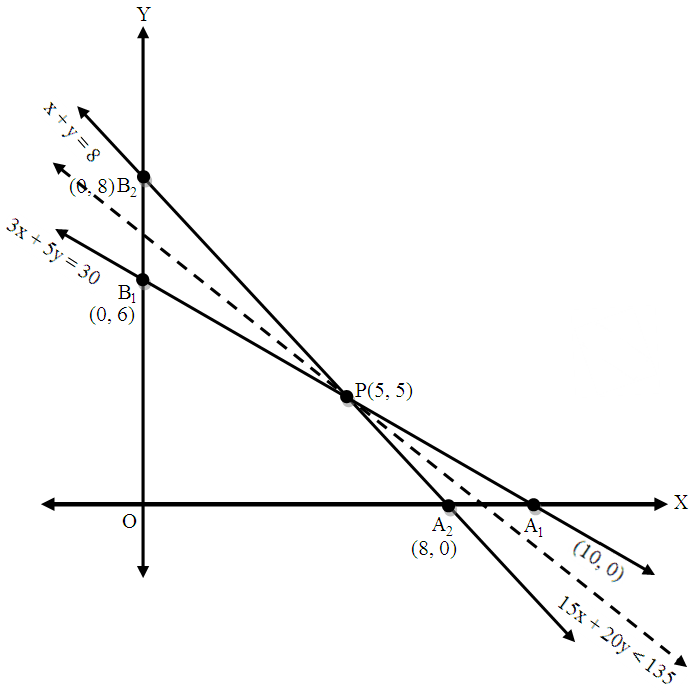
Line $3x + 5y = 30 $meets axes at $A_1(10, 0), B_1(0, 6)$ respectively.
Region not containing origin represents $3\text{x}+5\text{y}\geq30$ as $(0, 0) $ does not satisfy $3\text{x}+5\text{y}\geq30$.
Region $\text{x}+\text{y}\geq8$:
Line $x + y = 8 $ meets axes at $A_2(8, 0), B_2(0, 8)$ respectively.
Region not containing origin represents $\text{x}+\text{y}\geq8$ as $(0, 0)$ does not satisfy $\text{x}+\text{y}\geq8$.
Region $\text{x},\text{y}\geq0$:
It represent first quadrant.
Unbounded shaded region $AP_1B_2 $ represents feasible region with corner points $A_1(10, 0), P(5, 3),B_2(0, 8).$​​​​​​​

The value of $Z = 15x + 20y$ at
$A_1(10, 0) = 15(10) + 20(0) = 150$
$P(5, 3) = 15(5) + 20(3) = 135$
$B_2(0, 8) = 15(0) + 20(8) = 160$
Smallest value of Z is $135,$
Now open half plane $15x + 20y < 135$ has no point in common with feasible region, so smallest value is the minimum value.
So, $Z = 135, at x = 5, y = 3$
Tailor A should work for 5 days and B should work for 3 days.
View full question & answer
Question 615 Marks
An automobile manufacturer makes automobiles and trucks in a factory that is divided into two shops. Shop A, which performs the basic assembly operation, must work 5 man-days on each truck but only 2 man-days on each automobile. Shop B, which performs finishing operations, must work 3 man-days for each automobile or truck that it produces. Because of men and machine limitations, shop A has 180 man-days per week available while shop B has 135 man-days per week. If the manufacturer makes a profit of Rs 30000 on each truck and Rs 2000 on each automobile, how many of each should he produce to maximize his profit? Formulate this as a LPP.
Answer
Let x number of trucks and y number of automobiles were produced to maximize the profit.
Since, the manufacturer makes profit of Rs. 30000 on each truck and Rs. 2000 on each automobile.
Therefore, on x number of trucks and y number of automobiles profit would be Rs. 30000x and Rs. 2000yrespectively.
Total profit = Rs. (30000x + 2000y)
​Let Z denote the total profit
Then, Z = 30000x + 2000y
Since, 5 man-days and 2 man-days were required to produce each truck and automobile at shop A.
Therefore, 5x man-days and 2y man-days are required to produce x trucks and y automobiles at shop A.
Also,
Since 3 man-days were required to produce each truck and automobile at shop B.
Therefore, 3x man-days and 3y man-days are required to produce x trucks and y automobiles​.
As, shop A has 180 man-days per week available while shop B has 135 man-days per week.
$\therefore5\text{x}+2\text{y}\leq180,3\text{x}+3\text{y}\leq135$
Number of trucks and automobiles cannot be negative.
$\therefore\text{x},\text{y}\geq0$
Hence, the required LPP is as follows:
Maximize Z = 30000x + 2000y
Subject to
$5\text{x}+2\text{y}\leq180,$
$3\text{x}+3\text{y}\leq135,$
$\text{x}\geq0,\text{y}\geq0$
View full question & answer
Question 625 Marks
A manufacturer has three machine I, II, III installed in his factory. Machines I and II are capable of being operated for at most 12 hours whereas machine III must be operated for atleast 5 hours a day. She produces only two items M and N each requiring the use of all the three machines.
The number of hours required for producing 1 unit each of M and N on the three machines are given in the following table:
Item
Number of hours required on machines
 
I
II
III
M
1
2
1
N
2
1
1.25
She makes a profit of Rs. 600 and Rs. 400 on items M and N respectively. How many of each item should she produce so as to maximise her profit assuming that she can sell all the items that she produced? What will be the maximum profit?
Answer
Suppose x units of item M and y units of item N are produced to maximise the profit.
Since each unit of item M require 1 hours on machine I and each unit of item N require 2 hours on machine I, therefore, the total hours required for producing x units of item M and yunits of item N on machine I are (2x + y).

But, machines I is capable of being operated for at most 12 hours.

2x + y ≤ 12 Similarly, each unit of item M require 2 hours on machine II and each unit of item N require 1 hour on machine II, therefore, the total hours required for producing x units of item M and yunits of item N on machine II are (x + 2y).

But, machines II is capable of being operated for at most 12 hours.

x + 2y ≤ 12 Also, each unit of item M require 1 hour on machine III and each unit of item N require 1.25 hour on machine III, therefore, the total hours required for producing x units of item M and yunits of item N on machine III are (x+ 1.25y).

But, machines III must be operated for atleast 5 hours.

x + 1.25 ≥ 5

The profit from each unit of item M is 2600 and each unit of item N is Rs. 400.

Therefore, the total profit from x units of item M and yunits of item N is Rs. (600x + 400y).

Thus, the given linear programming problem is Maximise Z = 600x + 400y

Subject to the constraints

2x + y ≤ 12

x + 2y ≤ 12

x + 1.25y ≥ 5

x, y ≥ 0

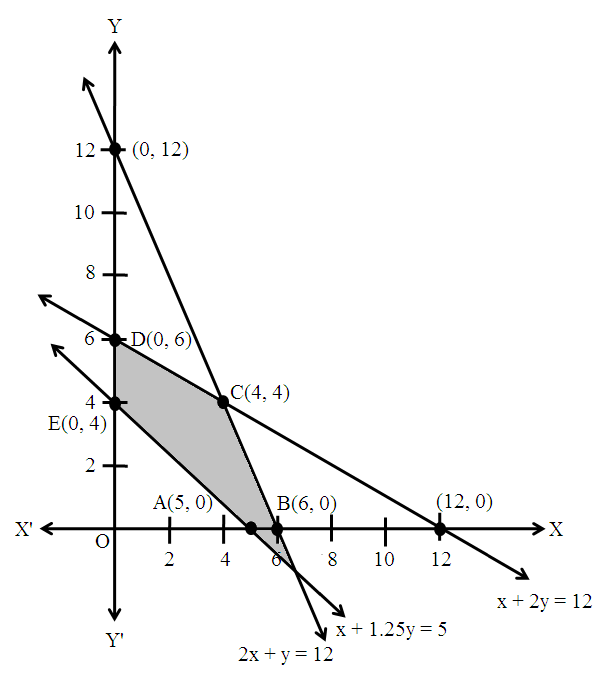
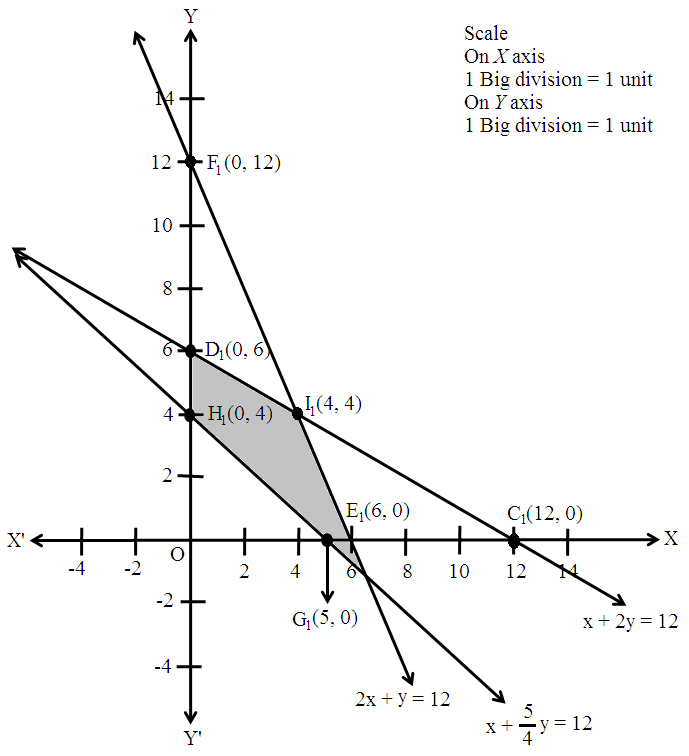
The feasible region determined by the given constraints can be diagrammatically represented.


The coordinates of the corner points of the feasible region are A(5, 0), B(6, 0), C(4, 4), D(0, 6) and E(0, 4).

The value of the objective function at these points are given in the following table.
Corner Point
Z = 600x + 400y
 
(5, 0)
600 × 5 + 400 × 0 = 3000
 
(6, 0)
600 × 6 + 400 × 0 = 3600
 
(4, 4)
600 × 4 + 400 × 4 = 4000
→ Maximum
(0, 6)
600 × 0 + 400 × 6 = 2400
 
(0, 4)
600 × 0 + 400 × 4 = 1600
 
The maximum value of Z is 4000 at x = 4, y = 4.

Hence, 4 units of item M and 4 units of item N should be produced to maximise the profit.

The maximum profit of the manufacturer is Rs. 4,000.
View full question & answer
Question 635 Marks
A firm manufactures 3 products A, B and C. The profits are Rs. 3, Rs. 2 and Rs. 4 respectively. The firm has 2 machines and below is the required processing time in minutes for each machine on each product:
Machine
Products
A
B
C
$M_1$
4
3
5
$M_2$
2
2
4
Machines $M_1$ and $M_2$ have 2000 and 2500 machine minutes respectively. The firm must manufacture 100 A's, 200 B's and 50 C's but not more than 150 A's. Set up a LPP to maximize the profit.
Answer
Product
Machine $(M_1)$
Machine $(M_2)$
Profit
A
4
2
3
B
3
2
2
C
5
4
4
Capacity maximum
2000
2500
 
Let required production of product A, B and C bex,y and z units respectively.
Given, profit on one unit of product A, B and C are Rs. 3, RS. 2, RS. 4, so Profit on x unit of A, y unit of B and z unit of C are given by Rs. 3x, Rs. 2y, Rs. 4z.
Let U be the total profit, so
$U = 3x + 2y + 4z$
Given, one unit of product A, B and C requires 4,3 and 5 minutes on machine M. So, x units of product A, y units of B and z units of product C need 4x, 3y and 5z minutes on machine M, is $2000$ minutes, so
$4\text{x}+3\text{y}+5\text{z}\leq200$ (First constraint)
Given, one unit of product A, B and C requires 2,2 and 4 minutes on machine M2. So, X units of A, y units of B and z units of C require 2x, 2y and 4z minutes on machine M2 is 2500 minutes, so
$2\text{x}+2\text{y}+4\text{z}\leq2500$ (Second constraint)
Also, given that firm must manufacture 100 A's, 200 B's and 50 C's but not more than 150 A's.
$100\leq\times\leq150$
$\text{y}\geq200$ (Other constraints)
$\text{z}\geq50$
Hence, mathematical formulation of LPP is:-
Find x, y and z which
maximize $U = 3x + 2y + 4z$
Subject to constraints,
$4\text{x}+3\text{y}+5\text{z}\leq2000$
$2\text{x}+2\text{y}+4\text{z}\leq2500$
$100\leq\times\leq150$
$\text{y}\geq200$
$\text{z}\geq50$
And, $\text{x},\text{y},\text{z}\geq0$ [Since, x, y, z are non-negative]
View full question & answer
Question 645 Marks
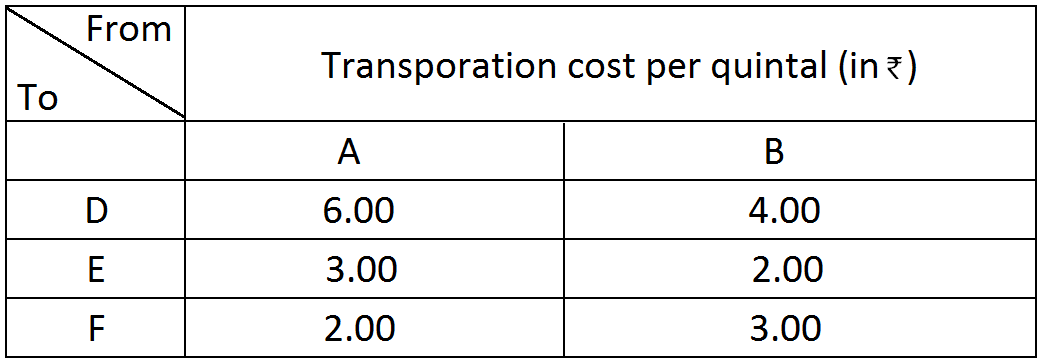
Tow godowns,$ A$   and $B,$ have grain storage capacity of $100$ quintals and $50$ quintals respectively. They supply to $3$ ration shops, $D,\ E$ and $F$, whose requirements are $60,\ 50$ and $40$ quintals respectively. The cost of transportation per quintal from the godowns to the shops are given in the following table:

How should the supplies be transported in order that the transportation cost is minimum?
Answer
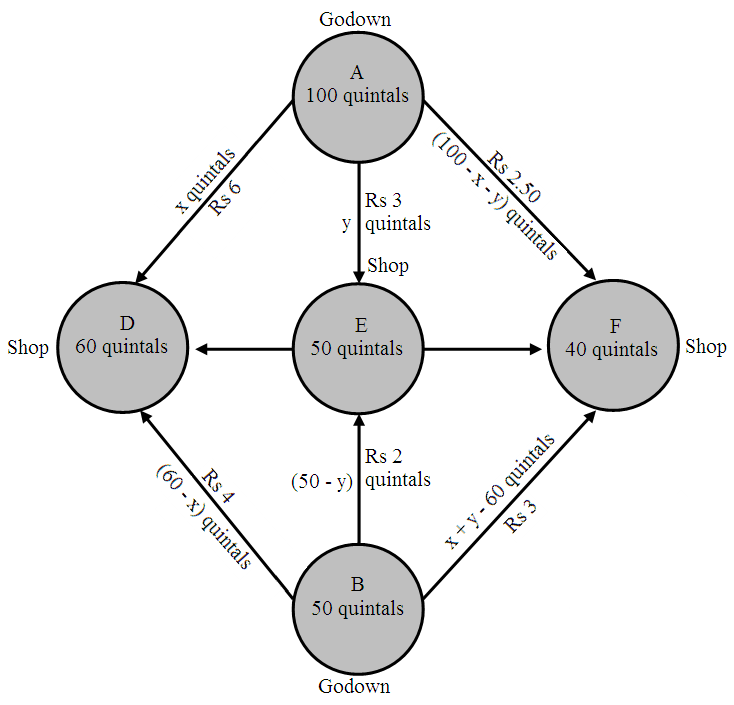
Let godown A supply x quintals and y quintals of grain to the shops $D$ and $E$ respectively.
Then, $(100 - x - y)$ will be supplied to shop $F$.
The requirement at shop $D$ is $60$ quintals since, x quintals are transported from godown $A$.
Therefore, the remaining $(60 - x)$ quintals will be transported from godown $B.$
Similarly, $(50 - y)$ quintals and $40 - (100 - x - y)$ i.e. $(x + y - 60)$ quintals will be transported from godown $B$ to shop $E $ and $F$ respectively.
The given problem can be represented diagrammatically as follows.

Quantity of the grain cannot be negative.
Therefore, $x \geq 0, y \geq 0,$ and $100 - x - y \geq 0$
$x \geq 0, y \geq 0,$ and $x + y \leq 100$
$60 - x \geq 0, 50 - y \geq 0, $and $x + y - 60 \geq 0$
$x \leq 60, y \leq 50,$ and $x + y \geq 60$
Total transportation cost Z is given by,
$Z = 6x + 3y + 2.5 (100 - x - y) + 4(60 - x) + 2(50 - y) + 3(x + y - 60)$
$= 6x + 3y + 250 - 2.5x - 2. 5y + 240 - 4x + 100 - 2y + 3x + 3y - 180$
$= 2.5x + 1. 5y + 410$
The given problem can be formulated as:
Minimize $Z = 2.5x + 1.5y + 410$
Subject to the constraints,
$x + y ≤ 100$
$X ≤ 60$
$y ≤ 50$
$x + y ≥ 60$
$x, y ≥ 0$
First we will convert inequations into equations as follows:
$x + y = 100, x = 60, y = 50, x + y = 60, x = 0$ and $y = 0$
Region represented by $x + y ≤ 100:$
The line $x + y = 100$ meets the coordinate axes at $A_1(100, 0)$ and $B_1(0, 100)$ respectively.
By joining these points we obtain the line $x + y = 100.$
Clearly $(0, 0)$ satisfies the $x + y ≤ 100.$
So, the region which contains the origin represents the solution set of the inequation
$x + y ≤ 100.$
Region represented by $x ≤ 60:$
$x = 60$ is the line that passes $(60, 0)$ and is parallel to the y-axis.
The region to the left of the line $x = 60$  will satisfy the inequation $x ≤ 60.$
Region represented by $y ≤ 50:$
$y = 50$ is the line that passes $(0, 50)$ and is parallel to the x-axis.
The region below the line $y = 50$ will satisfy the inequation $y ≤ 50.$
Region represented by $x + y ≥ 60:$
The line $x + y= 60$ meets the coordinate axes at $C_1(60, 0)$ and $D_1(0, 60)$ respectively.
By joining these points we obtain the line $x + y = 60.$
Clearly $(0, 0)$ does not satisfies the inequation $x + y ≥ 60.$
So, the region which does not contain the origin represents the solution set of the inequation $x + y ≥ 60.$
Region represented by $x ≥ 0$ and $y ≥ 0:$
Since, every point in the first quadrant satisfies these inequations.
So, the first quadrant is the region represented by the inequations $x ≥ 0$, and $y ≥ 0.$
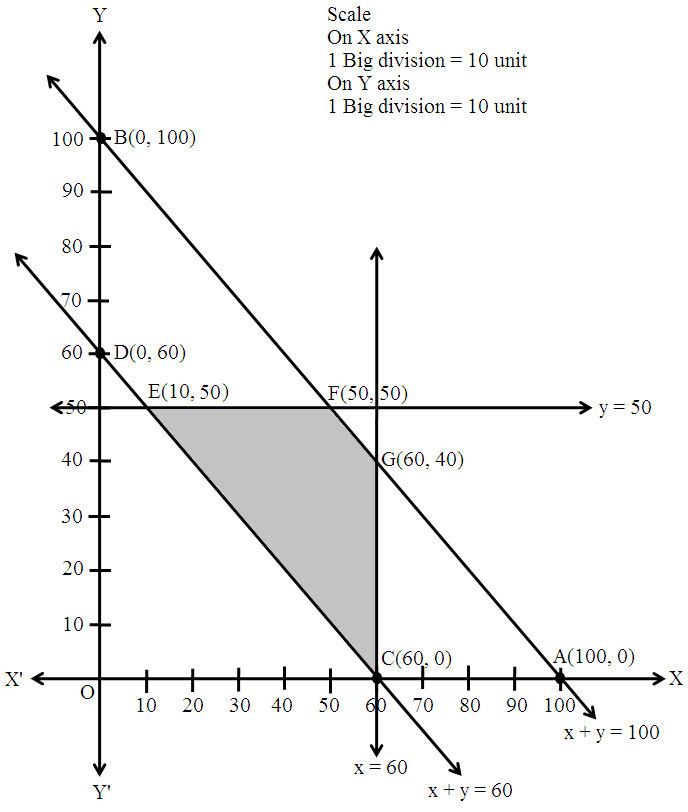
The feasible region determined by the system of constraints $x + y ≤ 100, x ≤ 60, y ≤ 50, x + y ≥ 60, x ≥ 0$ and $y ≥ 0$ are as follows.

The corner points are $C_1(60, 0), G_1(60, 40), F_1(50, 50),$ and $E_1(10, 50).$
The values of Z at these corner points are as follows:
Corner point
$Z = 2.5x + 1.5y + 410$
$C_1(60, 0)$
$560$
$G_1(60, 0)$
$620$
$F_1(50, 5)$
$610$
$E_1(10, 0)$
$510$
The minimum value of $Z$ is $510$ at $E_1(10, 50).$
Thus, the amount of grain transported from $A$ to $D$,$ E$, and $F$ is $10$ quintals, $50$ quintals, and $40$ quintals respectively and from B to $D$, $E,$ and $F$ is $50$ quintals,$ 0$ quintals, and $0$ quintals respectively.
The minimum cost is Rs. $510.$
View full question & answer
Question 655 Marks
Maximum Z = 2x + 3y
Subject to
$\text{x}+\text{y}\geq1$
$10\text{x}+\text{y}\geq5$
$\text{x}+10\text{y}\geq1$
$\text{x},\text{y}\geq0$
Answer
First, we will convert the given inequations into equations, we obtain the following equations:
x + y = 1, 10x +y = 5, x + 10y = 1, x = 0 and y = 0
Region represented by x + y ≥ 1:
The line x + y = 1 meets the coordinate axes at A(1, 0) and B(0, 1) respectively.
By joining these points we obtain the line x + y = 1.
Clearly (0, 0) does not satisfies the inequation x + y ≥ 1.
So, the region in xy plane which does not contain the origin represents the solution set of the inequation x + y ≥ 1.
Region represented by 10x + y ≥ 5:
The line 10x + y = 5 meets the coordinate axes at $\text{C}\Big(\frac{1}{2},0\Big)$ and D(0, 5) respectively.
By joining these points we obtain the line 10x + y = 5.
Clearly (0, 0) does not satisfies the inequation 10x + y ≥ 5.
So, the region which does not contains the origin represents the solution set of the inequation 10x +y ≥ 5.
Region represented by x + 10y ≥ 1:
The line x + 10y = 1 meets the coordinate axes at A(1, 0) and $\text{F}\Big(0,\frac{1}{2}\Big)$ respectively.
By joining these points we obtain the line.
x + 10y = 1.
Clearly (0, 0) does not satisfies the inequation x + 10y ≥ 1.
So, the region which does not contains the origin represents the solution set of the inequation x + 10y ≥ 1.
Region represented by x ≥ 0 and y ≥ 0:
Since, every point in the first quadrant satisfies these inequations.
So, the first quadrant is the region represented by the inequations x ≥ 0, and y ≥ 0.
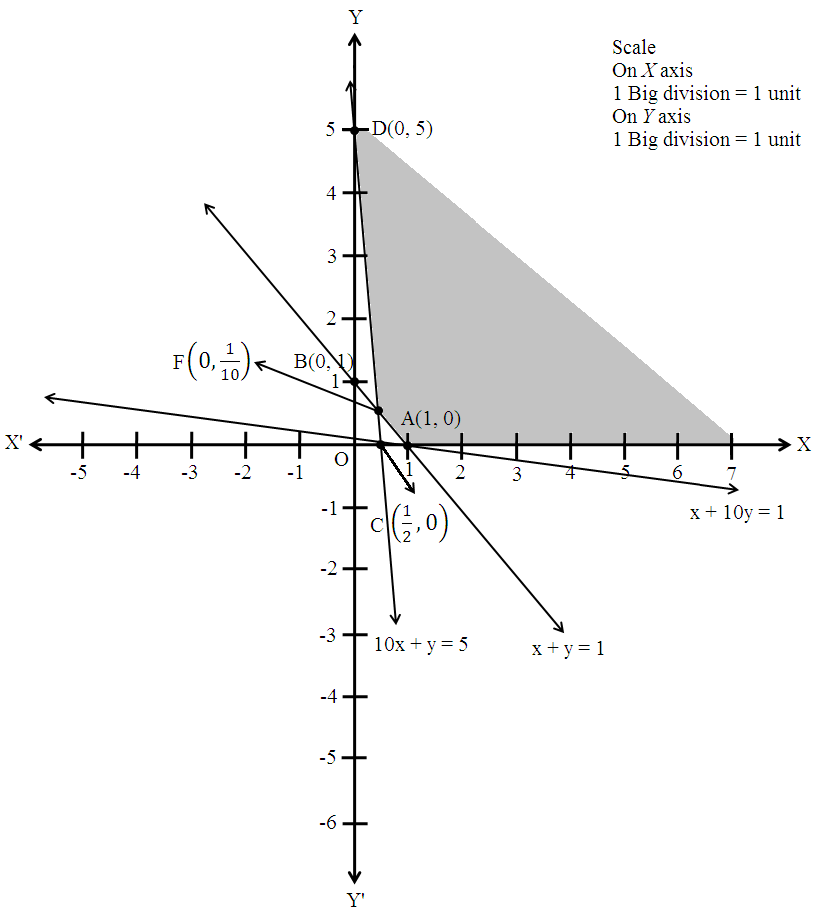
The feasible region determined by the system of constraints x + y ≥ 1, 10x + y ≥ 5, x + 10y ≥ 1, x ≥ 0, and y ≥ 0, are as follows.

The feasible region is unbounded.
Therefore, the maximum value is infinity i.e. the solution is unbounded.
View full question & answer
Question 665 Marks
Maximize $Z = -x_1 + 2x_2$
Subject to
$-\text{x}_1+3\text{x}_2\leq10$
$\text{x}_1+\text{x}_2\leq6$
$\text{x}_1+\text{x}_2\leq2$
$\text{x}_1,\text{x}_2\geq0$
Answer
First, we will convert the given inequations into equations, we obtain the following equations:
$-X_1 + 3 \times 2 = 10, x_1 + x_2 = 6, X_1 + X_2 = 2, X_1 = 0$ and $X_2 = 0$
Region represented by $-\text{x}_1+3\text{x}_2\leq10$:
The line $–x1 + 3 \times 2 = 10$ meets the coordinate axes at $A(-10, 0)$ and $\text{B}\Big(0,\frac{10}{3}\Big)$ respectively.
By joining these points we obtain the line $-X_1 + 3 \times 2 = 10.$
Clearly $(0, 0)$ satisfies the inequation $-\text{x}_1+3\text{x}_2\leq10$.
So, the region in the plane which contain the origin represents the solution set of the inequation $-\text{x}_1+3\text{x}_2\leq10$.
Region represented by $\text{x}_1+\text{x}_2\leq6$:
The line $x_1 + x_2 = 6$ meets the coordinate axes at $C(6, 0)$ and $D(0, 6)$ respectively.
By joining these points we obtain the line $X_1 + X_2 = 6.$
Clearly $(0, 0)$ satisfies the inequation $\text{x}_1+\text{x}_2\leq6$.
So, the region containing the origin represents the solution set of the inequation $\text{x}_1+\text{x}_2\leq6$.
Region represented by $\text{x}_1+\text{x}_2\leq2$:
The line $x_1 - x_2 = 2$ meets the coordinate axes at $E(2, 0)$ and $F(0, -2)$ respectively.
By joining these points we obtain the line $x_1 - x_2 = 2.$
Clearly $(0, 0)$ satisfies the inequation $\text{x}_1+\text{x}_2\leq2$.
So, the region containing the origin represents the solution set of the inequation $\text{x}_1+\text{x}_2\leq2$.
Region represented by $\text{x}_1\geq0$ and $\text{x}_2\geq0$:
Since, every point in the first quadrant satisfies these inequations.
So, the first quadrant is the region represented by the inequations $\text{x}_1\geq0$ and $\text{x}_2\geq0$.
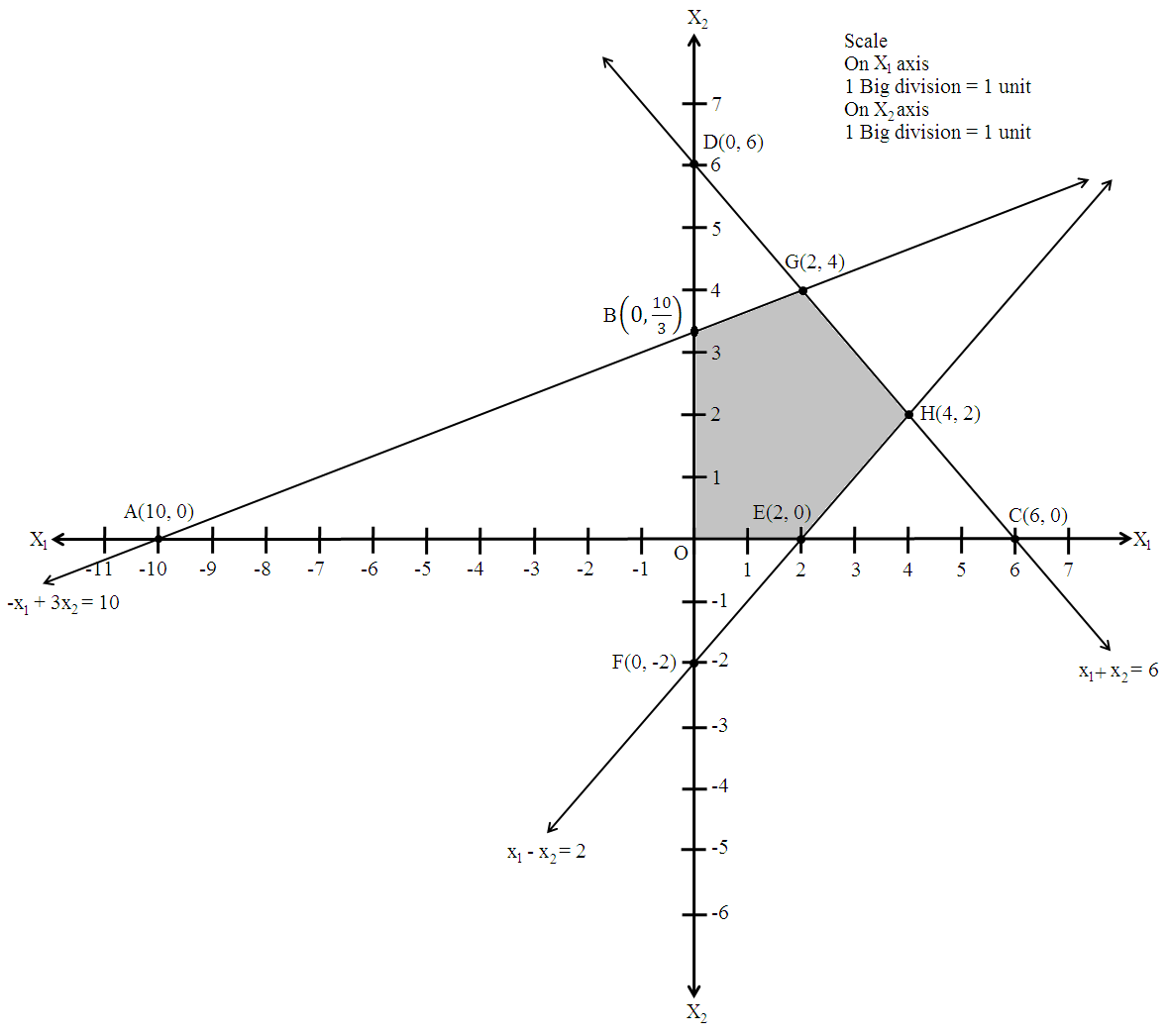
The feasible region determined by the system of constraints, $\text{x}_1+3\text{x}_2\leq10,\text{x}_1+\text{x}_2\leq6,\text{x}_1+\text{x}_2\leq2,\text{x}_1\geq0$, and $\text{x}_2\geq0$, are as follows.

The corner points of the feasible region are $O(0, 0), E(2, 0), H(4, 2), G(2, 4)$ and $\text{B}\Big(0,\frac{10}{3}\Big)$.
The values of $Z$ at these corner points are as follows.
$\text{Corner point}$
$\text{Z}=-\text{x}_1+2\text{x}_2$
$\text{O}(0, 0)$
$-1\times0+2\times0=0$
$\text{E}(2, 0)$
$-1\times2+2\times0=-2$
$\text{H}(4, 2)$
$-1\times4+2\times2=0$
$\text{G}(2, 4)$
$-1\times2+2\times4=6$
$\text{B}\Big(0,\frac{10}{3}\Big)$
$-1\times0+2\times\frac{10}{3}=\frac{20}{3} $
We see that the maximum value of the objective function $Z$ is $\frac{20}{3}$ which is at $\text{B}\Big(0,\frac{10}{3}\Big)$.
View full question & answer
Question 675 Marks
There are two types of fertilizers $F_1$ and $F_2$. $F_1$ consists of $10%$ nitrogen and $6%$ phosphoric acid and ​$F_2$ consists of $5%$ nitrogen and $10%$ phosphoric acid. After testing the soil conditions, a farmer finds the she needs atleast $14$ kg of nitrogen and $14$  kg of phosphoric acid for her crop. If $F_1$ costs Rs 6/kg and $F_2$ costs Rs $5/$kg, determine how much of each type of fertilizer should be used so that the nutrient requirements are met at minimum cost. What is the minimum cost?
Answer
Suppose x kg of fertilizer $F_1$ and and $y$ kg of fertilizer $F_2$ is used to meet the nutrient requirements.
$F_1 $ consists of $10% $ nitrogen and $F_2$ consists of $5%$ nitrogen.
But, the farmer needs atleast 14kg of nitorgen for the crops.
$10%$ of $x$ kg $+\  5%$ of $y$ kg $14$kg
$\Rightarrow\frac{\text{x}}{10}+\frac{\text{y}}{20}\geq14$
$\Rightarrow2\text{x}+\text{y}\geq280$
Similarly, $F_1$ consists of $6%$ phosphoric acid and $F_2$ consists of $10%$ phosphoric acid.
But, the farmer needs atleast $14$kg of phosphoric acid for the crops.
$\Rightarrow\frac{6\text{x}}{100}+\frac{10\text{y}}{100}\geq14$
$\Rightarrow3\text{x}+5\text{y}\geq700$
The cost of fertilizer $F_1$ is Rs. $6$/kg and fertilizer $F_2$ is Rs. $5$/kg,
Therefore, total cost of $x$ kg of fertilizer $F_1$ and and $y$ kg of fertilizer $F_2$ is Rs.$ (6x + 5y).$
Thus, the given linear programming problem is
Minimise $Z = 6x + 5y$
Subject to the constraints
$2x + y ≥ 280$
$3x + 5y ≥ 700$
$x, y ≥ 0$
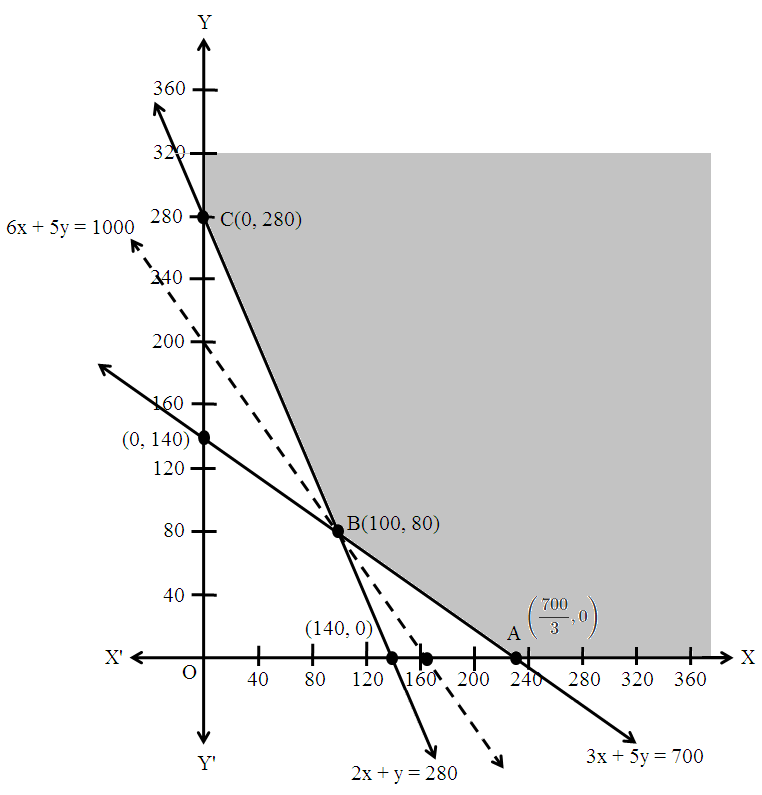
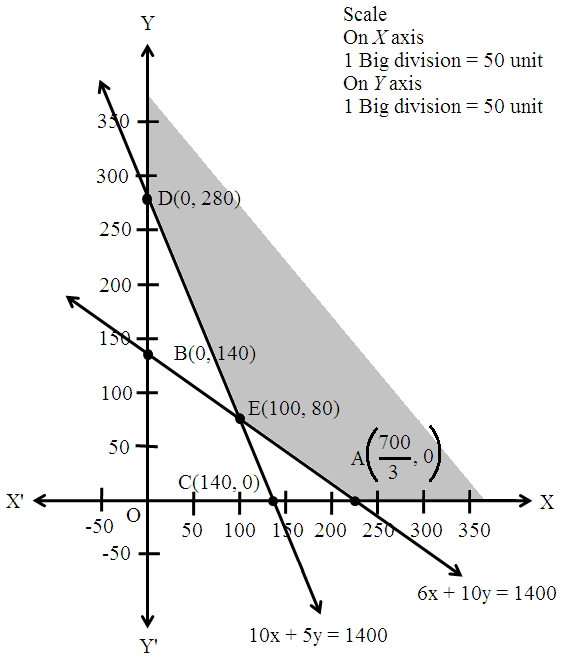
The feasible region determined by the given constraints can be diagrammatically represented as,

The coordinates of the corner points of the feasible region are al $\text{A}\Big(\frac{700}{3},0\Big),$ B(100, 80) and C(0, 280).
The value of the objective function at these points are given in the following table.
$\text{Corner Point}$ $\text{Z} = 6\text{x} + 5\text{y}$
$\Big(\frac{700}{3},0\Big)$ $6\times\frac{700}{3}+5 \times 0= 1400$
$(100, 80)$ $6 \times 100+ 5 \times 80 = 1000 → \text{Minimum}$
$(0, 280)$ $6 \times 0 + 5 \times 280 =1400$
The smallest value of $Z$ is $1000$ which is obtained at $x = 100, y = 80.$
It can be seen that the open half-plane represented by has no common points with the feasible region.
So, the minimum value of $ Z$ is $1000.$
Hence, 100kg of fertilizer $F_$1 and 80kg of fretilizer $F_2$ should be used so that the nutrient requirements are met at minimum cost.
The minimum cost is Rs. $1,000.$
View full question & answer
Question 685 Marks
A dietician has to develop a special diet using two foods P and Q. Each packet (containing 30g) of food P contains 12 units of calcium, 4 units of iron, 6 units of cholesterol and 6 units of vitamin A. Each packet of the same quantity of food Q contains 3 units of calcium, 20 units of iron, 4 units of cholesterol and 3 units of vitamin A. The diet requires atleast 240 units of calcium, atleast 460 units of iron and at most 300 units of cholesterol. How many packets of each food should be used to minimise the amount of vitamin A in the diet? What is the minimum Amount of vitamin A.
Answer
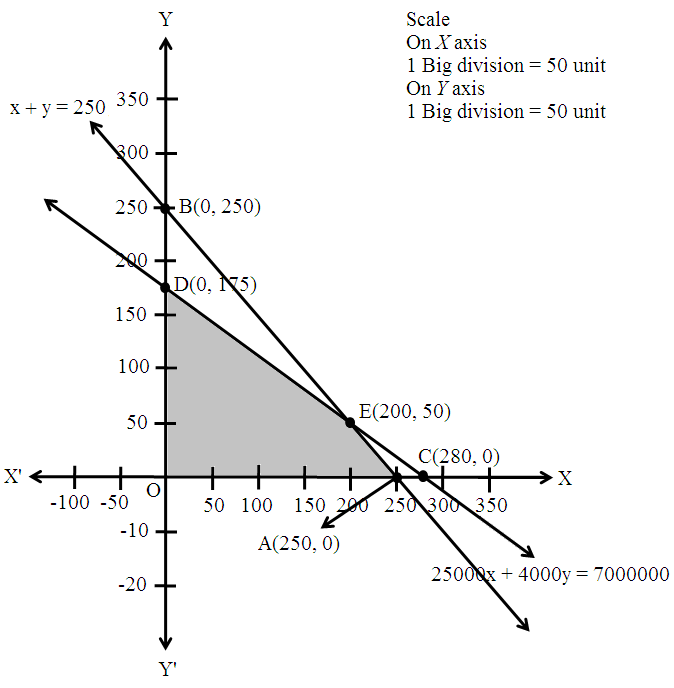
Let x packets of food P and y packets of food Q be used to make the diet.

Each packet of food P contains 6 units of vitamin A and each packet of food Q contains 3 units of vitamin A.

Therefore, x packets of food P and y packets of food Q contains (6x + 3y) units of vitamin A.

Since each packet of food P contains 12 units of calcium and each packet of food Q contains 3 units of calcium, therefore, x packets food P and y packets of food Q will contain (12x + 4y) units of calcium.

But, the diet should contain atleast 240 units of calcium.

$\therefore12\text{x}+3\text{y}\geq240$

$\Rightarrow4\text{x}+\text{y}\geq80$

Similarly, x packets of food P and y packets of food Q will contain (4x + 207) units of iron. But, the diet should contain atleast 460 units of iron.

$\therefore4\text{x}+20\text{y}\geq460$

$\Rightarrow\text{x}+5\text{y}\geq115$

Also, x packets of food P and y packets of food Q will contain (6x + 4y) units of cholesterol.

But, the diet should contain atmost 300 units of cholesterol.

$\therefore6\text{x}+4\text{y}\leq300$

$3\text{x}+2\text{y}\leq150$

Thus, the given linear programming problem is

Minimise Z = 6x + 3y

subject to the constraints

$4\text{x}+\text{y}\geq80$

$\text{x}+5\text{y}\geq115$

$3\text{x}+2\text{y}\leq150$

$\text{x},\text{y}\geq0$

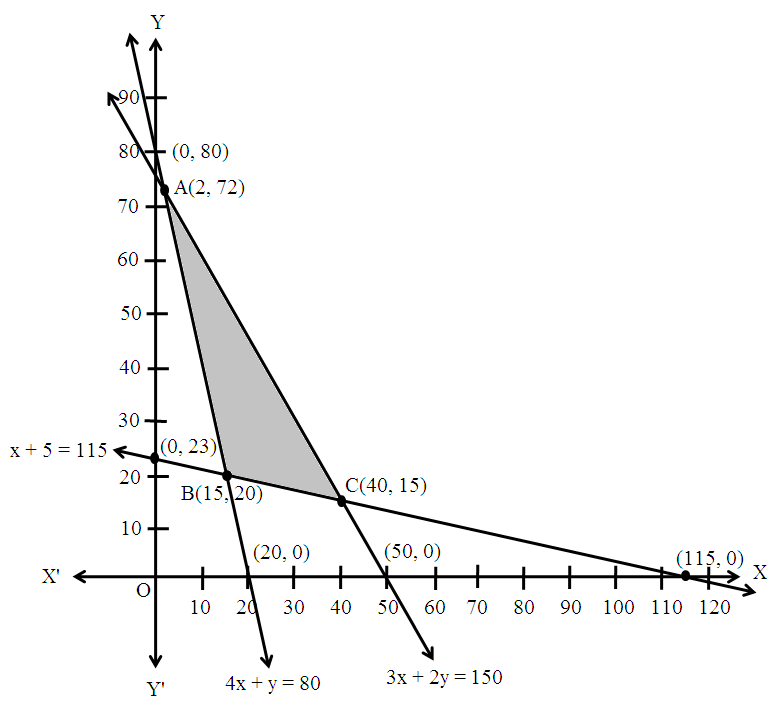
The feasible region determined by the given constraints can be diagrammatically represented as,


The coordinates of the corner points of the feasible region are A(2, 72), B(15, 20) and C(40, 15).

The value of the objective function at these points are given in the following table.
Corner Point
Z = 6x + 3y
(2, 72)
6 × 0 + 3 × 72 = 216
(15, 20)
6 × 15 + 3 × 20 = 150
(40, 15) 6 × 40 + 3 × 15 = 285
The smallest value of Z is 150 which is obtained at x = 15 and y = 20.

It can be verified that the open half-plane represented by $6\text{x}+3\text{y}\leq150$ has no common points with the feasible region.

Thus, 15 packets of food P and 20 packets of food Q should be used to minimise the amount of vitamin A in the diet.

Hence, the minimum amount of vitamin A is 150 units.
View full question & answer
Question 695 Marks
A manufacturer makes two types $A$ and $B$ of tea-cups. Three machines are needed for the manufacture and the time in minutes required for each cup on the machines is given below:
  Machines
$I$ $II$ $III$
$A$ $12$ $18$ $6$
$B$ $6$ $0$ $9$
Each machine is available for a maximum of $6$ hours per day. If the profit on each cup $A$ is $75$ paise and that on each cup $B$ is $50$ paise, show that $15$ tea-cups of type $A$ and $30$ of type $B$ should be manufactured in a day to get the maximum profit.
Answer
Let $x$ units of type $A$ and $y$ units of type $B$ cups were made. Quantities cannot be negative.
Therefore, $\text{x},\text{y}\geq0$
As we are given,
  Machines
$I$ $II$ $III$
$A$ $12$ $18$ $6$
$B$ $6$ $0$ $9$
Every machine is available for a maximum of $6$ hours per day i.e. $360$ minutes per day.
Therefore, the constraints are
$12\text{x}+6\text{y}\leq360$
$18\text{x}+0\text{y}\leq360$
$6\text{x}+9\text{y}\leq360$
If the profit on each cup A is $75$ paise and that on each cup $B$ is $50$ paise.
Total profit $= Z = 0.75x + 0.50y$ which is to be maximised.
Thus, the mathematical formulation of the given linear programmimg problem is
Max $Z = 0.75x + 0.50y$
Subject to
$12\text{x}+6\text{y}\leq360$
$18\text{x}+0\text{y}\leq360$
$6\text{x}+9\text{y}\leq360$
$\text{x},\text{y}\geq0$
First we will convert inequations into equations as follows:
$12\text{x}+6\text{y}\leq360,18\text{x}+0\text{y}\leq360,6\text{x}+9\text{y}\leq360,\text{x}\geq0$and $\text{y}\geq0$
Region represented by $12\text{x}+6\text{y}\leq360$:
The line $12x + 6y = 360 $ meets the coordinate axes at $A_1(30, 0)$ and $B_1(0, 60)$ respectively.
By joining these points we obtain the line $12x + 6y = 360.$
Clearly $(0, 0) $ satisfies the $12x + 6y = 360.$
So, the region which contains the origin represents the solution set of the inequation $12\text{x}+6\text{y}\leq360$.
Region represented by $18\text{x}+0\text{y}\leq360$:
The line $18x + 0y = 360$ meets the coordinate axes at $C_1(20, 0).$
We obtain the line $18x + 0y = 360.$
Clearly $(0, 0)$ satisfies the inequation $18\text{x}+0\text{y}\leq360$.
So, the region which contains the origin represents the solution set of the inequation $18\text{x}+0\text{y}\leq360$.
Region represented by $6\text{x}+9\text{y}\leq360$:
The line $6x + 9y = 360$ meets the coordinate axes at $E_1(60, 0)$ and $F_1(0, 40)$ respectively.
By joining these points we obtain the line $6x + 9y = 360.$
Clearly $(0, 0)$ satisfies the inequation $6\text{x}+9\text{y}\leq360$.
So, the region which contains the origin represents the solution set of the inequation $6\text{x}+9\text{y}\leq360$.
Region represented by $\text{x}\geq0$ and $\text{y}\geq0$:
Since, every point in the first quadrant satisfies these inequations.
So, the first quadrant is the region represented by the inequations $\text{x}\geq0$, and $\text{y}\geq0$.
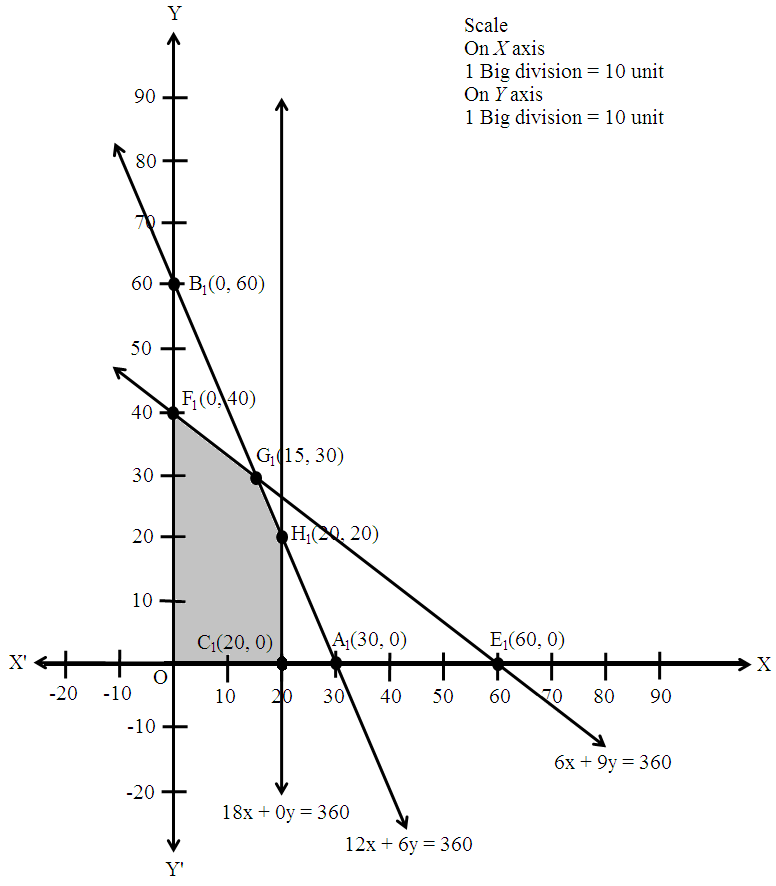
The feasible region determined by the system of constraints $12\text{x}+6\text{y}\leq360,18\text{x}+0\text{y}\leq360,6\text{x}+9\text{y}\leq360,\text{x}\geq0$ and $\text{y}\geq0$ are as follows.

The corner points are $O(0, 0) F_1(0, 40), G_1(15, 30), H_1(20, 20)$ and $C_1(20, 0).$
The values of $Z$ at these corner points are as follows:
Corner point
$Z = 0.75x + 0.50y$
$O$
$0$
$F_1$
$20$
$G_1$
$26.25$
$H_1$
$25$
$C_1$
$15$
Thus, the maximum profit is Rs. $26.25$ obtained when $15$ unit of type A and $30$ unit of type $B$ cups were made.
View full question & answer
Question 705 Marks
A small firm manufacturers items $A$ and $B.$ The total number of items $A$ and $B$ that it can manufacture in a day is at the most $24.$ Item A takes one hour to make while item $B$ takes only half an hour. The maximum time available per day is $16$ hours. If the profit on one unit of item $A$ be Rs. $300$ and one unit of item $B$ be Rs. $160,$ how many of each type of item be produced to maximize the profit? Solve the problem graphically.
Answer
Let required quantity of item $A$ and $B$ produced be $x$ and $y$ respectively.
Since, profits on each item $A$ and $B$ are Rs. $300$ and Rs. $160$ respectively, so, profits on $X$ unit of item $A$ and $y$ units of item $8$ are Rs. $300x$ and Rs. $160y$ respectively
Let $z$ be total profit so
$Z = 300x + 160y$
Since one unit of item $A$ and $B$ require one and $\frac{1}{2}$ hr respectively, so, $x$ units of item $A$ and $y$ units of item $B$ require $x$ and $\frac{1}{2} \text{y}$ hr. respectivley but maximum time available is $16$ hours., so
$\text{x}+\frac{1}{2}\text{y}\leq16$
$\Rightarrow2\text{x}+\text{y}\leq32$ (first constraint)
Given, manufacturer can produce at most $24$ items, so,
$\Rightarrow\text{x}+\text{y}\leq24$ (second constraint)
Hence, mathematical formulation of LPP is find $x$ and $y$ which
Maximize $Z = 300x + 160y$
Subject to constriants,
$2\text{x}+\text{y}\leq32$
$\text{x}+\text{y}\leq24$
$\text{x},\text{y}\geq0$ [Since production can not be less than zero]
Region $2\text{x}+\text{y}\leq32$:
Line $2x + y = 32$ meets axes at $A_1(16, 0), B_1(0, 32)$ respectively.
Region containing origin represents $2\text{x}+\text{y}\leq32$ as $(0, 0)$ satisfies $2\text{x}+\text{y}\leq32$.
Region $\text{x}+\text{y}\leq24$:
Line $x + y = 24$ meets axes at $A_2(24 ,0), B_2(0, 24)$ respectively.
Region containing origin represents $\text{x}+\text{y}\leq24$ as $(0, 0)$ satisfies $\text{x}+\text{y}\leq24$.
Region $\text{x},\text{y}\geq0$:
It represent first quandrant

Shaded region $OA_1PB_2 $ represents feasible region.
Point $P$ is obtained by solving
$x + y = 24$ and $2x + y = 32$
The value of $Z = 300x + 160y$ at
$O(0, 0) = 300(0) + 160(0) = 0$
$A_1(16, 0) = 300(180) + 160(0) = 4800$
$P(8, 16) = 300(8) + 160(16) = 4960$
$B_2(0, 24) = 300(0) + 160(24) = 3640$
Maximum $Z = 4960$
Number of item $A = 8,$ item $B = 16$
Maximum profit $=$ Rs. $4960.$
 
View full question & answer
Question 715 Marks
A firm has to transport at least 1200 packages daily using large vans which carry 200 packages each and small vans which can take 80 packages each. The cost of engaging each large van is Rs 400 and each small van is Rs 200. Not more than Rs 3000 is to be spent daily on the job and the number of large vans cannot exceed the number of small vans. Formulate this problem as a LPP given that the objective is to minimize cost.
Answer
Let the number of large vans and small vans used for transporting the packages be x and y, respectively.

It is given that the cost of engaging each large van is Rs. 400 and each small van is Rs. 200

Cost of engaging x large vans = Rs. 400x

Cost of engaging y small vans = Rs. 200y

Let Z be the total cost of engaging xlarge vans and y small vans.

$\therefore$ Z = Rs. (400x + 200y)

The firm has to transport at least 1200 packages daily using large vans which carry 200 packages each and small vans which can take 80 packages each.

$\therefore$ Number of packages transported by xlarge vehicles + Number of packages transported by y small vehicles $\geq1200$

$\Rightarrow200\text{x}+80\text{y}\geq1200$

Not more than Rs.3000 is to be spent daily on the transportation.

$\therefore400\text{x}+200\text{y}\leq3000$

Also, the number of large vans cannot exceed the number of small vans.

$\therefore\text{x}\leq\text{y}$

Thus, the linear programming problem of the given problem is

Minimise Z = Rs. (400x + 2007)

Subject to constraints

$\Rightarrow200\text{x}+80\text{y}\geq1200$

$400\text{x}+200\text{y}\leq3000$

$\text{x}\leq\text{y}$

$\text{x}\geq0,\text{y}\geq0$
View full question & answer
Question 725 Marks
Maximize Z = 4x + 3y
Subject to
$3\text{x}+4\text{y}\leq24$
$8\text{x}+6\text{y}\leq48$
$\text{x}\leq5$
$\text{y}\leq5$
$\text{x},\text{y}\geq0$
Answer

$\text{3x}+\text{4y }\leq24\ ;$ when x = 0, y = 6 & when y = 0, x = 8, line AB
$\text{8x}+\text{6y }\leq48\ ;$ when x = 0, y = 8 & when y = 0, x = 8, line CD
Plotting $\text{x}\leq5$ given line EF; Plotting $\text{y}\leq6$ given line AG
The feasible area is 0, 0 - C - H - G - E
Corner point Value of Z = 4x + 3y
0, 0 0
0, 6 18
3.4, 3.4 24
5, 1 23
5, 0 20
The maximum of Z = 4x + 3y, occurs at x = 3.4, y = 3.4
View full question & answer
Question 735 Marks
A cooperative society of farmers has $50$ hectares of land to grow two crops $X$ and $Y.$ The profits from crops $X$ and $Y$ per hectare are estimated as Rs. $10,500$ and Rs. $9,000$ respectively. To control weeds, a liquid herbicide has to be used for crops $X$ and $Y$ at the rate of $20$ litres and $10$ litres per hectare, respectively. Further not more than $800$ litres of herbicide should be used in order to protect fish and wildlife using a pond which collects drainage from this land. How much land should be allocated to each crop so as to maximise the total profit of the society$?$
Answer
Let $x$ hectores of land grows crop $X.$
Let $y$ hectores of land grows crop $Y.$
Then the mathematical model of the LPP is as follows:
Maximize $Z = 10,500x + 9,000$
Subject to $x + y <50, 20x + 10y\ 5800$ and $x 20, y20$
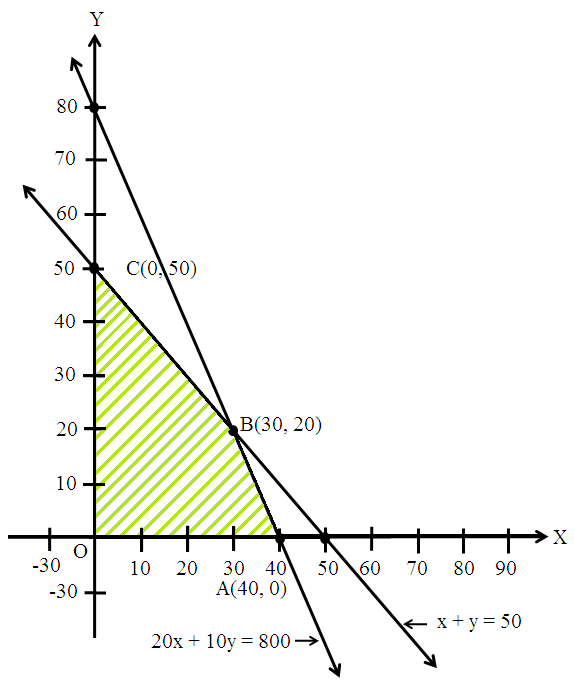
To solve the LPP we draw the lines, $x + y = 50, 20x + 10y = 800$
The feasible region of the LPP is shaded in graph

The coordinates of the vertices (Corner - points) of shaded feasible region $ABC$ are $A(40, 0), B(30, 20)$ and $C(0, 50).$
The values of the objective of function at these points are given in the following table:
Point $(x_1, x_2)$
Value of objective function $= Z = 10,500x + 9,000y$
$A(40, 0)$
$Z = 4,20,000$
$B(30, 20)$
$Z = 4,95,000$
$C(0, 50)$
$Z = 4,50,000$
$30$ hectors of land should be allocated to crop $X$ and
$20$ hectors of land should be allocated to crop $Y$ to maximize the profit
The maximum profit that can be eared is Rs. $4,95,000.$
 
View full question & answer
Question 745 Marks
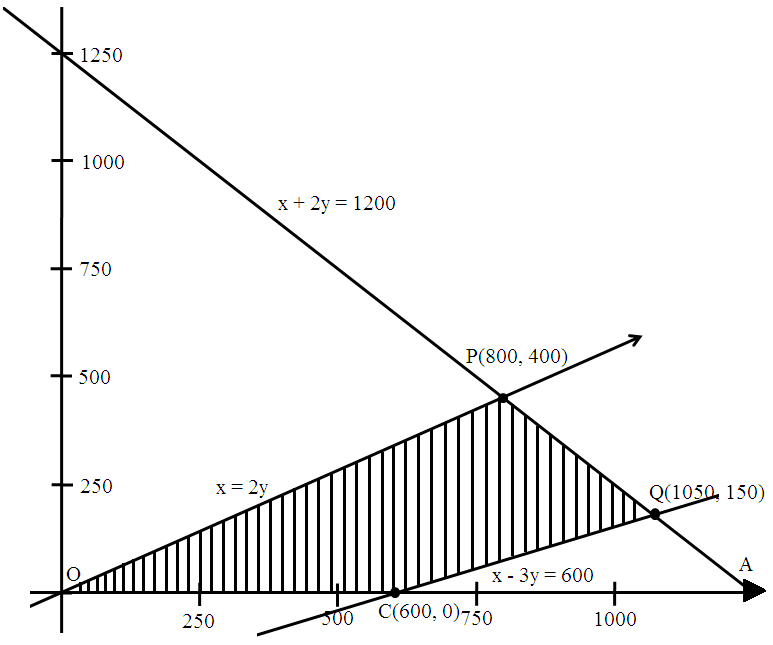
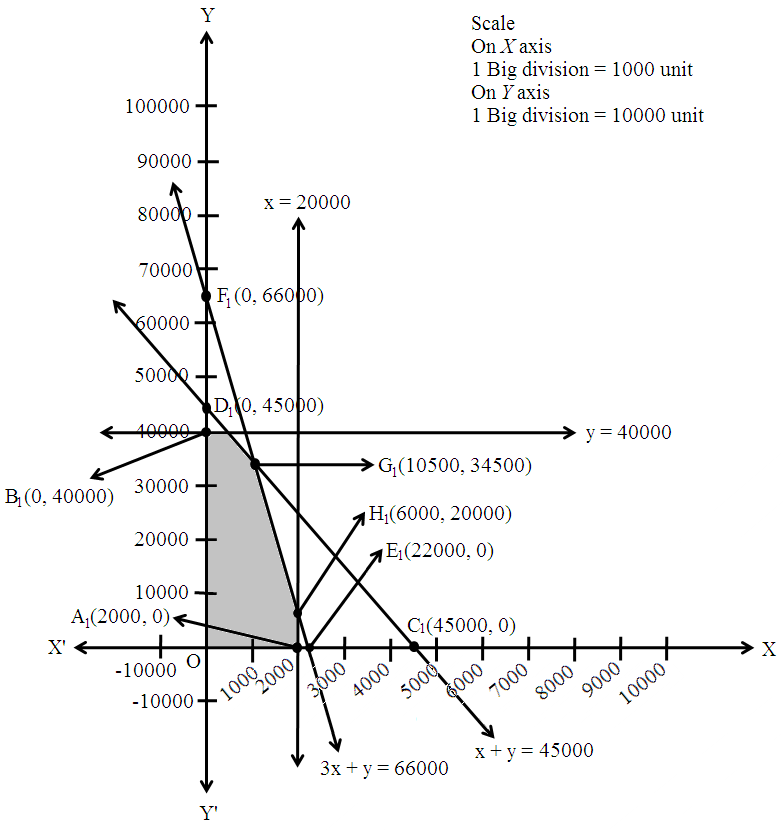
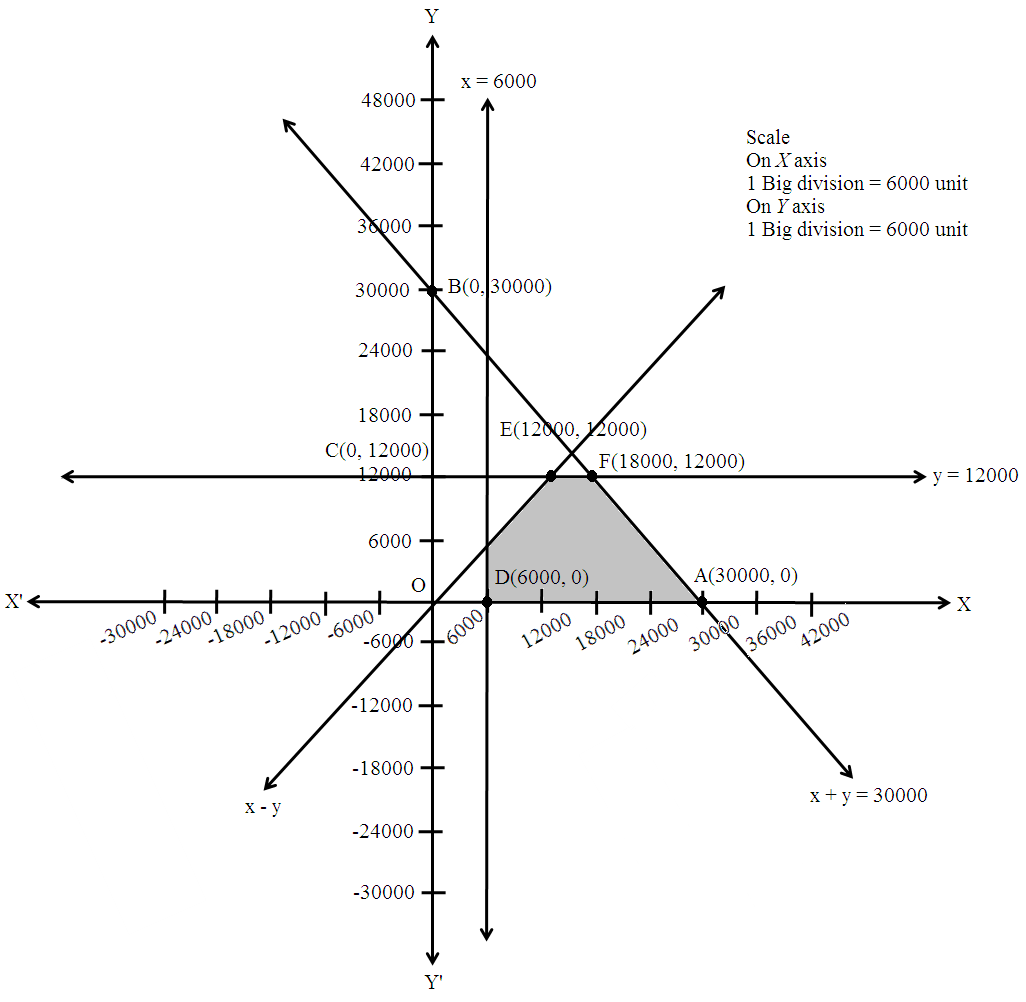
Maximum Z = 3x + 4y Subject to$\text{x}+\text{y}\leq30000$
$\text{y}\leq12000$
$\text{x}\geq6000$
$\text{x}\geq\text{y}$
$\text{x},\text{y}\geq0$
Answer
We have to maximize Z = 7x + 10y

First, we will convert the given inequations into equations, we obtain the following equations:

x + y = 30000.y = 12000, x = 6000, x = y, x = 0 and y = 0.

Region represented by $\text{x}+\text{y}\leq30000$:

The line x + y = 30000 meets the coordinate axes at A(30000, 0) and B(0, 30000) respectively.

By joining these points we obtain the line x + y = 30000. Clearly (0, 0) satisfies the inequation $\text{x}+\text{y}\leq30000$.

So, the region containing the origin represents the solution set of the inequation $\text{x}+\text{y}\leq30000$.

The line y = 12000 is the line that passes through C(0, 12000) and parallel to x axis.

The line x = 6000 is the line that passes through (6000, 0) and parallel to y axis.

Region represented by $\text{x}\geq\text{y}$

The line x = y is the line that passes through origin.

The points to the right of the line x=y satisfy the inequation $\text{x}\geq\text{y}$.

Like by taking the point (-12000, 6000).

Here, 6000 > -12000 which implies y > x.

Hence, the points to the left of the line x = y will not satisfy the given inequation $\text{x}\geq\text{y}$.

Region represented by $\text{x}\geq0$ and $\text{y}\geq0$: Since, every point in the first quadrant satisfies these inequations. So, the first quadrant is the region represented by the inequations $\text{x}\geq0$ and $\text{y}\geq0$.

The feasible region determined by the system of constraints, $\text{x}+\text{y}\leq30000,\text{y}\leq12000,\text{x}\geq6000,\text{x}\geq\text{y},\text{x}\geq0$ and $\text{y}\geq0$ are as follows:


The corner points of the feasible region are D(6000, 0), A(3000,0), F(18000, 12000) and E(12000, 12000).

The values of Z at these corner points are as follows:
View full question & answer
Question 755 Marks
Find the minimum value of 3x + 5y subject to the constraints:

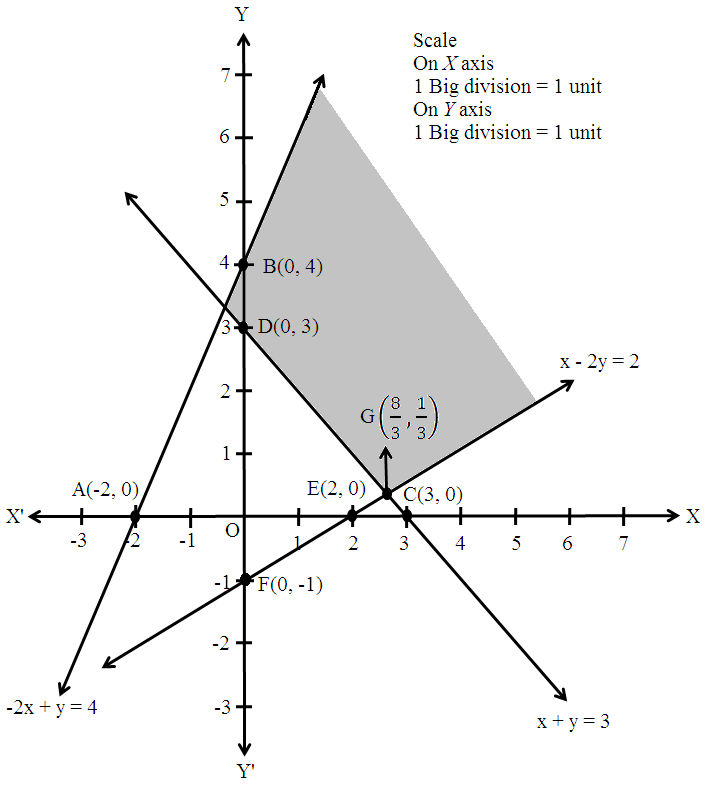
$-2\text{x}+\text{y}\leq4,\text{x}+\text{y}\geq3,$ $\text{x}-2\text{y}\leq2,\text{x},\text{y}\geq0.$
Answer
First, we will convert the given inequations into equations, we obtain the following equations:

-2x + y = 4, x + y = 3, x - 2y = 2, x = 0 and y = 0.

The line -2x + y = 4 meets the coordinate axis at A(-2, 0) and B(0, 4).

Join these points to obtain the line -2x + y = 4.

Clearly, (0, 0) satisfies the inequation $-2\text{x}+\text{y}\leq4$.

So, the region in xy-plane that contains the origin represents the solution set of the given equation.

The line x + y = 3 meets the coordinate axis at C(3, 0) and D(0, 3).

Join these points to obtain the line x + y = 3.

Clearly, (0, 0) does not satisfies the inequation $\text{x}+\text{y}\geq3$.

So, the region in xy-plane that does not contains the origin represents the solution set of the given equation.

The line x - 2y = 2 meets the coordinate axis at E(2, 0) and F(0, -1).

Join these points to obtain the line x - 2y = 2.

Clearly, (0, 0) satisfies the inequation $\text{x}-2\text{y}\leq2$.

So, the region in xy-plane that contains the origin represents the solution set of the given equation.

Region represented by $\text{x}\geq0$ and $\text{y}\geq0$:

Since, every point in the first quadrant satisfies these inequations.

So, the first quadrant is the region represented by the inequations.

These lines are drawn using a suitable scale.


The cornerpoint of the feasible region are B(0, 4), D(0, 3) and $\text{G}\Big(\frac{8}{3},\frac{1}{3}\Big)$.

The values of Z at these corner points are as follows.
$\text{Corner point}$
$\text{Z}=3\text{x}+5\text{y}$
$\text{B}(0, 4)$
$3\times0+5\times4=20$
$\text{D}(0, 3)$
$3\times0+5\times3=15$
$\text{G}\Big(\frac{8}{3},\frac{1}{3}\Big)$
$3\times\frac{8}{3}+5\times\frac{1}{3}=\frac{29}{3}$
We see that minimum value of the objective function Z is $\frac{29}{3}$ which is at $\text{G}\Big(\frac{8}{3},\frac{1}{3}\Big)$.

Thus, the optimal value of Z is $\frac{29}{3}$.
View full question & answer
Question 765 Marks
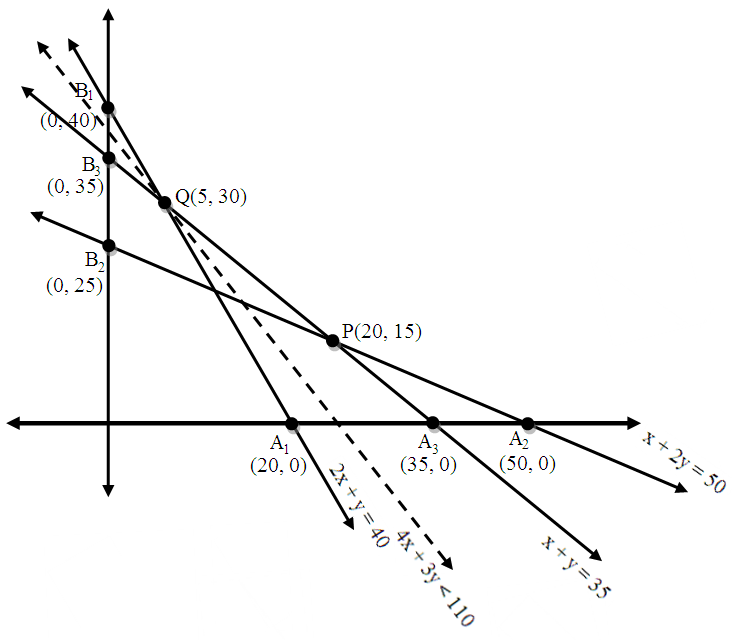
One kind of cake requires 200g of flour and 25g of fat, and another kind of cake requires 100g of flour and 50g of fat. Find the maximum number of cakes which can be made from 5kg of flour and 1kg of fat assuming that there is no shortage of the other ingredients used in making the cakes.
Answer
Let the number of cakes of one kind and another kind be x and y, respectively.

Therefore, the total number of cakes produced are (x + y).

One kind of cake requires 200g of flour and another kind of cake requires 100g of flour.

So, x cakes of one kind and ycakes of another kind requires (200x + 100y)g of flour.

But, cakes should contain atmost 5kg of flour.

$200\text{x}+100\text{y}\leq1000$

$2\text{x}+\text{y}\leq50$

One kind of cake requires 25g of fat and another kind of cake requires 50g of fat.

So, X cakes of one kind and y cakes of another kind requires (25x + 50y)g of fat.

But, cakes should contain atmost 1 kg of fat.

$25\text{x}+50\text{y}\leq1000$

$\text{x}+2\text{y}\leq40$

Thus, the given linear programming problem is Minimise

Z= x + y

Subject to the constraints

$2\text{x}+\text{y}\leq50$

$\text{x}+2\text{y}\leq40$

$\text{x},\text{y}\geq0$

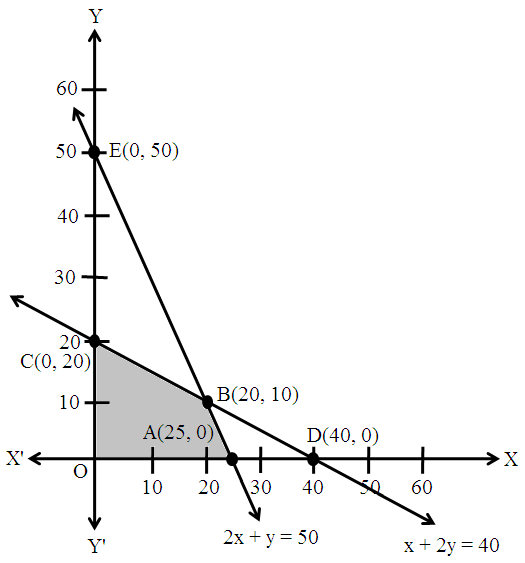
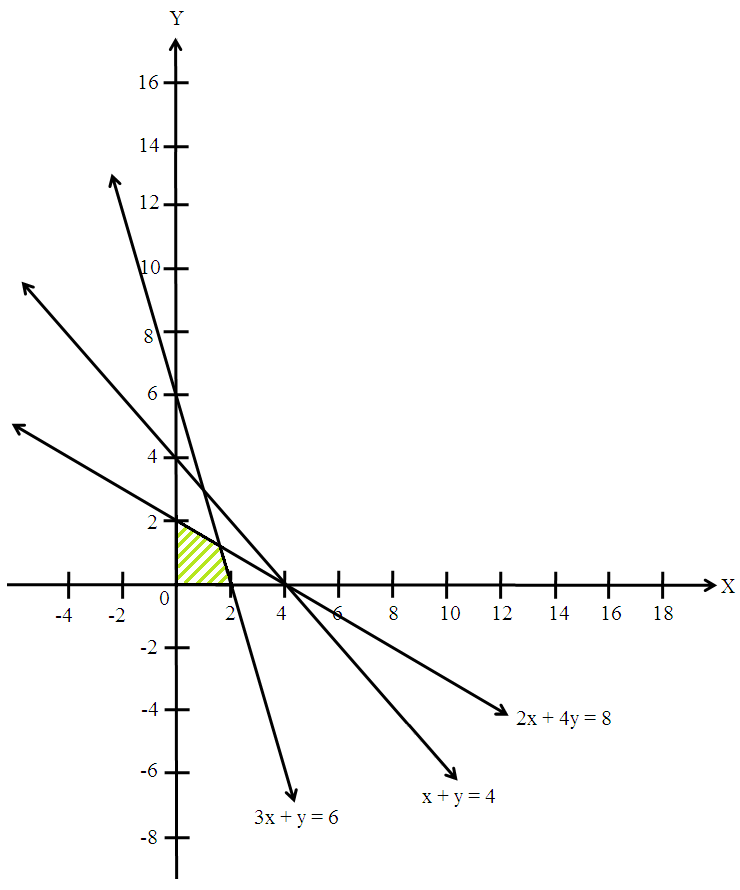
The feasible region determined by the given constraints can be diagrammatically represented as,


The coordinates of the corner points of the feasible region are O(0, 0), A(25, 0), B(20, 10) and C(0, 20).

The value of the objective function at these points are given in the following table.
Corner Point
Z = x + y
(0, 0)
0 + 0 = 0
(25, 0)
25 + 0 = 25
(20, 10)
20 + 10 = 30 → Maximum
(0, 20)
0 + 20 = 20
Thus, the maximum value of Z is 30 at x = 20, y = 10.

Hence, the maximum number of cakes which can be made are 30.
View full question & answer
Question 775 Marks
A chemical company produces two compounds, $A$ and $B.$ The following table gives the units of ingredients, $C$ and $D$ per kg of compounds $A$ and $B$ as well as minimum requirements of $C$ and $D$ and costs per kg of $A$ and $B$. Find the quantities of $A$ and $B$ which would give a supply of $C$ and $D$ at a minimum cost.
 
Compound
Minimum requirement
$A$
$B$
 
Ingredient $C$
$1$
$2$
$80$
Ingredient $D$
$3$
$1$
$75$
Coist $($in Rs.$)$ per Kg
$4$
$6$
 
Answer
Let required quantity of compound $A$ and $B$ are $x$ and $y$ kg.
Since, cost of one kg of compound $A$ and $B$ are Rs. $4$ and Rs. $6$ per kg.
So, cost of $x$ kg. of compound $A$ and $y$ kg. of compound B are Rs. $4x$ and Rs by respectively,
Let $Z$ be the total cost of compounds, so,
$Z = 4x + 6y$
Since, compound $A$ and $B$ contain $1$ and $2$ units of ingredient $c$ per kg, respectively, so, $x$ kg. of compound $A$ and $y$ kg. of compound $B$ contain $x$ and $2y$ units of ingredient $C$ respectively but minimum requirement of ingredient $C$ is $80$ units, so,
$\text{x}+2\text{y}\geq80$ (first constraint)
Since, compound $A$ and $B$ contain $3$ and $1$ unit of ingredient $D$ per kg, respectively, so, $x$ kg. of compound $A$ and $y$ kg. of compound $B$ contain $3x$ and $y$ units of ingredient respectively but minimum requirement of ingredient $D$ is $75$ units, so,
$3\text{x}+\text{y}\geq75$ (second constraint)
Hence, mathematical formulation of LPP is,
Find x and y which minimize
$Z = 4x + 6y$
Subject to constraints,
$\text{x}+2\text{y}\geq80$
$3\text{x}+\text{y}\geq75$
$\text{x},\text{y}\geq0$ [Since production can not be less than zero]
Region $\text{x}+2\text{y}\geq80$:
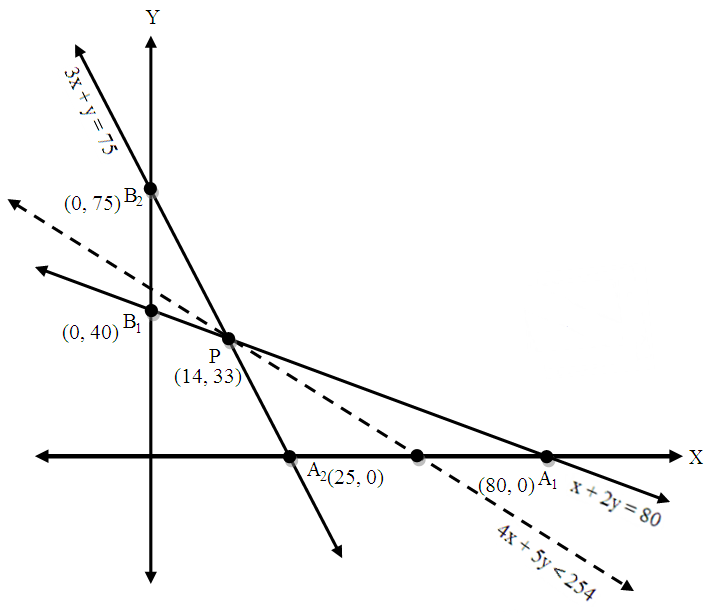
Line $x + 2y = 80$ meets axes at $A_1(80, 0), B_1(0, 40)$ respectively.
Region not containing origin represents $\text{x}+2\text{y}\geq80$ as $(0, 0)$ does not satisfy $\text{x}+2\text{y}\geq80$.
Region $3\text{x}+\text{y}\geq75$:
Line $3x +y = 75$ meets axes at $A_2(25, 0), B_2(0, 75)$ respectively.
Region not containing origin represents $3\text{x}+\text{y}\geq75$ as $(0, 0)$ does not satisfy $3\text{x}+\text{y}\geq75$.
Region $\text{x},\text{y}\geq0$:
It represents first quadrant.

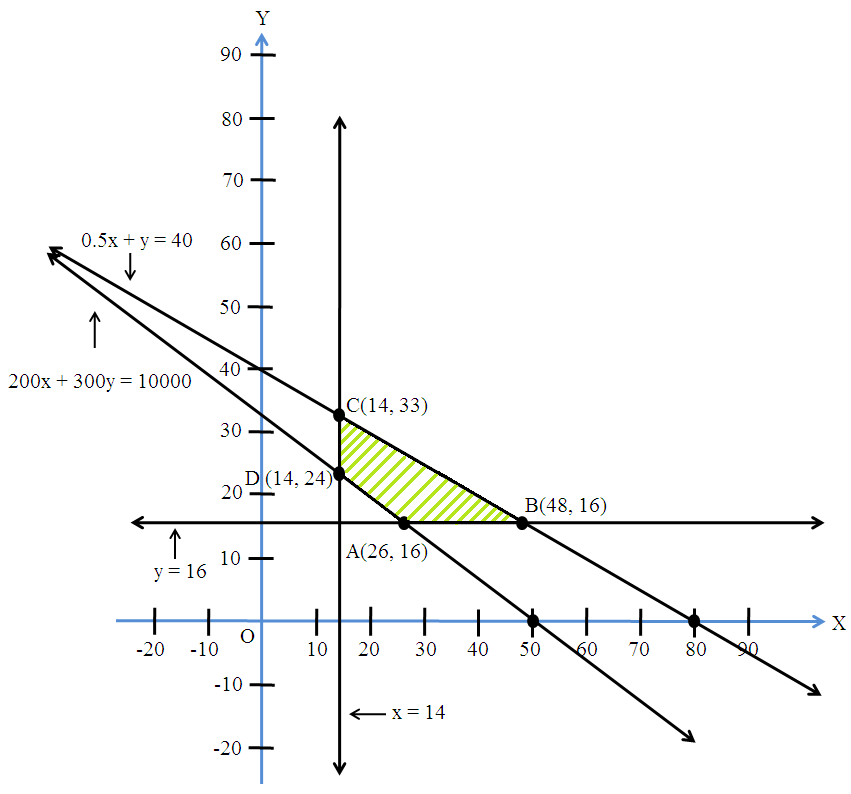
Unbouded shaded region $A_1PB_2 $ represents feasible region point is obtained by solving $x + 2y = 80$ and $3x + y = 75$
The value of $Z = 4x + 6y$ at
$A_1(80, 0) = 4(80) + 6(0) = 320$
$P(14, 33) = 4(14) + 6(33) = 254$
$B_2(0, 75) = 4(0) + 6(75) = 450$
Smallest value of $Z = 254$ open half plane $4x + 6y < 254$ has no point in common with feasible region.
So,
Smallest value is the minimum value.
Minimum cost $= Rs. 254$
Quantity of $A = 14kg$
Quantity of $B = 33kg.$
 
View full question & answer
Question 785 Marks
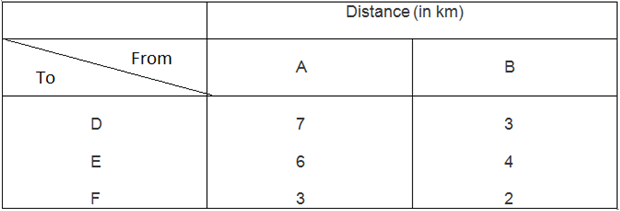
An oil company has two depots, $A$ and $B$, with capacities of $7000$ litres and $4000$  litres respectively. The company is to supply oil to three petrol pumps, $D, E, F$ whose requirements are $4500, 3000$ and $3500$ litres respectively. The distance (in km) between the depots and petrol pumps is given in the following table:

Assuming that the transportation cost per km is Rs. $1.00$ per litre, how should the delivery be scheduled in order that the transportation cost is minimum?
Answer
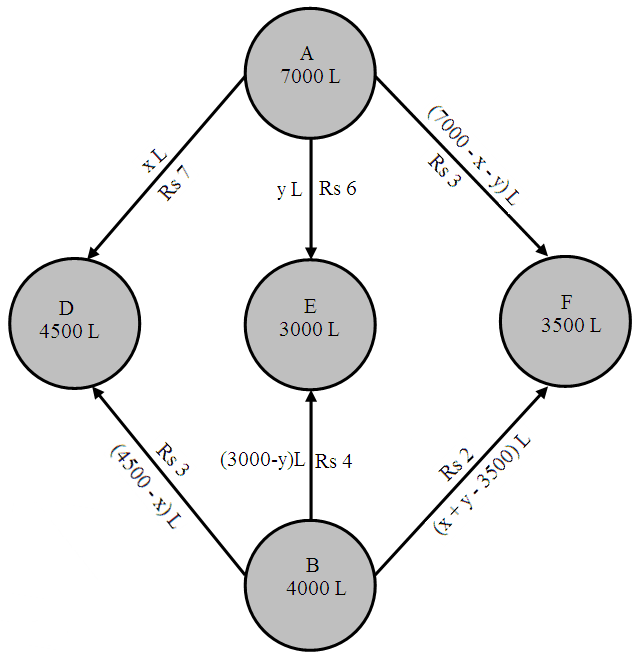
Let $x$ and $y$ litres of oil be supplied from $A$ to the petrol pumps $D$ and $E.$
Then, $(7000 − x − y) L$ will be supplied from $A$ to petrol pump $F.$
The requirement at petrol pump $D$ is $4500 L.$
Since, $x L$ are transported from depot $A$, the remaining $(4500 − x) L$ will be transported from petrol pump $B$.
Similarly, $(3000 − y) L$ and $[3500 − (7000 − x − y)]$
$L$ i.e. $(x + y − 3500) L$ will be transported from depot $B$ to petrol pump $E$ and $F.$ respectively.
The given problem can be represented diagrammatically as follows.

Since, quantity of oil are non-negative quantities.
Therefore,
$x \geq 0, y \geq 0 and (7000 - x - y) \geq 0$
$\Rightarrow x \geq 0, y \geq 0 and x + y \leq 7000$
$4500 - x \geq 0, 3000 - y \geq 0 and x + y - 3500 \geq 0$
$\Rightarrow x \leq 4500, y \leq 3000 and x + y \geq 3500$
Cost of transporting $10 L$ of petrol $=$ RS. $1$
Cost of transporting $1 L$ of petrol $=$ Rs. $110$
Therefore, total transportation cost is given by,
$\text{Z}=\frac{7}{10}\times\text{x}+\frac{6}{10}\text{y}+\frac{3}{10}(7000-\text{x}-\text{y})+\frac{3}{10}(4500-\text{x})$
$+\frac{4}{10}(3000-\text{y})+\frac{2}{10}(\text{x}+\text{y}-3500)$$$
$= 0.3x + 0.1y + 3950$
The problem can be formulated as follows.
Minimize$ Z = 0.3x + 0.1y + 3950$
Subject to the constraints,
$x + y \leq 7000$
$x \leq 4500$
$y \leq 3000$
$x + y \geq 3500$
$x, y \geq 0$
First we will convert inequations into equations as follows:
$x + y = 7000, x = 4500, y = 3000, x + y = 3500, x = 0$ and $y = 0$
Region represented by $x + y \leq 7000:$
The line $x + y = 7000$ meets the coordinate axes at $A_1(7000, 0) and B_1(0, 7000)$ respectively.
By joining these points we obtain the line $x + y = 7000.$
Clearly $(0, 0)$ satisfies the $x + y = 7000.$
So, the region which contains the origin represents the solution set of the inequation $x + y \leq 7000.$
Region represented by $x ​ \leq 4500:$
The line ​$x = 4500$ is the line passes through $C_1(4500, 0)$ and is parallel to $Y$ axis.
The region to the left of the line $x = 4500$ will satisfy the inequation $x ​ \leq 4500.$
Region represented by y ​ $\leq 3000:$
The line ​$y = 3000$ is the line passes through $D_1(0, 3000)$ and is parallel to $X$ axis.
The region below the line $y = 3000$ will satisfy the inequation $y ​ \leq 3000.$
Region represented by $x + y \geq 3500:$
The line $x + y = 7000$ meets the coordinate axes at $E_1(3500, 0)$ and $F_1(0, 3500)$ respectively.
By joining these points we obtain the line $x + y = 3500.$
Clearly $(0, 0)$ satisfies the $x + y = 3500.$
So, the region which contains the origin represents the solution set of the inequation $x + y \geq 3500.$
Region represented by $x \geq 0$ and $y \geq 0:$
Since, every point in the first quadrant satisfies these inequations.
So, the first quadrant is the region represented by the inequations $x \geq 0,$ and $y \geq 0.$
The feasible region determined by the system of constraints $x + y \leq 7000, x ​ \leq 4500, y ​ \leq 3000, x + y \geq 3500, x \geq 0$ and $y \geq 0$ are as follows.
GRAPH
The corner points of the feasible region are $E_1(3500, 0), C_1(4500, 0), I_1(4500, 2500), H_1(4000, 3000),$ and $G_1(500, 3000).$
The values of $Z$ at these corner points are as follows.
Corner point
$Z = 0.3 + 0.1y + 3950$
$E_1(3500, 0)$
$5000$
$C_1(4500, 0)$
$5300$
$I_1(4500, 2500)$
$5550$
$H_1(4000, 3000)$
$5450$
$G_1(500, 3000)$
$4400$
The minimum value of $Z$ is $4400$ at $G_1(500, 3000).$
Thus, the oil supplied from depot $A$ is $500 L, 3000 L,$ and $3500 L$ and from depot $B$ is $4000 L, 0 L,$ and $0 L$ to petrol pumps $D, E,$ and $F$ respectively.
The minimum transportation cost is Rs $4400.$
 
View full question & answer
Question 795 Marks
A cottage industry manufactures pedestal lamps and wooden shades, each requiring the use of grinding/cutting machine and sprayer. It takes 2 hours on the grinding/cutting machine and 3 hours on the sprayer to manufacture a pedestal lamp while it takes 1 hour on the grinding/cutting machine and 2 hours on the sprayer to manufacture a shade. On any day, the sprayer is available for at most 20 hours and the grinding/cutting machine for at most 12 hours. The profit from the sale of a lamp is Rs. 5.00 and a shade is Rs. 3.00. Assuming that the manufacturer can sell all the lamps and shades that he produces, how should he schedule his daily production in order to maximise his profit?
Answer
Let the cottage industry manufacture x pedestal lamps and y wooden shades.

Therefore, x ≥ 0 and y ≥ 0

The given information can be compiled in a table as follows.
 
Lamps
shades
Availability
Grinding/Cutting Machine (h)
2
1
12
Sprayer (h)
3
2
20
The profit on a lamp is Rs. 5 and on the shades is Rs 3.

Therefore, the constraints are

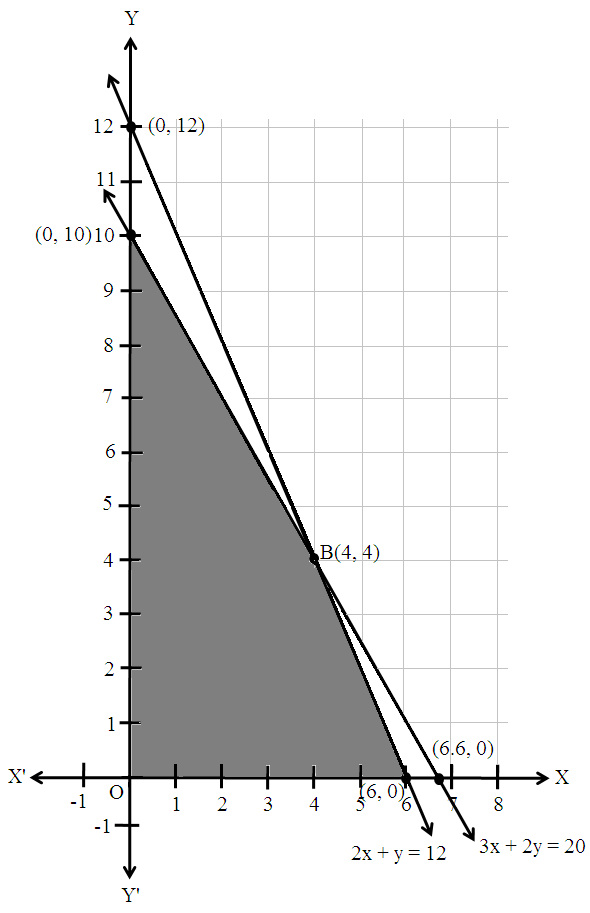
2x + y ≤ 12

3x + 2y ≤ 0

Total profit, Z = 5x + 3y

The mathematical formulation of the given problem is Maximize Z = 5x + 3y ... (1)

subject to the constraints,

2x + y ≤ 12... (2)

3x +2y ≤ 0... (3)

X, y ≥ 0... (4)

The feasible region determined by the system of constraints is as follows.


The corner points are A(6, 0), B(4, 4) and C(0, 10).

The values of Z at these corner points are as follows.
Corner point Z = 5x + 3y  
A(6, 0) 30  
B(4, 4) 32 → Maximum
C(0, 10) 30  
The maximum value of Z is 32 at (4, 4).

Thus, the manufacturer should produce 4 pedestal lamps and 4 wooden shades to maximize his profits.
View full question & answer
Question 805 Marks
A firm manufactures two products $A$ and $B$. Each product is processed on two machines $M_1$ and $M_2$. Product $A$ requires $4$ minutes of processing time on $M_1$ and $8$ min. on $M_2;$ product $B$ requires $4$ minutes on $M_1$ and $4$ min. on $M_2$. The machine $M_1$ is available for not more than $8$ hrs $20$ min. while machine $M_2$ is available for $10$ hrs. during any working day. The products $A$ and $B$ are sold at a profit of Rs. $3$ and Rs. $4$ respectively.
Formulate the problem as a linear programming problem and find how many products of each type should be produced by the firm each day in order to get maximum profit.
Answer
Let required production of product $A$ and $B$ be $x$ and $y$ respectively.
Since, profit on each product $A$ and $B$ are Rs. $3$ and Rs. $4$ respectively,
So, profit on x product $A$ and $y$ product $B$ are Rs. $3x$ and Rs. $4y$ respectively, Let $z$ be the total profit on product, so,
$Z = 3x + 4y$
Since, each product $A$ and $B$ requires $4$ minutes each on machine $M_1 $ so, $x$ product $A$ and $y$ product $B$ require $4x$ and $4y$ minutes on machine $M_1$ respectively but maximum available time on machine $M_1$  is $8$ hrs $20$ min.$= 500$ min. so,
$4\text{x}+4\text{y}\leq500$
$\text{x}+\text{y}\leq125$ (first constraint)
Since, each product $A$ and $B$ requires $8$ minutes and $4$ min. on machine $M_2$  respectively. so, $x$ product $A$ and $y$ product $B$ require $8x $ and $4y$ min. respectively on machine $M_2$ but, maximum available time on machine $M_2$​​​​​​​_ is $10$ hrs $= 600$ min. so,
$8\text{x}+4\text{y}\leq600$
$2\text{x}+\text{y}\leq150$ (second constraint)
Hence, mathematical formulation of LPP is,
Find $x$ and $y$ which maximize
$Z = 3x + 4y$
Subject to constraints,
$\text{x}+\text{y}\leq125$
$2\text{x}+\text{y}\leq150$
$\text{x},\text{y}\geq0$
Since number of product can not be less than zero]
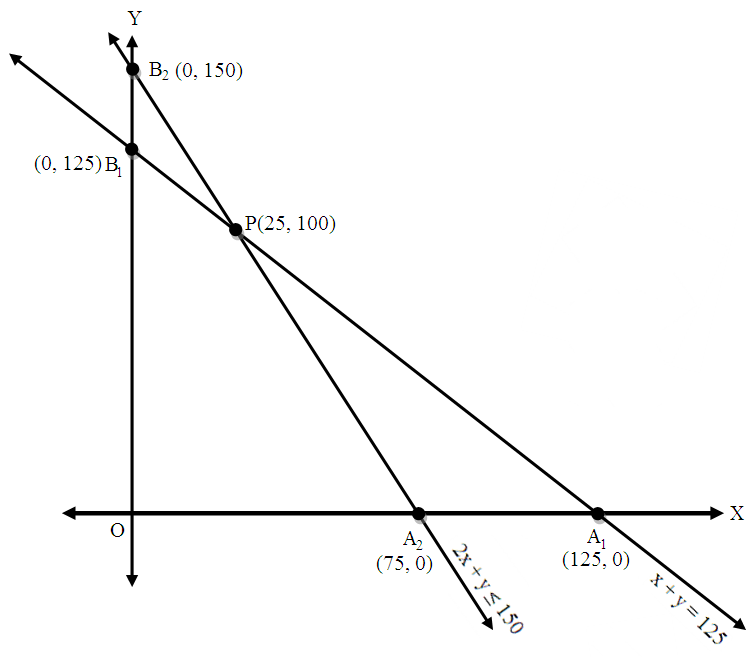
Region $\text{x}+\text{y}\leq125$:
Line $x + y = 125$ meets axis at $A_1(125, 0),B_1(0, 125)$ respectively.
Region $\text{x}+\text{y}\leq125$
Contains origin represents as $(0, 0)$ satisfies $x + y$ s $125.$
Region $2\text{x}+\text{y}\leq150$:
Line $2x + y = 150$ meets axis at $A_2(75, 0), B_2(0, 150)$ respectively.
Region containing origin represents $2\text{x}+\text{y}\leq150$ as $(0, 0) $  satisfies $2\text{x}+\text{y}\leq150$
Region $\text{x},\text{y}\geq0$:
It represents first quadrant.
Shaded region $OA_2PB_1 $ is feasible region $P(25, 100)$ is obtained by solving $x + y = 125$ and $2x + y = 150$​​​​​​​

The value of $Z = 3x + 4y$ at
$0(0, 0) = 3(0) + 4(0) = 0$
$A_2(75, 0) = 3(75) + 4(0) = 225$
$P(25, 100) = 3(25) + 4(100) = 475$
$B_1(0, 125) = 3(0) + 4(125) = 500$
Maximum profit $= Rs. 500,$ product $A = 0$
Product $B = 125.$
 
View full question & answer
Question 815 Marks
A manufacturer makes two types of toys A and B. Three machines are needed for this purpose and the time (in minutes) required for each toy on the machines is given below:
Type of Toys
Machine
 
I
II
III
A
12
18
6
B
6
0
9
Each machine is available for a maximum of 6 hours per day. If the profit on each toy of type A is Rs. 7.50 and that on each toy of type B is Rs. 5, show that 15 toys of type A and 30 toys of type B should be manufactured in a day to get maximum profit.
Answer
Suppose the manufacturer makes x toys of type A and y toys of type B.
Since each toy of type A require 12 minutes on machine I and each toy of type B require 6 minutes on machine I, therefore, x toys of type A and y toys of type B require (12x + 6y) minutes on machine I.

But, machines I is available for at most 6 hours.

12x + 6y ≤ 360

2x + y ≤ 60

Similarly, each toy of type A require 18 minutes on machine II and each toy of type B require 0 minutes on machine II, therefore, xtoys of type A and ytoys of type B require (18x + Oy) minutes on machine II.

But, machines II is available for at most 6 hours.

18x + 6y ≤ 360

x ≤ 20 Also, each toy of type A require 6 minutes on machine III and each toy of type B require 9 minutes on machine III, therefore, x toys of type A and y toys of type B require (6x + 9y) minutes on machine III.

But, machines III is available for at most 6 hours.

6x + 9y ≤ 360

2x + 3y ≤ 120

The profit on each toy of type A is Rs. 7.50 and each toy of type B is Rs. 5.

Therefore, the total profit from x to y of type A and y toys of type B is Rs. (7.50x + 5y).

Thus, the given linear programming problem is Maximise Z = 7.5x + 5y

Subject to the constraints

2x + y ≤ 60

x ≤ 20

2x + 3y ≤ 120

x, y ≥ 0

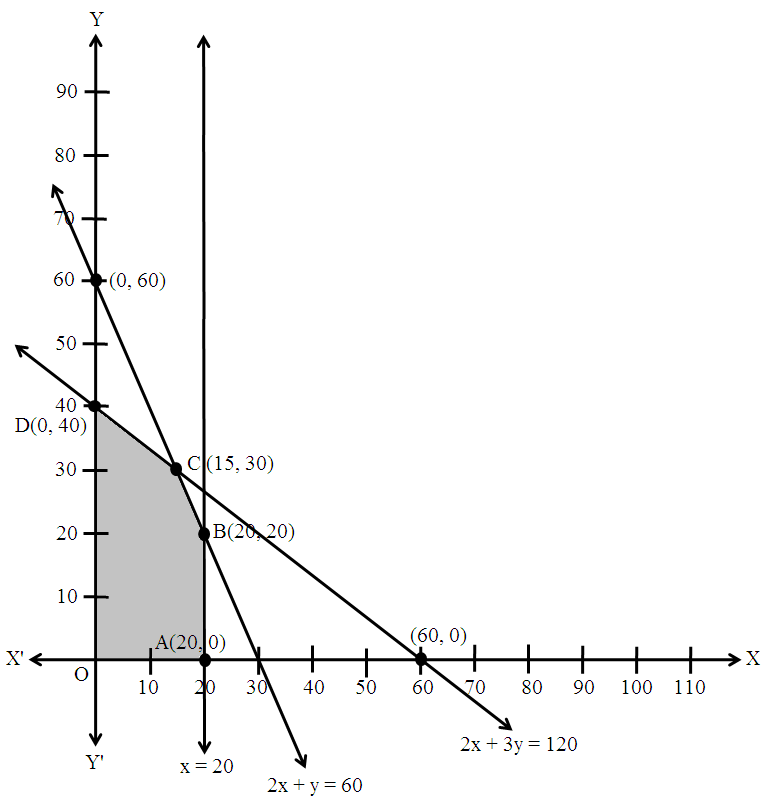
The feasible region determined by the given constraints can be diagrammatically represented as


Hence, 15 toys of type A and 30 toys of type B should be manufactured in a day to get maximum profit.

The maximum profit is Rs. 262.50.

The coordinates of the corner points of the feasible region are O(0, 0), A(20, 0), B(20, 20), C(15, 30) and D(0, 40).

The value of the objective function at these points are given in the following table.
Corner Point
Z = 7.5x + 5y
(0, 0)
7.5 × 0 + 5 × 0 = 0
(20, 0)
7.5 × 20 + 5 × 0 =150
(20, 20)
7.5 × 20 + 5 × 20 = 250
(15, 30)
7.5 × 15 + 5 × 30 = 262.5 → Maximum
(0, 40)
7.5 × 0 +5 × 40 = 200
The maximum value of Z is 262.5 at x = 15, y = 30.

Hence, 15 toys of type A and 30 toys of type B should be manufactured in a day to get maximum profit.

The maximum profit is Rs. 262.50.
View full question & answer
Question 825 Marks
A rubber company is engaged in producing three types of tyres A, B and C. Each type requires processing in two plants, Plant I and Plant II. The capacities of the two plants, in number of tyres per day, are as follows:
Plant
A
B
C
I
50
100
100
II
60
60
200
The monthly demand for tyre A, B and C is 2500, 3000 and 7000 respectively. If plant I costs Rs. 2500 per day, and plant II costs Rs. 3500 per day to operate, how many days should each be run per month to minimize cost while meeting the demand? Formulate the problem as LPP.
Answer
Let plant I be run for x days and plant II be run for y dayes
Then,
Tyres
Plant I (4)
Plant II (y)
Demand
 
A
50
60
2500
B
100
60
3000
C
100
200
7000
Minimum demand for Tyres A,B and C is 2500, 3000 and 7000 respectively. The demand can be more then the minimum demand.
Therefore, the incquations will be.
$50\text{x}+60\text{y}\geq2500$
$100\text{x}+60\text{y}\geq3000$
$100\text{x}+200\text{y}\geq7000$
Also, the objective function is Z = 2500x + 3500y
Hence, the required LPP is as follows:
Minimise Z = 2500x + 3500y
subject to
$50\text{x}+60\text{y}\geq2500$
$100\text{x}+60\text{y}\geq3000$
$100\text{x}+200\text{y}\geq7000$
View full question & answer
Question 835 Marks
A manufacturer considers that men and women workers are equally efficient and so he pays them at the same rate. He has 30 and 17 units of workers (male and female) and capital respectively, which he uses to produce two types of goods A and B. To produce one unit of A, 2 workers and 3 units of capital are required while 3 workers and 1 unit of capital is required to produce one unit of B. If A and B are priced at Rs. 100 and Rs. 120 per unit respectively, how should he use his resources to maximise the total revenue? Form the above as an LPP and solve graphically. Do you agree with this view of the manufacturer that men and women workers are equally efficient and so should be paid at the same rate?
Answer
Let x units of A and y units of B be produced by the manufacturer.
The price of one unit of A is Rs. 100 and the price of one unit of B is Rs. 120.
Therefore, the total price of x units of A and y units of B or the total revenue is Rs. (100x + 120y).
One unit of A requires 2 workers and one unit of B requires 3 workers.
Therefore, x units of A and y units of B requires (2x + 3y) workers.
But, the manufacturer has 30 workers.
$\therefore$ 2x + 3y ≤ 30
Similarly, one unit of A requires 3 units of capital and one unit of B requires 1 unit of capital.
Therefore, x units of A and y units of B requires (3x + y) units of capital.
But, the manufacturer has 17 units of capital.
$\therefore$ 3x + y ≤ 17
Thus, the given linear programming problem is
Maximise Z = 100x + 120y
Subject to the constraints
2x + 3y ≤ 30
3x + y ≤ 17
x, y ≥ 0
The feasible region determined by the given constraints can be diagrammatically represented as,

The coordinates of the corner points of the feasible region are O(0, 0), A(0, 10), B(173, 0) and C(3, 8).
The value of the objective function at these points are given in the following table:
Corner point
Z = 100x + 120y
(0, 0)
100 × 0 + 120 × 0 = 0
(0, 10)
100 × 0 + 120 × 10 = 1200
(173, 0)
100 × 173 + 120 × 0 = 17003
(3, 8)
100 × 3 + 120 × 8 = 1260
The maximum value of Z is 1260 at x = 3, y = 8.
Hence, the maximum total revenue is Rs. 1,260 when 3 units of A and 8 units of B are produced.
Yes, because the efficiency of a worker does not depend on whether the worker is a male or a female.
View full question & answer
Question 845 Marks
A firm manufactures two products, each of which must be processed through two departments, 1 and 2. The hourly requirements per unit for each product in each department, the weekly capacities in each department, selling price per unit, labour cost per unit, and raw material cost per unit are summarized as follows:
 
 
Product A
Product B
Weekly capacity
Department 1
3
2
130
Department 2
4
6
260
Selling price per unit
Rs. 25
Rs. 30
 
Labour cost per unit
Rs. 16
Rs. 20
 
Raw material cost per unit
Rs. 4
Rs. 4
 
The problem is to determine the number of units to produce each product so as to maximize total contribution to profit. Formulate this as a LPP.
Answer
Given information can be tabulated below:
Product
Department 1
Department 2
Selling price
Labour cost
Row material cost
A
3
4
25
16
4
B
2
6
30
20
4
Capacity
130
260


Let the required product of product A and B be x and y units respectively.

Given, labour cost and raw material cost of one unit of product A is Rs 16 and Rs 4, so total cost of product A is Rs 16 + RS 4 = Rs 20 And given selling price of 1 unit of product A is Rs 25, So, profit on one unit of product.

A - 25 - 20 - Rs 5

Again, given labour cost and raw material cost of one unit of product B is Rs 20 and Rs 4 So, that cost of product B is Rs 20 + RS 4 - Rs 24 And given selling price of 1 unit of product B is Rs 30 So, profit on one unit of product B = 30 - 24 = Rs 6

Hence, profits on x unit of product A and y units of product B are Rs 5x and Rs 6y respectively.

Let z be the total profit, so Z = 5x + 6y

Given, production of one unit of product A and B need to process for 3 and 4 hours respectively in department 1, so production of x units of product A and y units of product 8 need to process for 3x and 4 hours respectively in Department 1. But to tal capacity of Department 1 is 130 hour, So, $\text{3x}+\text{2y}\leq130$ (First constraint)

Given, production of one unit of product A and B need to process for 4 and 6 hours respectively in department 2, so production of x units of product A and y units of product B need to process for 4x and 6y hours respectively in Department 2 but total capacity of Department 2 is 260 hours So, $\text{4x}+\text{6y}\leq 260$ (Second constraint)

Hence, mathematical formulation of LPP IS, Find x and y which Maximize z = 5x + 6y

Subject to constraint,

$\text{3x}+\text{2y}\leq130$

$\text{4x}+\text{6y}\leq260$

$\text{X,Y}\geq 0$ [Since production cannot be less than zero]
View full question & answer
Question 855 Marks
A firm manufactures headache pills in two sizes A and B. Size A contains 2 grains of aspirin, 5 grains of bicarbonate and 1 grain of codeine; size B contains 1 grain of aspirin, 8 grains of bicarbonate and 66 grains of codeine. It has been found by users that it requires at least 12 grains of aspirin, 7.4 grains of bicarbonate and 24 grains of codeine for providing immediate effects. Determine graphically the least number of pills a patient should have to get immediate relief. Determine also the quantity of codeine consumed by patient
Answer
Let the number of size A pill be x and the number of size B pill be y.

Therefore, the constraints are

$2\text{x}+\text{y}\geq12$

$5\text{x}+8\text{y}\geq7.4$

$4\text{x}+66\text{y}\geq24$

Z = x + y which is to be minimised


The corner points are (0, 12), (24, 0) and 768131, 36131.

The values of Z at these corner points are as follows:
Corner point
Z = x + y
(0, 12)
12
(24, 0)
24
768131, 36131
6.1373
The minimum value of Z is 6.1373 but the region is unbounded so check whether x + y < 6.1373 has common region with the feasible solution.

Clearly, it can be seen that it doesn't has any common region.

So,

x = 768131, y = 36131

This is the least quantity of pill A and B.

Codline quantity = 768131 + 66 x 36131 =24 grains.
View full question & answer
Question 865 Marks
A gardener has supply of fertilizer of type I which consists of 10% nitrogen and 6% phosphoric acid and type II fertilizer which consists of 5% nitrogen and 10% phosphoric acid. After testing the soil conditions, he finds that he needs at least 14kg of nitrogen and 14kg of phosphoric acid for his crop. If the type I fertilizer costs 60 paise per kg and type II fertilizer costs 40 paise per kg, determine how many kilograms of each fertilizer should be used so that nutrient requirements are met at a minimum cost. What is the minimum cost?
Answer
Let x kg of type 1 fertilizer and y kg of type II fertilizer are supplied.

Quantity of fertilizer cannot be negative.

Therefore, x, y ≥ 0

A gardener has supply of fertilizer of type I which consists of 10% nitrogen and type II fertilizer consists of 5% nitrogen and he needs at least 14kg of nitrogen for his crop.

10 × 100 + 5 × 100 ≥ 14 = 10x + 5x ≥ 1400

A gardener has supply of fertilizer of type I which consists 6% phosphoric acid and type II fertilizer consists of 10% phosphoric acid.

And he needs 14kg of phosphoric acid for his crop.

6 × 100 + 10 × 100 ≥ 14 = 6x + 10x ≥ 1400

Therefore, according to the question, constraints are 10x + 5y ≥ 1400, 6x + 10y ≥ 1400

If the type I fertilizer costs 60 paise per kg and type II fertilizer costs 40 paise per kg.

Therefore, cost of x kg of type 1 fertilizer and y kg of type II fertilizer is Rs. 0.60x and Rs. 0.40y respectively.

Total cost = Z = 0.60x + 0.40y which is to be minimised.

Thus, the mathematical formulation of the given linear programmimg problem is

Min Z = 0.60x + 0.40y

Subject to

6x + 10y ≥ 1400

10x + 5y ≥ 1400

x, y ≥ 0

First we will convert inequations into equations as follows:

6x + 10y = 1400, 10x + 5y = 1400, x = 0 and y = 0

Region represented by 6x +10y ≥ 1400:

The line 6x +10y = 1400 meets the coordinate axes at A(7003, 0) and B(0, 140) respectively.

By joining these points we obtain the line 6x + 10y = 1400.

Clearly (0, 0) does not satisfies the 6x + 10y = 1400.

So, the region which does not contain the origin represents the solution set of the inequation 6x + 10y ≥ 1400.

Region represented by 10x + 5y ≥ 1400:

The line 10x + 5y = 1400 meets the coordinate axes at C(140, 0) and D(0, 280) respectively.

By joining these points we obtain the line 10x + 5y = 1400.

Clearly (0, 0) does not satisfies the inequation 10x + 5y 1400.

So, the region which does not contain the origin represents the solution set of the inequation 10x + 5y ≥ 1400.

Region represented by x ≥ 0 and y ≥ 20:

Since, every point in the first quadrant satisfies these inequations.

So, the first quadrant is the region represented by the inequations x ≥ 0, and y ≥ 0.

The feasible region determined by the system of constraints 6x + 10y ≥ 1400, 10x + 5y ≥ 1400, X ≥ 0 and y ≥ 0 are as follows.


The corner points are D(0, 280), E(100, 80) and $\text{A}\Big(\frac{700}{3}, 0\Big).$

The values of Z at these corner points are as follows:
Corner point
Z = 0.60x + 0.40y
D
112
E
92
A
140
The minimum value of Z is Rs. 92 which is attained at E(100, 80).

Thus, the minimum cost is Rs. 92 obtained when 100kg of type I fertilizer and 80kg of type II fertilizer were supplied.
View full question & answer
Question 875 Marks
A merchant plans to sell two types of personal computers a desktop model and a portable model that will cost Rs. 25,000 and Rs. 40,000 respectively. He estimates that the total monthly demand of computers will not exceed 250 units. Determine the number of units of each type of computers which the merchant should stock to get maximum profit if he does not want to invest more than Rs. 70 lakhs and his profit on the desktop model is Rs. 4500 and on the portable model is Rs. 5000.
Answer
Let x and y be the number of desktop model and portable model respectively.
Number of desktop model and portable model cannot be negative.

Therefore,

It is given that the monthly demand will not exist 250 units.

$\therefore$ x + y ≤ 250

Cost of desktop and portable model is Rs. 25,000 and Rs. 40,000 respectively.

Therefore, cost of x desktop model and y portable model is Rs. 25,000 and Rs. 40,000 respectively and he does not want to invest more than Rs. 70 lakhs.

25000x + 40000y ≤ 7000000

Profit on the desktop model is Rs. 4500 and on the portable model is Rs. 5000.

Therefore, profit made by x desktop model and y portable model is Rs. 4500x and Rs. 5000y respectively.

Total profit = Z = 4500x + 5000y

The mathematical form of the given LPP is:

Maximize Z = 4500x + 5000y

Subject to constraints:

x + y ≤ 250

25000x + 40000y ≤ 7000000

First we will convert inequations into equations as follows:

x + y = 250, 25000x + 40000y = 7000000, x = 0 and y = 0

Region represented by x + y ≤ 250:

The line x + y = 250 meets the coordinate axes at A(250, 0) and B(0, 250) respectively.

By joining these points we obtain the line x + y = 250.

Clearly (0, 0) satisfies the x + y = 250.

So, the region which contains the origin represents the solution set of the inequation x + y ≤ 250.

Region represented by 25000x + 40000y ≤ 7000000:

The line 25000x + 40000y = 7000000 meets the coordinate axes at C(280, 0) and D(0, 175) respectively.

By joining these points we obtain the line 25000x + 40000y = 7000000.

Clearly (0, 0) satisfies the inequation 25000x + 40000y ≤ 7000000.

So, the region which contains the origin represents the solution set of the inequation 25000x + 40000y ≤ 7000000.

Region represented by x ≥ 0 and y ≥ 0:

Since, every point in the first quadrant satisfies these inequations.

So, the first quadrant is the region represented by the inequations x ≥ 0, and y ≥ 0.

The feasible region determined by the system of constraints x + y ≤ 250, 25000x + 40000y ≤ 7000000, x ≥ 0 and y ≥ 0 are as follows.


The corner points are O(0, 0), D(0, 175), E(200, 50) and A(250, 0).

The values of the objective function Z at corner points of the feasible region are given in the following table:
Corner Points
Z = 4500x + 5000  
O(0, 0) 0  
D(0, 175) 875000  
E(200, 50) 1150000 → Maximum
A(250, 0) 1125000  
Clearly, Z is maximum at x = 200 and y = 50 and the maximum value of Z at this point is 1150000.

Thus, 200 desktop models and 50 portable units should be sold to maximize the profit.
View full question & answer
Question 885 Marks
A toy company manufactures two types of dolls, A and B. Market tests and available resources have indicated that the combined production level should not exceed 1200 dolls per week and the demand for dolls type B is at most half of that for dolls of types A. Further, the production level of dolls of type A can exceed three times the production of dolls of other type by at most 600 units. If the company makes profit of Rs. 12 and Rs. 16 per doll respectively on dolls A and B, how many of each should be produced weekly in order to maximize the profit ?
Answer
Let x dolls of type A and y dolls of type B be produced to have the maximum profit.
The company makes profit of Rs. 12 and Rs. 16 per doll respectively on doll A and doll B

Step I

= Z = 12x + 16y

The production level of x + y should not exceed 1200

x + y ≤ 1200

The production level of dolls of type A exceeds three times the production of dolls of type B by at most 600

x - 3y ≤ 600

Demand for dolls of type B is at most of that for dolls of type A.

$\text{y}\leq\frac{\text{x}}{2}$

Hence we can say the LPP is subject to maximize Z = 12x + 16y and to constraints

$\text{x}+\text{y}\leq1200$

$\text{x}-3\text{y}\leq600$

$\text{y}\leq\frac{\text{x}}{2}$

$\text{x},\text{y}\geq0$

Step II
  1. The line x + y = 1200 passes through A(1200, 0),B(0, 1200)
Put x = 0, y = 0 in x + y ≤ 1200

We get 0 ≤ 1200 which is true.

$\therefore$ x + y ≤ 1200 lies on and below AB
  1. The line x - 3y = 600, passes through C(600, 0),D(0, –200)
Put x = 0,y = 0 in x - 3y 5600

Clearly 0 ≤ 600 is true.

Hence x - 3y ≤ 600 lies above the line CDCD
  1. $\text{y}\leq\frac{\text{x}}{2}$ passes through (400, 200) and (0, 0)
Put x = 200, y = 0 in $\text{y}\leq\frac{\text{x}}{2}$

$0\text{}\leq\frac{\text{200}}{2}$ is also true.

→ (200, 0) lies in the region (i.e) below OP
  1. x ≥ 0 lies on and to the right of y-axis.
  2. y ≥ 0 lies on and above X-axis.
The shaded portion PQCO represents the feasible region.


Step III

The point P is in the intersection of the lines x + y = 1200,

$\text{y}\leq\frac{\text{x}}{2}$

⇒ 2y = x

On solving these two equations we get,

x = 800 and y = 400

The point Q is in the intersection of the lines x + y = 1200 and x - 3y = 600

Let us solve these two equations to get the value of x and y

x + y = 1200

x - 3y = 600

4y = 600

y = 150

Hence x = 1050

The coordinates of Q are (1050, 150).

The point C is (600, 0)

The objective function is Z = 12x + 16y

Step IV

Let us now obtain the values of objective function as follows:

At the points (x, y) the value of the objective function Z = 12x + 16

At P(800, 400) the value of the objective function

Z = 12 × 800 + 16 × 400 = 16,000

At Q(1050, 150) the value of the objective function

Z = 12 × 1050 + 16 × 150 = 15,000

At C(600, 0) the value of the objective function Z = 12 × 600 + 16 × 0 = 7200

At 0(0, 0) the value of the objective function Z =12 × 0 + 16 × 0 = 0

It is clear that Z is maximum at P(800, 400).

The maximum value of Z is Rs. 16,000.

Thus to maximize the profit 800 dolls of type A and 400 dolls of type B should be produced to get a maximum profit of Rs. 16,000.
View full question & answer
Question 895 Marks
A manufacturer of Furniture makes two products : chairs and tables. processing of these products is done on two machines $A$ and $B$. $A$ chair requires $2$ hrs on machine $A$ and $6$ hrs on machine $B$. $A$ table requires $4$ hrs on machine $A$ and $2$ hrs on machine $B.$ There are $16$ hrs of time per day available on machine $A$ and $30$ hrs on machine $B$. Profit gained by the manufacturer from a chair and a table is Rs. $3$ and Rs. $5$ respectively. Find with the help of graph what should be the daily production of each of the two products so as to maximize his profit.
Answer
Let $x$ chairs and $y$ tables were produced. Number of chairs and tables cannot be negative.
Therefore, $\text{x},\text{y}\geq0$
The given information can be tabulated as follows:
 
Time on machine A(hrs)
Time on machine B (hrs)
Chairs
$2$
$6$
Tables
$4$
$2$
Availability
$16$
$30$
Therefore, the constraints are
$2\text{x}+4\text{y}\leq16$
$6\text{x}+2\text{y}\leq30$
Profit gained by the manufacturer from a chair and a table is Rs. $3$ and Rs. $5$ respectively.
Therefore, profit gained from x chairs and y tables is Rs. $3x$ and Rs $5y.$
Total profit $= Z = 3x + 5y$ which is to be maximised
Thus, the mathematical formulation of the given linear programmimg problem is
Max $Z = 3x + 5y$
subject to
$2\text{x}+4\text{y}\leq16$
$6\text{x}+2\text{y}\leq30$
$\text{x},\text{y}\geq0$
First we will convert inequations into equations as follows:
$2x + 4y = 16, 6x + 2y =30, x = 0$ and $y = 0$
Region represented by $2\text{x}+4\text{y}\leq16$:
The line $2x + 4y = 16$ meets the coordinate axes at $A1(8, 0)$ and $B(0, 4)$ respectively.
By joining these points we obtain the line $2x + 4y = 16.$
Clearly $(0, 0)$ satisfies the $2\text{x}+4\text{y}\leq16$.
So, the region which contains the origin represents the solution set of the inequation $2\text{x}+4\text{y}\leq16$.
Region represented by $6\text{x}+2\text{y}\leq30$:
The line $6x + 2y =30$ meets the coordinate axes at $C (5, 0)$ and $D (0, 15)$ respectively.
By joining these points we obtain the line $6x + 2y =30.$
Clearly $(0, 0)$ satisfies the inequation $6\text{x}+2\text{y}\leq30$.
So, the region which contains the origin represents the solution set of the inequation $6\text{x}+2\text{y}\leq30$.
Region represented by $\text{x}\geq0$ and $\text{y}\geq0$:
Since, every point in the first quadrant satisfies these inequations.
So, the first quadrant is the region represented by the inequations $\text{x}\geq0$, and $\text{y}\geq0$.
The feasible region determined by the system of constraints $2\text{x}+4\text{y}\leq16,6\text{x}+2\text{y}\leq30,\text{x}\geq0,$ and $\text{y}\geq0$ are as follows.

The corner points are $O(0, 0), B_1(0, 4),$
$\text{E}_1\Big(\frac{22}{5},\frac{9}{5}\Big)$ and $C_1(5, 0).$
The values of $Z$ at these corner points are as follows.
Corner point
$Z = 3x + 5y$
$O$
$0$
$B_1$
$20$
$E_1$
$22.2$
$C_1$
$15$
The maximum value of $Z $ is $22.2$ which is attained at $\text{B}_1\Big(\frac{22}{5},\frac{9}{5}\Big)$.
Thus, the maximum profit is of Rs. $\frac{22}{5}$ obtained when $\frac{9}{5}$ units of chairs and $95$ units of tables are produced.
 
View full question & answer
Question 905 Marks
A hospital dietician wishes to find the cheapest combination of two foods, $A$ and $B$, that contains at least $0.5$ milligram of thiamin and at least $600$ calories. Each unit of A contains $0.12$ milligram of thiamin and $100$ calories, while each unit of B contains $0.10$ milligram of thiamin and $150$ calories. If each food costs $10$ paise per unit, how many units of each should be combined at a minimum cost?
Answer
Let required quantity of food A and food B bex and y units.
Given, costs of one unit of food A and B are 10 paise per unit each, so costs ofx unit of food A and y unit of food B are 10x and 10y respectively, let z be total cost of foods, so
Z = 10x + 10y
Since one unit of food A and B contain 0.12mg and 0.10mg of Thiamin respectively, so, x units of food A and y units of food B contain 0.12xmg and 0.10ymg of Thiamin respectively but minimum requirement of Thiamin is 0.4 mg, so
$0.12\text{x}+10\text{y}\geq0.5$
$12\text{x}+10\text{y}\geq50$
$6\text{x}+5\text{y}\geq25$ (first constraint)
Since one unit of food A and B contain 100 and 150 calories respectively, so x units of food A and y units of food B contain 100x and 150y units of Calories but minimum requirement of Calories is 600, so
$100\text{x}+150\text{y}\geq600$
$\Rightarrow2\text{x}+3\text{y}\geq12$ (second constraint)
Hence, mathematical formulation of LPP is find x and y which
minimize Z = 10x + 10y
Subject to constraint,
$6\text{x}+5\text{y}\geq25$
$2\text{x}+3\text{y}\geq12$
$\text{x},\text{y}\geq0$ [Since quantity of food A and B can not be less than zero]
Region $6\text{x}+5\text{y}\geq25$:
6x + 5y = 25 meets axes at $\text{A}_1\Big(\frac{25}{6},0\Big),$ $B_1$(0, 5).
Region not containing origin represents $6\text{x}+5\text{y}\geq25$ as (0, 0) does not satisfy $6\text{x}+5\text{y}\geq25$.
Region $2\text{x}+3\text{y}\geq12$:
Line 2x + 3y = 12 meets axes at $A_2(6, 0), B_2(0, 4).$
Region not containing origin represents $2\text{x}+3\text{y}\geq12$ as (0, 0) does not satisfy $2\text{x}+3\text{y}\geq12$.
Region $\text{x},\text{y}\geq0$ represent first quadrant in xy-plane.

Unbounded shaded region $A_2PB_1 $represents feasible region with corner points $A_2(6, 0)$, $\text{P}\Big(\frac{15}{8},\frac{11}{4}\Big), B_1(0, 5)$
The value of $Z = 10x + 10y at$
$A_2(6, 0) = 10 (6) + 10(0) = 60$
$\text{P}\Big(\frac{15}{8},\frac{11}{4}\Big)=10\Big(\frac{15}{8}\Big)+10\Big(\frac{11}{4}\Big)=\frac{370}{8}=46\frac{1}{4}$
$B_1(0, 5) = 10(0) + 10(5) = 50$
Smallest value of Z is $46\frac{1}{4}.$
Now open half plane $10\text{x}+10\text{y}<\frac{370}{8}$
$= 8x + 8y < 370$ has no point in common with feasible region, so smallest value is the minimum value.
Hence,
Required quantity of food $\text{A}=\frac{15}{8}$ units, food $\text{B}=\frac{11}{4}$ units
minimum cost - Rs $46.25$
$\Rightarrow\frac{15}{8}=1.875$ units of food A and $\frac{11}{4}=2.75$ units of $B.$
View full question & answer
Question 915 Marks
A merchant plans to sell two types of personal computers a desktop model and a portable model that will cost Rs. 25,000 and Rs. 40,000 respectively. He estimates that the total monthly demand of computers will not exceed 250 units. Determine the number of units of each type of computers which the merchant should stock to get maximum profit if he does not want to invest more than Rs. 70 lakhs and his profit on the desktop model is Rs. 4500 and on the portable model is Rs. 5000. Make an LPP and solve it graphically.
Answer
Let x and y be the number of desktop model and portable model respectively.
Number of desktop model and portable model cannot be negative.
Therefore,
x ≥ 0, y ≥ 0:
It is given that the monthly demand will not exist 250 units.
$\therefore$ x + y ≤ 250
Cost of desktop and portable model is Rs. 25,000 and Rs. 40,000 respectively.
Therefore, cost of x desktop model and y portable model is Rs. 25,000 and Rs. 40,000 respectively and he does not want to invest more than Rs. 70 lakhs.
25000x + 40000y ≤ 7000000
Profit on the desktop model is Rs. 4500 and on the portable model is Rs. 5000.
Therefore, profit made by x desktop model and y portable model is Rs. 4500x and Rs. 5000y respectively.
Total profit = Z = 4500x + 5000y
The mathematical form of the given LPP is:
Maximize Z = 4500x + 5000y
Subject to constraints:
x + y ≤ 250
25000x + 40000y ≤ 7000000
x ≥ 0, y ≥ 0:
First we will convert inequations into equations as follows:
x + y = 250, 25000x + 40000y = 7000000, x = 0 and y = 0
Region represented by x + y ≤ 250:
The line x + y = 250 meets the coordinate axes at A(250, 0) and B(0, 250) respectively.
By joining these points we obtain the line x + y = 250.
Clearly (0, 0) satisfies the x + y = 250.
So, the region which contains the origin represents the solution set of the inequation x + y ≤ 250.
Region represented by 25000x + 40000y ≤ 7000000:
The line 25000x + 40000y = 7000000 meets the coordinate axes at C(280, 0) and D(0, 175) respectively.
By joining these points we obtain the line 25000x + 40000y = 7000000.
Clearly (0, 0) satisfies the inequation 25000x + 40000y ≤ 7000000.
So, the region which contains the origin represents the solution set of the inequation 25000x + 40000y ≤ 7000000.
Region represented by x ≥ 0 and y ≥ 0:
Since, every point in the first quadrant satisfies these inequations.
So, the first quadrant is the region represented by the inequations x ≥ 0, and y ≥ 0.
The feasible region determined by the system of constraints x + y ≤ 250, 25000x + 40000y ≤ 7000000, x ≥ 0 and y ≥ 0 are as follows.

The corner points are O(0, 0), D(0, 175), E(200, 50) and A(250, 0).
The values of the objective function Z at corner points of the feasible region are given in the following table:
Corner point
Z = 4500x + 5000y
 
O(0, 0)
0
 
D(0, 175)
875000
 
E(200, 50)
1150000
→ Maximum
A(250, 0)
1125000
 
Clearly, Z is maximum at x = 200 and y = 50 and the maximum value of Z at this point is 1150000.
Thus, 200 desktop models and 50 portable units should be sold to maximize the profit.
View full question & answer
Question 925 Marks
A diet for a sick person must contain at least 4000 units of vitamins, 50 units of minerals and 1400 of calories. Two foods A and B, are available at a cost of Rs 4 and Rs 3 per unit respectively. If one unit of A contains 200 units of vitamin, 1 unit of mineral and 40 calories and one unit of food B contains 100 units of vitamin, 2 units of minerals and 40 calories, find what combination of foods should be used to have the least cost?
Answer
Let required quantity of food A and B be x and y units respectively.
Costs of one unit of food A and B are Rs. 4 and Rs. 3 per unit respectively, so, costs of x unit of food A and y unit of food B are 4x and 3y respectively.
Let Z be minimum total cost, so
Z = 4x + 3y
Since one unit of food A and B contain 200 and 100 units of vitamin respectively.
So, x units of food A and y units of food B contain 200x and 100y units of vitamin but minimum requirement of vitamin is 4000 units, so
$200\text{x}+100\text{y}\geq4000$
$\Rightarrow2\text{x}+\text{y}\geq40$ (first constraint)
Since one unit of food A and B contain 1 unit and 2 unit of minerals, so x units of food A and y units of food B contain x and 2y units of minerals respectively but minimum requirement of minerals is 50 units, so
$\text{x}+2\text{y}\geq50$ (second constraint)
Since one unit of food A and B contain 40 calories each, so x units of food A and y units of food B contain 40x and 40y calories respectively but minimum requirement of calories is 1400, so
$40\text{x}+40\text{y}\geq1400$
$\Rightarrow2\text{x}+2\text{y}\geq70$
$\Rightarrow\text{x}+\text{y}\geq35$ (third constraint)
So, mathematical formulation of LPP is find x and y which
minimize Z = 4x + 3y
Subject to constraint,
$2\text{x}+\text{y}\geq40$
$\text{x}+2\text{y}\geq50$
$\text{x}+\text{y}\geq35$
$\text{x},\text{y}\geq0$ [Since quantity of food can not be less than zero]
Region $2\text{x}+\text{y}\geq40$:
Line 2x + y = 40 meets axes at $A_1(20, 0), B_1(0, 40)$ region not containing origin represents 2x +y > 40 as (0, 0) does not satisfy $2\text{x}+\text{y}\geq40$.
Region $\text{x}+2\text{y}\geq50$:
Line x + 2y = 50 meets axes at $A_2(50, 0), B_2(0, 25)$.
Region not containing origin represents $\text{x}+2\text{y}\geq50$ as (0, 0) does not satisfy x + 2y = 50.
Region $\text{x}+\text{y}\geq35$:
Line x + y = 35 meets axes at $A_3 (35, 0), B_3(0, 35)$.
Region not containing origin represents $\text{x}+\text{y}\geq35$ as (0, 0) does not satisfy $\text{x}+\text{y}\geq35$.
Region $\text{x},\text{y}\geq0$:
It represent first quadrant in xy-plane.

Unbounded shaded region $A_2PQB_1$ represents feasible region with corner points $A_2(50, 0), P(20,15), Q(5, 30), B_2(0, 40)$
The value of $Z = 4x + 3y$ at
$A_2(50, 0) = 4(50) + 3(0) = 2000$
$P(20, 15) = 4(20) + 3(15) = 125$
$Q(5, 30) = 4(5) + 3(30) = 110$
$B_1(0, 40) = 4(0) + 3(40) = 110$
Smallest value of Z = 110
Open half plane $4\text{x}+3\text{y}\leq110$ has no point in common with feasible region, so, smallest value is the minimum value.
Hence,
quantity of food A = x = 5 unit
quantity of food B = y = 30 unit
minimum cost = Rs 110.
View full question & answer
Question 935 Marks
A manufacturer can produce two products, A and B, during a given time period. Each of these products requires four different manufacturing operations: grinding, turning, assembling and testing. The manufacturing requirements in hours per unit of products A and B are given below.
 
A
B
Grinding
1
2
Turning
3
1
Assembling
6
3
Testing
5
4
The available capacities of these operations in hours for the given time period are: grinding 30; turning 60, assembling 200; testing 200. The contribution to profit is Rs 20 for each unit of A and Rs 30 for each unit of B. The firm can sell all that it produces at the prevailing market price. Determine the optimum amount of A and B to produce during the given time period. Formulate this as a LPP.
Answer
Given inform ation can be tabulated:-
Product
Grinding
Turning
Assembling
Testing
Profit
A
1
3
6
5
2
B
2
1
3
4
3
Maximum
capacity
30 hours
60 hours
200 hours
200 hours
 
Let required production of product A and B be x and y respectively

Given, profits on one unit of product A and B are Rs. 2 and Rs. 3 respectively, so profits on x units of product A and y units of product B are given by 2x and 3y respectively. Let Z be total profit, so

Z = 2x + 3y

Given, production of 1 unit of product A and B require 1 hour and 2 hours of grinding respectively, so, production of x units of product A and y units of of product B require x hours and 2y hours of grinding respectively but maximum time available for grinding is 3 hours, so

$\text{x}+2\text{y}\leq30$ (First constraint)

Given, production of 1 unit of product A and B require 3 hours and 1 hours of turning respectively, so x units of product A and y units of of product B require 3x hours and y hours of turning respectively but total time available for turning is 60 hours, so

$3\text{x}+\text{y}\leq60$ (Second constraint)

Given, production of 1 unit of product A and B require 6 hour and 3 hours of assembling respectively, so productinon of x units of product A and y units of product 8 require 6x hours and 3y hours of assembling respectively but total time available for assembling is 200 hours, so

$6\text{x}+3\text{y}\leq200$ (Third constraint)

Given, production of 1 unit of product A and B require 5 hours and 4 hours of testing respectively, so productinon of x units of product A and y units of product B require 5x hours and 4y hours of testing respectively but total time available for testing is 200 hours, so

$5\text{x}+4\text{y}\leq200$ (Fourth constraint)

Hence, mathematical formulation of LPP is,

Find x and y which

maximize Z = 2x + 3y

Subject to constraints,

$\text{x}+2\text{y}\leq30$

$3\text{x}+\text{y}\leq60$

$6\text{x}+3\text{y}\leq200$

$5\text{x}+4\text{y}\leq200$

and, $\text{x},\text{y}\geq0$ [Since production can not be negative].
View full question & answer
Question 945 Marks
A manufacturer of patent medicines is preparing a production plan on medicines, A and B. There are sufficient raw materials available to make 20000 bottles of A and 40000 bottles of B, but there are only 45000 bottles into which either of the medicines can be put. Further, it takes 3 hours to prepare enough material to fill 1000 bottles of A, it takes 1 hour to prepare enough material to fill 1000 bottles of B and there are 66 hours available for this operation. The profit is Rs. 8 per bottle for A and Rs. 7 per bottle for B. How should the manufacturer schedule his production in order to maximize his profit?
Answer
Let x bottles of medicine A and y bottles of medicine B are prepared. Number of bottles cannot be negative.
Therefore, x, y ≥ 0
According to question, the constraints are
x ≤ 20000
y ≤ 40000
x + y ≤ 45000
It takes 3 hours to prepare enough material to fill 1000 bottles of A, it takes 1 hour to prepare enough material to fill 1000 bottles of B Time taken to fill one bottle of A is 31000 hrs and time taken by to fill one bottle of B is 11000 hrs.
Therefore, time taken to fill x bottles of A and y bottles of B is 3x 1000 hrs and y1000hrs respectively.
It is given that there are 66 hours available for this operation.
$\therefore$ 3x1000 + y1000 ≤ 66
The profit is Rs. 8 per bottle for A and Rs. 7 per bottle for B.
Therefore, profit gained on x bottles of medicine A and y bottles of medicine B is 8x and 7y respectively.
Total profit = Z = 8x + 7y which is to be maximised.
Thus, the mathematical formulation of the given linear programmimg problem is
Max Z = 8x + 7y subject to
X ≤ 20000
y ≤ 40000
x + y ≤ 45000
3x 1000 + y1000 ≤ 66 = 3x + y ≤ 66000
x, y ≥ 0
First we will convert inequations into equations as follows:
x = 20000, y = 40000, x + y = 45000, 3x + y = 66000, x = 0 and y = 0
Region represented by x ≤ 20000:
The line x = 20000 is the line that passes through $A_1(20000, 0)$ and is parallel to Y axis.
The region to the left of the line x = 20000 will satisfy the inequation x ≤ 20000.
Region represented by y ≤ 40000:
The line y = 40000 is the line that passes through $B_1(0, 40000)$ and is parallel to X axis.
The region below the line y = 40000 will satisfy the inequation y ≤ 40000.
Region represented by x + y ≤ 45000:
The line x + y = 45000 meets the coordinate axes at $C_1(45000, 0)$ and $D_1(0, 45000)$ respectively By joining these points we obtain the line x + y = 45000.
Clearly (0, 0) satisfies the inequation x + y ≤ 45000.
So, the region which contains the origin represents the solution set of the inequation x + y ≤ 45000.
Region represented by 3x + y ≤ 66000:
The line 3x + y = 66000 meets the coordinate axes at $E_1(22000, 0)$ and $F_1(0, 66000)$ respectively.
By joining these points we obtain the line 3x + y = 66000.
Clearly (0, 0) satisfies the inequation 3x + y = 66000.
So, the region which contains the origin represents the solution set of the inequation 3x + y ≤ 66000.
Region represented by x ≥ 0 and y ≥ 0:
Since, every point in the first quadrant satisfies these inequations.
So, the first quadrant is the region represented by the inequations x ≥ 0, and y ≥ 0.
The feasible region determined by the system of constraints x ≤ 20000, y ≤ 40000, x + y ≤ 45000, 3x + y ≤ 66000, x ≥ 0 and y ≥ 0 are as follows.

The corner points are $O(0, 0), B_1(0, 40000), G_1(10500, 34500), H_1(6000, 20000)$ and $A_1(20000, 0)$.
The values of Z at these corner points are as follows:
Corner point
Z = 8x + 7y
$O$
0
$B_1$
280000
$E_1$ 325500
$C_1$ 188000
$A_1$ 160000
The maximum value of Z is 325500 which is attained at $G_1(10500, 34500)$.
Thus, the maximum profit is Rs. 325500 obtained when 10500 bottles of A and 34500 bottals of B were manufactured.
View full question & answer
Question 955 Marks
Find graphically, the maximum value of Z = 2x + 5y, subject to constraints given below:
$2\text{x}+4\text{y}\leq8$
$3\text{x}+\text{y}\leq6$
$\text{x}+\text{y}\leq4$
$\text{x}\geq0,\text{y}\geq0$
Answer
Converting the inequations into equations, ew obtain the lines.

2x + 4y = 8, 3x + y = 6, x + y =4, x = 0, y = 0.

These lines are drawn on a suitable scale and the feasible region of the LPP is shaded in the graph.


From the graph we can see the corner point as (0, 2) and (2, 0).

Now, solving the equations 3x + y = 6 and 2x +4y = 8 we get the values of x and y as $\text{x}=\frac{8}{5}$ and $\text{y}=\frac{6}{5}$.

Substituting $\text{x}=\frac{8}{5}$ and $\text{y}=\frac{6}{5}$ in Z = 2x + 5y we get,

$\text{z}=2\Big(\frac{8}{5}\Big)+5\Big(\frac{6}{5}\Big)$

$\text{z}=\frac{46}{5}$

Hence maximum value of Z is $\frac{46}{5}$ at $\text{x}=\frac{8}{5}$ and $\text{y}=\frac{6}{5}$.
View full question & answer
Question 965 Marks
A manufacturer has three machines installed in his factory. machines I and II are capable of being operated for at most 12 hours whereas Machine III must operate at least for 5 hours a day. He produces only two items, each requiring the use of three machines. The number of hours required for producing one unit each of the items on the three machines is given in the following table:
Item Number of hours required by the machine
  I II III
A 1 2 1
B 2 1 $\frac{5}{4}$
He makes a profit of Rs. 6.00 on item A and Rs. 4.00 on item B. Assuming that he can sell all that he produces, how many of each item should he produces so as to maximize his profit? Determine his maximum profit. Formulate this LPP mathematically and then solve it.
Answer
Let x units of item A and Y units of item B be manufactured.
Therefore,
As we are given,
Item Number of hours required by the machine
  I II III
A 1 2 1
B 2 1 $\frac{5}{4}$
Machines I and II are capable of being operated for at most 12 hours whereas Machine Ill must operate at least for 5 hours a day.
According to question, the constraints are
$\text{x}+2\text{y}\leq12$
$2\text{x}+\text{y}\leq12$
$\text{x}+\frac{5}{4}\text{y}\geq5$
He makes a profit of Rs. 6.00 on item A and Rs 4.00 on item B.
Profit made by him in producing x items of A and y items of B is 6x + 4y.
Total profit Z = 6x + 4y which is to be maximised.
Thus, the mathematical formulation of the given linear programmimg problem is
Max Z = 6x + 4y
Subject to
$\text{x}+2\text{y}\leq12$
$2\text{x}+\text{y}\leq12$
$\text{x}+\frac{5}{4}\text{y}\geq5$
$\text{x},\text{y}\geq0$
First we will convert inequations into equations as follows:
x + 2y = 12
2x + y= 12,
$\text{x}+\frac{5}{4}\text{y}=5$
x = 0 and y = 0
Region represented by $\text{x}+2\text{y}\leq12$:
The line x + 2y = 12 meets the coordinate axes at $A_1(12, 0)$ and $B_1(0, 6)$ respectively.
By joining these points we obtain the line x + 2y = 12.
Clearly (0, 0) satisfies the x + 2y = 12.
So, the region which contains the origin represents the solution set of the inequation $\text{x}+2\text{y}\leq12$.
Region represented by $2\text{x}+\text{y}\leq12$:
The line 2x + y = 12 meets the coordinate axes at $C_1(6, 0)$ and $D_1(0, 12)$ respectively.
By joining these points we obtain the line 2x + y = 12.
Clearly (0, 0) satisfies the inequation $2\text{x}+\text{y}\leq12$.
So, the region which contains the origin represents the solution set of the inequation $2\text{x}+\text{y}\leq12$.
Region represented by $\text{x}+\frac{5}{4}\text{y}\geq5$:
The line $\text{x}+\frac{5}{4}\text{y}\geq5$ meets the coordinate axes at $E_1(5, 0)$ and $F_1(0, 4)$ respectively.
By joining these points we obtain the line x + 2y = 5.
Clearly (0, 0) does not satisfies the inequation $\text{x}+\frac{5}{4}\text{y}\geq5$.
So,the region which does not contains the origin represents the solution set of the inequation.
Region represented by $\text{x}\geq0$ and $\text{y}\geq0$:
Since, every point in the first quadrant satisfies these inequations.
So, the first quadrant is the region represented by the inequations , $\text{x}\geq0$ and $\text{y}\geq0$.
The feasible region determined by the system of constraints $\text{x}+2\text{y}\leq12,2\text{x}+\text{y}\leq12,\text{x}+\frac{5}{4}\text{y}\geq5,\text{x}\geq0$ and $\text{y}\geq0$ are as follows.

Thus, the maximum profit is Rs. 40 obtained when 4 units each of item A and B are manufactured.
The corner points are B(0, 6), G(4, 4), C(6, 0), E(5, 0) and F(0, 4).
The values of Z at these corner points are as follows:
Corner point
Z = 6x + 4y
$B_1$
24
$G_1$
40
$C_1$
36
$E_1$
30
$F_1$
16
The maximum value of Z is 40 which is attained at G (4, 4).
View full question & answer
Question 975 Marks
A box manufacturer makes large and small boxes from a large piece of cardboard. The large boxes require 4 sq. metre per box while the small boxes require 3 sq. metre per box. The manufacturer is required to make at least three large boxes and at least twice as many small boxes as large boxes. If 60 sq. metre of cardboard is in stock, and if the profits on the large and small boxes are Rs. 3 and Rs. 2 per box, how many of each should be made in order to maximize the total profit?
Answer
The given data can be written in the tabular form as follows:
Product
A
B
Working week
Turn over
Time
0.5
1
40
 
Prise
200
300
 
10000
Profit
20
30
 
 
Permanent order
14
16
 
 
Let x be the number of units of A and y be the number of units of B produced to earn the maximum profit.
Then the mathematical model of the LPP is as follows:
Maximize Z = 20x + 30y
Subject to 0.5x + y ≤ 40
200x + 300y ≥ 10000
x ≥ 14
y ≥ 16
To solve the LPP we draw the lines,
0.5x + y = 40,
200x + 300y = 10000
x = 14,
y = 16
The feasible region of the LPP is shaded in graph.

The coordinates of the vertices (Corner - points) of shaded feasible region ABCD are A(26, 16), B(48, 16), C(14, 33) and D(14, 24).
The values of the objective of function at these points are given in the following table:
Point $(x_1, x_2)$
Value of objective function Z = 20x + 30y
A(26, 16)
Z = 1000
B(48, 16)
Z = 1440
C(14, 33)
Z = 1270
D(14, 24)
Z = 600
48 units of product A and 16 units of product B should be produced to earn the maximum profit of Rs. 1440.
View full question & answer
Question 985 Marks
If a young man drives his vehicle at 25 km/hr, he has to spend Rs. 2 per km on petrol. If he drives it at a faster speed of 40 km/hr, the petrol cost increases to Rs. 5 per km. He has Rs. 100 to spend on petrol and travel within one hour. Express this as an LPP and solve the same.
Answer
Let young man drives x km at a speed of 25 km/hr and y km at a speed of 40 km/hr.

Clearly, x, y ≥ 0

It is given that, he spends Rs. 2 per km if he drives at a speed of 25 km/hr and Rs 5 per km if he drives at a speed of 40 km/hr.

Therefore, money spent by him when he travelled x km and y km is Rs. 2x and Rs. 5y respectively.

It is given that he has a maximum of Rs. 100 to spend.

Thus, 2x + 5y ≤ 100

Time spent by him when travelling with a speed of 25 km/hr = x25hr

Time spent by him when travelling with a speed of 40 km/hr = x40hr

Also, the available time is of 1 hour.

x25 + y40 ≤ I = 40x + 25y ≤ 1000

The distance covered is Z = x + y which is to be maximised.

Max Z = x + y

Subject to

2x + 5y ≤ 100

40x + 25y ≤ 1000

x, y ≥ 0

First we will convert inequations into equations as follows:

2x + 5y = 100, 40x + 25y = 1000, x = 0 and y = 0

Region represented by 2x + 5y ≤ 100:

The line 2x + 5y = 100 meets the coordinate axes at A(50, 0) and B(0, 20) respectively.

By joining these points we obtain the line 2x + 5y = 100.

Clearly (0, 0) satisfies the 2x + 5y = 100.

So, the region which contains the origin represents the solution set of the inequation 2x + 5y ≤ 100.

Region represented by 40x + 25y ≤ 1000:

The line 40x + 25y = 1000 meets the coordinate axes at C(25, 0) and D(O, 40) respectively.

By joining these points we obtain the line 2x + y = 12.

Clearly (0, 0) satisfies the inequation 40x + 25y ≤ 1000.

So, the region which contains the origin represents the solution set of the inequation 40x + 25y ≤ 1000.

Region represented by x ≥ 0 and y ≥ 0:

Since, every point in the first quadrant satisfies these inequations.

So, the first quadrant is the region represented by the inequations x ≥ 0, and y ≥ 0.

The feasible region determined by the system of constraints 2x + 5y ≤ 100, 40x + 25y ≤ 1000, X ≥ 0, and y ≥ 0 are as follows.


The corner points are O(0, 0), B(0, 20), E(503, 403) and C(25, 0).

The values of Z at these corner points are as follows.
Corner point
Z = x + y
O
0
B
20
E
30
C
25
The maximum value of Z is 30 which is attained at E.

Thus, the maximum distance travelled by the young man is 30kms,

If he drives 503 km at a speed of 25 km/hr and 403km at a speed of 40 km/hr.
View full question & answer
Question 995 Marks
A factory makes tennis rackets and cricket bats. A tennis racket takes 1.5 hours of machine time and 3 hours of craftman's time in its making while a cricket bat takes 3 hours of machine time and 1 hour of craftman's time. In a day, the factory has the availability of not more than 42 hours of machine time and 24 hours of craftman's time. If the profit on a racket and on a bat is Rs. 20 and Rs. 10 respectively, find the number of tennis rackets and cricket bats that the factory must manufacture to earn the maximum profit. Make it as an LPP and solve it graphically.
Answer
Let x number of tennis rackets and y number of cricket bats were sold.
Number of tennis rackets and cricket balls cannot be negative.
Therefore, x ≥ 0, y ≥ 0
It is given that a tennis racket takes 1.5 hours of machine time and 3 hours of craftman's time in its making while a cricket bat takes 3 hours of machine time and 1 hour of craftman's time.
Also, the factory has the availability of not more than 42 hours of machine time and 24 hours of craftman's time.
Therefore,
1.5x plus 3y less or equal than 42
3x plus y less or equal than 24
If the profit on a racket and on a bat is Rs. 20 and Rs. 10 respectively.
Therefore, profit made on x tennis rackets and y cricket bats is Rs. 20x and Rs. 10y respectively.
Total profit = Z = 20x + 10y
The mathematical form of the given LPP is
Maximize Z = 20x + 10y
Subject to constraints:
1.5 x plus 3y less or equal than 42
3x plus y less or equal than 24
x ≥ 0, y ≥ 0
First we will convert inequations into equations as follows:
1.5x + 3y = 42, 3x + y = 24, x = 0 and y = 0
Region represented by 1.5x + 3y ≤ 42:
The line 1.5x + 3y = 42 meets the coordinate axes at $A_1(28, 0)$ and $B_1(0, 14)$ respectively.
By joining these points we obtain the line 1.5x + 3y = 42.
Clearly (0, 0) satisfies the 1.5x + 3y = 42.
So, the region which contains the origin represents the solution set of the inequation 1.5x + 3y ≤ 42.
Region represented by 3x + y ≤ 24:
The line 3x + y = 24 meets the coordinate axes at $C_1(8, 0)$ and $D_1(0, 24)$ respectively.
By joining these points we obtain the line 3x + y = 24.
Clearly (0, 0) satisfies the inequation 3x + y ≤ 24.
So, the region which contains the origin represents the solution set of the inequation 3x + y ≤ 24.
Region represented by x ≥ 0 and y ≥ 0:
Since, every point in the first quadrant satisfies these inequations.
So, the first quadrant is the region represented by the inequations x ≥ 0, and y ≥ 0.
The feasible region determined by the system of constraints 1.5x + 3y ≤ 42, 3x + y ≤ 24, X ≥ 0 and y ≥ 0 are as follows.

In the above graph, the shaded region is the feasible region.
The corner points are $O(0, 0), B_1(0, 14), E_1(4, 12)$, and $C_1(8, 0)$.
The values of the objective function Z at corner points of the feasible region are given in the following table:
Corner Points
Z = 20x + 10y
 
$O(0, 0)$
0
 
$B_1(0, 14)$
140
 
$E_1(4, 12)$
200
→ Maximum
$C_1(8, 0)$
16
 
Clearly, Z is maximum at x = 4 and y = 12 and the maximum value of Z at this point is 200.
Thus, maximum profit is of Rs. 200 obtained when 4 tennis rackets and 12 cricket bats were sold.
View full question & answer
Question 1005 Marks
Anil wants to invest at most Rs. 12000 in Saving Certificates and National Saving Bonds. According to rules, he has to invest at least Rs. 2000 in Saving Certificates and at least Rs. 4000 in National Saving Bonds. If the rate of interest on saving certificate is 8% per annum and the rate of interest on National Saving Bond is 10% per annum, how much money should he invest to earn maximum yearly income? Find also his maximum yearly income.
Answer
Let Anil invests Rs. x in Saving certificates and Rs. y in National Saving bonds.
Therefore,
x, y ≥ 0
Anil wants to invest at most Rs. 12000 in Saving Certificates and National Saving Bonds.
x + y ≤ 12000
According to rules, he has to invest at least Rs. 2000 in Saving Certificates and at least Rs. 4000 in National Saving Bonds.
x ≥ 2000
y ≥ 4000
If the rate of interest on saving certificate is 8% per annum and the rate of interest on National Saving Bond is 10% per annum.
Total earning from investment $=\text{Z}=\frac{8\text{x}}{100}+\frac{10\text{y}}{100}$ which is to be maximised.
Thus, the mathematical formulat​ion of the given linear programmimg problem is
Max $\text{Z}=\frac{8\text{x}}{100}+\frac{10\text{y}}{100}$
Subject
x + y ≤ 12000
x ≥ 2000
y ≥ 4000
First we will convert inequations into equations as follows:
x + y = 12000, x = 2000, y = 4000, x = 0 and y = 0
Region represented by x + y ≤ 12000:
The line x + y = 12000 meets the coordinate axes at A(12000, 0) and B(0, 12000) respectively.
By joining these points we obtain the line x + y = 12000.
Clearly (0, 0) satisfies the inequation x + y ≤ 12000.
So, the region which contains the origin represents the solution set of the inequation x + y ≤ 12000.
Region represented by x ≥ 2000:
The line x = 2000 is the line that passes through (2000, 0) and is parallel to Y axis.
The region to the right of the line x = 2000 will satisfy the inequation x ≥ 2000.
Region represented by y ≥ 4000:
The line y = 4000 is the line that passes through (0, 4000) and is parallel to X axis.
The region above the line y = 4000 will satisfy the inequation y ≥ 4000.
Region represented by x ≥ 0 and y ≥ 0:
Since, every point in the first quadrant satisfies these inequations.
So, the first quadrant is the region represented by the inequations x ≥ 0, and y ≥ 0.
The feasible region determined by the system of constraints is

The corner points are E(2000, 10000), D(8000, 4000), C(2000, 4000)
The values of Z at these corner points are as follows.
$\text{Corner point}$
$\text{Z}=\frac{8\text{x}}{100}+\frac{10\text{y}}{100}$
E
1160
D
1040
C
560
The maximum value of Z is 1160 which is attained at E(2000, 10000).
Thus, the maximum earning is Rs. 1160 obtained when Rs. 2000 were invested in Saving's certificates and Rs. 10000 were invested in National Saving Bond.
View full question & answer