Questions · Page 3 of 3

5 Marks Questions

Question 1015 Marks
Two tailors A and B earn Rs 150 and Rs 200 per day respectively. A can stitch 6 shirts and 4 pants per day while B can stitch 10 shirts and 4 pants per day. Form a linear programming problem to minimize the labour cost to produce at least 60 shirts and 32 pants.
Answer
Let tailor A work for x days and tailor B work for y days.

In one day, A can stitch 6 shirts and 4 pants whereas B can stitch 10 shirts and 4 pants. Thus, in x days A can stitch 6x shirts and 4x pants. Similarly, in y days B can stitch 10y shirts and 4y pants.

It is given that the minimum requirement of the shirts and pants are respectively 60 and 32 respectively.

Thus,

$6\text{x}+10\text{y}\geq60,4\text{x}+4\text{y}\geq32$

Further it is given that A and B earn Rs 150 and Rs 200 per day respectively. Thus, in x days and y days, A and B earn Rs 150x and Rs 200y respectively.

Let Z denotes the total cost

$\therefore$ Z = Rs 150x + 200 y

Number of days cannot be negative.

Therefore, $\text{x},\text{y}\geq0$

Hence, the required LPP is as follows:

Minimize Z=150x + 200 y

Subject to

$6\text{x}+10\text{y}\geq60$

$4\text{x}+4\text{y}\geq32$

$\text{x}\geq0,\text{y}\geq0$
View full question & answer
Question 1025 Marks
To maintain his health a person must fulfil certain minimum daily requirements for several kinds of nutrients. Assuming that there are only three kinds of nutrients-calcium, protein and calories and the person's diet consists of only two food items, I and II, whose price and nutrient contents are shown in the table below:
 
Food I
(per Ib)
Food II
(per Ib)
Minimum daliy requarement
for the nutrient
Calcium
10
5
20
Protein
5
4
20
Calories
2
6
13
Price (Rs)
60
100
 
What combination of two food items will satisfy the daily requirement and entail the least cost? Formulate this as a LPP.
Answer
Let the person takes x lbs and y lbs of food I and II respectively that were taken in the diet. Since, per lb of food I costs Rs 60 and that of food II costs Rs 100.

Therefore, x lbs of food I costs Rs 60x and y lbs of food II costs Rs 100y.

Total cost per day = Rs (60x + 100y)

Let Z denote the total cost per day

Then, Z = 60x + 100 y

Total amount of calcium in the diet is 10x+5y

Since, each lb of food I contains 10 units of calcium. Therefore, x lbs of food I contains 10x units of calciumn.

Each lb of food II contains 5 units of calciu.So,y lbs of food II contains 5y units of calcium.

Thus, x lbs of food I and y lbs of food II contains 10x + 5y units of calcium.

But, the minimum requirement is 20 lbs of calcium.

$\therefore10\text{x}+5\text{y}\geq20$

Since, each lb of food I contains 5 units of protein. Therefore, x lbs of food I contains 5x units of protein,

Each lb of food II contains 4 units of protein. So,y lbs of food II contains 4y units of protein,

Thus, x lbs of food I and y lbs of food II contains 5x + 4y units of protein.

But, the minimum requirement is 20 lbs of protein.

$\therefore5\text{x}+4\text{y}\geq20$

Since, each lb of food I contains 2 units of calories. Therefore, x lbs of food I contains 2x units of calories.

Each lb of food II contains units of calories. So,y lbs of food II contains by units of calories.

Thus, x lbs of food I and y lbs of food II contains 2x + 6y units of calories.

But, the minimum requirement is 13 lbs of calories.

$\therefore2\text{x}+6\text{y}\geq13$

Finally, the quantities of food I and food II are non negative values.

So,$\text{x},\text{y}\geq0$

Hence, the required LPP is as follows:

Min Z = 60x + 100y

subject to

$10\text{x}+5\text{y}\geq20$

$5\text{x}+4\text{y}\geq20$

$2\text{x}+6\text{y}\geq13$

$\text{x},\text{y}\geq0$
View full question & answer
Question 1035 Marks
A company manufactures two types of toys A and B. Type A requires 5 minutes each for cutting and 10 minutes each for assembling. Type B requires 8 minutes each for cutting and 8 minutes each for assembling. There are 3 hours available for cutting and 4 hours available for assembling in a day. The profit is Rs. 50 each on type A and Rs. 60 each on type B. How many toys of each type should the company manufacture in a day to maximize the profit?
Answer
Let x toys of type A and y toys of type B were manufactured.
The given information can be tabulated as follows:
 
Cutting time (minutes)
Assembling time (minutes)
Toy A(x)
5
10
Toy B(y)
8
8
Availability
180
240
The constraints are
5x + 8y ≤ 180
10x + 8y ≤ 240
The profit is Rs. 50 each on type A and Rs. 60 each on type B.
Therefore, profit gained on x toys of type A and y toys of type B is Rs. 50x and Rs. 60 y respectively.
Total profit = Z = 50x + 60y
The mathematical formulation of the given problem is
Max Z = 50x + 60y
Subject to
5x +8y ≤ 180
10x + 8y ≤ 240
x, y ≥ 0
First we will convert inequations into equations as follows:
5x + 8y = 180, 10x + 8y = 240, x = 0 and y = 0
Region represented by 5x + 8y ≤ 180:
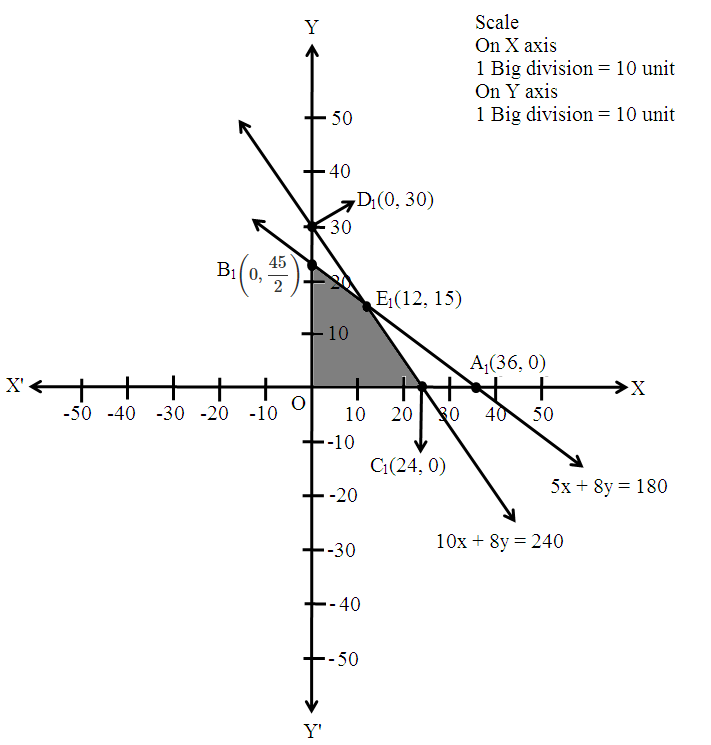
The line 5x + 8y = 180 meets the coordinate axes at $A_1(36,0)$ and $B_1(0, 452)$ respectively.
By joining these points we obtain the line 5x + 8y = 180.
Clearly, (0, 0) satisfies the 5x + 8y = 180.
So, the region which contains the origin represents the solution set of the inequation 5x + 8y ≤ 180.
Region represented by 10x + 8y ≤ 240:
The line 10x + 8y = 240 meets the coordinate axes at $C_1(24, 0)$ and $D_1(0, 30)$ respectively.
By joining these points we obtain the line 10x + 8y = 240.
Clearly (0, 0) satisfies the inequation 10x + 8y ≤ 240.
So, the region which contains the origin represents the solution set of the inequation 10x + 8y ≤ 240.
Region represented by x ≥ 0 and y ≥ 0:
Since, every point in the first quadrant satisfies these inequations.
So, the first quadrant is the region represented by the inequations x ≥ 0, and y ≥ 0.
The feasible region determined by the system of constraints 5x + 8y ≤ 180, 10x + 8y ≤ 240, x ≥ 0 and y ≥ 0 are as follows.
The feasible region is shown in the figure:

The corner points are $B_1(0, 452), E_1(12, 15)$ and $C_1(24,0)$.
The values of Z at the corner points are.
Corner points
Z = 50x + 60y
$O$
0
$B_1$
1350
$E_1$
1500
$C_1$
1200
The maximum value of Z is 1500 which is at $E_1(12, 15)$.
Thus, for maximum profit, 12 units of toy A and 15 units of toy B should be manufactured.
View full question & answer
Question 1045 Marks
A manufacturer makes two products A and B. Product A sells at Rs. 200 each and takes 1/2 hour to make. Product B sells at Rs. 300 each and takes 1 hour to make. There is a permanent order for 14 of product A and 16 of product B. A working week consists of 40 hours of production and weekly turnover must not be less than Rs 10000. If the profit on each of product A is Rs. 20 and on product B is Rs. 30, then how many of each should be produced so that the profit is maximum. Also, find the maximum profit.
Answer
Let x units of product A and y units of product B were manufactured.
Number of units cannot be negative.
Therefore, x, y ≥ 0
According to question, the given information can be tabulated as
 
Type A
Type B
Availability
Cutting (min)
5
8
3 × 60 + 20 = 200
Assembling (min)
10
8
4 × 60 = 240
Also, the availability of time is 40 hours and the revenue should be atleast Rs 10000.
Further, it is given that there is a permanent order for 14 units of product A and 16 units of product B.
Therefore, the constraints are
$200\text{x}+300\text{y}\geq10000$
$0.5\text{x}+\text{y}\leq40$
$\text{x}\geq14$
$\text{y}\geq16$
If the profit on each of product A is Rs 20 and on product B is Rs 30.Therefore, profit gained on x units of product A and y units of product B is Rs 20x and Rs 30y respectively.
Total profit = Z = 20x+30y which is to be maximised
Thus, the mathematical formulat​ion of the given linear programmimg problem is
Max Z = 20x + 30y
Subject to
$2\text{x}+3\text{y}\geq100$
$\text{x}+2\text{y}\leq80$
$\text{x}\geq14$
$\text{y}\geq16$
$\text{x},\text{y}\geq0$
First we will convert inequations into equations as follows:
2x + 3y = 100
x + 2y = 80
x = 14
y = 16
x = 0
y = 0
Region represented by 2x + 3y ≥ 100:
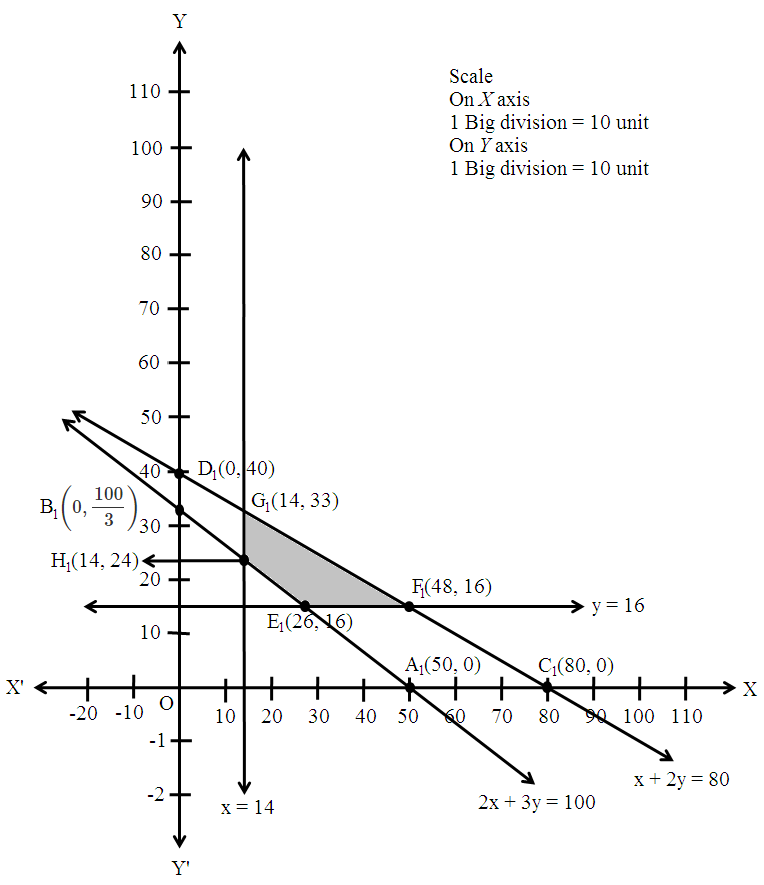
The line 2x + 3y = 100 meets the coordinate axes at $A_1(50, 0)$ and $\text{B}_1\Big(0,\frac{100}3{}\Big)$ respectively.
By joining these points we obtain the line 2x + 3y = 100.
Clearly (0, 0) does not satisfies the 2x + 3y = 100.
So, the region which does not contain the origin represents the solution set of the inequation 2x + 3y ≥ 100.
Region represented by x + 2y ≤ 80:
The line x + 2y = 80 meets the coordinate axes at $C_1(80, 0)$ and $D_1(0, 40)$ respectively.
By joining these points we obtain the line x + 2y = 80.
Clearly (0, 0) satisfies the inequation x + 2y ≤ 80.
So, the region which contains the origin represents the solution set of the inequation x + 2y ≤ 80.
Region represented by x ≥ 14
x = 14 is the line passes through (14, 0) and is parallel to the Y axis.
The region to the right of the line x = 14 will satisfy the inequation.
Region represented by y ≥ 16
y = 16 is the line passes through (0, 16) and is parallel to the X axis.
The region above the line y = 16 will satisfy the inequation.
Region represented by x ≥ 0 and y ≥ 0:
Since, every point in the first quadrant satisfies these inequations.
So, the first quadrant is the region represented by the inequations x ≥ 0, and y ≥ 0.
The feasible region determined by the system of constraints 2x + 3y ≥ 100, x + 2y ≤ 80, x ≥ 14, y ≥ 16, x ≥ 0 and y ≥ 0 are as follows.

The corner points of the feasible region are $E_1(26, 16), F_1(48, 16), G_1(14, 33)$ and $H_1(14, 24)$
The values of Z at these corner points are as follows.
Corner point
Z = 5x + 6y
$E_1$
1000
$F_1$
1440
$G_1$
1270
$H_1$ 1000
The maximum value of Z is Rs 1440 which is attained at $F_1(48, 16)$.
Thus, the maximum profit is Rs 1440 obtained when 48 units of product A and 16 units of product B were manufactured.
View full question & answer
Question 1055 Marks
An aeroplane can carry a maximum of 200 passengers. A profit of Rs. 400 is made on each first class ticket and a profit of Rs. 600 is made on each economy class ticket. The airline reserves at least 20 seats of first class. However, at least 4 times as many passengers prefer to travel by economy class to the first class. Determine how many each type of tickets must be sold in order to maximize the profit for the airline. What is the maximum profit.
Answer
Let required number of first class and economy class tickets be x and y respectively.
Each ticket of first class and economy class make profit of Rs. 400 and Rs. 600 respectively.
So, x ticket of first class and y tickets of economy class make profits of Rs. 400x and Rs. 600y respectively,
Let total profit be Z, so,
Z = 400x + 600y
Given, aeroplane can carry a maximum of 200 passengers, so
= x + y ≤ 200 (first constraint)
Given, airline reservesa at least 20 seats for first class, so,
= x ≥ 20 (second constraint)
Given, at least 4 times as many passengers prefer to travel by economy class to the first class, so,
y ≥ 4x
x = 4x - y ≤ 0 (third constraint)
Hence, mathematical formulation of LPP is find x and y which
maximize Z = 400x + 600y
Subject to constriants,
x + y ≤ 200
x ≥ 20
x = 4x - y ≤ 0
X, Y ≥ 0 [Since seats of both the classes can not be less than zero]
Region x + y ≤ 200:
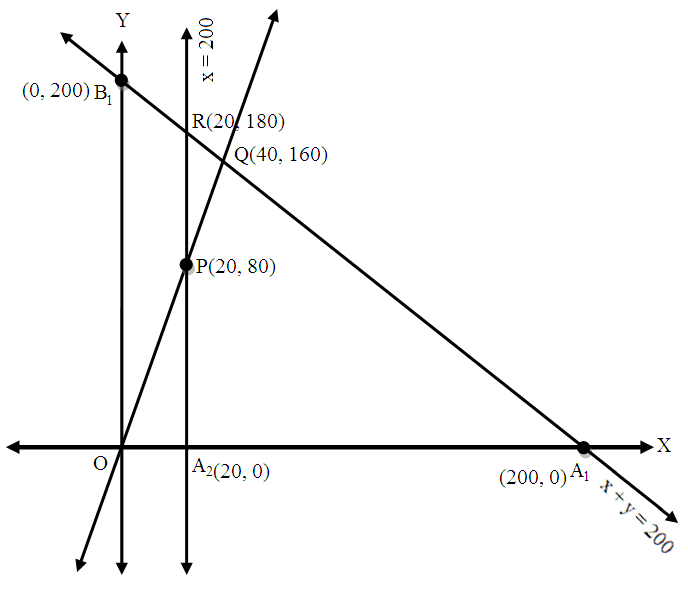
Line x + y = 200 meets axes at $A_1(200, 0), B_1(0, 200)$ respectively.
Region containing origin represents x + y ≤ 200 as (0, 0) satisfies x + y ≤ 200.

Shaded region POR represents feasible region. Q(40, 160) is obtained by solving x + y = 200 and 4x - y = 0, R(20, 180) is obtained by solving x = 20 and x + y = 200
The value of Z = 400x + 600y at
P(20, 80) = 400(20)+600 (80) = 56000
Q(40, 160) = 400(40) + 600(160) = 112000
R(20, 180) = 400(20) + 600(180) = 116000
So,
Maximum Z = Rs. 116000 at x = 20, y = 180
Number of first class ticket = 20,
Number of economy class ticket = 180
Maximum profit - Rs. 116000.
View full question & answer
Question 1065 Marks
Maximum $Z = 3x_1 + 5y_2$
Subject to
$\text{x}_1+3\text{x}_2\geq3$
$\text{x}_1+\text{x}_2\geq2$
$\text{x}_1,\text{x}_2\geq0$
Answer
First, we will convert the given inequations into equations, we obtain the following equations:
$X_1 + 3 x 2 = 3, x_1 + x_2 = 2, x_1 = 0$ and $x_2 = 0$
Region represented by $\text{x}_1+3\text{x}_2\geq3$:
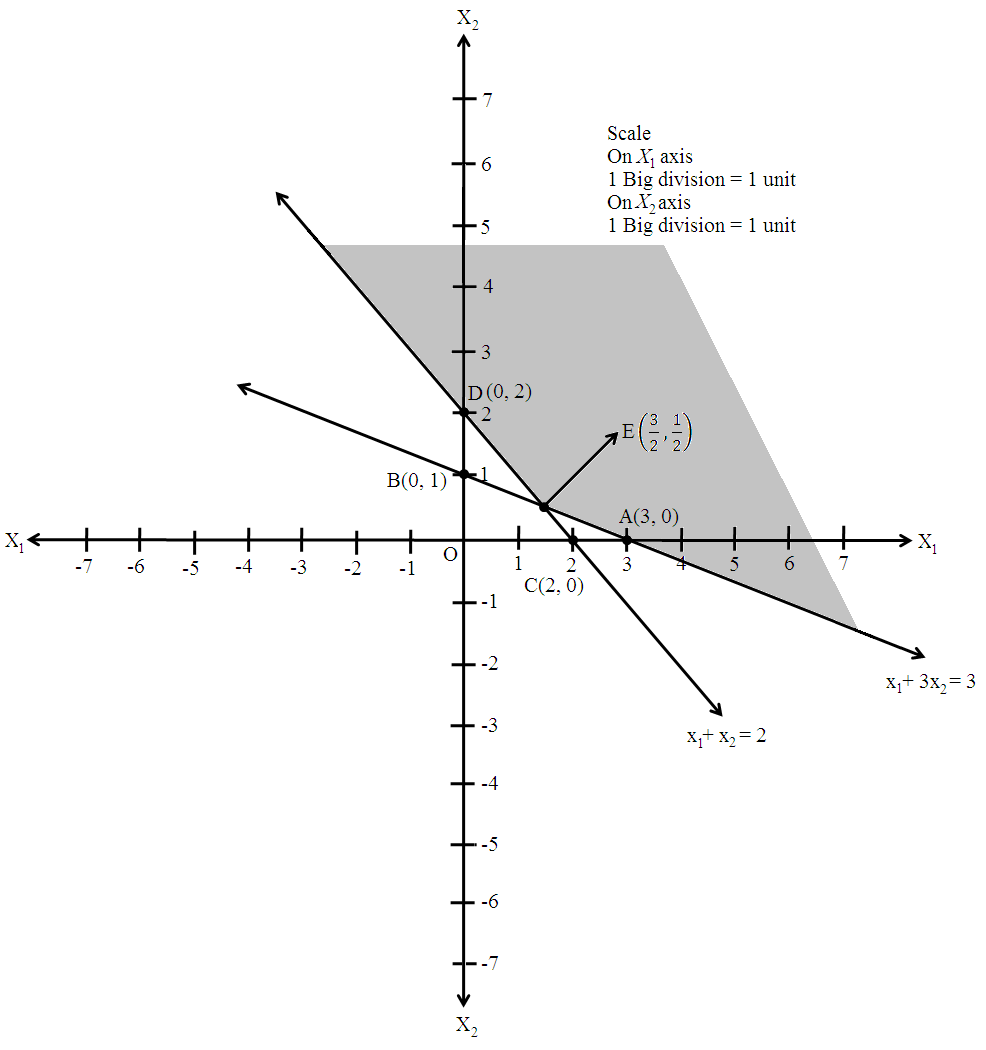
The line $x_1 + 3x_2 = 3$ meets the coordinate axes at A (3, 0) and B (0, 1) respectively.
By joining these points we obtain the line $\text{x}_1+3\text{x}_2\geq3$.
Clearly (0, 0) does not satisfies the inequation $\text{x}_1+3\text{x}_2\geq3$.
So, the region in the plane which does not contain the origin represents the solution set of the inequation $\text{x}_1+3\text{x}_2\geq3$.
Region represented by $\text{x}_1+\text{x}_2\geq2$:
The line $x_1 + x_2 = 2$ meets the coordinate axes at C(2, 0) and D(0, 2) respectively.
By joining these points we obtain the line $x_1 + x_2 = 2$.
Clearly (0, 0) does not satisfies the inequation $\text{x}_1+\text{x}_2\geq2$.
So, the region containing the origin represents the solution set of the inequation $\text{x}_1+\text{x}_2\geq2$.
Region represented by $\text{x}_1\geq0$ and $\text{x}_2\geq0$:
Since, every point in the first quadrant satisfies these inequations.
So, the first quadrant is the region represented by the inequations $\text{x}_1\geq0$ and $\text{x}_2\geq0$.
The feasible region determined by the system of constraints, $\text{x}_1+3\text{x}_2\geq3,\text{x}_1+\text{x}_2\geq2,\text{x}_1\geq0,$ and $\text{x}_2\geq0$, are as follows.

The corner points of the feasible region are O(0, 0), B(0, 1), $\text{E}\Big(\frac{3}{2} ,\frac{1}{2} \Big)$ and C(2, 0).
The value of Z at these corner points are as follows.
$\text{Corner point}$
$\text{Z}=3\text{x}_1+5\text{x}_2$
$\text{O}(0, 0)$
$3\times0+5\times0=0$
$\text{B}(0, 1)$
$3\times0+5\times1=5$
$\text{E}\Big(\frac{3}{2} ,\frac{1}{2} \Big)$
$3\times\frac{3}{2} +5\times\frac{1}{2} =7$
$\text{C}(2, 0)$
$3\times2+5\times0=6$
Therefore, the minimum value of Z is 0 at the point O(0, 0).
Hence, $X_1 = 0$ and $x_2 = 0$ is the optimal solution of the given LPP.
Thus, the optimal value of Z is 0.
View full question & answer
Question 1075 Marks
A company manufactures two types of novelty Souvenirs made of plywood. Souvenirs of type A require 5 minutes each for cutting and 10 minutes each for assembling. Souvenirs of type B require 8 minutes each for cutting and 8 minutes each for assembling. There are 3 hours 20 minutes available for cutting and 4 hours available for assembling. The profit is 50 paise each for type A and 60 paise each for type B souvenirs. How many souvenirs of each type should the company manufacture in order to maximize the profit?
Answer
Let the company manufacture x souvenirs of type A and y souvenirs of type B.

Therefore, $\text{x}\geq0$ and $\text{y}\geq0$ The given information can be complied in a table as follows.
 
Type A
Type B
Availability
Cutting (min)
5
8
3 × 60 + 20 = 200
Assembling (min)
10
8
4 × 60 = 240
The profit on type A souvenirs is Rs. 5 and on type B souvenirs is Rs. 6.

Therefore, the constraints are

$5\text{x}+8\text{y}\leq200$

$10\text{x}+8\text{y}\leq240$

i.e., $5\text{x}+4\text{y}\leq120$

Total profit, Z = 5x + 6y

The mathematical formulation of the given problem is

Maximize Z = 5x + 6y ... (1)

Subject to the constraints,

$5\text{x}+8\text{y}\leq200 \dots (2)$

$5\text{x}+4\text{y}\leq120\dots(3)$

$\text{x},\text{y}\geq0\dots(4)$

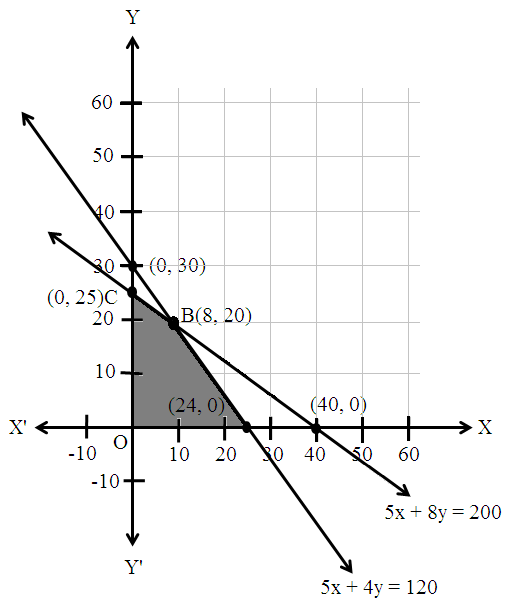
The feasible region determined by the system of constraints is as follows.


The corner point are A(24, 0), B(8, 20), and C(0, 25).

The values of Z at these corner points are as follows.
Corner point
Z = 5x + 6y
 
A(24, 0)
120
 
B(8, 20)
160
→ Maximum
C(0, 25)
150
 
The maximum value of Z is 200 at (8, 20).

Thus, 8 souvenirs of type A and 20 souvenirs of type B should be produced each day to get the maximum profit of Rs. 160.
View full question & answer
Question 1085 Marks
One kind of cake requires $300\ gm$ of flour and $15\ gm$ of fat, another kind of cake requires $150\ gm$ of flour and $30\ gm$ of fat. Find the maximum number of cakes which can be made from $7.5\ kg$ of flour and $600\ gm$ of fat, assuming that there is no shortage of the other ingradients used in making the cake. Make it as an $LPP$ and solve it graphically.
Answer
Let required number of cakes of type A and B arex and y respectively.
Let Z be total number of cakes, so,
$Z = x + y$
Since one unit of cake of type A and B contain 300gm and 150gm flour respectively, so, x unit of cake of type A and y units of cake of type B require 300x and 150y gms of flour respectivley, but maximum flour available is 7.5 x 1000 - 7500gm, so
$300\text{x}+150\text{y}\leq7500$
$2\text{x}+\text{y}\leq50$ (first constraint)
Since one unit of cake of type A and B contain 15 and 30gm fat respectively, so, x unit of cake of type A and y units of cake of type B contain 15x and 30y gms of fat respectivley, but maximum fat available is 600gm, so
$15\text{x}+300\text{y}\leq600$
$\text{x}+2\text{y}\leq40$ (second constraint)
Hence, mathematical formulation of LPP is,
Find x and y which maximize
$Z = x + y$
Subject to constriants,
$2\text{x}+\text{y}\leq50$
$\text{x}+2\text{y}\leq40$
$\text{x},\text{y}\geq0$ [Since number of cakes can not be less than zero]
Region $2\text{x}+\text{y}\leq50$:
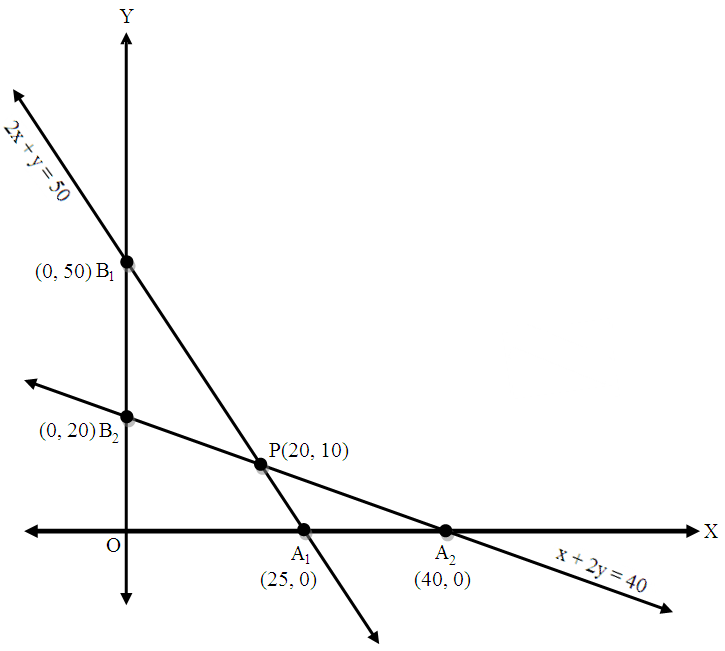
Line $2x + y = 50$ meets axes at $A_1(25, 0), B_1(0, 50)$ respectively.
Region containing origin represents $2\text{x}+\text{y}\leq50$ as (0, 0) satisfies 2x + y = 50.
Region $\text{x}+2\text{y}\leq40$:
Line $x + 2y = 40$ meets axes at $A_2(40, 0), B_2(0, 20)$ respectively.
Region containing origin represents $\text{x}+2\text{y}\leq40$ as (0, 0) satisfies $\text{x}+2\text{y}\leq40$.
Region $\text{x},\text{y}\geq0$:
It represent first quandrant.
Shaded region $OA_1PB_2$​​​​​​​ represents feasible region.
Point $P(20, 10)$ is obtained by solving $x + 2y = 40$ and $2x + y = 50$​​​​​​​

The value of $Z = x +y$ at
$O(0, 0) = 0 + 0 = 0$
$A_1(25, 0) = 25 + 0 = 25$
$P(20, 10) = 20 + 10 = 30$
$B_2(0, 20) = 0 + 20 = 20$
maximum $Z = 30$ at $x = 20, y = 10$
Number of books of type $A = 20$, type $B = 10$
View full question & answer
Question 1095 Marks
Solve the following LPP graphically:
Manimize Z = 6x + 3y
Subject to the constraints:
$4\text{x}+\text{y}\geq80$
$\text{x}+5\text{y}\geq115$
$3\text{x}+2\text{y}\leq150$
$\text{x}\geq0,\text{y}\geq0$
Answer
The given contraints are:
$4\text{x}+\text{y}\geq80$
$\text{x}+5\text{y}\geq115$
$3\text{x}+2\text{y}\leq150$
$\text{x}\geq0,\text{y}\geq0$
Converting the given inequation into equation, we get
4x + y = 80, x + 5y = 115, 3x + 2y = 150, x = 0 and y = 0
These lines are drawn on the graph and the shaded region ABC represents the feasible region of the given LPP.

It can be observed that the feasible region is bounded.
The coordinates of the corner points of the feasible region are A(2, 72), B(15, 20), and C(40, 15).
The values of the objective function, Z at these corner points are given in the following table:
Corner point Value of the objective Function Z = 6x + 3y
A(2, 72) Z = 6 × 2 + 3 × 72 = 228
B(15, 20) Z = 6 × 15 + 3 × 20 = 150
C(40, 15) Z = 6 × 40 + 3 × 15 = 150
From the table, Z is manimum at x = 15 and y = 20 and the manimum value of Z is 150.
Thus, the manimum value of Z is 150.
View full question & answer
Question 1105 Marks
Maximum $Z = 10x + 6y$
Subject to
$3\text{x}+\text{y}\leq12$
$2\text{x}+5\text{y}\leq34$
$\text{x},\text{y}\geq0$
Answer
Converting the given inequations in to equations.
$3x + y = 12, 2x + 5y = 34, x = y = 0$


Region represented by $3\text{x}+\text{y}\leq12$:
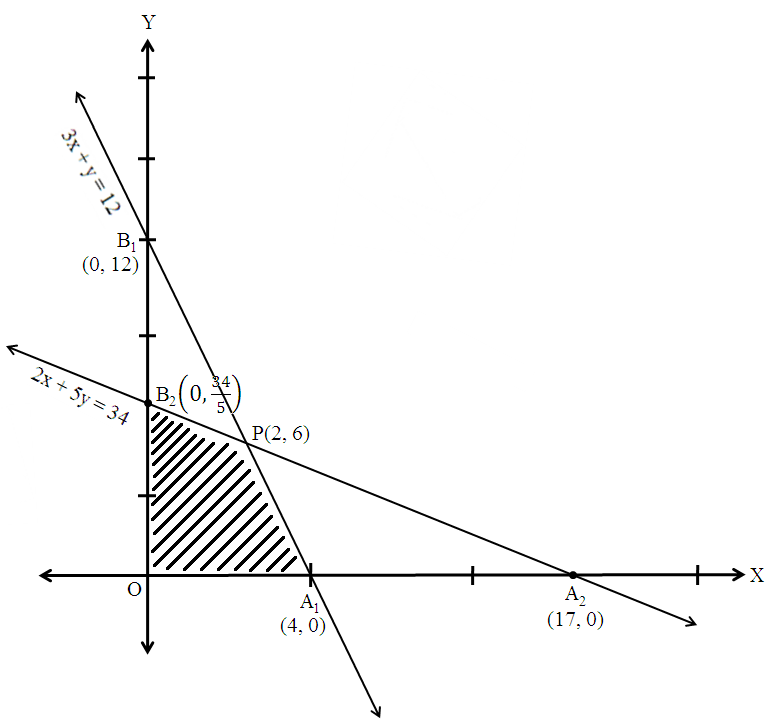
Line $3x + y = 12$ meets the coordinate axes at $A_1(4, 0)$ and $B(0, 12)$, clearly, $(0, 0)$ satisfies $3\text{x}+\text{y}\leq12$, so, region containing origin is represented by $3\text{x}+\text{y}\leq12$ in xy-plane.
Region represented by $2\text{x}+5\text{y}\leq34$:
Line $2x +y = 34$ meets coordinate axes at $A_2$_$(17, 0)$ and $\text{B}\Big(0,\frac{34}{5}\Big)$ clearly, $(0, 0)$ satisfies the $2\text{x}+5\text{y}\leq34$ so, region containing origin represents $2\text{x}+5\text{y}\leq34$ in xy-plane.
Region represented by $\text{x},\text{y}\geq0$:
It represent the first quadrant in xy-plane
Therefore, shaded area $OA_1PB_2$ is the feasible region.
The coordinate of $P(2, 6)$ is obtained by solving $2x + 5y = 34$ and $3x + y = 12$
The value of $Z = 10x + 6y at$
$\text{O}(0, 0) = 10(0) + 6(0) = 0$
$\text{A}_1(4, 0) = 10(4) + 6(0) = 40$
$\text{P}(2, 6) = 10(2) + 6(6) = 56$
$\text{B}_2\Big(0,\frac{34}{5}\Big)=10(0)+6\Big(\frac{34}{5}\Big)=\frac{204}{5}=40\frac{4}{5}$
Hence, maximum $Z = 56 at x = 2, y = 6.$
View full question & answer
Question 1115 Marks
Maximize $Z = 9x + 3y$
Subject to
$2\text{x}+3\text{y}\leq13$
$3\text{x}+\text{y}\leq5$
$\text{x},\text{y}\geq0$
Answer
Coverting the given inequation into equations, we get
$2x + 3y = 13, 3x + y = 5 and x = 0, y = 0$


Region represented by $2\text{x}+3\text{y}\leq13:$
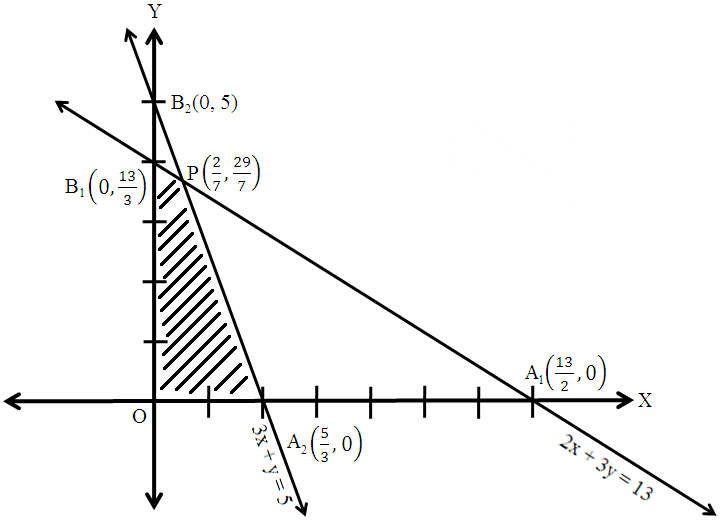
The line meets coordinate axes at $\text{A}_1\Big(\frac{13}{2},0\Big)$ and $\text{B}_1\Big(0,\frac{13}{3}\Big)$ respectively.
Join these points to obtain the line $2x + 3y = 13,$ clearly, $(0,0)$ satisfies the in eqation $2\text{x}+3\text{y}\leq13$, so, the region in xy-plane that contains origin represents the solution set of $2\text{x}+3\text{y}\leq13$.
Region represented by $3\text{x}+\text{y}\leq5:$
The line meets coordinate axes at $\text{A}_2\Big(\frac{5}{3},0\Big)$ and $B_2(0, 5)$ respectively.
Join these points to obtain the line $3x + y = 5$, clearly, $(0, 0)$ satisfies the in eqation $3\text{x}+\text{y}\leq5$, so, the region in xy-plane that contains origin represents the solution set of $3\text{x}+\text{y}\leq5$.
Region represented by $\text{x},\text{y}\geq0:$
It clearly represent first quadrant of xy-plane.
The common region to regions represented by above in equalities.
The coordinates of the corner points of the shaded region are $\text{O}(0,0),\text{A}\Big(\frac{5}{3},0\Big),\text{P}\Big(\frac{2}{7},\frac{29}{7}\Big),\text{B}_2\Big(0,\frac{13}{3}\Big)$.
The value of $Z = 9x + 3y at$
$\text{O}(0,0)=9(0)+3(0)=0$
$\text{A}_1\Big(\frac{5}{3},0\Big)=9\Big(\frac{5}{3}\Big)+3(0)=15$
$\text{P}\Big(\frac{2}{7},\frac{29}{7}\Big)=9\Big(\frac{2}{7}\Big)+3\Big(\frac{29}{7}\Big)=15$
$\text{B}_2\Big(0,\frac{13}{3}\Big)=9(0)+3\Big(\frac{13}{3}\Big)=13$
Clearly, $Z$ is maximum at every point on the line joining $A_1$​​​​​​​​​​​​​​ and $P$, So
$\text{x}=\frac{2}{7}$ or $\frac{2}{7}$, $\text{y}=0$ or $\frac{29}{7}$
and maximum $Z = 15.$
View full question & answer
Question 1125 Marks
Maximum Z = 3x + 4y
Subject to
$2\text{x}+2\text{y}\leq80$
$2\text{x}+4\text{y}\leq120$
Answer
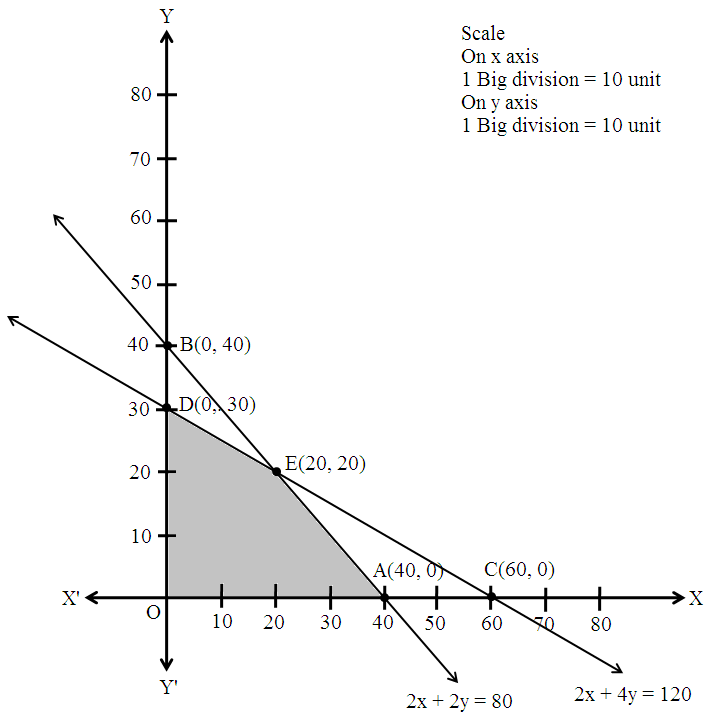
We have to maximize Z = 3x + 4y First, we will convert the given inequations into equations, we obtain the following equations: 2x + 2y = 80, 2x + 4y = 120 Region represented by 2x + 2y ≤ 80: The line 2x + 2y = 80 meets the coordinate axes at A(40, 0) and B(0, 40) respectively. By joining these points we obtain the line 2x + 2y = 80. Clearly (0, 0) satisfies the inequation 2x + 2y ≤ 80. So,the region containing the origin represents the solution set of the inequation 2x + 2y ≤ 80. Region represented by 2x + 4y ≤ 120: The line 2x + 4y = 120 meets the coordinate axes at C(60, 0) and D(0, 30) respectively. By joining these points we obtain the line 2x + 4y ≤ 120. Clearly (0, 0) satisfies the inequation 2x + 4y ≤ 120. So,the region containing the origin represents the solution set of the inequation 2x + 4y ≤ 120. The feasible region determined by the system of constraints, 2x + 2y ≤ 80, 2x + 4y ≤ 120 are as follows:
The corner points of the feasible region are O(0, 0), A(40, 0), E(20, 20) and D(0, 30). The values of Z at these corner points are as follows:
Corner point
Z = 3x +4y
O(0, 0)
3 × 0 + 4 × 0 = 0
A(40, 0)
3 × 40 + 4 × 0 = 120
E(20, 20)
3 × 20 + 4 × 20 = 140
D(0, 30)
10 × 0 + 4 × 30 = 120
We see that the maximum value of the objective function Z is 140 which is at E(20, 20) that means at x = 20 and y = 20. Thus, the optimal value of Z is 140.
View full question & answer
Question 1135 Marks
Maximize Z = 5x + 3y
Subject to
$3\text{x}+5\text{y}\leq15$
$5\text{x}+2\text{y}\leq10$
$\text{x},\text{y}\geq0$
Answer
First, we will convert the given inequations into equations, we obtain the following equations:

3x + 5y = 15, 5x + 2 y = 10, x = 0 and y = 0

Region represented by $3\text{x}+5\text{y}\leq15:$

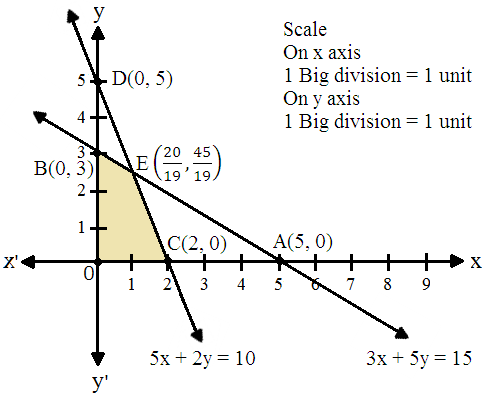
The line 3x + 5y = 15 meets the coordinate axes at A(5, 0) and B(0, 3) respectively.

By joining these points we obtain the line 3x + 5y = 15.

Clearly (0, 0) satisfies the inequation $3\text{x}+5\text{y}\leq15$.

So, the region containing the origin represents the solution set of the inequation $3\text{x}+5\text{y}\leq15$.

Region represented by $5\text{x}+2\text{y}\leq10:$

The line 5x + 2y = 10 meets the coordinate axes at C(2, 0) and D(0, 5) respectively.

By joining these points we obtain the line 5x + 2y = 10.

Clearly (0, 0) satisfies the inequation $5\text{x}+2\text{y}\leq10$.

So, the region containing the origin represents the solution set of the inequation $5\text{x}+2\text{y}\leq10$.

Region represented by $\text{x}\geq0$ and $\text{y}\geq0:$

Since, every point in the first quadrant satisfies these inequations.

So, the first quadrant is the region represented by the inequations $\text{x}\geq0$, and $\text{y}\geq0$.

The feasible region determined by the system of constraints, $3\text{x}+5\text{y}\leq15,5\text{x}+2\text{y}\leq10,\text{x}\geq0$ and $\text{y}\geq0$,are as follows.

View full question & answer
Question 1145 Marks
A small firm manufactures necklaces and bracelets. The total number of necklaces and bracelets that it can handle per day is at most 24. It takes one hour to make a bracelet and half an hour to make a necklace. The maximum number of hours available per day is 16. If the profit on a necklace is Rs. 100 and that on a bracelet is Rs. 300. Formulate on L.P.P. for finding how many of each should be produced daily to maximize the profit?
It is being given that at least one of each must be produced.
Answer
Let the number of necklaces manufacture be x, and the number of bracelets manufacture be y.

Since the total number of items are at most 24.

$\text{x}+\text{y}\leq24\ ....(1)$

Bracelets takes 1 hour to manufacture and necklaces takes half an hour to manufacture.

x item takes x hour to manufacture and y items take y/2 hour to manufacture and maximum time available is 16 hours. therefore

$\text{x}_2+\text{y}\leq16\ ....(2)$

the profit on one necklace is Rs. 100 and the profit on one bracelet is Rs. 300

Let the profit be Z.

Now we wish to maximize the profit.

So,

Max Z = 100x + 300y ....(3)

So,

$\text{x}+\text{y}\leq24$

$\text{x}_2+\text{y}\leq16$

Max Z = 100x + 300 is the required L.P.P.
View full question & answer
Question 1155 Marks
Solve the following LPP graphically:
Maximize Z = 20x + 10y
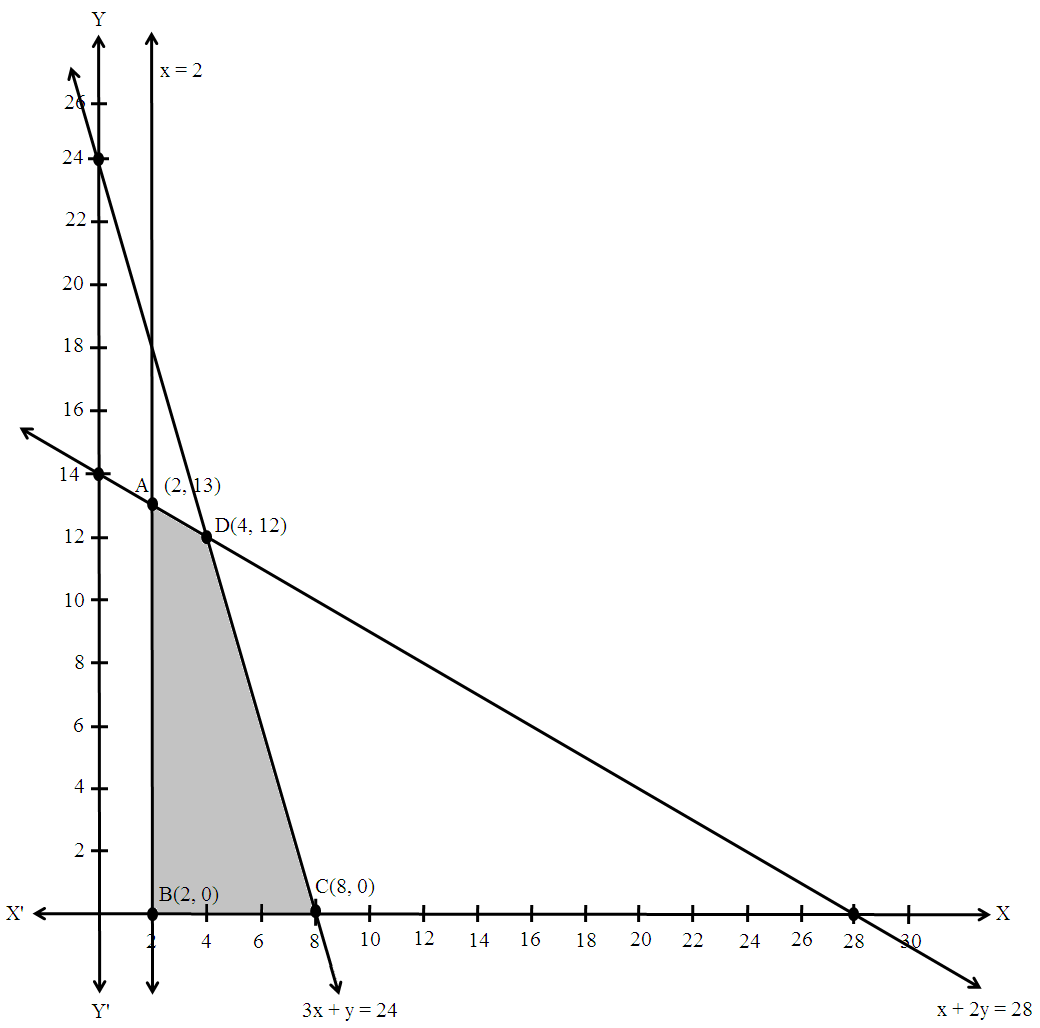
Subject to the following constraints
$\text{x}+2\text{y}\leq28$
$3\text{x}+\text{y}\leq24$
$\text{x}\geq2$
$\text{x},\text{y}\geq0$
Answer
The given contraints are:
$\text{x}+2\text{y}\leq28$
$3\text{x}+\text{y}\leq24$
$\text{x}\geq2$
$\text{x},\text{y}\geq0$
Converting the given inequation into equation, we get
x + 2y = 28, 3x + y = 24, x = 2 and y = 0
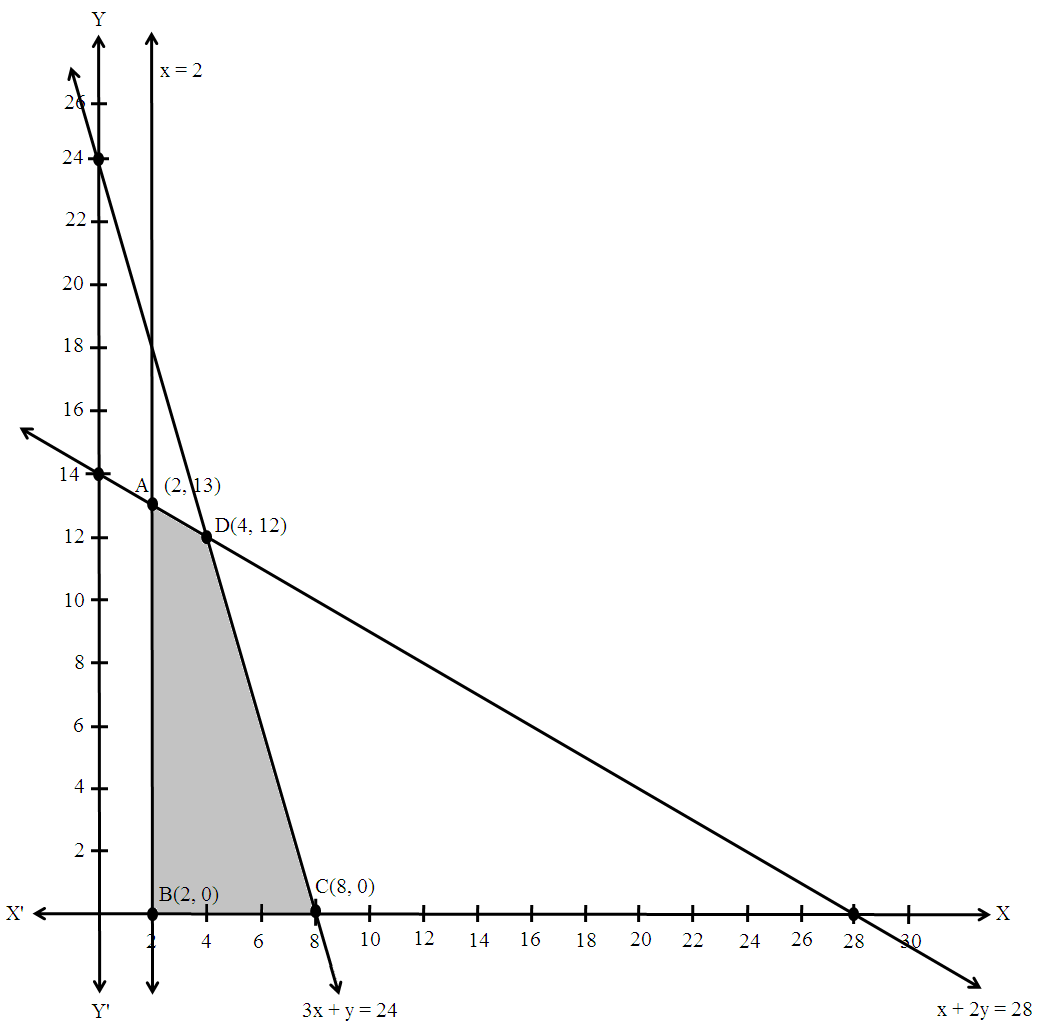
These lines are drawn on the graph and the shaded region ABCD represents the feasible region of the given LPP.

It can be observed that the feasible region is bounded.
The coordinates of the corner points of the feasible region are A(2, 13), B(2, 0), C(4, 12) and D(8, 0).
The values of the objective function, Z at these corner points are given in the following table:
Corner point Value of the objective Function Z = 20x + 10y
A(2, 13) Z = 20 × 2 + 10 × 13 = 170
B(2, 0) Z =20 × 2 + 10 × 0 = 40
C(8, 0) Z = 20 × 8 + 10 × 0 = 160
D(4, 12) Z = 20 × 4 + 10 × 12 = 200
From the table, Z is maximum at x = 4 and y = 12 and the maximum value of Z is 200.
Thus, the maximum value of Z is 200.
View full question & answer
Question 1165 Marks
Maximum Z = 15x + 10y
Subject to
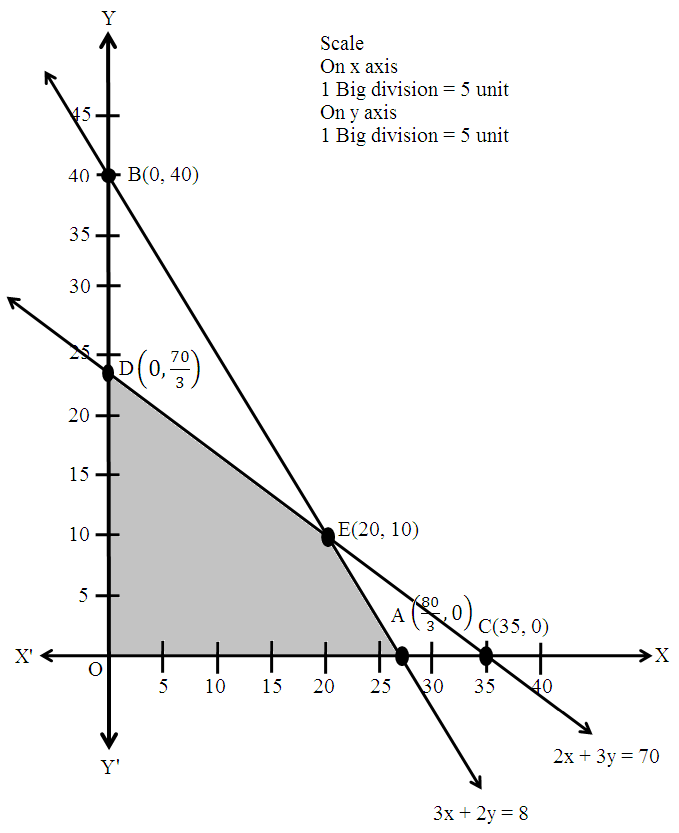
$3\text{x}+2\text{y}\leq80$
$2\text{x}+3\text{y}\leq70$
$\text{x},\text{y}\geq0$
Answer
First, we will convert the given inequations into equations, we obtain the following equations:

3x + 2y = 80, 2x + 3y = 70, x = 0 and y=0

Region represented by $3\text{x}+2\text{y}\leq80:$

The line 3x + 2y = 80 meets the coordinate axes at $\text{A}\Big(\frac{80}{3},0\Big)$ and B(0, 40) respectively.

By joining these points we obtain the line 3x + 2y = 80.

Clearly (0,0) satisfies the inequation $3\text{x}+2\text{y}\leq80$.

So, the region containing the origin represents the solution set of the inequation $3\text{x}+2\text{y}\leq80$.

Region represented by $2\text{x}+3\text{y}\leq70:$

The line 2x + 3y = 70 meets the coordinate axes at C(35, 0) and $\text{D}\Big(0,\frac{70}{3}\Big)$ respectively.

By joining these points we obtain the line $2\text{x}+3\text{y}\leq70$.

Clearly (0,0) satisfies the inequation $2\text{x}+3\text{y}\leq70$.

So, the region containing the origin represents the solution set of the inequation $2\text{x}+3\text{y}\leq70$.

Region represented by $\text{x}\geq0$ and $\text{y}\geq0$.

Since, every point in the first quadrant satisfies these inequations.

So, the first quadrant is the region represented by the inequations $\text{x}\geq0$ and $\text{y}\geq0$.

The feasible region determined by the system of constraints $3\text{x}+2\text{y}\leq80$, $2\text{x}+3\text{y}\leq70$, $\text{x}\geq0$ and $\text{y}\geq0$ are as follows.


The corner points of the feasible are O(0, 0), $\text{A}\Big(\frac{80}{3},0\Big)\text{E}(20,10)$ and $\text{D}\Big(0,\frac{700}{3}\Big)$ .

The values of Z at these corner point are as follows.
$\text{Corner point}$
$\text{Z}=15\text{x}+10\text{y}$
$\text{O}(0, 0)$
$15\times0+10\times0=0$
$\text{A}\Big(\frac{80}{3},0\Big)$
$15\times\frac{80}{3}+10\times0=400$
$\text{E}(20, 10)$
$15\times20+10\times10=400$
$\text{D}\Big(0,\frac{70}{3}\Big)$
$15\times0+10\times\frac{70}{3}=\frac{700}{3}$
We see that maximum value of the objective functioin Z is 400 which is at $\text{A}\Big(\frac{80}{3},0\Big)$ and E(20, 10).

Thus, the optimal value of Z is 400.
View full question & answer