Questions · Page 1 of 2

1 Marks Question

🎯

Test yourself on this topic

50 questions · timed · auto-graded

Question 11 Mark
An electronic assembly consists of two subsystems, say, $A$ and $B.$ From previous testing procedures, the following probabilities are assumed to be known:
$P(A$ fails$) = 0.2$
$P(B$ fails alone$) = 0.15$
$P(A$ and $B$ fail$) = 0.15$
Evaluate the following probabilities $P(A$ fails alone$).$
Answer
Let us define events;
$A : A$ fails. and $B: B$ fails.
Given: $P (A) = 0.2$
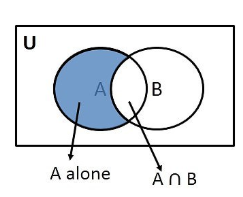
Event failed by both, $P\left(A \cap B\right) = 0.15$
We have,
$P(A$ fails alone$) = P(A) - P\left(A \cap B\right)$
$= 0.2 - 0.15$
$= 0.05$
View full question & answer
Question 21 Mark
An electronic assembly consists of two subsystems, say, $A$ and $B.$ From previous testing procedures, the following probabilities are assumed to be known:
$P(A$ fails$) = 0.2$
$P(B$ fails alone$) = 0.15$
$P(A$ and $B$ fail$) = 0.15$
Evaluate the following probabilities $P(A$ fails $B$ has failed$).$
Answer
Let's define events;
$E_{A }: A$ fails
$E_{B }: B$ fails
Given that:
Event failed by $A, P(E_A) = 0.2$
Event failed by both, $P\left(E_{A} \cap E_{B}\right) = 0.15$
And, event failed by B alone = $P\left(E_{B}\right)-P\left(E_{A} \cap E_{B}\right)$
$0.15 = P (E_B) - 0.15$
$\therefore P (E_B) = 0.30$
Therefore, $P\left(E_{A} | E_{B}\right)=\frac{P\left(E_{A} \cap E_{B}\right)}{P\left(E_{B}\right)}$
$= \frac{0.15}{0.3}$
$= 0.5$
Which is the required solution.
View full question & answer
Question 31 Mark
If each element of a second order determinant is either zero or one, what is the probability that the value of the determinant is positive? $($Assume that the individual entries of the determinant are chosen independently, each value being assumed with probability $\frac{1}{2}).$
Answer
There are four entries in a determinant of $2 \times 2$ order. Each entry may be filled up in two ways with $0$ or $1.$
$\therefore $ Number of determinants that can be formed $= 2^4 = 16$
The value of determinants is positive in the following cases:
$\left| {\begin{array}{*{20}{c}} 1&0 \\ 0&1 \end{array}} \right|,\left| {\begin{array}{*{20}{c}} 1&0 \\ 1&1 \end{array}} \right|,\left| {\begin{array}{*{20}{c}} 1&1 \\ 0&1 \end{array}} \right| = 3$
Therefore, the probability that the determinant is positive $ = \frac{3}{{16}}$
View full question & answer
Question 41 Mark
If a leap year is selected at random, what is the chance that it will contain 53 tuesdays?
Answer
We know that, in a leap year there are total 366 days, 52 weeks and 2 days.
Now, in 52 weeks there are total 52 Tuesdays.
$\therefore$ Probability that the leap year will contain 53 Tuesdays is equal to the probability of remaining 2 days will be Tuesdays.
Thus, the remaining two days can be:
(Monday and Tuesday), (Tuesday and Wednesday), (Wednesday and Thursday), (Thursday and Friday), (Friday and Saturday), (Saturday and Sunday) and (Sunday and Monday)
$\therefore$ Total Number of cases = 7
Cases in which Tuesday can come = 2
Hence, probability (leap year having 53 Tuesdays) = $\frac{2}{7}$
View full question & answer
Question 51 Mark
If A and B are any two events such that P(A) + P(B) - P(A and B) = P(A), then
Answer
It is given in the question that,
A and B are any two events where,
P(A) + P(B) - P(A and B) = P(A)
P(A) + P(B) - P(A $\cap$ B) = P(A)
P(A $\cap$ B)  = P(B)
$\therefore P(A | B)=\frac{P(A \cap B)}{P(B)}$ = 1
View full question & answer
Question 61 Mark
If P(A|B) > P(A), then which of the following is correct :
Answer
It is given in the question that,
P (A|B) > P (A)
$\therefore \frac{P(A \cap B)}{P(B)}>P(A)$ 
$P(A \cap B)>P(A) \cdot P(B)$ 
$\frac{P(A \cap B)}{P(A)}>P(B)$ 
P(B|A) > P (B)
View full question & answer
Question 71 Mark
A and B are two events such that P (A) $\ne$ 0. Find P(B|A), if $A \cap B=\phi$.
Answer
Given that $A \cap B = \phi \Rightarrow P(A \cap B)=0$ 
$\therefore P(B | A)=\frac{P(A \cap B)}{P(A)} = 0$ 
View full question & answer
Question 81 Mark
If A and B are two events such that P(A) $\ne$ 0 and P(B|A) = 1, then
Answer
It is given in the question that,
A and B are two events where,
p(A) $\ne$ 0
And, P (B|A) = 1
$\therefore P(B | A)=\frac{P(B \cap A)}{P(A)}$ 
$1=\frac{P(B \cap A)}{P(A)}$ 
p(A) = p(B $\cap$ A)
$\therefore A \subset B$
View full question & answer
Question 91 Mark
A factory has two machines A and B. Past record shows that machine A produced 60% of the items of output and machine B produced 40% of the items. Further, 2% of the items produced by machine A and 1% produced by machine B were defective. All the items are put into one stockpile and then one item is chosen at random from this and is found to be defective. What is the probability that it was produced by machine B?
Answer
Given: P(A) = $\frac{{60}}{{100}}$,  P(B) = $\frac{{40}}{{100}}$
Let D denotes a defective item :
$\therefore $ P(D|A) = $\frac{2}{{100}}$and P(D|B) $ = \frac{1}{{100}}$
P(B|D) =$\frac{{P\left( B \right)P\left( {D|B} \right)}}{{P\left( A \right)P\left( {D|A} \right) + P\left( B \right)P\left( {D|B} \right)}}$
=$\frac{{\frac{{40}}{{100}} \times \frac{1}{{100}}}}{{\frac{{60}}{{100}} \times \frac{2}{{100}} + \frac{{40}}{{100}} \times \frac{1}{{100}}}}$
=$\frac{{40}}{{120 + 40}} = \frac{{40}}{{160}} = \frac{1}{4}$
View full question & answer
Question 101 Mark
If A and B are two events such that A ⊂ B and P(B) ≠ 0, then which of the following is correct?
Answer
Since, $\space A\subset{B},\space\space \space A\cap{B} =A$

$P(A/B) =\frac{P(A\cap{B})}{P(B)} =\frac{P(A)}{P(B)}$

View full question & answer
Question 111 Mark
Let A and B be independent events with P(A) = 0.3 and P(B) = 0.4. Find P(B|A)
Answer
Given: P(A) = 0.3 and P(B) = 0.4
Two events A and B are independent if  $P(A \cap B)=P(A) . P(B) = 0.12$
As we know $P(B | A)=\frac{P(A \cap B)}{P(A)}$ 
$\Rightarrow P(B | A)=\frac{0.12}{0.3}$ 
$\Rightarrow$ P(B|A) = 0.4
View full question & answer
Question 121 Mark
Let A and B be independent events with P(A) = 0.3 and P(B) = 0.4. Find P(A|B)
Answer
Given: P(A) = 0.3 and P(B) = 0.4
Two events A and B are independent if $ P(A \cap B)=P(A) . P(B)$
$\Rightarrow P(A \cap B) = 0.12$
As we know $P(A | B)=\frac{P(A \cap B)}{P(B)}$ 
$\Rightarrow P(A | B)=\frac{0.12}{0.4}$ 
$\Rightarrow$ P (A|B) = 0.3
View full question & answer
Question 131 Mark
Let A and B be independent events with P(A) = 0.3 and P(B) = 0.4. Find P(A $\cup$ B)
Answer
Given: P(A) = 0.3 and P(B) = 0.4
As we know, P (A $\cup$ B) = P(A) + P(B) - P (A $\cap$ B)
Since events are independent so P (A $\cap$ B) = 0. Therefore,
 P (A $\cup$ B) = 0.3 + 0.4
⇒ P (A $\cup$ B) = 0.7
View full question & answer
Question 141 Mark
Let A and B be independent events with P(A) = 0.3 and P(B) = 0.4. Find P(A $\cap$ B)
Answer
Given: P(A) = 0.3 and P(B) = 0.4
When A and B are independent.
$\Rightarrow$ P (A $\cap$ B) = P(A) . P(B)
$\Rightarrow P(A \cap B)=0.3 \times 0.4$ 
$\Rightarrow$ P (A $\cap$ B) = 0.12
View full question & answer
Question 151 Mark
Given that the events A and B are such that P(A) = $\frac{1}{2}$, $P(A \cup B)=\frac{3}{5}$ and P(B) = p.
Find p if they are independent.
Answer
Given: P(A) = $\frac{1}{2}$, P(A $\cup$ B) = $\frac{3}{5}$ and P(B) = p
When A and B are independent.
$\Rightarrow P(A \cap B)=P(A) \cdot P(B)$ 
$\Rightarrow P(A \cap B)=\frac{1}{2} \cdot p$ 
As we know, P (A $\cup$ B) = P(A) + P(B) - P (A $\cap$ B)
$\Rightarrow \frac{3}{5}=\frac{1}{2}+p-\frac{p}{2}$ 
$\Rightarrow \frac{p}{2}=\frac{3}{5}-\frac{1}{2}$ 
$\Rightarrow \mathrm{p}=2 \times \frac{1}{10}=\frac{1}{5}$
View full question & answer
Question 161 Mark
Given that the events A and B are such that P(A) = $\frac{1}{2}$, $P(A \cup B)=\frac{3}{5}$ and P(B) = p.
Find p if they are mutually exclusive.
Answer
Given: P(A) = $\frac{1}{2}$, P(A $\cup$ B) = $\frac{1}{5}$ and P(B) = p
When A and B are mutually exclusive,
$\Rightarrow (A \cap B)=\phi$ 
$\Rightarrow P(A \cap B)=0$ 
As we know, P (A $\cup$ B) = P(A) + P(B) - P (A $\cap$ B)
$\Rightarrow \frac{3}{5}=\frac{1}{2}+p-0$ 
$\Rightarrow \mathrm{p}=\frac{3}{5}-\frac{1}{2}=\frac{1}{10}$
View full question & answer
Question 171 Mark
Two events A and B will be independent, if
Answer
Two events A and B will be independent, then $P(A\cap{B}) =P(A).P(B)$

 $P(A'\cap{B' })=P(AUB)' = 1- P(AUB) \\=1-P(A)-P(B)-P(A).P(B) \\=[1-P(A)][1-P(B)]=P(A').P(B')$

View full question & answer
Question 181 Mark
The probability of obtaining an even prime number on each die, when a pair of dice is rolled is:
Answer
Clearly, n(s) = 36. Favourable cases are {2, 2} Therefore required probability = $\frac{1}{36}$
View full question & answer
Question 191 Mark
In a hostel, 60% of the students read Hindi newspaper, 40% read English newspaper and 20% read both Hindi and English newspapers. A student is selected at random. If she reads English newspaper, find the probability that she reads Hindi newspaper.
Answer
Let H and E denote the number of students who read Hindi and English newspaper respectively.
Hence, P(H) = Probability of students who read Hindi newspaper = $\frac{60}{100}=\frac{3}{5}$ 
P(E) = Probability of students who read English newspaper = $\frac{40}{100}=\frac{2}{5}$ 
P (H $\cap$ E) = Probability of students who read Hindi and English both newspaper = $\frac{20}{100}=\frac{1}{5}$ 
P (H|E) = English newspaper reading has already occurred and the probability that she reads Hindi newspaper is to find.
As we know $P(H | E)=\frac{P(H \cap E)}{P(E)}$ 
$\Rightarrow \mathrm{P}(\mathrm{H} | \mathrm{E})=\frac{\frac{1}{5}}{\frac{2}{5}}=\frac{1}{5} \times \frac{5}{2}$ 
$\Rightarrow P(H | E)=\frac{1}{2}$
View full question & answer
Question 201 Mark
In a hostel, 60% of the students read Hindi newspaper, 40% read English newspaper and 20% read both Hindi and English newspapers. A student is selected at random. If she reads Hindi newspaper, find the probability that she reads English newspaper.
Answer
Let H and E denote the number of students who read Hindi and English newspaper respectively.
Hence, P(H) = Probability of students who read Hindi newspaper = $\frac{60}{100}=\frac{3}{5}$
P(E) = Probability of students who read English newspaper = $\frac{40}{100}=\frac{2}{5}$ 
P (H $\cap$ E) = Probability of students who read Hindi and English both newspaper = $\frac{20}{100}=\frac{1}{5}$ 
P (E|H) = Hindi newspaper reading has already occurred and the probability that she reads English newspaper is to find.
As we know $P(E | H)=\frac{P(H \cap E)}{P(H)}$ 
$\Rightarrow P(E | H)=\frac{\frac{1}{5}}{\frac{2}{5}}=\frac{1}{5} \times \frac{5}{3}$ 
$\Rightarrow P(E | H)=\frac{1}{3}$
View full question & answer
Question 211 Mark
In a hostel, 60% of the students read Hindi newspaper, 40% read English newspaper and 20% read both Hindi and English newspapers. A student is selected at random. Find the probability that she reads neither Hindi nor English newspapers.
Answer
Given: Let H and E denote the number of students who read Hindi and English newspaper respectively.
Hence, P(H) = $\frac{60}{100}=\frac{3}{5}$  and P(E) = $\frac{40}{100}=\frac{2}{5}$ 
P (H $\cap$ E) = Probability of students who read Hindi and English both newspaper = $\frac{20}{100}=\frac{1}{5}$ 
We need to find the Probability that she reads neither Hindi nor English newspapers.
$\begin{equation} \text { i.e. } P\left(H^{\prime} \cap E^{\prime}\right) \end{equation}$
Where, $ ~P\left(H^{\prime} \cap E^{\prime}\right)=1- $Probability that she reads both the newspapers.
= 1 - P (H $\cup$ E)
= 1- [P(H) + P(E) - P (H $\cap$ E)]
= $1-\left[\frac{3}{5}+\frac{2}{5}-\frac{1}{5}\right]$ 
= $1-\left[\frac{4}{5}\right]=\frac{1}{5}$
View full question & answer
Question 221 Mark
One card is drawn at random from a well shuffled deck of 52 cards.
In which of the following cases are the events E and F independent?
E: the card drawn is a king or queen
F: the card drawn is a queen or jack
Answer
Given: A deck of 52 cards.
In a deck of 52 cards, 4 cards are queen, 4 cards are king and 4 cards are jack.
Hence, P(E) = The card drawn is either king or queen = $\frac{8}{52}=\frac{2}{13}$
P(F) = The card drawn is either queen or jack = $\frac{8}{52}=\frac{2}{13}$ 
There are 4 cards which are either king or queen and either queen or jack.
P(E ∩ F) = The card drawn is either king or queen and either queen or jack = $\frac{4}{52}=\frac{1}{13}$ ......(i)
And P(E).P(F) = $\frac{2}{13} \times \frac{2}{13}=\frac{4}{169}$ ......(ii)
From (i) and (ii)
$\Rightarrow \mathrm{P}(\mathrm{E} \cap \mathrm{F}) \neq \mathrm{P}(\mathrm{E}) \cdot \mathrm{P}(\mathrm{F})$
Hence, E and F are not independent events.
View full question & answer
Question 231 Mark
One card is drawn at random from a well shuffled deck of 52 cards.
In which of the following cases are the events E and F independent?
E: the card drawn is black 
F: the card drawn is a king
Answer
Given: A deck of 52 cards.
In a deck of 52 cards, 26 cards are black and 4 cards are king and only 2 cards are black and King both.
Hence, P(E) = The card drawn is black = $\frac{26}{52}=\frac{1}{2}$
P(F) = The card drawn is a king = $\frac{4}{52}=\frac{1}{13}$ 
P(E $\cap$ F) = The card drawn is a black and king both = $\frac{2}{52}=\frac{1}{26}$ ......(i)
And P(E).P(F) = $\frac{1}{2} \times \frac{1}{13}=\frac{1}{26}$ ......(ii)
From (i) and (ii)
P (E $\cap$ F) = P(E).P(F)
Hence, E and F are independent events.
View full question & answer
Question 241 Mark
One card is drawn at random from a well shuffled deck of 52 cards.
In which of the following cases are the events E and F independent?
E: the card drawn is a spade
F: the card drawn is an ace
Answer
Given: A deck of 52 cards.
In a deck of 52 cards, 13 cards are spade and 4 cards are ace and only one card is there which is spade and ace both.
Hence, P(E) = The card drawn is a spade = $\frac{13}{52}=\frac{1}{4}$
P(F) = The card drawn is an ace = $\frac{4}{52}=\frac{1}{13}$ 
P(E $\cap$ F) = The card drawn is a spade and ace both = $\frac{1}{52}$ .....(i)
And P(E).P(F) = $\frac{1}{4} \times \frac{1}{13}=\frac{1}{52}$ ...(ii)
From (i) and (ii)
P (E $\cap$ F) = P(E).P(F)
Hence, E and F are independent events.
View full question & answer
Question 251 Mark
Probability of solving specific problem independently by A and B are $\frac{1}{2}$ and $\frac{1}{3}$ respectively. If both try to solve the problem independently, find the probability that exactly one of them solves the problem.
Answer
Given:
P(A) = Probability of solving the problem by A = $\frac{1}{2}$
P(B) = Probability of solving the problem by B = $\frac{1}{3}$
P(A') = $1 - \frac{1}{2} = \frac12$
and P(B') = $1 - \frac{1}{3} = \frac23$
Since, A and B are independent.
Now, P (exactly one of them solves) = Either problem is solved by A but not by B or vice versa
= P(A).P(B’) + P(A’).P(B)
= $\frac{1}{2} \cdot \frac{2}{3}+\frac{1}{2} \cdot \frac{1}{3}$ 
= $\frac{1}{3}+\frac{1}{6}=\frac{3}{6}$ 
⇒ P(A).P(B') + P(A').P(B) = $\frac{1}{2}$
View full question & answer
Question 261 Mark
Probability of solving specific problem independently by A and B are $\frac{1}{2}$ and $\frac{1}{3}$ respectively. If both try to solve the problem independently, find the probability that the problem is solved.
Answer
Given:
P(A) = Probability of solving the problem by A = $\frac{1}{2}$
P(B) = Probability of solving the problem by B = $\frac{1}{3}$
Since, A and B both are independent.
$\Rightarrow$ P(A $\cap$ B) = P(A).P(B)
$\Rightarrow$ P (A $\cap$ B) = $\frac{1}{2} \times \frac{1}{3}=\frac{1}{6}$ 
The problem is solved, i.e. it is either solved by A or it is solved by B.
= P(A $\cup$ B)
As we know, P (A $\cup$ B) = P(A) + P(B) - P (A $\cap$ B)
⇒ P (A $\cup$ B) = $\frac{1}{2}+\frac{1}{3}-\frac{1}{6}=\frac{4}{6}$ 
$\Rightarrow \mathrm{P}(\mathrm{A} \cup \mathrm{B})=\frac{2}{3}$
View full question & answer
Question 271 Mark
Two balls are drawn at random with replacement from a box containing 10 black and 8 red balls. Find the probability that one of them is black and other is red.
Answer
Given: A box containing 10 black and 8 red balls.
Total number of balls in box = 18
Probability of getting a black ball in first draw = $\frac{10}{18}=\frac{5}{9}$
As the ball is replaced after first throw,
Hence, Probability of getting a red ball in second draw = $\frac{8}{18}=\frac{4}{9}$ 
Now, Probability of getting first ball is black and second is red = $\frac{5}{9} \times \frac{4}{9}=\frac{20}{81}$ 
Probability of getting a red ball in first draw = $\frac{8}{18}=\frac{4}{9}$ 
As the ball is replaced after first throw,
Hence, Probability of getting a black ball in second draw = $\frac{10}{18}=\frac{5}{9}$ 
Now, Probability of getting first ball is red and second is black = $\frac{4}{9} \times \frac{5}{9}=\frac{20}{81}$ 
Therefore, Probability of getting one of them is black and other is red :
= Probability of getting first ball is black and second is red + Probability of getting first ball is red and second is black
= $\frac{20}{81}+\frac{20}{81}$ = $\frac{40}{81}$
View full question & answer
Question 281 Mark
Two balls are drawn at random with replacement from a box containing 10 black and 8 red balls. Find the probability that first ball is black and second is red.
Answer
Given: A box containing 10 black and 8 red balls.
Total number of balls in box = 18
Probability of getting a black ball in first draw = $\frac{10}{18}=\frac{5}{9}$ 
As the ball is replaced after first throw,
Hence, Probability of getting a red ball in second draw = $\frac{8}{18}=\frac{4}{9}$
Now, Probability of getting first ball is black and second is red = $\frac{5}{9} \times \frac{4}{9}=\frac{20}{81}$ 
View full question & answer
Question 291 Mark
Two balls are drawn at random with replacement from a box containing 10 black and 8 red balls.
Find the probability that both balls are red.
Answer
Given: A box containing 10 black and 8 red balls.
Total number of balls in box = 18
Probability of getting a red ball in first draw = $\frac{8}{18}=\frac{4}{9}$ 
As the ball is replaced after first throw,
Hence, Probability of getting a red ball in second draw = $\frac{8}{18}=\frac{4}{9}$ 
Now, Probability of getting both balls red = $\frac{4}{9} \times \frac{4}{9}=\frac{16}{81}$
View full question & answer
Question 301 Mark
Given two independent events A and B such that P(A) = 0.3, P(B) = 0.6. Find: P(neither A nor B)
Answer
P (neither A nor B) = P [not $\left( {A \cup B} \right)$] $ = 1 - P(A \cup B) $= 1 - 0.72 = 0.28 
View full question & answer
Question 311 Mark
Given two independent events A and B such that P (A) = 0.3, P (B) = 0.6. Find P(A or B).
Answer
P (A or B) = P (A) + P (B) – P (A and B) = 0.3 + 0.6 – P(A)P(B) = 0.9 – 0.6 $ \times $ 0.3= 0.9 - 0.18 = 0.72
View full question & answer
Question 321 Mark
Given two independent events A and B such that P (A) = 0.3, P (B) = 0.6. Find P (A and not B).
Answer
P (A and not B) = $P\left( {A \cap \bar B} \right)$ = P (A) – $P\left( {A \cap B} \right)$ = 0.3 – 0.18 = 0.12
View full question & answer
Question 331 Mark
Given two independent events A and B such that P (A) = 0.3, P (B) = 0.6. Find P(A and B).
Answer
P (A and B) = P (A).P(B) = 0.3 $ \times $ 0.6 = 0.18
View full question & answer
Question 341 Mark
Two coins are tossed once, determine P(E|F), where E: no tail appears, F: no head appears.
Answer
Sample space of the given experiment, 'S' = {HH, HT, TH, TT}
Here, E: no tail appears F: no head appears
$\Rightarrow$ E = {HH} and F = {TT}
$\Rightarrow \mathrm{E} \cap \mathrm{F}=\phi$ 
So, P(E) = $\frac{1}{4}$, P(F) = $\frac{1}{4}$, $\mathrm{P}(\mathrm{E} \cap \mathrm{F})=\frac{0}{4}=0$ 
$\text {By definition of conditional probability,}~P(E | F)=\frac{P(E \cap F)}{P(F)}$ 
$\Rightarrow \mathrm{P}(\mathrm{E} | \mathrm{F})=\frac{0}{1 / 4}$ 
$\Rightarrow$ P(E|F) = 0
View full question & answer
Question 351 Mark
Two coins are tossed once, determine P(E|F), where E: tail appears on one coin, F: one coin shows head.
Answer
Sample space of the experiment, 'S' = {HH, HT, TH, TT}
Here, E: tail appears on one coin and F: head appears on one coin
$\Rightarrow$ E = {HT, TH} and F = {HT,TH}
$\Rightarrow$ E $\cap$ F = {HT, TH}
So, P(E) = $\frac{2}{4}=\frac{1}{2}$, P(F) = $\frac{2}{4}=\frac{1}{2}$, $P(E \cap F)=\frac{2}{4}=\frac{1}{2}$ 
By the definition of conditional probability, $\mathrm{P}(\mathrm{E} | \mathrm{F})=\frac{\mathrm{P}(\mathrm{E} \cap \mathrm{F})}{\mathrm{P}(\mathrm{F})}$ 
$\Rightarrow \mathrm{P}(\mathrm{E} | \mathrm{F})=\frac{1 / 2}{1 / 2}$ 
$\Rightarrow$ P(E|F) = 1
View full question & answer
Question 361 Mark
A coin is tossed three times determine P(E|F),
where E: at most two tails, F: at least one tail.
Answer
The sample space of the given experiment will be:
S = {HHH, HHT, HTH, THH, HTT, THT, TTH, TTT}
Here, E: at most two tails
And F: at least one tail
⇒ E = {HHH, HHT, HTH, THH, HTT, THT, TTH}
And F = {HHT, HTH, THH, HTT, THT, TTH, TTT}
$P(E \cap F)= \text {{HHT, HTH, THH, HTT, THT, TTH}}$
So, P(E) = $\frac{7}{8}$, P(F) = $\frac{7}{8}$, $P(E \cap F)=\frac{6}{8}=\frac{3}{4}$
$\text {Bydefinition of conditional probability,}~ \mathrm{P}(\mathrm{E} | \mathrm{F})=\frac{\mathrm{P}(\mathrm{E} \cap \mathrm{F})}{\mathrm{P}(\mathrm{F})}$ 
$\Rightarrow P(E | F)=\frac{\frac{3}{ 4}}{\frac{7}{8}}=\frac{6}{7}$
View full question & answer
Question 371 Mark
A coin is tossed three times, determine P(E|F),
where E: at least two heads, F: at most two heads.
Answer
The sample space of the given experiment will be:
S = {HHH, HHT, HTH, THH, HTT, THT, TTH, TTT}
Here, E: at least two heads
And F: at most two heads
⇒ E = {HHH, HHT, HTH, THH}
and F = {HHT, HTH, THH, HTT, THT, TTH, TTT}
⇒ E ∩ F = {HHT, HTH, THH}
So, P(E) = $\frac{4}{8}=\frac{1}{2}$, P(F) = $\frac{7}{8}$, $\mathrm{P}(\mathrm{E} \cap \mathrm{F})=\frac{3}{8}$ 
By the definition of conditional probability $P(E | F)=\frac{P(E \cap F)}{P(F)}$ 
$\Rightarrow P(E | F)=\frac{\frac{3}{8}}{\frac{7}{ 8}}=\frac{3}{7}$.

Which is the required solution.

View full question & answer
Question 381 Mark
A coin is tossed three times, determine P(E|F),
where E: Head on third toss, and F: Head on first two tosses.
Answer
The sample space of the given experiment will be:
S = {HHH, HHT, HTH, THH, HTT, THT, TTH, TTT}
Here, E: head on third toss 
And F: head on first two tosses
⇒ E = {HHH, HTH, THH, TTH} and F = {HHH, HHT}
⇒ E ∩ F = {HHH}
So, P(E) = $\frac{4}{8}=\frac{1}{2}$, P(F) = $\frac{2}{8}=\frac{1}{4}$, $\mathrm{P}(\mathrm{E} \cap \mathrm{F})=\frac{1}{8}$ 
$\text{Now, we know that}~P(E | F)=\frac{P(E \cap F)}{P(F)}$ 
$\Rightarrow P(E | F)=\frac{\frac{1 }{ 8}}{\frac{1}{ 4}}=\frac{4}{8}=\frac{1}{2}$ 
$\Rightarrow P(E | F)=\frac{1}{2}$
View full question & answer
Question 391 Mark
If P(A) = $\frac{6}{11}$, P(B) = $\frac{5}{11}$ and $\mathrm{P}(\mathrm{A} \cup \mathrm{B})=\frac{7}{11}$, find P(B|A)
Answer
Given: P(A) = $\frac{6}{11}$, P(B) = $\frac{5}{11}$, $\mathrm{P}(\mathrm{A} \cup \mathrm{B})=\frac{7}{11}$ 
We know that, 
$\because$ By definition of conditional probability,
$\mathrm{P}(\mathrm{B} | \mathrm{A})=\frac{\mathrm{P}(\mathrm{A} \cap \mathrm{B})}{\mathrm{P}(\mathrm{A})}$ 
$\Rightarrow P(B | A)=\frac{4 / 11}{6 / 11}=\frac{4}{6}=\frac{2}{3}$ 
$\Rightarrow P(B | A)=\frac{2}{3}$
View full question & answer
Question 401 Mark
If P(A) = $\frac{6}{11}$, P(B) = $\frac{5}{11}$ and $\mathrm{P}(\mathrm{A} \cup \mathrm{B})=\frac{7}{11}$, find P(A|B)
Answer
Given: P(A) = $\frac{6}{11}$, P(B) = $\frac{5}{11}$, $\mathrm{P}(\mathrm{A} \cup \mathrm{B})=\frac{7}{11}$ 
we know that $P(A \cap B)=P(A)+P(B)-P(A \cup B) $
$=\frac{6}{11}+\frac{5}{11}-\frac{7}{11} = \frac{4}{11}$
Now, By definition of conditional probability,$\mathrm{P}(\mathrm{A} | \mathrm{B})=\frac{\mathrm{P}(\mathrm{A} \cap \mathrm{B})}{\mathrm{P}(\mathrm{B})}$
$\Rightarrow \mathrm{P}(\mathrm{A} | \mathrm{B})=\frac{\frac{4}{11}}{\frac{5 }{ 11}}$ 
$\Rightarrow \mathrm{P}(\mathrm{A} | \mathrm{B})=\frac{4}{5}$
View full question & answer
Question 411 Mark
If P(A) = $\frac{6}{11}$, P(B) = $\frac{5}{11}$ and $\mathrm{P}(\mathrm{A} \cup \mathrm{B})=\frac{7}{11}$, find $\mathrm{P}(\mathrm{A} \cap \mathrm{B})$
Answer
Given that P(A) = $\frac{6}{11}$, P(B) = $\frac{5}{11}$, $\mathrm{P}(\mathrm{A} \cup \mathrm{B})=\frac{7}{11}$ 
we know that $P(A \cap B)=P(A)+P(B)-P(A \cup B)$ 
$\Rightarrow P(A \cap B)=\frac{6}{11}+\frac{5}{11}-\frac{7}{11}=\frac{11-7}{11}$ 
$\Rightarrow P(A \cap B)=\frac{4}{11}$
View full question & answer
Question 421 Mark
If P(A) = 0.8, P (B) = 0.5 and P(B|A) = 0.4, find $\mathrm{P}(\mathrm{A} \cup \mathrm{B})$
Answer
Given: P(A) = 0.8, P(B) = 0.5 and P(B|A) = 0.4
$ P(A \cap B) = P(B|A) \cdot P(A) = 0.32$
We know that, $ P(A \cup B)=P(A)+P(B) -P(A \cap B) $
$\Rightarrow$ $P(A \cup B)$ =  0.8 + 0.5 – 0.32 = 1.3 - 0.32
$\Rightarrow P(A \cup B)$ = 0.98
View full question & answer
Question 431 Mark
If P(A) = 0.8, P (B) = 0.5 and P(B|A) = 0.4, find P(A|B)
Answer
Given: P(A) = 0.8, P(B) = 0.5 and P(B|A) = 0.4
By definition of conditional probability $P(B | A)=\frac{P(A \cap B)}{P(A)}$ 
$\Rightarrow P(A \cap B) = P(B | A) ~P(A) = 0.32$
$Now,~ P(A | B)=\frac{0.32}{0.5}=0.64$ 
$\Rightarrow$ P(A|B) = 0.64
View full question & answer
Question 441 Mark
If P(A) = 0.8, P (B) = 0.5 and P(B|A) = 0.4, find $P(A \cap B)$
Answer
Given: P(A) = 0.8, P(B) = 0.5 and P(B|A) = 0.4
We know that
By definition of conditional probability,
${P}({B} | {A})=\frac{{P}({A} \cap \mathrm{B})}{\mathrm{P}(\mathrm{A})}$ 
$\Rightarrow P(A \cap B)=P(B | A) P(A)$ 
$\Rightarrow P(A \cap B)=0.4 \times 0.8$ 
$\Rightarrow P(A \cap B)=0.32$
View full question & answer
Question 451 Mark
If A and B are events such that P(A|B) = P(B|A), then
Answer
It is given that : P( A | B) = P( B | A)
$ \Rightarrow \frac{{P(A \cap B)}}{{P(B)}} = \frac{{P(B \cap A)}}{{P(A)}} $

$\Rightarrow \frac{1}{{P(B)}} = \frac{1}{{P(A)}} \Rightarrow P(A) = P(B) $

View full question & answer
Question 461 Mark
If P(A) = $\frac{1}{2}$, P(B) = 0, then P(A|B) is
Answer
We know that :
$ \\ P(A/B) = \frac{{P(A \cap B)}}{{P(B)}} = \frac{{P(A \cap B)}}{0} \\$
which is not defined
View full question & answer
Question 471 Mark
Assume that each born child is equally likely to be a boy or a girl. If a family has two children, what is the conditional probability that both are girls given that at least one is a girl?
Answer
Let B denote boy and G denote girl.
Sample space of the experiment is, S = {GG, GB, BG, BB}
Let E be the event that ‘both are girls’.
$\Rightarrow$ E = {GG}
$\Rightarrow$ P(E) = $\frac{1}{4}$ 
Let H be the event that ‘at least one is a girl’.
$\Rightarrow$ H = {GG, GB, BG}
$\Rightarrow \mathrm{P}(\mathrm{H})=\frac{3}{4}$ ......(i)
Now, E $\cap$ H = {GG}
$\Rightarrow \mathrm{P}(\mathrm{E} \cap \mathrm{H})=\frac{1}{4}$ .....(ii)
Now, By definition of conditional probability,
$P(E | F)=\frac{P(E \cap F)}{P(E)}$ 
$\Rightarrow P(E | H)=\frac{P(E \cap H)}{P(H)}=\frac{1 / 4}{3 / 4}=\frac{1}{3}$ [Using (i) and (ii)]
$\Rightarrow P(E | H)=\frac{1}{3}$
View full question & answer
Question 481 Mark
Assume that each born child is equally likely to be a boy or a girl. If a family has two children, what is the conditional probability that both are girls given that the youngest is a girl?
Answer
Let B denote boy and G denote girl.
Sample space of the experiment, S = {GG, GB, BG, BB}
Let E be the event that ‘both are girls’.
$\Rightarrow$ E = {GG}
$\Rightarrow$ P(E) = $\frac{1}{4}$
Let F be the event that ‘youngest one is a girl’.
⇒ F = {GG, BG}
$\Rightarrow P(F)=\frac{2}{4}=\frac{1}{2}$ ......(i)
Now, E $\cap$ F = {GG}
$\Rightarrow \mathrm{P}(\mathrm{E} \cap \mathrm{F})=\frac{1}{4}$ .....(ii)
Now, By definition of conditional probability, $\mathrm{P}(\mathrm{E} | \mathrm{F})=\frac{\mathrm{P}(\mathrm{E} \cap \mathrm{F})}{\mathrm{P}(\mathrm{F})}$
$\Rightarrow P(E | F)=\frac{1 / 4}{1 / 2}=\frac{2}{4}=\frac{1}{2}$ [Using (i) and (ii)]
$\Rightarrow P(E | F)=\frac{1}{2}$
View full question & answer
Question 491 Mark
A fair die is rolled. Consider events E = {1,3,5}, F = {2,3} and G = {2,3,4,5} Find $\mathrm{P}((\mathrm{E} \cup \mathrm{F}) | \mathrm{G})$ and $\mathrm{P}((\mathrm{E} \cap \mathrm{F}) | \mathrm{G})$
Answer
Sample space of given experiment is,S = {1, 2, 3, 4, 5, 6}
Here, E = {1, 3, 5}, F = {2, 3} and  G = {2,3,4,5} ......(i)
$\Rightarrow P(E)=\frac{3}{6}=\frac{1}{2}, P(F)=\frac{2}{6}=\frac{1}{3}, P(G)=\frac{4}{6}=\frac{2}{3}$ .....(ii)
Now, E $\cap$ F = {3}, F $\cap$ G = {2, 3}, E $\cap$ G = {3, 5} ......(iii)
$\Rightarrow \mathrm{P}(\mathrm{E} \cap \mathrm{F})=\frac{1}{6}, \mathrm{P}(\mathrm{F} \cap \mathrm{G})=\frac{2}{6}=\frac{1}{3}, \mathrm{P}(\mathrm{E} \cap \mathrm{G})=\frac{2}{6}=\frac{1}{3}$ .....(iv)
Clearly, from (i), we have
E = {1, 3, 5}, F = {2, 3} and G = {2, 3, 4, 5}
$\Rightarrow$ E $\cup$ F = {1, 2, 3, 5}
$\Rightarrow$ (E $\cup$ F) $\cap$ G = {2, 3, 5}
$\Rightarrow \mathrm{P}((\mathrm{E} \cup \mathrm{F}) \cap \mathrm{G})=\frac{3}{6}=\frac{1}{2}$.....(v)
Now, By definition of conditional probability, $\mathrm{P}(\mathrm{E} | \mathrm{F})=\frac{\mathrm{P}(\mathrm{E} \cap \mathrm{F})}{\mathrm{P}(\mathrm{F})}$
$\Rightarrow P((E \cup F) | G)=\frac{P((E \cup F) \cap G)}{P(G)}=\frac{1 / 2}{2 / 3}=\frac{3}{4}$ [Using (ii) and (v)]
$\Rightarrow \mathrm{P}((\mathrm{E} \cup \mathrm{F}) | \mathrm{G})=\frac{3}{4}$ 
Similarly, we have E $\cap$ F = {3} [Using (iii)]
And G = {2, 3, 4, 5} [Using (i)]
$\Rightarrow(E \cap F) \cap G=\{3\}$ 
$\Rightarrow \mathrm{P}((\mathrm{E} \cap \mathrm{F}) \cap \mathrm{G})=\frac{1}{6}$ .....(vi)
So, 
$P((E \cap F) | G)=\frac{P((E \cap F) \cap G)}{P(G)}=\frac{1 / 6}{2 / 3}=\frac{1}{4}$ [Using (ii) and (vi)]
$\Rightarrow \mathrm{P}((\mathrm{E} \cap \mathrm{F}) | \mathrm{G})=\frac{1}{4}$
View full question & answer
Question 501 Mark
A fair die is rolled. Consider events E = {1,3,5}, F = {2,3} and G = {2,3,4,5}.
Find P(E|G) and P(G|E)
Answer
Sample space for the given experiment, 'S' = {1, 2, 3, 4, 5, 6}
Here, E = {1, 3, 5}, F = {2, 3} and G = {2, 3, 4, 5} .....(i)
$\Rightarrow P(E)=\frac{3}{6}=\frac{1}{2}, P(F)=\frac{2}{6}=\frac{1}{3}, P(G)=\frac{4}{6}=\frac{2}{3}$ ......(ii)
Now, E $\cap$ F = {3},  F $\cap$ G = {2, 3},  E $\cap$ G = {3, 5} .....(iii)
$\Rightarrow \mathrm{P}(\mathrm{E} \cap \mathrm{F})=\frac{1}{6}, \mathrm{P}(\mathrm{F} \cap \mathrm{G})=\frac{2}{6}=\frac{1}{3}, \mathrm{P}(\mathrm{E} \cap \mathrm{G})=\frac{2}{6}=\frac{1}{3}$ ......(iv)
By definition of conditional probability, $P(E | F)=\frac{P(E \cap F)}{P(F)}$ 
$\Rightarrow P(E | G)=\frac{P(E \cap G)}{P(G)}=\frac{1 / 3}{2 / 3}=\frac{1}{2}$ 
$\Rightarrow \mathrm{P}(\mathrm{E} | \mathrm{G})=\frac{1}{2}$ 
Similarly, we have
$P(G | E)=\frac{P(G \cap E)}{P(E)}=\frac{1 / 3}{1 / 2}=\frac{2}{3}$ 
$\Rightarrow P(G | E)=\frac{2}{3}$
View full question & answer
1 Marks Question - MATHS STD 12 Science Questions - Vidyadip