Questions · Page 2 of 2

1 Marks Question

Question 511 Mark
A fair die is rolled. Consider events E = {1,3,5}, F = {2,3} and G = {2,3,4,5}.
Find P(E|F) and P(F|E).
Answer
Sample space for the given experiment, 'S' = {1, 2, 3, 4, 5, 6}
Here, E = {1, 3, 5}, F = {2, 3} and G = {2, 3, 4, 5} ......(i)
$\Rightarrow P(E)=\frac{3}{6}=\frac{1}{2}, P(F)=\frac{2}{6}=\frac{1}{3}, P(G)=\frac{4}{6}=\frac{2}{3}$ ......(ii)
Now, $E \cap F$ = {3}, F $\cap$ G = {2, 3}, E $\cap$ G = {3, 5} ......(iii)
$\Rightarrow \mathrm{P}(\mathrm{E} \cap \mathrm{F})=\frac{1}{6}, \mathrm{P}(\mathrm{F} \cap \mathrm{G})=\frac{2}{6}=\frac{1}{3}, \mathrm{P}(\mathrm{E} \cap \mathrm{G})=\frac{2}{6}=\frac{1}{3}$ ......(iv)
By the definition of conditional probability $\mathrm{P}(\mathrm{E} | \mathrm{F})=\frac{\mathrm{P}(\mathrm{E} \cap \mathrm{F})}{\mathrm{P}(\mathrm{F})}$ 
$\Rightarrow \mathrm{P}(\mathrm{E} | \mathrm{F})=\frac{1 / 6}{1 / 3}=\frac{3}{6}=\frac{1}{2}$ [Using (ii) and (iv)]
$\Rightarrow \mathrm{P}(\mathrm{E} | \mathrm{F})=\frac{1}{2}$ 
Similarly, we have
$P(F | E)=\frac{P(F \cap E)}{P(E)}=\frac{1 / 6}{1 / 2}=\frac{2}{6}=\frac{1}{3}$ [Using (ii) and (iv)]
$\Rightarrow \mathrm{P}(\mathrm{F} | \mathrm{E})=\frac{1}{3}$
View full question & answer
Question 521 Mark
A black and a red dice are rolled. Find the conditional probability of obtaining the sum 8, given that the red die resulted in a number less than 4.
Answer
When 2 die are rolled, total number of outcomes = 36.
Let first die is red and second die is black.
Let A be the event of getting sum equal to 8.
$\therefore $  A = {(2, 6), (3, 5), (4, 4), (5, 3), (6, 2)}
Let A be the event B that red die results in a number less than 4.
$\therefore $ B = {(1, 1), (1, 2), (1, 3), (1, 4), (1, 5), (1, 6), (2, 1), (2, 2), (2, 3), (2, 4), (2, 5), (2, 6), (3, 1), (3, 2), (3, 3), (3, 4), (3, 5), (3, 6)}
P (B) = $\frac{{n\left( B \right)}}{{n\left( S \right)}} = \frac{{18}}{{36}} = \frac{1}{2}$
$A \cap B$ = {(2, 6), (3, 5)}
$ \Rightarrow n\left( {A \cap B} \right) = 2$
$P\left( {A \cap B} \right)$ = $\frac{2}{{36}} = \frac{1}{{18}}$
$P\left( {A\over B} \right) = \frac{{P\left( {A \cap B} \right)}}{{P\left( B \right)}} $
$= \frac{{\frac{1}{{18}}}}{{\frac{1}{2}}} \\= \frac{2}{{18}} \\= \frac{1}{9}.$
View full question & answer
Question 531 Mark
A black and a red dice are rolled. Find the conditional probability of obtaining a sum greater than 9, given that the black die resulted in a 5.
Answer
Let the first observation be from the black die and second from the red die.
When two dice (one black die and another red) are rolled, the sample space S has 6×6 = 36 number of elements.
Let A : obtaining a sum greater than 9 = {(4,6),(5,5),(5,6),(6,4),(6,5),(6,6)}
and B: black die resulted in a 5 = {(5,1),(5,2),(5,3),(5,4),(5,5),(5,6)}
$$$\therefore A\cap B$ = {(5,5),(5,6)}
$$The conditional probability of obtaining a sum greater than 9, given that the black die resulted in a 5, is given by P(A/B)
$\therefore P(A/B)=\frac{P(A\cap B)}{P(B)}=\frac{\frac{2}{36}}{\frac{6}{36}}=\frac{2}{6}=\frac{1}{3}$
View full question & answer
Question 541 Mark
Three cards are drawn successively, without replacement from a pack of 52 well shuffled cards.
What is the probability that first two cards are kings and the third card drawn is an ace?
Answer
Let's define the events
K: card drawn is king and A: card drawn is an ace. Clearly, we have to find P (KKA)
Now $P(K)=\frac{\text {Number of kings}}{\text {Total number of cards }} \Rightarrow \frac{4}{52} = \frac{1}{13}$
Also, P (K|K) is the probability of second king with the condition that one king has already been drawn.
Now there are three kings in (52 - 1) = 51 cards.
Therefore P(K|K) = $\frac{3}{51} = \frac{1}{17}$
Lastly, P(A|KK) is the probability of third drawn card to be an ace, with the condition that two kings have already been drawn. Now there are four aces in left 50 cards.
Therefore P(A|KK) = $\frac{4}{50} = \frac{2}{25}$ 
By multiplication law of probability, we have
P(KKA) = P(K) P(K|K) P(A|KK)
= $=\frac{1}{13} \times \frac{1}{17} \times \frac{2}{25}=\frac{2}{5525}$ 
View full question & answer
Question 551 Mark
An urn contains 10 black and 5 white balls. Two balls are drawn from the urn one after the other without replacement. What is the probability that both drawn balls are black?
Answer
Let the events be
E: First ball drawn is black. and F: Second ball drawn is black.
We need to find the probability that both drawn balls are black. i,e $P(E \cap F)$
$P(E \cap F) = $ Probability first ball drawn is black x Probability second ball is black if first is black
$i,e~P(E \cap F)=P(E) P(F | E)$
Now P(E) = P (black ball in first draw) = $\frac{10}{15} = \frac{2}{3}$ 
$\mathrm{P}(\mathrm{F} | \mathrm{E})$ is the Probability of F after E has happened i,e. probability of second ball drawn black if first ball was black if first ball drawn was black, we are left with 9 black, 5 white balls
$P(F | E)=\frac{\text {Remaining Black ball}}{\text {remaining balls}}$
i.e. P(F|E} = $\frac{9}{14}$ 
By multiplication rule of probability, we have
P(E $\cap$ F) = P(E) P(F|E) 
= $\frac{10}{15} \times \frac{9}{14}=\frac{3}{7}$ 
View full question & answer
Question 561 Mark
Consider the experiment of tossing a coin. If the coin shows head, toss it again, but if it shows tail, then throw a die. Find the conditional probability of the event that the die shows a number greater than 4, given that there is atleast one tail.
Answer
The sample space S of the experiment is given as
S = {(H, H), (H, 1), (T, 1), (T, 2), (T, 3),
(T, 4), (T, 5), (T, 6)}
The probabilities of these elementary events are
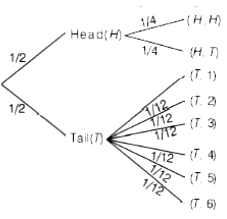
$P \{ ( H , T ) \} = \frac { 1 } { 2 } \times \frac { 1 } { 2 } = \frac { 1 } { 4 },$ $P \{ ( H , T ) \} = \frac { 1 } { 2 } \times \frac { 1 } { 2 } = \frac { 1 } { 4 },$
$P \{ ( T , 1 ) \} = \frac { 1 } { 2 } \times \frac { 1 } { 6 } = \frac { 1 } { 12 },$ $P \{ ( T , 2 ) \} = \frac { 1 } { 2 } \times \frac { 1 } { 6 } = \frac { 1 } { 12 },$
$P \left\{ ( T , 3 ) = \frac { 1 } { 2 } \times \frac { 1 } { 6 } = \frac { 1 } { 12 }\right.,$ $P \{ ( T , 4 ) \} = \frac { 1 } { 2 } \times \frac { 1 } { 6 } = \frac { 1 } { 12 },$
$P \left\{ ( T , 5 ) = \frac { 1 } { 2 } \times \frac { 1 } { 6 } = \frac { 1 } { 12 }\right.$ and $P \{ ( T , 6 ) \} = \frac { 1 } { 2 } \times \frac { 1 } { 6 } = \frac { 1 } { 12 }$
The outcomes of the experiment can be represented in the following tree diagram.

Consider the following events:
A = the die shows a number greater than 4 and
B = there is atleast one tail.
We have, A = {(T, 5), (T, 6)},
B = {(H, 1), (T, 1), (T, 2),(T, 3),
(T, 4), (T, 5), (T, 6)}
and A $\cap$ B = {(T, 5), (T, 6)}
$\therefore$ P(B) = P{(H, 1)} + P{(T, l)} + P{(T, 2)}
+ P{(T, 3)} + P{(T, 4)} + P{(T, 5)} + P{(T, 6)}
$\Rightarrow P ( B ) = \frac { 1 } { 4 } + \frac { 1 } { 12 } + \frac { 1 } { 12 } + \frac { 1 } { 12 } + \frac { 1 } { 12 } + \frac { 1 } { 12 } + \frac { 1 } { 12 } = \frac { 3 } { 4 }$
and P(A $\cap$ B) = P{(T, 5)} + P{(T, 6)} =$\frac { 1 } { 12 } + \frac { 1 } { 12 } = \frac { 1 } { 6 }$
$\therefore$ Required probability
$= P \left( \frac { A } { B } \right) = \frac { P ( A \cap B ) } { P ( B ) } = \frac { 1 / 6 } { 3 / 4 } = \frac { 4 } { 18 } = \frac { 2 } { 9 }$
View full question & answer
Question 571 Mark
A die is thrown twice and the sum of the numbers appearing is observed to be 6. What is the conditional probability that the number 4 has appeared at least once?
Answer
Let's define events;
E : Number 4 appears at least once.
F : Sum of the numbers appearing is 6.
Then, E = {(4,1), (4,2), (4,3), (4,4), (4,5), (4,6), (1,4), (2,4), (3,4), (5,4), (6,4)}
and F = {(1,5), (2,4), (3,3), (4,2), (5,1)} 
We have P(E) = $\frac{11}{36}$ and P(F) = $\frac{5}{36}$ 
Also $\mathrm{E} \cap \mathrm{F}$ = {(2,4), (4,2)}
Therefore $\mathrm{P}(\mathrm{E} \cap \mathrm{F})$ = $\frac{2}{36}$ 
Hence, the required probability
$\mathrm{P}(\mathrm{E} | \mathrm{F})=\frac{\mathrm{P}(\mathrm{E} \cap \mathrm{F})}{\mathrm{P}(\mathrm{F})}=\frac{\frac{2}{36}}{\frac{5}{36}}=\frac{2}{5}$ 
View full question & answer
Question 581 Mark
A die is thrown three times. Events A and B are defined as below:
A: 4 on the third throw
B: 6 on the first and 5 on the second throw
Find the probability of A given that B has already occurred.
Answer
Total sample space = 216
A = $\left\{ \begin{gathered} (1,1,4)(1,2,4)...(1,6,4)(2,1,4)(2,2,4)...(2,6,4) \hfill \\ (3,1,4)(3,2,4)...(3,6,4)(4,1,4)(4,2,4)...(4,6,4) \hfill \\ (5,1,4)(5,2,4)...(5,6,4)(6,1,4)(6,2,4)...(6,6,4) \hfill \\ \end{gathered} \right\}$
B = {(6, 5, 1), (6, 5, 2), (6, 5, 3), (6, 5, 4), (6, 5, 5), (6, 5, 6)}
$A \cap B $ = {6, 5, 4}
P(B) = $ \frac{6}{{216}}$, $P(A \cap B) = \frac{1}{{216}}$
$P(\frac {A}{B}) = \frac{{P(A \cap B)}}{{P(B)}} = \frac{{\frac{1}{{216}}}}{{\frac{6}{{216}}}} = \frac{1}{6}$
View full question & answer
Question 591 Mark
In a school there are 1000 students, out of which 430 are girls. It is known that out of 430, 10% of the girls study in class XII. What is the probability that a student chosen randomly studies in class XII given that the chosen student is a girl?
Answer
Let E denotes the event that  student chosen randomly studies in class XII, F denotes the event that randomly chosen student is girl.
P (E|F) = ?
$P(F) = \frac{{430}}{{1000}} = 0.43$
$P\left( {E \cap F} \right) = \frac{{43}}{{1000}} = 0.043$
$P\left( {\frac{E}{F}} \right) = \frac{{P\left( {E \cap F} \right)}}{{P(F)}}$
$ = \frac{{0.043}}{{0.43}} = 0.1$
View full question & answer
Question 601 Mark
Ten cards numbered 1 to 10 are placed in a box, mixed up thoroughly and then one card is drawn randomly. If it is known that the number on the drawn card is more than 3, what is the probability that it is an even number?
Answer
Sample space of the experiment is 'S' = {1, 2, 3, 4, 5, 6, 7, 8, 9, 10}
Let's define two events
A : Number on the card drawn is even.
B : Number on the card drawn is greater than 3.
$\Rightarrow$ A = {2, 4, 6, 8, 10}, B = {4, 5, 6, 7, 8, 9, 10}
 $A \cap B$ = {4, 6, 8, 10}
Also, P(A) = $\frac{5}{10}$, P(B) = $\frac{7}{10}$ and $P(A \cap B)=\frac{4}{10}$ 
Then $\mathrm{P}(\mathrm{A} | \mathrm{B})=\frac{\mathrm{P}(\mathrm{A} \cap \mathrm{B})}{\mathrm{P}(\mathrm{B})}=\frac{\frac{4}{10}}{\frac{7}{10}}=\frac{4}{7}$
View full question & answer
Question 611 Mark
If a machine is correctly set up, it produces $90\%$ acceptable items. If it is incorrectly set up, it produces only $40\%$ acceptable items. Past experience shows that $80\%$ of the set ups are correctly done. If after a certain set up, the machine produces $2$ acceptable items, find the probability that the machine is correctly setup.
Answer
Let's define events;
$A :$ Machine produces $2$ acceptable items.
$B_1:$ Machine is correctly setup.
$B_2:$ Machie is incorrectly setup.
Now $P(B_1) = 0.8, P(B_2) = 0.2$
$P(A|B_1) = 0.9 \times 0.9$ and $P(A|B_2) = 0.4 \times 0.4$
Therefore $\mathrm{P}\left(\mathrm{B}_{1} | \mathrm{A}\right)=\frac{\mathrm{P}\left(\mathrm{B}_{1}\right) \mathrm{P}\left(\mathrm{A} | \mathrm{B}_{1}\right)}{\mathrm{P}\left(\mathrm{B}_{1}\right) \mathrm{P}\left(\mathrm{A} | \mathrm{B}_{1}\right)+\mathrm{P}\left(\mathrm{B}_{2}\right) \mathrm{P}\left(\mathrm{A} | \mathrm{B}_{2}\right)}$
$= \frac{0.8 \times 0.9 \times 0.9}{0.8 \times 0.9 \times 0.9+0.2 \times 0.4 \times 0.4} = \frac{648}{680}= \frac{81}{85}$
View full question & answer
Question 621 Mark
A and B throw a die alternatively till one of them gets a 6 and wins the game. Find their respective probabilities of winning, if A starts first.
Answer
S denote the success(getting a 6) and F denotes the failure(not getting a 6)
$P(S) = \frac{1}{6},P(F) = \frac{5}{6}$
P(A win in the first throw) = (S) $ = \frac{1}{6}$
P(A win in the 3rd throw) $ = {\left( {\frac{5}{6}} \right)^2} \times \frac{1}{6}$
P(A win in the fifth throw) $ = {\left( {\frac{5}{6}} \right)^4} \times \frac{1}{6}$
P (A win) $ = \frac{1}{6} + {\left( {\frac{5}{6}} \right)^2} \times \frac{1}{6} + {\left( {\frac{5}{6}} \right)^4} \times \frac{1}{6} + ........$
$ = \frac{{\frac{1}{6}}}{{1 - \frac{{25}}{{36}}}}$ $\left[ {u\sin g\;s = \frac{a}{{1 - r}}} \right]$
$ = \frac{6}{{11}}$
View full question & answer
Question 631 Mark
Coloured balls are distributed in four boxes as shown in the following table: 
Box Colour
Black White Red Blue
$I$ $3$ $4$ $5$ $6$
$II$ $2$ $2$ $2$ $2$
$III$ $1$ $2$ $3$ $1$
$IV$ $4$ $3$ $1$ $5$
A box is selected at random and then a ball is randomly drawn from the selected box. The colour of the ball is black, what is the probability that ball drawn is from the box $III?$
Answer
Let $A, E_1, E_2, E_3$ and $E_4$ be the events as defined below :
$A :$ black ball is selected
$E_1 :$ box $I$ is selected
$E_2 :$ box $II$ is selected
$E_3 :$ box $III$ is selected
$E_4 :$ box $IV$ is selected
Since the boxes are chosen at random,
Therefore, $P(E_1) = P(E_2) = P(E_3) = P(E_4)$
Also $P(A|E_1) = \frac{3}{18}, P(A|E_2) = \frac {2}{8}, P(A|E_3) = \frac{1}{7}$ and $P(A|E_4) = \frac{4}{13}$
$P($box $III$ is selected, given that the drawn ball is black$) = P(E_3|A).$ By Bayes' theorem,
$P(E_3|A) = \frac{\mathrm{P}\left(\mathrm{E}_{3}\right) \cdot \mathrm{P}\left(\mathrm{A|E}_{3}\right)}{\mathrm{P}\left(\mathrm{E}_{1}\right) \mathrm{P}\left(\mathrm{A|E}_{1}\right)+\mathrm{P}\left(\mathrm{E}_{2}\right) \mathrm{P}\left(\mathrm{A|E}_{2}\right)+\mathrm{P}\left(\mathrm{E}_{3}\right) \mathrm{P}\left(\mathrm{A|E}_{3}\right)+\mathrm{P}\left(\mathrm{E}_{4}\right) \mathrm{P}\left(\mathrm{A|E}_{4}\right)}$
$= \frac{\frac{1}{4} \times \frac{1}{7}}{\frac{1}{4} \times \frac{3}{18}+\frac{1}{4} \times \frac{1}{4}+\frac{1}{4} \times \frac{1}{7}+\frac{1}{4} \times \frac{4}{13}} = 0.165$
View full question & answer
Question 641 Mark
A man is known to speak truth $3$ out of $4$ times. He throws a die and reports that it is a six. Find the probability that it is actually a six.
Answer
Let $E$ be the event that the man reports that six occurs in the throwing of the dice and let $S_1$ be the event that six occurs and $S_2$ be the event six does not occur.
Then $P(S_1) =$ Probability that six occurs $= \frac{1}{6}$
$P(S_2) =$ Probability that six does not occur $= \frac{5}{6}$
$P(E|S_1) =$ Probability that the man reports that six occurs when six has actually occurred on the die
$=$ Probability that the man speaks the truth $= \frac{3}{4}$
$P(E|S_2) =$ Probability that the man reports that six occurs when six hasn't actually occurred on the die
$=$ Probability that the man does not speak the truth $1 - \frac{3}{4} = \frac{1}{4}$
Thus, by Bayes' theorem, we get
$P(S_1|E) =$ Probability that the report of the man that six has occurred is actually a six
$= \frac{{P({S_1})P(E/{S_2})}}{{P({S_1})P(E/{S_1}) + P({S_2})P(E/{S_2})}}$
$=\frac{1/6\times 3/4}{1/6\times 3/4+5/6\times 1/4}$ = $\frac {1}{8} \times \frac {24}{8} = \frac {3}{8}$
View full question & answer
Question 651 Mark
A doctor is to visit a patient. From the past experience, it is known that the probabilities that he will come by train, bus, scooter or by other means of transport are respectively $\frac{3}{{10}},\frac{1}{5},\frac{1}{{10}}$ and $\frac{2}{5}$. The probabilities that he will be late are $\frac{1}{4},\frac{1}{3}$ and $\frac{1}{{12}}$, if he comes by train, bus and scooter respectively, but if he comes by other means of transport, that he will not be late. When he arrives, he is late. What is the probability that he comes by train?
Answer
Let $E$ be the event that the doctor visits the patient late and let $T_1, T_2, T_3, T_4,$ be the event that the doctor comes by train, bus, scooter and other means of Transport respectively.
$P(T_1) = \frac{3}{{10}}, P(T_2) = \frac{1}{5}, P(T_3) = \frac{1}{{10}}, P(T_4) = \frac{2}{5}$
$P(\frac {E}{T_1}) =$ probability that the doctor arriving late comes by train $= \frac{1}{4}$
Similarly, $P(\frac {E}{T_2}) = \frac{1}{3},P(\frac {E}{T_3}) = \frac{1}{{12}},P(\frac {E}{T_4}) = 0$
$P(\frac {T_1}{E}) = \frac{{P({T_1})P(E/{T_1})}}{{P({T_1})P(E/{T_1}) + P({T_2})P(E/{T_2}) + P({T_3})P(E/{T_3}) + P({T_4})P(E/{T_4})}}$
$=\frac{\frac{3}{10}\times \frac{1}{4}}{\frac{3}{10}\times\frac{1}{4}+\frac{1}{5}\times\frac{1}{3}+\frac{1}{10}\times\frac{1}{12}+\frac{2}{5}\times 0}$
$= \frac{1}{2}$
View full question & answer
Question 661 Mark
A family has two children. What is the probability that both the children are boys given that at least one of them is a boy?
Answer
We are given that a family has two children.
Let b stand for Boy and g for Girl.
The sample space of the experiment is
S = {(b, b), (g, b), (b, g), (g, g)}
Let E and F denote the following events :
E : Both the children are Boys
F : At least one of the child is a Boy
Then, E = {(b,b)} and F = {(b,b), (g,b), (b,g)}
Now ${E} \cap {F}$ = {(b,b)}
Thus P(F) = $\frac{3}{4}$ and $P(E \cap F)=\frac{1}{4}$ 
Therefore $\mathrm{P}(\mathrm{E} /\mathrm{F})=\frac{\mathrm{P}(\mathrm{E} \cap \mathrm{F})}{\mathrm{P}(\mathrm{F})}=\frac{\frac{1}{4}}{\frac{3}{4}}=\frac{1}{3}$ 
View full question & answer
Question 671 Mark
In a factory which manufactures bolts, machines. $A, B$ and $C$ manufacture respectively $25\%, 35\%$ and $40\%$ of the bolts. Of their output $5, 4$ and $2$ percent are respectively defective bolts. A bolt is drawn at random from the product and is found to be defective. What is the probability that it is manufactured by the machine $B?$
Answer
Let $B_1 =$ bolt is manufactured by $A$
$B_2 =$ bolt is manufactured by $B$
$B_3 =$ bolt is manufactured by $C$
Let $E$ denote the event that bolt is defective.
The event $E$ occurs with $B_1$ or with $B_2$ or with $B_3$. Given that,
$P (B_1) = 25\% = 0.25$
$P (B_2) = 0.35$
$P (B_3) = 0.40$
$P ( E|B_1) =$ Probability that the bolt drawn is defective given that it is manu$-$factured by machine $A = 5\% = 0.05.$
Similarly, $P (E|B_2) = 0.04$
$P (E|B_3) = 0.02$
Hence, by Bayes theorm, we have,
$P({B_2}/E) = \frac{{P({B_2})P(E/{B_2})}}{{P({B_1})P(E/{B_1}) + P({B_2})P(E/{B_2}) + P({B_3})P(E/{B_3})}}$
$=\frac{0.35\times 0.04}{0.25\times0.05+0.35\times0.04+0.40\times0.02}$
$=\frac{0.0140}{0.0345}$
$=\frac{28}{69}$
View full question & answer
Question 681 Mark
Suppose that the reliability of a HIV test is specified as follows:
Of people having HIV, 90% of the test detect the disease but 10% go undetected. Of people free of HIV, 99% of the test are Judged HIV-ive but 1% are diagnosed as showing HIV+ive. From a large population of which only 0.1% have HIV, one person is selected at random, given the HIV test, and the pathologist reports him/her is HIV+ive. What is the probability that the person actually has HIV?
Answer
Let E denote the event that the person selected is actually having HIV and A the event that the person’s HIV test is diagnosed as +ve.
Let E' denote the event that person selected is actually not having HIV.
Clearly, {E, E'} is a partition of the sample space of all people in the population.
We are given that
P(E) = 0.1% = $\frac{{0.1}}{{100}} $ = 0.001
P(E') = 1 - P(E) = 0.999
$P(\frac {A}{E}) $ = 90% = $ \frac{{90}}{{100}} $ = 0.9
$P(\frac {A}{E'}) $ = 1% = $ \frac{1}{{100}}$ = 0.01
By Bayes theorm,we have,
$P(\frac {E}{A}) = \frac{{P(E)P(A/E)}}{{P(E)P(A/E) + P(E')P(A/E')}}$
$ = \frac{{0.001 \times 0.9}}{{0.001 \times 0.9 + 0.999 \times 0.01}}$
$ = \frac{9}{{9 + 99.9}}$
$ = \frac{{90}}{{1089}}$
= 0.083
View full question & answer
Question 691 Mark
Given three identical boxes $I, II$ and $III$ each containing two coins. In box $I$ both coins are gold coins, in box $II,$ both are silver coins and in the box $III,$ there is one gold and one silver coin. A person chooses a box at random and takes out a coin. If the coin is of gold, what is the probability that the other coin in the box is also of gold?
Answer
Let $E_1, E_2$ and $E_3$ be the events that boxes $I, II$ and $III$ are chosen.
$P (E_1) = P (E_2) = P (E_3) = \frac{1}{3}$
let $A$ be the event the coin drawn is of gold.
$p(A|{E_1}) = \frac{2}{2} = 1$
$P(A|{E_2}) = 0$
$P(A|{E_3}) = \frac{1}{2}$
$P({E_1}|A) = \frac{{P({E_1})P(A|{E_1})}}{{P({E_1})P(A|{E_1}) + P({E_2}) + P(A|{E_2}) + P({E_3})P(A|{E_3})}}$
$=\frac{\frac{1}{3}×1}{\frac{1}{3}×1+\frac{1}{3}×0+\frac{1}{3}×\frac{1}{2}}$  
$ = \frac{2}{3}$
View full question & answer
Question 701 Mark
Bag $I$ contains $3$ red and $4$ black balls while another Bag $II$ contains $5$ red and $6$ black balls. One ball is drawn at random from one of the bags and it is found to be red. Find the probability that it was drawn from Bag $II.$
Answer
Let $E_1 : $Bag selected is Bag $I$
$E_2 : $ Bag selected is Bag $II$
$A :$ Ball selected is Red
$B :$ Ball selected is Black
Now,
$P($ball was drawn from bag $II,$ if ball is red$) = P(\frac{E_2}{A})$
$P(\frac{E_2}{A}) = \frac{P(A) P\left(A | E_{2}\right)}{P\left(E_{1}\right) P\left(A | E_{1}\right)+P\left(E_{2}\right) P\left(A | E_{2}\right)}$
$P(E_1) =$ Probability bag selected is Bag $I = \frac{1}{2}$
$P(E_2) =$ Probability bag selected is Bag $II = \frac{1}{2}$
$P(\frac{A}{E_2}) =$ Probability red ball was selected from Bag $II = \frac{5}{5+6} = \frac{5}{11}$
$P(\frac{A}{E_1}) =$ Probability red ball was selected from Bag $I = \frac{3}{3+4} = \frac{3}{7}$
Putting values in formula,
$P(\frac{E_{2}} { A}) = \frac{\frac{1}{2} \times \frac{5}{11}}{\frac{1}{2} \times \frac{3}{7}+\frac{1}{2} \times \frac{5}{11}}$
$=\frac{\frac{1}{2} \times \frac{5}{11}}{\frac{1}{2}\left[\frac{3}{7} + \frac{5}{11}\right]}$
$=\frac{\frac{5}{11}}{\frac{33+35}{77}}$
$= \frac{\frac{5}{11}}{\frac{68}{77}}$ = $\frac{5}{11} \times \frac{77}{68}$ = $\frac{35}{68}$
Therefore, required probability is $\frac{35}{68}$
View full question & answer
Question 711 Mark
A person has undertaken a construction job. The probabilities are 0.65 that there will be strike, 0.80 that the construction job will be completed on time if there is no strike, and 0.32 that the construction job will be completed on time if there is a strike. Determine the probability that the construction job will be completed on time.
Answer
Let, A : Construction job will be completed on time,
and B : There will be a strike.
We have
P(B) = 0.65, P(no strike) = P(B′) = 1 - P(B) = 1 - 0.65 = 0.35
P(A|B) = 0.32, P(A|B′) = 0.80
Since events B and B′ form a partition of the sample space S, therefore, by Theorem on total probability, we have
P(A) = P(B) P(A|B) + P(B′) P(A|B′)
= 0.65 $\times$ 0.32 + 0.35 $\times$ 0.8 = 0.208 + 0.28 = 0.488
Thus, the probability that the construction job will be completed in time is 0.488.
View full question & answer
Question 721 Mark
If A and B are two independent events, then the probability of occurrence of at least one of A and B is given by 1- P(A')(P(B').
Answer
We have,
P(at least one of A and B) $ = P\left( {A \cup B} \right)$
$ = P(A) + P(B) - P(A \cap B)$
= P(A) + P(B) - P(A) P(B)
=P(A) + P(B) [1−P(A)]
=P(A)  +  P(B). P(A′)
=1− P(A′) + P(B) P(A′)
=1− P(A′)  [1− P(B)]
=1− P(A′) P (B′)
View full question & answer
Question 731 Mark
Prove that if E and F are independent events, then so are the events E and F′.
Answer
Since E and F are independent, we have
P(E $\cap$ F) = P(E) . P(F) ......(i)

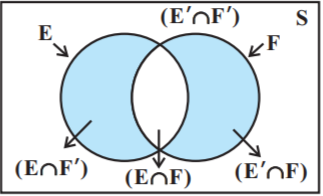
From the venn diagram in Figure, it is clear that E $\cap$ F and E $\cap$ F′ are mutually exclusive events and
also E = (E $\cap$ F) $\cup$ (E $\cap$ F′).
Therefore P(E) = P(E $\cap$ F) + P(E $\cap$ F′)
or P(E $\cap$ F′) = P(E) - P(E $\cap$ F)
= P(E) - P(E) . P(F) (by (i))
= P(E) (1 - P(F))
= P(E). P(F′)
Hence, E and F′ are independent.
View full question & answer
Question 741 Mark
Three coins are tossed simultaneously. Consider the event E three heads or three tails, F at least two heads and G at most two heads. Of the pairs (E, F), (E, G) and (F, G), which are independent? which are dependent?
Answer
The sample space of the experiment is given by
S = {HHH, HHT, HTH, THH, HTT, THT, TTH, TTT}
Clearly, E = {HHH, TTT},  F = {HHH, HHT, HTH, THH}
and G = {HHT, HTH, THH, HTT, THT, TTH, TTT}
Also E $\cap$ F = {HHH}, E $\cap$ G = {TTT}, F $\cap$ G = { HHT, HTH, THH}
Therefore P(E) = $\frac{2}{8}=\frac{1}{4}$, P(F) = $\frac{4}{8}=\frac{1}{2}$, P(G) = $\frac{7}{8}$ 
and $\mathrm{P}(\mathrm{E} \cap \mathrm{F})=\frac{1}{8}$, $\mathrm{P}(\mathrm{E} \cap \mathrm{G})=\frac{1}{8}$, $\mathrm{P}(\mathrm{F} \cap \mathrm{G})=\frac{3}{8}$
Also, P(E).P(F) = $\frac{1}{4} \times \frac{1}{2}=\frac{1}{8}$, P(E).P(G) = $\frac{1}{4} \times \frac{7}{8}=\frac{7}{32}$ and P(F).P(G) = $\frac{1}{2} \times \frac{7}{8}=\frac{7}{16}$ 
Thus P(E $\cap$ F) = P(E) . P(F)
$\mathrm{P}(\mathrm{E} \cap \mathrm{G}) \neq \mathrm{P}(\mathrm{E}) \cdot \mathrm{P}(\mathrm{G})$ 
and $\mathrm{P}(\mathrm{F} \cap \mathrm{G}) \neq \mathrm{P}(\mathrm{F}) \cdot \mathrm{P}(\mathrm{G})$ 
Hence, the events (E and F) are independent, and the events (E and G) and (F and G) are dependent.
View full question & answer
Question 751 Mark
An unbiased die is thrown twice. Let the event A be odd number on the first throw and B the event odd number on the second throw. Check the independence of the events A and B.
Answer
If all the 36 elementary events of the experiment are considered to be equally likely,
we have P(A) = $\frac{18}{36}=\frac{1}{2}$ and P(B) = $\frac{18}{36}=\frac{1}{2}$ 
Also P(A $\cap$ B) = P (odd number on both throws)
= $\frac{9}{36}=\frac{1}{4}$ 
Also P(A) P(B) = $\frac{1}{2} \times \frac{1}{2}=\frac{1}{4}$ 
Clearly P(A $\cap$ B) = P(A) $\times$ P(B)
Thus, A and B are independent events
View full question & answer
Question 761 Mark
A die is thrown. If E is the event the number appearing is a multiple of 3 and F be the event the number appearing is even then find whether E and F are independent?
Answer
Two event A and B are independent if $ P(A \cap B)=P(A) . P(B)$
Sample space of the experiment is, S = {1, 2, 3, 4, 5, 6}
Now E = {3, 6}, F = { 2, 4, 6} and E $\cap$ F = {6}
Then P(E) = $\frac{2}{6}=\frac{1}{3}$, P(F) = $\frac{3}{6}=\frac{1}{2}$ and $\mathrm{P}(\mathrm{E} \cap \mathrm{F})=\frac{1}{6}$
Clearly P(E $\cap$ F) = P(E). P(F) $=\frac{1}{6}$
Hence E and F are independent events.
View full question & answer
Question 771 Mark
If P(A) = $\frac{7}{13}$, P(B) = $\frac{9}{13}$ and $\mathrm{P}(\mathrm{A} \cap \mathrm{B})=\frac{4}{13}$, evaluate P(A|B).
Answer
We have P(A|B) = $\frac{P(A \cap B)}{P(B)}=\frac{\frac{4}{13}}{\frac{9}{13}}=\frac{4}{9}$ 
View full question & answer
Question 781 Mark
If $P(A)=\frac{1}{2}, P(B)=0$ then find value of $P\left(\frac{A}{B}\right)$.
Answer
Value of $P(A / B):$ Not Defined (because $P(B)=0$)
View full question & answer
1 Marks Question - Page 2 - MATHS STD 12 Science Questions - Vidyadip